


Esther 5:3
Bible text: King James Version (1769 Blayney text) · Public domain
Bible text: Berean Standard Bible · Public domain
Bible text: American Standard Version (1901) · Public domain
Bible text: World English Bible, Messianic edition · Public domain
Bible text: Geneva Bible (1599) · Public domain
Bible text: Young's Literal Translation · Public domain
- וַיֹּאמֶרvai·Yo·merand he saidH559Conj-w ¦ V-Qal-ConsecImperf-3msVerb Qal Consecutive Imperfect 3rd Singular Masculineוַandיֹּאמֶרhe said
- לָהּlahto herPrep-l ¦ 3fsSuffix Personal 3rd Singular Feminineלָtoהּher
- הַמֶּלֶךְha·Me·lekhthe kingH4428Art ¦ N-msNoun Singular Masculine Absoluteהַtheמֶּלֶךְking
- מַהmahwhat?H4100InterrogPronoun Interrogative
- לָּךְlakh[is] to youPrep-l ¦ 2fsSuffix Personal 2nd Singular Feminineלָּ[is] toךְyou
- אֶסְתֵּר'es·TerO EstherH635N-proper-fNoun Proper Feminine
- הַמַּלְכָּהha·mal·Kahthe queenH4436Art ¦ N-fsNoun Singular Feminine Absoluteהַtheמַּלְכָּהqueen
- וּמַהu·mahand what?H4100Conj-w ¦ InterrogPronoun Interrogativeוּandמַהwhat?
- בַּקָּשָׁתֵךְba·ka·sha·Tekh[is] your requestH1246N-fsc ¦ 2fsNoun Singular Feminine Constructבַּקָּשָׁתֵ[is] requestךְyour
- עַד'adup toH5704PrepPreposition
- חֲצִיcha·Tzi<the> half ofH2677N-mscNoun Singular Masculine Construct
- הַמַּלְכוּתha·mal·Khutthe kingdomH4438Art ¦ N-fsNoun Singular Feminine Absoluteהַtheמַּלְכוּתkingdom
- וְיִנָּתֵןve·yi·Na·tenso it may be givenH5414Conj-w ¦ V-Niphal-ConjImperf-3msVerb Niphal Conjunction+Imperfect 3rd Singular Masculineוְsoיִנָּתֵןit may be given
- לָךְLakhto youPrep-l ¦ 2fsSuffix Personal 2nd Singular Feminineלָtoךְyou
English is a literal word-by-word gloss of the Hebrew, not the KJV's wording. Why?
This is the original text the KJV's translators worked from — each Hebrew word with its own literal English meaning in this verse, prepared by scholars at Tyndale House, Cambridge. The KJV translates whole sentences, not word by word, so its wording differs: one Hebrew word can become several English words, and the KJV may choose “the LORD” where the gloss reads “Yahweh”. Both are faithful — they answer different questions. For the KJV's own rendering, switch to the KJV text.
Details
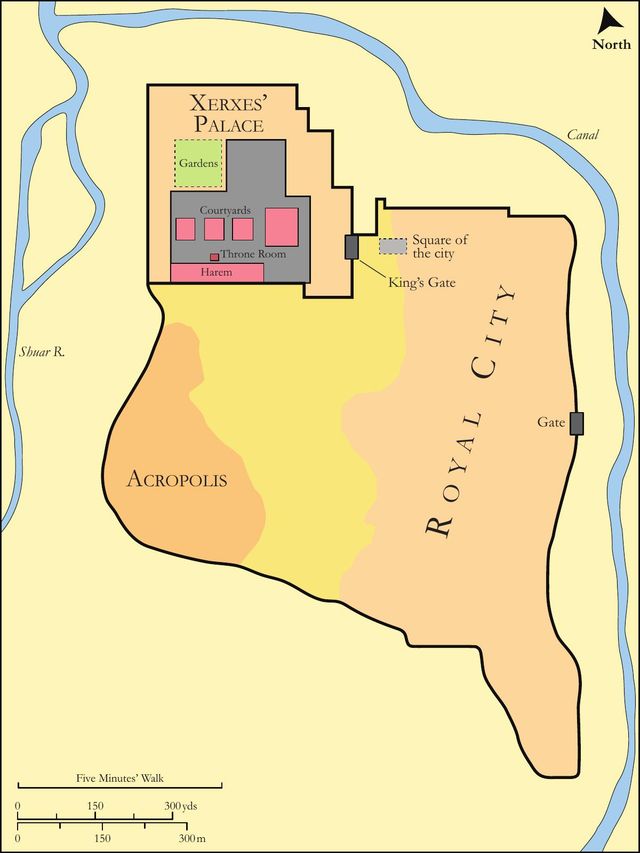
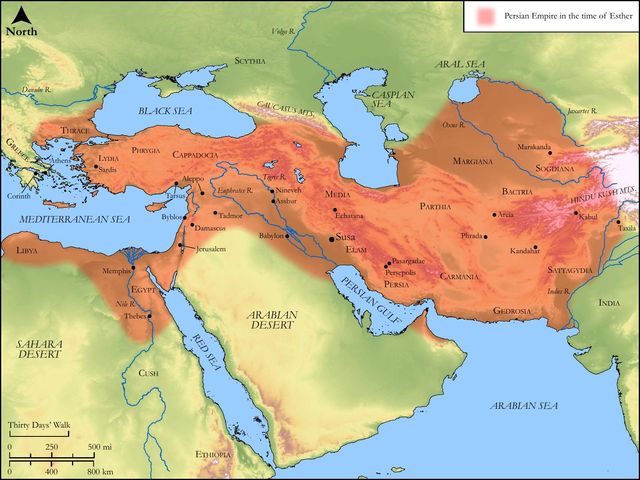
See on the biblical-era maps
Study this verse
Public-domain commentary
Matthew Henry
From his Commentary on the Whole Bible. Henry comments on passages, not single verses — this entry covers Esther 5:1–8. His three-level outline is real structure in the source text, so it is rendered as structure.
Here is, I. Esther's bold approach to the king, Est 5:1. When the time appointed for their fast was finished she lost no time, but on the third day, when the impression of her devotions were fresh upon her spirit, she addressed the king. When the heart is enlarged in communion with God it will be emboldened in doing and suffering for him. Some think that the three days' fast was only one whole day and two whole nights, in all which time they did not take any food at all, and that this is called three days, as Christ's lying in the grave so long is. This exposition is favoured by the consideration that on the third day the queen made her appearance at court. Resolutions which have difficulties and dangers to break though should be pursued without delay, lest they cool and slacken. What thou doest, which must be done boldly, do it quickly. Now she put on her royal apparel, that she might the better recommend herself to the king, and laid aside her fast-day clothes. She put on her fine clothes, not to please herself, but her husband; in her prayer, as we find in the Apocrypha (Esther 14:16), she thus appeals to God: Thou knowest, Lord, I abhor the sign of my high estate which is upon my head, in the days wherein I show myself, etc. Let hose whose rank obliges them to wear rich clothes learn hence to be dead to them, and not make them their adorning. She stood in the inner court over against the king, expecting her doom, between hope and fear.
II.The favourable reception which the king gave her.
When he saw her she obtained favour in his sight. The apocryphal author and Josephus say that she took two maids with her, on one of whom she leaned, while the other bore up her train, - that her countenance was cheerful and very amiable, but her heart was in anguish, - that the king, lifting up his countenance that shone with majesty, at first looked very fiercely upon here, whereupon she grew pale, and fainted, and bowed herself on the head of the maid that went by her; but then God changed the spirit of the king, and, in a fear, he leaped from his throne, took her in his arms till she came to herself, and comforted her with loving words. Here we are only told,
1.That he protected her from the law, and assured her of safety, by holding out to her the golden sceptre (Est 5:2), which she thankfully touched the top of, thereby presenting herself to him as a humble petitioner. Thus having had power with God and prevailed, like Jacob, she had power with men too. He that will lose his life for God shall save it, or find it in a better life.
2.That he encouraged her address (Est 5:3): What wilt thou, queen Esther, and what is thy request? So far was he from counting her an offender that he seemed glad to see her, and desirous to oblige her. He that had divorced one wife for not coming when she was sent for would not be severe to another for coming when she was not sent for. God can turn the hearts of men, of great men, of those that act most arbitrarily, which way he pleases towards us. Esther feared that she should perish, but was promised that she should have what she might ask for, though it were the half of the kingdom. Note, God in his providence often prevents the fears, and outdoes the hopes, of his people, especially when they venture in his cause. Let us from this story infer, as our Saviour does from the parable of the unjust judge, an encouragement to pray always to our God, and not faint, Luk 18:6-8. Hear what this haughty king says (What is thy petition, and what is thy request? It shall be granted thee), and say shall not God hear and answer the prayers of his own elect, that cry day and night to him? Esther came to a proud imperious man; we come to the God of love and grace. She was not called; we are: the Spirit says, Come, and the bride says, Come. She had a law against her; we have a promise, many a promise, in favour of us: Ask, and it shall be given you. She had no friend to introduce her, or intercede for her, while on the contrary he that was then the king's favourite was her enemy; but we have an advocate with the Father, in whom he is well pleased. Let us therefore come boldly to the throne of grace.
3.That all the request she had to make to him, at this time, was that he would please to come to a banquet which she had prepared for him, and bring Haman along with him, Est 5:4, Est 5:5. Hereby,
(1.)She would intimate to him how much she valued his favour and company. Whatever she had to ask, she desired his favour above any thing, and would purchase it at any rate.
(2.)She would try how he stood affected to her; for, if he should refuse this, it would be to no purpose as yet to present her other request.
(3.)She would endeavour to bring him into a pleasant humour, and soften his spirit, that he might with the more tenderness receive the impressions of the complaint she had to make to him.
(4.)She would please him, by making court to Haman his favourite, and inviting him to come whose company she knew he loved and whom she desired to have present when she made her complaint; for she would say nothing of him but what she durst say to his face.
(5.)She hoped at the banquet of wine to have a fairer and more favourable opportunity of presenting her petition. Wisdom is profitable to direct how to manage some men that are hard to deal with, and to take them by the right handle.
4.That he readily came, and ordered Haman to come along with him (Est 5:5), which was an indication of the kindness he still retained for her; if he really designed the destruction of her and her people, he would not have accepted her banquet. There he renewed his kind enquiry (What is thy petition?) and his generous promise, that it should be granted, even to the half of the kingdom (Est 5:6), a proverbial expression, by which he assured her that he would deny her nothing in reason. Herod used it, Mar 6:23.
5.That then Esther thought fit to ask no more than a promise that he would please to accept of another treat, the next day, in her apartment, and Haman with him (Est 5:7, Est 5:8), intimating to him that then she would let him know what her business was. This adjourning of the main petition may be attributed,
(1.)To Esther's prudence; thus she hoped yet further to win upon him and ingratiate herself with him. Perhaps her heart failed her now when she was going to make her request, and she desired to take some further time for prayer, that God would give her a mouth and wisdom. The putting of it off thus, it is likely, she knew would be well taken as an expression of the great reverence she had for the king, and her unwillingness to be too pressing upon him. What is hastily asked is often as hastily denied; but what is asked with a pause deserves to be considered.
(2.)To God's providence putting it into Esther's heart to delay her petition a day longer, she knew not why, but God did, that what was to happen in the night intervening between this and tomorrow might further her design and make way for her success, that Haman might arrive at the highest pitch of malice against Mordecai and might begin to fall before him. The Jews perhaps blamed Ester as dilatory, and some of them began to suspect her sincerity, or at least her zeal; but the event disproved their jealousy, and all was for the best.
Historical interpretation
Six Centuries of Reception
3 surviving comments on this verse. Each one is dated, so this reads as a timeline rather than a list.
Select a marker to jump to its quote. Markers stagger vertically where authors wrote within a few decades of each other.
If the Lord places more importance on beauty of soul than on that of the body, what must he think of artificial beautification when he abhors so thoroughly every sort of lie? “We walk by faith, not by sight.” As a matter of fact, it is the Lord who plainly teaches by the example of Abraham that one who obeys God will make small account of even father and relations and possessions and of his entire fortune. He made Abraham an exile, and then, because of that, gave him the name “friend,” because he was so little attached to the things of his own home. Yet, Abraham was of a noble family and had possessed a large fortune. A proof of this is that he overcame the four kings who had captured Lot, with 318 servants belonging to him. As for women, the only one we know of who used ornaments without blame is Esther. Her action in making herself beautiful had a mystical significance, however, for, as the wife of her king, she obtained deliverance for her people by her beauty when they were being slaughtered.
What can it mean that on the third day Esther dressed in royal garments, if not that in the third age of the world—i.e. after the incarnation, passion and resurrection of Christ—the Church of the nations dressed herself in faith, hope and charity, and in the beauty of all the virtues, to receive the sacraments of baptism through the confession of the holy Trinity so that she would then be worthy of the king’s company, since she was burning incessantly with a special love for him? She stands in the courtyard of the king’s house which was inside, opposite the king’s basilica, i.e. in the righteous works of this life which looks toward future compensation in Heaven, where the king himself sits on his celestial throne and assents to the prayers of those who piously cry out to him. He extends to this queen the staff he holds in his hand when he shows her the power of his rule, or rather the cross of his passion through which he has acquired for himself power in Heaven, on earth, and below the earth; so that “in his name every creature—celestial, terrestrial and infernal—shall bend his knee.” In fact, she kisses this staff lovingly, that is, she reveres it with total devotion. And the king himself pledges that he will agree to her request, just as he says in the Gospel: “Ask and it shall be given to you; seek and you shall find; knock and it shall be opened to you” (Matthew 7). And likewise: “Seek and you will receive, so that your joy may be complete.” For complete joy is given to the holy Church solely in the sense that it partakes in the kingdom of Heaven, where the fortunate queen will rule forever with Christ the king. And yet once she is allowed to choose her request, she invites him to the feast she has prepared for him; though this can best be understood as that complete and perfect devotion to her faith upon which the observer and arbiter of all the ages nourishes himself within. Of course, the Church invites to this refreshment, i.e. to this communion of vigorous faith, not only her friends but even her enemies and persecutors, namely pagans, Jews and heretics, so that—leaving behind the isolation of complete error—they may rejoice in the common good in the single home of catholic belief.
The fact that Esther put on all her royal robes on the third day undoubtedly signifies that the church of the nations, in the third time of the world, that is, after the incarnation, passion and resurrection of Christ, clothed herself through the sacrament of baptism and the confession of the Holy Trinity with faith, hope and charity, and the ornament of every virtue so that she might become worthy of the royal marriage while the love of (the Lord) remained constantly fervent. She stood in the inner court of the royal palace, that is, in the pious actions of this life which look at the future reward in heaven where the king himself sits on the supreme throne and fulfills the prayers of those who implore him piously. He, who held out to that queen the golden scepter that was in his hand, showed the power of his rule, that is, the cross of his passion through which he gained authority over heaven, earth and the underworld so that “at his name every knee shall bow in heaven, on earth and under the earth.” And (the church) lovingly kissed it, that is, worshiped it with all her devotion. And with regard to her petition, the king answered that he would listen to it, as it is said in the gospel as well, “Ask, and it will be given you; seek and you will find; knock, and the door will be opened for you.” And again: “Ask, and you will receive, that you joy may be full.” Indeed the full joy of the church is provided nowhere but in the perception of the heavenly kingdom where the queen will happily reign with the king Christ forever. But she, after choosing her petition, invited him to the banquet that she had prepared. This cannot be better interpreted than as the full and perfect devotion of her faith of which the supervisor and arbiter of all things himself nourishes in her. To that magnificent repast, that is, to the communion of wholesome faith, the church invites not only her friends but also her enemies and persecutors, namely the pagans, the Jews, and the heretics so that, after abandoning the wrong path of error, they may rejoice in the one house of universal confession for the common good.
Continue studying Esther 5:3 across the web’s major study libraries — every link below opens this exact verse, chapter, or book on the destination site.
Read & Compare
 BibleGatewayThis verse in more than 200 translations and 70 languages.
 Bible.comThe YouVersion reader — hundreds of translations, reading plans, and highlights.
 ESV.orgCrossway's official English Standard Version reader.
 NET BibleThe NET translation with 60,000+ translators' notes on every rendering decision.
 STEP BibleTyndale House's free study tool — original text, vocabulary, and scholarly resources.
 BibliaLogos Bible Software's free web reader.
 USCCBThe New American Bible (Revised Edition) with the U.S. bishops' study notes.
Commentaries
 BibleHub CommentariesDozens of classic commentaries on this verse, gathered on one page.
 StudyLightMore than 100 commentary sets — the largest collection on the web.
 BibleRefPlain-English commentary on what this verse means, verse by verse.
 Enduring WordDavid Guzik's free commentary on this chapter, widely used by Bible teachers.
 Bible Study ToolsVerse commentary alongside Greek and Hebrew study aids.
Original Language & Research
- BibleHub InterlinearThe verse word by word — original language, transliteration, and English.
- BibleHub LexiconEvery word's original-language definition and Strong's entry.
 Blue Letter BibleDeep-study tools — Strong's numbers, concordance, and word studies.
 SefariaThe Hebrew text with Rashi and centuries of Jewish commentary.
Sermons, Hymns & Audio


TrulyRandomVerse is not affiliated with these sites and doesn’t control their content. They’re linked because they’re genuinely useful.
Summary
Esther 5:3 marks a pivotal moment of divine favor and human courage, as King Ahasuerus extends an extraordinary and hyperbolic offer to Queen Esther. Having risked her life by approaching the king unsummoned, Esther finds immediate acceptance and immense grace, symbolized by the extended golden scepter. The king's boundless generosity, expressed as "to the half of the kingdom," underscores the absolute power of the Persian monarch and the strategic wisdom of Esther, who, rather than immediately revealing her petition, subtly prepares the ground for the dramatic deliverance of her people from Haman's genocidal decree.
Context
ShowHideLiterary Context
Esther 5:3 immediately follows Esther's courageous and life-threatening decision to enter the king's inner court without a summons, an act punishable by death under stringent Persian law, as clearly outlined in Esther 4:11. This desperate measure was prompted by Mordecai's urgent appeal and the imminent threat of annihilation facing the Jewish people due to Haman's wicked decree. Upon seeing Esther, the king, instead of condemning her, extended his golden scepter, a profound gesture of mercy and acceptance, as detailed in Esther 5:2. The king's immediate question and incredibly generous offer in verse 3 signify a dramatic shift from a moment of mortal peril to one of immense favor, laying the essential groundwork for the unfolding drama and the eventual salvation of the Jews. The narrative then swiftly moves to Esther's strategic invitation for the king and Haman to a banquet, demonstrating her calculated and patient approach.
Historical & Cultural Context
The Persian Empire, at its zenith under Ahasuerus (widely identified as Xerxes I, who reigned from 486-465 BC), was an immense and formidable power, stretching across 127 provinces from India to Ethiopia. The king's authority was absolute, and court protocol was rigidly enforced, making Esther's unsummoned approach an act of extraordinary bravery and profound risk. The phrase "to the half of the kingdom" was a common proverbial expression among the kings of that day, not intended as a literal division of territory or power, but as a hyperbolic declaration of boundless generosity and willingness to grant virtually any reasonable request. Similar expressions appear in other ancient texts, including the biblical narrative of King Herod's oath to Salome in Mark 6:23, emphasizing the monarch's immense wealth, magnanimity, and the extent of their power to bestow gifts. This cultural understanding illuminates the profound depth of the king's favor towards Esther and the immense opportunity presented to her.
Key Themes
ShowHideThis verse powerfully contributes to several overarching themes within the book of Esther. Firstly, it highlights Divine Providence, even though the name of God is conspicuously absent from the entire book. The king's unexpected mercy and disproportionate generosity are clearly orchestrated by a hidden, sovereign hand, turning a seemingly impossible situation into a miraculous opportunity for deliverance. This subtly echoes the broader theme of God's sovereign control over human affairs, even those of pagan kings, as seen throughout the narrative of Esther. Secondly, it underscores the theme of Courage and Strategic Wisdom. Esther's initial boldness in risking her life is immediately followed by her calculated decision not to reveal her request prematurely, instead inviting the king and Haman to a banquet. This strategic patience is crucial, setting the stage for Haman's eventual downfall and demonstrating that divine intervention often works through human prudence, timing, and discernment, as also powerfully conveyed through Mordecai's counsel in Esther 4:14. Finally, the verse showcases the Absolute Power and Generosity of Royalty, a motif that serves as a backdrop for the ultimate display of God's power and grace.
Exposition and Analysis
ShowHideKey Word Analysis
ShowHideThis noun (H1246), derived from the verb "to ask" or "to petition," signifies a formal plea or petition. In this context, it emphasizes that Esther's purpose in approaching the king was not merely a social call but a specific, weighty matter she intended to present. The king's immediate inquiry about her "request" indicates his understanding that she had a serious petition, and his offer preemptively assures her of its fulfillment, highlighting the gravity of the moment.
This noun (H2677) literally means "the half or middle." When combined with "kingdom," it forms a hyperbolic expression. It is not meant to be understood as a literal division of territory or power, but rather emphasizes the immense scope of the king's generosity, signifying that he would grant a portion so vast it would be almost unimaginable, short of his own abdication.
This noun (H4438) refers to a "rule" or "dominion," concretely representing an "empire" or "realm." In the context of the king's offer, it underscores the vastness and power of the Persian Empire, making the "half of the kingdom" an even more impressive and significant declaration of ultimate favor and willingness to concede immense resources or authority.
Verse Breakdown
ShowHide"Then said the king unto her, What wilt thou, queen Esther?"
This opening phrase indicates the king's immediate and direct engagement with Esther after extending the golden scepter. His question is one of genuine curiosity and concern, signaling that her bold approach has been met with favor rather than wrath. The address "queen Esther" reinforces her royal status and the respect he accords her, despite her breach of protocol. It sets a tone of openness and willingness to hear, inviting her to articulate her deepest desire.
"and what [is] thy request?"
This second question reiterates the king's invitation for Esther to state her purpose. It clarifies that he understands she has a specific petition in mind and is ready to receive it. The repetition emphasizes his eagerness and the extent of his willingness to accommodate her, creating a profound sense of anticipation for what she might ask and solidifying the moment as one of significant opportunity.
"it shall be even given thee to the half of the kingdom."
This climactic declaration is the king's extraordinary promise of fulfillment. The phrase "to the half of the kingdom" is a proverbial expression of ultimate generosity, signifying that no reasonable request would be denied. It underscores the king's absolute power and his profound favor towards Esther, assuring her that her petition, whatever its magnitude, would be granted, thereby providing her with immense leverage and setting the stage for the unfolding drama of deliverance.
Literary Devices
ShowHideEsther 5:3 is rich in literary devices that enhance its dramatic impact and thematic depth. The most prominent is Hyperbole, powerfully evident in the king's declaration, "it shall be even given thee to the half of the kingdom." This exaggerated promise is not meant to be taken literally but serves to emphasize the king's boundless generosity and the extraordinary favor Esther has found. This hyperbole heightens the tension and anticipation, making the audience wonder what request could possibly warrant such a grand offer. Another significant device is Dramatic Irony. The king makes this sweeping promise completely unaware that Esther's "request" will ultimately involve the downfall of his trusted vizier, Haman, and the reversal of his own decree. The audience, privy to Haman's wicked plot and Esther's Jewish identity, understands the profound implications of this offer in a way the king does not, adding a layer of suspense and foreshadowing. The verse also employs Foreshadowing, as the king's unconditional offer strongly hints at the dramatic turn of events to come, indicating that Esther's petition, once revealed, will indeed be granted and will have kingdom-altering consequences for the Jewish people.
Theological and Thematic Connections
ShowHideEsther 5:3 is a profound testament to God's hidden providence and the power of courageous, strategic action. While God is not explicitly named in the book, His sovereign hand is undeniably at work, orchestrating the king's unexpected favor and boundless generosity towards Esther. This moment demonstrates that God can turn the hearts of kings and use human instruments to accomplish His purposes, even in seemingly secular or hostile contexts. It speaks to the truth that divine intervention often works through natural means and human decisions, transforming perilous situations into opportunities for deliverance. Esther's strategic delay in revealing her request also highlights the importance of wisdom, patience, and divine timing in prayer and action, reminding us that God's answers may unfold in stages, requiring discernment and trust.
Reflection and Application
ShowHideEsther 5:3 offers powerful lessons for believers today, encouraging us to approach our heavenly King with both boldness and strategic wisdom. Just as Esther risked everything to stand before Ahasuerus, we are invited to draw near to God's throne of grace with confidence, knowing that He is a benevolent King who hears and delights in answering the prayers of His children. This verse reminds us that God often works through unexpected avenues and opens doors that seem humanly impossible. It challenges us to cultivate a spirit of courage in our faith, trusting that even when circumstances appear dire, God's providence is at work behind the scenes, orchestrating events for His glory and our good. Furthermore, Esther's patient and strategic approach to her request teaches us the invaluable lesson of discernment and timing in our petitions and actions. Not every request needs to be presented immediately; sometimes, wisdom dictates waiting, preparing the ground, and trusting God to orchestrate the perfect moment for His will to be revealed and accomplished. This requires a deep reliance on the Holy Spirit's guidance, allowing us to act not impulsively, but with prayerful consideration and faith.
Questions for Reflection
ShowHideFAQ
ShowHideWhat does "to the half of the kingdom" literally mean?
ShowHideThe phrase "to the half of the kingdom" (Hebrew: חֲצִי הַמַּלְכוּת, chêtsîy ha-malkûwth) is not meant to be taken literally as a division of the vast Persian Empire. Instead, it is a common hyperbolic expression found among the kings of that day, signifying an extraordinary and boundless grant of favor, wealth, or power. It means that the king was willing to grant virtually any request, no matter how great, short of abdicating his throne or compromising his absolute authority. A similar expression is found in Mark 6:23, where King Herod makes a similar oath to Salome, promising to give her "whatever you ask me, up to half of my kingdom." This demonstrates its widespread use to convey ultimate generosity and the extent of a monarch's willingness to fulfill a petition.
Christ-Centered Fulfillment
ShowHideEsther 5:3, with its depiction of an earthly king's boundless generosity, powerfully foreshadows the far greater and eternal generosity of the King of Kings, Jesus Christ. While King Ahasuerus offered "half of the kingdom," Christ offers Himself and His entire heavenly kingdom, not as a hyperbolic promise, but as a redemptive reality. Through His ultimate sacrifice on the cross, Jesus, the true Lamb of God who takes away the sin of the world, has opened a new and living way for us to approach the very throne of God with boldness and confidence, as taught in Hebrews 4:16. Unlike Esther, who risked death to approach an earthly king, we are invited by grace to come to a King who has already conquered death and offers eternal life. Our "request" to Him is not for a portion of an earthly empire, but for spiritual blessings, forgiveness, and an inheritance that is imperishable, undefiled, and unfading, kept in heaven for us, as described in 1 Peter 1:3-4. In Christ, we receive not just "half" but the fullness of God's grace and glory, becoming co-heirs with Him, as joyfully declared in Romans 8:17. His reign is eternal, and His generosity knows no bounds, extending to salvation, adoption into His family, and the promise of His very presence forevermore, a far greater gift than any earthly kingdom could offer.