


Old Testament · Poetry and Wisdom · Book 18 of 66
Job
A blameless man of Uz, tested with God’s leave, loses his children, wealth and health, disputes with three friends, and is answered by the LORD out of the whirlwind.
- 42 chapters
- 1,070 verses
- About 82 minutes to read
The book opens on a scene Job himself never sees. The LORD calls him “a perfect and an upright man, one that feareth God, and escheweth evil” (Job 1:8), and Satan answers, “Doth Job fear God for nought?” (1:9). Leave is given, within limits. In one day Job loses his oxen, sheep and camels, his servants and his ten children, and then his health. His answer is worship: “the LORD gave, and the LORD hath taken away; blessed be the name of the LORD” (1:21).
Most of the book is speech. Three friends come to comfort him and stay to accuse, reasoning that so great a fall must have a great sin behind it. Job knows there was none, and appeals past them to God. The LORD answers out of the whirlwind with questions of his own, and Job lays his hand on his mouth. Then the LORD tells the friends that they have “not spoken of me the thing that is right, as my servant Job hath” (42:7). The book ends on both verdicts: Job is corrected, and Job is vindicated.
For I know that my redeemer liveth, and that he shall stand at the latter day upon the earth:
Job 19:25 KJV
Before you read
- Who wrote it
- The book does not name its writer or say when it was written. The writer knows what passed in heaven before the trial (1:6–12), and sets down in full the words Job wished were “graven with an iron pen and lead in the rock for ever” (19:24).
- When it happens
- No king, law or temple of Israel appears. Job offers burnt offerings for his own household (1:5), his wealth is counted in flocks and herds (1:3), and he lives a hundred and forty years after his trial (42:16). Ezekiel names him beside Noah and Daniel (Ezekiel 14:14).
How Job is laid out
8 movements · 163 passages · 1,070 verses
The hedge taken away
Chapters 1–2 · 35 verses
Job of Uz is perfect and upright, rich in flocks and herds, and offers burnt offerings for his children. In the council of heaven Satan asks whether Job fears God for nought, and the LORD gives him leave within limits. Job loses his goods and children in one day, then his health, and does not sin with his lips. Three friends sit with him seven days in silence.
The first round of speeches
Chapters 3–14 · 299 verses
Job curses the day he was born. Eliphaz answers that the innocent do not perish, and urges him not to despise the Almighty’s chastening; Bildad suggests his children were cast away for their transgression; Zophar says God exacts less than his iniquity deserves. Job answers each, holds to his innocence, and wishes for a daysman to stand between himself and God.
12 chapters
- 3 Cursing the Day of Birth
- 4 Eliphaz Begins His Counsel
- 5 The Consequences of Folly and Wrath
- 6 Job Justifies His Complaint
- 7 The Misery and Brevity of Life
- 8 Bildad Accuses Job and Defends God's Justice
- 9 Job Poses the Central Question
- 10 Job's Bitter Complaint and Challenge
- 11 Zophar Condemns Job's Claims
- 12 Job Rebukes His Friends' Arrogance
- 13 Job Rejects His Friends' Counsel
- 14 The Brevity and Misery of Human Life
The second round
Chapters 15–21 · 186 verses
Each friend speaks again, now only of the end of the wicked: darkness, snares, a name cut off, riches vomited up. Job calls them “miserable comforters,” declares that his witness is in heaven and that his redeemer lives, and in chapter 21 answers their rule with what all can see: the wicked often prosper and die at ease.
The third round
Chapters 22–27 · 115 verses
Eliphaz charges Job with sins against the poor, the widow and the fatherless that he never committed, and urges him to acquaint himself with God. Job longs to find God and lay his cause before him, sure that he would come forth as gold. Bildad’s third speech is one short chapter, and Zophar does not speak again. Job swears to hold fast his righteousness while he lives.
Wisdom, and Job’s last defence
Chapters 28–31 · 124 verses
A poem asks where wisdom is found: men mine the earth for silver and sapphires, but only God knows its way, and to man he says that the fear of the Lord is wisdom. Job then recalls his days of honour at the city gate, laments the scorn he now bears, and swears his innocence sin by sin. “The words of Job are ended.”
21 passages
- 28:1–11 Human Skill in Mining the Earth
- 28:12–19 The Elusive Nature of True Wisdom
- 28:20–28 God Alone Knows the Path to Wisdom
- 29:1–6 Job Recalls His Days of Divine Favor
- 29:7–17 Job’s Righteousness and Esteem in the City Gate
- 29:18–20 The Expectation of Undisturbed Life
- 29:21–25 The Authority of Job's Counsel
- 30:1–8 Job's Contemptible Tormentors
- 30:9–14 Suffering Mockery and Abuse
- 30:15–19 Overwhelming Physical Affliction
- 30:20–24 Complaint Against God’s Cruelty
- 30:25–31 Contrast of Past Compassion and Present Misery
- 31:1–4 Job’s Oath of Integrity: Purity of the Eyes
- 31:5–8 Honesty and Uprightness in Conduct
- 31:9–12 Commitment to Marital Fidelity
- 31:13–15 Justice in Dealing with Servants
- 31:16–23 Generosity to the Poor and Vulnerable
- 31:24–28 Rejection of Materialism and Idolatry
- 31:29–32 Ethics toward Enemies and Strangers
- 31:33–37 Refusing to Hide Sin
- 31:38–40 Justice Regarding the Land
Elihu
Chapters 32–37 · 165 verses
Elihu the Buzite, a younger man, is angry with Job for justifying himself rather than God, and with the friends for condemning Job without an answer. God speaks in dreams and through pain to keep a man back from the pit; he will not do wickedly; his greatness shows in the storm. Job does not reply, and the LORD never names Elihu.
The LORD out of the whirlwind
38:1–42:6 · 135 verses
The LORD answers Job with questions: where was he when the earth was founded, who shut in the sea, who feeds the lion and the raven, who gave the horse his strength? Job lays his hand on his mouth. A second speech sets behemoth and leviathan before him. Job owns that he spoke of what he did not understand, and repents in dust and ashes.
The latter end of Job
42:7–17 · 11 verses
The LORD’s wrath is kindled against the three friends, for they have not spoken of him what is right, as Job has. They bring burnt offerings, Job prays for them, and the LORD accepts him. The LORD turns Job’s captivity and gives him twice as much as before, seven sons and three daughters, and a hundred and forty years more.
The words Job turns on
Most verses in the Bible with Almighty or millâh, “word,” are in Job, where the speeches argue who is righteous and who may plead.
- שַׁדַּי Shaddaythe Almighty (Shaddai)31 verses
- מִלָּה millâhword, speech; a matter to answer34 verses
- צָדַק tsâdaqbe righteous, be in the right; justify17 verses
- יָכַח yâkachargue, plead, reprove; the daysman between two15 verses
- חִנָּם chinnâmfor nought, without cause4 verses
- גָּאַל gâʼalredeem; the redeemer, next of kin2 verses
What Job teaches
chinnâm · for nought
For nought
Satan’s charge is about motive: “Doth Job fear God for nought? Hast not thou made an hedge about him” (1:9–10). Take the hedge away, he says, and Job will curse God to his face. The LORD gives leave twice and sets the limit both times: “only upon himself put not forth thine hand” (1:12), and “but save his life” (2:6). The adversary can do nothing the LORD does not allow. The word for nought returns when the LORD says, “thou movedst me against him, to destroy him without cause” (2:3), and Job, who knows nothing of the council, says God “multiplieth my wounds without cause” (9:17). His answer to the first blow settles the charge: “In all this Job sinned not, nor charged God foolishly” (1:22).
millâh · words
Words without knowledge
The friends argue from one rule, which Eliphaz states first: “who ever perished, being innocent?” (4:7). Bildad applies it to Job’s children (8:4), and by the third round Eliphaz charges Job with sins he did not commit (22:5–9), which Job answers under oath (31:16–22). Much of what the friends say about God is true. Paul quotes Eliphaz as Scripture: “He taketh the wise in their own craftiness” (1 Corinthians 3:19; Job 5:13). Their error was to read Job’s heart from his suffering. The LORD rebukes both sides. To Job he says, “Who is this that darkeneth counsel by words without knowledge?” (38:2). Against the friends his wrath is kindled, and they are accepted only by a burnt offering and Job’s prayer (42:7–9).
gâʼal · redeemer
My redeemer liveth
Forsaken by kin and friends (19:13–19), Job says what he knows: “For I know that my redeemer liveth, and that he shall stand at the latter day upon the earth” (19:25). The word is the kinsman’s, used of the next of kin who buys back what a poor brother has sold (Leviticus 25:25), and Job expects to see him “in my flesh” (19:26). Chrysostom names the two ways it is read: Did Job know the doctrine of resurrection? I believe so, and the doctrine concerning the resurrection of the body, unless he says here that the resurrection that he speaks about is the deliverance from the afflictions that pressed him.
Gregory held the first: Whereas the ‘skin’ is expressly named, all doubt of a true resurrection is removed
. On the second, the promise is kept when the LORD turns Job’s captivity (42:10).
chokmâh · wisdom
Where wisdom is found
Chapter 28 asks what the speeches cannot settle: “But where shall wisdom be found? and where is the place of understanding?” (28:12). Men cut shafts into the rock for silver, gold and sapphires, but wisdom cannot be dug out or bought. “God understandeth the way thereof” (28:23), and he has told man where his part lies: “the fear of the Lord, that is wisdom” (28:28). When the LORD answers out of the whirlwind, he does not tell Job about the council in heaven. He asks, “Where wast thou when I laid the foundations of the earth?” (38:4), and shows him the sea, the dawn, the snow, the wild beasts, behemoth and leviathan. Job is answered by seeing who speaks: “I have heard of thee by the hearing of the ear: but now mine eye seeth thee” (42:5).
Christ in Job
Job asks for what no one on earth can give him: “Neither is there any daysman betwixt us, that might lay his hand upon us both” (9:33). He wants an umpire with a hand on God and a hand on man. Soon he says, “my witness is in heaven, and my record is on high” (16:19), and then, “I know that my redeemer liveth” (19:25). The New Testament names the one who stands where Job looked: “there is one God, and one mediator between God and men, the man Christ Jesus” (1 Timothy 2:5).
The ending points the same way. The LORD sends the friends to Job with burnt offerings: “my servant Job shall pray for you: for him will I accept” (42:8). The righteous sufferer intercedes for the men who wronged him, and they are accepted for his sake. Christ “ever liveth to make intercession” for those who come to God by him (Hebrews 7:25). James reads the book from its end: “Ye have heard of the patience of Job, and have seen the end of the Lord; that the Lord is very pitiful, and of tender mercy” (James 5:11).
People
By how many verses name them
- JobFather of Jemimah, Keziah, Keren-happuch50
- Satan11
- ElihuA son of Barachel7
- Eliphaz6
- Bildad5
- Zophar4
- BarachelFather of Elihu2
- AdamHusband of Eve; father of Cain, Abel and Seth1
4 more are named.
Places
6 named
- OphirIts gold: Eliphaz’s promised wealth, and no price for wisdom2
- EthiopiaIts topaz cannot equal wisdom1
- JordanBehemoth trusts he can draw it into his mouth1
- ShebaIts companies hope for water, and are ashamed1
- TemaIts caravans look for water; Job’s friends are the dry brook1
- UzJob’s homeland, where the book begins1
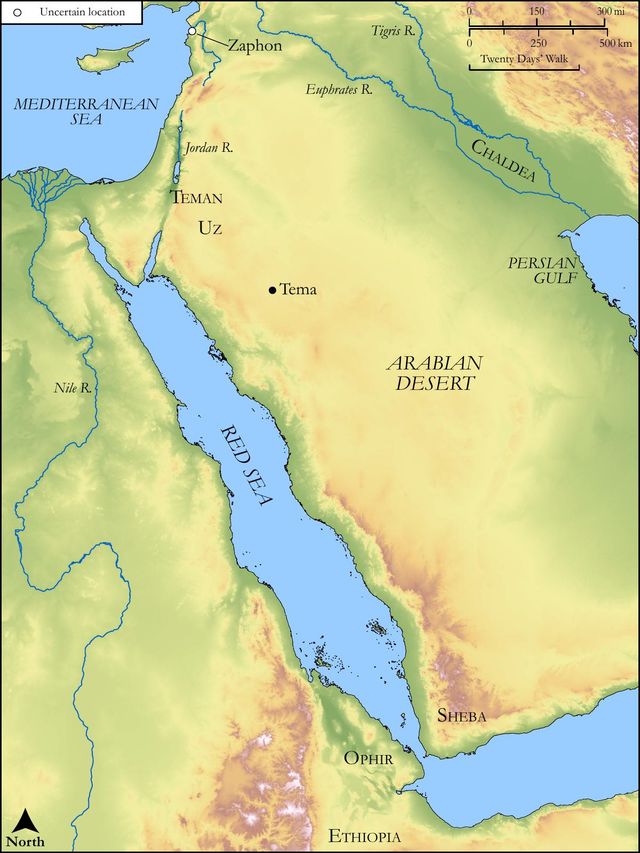
Where Job reaches
The passages it leans on, and the ones that lean on it
Job 1:1 Ezekiel 14:14 James 5:11
Ezekiel names Job with Noah and Daniel for righteousness; James names his patience, and the end the Lord gave.
Satan must ask leave: against Job in the council of heaven, and against Simon Peter on the night of the betrayal.
Paul quotes Eliphaz as Scripture: “He taketh the wise in their own craftiness.”
Job 28:28 Proverbs 1:7 Psalms 111:10
Wisdom begins in the fear of the Lord: Job’s poem, the motto of Proverbs, and the Psalm.
Job prays for his friends and is accepted: “The effectual fervent prayer of a righteous man availeth much.”
Books Job links to most
The Church Fathers on Job
1,494 quotations from 15 writers before AD 800 · the ten most quoted, in date order
- Clement99
- Origen253
- Ephrem373
- Didymus398
- Chrysostom407
- Hesychius450
- Julian455
- Desert Fathers500
- Olympiodorus600
- Gregory604
Chrysostom on Job’s torn mantle: grief, and not one wrong word.
Do not believe, dear brothers, that Job’s gesture indicates a defeat. It is, above all, a sign of victory. … Job also deserves to be admired because, in spite of the emotion that pushed him to make that moving gesture, he does not speak a single inappropriate word.
Ephrem read 19:25 as Job’s prophecy of Emmanuel.
“For I know that my Redeemer lives and that at last he will be revealed upon the earth.” Here the blessed Job predicts the future manifestation of Emmanuel in the flesh at the end of time.
Gregory on the LORD’s verdict: the friends who spoke on God’s behalf are the ones condemned.
Behold, we know that in Thy judgment blessed Job is victorious, whom we believed to have sinned against Thee by his words. In Thy judgment those are condemned, who believed that they surpassed the merits of blessed Job by speaking in Thy behalf.
Chrysostom on Job made priest for the friends who accused him.
He would have not ordered that if there had been the law, but now he becomes priest, while they bring offerings. Job had made sacrifices for his children; now he makes them for his friends. See how the text shows that Job is devoid of resentment.
Keep studying
Articles