


John 4:22
Bible text: King James Version (1769 Blayney text) · Public domain
Bible text: Berean Standard Bible · Public domain
Bible text: American Standard Version (1901) · Public domain
Bible text: World English Bible, Messianic edition · Public domain
Bible text: Geneva Bible (1599) · Public domain
Bible text: Young's Literal Translation · Public domain
- ὑμεῖςhumeisYou yourselvesG4771P-2NPPersonal pronoun Nominative 2nd Plural
- προσκυνεῖτεproskuneiteworshipG4352V-PAI-2PVerb Present Active Indicative 2nd Plural
- ὃhowhatG3739R-ASNRelative pronoun Accusative Singular Neuter
- οὐκouknotG3756PRT-NNegative Particle Negative
- οἴδατεoidateyou knowG1492V-PAI-2PVerb Present Active Indicative 2nd Plural
- ἡμεῖςhēmeiswe ourselvesG3165P-1NPPersonal pronoun Nominative 1st Plural
- προσκυνοῦμενproskunoumenworshipG4352V-PAI-1PVerb Present Active Indicative 1st Plural
- ὃhowhatG3739R-ASNRelative pronoun Accusative Singular Neuter
- οἴδαμενoidamenwe knowG1492V-PAI-1PVerb Present Active Indicative 1st Plural
- ὅτιhotiforG3754CONJConjunction
- ἡhē<the>G3588T-NSFDefinite article Nominative Singular Feminine
- σωτηρίαsōtēriasalvationG4991N-NSFNoun Nominative Singular Feminine
- ἐκekofG1537PREPPreposition
- τῶνtōntheG3588T-GPMDefinite article Genitive Plural Masculine
- ἸουδαίωνIoudaiōnJewsG2453N-GPM-PGNoun Genitive Plural Masculine Person Gentilic
- ἐστίνestinisG1510V-PAI-3SVerb Present Active Indicative 3rd Singular
English is a literal word-by-word gloss of the Greek, not the KJV's wording. Why?
This is the original text the KJV's translators worked from — each Greek word with its own literal English meaning in this verse, prepared by scholars at Tyndale House, Cambridge. The KJV translates whole sentences, not word by word, so its wording differs: one Greek word can become several English words, and the KJV may choose “charity” where the gloss reads “love”. Both are faithful — they answer different questions. For the KJV's own rendering, switch to the KJV text.
Details
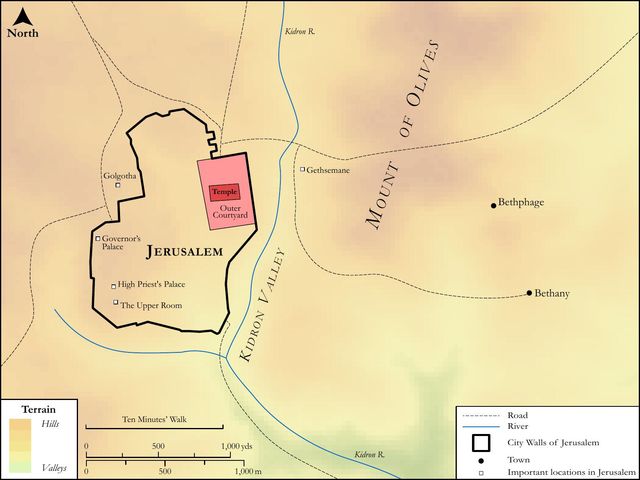
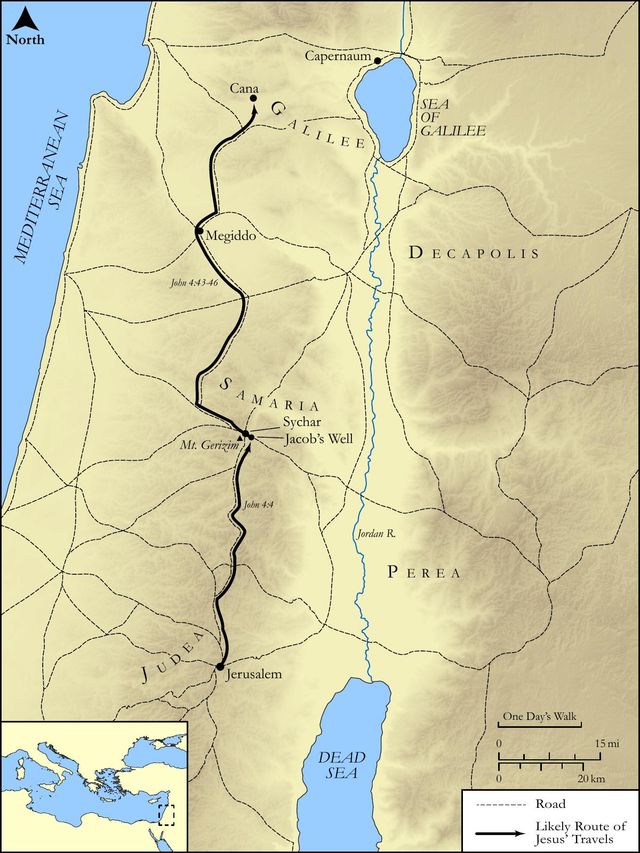
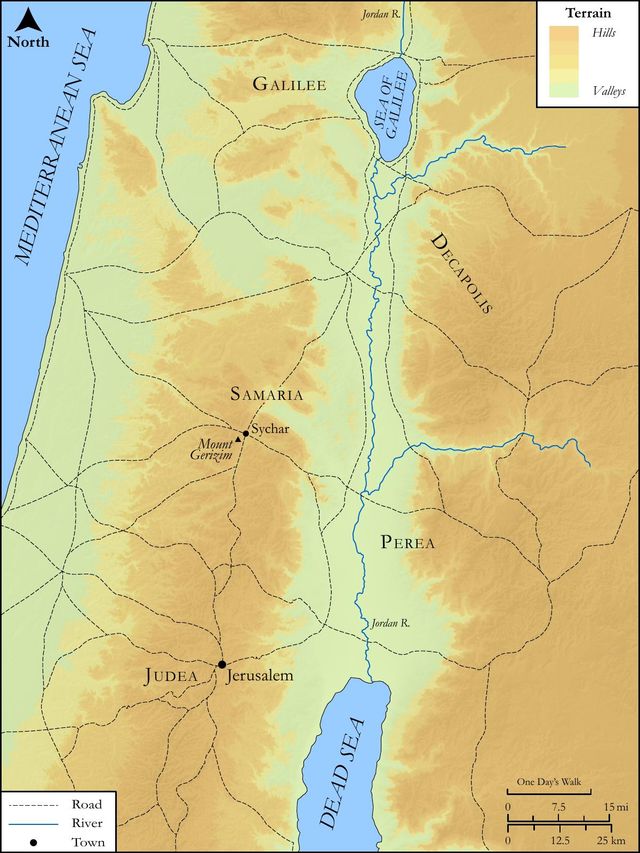
See on the biblical-era maps
Study this verse
Public-domain commentary
Matthew Henry
From his Commentary on the Whole Bible. Henry comments on passages, not single verses — this entry covers John 4:4–26. His four-level outline is real structure in the source text, so it is rendered as structure.
We have here an account of the good Christ did in Samaria, when he passed through that country in his way to Galilee. The Samaritans, both in blood and religion, were mongrel Jews, the posterity of those colonies which the king of Assyria planted there after the captivity of the ten tribes, with whom the poor of the land that were left behind, and many other Jews afterwards, incorporated themselves. They worshipped the God of Israel only, to whom they erected a temple on mount Gerizim, in competition with that at Jerusalem. There was great enmity between them and the Jews; the Samaritans would not admit Christ, when they saw he was going to Jerusalem (Luke ix. 53); the Jews thought they could not give him a worse name than to say, He is a Samaritan. When the Jews were in prosperity, the Samaritans claimed kindred to them (Ezra iv. 2), but, when the Jews were in distress, they were Medes and Persians; see Joseph. Antiq. 11. 340-341; 12. 257. Now observe,
I.Christ's coming into Samaria.
He charged his disciples not to enter into any city of the Samaritans (Matt. x. 5), that is, not to preach the gospel, or work miracles; nor did he here preach publicly, or work any miracle, his eye being to the lost sheep of the house of Israel. What kindness he here did them was accidental; it was only a crumb of the children's bread that casually fell from the master's table.
1.His road from Judea to Galilee lay through the country of Samaria (v. 4): He must needs go through Samaria. There was no other way, unless he would have fetched a compass on the other side Jordan, a great way about. The wicked and profane are at present so intermixed with God's Israel that, unless we will go out of the world, we cannot avoid going through the company of such, 1 Cor. v. 10. We have therefore need of the armour or righteousness on the right hand and on the left, that we may neither give provocation to them nor contract pollution by them. We should not go into places of temptation but when we needs must; and then we should not reside in them, but hasten through them. Some think that Christ must needs go through Samaria because of the good work he had to do there; a poor woman to be converted, a lost sheep to be sought and saved. This was work his heart was upon, the therefore he must needs go this way. It was happy for Samaria that it lay in Christ's way, which gave him an opportunity of calling on them. When I passed by thee, I said unto thee, Live, Ezek. xvi. 6.
2.His baiting place happened to be at a city of Samaria. Now observe,
(1.)The place described. It was called Sychar; probably the same with Sichem, or Shechem, a place which we read much of in the Old Testament. Thus are the names of places commonly corrupted by tract of time. Shechem yielded the first proselyte that ever came into the church of Israel (Gen. xxxiv. 24), and now it is the first place where the gospel is preached out of the commonwealth of Israel; so Dr. Lightfoot observes; as also that the valley of Achor, which was given for a door of hope, hope to the poor Gentiles, ran along by this city, Hos. ii. 15. Abimelech was made king here; it was Jeroboam's royal seat; but the evangelist, when he would give us the antiquities of the place, takes notice of Jacob's interest there, which was more its honour than its crowned heads.
[1.]Here lay Jacob's ground, the parcel of ground which Jacob gave to his son Joseph, whose bones were buried in it, Gen. xlviii. 22; Josh. xxiv. 32. Probably this is mentioned to intimate that Christ, when he reposed himself hard by here, took occasion from the ground which Jacob gave Joseph to meditate on the good report which the elders by faith obtained. Jerome chose to live in the land of Canaan, that the sight of the places might affect him the more with scripture stories.
[2.]Here was Jacob's well which he digged, or at least used, for himself and his family. We find no mention of this well in the Old Testament; but the tradition was that it was Jacob's well.
(2.)The posture of our Lord Jesus at this place: Being wearied with his journey, he sat thus on the well. We have here our Lord Jesus,
[1.]Labouring under the common fatigue of travellers. He was wearied with his journey. Though it was yet but the sixth hour, and he had performed but half his day's journey, yet he was weary; or, because it was the sixth hour, the time of the heat of the day, therefore he was weary. Here we see, First, That he was a true man, and subject to the common infirmities of the human nature. Toil came in with sin (Gen. iii. 19), and therefore Christ, having made himself a curse for us, submitted to it. Secondly, That he was a poor man, else he might have travelled on horseback or in a chariot. To this instance of meanness and mortification he humbled himself for us, that he went all his journeys on foot. When servants were on horses, princes walked as servants on the earth, Eccl. x. 7. When we are carried easily, let us think on the weariness of our Master. Thirdly, It should seem that he was but a tender man, and not of a robust constitution; it should seem, his disciples were not tired, for they went into the town without any difficulty, when their Master sat down, and could not go a step further. Bodies of the finest mould are most sensible of fatigue, and can worst bear it.
[2.]We have him here betaking himself to the common relief of travellers; Being wearied, he sat thus on the well. First, He sat on the well, an uneasy place, cold and hard; he had no couch, no easy chair to repose himself in, but took to that which was next hand, to teach us not to be nice and curious in the conveniences of this life, but content with mean things. Secondly, He sat thus, in an uneasy posture; sat carelessly—incuriose et neglectim; or he sat so as people that are wearied with travelling are accustomed to sit.
II.His discourse with a Samaritan woman, which is here recorded at large, while Christ's dispute with the doctors, and his discourse with Moses and Elias on the mount, are buried in silence. This discourse is reducible to four heads:—
1.They discourse concerning the water, v. 7-15.
(1.)Notice is taken of the circumstances that gave occasion to this discourse.
[1.]There comes a woman of Samaria to draw water. This intimates her poverty, she had no servant to be a drawer of water; and her industry, she would do it herself. See here, First, How God owns and approves of honest humble diligence in our places. Christ was made known to the shepherds when they were keeping their flock. Secondly, How the divine Providence brings about glorious purposes by events which seem to us fortuitous and accidental. This woman's meeting with Christ at the well may remind us of the stories of Rebekah, Rachel, and Jethro's daughter, who all met with husbands, good husbands, no worse than Isaac, Jacob, and Moses, when they came to the wells for water. Thirdly, How the preventing grace of God sometimes brings people unexpectedly under the means of conversion and salvation. He is found of them that sought him not.
[2.]His disciples were gone away into the city to buy meat. Hence learn a lesson, First, Of justice and honesty. The meat Christ ate, he bought and paid for, as Paul, 2 Thess. iii. 8. Secondly, Of daily dependence upon Providence: Take no thought for the morrow. Christ did not go into the city to eat, but sent his disciples to fetch his meat thither; not because he scrupled eating in a Samaritan city, but, 1. Because he had a good work to do at that well, which might be done while they were catering. It is wisdom to fill up our vacant minutes with that which is good, that the fragments of time may not be lost. Peter, while his dinner was getting ready, fell into a trance, Acts x. 10. 2. Because it was more private and retired, more cheap and homely, to have his dinner brought him hither, than to go into the town for it. Perhaps his purse was low, and he would teach us good husbandry, to spend according to what we have and not go beyond it. At least, he would teach us not to affect great things. Christ could eat his dinner as well upon a draw well as in the best inn in the town. Let us comport with our circumstances. Now this gave Christ an opportunity of discoursing with this woman about spiritual concerns, and he improved it; he often preached to multitudes that crowded after him for instruction, yet here he condescends to teach a single person, a woman, a poor woman, a stranger, a Samaritan, to teach his ministers to do likewise, as those that know what a glorious achievement it is to help to save, though but one soul, from death.
(2.)Let us observe the particulars of this discourse.
[1.]Jesus begins with a modest request for a draught of water: Give me to drink. He that for our sakes became poor here becomes a beggar, that those who are in want, and cannot dig, may not be ashamed to beg. Christ asked for it, not only because he needed it, and needed her help to come at it, but because he would draw on further discourse with her, and teach us to be willing to be beholden to the meanest when there is occasion. Christ is still begging in his poor members, and a cup of cold water, like this here, given to them in his name, shall not lose its reward.
[2.]The woman, though she does not deny his request, yet quarrels with him because he did not carry on the humour of his own nation (v. 9): How is it? Observe, First, What a mortal feud there was between the Jews and the Samaritans: The Jews have no dealings with the Samaritans. The Samaritans were the adversaries of Judah (Ezra iv. 1), were upon all occasions mischievous to them. The Jews were extremely malicious against the Samaritans, "looked upon them as having no part in the resurrection, excommunicated and cursed them by the sacred name of God, by the glorious writing of the tables, and by the curse of the upper and lower house of judgment, with this law, That no Israelite eat of any thing that is a Samaritan's, for it is as if he should eat swine's flesh." So Dr. Lightfoot, out of Rabbi Tanchum. Note, Quarrels about religion are usually the most implacable of all quarrels. Men were made to have dealing one with another; but if men, because one worships at one temple and another at another, will deny the offices of humanity, and charity, and common civility, will be morose and unnatural, scornful and censorious, and this under colour of zeal for religion, they plainly show that however their religion may be true they are not truly religious; but, pretending to stickle for religion, subvert the design of it. Secondly, How ready the woman was to upbraid Christ with the haughtiness and ill nature of the Jewish nation: How is it that thou, being a Jew, askest drink of me? By his dress or dialect, or both, she knew him to be a Jew, and thinks it strange that he runs not to the same excess of riot against the Samaritans with other Jews. Note, Moderate men of all sides are, like Joshua and his fellows (Zech. iii. 8), men wondered at. Two things this woman wonders at, 1. That he should ask this kindness; for it was the pride of the Jews that they would endure any hardship rather than be beholden to a Samaritan. It was part of Christ's humiliation that he was born of the Jewish nation, which was now not only in an ill state, subject to the Romans, but in an ill name among the nations. With what disdain did Pilate ask, Am I a Jew? Thus he made himself not only of no reputation, but of ill reputation; but herein he has set us an example of swimming against the stream of common corruptions. We must, like our master, put on goodness and kindness, though it should be ever so much the genius of our country, or the humour of our party, to be morose and ill-natured. This woman expected that Christ should be as other Jews were; but it is unjust to charge upon every individual person even the common faults of the community: no rule but has some exceptions. 2. She wonders that he should expect to receive this kindness from her that was a Samaritan: "You Jews could deny it to one of our nation, and why should we grant it to one of yours?" Thus quarrels are propagated endlessly by revenge and retaliation.
[3.]Christ takes this occasion to instruct her in divine things: If thou knewest the gift of God, thou wouldst have asked, v. 10. Observe,
First, He waives her objection of the feud between the Jews and Samaritans, and takes no notice of it. Some differences are best healed by being slighted, and by avoiding all occasions of entering into dispute about them. Christ will convert this woman, not by showing her that the Samaritan worship was schismatical (though really it was so), but by showing her her own ignorance and immoralities, and her need of a Saviour.
Secondly, He fills her with an apprehension that she had now an opportunity (a fairer opportunity than she was aware of) of gaining that which would be of unspeakable advantage to her. She had not the helps that the Jews had to discern the signs of the times, and therefore Christ tells her expressly that she had now a season of grace; this was the day of her visitation.
a.He hints to her what she should know, but was ignorant of: If thou knewest the gift of God, that is, as the next words explain it, who it is that saith, Give me to drink. If thou knewest who I am. She saw him to be a Jew, a poor weary traveller; but he would have her know something more concerning him that did yet appear. Note, (a.) Jesus Christ is the gift of God, the richest token of God's love to us, and the richest treasure of all good for us; a gift, not a debt which we could demand from God; not a loan, which he will demand from us again, but a gift, a free gift, ch. iii. 16. (b.) It is an unspeakable privilege to have this gift of God proposed and offered to us; to have an opportunity of embracing it: "He who is the gift of God is now set before thee, and addresses himself to thee; it is he that saith, Give me to drink; this gift comes a begging to thee." (c.) Though Christ is set before us, and sues to us in and by his gospel, yet there are multitudes that know him not. They know not who it is that speaks to them in the gospel, that saith, Give me to drink; they perceive not that it is the Lord that calls them.
b.He hopes concerning her, what she would have done if she had known him; to be sure she would not have given him such a rude and uncivil answer; nay, she would have been so far from affronting him that she would have made her addresses to him: Thou wouldest have asked. Note, (a.) Those that would have any benefit by Christ must ask for it, must be earnest in prayer to God for it. (b.) Those that have a right knowledge of Christ will seek to him, and if we do not seek unto him it is a sign that we do not know him, Ps. ix. 10. (c.) Christ knows what they that want the means of knowledge would have done if they had had them, Matt. xi. 21.
c.He assures her what he would have done for her if she had applied to him: "He would have given thee (and not have upbraided thee as thou doest me) living water." By this living water is meant the Spirit, who is not like the water in the bottom of the well, for some of which he asked, but like living or running water, which was much more valuable. Note, (a.) The Spirit of grace is as living water; see ch. vii. 38. Under this similitude the blessings of the Messiah had been promised in the Old Testament, Isa. xii. 3; xxxv. 7; xliv. 3; lv. 1; Zech. xiv. 8. The graces of the Spirit, and his comforts, satisfy the thirsting soul, that knows its own nature and necessity. (b.) Jesus Christ can and will give the Holy Spirit to them that ask him; for he received that he might give.
[4.]The woman objects against and cavils at the gracious intimation which Christ gave her (v. 11, 12): Thou hast nothing to draw with; and besides, Art thou greater than our father Jacob? What he spoke figuratively, she took literally; Nicodemus did so too. See what confused notions they have of spiritual things who are wholly taken up with the things that are sensible. Some respect she pays to this person, in calling him Sir, or Lord; but little respect to what he said, which she does but banter.
First, She does not think him capable of furnishing her with any water, no, not this in the well that is just at hand: Thou has nothing to draw with, and the well is deep. This she said, not knowing the power of Christ, for he who causeth the vapours to ascend from the ends of the earth needs nothing to draw. But there are those who will trust Christ no further than they can see him, and will not believe his promise, unless the means of the performance of it be visible; as if he were tied to our methods, and could not draw water without our buckets. She asks scornfully, "Whence hast thou this living water? I see not whence thou canst have it." Note, The springs of that living water which Christ has for those that come to him are secret and undiscovered. The fountain of life is hid with Christ. Christ has enough for us, though we see not whence he has it.
Secondly, She does not think it possible that he should furnish her with any better water than this which she could come at, but he could not: Art thou greater than our father Jacob, who gave us the well?
a.We will suppose the tradition true, that Jacob himself, and his children, and cattle, did drink of this well. And we may observe from it, (a.) The power and providence of God, in the continuance of the fountains of water from generation to generation, by the constant circulation of the rivers, like the blood in the body (Eccl. i. 7), to which circulation perhaps the flux and reflux of the sea, like the pulses of the heart, contribute. (b.) The plainness of the patriarch Jacob; his drink was water, and he and his children drank of the same well with his cattle.
b.Yet, allowing that to be true, she was out in several things; as, (a.) In calling Jacob father. What authority had the Samaritans to reckon themselves of the seed of Jacob? They were descended from that mixed multitude which the king of Assyria had placed in the cities of Samaria; what have they to do then with Jacob? Because they were the invaders of Israel's rights, and the unjust possessors of Israel's lands, were they therefore the inheritors of Israel's blood and honour? How absurd were those pretensions! (b.) She is out in claiming this well as Jacob's gift, whereas he did no more give it than Moses gave the manna, ch. vi. 32. But thus we are apt to call the messengers of God's gifts the donors of them, and to look so much at the hands they pass through as to forget the hand they come from. Jacob gave it to his sons, not to them. Yet thus the church's enemies not only usurp, but monopolize, the church's privileges. (c.) She was out in speaking of Christ as not worthy to be compared with our father Jacob. An over-fond veneration for antiquity makes God's graces, in the good people of our own day, to be slighted.
[5.]Christ answers this cavil, and makes it out that the living water he had to give was far better than that of Jacob's well, v. 13, 14. Though she spoke perversely, Christ did not cast her off, but instructed and encouraged her. He shows her,
First, That the water of Jacob's well yielded but a transient satisfaction and supply: "Whoso drinketh of this water shall thirst again. It is no better than other water; it will quench the present thirst, but the thirst will return, and in a few hours a man will have as much need, and as much desire, of water as ever he had." This intimates, 1. The infirmities of our bodies in this present state; they are still necessitous, and ever craving. Life is a fire, a lamp, which will soon go out, without continual supplies of fuel and oil. The natural heat preys upon itself. 2. The imperfections of all our comforts in this world; they are not lasting, nor our satisfaction in them remaining. Whatever waters of comfort we drink of, we shall thirst again. Yesterday's meat and drink will not do to-day's work.
Secondly, That the living waters he would give should yield a lasting satisfaction and bliss, v. 14. Christ's gifts appear most valuable when they come to be compared with the things of this world; for there will appear no comparison between them. Whoever partakes of the Spirit of grace, and the comforts of the everlasting gospel,
a.He shall never thirst, he shall never want that which will abundantly satisfy his soul's desires; they are longing, but not languishing. A desiring thirst he has, nothing more than God, still more and more of God; but not a despairing thirst.
b.Therefore he shall never thirst, because this water that Christ gives shall be in him a well of water. He can never be reduced to extremity that has in himself a fountain of supply and satisfaction. (a.) Ever ready, for it shall be in him. The principle of grace planted in him is the spring of his comfort; see ch. vii. 38. A good man is satisfied from himself, for Christ dwells in his heart. The anointing abides in him; he needs not sneak to the world for comfort; the work and the witness of the Spirit in the heart furnish him with a firm foundation of hope and an overflowing fountain of joy. (b.) Never failing, for it shall be in him a well of water. He that has at hand only a bucket of water needs not thirst as long as this lasts, but it will soon be exhausted; but believers have in them a well of water, overflowing, ever flowing. The principles and affections which Christ's holy religion forms in the souls of those that are brought under the power of it are this well of water. [a.] It is springing up, ever in motion, which bespeaks the actings of grace strong and vigorous. If good truths stagnate in our souls, like standing water, they do not answer the end of our receiving them. If there be a good treasure in the heart, we must thence bring forth good things. [b.] It is springing up unto everlasting life; which intimates, First, The aims of gracious actings. A sanctified soul has its eye upon heaven, means this, designs this, does all for this, will take up with nothing short of this. Spiritual life springs up towards its own perfection in eternal life. Secondly, The constancy of those actings; it will continue springing up till it come to perfection. Thirdly, The crown of them, eternal life at last. The living water rises from heaven, and therefore rises towards heaven; see Eccl. i. 7. And now is not this water better than that of Jacob's well?
[6.]The woman (whether in jest or earnest is hard to say) begs of him to give her some of this water (v. 15): Give me this water, that I thirst not. First, Some think that she speaks tauntingly, and ridicules what Christ had said as mere stuff; and, in derision of it, not desires, but challenges him to give her some of this water: "A rare invention; it will save me a great deal of pains if I never come hither to draw." But, Secondly, Others think that it was a well-meant but weak and ignorant desire. She apprehended that he meant something very good and useful, and therefore saith Amen, at a venture. Whatever it be, let me have it; who will show me any good? Ease, or saving of labour, is a valuable good to poor labouring people. Note, 1. Even those that are weak and ignorant may yet have some faint and fluctuating desires towards Christ and his gifts, and some good wishes of grace and glory. 2. Carnal hearts, in their best wishes, look no higher than carnal ends. "Give it to me," saith she, "not that I may have everlasting life" (which Christ proposed), "but that I come not hither to draw."
2.The next subject of discourse with this woman in concerning her husband, v. 16-18. It was not to let fall the discourse of the water of life that Christ started this, as many who will bring in any impertinence in conversation that they may drop a serious subject; but it was with a gracious design that Christ mentioned it. What he had said concerning his grace and eternal life he found had made little impression upon her, because she had not been convinced of sin: therefore, waiving the discourse about the living water, he sets himself to awaken her conscience, to open the wound of guilt, and then she would more easily apprehend the remedy by grace. And this is the method of dealing with souls; they must first be made weary and heavy-laden under the burden of sin, and then brought to Christ for rest; first pricked to the heart, and then healed. This is the course of spiritual physic; and if we proceed not in this order we begin at the wrong end.
Observe, (1.) How discreetly and decently Christ introduces this discourse (v. 16): Go, call thy husband, and come hither. Now, [1.] The order Christ gave her had a very good colour: "Call thy husband, that he may teach thee, and help thee to understand these things, which thou art so ignorant of" The wives that will learn must ask their husbands (1 Cor. xiv. 35), who must dwell with them as men of knowledge, 1 Pet. iii. 7. "Call thy husband, that he may learn with thee; that then you may be heirs together of the grace of life. Call thy husband, that he may be witness to what passes between us." Christ would thus teach us to provide things honest in the sight of all men, and to study that which is of good report. [2.] As it had a good colour, so it had a good design; for hence he would take occasion to call her sin to remembrance. There is need of art and prudence in giving reproofs; to fetch a compass, as the woman of Tekoa, 2 Sam. xiv. 20.
(2.)How industriously the woman seeks to evade the conviction, and yet insensibly convicts herself, and, ere she is aware, owns her fault; she said, I have no husband. Her saying this intimated no more than that she did not care to have her husband spoken of, nor that matter mentioned any more. She would not have her husband come thither, lest, in further discourse, the truth of the matter should come out, to her shame; and therefore, "Pray go on to talk of something else, I have no husband;" she would be thought a maid or a widow, whereas, though she had no husband, she was neither. The carnal mind is very ingenious to shift off convictions, and to keep them from fastening, careful to cover the sin.
(3.)How closely our Lord Jesus brings home the conviction to her conscience. It is probable that he said more than is here recorded, for she thought that he told her all that ever she did (v. 29), but that which is here recorded is concerning her husbands. Here is,
[1.]A surprising narrative of her past conversation: Thou has had five husbands. Doubtless, it was not her affliction (the burying of so many husbands), but her sin, that Christ intended to upbraid her with; either she had eloped (as the law speaks), had run away from her husbands, and married others, or by her undutiful, unclean, disloyal conduct, had provoked them to divorce her, or by indirect means had, contrary to law, divorced them. Those who make light of such scandalous practices as these, as no more than nine days' wonder, and as if the guilt were over as soon as the talk is over, should remember that Christ keeps account of all.
[2.]A severe reproof of her present state of life: He whom thou now hast is not thy husband. Either she was never married to him at all, or he had some other wife, or, which is most probable, her former husband or husbands were living: so that, in short, she lived in adultery. Yet observe how mildly Christ tells her of it; he doth not call her strumpet, but tells her, He with whom thou livest is not thy husband: and then leaves it to her own conscience to say the rest. Note, Reproofs are ordinarily most profitable when they are least provoking.
[3.]Yet in this he puts a better construction than it would well bear upon what she said by way of shuffle and evasion: Thou has well said I have no husband; and again, In that saidst thou truly. What she intended as a denial of the fact (that she had none with whom she lived as a husband) he favourably interpreted, or at least turned upon her, as a confession of the fault. Note, Those who would win souls should make the best of them, whereby they may hope to work upon their good-nature; for, if they make the worst of them, they certainly exasperate their ill-nature.
3.The next subject of discourse with this woman is concerning the place of worship, v. 19-24. Observe,
(1.)A case of conscience proposed to Christ by the woman, concerning the place of worship, v. 19, 20.
[1.]The inducement she had to put this case: Sir, I perceive that thou art a prophet. She does not deny the truth of what he had charged her with, but by her silence owns the justice of the reproof; nor is she put into a passion by it, as many are when they are touched in a sore place, does not impute his censure to the general disgust the Jews had to the Samaritans, but (which is a rare thing) can bear to be told of a fault. But this is not all; she goes further: First, She speaks respectfully to him, calls him Sir. Thus should we honour those that deal faithfully with us. This was the effect of Christ's meekness in reproving her; he gave her no ill language, and then she gave him none. Secondly, She acknowledges him to be a prophet, one that had a correspondence with Heaven. Note, The power of the word of Christ in searching the heart, and convincing the conscience of secret sins, is a great proof of its divine authority, 1 Cor. xiv. 24, 25. Thirdly, She desires some further instruction from him. Many that are not angry at their reprovers, nor fly in their faces, yet are afraid of them and keep out of their way; but this woman was willing to have some more discourse with him that told her of her faults.
[2.]The case itself that she propounded concerning the place of religious worship in public. Some think that she started this to shift off further discourse concerning her sin. Controversies in religion often prove great prejudices to serious godliness; but, it should seem, she proposed it with a good design; she knew she must worship God, and desired to do it aright; and therefore, meeting with a prophet, begs his direction. Note, It is our wisdom to improve all opportunities of getting knowledge in the things of God. When we are in company with those that are fit to teach, let us be forward to learn, and have a good question ready to put to those who are able to give a good answer. It was agreed between the Jews and the Samaritans that God is to be worshipped (even those who were such fools as to worship false gods were not such brutes as to worship none), and that religious worship is an affair of great importance: men would not contend about it if they were not concerned about it. But the matter in variance was where they should worship God. Observe how she states the case:—
First, As for the Samaritans: Our fathers worshipped in this mountain, near to this city and this well; there the Samaritan temple was built by Sanballat, in favour of which she insinuates, 1. That whatever the temple was the place was holy; it was mount Gerizim, the mount in which the blessings were pronounced; and some think the same on which Abraham built his altar (Gen. xii. 6, 7), and Jacob his, Gen. xxxiii. 18-20. 2. That it might plead prescription: Our fathers worshipped here. She thinks they have antiquity, tradition, and succession, on their side. A vain conversation often supports itself with this, that it was received by tradition from our fathers. But she had little reason to boast of their fathers; for, when Antiochus persecuted the Jews, the Samaritans, for fear of sharing with them in their sufferings, not only renounced all relation to the Jews, but surrendered their temple to Antiochus, with a request that it might be dedicated to Jupiter Olympius, and called by his name. Joseph. Antiq. 12. 257-264.
Secondly, As to the Jews: You say that in Jerusalem is the place where men ought to worship. The Samaritans governed themselves by the five books of Moses, and (some think) received only them as canonical. Now, though they found frequent mention there of the place God would choose, yet they did not find it named there; and they saw the temple at Jerusalem stripped of many of its ancient glories, and therefore thought themselves at liberty to set up another place, altar against altar.
(2.)Christ's answer to this case of conscience, v. 21, &c. Those that apply themselves to Christ for instruction shall find him meek, to teach the meek his way. Now here,
[1.]He puts a slight upon the question, as she had proposed it, concerning the place of worship (v. 21): "Woman, believe me as a prophet, and mark what I say. Thou art expecting the hour to come when either by some divine revelation, or some signal providence, this matter shall be decided in favour either of Jerusalem or of Mount Gerizim; but I tell thee the hour is at hand when it shall be no more a question; that which thou has been taught to lay so much weight on shall be set aside as a thing indifferent." Note, It should cool us in our contests to think that those things which now fill us, and which we make such a noise about, shall shortly vanish, and be no more: the very things we are striving about are passing away: The hour comes when you shall neither in this mountain nor yet at Jerusalem worship the Father. First, The object of worship is supposed to continue still the same—God, as a Father; under this notion the very heathen worshipped God, the Jews did so, and probably the Samaritans. Secondly, But a period shall be put to all niceness and all differences about the place of worship. The approaching dissolution of the Jewish economy, and the erecting of the evangelical state, shall set this matter at large, and lay all in common, so that it shall be a thing perfectly indifferent whether in either of these places or any other men worship God, for they shall not be tied to any place; neither here nor there, but both, and any where, and every where. Note, The worship of God is not now, under the gospel, appropriated to any place, as it was under the law, but it is God's will that men pray every where. 1 Tim. ii. 8; Mal. i. 11. Our reason teaches us to consult decency and convenience in the places of our worship: but our religion gives no preference to one place above another, in respect to holiness and acceptableness to God. Those who prefer any worship merely for the sake of the house or building in which it is performed (though it were as magnificent and as solemnly consecrated as ever Solomon's temple was) forget that the hour is come when there shall be no difference put in God's account: no, not between Jerusalem, which had been so famous for sanctity, and the mountain of Samaria, which had been so infamous for impiety.
[2.]He lays a stress upon other things, in the matter of religious worship. When he made so light of the place of worship he did not intend to lessen our concern about the thing itself, of which therefore he takes occasion to discourse more fully.
First, As to the present state of the controversy, he determines against the Samaritan worship, and in favour of the Jews, v. 22. He tells here, 1. That the Samaritans were certainly in the wrong; not merely because they worshipped in this mountain, though, while Jerusalem's choice was in force, that was sinful, but because they were out in the object of their worship. If the worship itself had been as it should have been, its separation from Jerusalem might have been connived at, as the high places were in the best reigns: But you worship you know not what, or that which you do not know. They worshipped the God of Israel, the true God (Ezra iv. 2; 2 Kings xvii. 32); but they were sunk into gross ignorance; they worshipped him as the God of that land (2 Kings xvii. 27, 33), as a local deity, like the gods of the nations, whereas God must be served as God, as the universal cause and Lord. Note, Ignorance is so far from being the mother of devotion that it is the murderer of it. Those that worship God ignorantly offer the blind for sacrifice, and it is the sacrifice of fools. 2. That the Jews were certainly in the right. For, (1.) "We know what we worship. We go upon sure grounds in our worship, for our people are catechised and trained up in the knowledge of God, as he has revealed himself in the scripture." Note, Those who by the scriptures have obtained some knowledge of God (a certain though not a perfect knowledge) may worship him comfortably to themselves, and acceptably to him, for they know what they worship. Christ elsewhere condemns the corruptions of the Jews' worship (Matt. xv. 9), and yet here defends the worship itself; the worship may be true where yet it is not pure and entire. Observe, Our Lord Jesus was pleased to reckon himself among the worshippers of God: We worship. Though he was a Son (and then are the children free), yet learned he this obedience, in the days of his humiliation. Let not the greatest of men think the worship of God below them, when the Son of God himself did not. (2.) Salvation is of the Jews; and therefore they know what they worship, and what grounds they go upon in their worship. Not that all the Jews were saved, nor that it was not possible but that many of the Gentiles and Samaritans might be saved, for in every nation he that fears God and works righteousness is accepted of him; but, [1.] The author of eternal salvation comes of the Jews, appears among them (Rom. ix. 5), and is sent first to bless them. [2.] The means of eternal salvation are afforded to them. The word of salvation (Acts xiii. 26) was of the Jews. It was delivered to them, and other nations derived it through them. This was a sure guide to them in their devotions, and they followed it, and therefore knew what they worshipped. To them were committed the oracles of God (Rom. iii. 2), and the service of God, (Rom. ix. 4). The Jews therefore being thus privileged and advanced, it was presumption for the Samaritans to vie with them.
Secondly, He describes the evangelical worship which alone God would accept and be well pleased with. Having shown that the place is indifferent, he comes to show what is necessary and essential—that we worship God in spirit and in truth, v. 23, 24. The stress is not to be laid upon the place where we worship God, but upon the state of mind in which we worship him. Note, The most effectual way to take up differences in the minor matters of religion is to be more zealous in the greater. Those who daily make it the matter of their care to worship in the spirit, one would think, should not make it the matter of their strife whether he should be worshipped here or there. Christ had justly preferred the Jewish worship before the Samaritan, yet here he intimates the imperfection of that. The worship was ceremonial, Heb. ix. 1, 10. The worshippers were generally carnal, and strangers to the inward part of divine worship. Note, It is possible that we may be better than our neighbours, and yet not so good as we should be. It concerns us to be right, not only in the object of our worship, but in the manner of it; and it is this which Christ here instructs us in. Observe,
a.The great and glorious revolution which should introduce this change: The hour cometh, and now is—the fixed stated time, concerning which it was of old determined when it should come, and how long it should last. The time of its appearance if fixed to an hour, so punctual and exact are the divine counsels; the time of its continuance is limited to an hour, so close and pressing is the opportunity of divine grace, 2 Cor. vi. 2. This hour cometh, it is coming in its full strength, lustre, and perfection, it now is in the embryo and infancy. The perfect day is coming, and now it dawns.
b.The blessed change itself. In gospel times the true worshippers shall worship the Father in spirit and in truth. As creatures, we worship the Father of all: as Christians, we worship the Father of our Lord Jesus. Now the change shall be, (a.) In the nature of the worship. Christians shall worship God, not in the ceremonial observances of the Mosaic institution, but in spiritual ordinances, consisting less in bodily exercise, and animated and invigorated more with divine power and energy. The way of worship which Christ has instituted is rational and intellectual, and refined from those external rites and ceremonies with which the Old-Testament worship was both clouded and clogged. This is called true worship, in opposition to that which was typical. The legal services were figures of the true, Heb. ix. 3, 24. Those that revolted from Christianity to Judaism are said to begin in the spirit, and end in the flesh, Gal. iii. 3. Such was the difference between Old-Testament and New-Testament institutions. (b.) In the temper and disposition of the worshippers; and so the true worshippers are good Christians, distinguished from hypocrites; all should, and they will, worship God in spirit and in truth. It is spoken of (v. 23) as their character, and (v. 24) as their duty. Note, It is required of all that worship God that they worship him in spirit and in truth. We must worship God, [a.] In spirit, Phil. iii. 3. We must depend upon God's Spirit for strength and assistance, laying our souls under his influences and operations; we must devote our own spirits to, and employ them in, the service of God (Rom. i. 9), must worship him with fixedness of thought and a flame of affection, with all that is within us. Spirit is sometimes put for the new nature, in opposition to the flesh, which is the corrupt nature; and so to worship God with our spirits is to worship him with our graces, Heb. xii. 28. [b.] In truth, that is, in sincerity. God requires not only the inward part in our worship, but truth in the inward part, Ps. li. 6. We must mind the power more than the form, must aim at God's glory, and not to be seen of men; draw near with a true heart, Heb. x. 22.
Thirdly, He intimates the reasons why God must be thus worshipped.
a.Because in gospel times they, and they only, are accounted the true worshippers. The gospel erects a spiritual way of worship, so that the professors of the gospel are not true in their profession, do not live up to gospel light and laws, if they do not worship God in spirit and in truth.
b.Because the Father seeketh such worshippers of him. This intimates, (a.) That such worshippers are very rare, and seldom met with, Jer. xxx. 21. The gate of spiritual worshipping is strait. (b.) That such worship is necessary, and what the God of heaven insists upon. When God comes to enquire for worshippers, the question will not be, "Who worshipped at Jerusalem?" but, "Who worshipped in spirit?" That will be the touchstone. (c.) That God is greatly well pleased with and graciously accepts such worship and such worshippers. I have desired it, Ps. cxxxii. 13, 14; Cant. ii. 14. (d.) That there has been, and will be to the end, a remnant of such worshippers; his seeking such worshippers implies his making them such. God is in all ages gathering in to himself a generation of spiritual worshippers.
c.Because God is a spirit. Christ came to declare God to us (ch. i. 18), and this he has declared concerning him; he declared it to this poor Samaritan woman, for the meanest are concerned to know God; and with this design, to rectify her mistakes concerning religious worship, to which nothing would contribute more than the right knowledge of God. Note, (a.) God is a spirit, for he is an infinite and eternal mind, an intelligent being, incorporeal, immaterial, invisible, and incorruptible. It is easier to say what God is not than what he is; a spirit has not flesh and bones, but who knows the way of a spirit? If God were not a spirit, he could not be perfect, nor infinite, nor eternal, nor independent, nor the Father of spirits. (b.) The spirituality of the divine nature is a very good reason for the spirituality of divine worship. If we do not worship God, who is a spirit, in the spirit, we neither give him the glory due to his name, and so do not perform the act of worship, nor can we hope to obtain his favour and acceptance, and so we miss of the end of worship, Matt. xv. 8, 9.
4.The last subject of discourse with this woman is concerning the Messiah, v. 25, 26. Observe here,
(1.)The faith of the woman, by which she expected the Messiah: I know that Messias cometh—and he will tell us all things. She had nothing to object against what Christ had said; his discourse was, for aught she knew, what might become the Messiah then expected; but from him she would receive it, and in the mean time she thinks it best to suspend her belief. Thus many have no heart to the price in their hand (Prov. xvii. 16), because they think they have a better in their eye, and deceive themselves with a promise that they will learn that hereafter which they neglect now. Observe here,
[1.]Whom she expects: I know that Messias cometh. The Jews and Samaritans, though so much at variance, agreed in the expectation of the messiah and his kingdom. The Samaritans received the writings of Moses, and were no strangers to the prophets, nor to the hopes of the Jewish nation; those who knew least knew this, that Messias was to come; so general and uncontested was the expectation of him, and at this time more raised than ever (for the sceptre was departed from Judah, Daniel's weeks were near expiring), so that she concludes not only, He will come, but erchetai—"He comes, he is just at hand:" Messias, who is called Christ. The evangelist, though he retains the Hebrew word Messias (which the woman used) in honour to the holy language, and to the Jewish church, that used it familiarly, yet, writing for the use of the Gentiles, he takes care to render it by a Greek word of the same signification, who is called Christ-Anointed, giving an example to the apostle's rule, that whatever is spoken in an unknown or less vulgar tongue should be interpreted, 1 Cor. xiv. 27, 28.
[2.]What she expects from him: "He will tell us all things relating to the service of God which it is needful for us to know, will tell us that which will supply our defects, rectify our mistakes, and put an end to all our disputes. He will tell us the mind of God fully and clearly, and keep back nothing." Now this implies an acknowledgement, First, Of the deficiency and imperfection of the discovery they now had of the divine will, and the rule they had of the divine worship; it could not make the comers thereunto perfect, and therefore they expected some great advance and improvement in matters of religion, a time of reformation. Secondly, Of the sufficiency of the Messiah to make this change: "He will tell us all things which we want to know, and about which we wrangle in the dark. He will introduce peace, by leading us into all truth, and dispelling the mists of error." It seems, this was the comfort of good people in those dark times that light would arise; if they found themselves at a loss, and run aground, it was a satisfaction to them to say, When Messias comes, he will tell us all things; as it may be to us now with reference to his second coming: now we see through a glass, but then face to face.
Historical interpretation
Two Centuries of Reception
14 surviving comments on this verse. Each one is dated, so this reads as a timeline rather than a list.
Select a marker to jump to its quote. Markers stagger vertically where authors wrote within a few decades of each other.
Accordingly, He who said, "Woe unto them that trust in the mountain of Samaria," vouchsafing now to restore that very region, purposely requests the men "to go and show themselves to the priests," because these were to be found only there where the temple was; submitting the Samaritan to the Jew, inasmuch as "salvation was of the Jews," whether to the Israelite or the Samaritan.
The "you" refers literally to the Samaritans but anagogically to all who are heterodox regarding the Scriptures. The "we" literally means the Jews, but allegorically it means, "I, the Word, and all who are changed by me receive salvation from the Jewish Scriptures." For the mystery now revealed was revealed both through the prophetic Scriptures and through the appearance of our Lord Jesus Christ.
(tom. xiii. c. 17) Ye, literally refers to the Samaritans, but mystically, to all who understand the Scriptures in an heretical sense. We again literally means the Jews, but mystically, I the Word, and all who conformed to My Image, obtain salvation from the Jewish Scriptures.
An exceedingly great doctrine He revealed to her, and one which He did not mention either to Nicodemus or Nathanael. She was eager to prove her own privileges more honorable than those of the Jews; and this she subtly argued from the Fathers, but Christ met not this question. For it was for the time distracting to speak on the matter, and to show why the Fathers worshiped in the mountain, and why the Jews at Jerusalem. Wherefore on this point He was silent, and having taken away from both places priority in dignity, rouses her soul by showing that neither Jews nor Samaritans possessed anything great in comparison with that which was to be given; and then He introduceth the difference. Yet even thus He declared that the Jews were more honorable, not preferring place to place, but giving them the precedence because of their intention. As though He had said, "About the 'place' of worship ye have no need henceforth to dispute, but in the 'manner' the Jews have an advantage over you Samaritans, for 'ye,' He saith, 'worship ye know not what; we know what we worship.'"
Everywhere, beloved, we have need of faith, faith the mother of blessings, the medicine of salvation; and without this it is impossible to possess any one of the great doctrines. Without this, men are like to those who attempt to cross the open sea without a ship, who for a little way hold out by swimming, using both hands and feet, but when they have advanced farther, are quickly swamped by the waves: in like manner they who use their own reasonings, before they have learnt anything, suffer shipwreck; as also Paul saith, "Who concerning faith have made shipwreck." That this be not our case, let us hold fast the sacred anchor by which Christ bringeth over the Samaritan woman now.
(Hom. xxxii. 3) Christ however does not solve this question immediately, but leads the woman to higher things, of which He had not spoken till she acknowledged Him to be a prophet, and therefore listened with a more full belief: Jesus saith unto her, Woman, believe Me, the hour cometh, when ye shall neither in this mountain, nor yet at Jerusalem, worship the Father. He says, Believe me, because we have need of faith, the mother of all good, the medicine of salvation, in order to obtain any real good. They who endeavour without it, are like men who venture on the sea without a boat, and, being able to swim only a little way, are drowned.
(Hom. xxxiii. 1) There was no necessity for Christ to show why the fathers worshipped in the mountain, and the Jews in Jerusalem. He therefore was silent on that question; but nevertheless asserted the religious superiority of the Jews on another ground, the ground not of place, but, of knowledge; Ye worship ye know not what, we know what we worship; for salvation if of the Jews.
(Hom. xxxiii. 1) The Samaritans worshipped they knew not what, a local, a partial God, as they imagined, of whom they had the same notion that they had of their idols. And therefore they mingled the worship of God with the worship of idols. But the Jews were free from this superstition: indeed they knew God to be the God of the whole world; wherefore He says, We worship what we know. He reckons Himself among the Jews, in condescension to the woman's idea of Him; and says as if He were a Jewish prophet, We worship, though it is certain that He is the Being who is worshipped by all. The words, For salvation is of the Jews, mean that every thing calculated to save and amend the world, the knowledge of God, the abhorrence of idols, and all other doctrines of that nature, and even the very origin of our religion, comes originally from the Jews. In salvation too He includes His own presence, which He says is of the Jews, as we are told by the Apostle, Of whom as concerning the flesh Christ came. (Rom. 9:5) See how He exalts the Old Testament, which He shows to be the root of every thing good; thus proving in every way that He Himself is not opposed to the Law.
"For salvation is of the Jews." What He saith is of this kind: neither, that blessings to the world came from them, (for to know God and condemn idols had its beginning, from them, and with you the very act of worship, although ye do it not rightly, yet received its origin from them,) or else, He speaketh of His own Coming. Or rather, one would not be wrong in calling both these things "salvation" which He said was "of the Jews"; which Paul implied when he said, "Of whom is Christ according to the flesh, who is God over all." Seest thou how He commendeth the old Covenant, and showeth that it is the root of blessings, and that He is throughout not opposed to the Law, since He maketh the groundwork of all good things to come from the Jews?
How then did the Samaritans "know not" what they worshiped? Because they thought that God was local and partial; so at least they served Him, and so they sent to the Persians, and reported that "the God of this place is wroth with us," in this respect forming no higher opinion of Him than of their idols. Wherefore they continued to serve both Him and devils, joining things which ought not to be joined. The Jews, on the contrary, were free from this supposition, at least the greater part of them, and knew that He was God of the world. Therefore He saith, "Ye worship ye know not what; we know what we worship." Do not wonder that He numbereth Himself among Jews, for He speaketh to the woman's opinion of Him as though He were a Jewish Prophet, and therefore He putteth, "we worship." For that He is of the objects of worship is clear to every one, because to worship belongs to the creature, but to be worshiped to the Lord of the creature. But for a time He speaketh as a Jew; and the expression "we" in this place meaneth "we Jews."
It is proper for Jesus to say now, “Believe me,” after he had clearly demonstrated the truth of the words that he had spoken to her before. “The hour is coming when you will worship the Father neither on this mountain nor in Jerusalem.” This, he says, is what you want to be instructed about. Know then that there will be a time when both places will end. However in order that it might not appear that Jews and Samaritans had to be considered equal (because he predicted the end of both their sanctuaries) he says, “You worship what you do not know,” that is, you Samaritans; “We worship what we know,” that is, we Jews. Then he adds, “For salvation is from the Jews.” He did not say “in the Jews” but “from the Jews.” In fact, salvation was not in them but from them because Christ in flesh came from them. Therefore, he says, the truth is by the Jews, but both sanctuaries will be emptied out.
"The hour cometh, and now is, when the true worshippers shall worship the Father in spirit and in truth. We worship that which we know: ye worship ye know not what; for salvation is of the Jews." A great thing has He attributed to the Jews; but do not understand Him to mean those spurious Jews. Understand that wall to which another is joined, that they may be joined together, resting on the corner-stone, which is Christ. For there is one wall from the Jews, another from the Gentiles; these walls are far apart, only until they are united in the Corner. Now the aliens were strangers and foreigners from the covenants of God. According to this, it is said, "We worship what we know." It is said, indeed, in the person of the Jews, but not of all Jews, not of reprobate Jews, but of such as were the apostles, as were the prophets, as were all those saints who sold all their goods, and laid the price of their goods at the apostles' feet. "For God hath not rejected His people which He foreknew."
What, however, does the Lord teach the woman now, as one whose husband has begun to be present? "The woman saith unto Him, Sir, I perceive that thou art a prophet. Our fathers worshipped in this mountain; and ye say that in Jerusalem is the place where men ought to worship. Jesus saith unto her, Woman, believe me." For the Church will come, as it is said in the Song of Songs, "will come, and will pass over from the beginning of faith." She will come in order to pass through; and pass through she cannot, except from the beginning of faith. Rightly she now hears, the husband being present: "Woman, believe me." For there is that in thee now which can believe, since thy husband is present. Thou hast begun to be present with the understanding when thou calledst me a prophet. Woman, believe me; for if ye believe not, ye will not understand. Therefore, "Woman, believe me, for the hour will come when ye shall neither in this mountain nor in Jerusalem worship the Father. Ye worship ye know not what: we worship what we know; for salvation is of the Jews. But the hour will come." When? "And now is." Well, what hour? "When the true worshippers shall worship the Father in spirit and in truth," not in this mountain, not in the temple, but in spirit and in truth. "For the Father seeketh such to worship Him." Why does the Father seek such to worship Him, not on a mountain, not in the temple, but in spirit and in truth? "God is Spirit." If God were body, it were right that He should be worshipped on a mountain, for a mountain is corporeal; it were right He should be worshipped in the temple, for a temple is corporeal. "God is Spirit; and they that worship Him, must worship in spirit and in truth."
Divergent walls have come to the cornerstone, the Jews from there, the Gentiles from here. You have seen and you know that the further walls are from the corner, the further they are from each other. As they approach the corner, so they approach each other. When they reach the corner, they join each other. Christ [as cornerstone] has joined Jews and Gentiles, who were far away from each other.…Those who came from the Jews are to be counted as being part of a good wall because those who came did not remain in the ruin. We have become one, they and we; but in the One, not in ourselves. Of what lineage was Christ born? Of the Jews. That is what you find written: “Salvation is from the Jews,” but not only for the Jews. He did not say, after all, “Salvation is for the Jews” but “Salvation is from the Jews.”
(in Joan. Tr. xv. c. 26) It is saying much for the Jews, to declare in their name, We worship what we know. But He does not speak for the reprobate Jews, but for that party from whom the Apostles and the Prophets came. Such were all those saints who laid the prices of their possessions at the Apostle's feet.
CHAPTER V. That the Son is not in the number of worshippers, in that He is Word and God, but rather is worshipped with the Father.
He speaks again as a Jew and a man, since the economy of the matter in hand demands now too this mode of speaking (for Christ would not have missed meet opportunity): yet does He attribute something more in respect of understanding to the worship of the Jews. For the Samaritans worship God simply and without search, but the Jews having received through the Law and Prophets the knowledge of Him Who is, as far as they were able. Therefore He says that the Samaritans know not, but that the Jews have good knowledge, of whom He affirms, that salvation shall be revealed, that is Himself. For Christ was of the seed of David according to the flesh, David of the tribe of Judah. Amongst the worshippers again as Man does He class Himself, Who together with God the Father is worshipped both by us and the holy angels. For since He had put on the garb of a servant, He fulfilleth the ministry befitting a servant, having not lost the being God and Lord and to be worshipped. For He abideth the Same, even though He hath become Man, retaining throughout the plan of the dispensation after the Flesh.
And even though thou see an abasement great and supernatural, approach wondering, not accusing, not faultfinding, but rather imitating. For such Paul desireth to see us, saying, Let this mind be in each of you, which was also in Christ Jesus, Who, being in the Form of God, thought it not robbery to be equal with God; but emptied Himself: taking upon Him the form of a servant, made in the likeness of men, and being found in fashion as a Man, He humbled Himself. Seest thou how the Son became to us a Pattern of lowliness, being in Equality and Form of the Father as it is written: yet descended for our sakes to a voluntary obedience and lowliness? How then could the garb of obedience, how could that of lowliness appear, otherwise than through deeds and words beneath His God-befitting Dignity, and having a great inferiority to those wherein He was while yet bare Word with the Father, and not involved in the form of a servant? How shall we say that He has at all descended, if we allow Him nothing unworthy of Him? How was He made in the likeness of men, according to the voice of Paul, if He imitated not what befits man? But a thing most befitting men is worship, regarded in the light of a debt, and offered by us to God. Therefore He worshippeth as Man, when He became Man; He is worshipped ever with the Father, since He was and is and will be, God by Nature and Very.
But our opponent will not endure this, but will withstand us, saying: "Think it not strange when we say that the Son worships: for we do not suppose that the Son ought to worship the Father, in the same way as we or the angels, for example: but the worship of the Son is something special and far better than ours."
What then shall we reply to these things? Thou thinkest, fellow, to mislead us, by putting a most noble bondage about the Only-Begotten, and gilding over the dignity of a servant by certain words of deceit. Cease from glorifying the Son with dishonour, that thou mayest continue to honour the Father. For he that honoureth not the Son, neither doth he honour the Father, as it is written. For what (tell me) will it profit the Only-Begotten in respect of freedom, that His worship of the Father should be made more excellent than ours? For so long as He is found among worshippers, He will be altogether a bondman, and even though He be conceived of as a superior worshipper, yet will He by no means differ from creatures in respect of being originate, but only in the remaining excellencies, as to men is superior Michael or any other of the holy and reasonable powers, to whom superiority to those upon earth seems essentially to belong, either in respect of holiness or any superabundance of glory, it having been so decreed by the Chief Artificer of all things, God: but the being classed with things originate, as having been created, is common to them with the rest. The Word then Who is in the Father and of the Father by Nature will never escape being originate, even though He be said to worship in a more excellent way. Then how will that which is made be yet Son, or how will the bondman and worshipper be by Nature Lord? For I suppose that the royal and lordly dignity is pre-eminent in being worshipped: but the office of servant and slave is defined in his paying worship. We confess then by being subject that we hold ourselves bound to worship the Nature which is superior and above all. Wherefore it was proclaimed to the whole creation by the all-wise Moses, Thou shalt worship the Lord thy God and Him only shalt thou serve. So that to whatsoever servitude belongs by nature, and whatever boweth under the yoke of the Godhead, this full surely must needs worship, and submit to the garb of adoration. For in saying Lord, he defines the bond, in saying God, the creature. For together are they conceived of, and contrasted, the bond with Him who is by Nature Lord, and that which is brought into being, with the Inoriginate Godhead.
But seeing the Son is eternally in the Father and is Lord as God, I am at a loss to show whence He can appear to owe worship. But let them proceed with their babbling: "The Only Begotten (says he) will worship the Father, neither as bond nor created, but as a Son the Father." We must therefore take adoration into the definition of Sonship, and say that it altogether behoves the Son to worship the Father, for that in this consists His being, even as does ours in being reasonable mortal creatures, recipient of mind and knowledge, rather than in committing ourselves to motions external and impulsive, and to the mere swayings of will. For if there have been implanted by Nature into the Only Begotten, the duty wholly and of necessity to worship, and they so hold and say, how will they not be caught in naked blasphemy against the Father Himself? For it is altogether necessary to conceive of Him too as such, since the Son is His Image and Impress, and whatever things are in exact likeness, these full surely will differ in nothing. But if they say that the Son pays worship to the Father in will alone, they are guessers, rather than knowers of the truth. For what would hinder others too from saying, fabricating a hazardous piety, that it was the will of the Father to worship the Son, though not a worshipper by Nature?
"But (says he) fitness itself will remove the Person of the Father, will subject the Son to this, His worship of the Father not unwilled."
What sayest thou, o sir? Dost thou again bring forth to us oracles as from shrines, or Greek tripods, or comest thou like that Shemaiah the Nehelamite, belching forth out of thine own heart, and not out of the mouth of the Lord? and dost thou not blush, opposing to us fitness, as though invincible in these matters? For dost thou not think it befits Him Who is by. Nature God, to have the Word begotten of Him God, and that He Whom the whole creation worships, should be called and be by Nature the Father of a Son Who is worshipped, rather than a worshipper? But I think I say nothing displeasing to the truly wise. But how shall we define that it also befits that the Father be worshipped by His Own offspring, when such a conception as to Both endures so great damage? For in the first place that which worships not will be neither in equality of dignity, nor in exact Image of nature with that which worships. For it worships as inferior, and that not measurable by quantity, in respect of any natural quality (for He That is God or Lord will not be lesser), but as differing in the definition of mode of being. Then how will He be shown to be true in saying, He that hath seen Me hath seen the Father? how doth He say that He ought to be honoured in no less degree than the Father, if He be not His Equal in glory by reason of His worshipping? Then besides, the Father will Himself too appear to be in no slight unseemliness. For it is His glory to beget such as Himself is by Nature: on the other hand it is no slight disgrace, to have a son of another kind and alien, and to be in such case as even the very nature of things originate shrinks from. For they that have received power to bear, bear not worse than themselves, by the ordinance and will of the Artificer of all things. For, saith He, let the earth bring forth grass, the fruit tree yielding fruit after his kind and after his likeness. The Godhead then will be in worse case than things originate, since they are thus, It not so, but that which was adjudged alike to befit and to have been well arranged for the successions of things which are, this It Alone will be found without.
Who then, most excellent sirs, will endure you saying, that it befits the Son to worship His Father? But when it has been added to those words of yours, that neither is this unwilled by the Only-Begotten, and this gratuitous argument of yours ye fortify merely by fitness; come, let us consider this too from the Divine Scriptures, whence I think one ought zealously to look for proof on every disputed point. The law therefore enjoined the half of a didrachm to be paid by every one of the Jews to Him Who is God over all, not as devising a way of getting wealth, nor contributions of money to no purpose, but imparting us instruction by clearest types: first, that no one is lord of his own head, but that we all have one Lord, enrolled unto servitude by the deposit of tribute; next, depicting the mental and spiritual fruits, as in a grosser representation and act. For (says he) Honour the Lord with thy righteous labours, and render Him the first fruits of thy fruits of righteousness, which came to pass through the Gospel teaching, the worship after the law being at last closed. For no longer do we think we ought to worship with external offerings the Lord of all, pressing to pay the didrachm of corruptible matter: but being true worshippers, we worship God the Father in Spirit and in. truth. This meaning we must suppose to lie hid in the letter of the law.
When then the Lord was in Jerusalem, the gatherers of the didrachm were asking of Peter, saying, Doth not your Master pay the didrachm? But when he was come into the house, as it is written, Jesus prevented him, saying, of whom do the kings of the earth take custom or tribute? of their own. children or of strangers? When he said, Of strangers, Jesus said, Then are the children free; yet lest we should offend them, go thou to the sea, and cast an hook, and take up the fish that first cometh up; and when thou hast opened his mouth, thou shalt find a stater: that take and give unto them for Me and thee. Seest thou that the Son endured not to be under tribute, and as one of those under' the yoke of bondage, to undergo a servile thing? For knowing the free dignity of His Own Nature He affirms that He owes nothing servile to God the Father: for He says, The children are free. How then hath He the worship befitting a slave, and that of His own will? He who shrank at even the bare type of the thing, how could He accept the verity? For shall we not reckon worship as a tribute and spiritual fruit-bearing, and say that it is a kind of service? For why did the law join service to worship, saying, Thou shalt worship the Lord thy God and Him only shalt thou serve? For worship is so to say the gate and way to service in deed, being the beginning of servitude to God. Wherefore the Psalmist says to some, O come, let us worship and fall down, and weep before the Lord our Maker. Seest thou how the duty of falling down follows upon, and is joined to, worshipping? than which what will be more befitting a servant, at least in the estimation of those who rightly weigh the qualities of things, I cannot say.
But if our opponents persist, bearing themselves haughtily in yet unbroken impudence, and cease not from their uninstructed reasonings on these subjects, let them going through the whole Holy Scripture, show us the Son worshipping God the Father, while He was yet bare Word, before the times of the Incarnation and the garb of servitude. For now as Man, He worships unblamed: but then, not yet so. But they will not be able to show this from the Divine and sacred Scriptures, but heaping up conjectures and surmisings of corrupt imaginations, will with reason hear. Ye do err, not knowing the Scriptures, nor the glory of the Only Begotten. For that He does not worship in that He is Word and God, but having become as we, He undertook to endure this too as befits man, by reason of the dispensation of the Flesh----; the proof shall not be sought by us from without, but we shall know it from His own Words. For what is it that He is saying to the woman of Samaria? YE worship ye know not what, WE know what we worship. Is it not hence too clear to every body that in using the plural number and numbering Himself with those who worship of necessity and as bond, that it is as made in human nature which is bond that He is saying this? For what (tell me) would hinder His drawing the worship apart into His own Person, if He wished to be conceived of by us as a worshipper? for He should rather have said, I know what I worship, in order that, unclassed with the rest, He might appropriate the force of the utterance to Himself alone. But, now most excellently and with all security He says WE, as already ranked among the bond by reason of His Manhood, as numbered among the worshippers, as a Jew by country.
Continue studying John 4:22 across the web’s major study libraries — every link below opens this exact verse, chapter, or book on the destination site.
Read & Compare
 BibleGatewayThis verse in more than 200 translations and 70 languages.
 Bible.comThe YouVersion reader — hundreds of translations, reading plans, and highlights.
 ESV.orgCrossway's official English Standard Version reader.
 NET BibleThe NET translation with 60,000+ translators' notes on every rendering decision.
 STEP BibleTyndale House's free study tool — original text, vocabulary, and scholarly resources.
 BibliaLogos Bible Software's free web reader.
 USCCBThe New American Bible (Revised Edition) with the U.S. bishops' study notes.
Commentaries
 BibleHub CommentariesDozens of classic commentaries on this verse, gathered on one page.
 StudyLightMore than 100 commentary sets — the largest collection on the web.
 BibleRefPlain-English commentary on what this verse means, verse by verse.
 Enduring WordDavid Guzik's free commentary on this chapter, widely used by Bible teachers.
 Bible Study ToolsVerse commentary alongside Greek and Hebrew study aids.
Original Language & Research
- BibleHub InterlinearThe verse word by word — original language, transliteration, and English.
- BibleHub LexiconEvery word's original-language definition and Strong's entry.
 Blue Letter BibleDeep-study tools — Strong's numbers, concordance, and word studies.
 CNTR CollationThe earliest Greek manuscripts of this verse, collated letter by letter.
Sermons, Hymns & Audio


TrulyRandomVerse is not affiliated with these sites and doesn’t control their content. They’re linked because they’re genuinely useful.
Summary
In this pivotal declaration to the Samaritan woman at Jacob's well, Jesus asserts the historical and theological lineage of salvation, stating that while the Samaritans worship what they do not fully comprehend, the Jews possess a divinely revealed understanding of God. This statement culminates in the profound truth that "salvation is of the Jews," signifying that the Messiah, the means of God's redemptive plan, would emerge from the Jewish people, thereby establishing the precise historical and theological roots for the universal gospel.
Context
ShowHideLiterary Context
This verse is deeply embedded within Jesus' remarkable encounter with the Samaritan woman, a narrative rich with theological significance. The conversation begins with a request for water, quickly shifts to the topic of "living water" John 4:10, and then to the woman's personal life, revealing Jesus' supernatural knowledge John 4:17-18. Her response, recognizing Him as a prophet, immediately pivots to the contentious issue of the proper place of worship, specifically contrasting Mount Gerizim with Jerusalem John 4:20. Jesus' response in John 4:21-24 directly addresses this, first affirming the Jewish heritage of salvation in John 4:22, and then transcending the geographical debate to introduce the concept of worship "in spirit and in truth." This verse, therefore, serves as a crucial bridge, validating God's historical work through Israel while preparing for the new covenant era.
Historical & Cultural Context
The animosity and theological divide between Jews and Samaritans were ancient and profound. The Samaritans were descendants of Israelites who intermarried with foreign settlers after the Assyrian conquest of the Northern Kingdom in 722 BC, leading to a syncretistic religion. They accepted only the Pentateuch (the first five books of Moses) as authoritative Scripture, rejecting the rest of the Old Testament, and worshipped on Mount Gerizim, where they had built their own temple, rather than in Jerusalem. Jews viewed them as ethnically and religiously impure, hence the surprise of the Samaritan woman that Jesus, a Jew, would even speak to her John 4:9. Jesus' statement directly confronts this historical tension, affirming the Jewish claim to the true lineage of divine revelation and the promised Messiah.
Key Themes
ShowHideJohn 4 explores several profound themes. The primary theme is True Worship, moving beyond physical locations to a spiritual and truthful encounter with God John 4:23-24. This verse specifically highlights Divine Revelation and Authority, asserting that God's full and accurate self-disclosure was entrusted to the Jewish people through the covenants, laws, and prophets, in contrast to the Samaritans' partial and corrupted understanding. It also underscores the Messianic Identity of Jesus, as the "salvation" that "is of the Jews" ultimately points to Him as the promised Christ John 4:25-26. Finally, the passage subtly introduces the Universality of the Gospel, as Jesus, the Jewish Messiah, extends the offer of living water and true worship to a Samaritan woman, foreshadowing the inclusion of all nations in God's redemptive plan John 4:39-42.
Exposition and Analysis
ShowHideKey Word Analysis
ShowHideThis verb means "to fawn or crouch to," specifically "to prostrate oneself in homage," or "to do reverence to, adore." It implies an act of profound submission, respect, and adoration, often involving physical prostration. In this context, Jesus is not merely discussing a ritual but the very posture of the heart and mind towards God. The Samaritans' worship, though sincere in its own way, lacked the full, divinely authorized object and understanding that the Jewish tradition possessed.
This primary verb, used here in the perfect tense, signifies a state of having seen and, by implication, to "know" with certainty, to "perceive," or to "understand." It denotes a settled, experiential knowledge, not merely intellectual assent. Jesus contrasts the Samaritans' lack of this certain knowledge ("ye know not what") with the Jews' possession of it ("we know what we worship"), emphasizing the authoritative and revealed nature of Jewish understanding concerning God.
This feminine noun refers to "rescue or safety," encompassing both physical and moral deliverance, preservation, and wholeness. It points to the comprehensive redemption offered by God. In the context of "salvation is of the Jews," it signifies that the entire redemptive plan, culminating in the person and work of the Messiah, originates from and is channeled through the Jewish people. It is not merely a concept but a divine reality that finds its historical and theological roots in Israel.
This primary preposition denotes "origin," "the point whence action or motion proceeds," or "from, out (of place, time, or cause; literal or figurative; direct or remote)." In the phrase "salvation is of the Jews," ek is crucial. It does not imply exclusivity ("salvation is for the Jews only") but rather the source, channel, or lineage through which God's saving work would be accomplished. The Messiah, the embodiment of salvation, would come from the Jewish people.
Verse Breakdown
ShowHide"Ye worship ye know not what:"
Jesus directly addresses the Samaritans' theological deficiency. Their worship, though perhaps earnest, was based on an incomplete and distorted understanding of God, derived from a partial revelation (only the Pentateuch) and mixed traditions. They lacked the full, accurate knowledge of God's character, His redemptive plan, and His appointed means of worship, which had been progressively revealed through the prophets and the entirety of the Old Testament to the Jewish people.
"we know what we worship:"
In contrast, Jesus, identifying with the Jewish people ("we"), asserts that they possess true and certain knowledge of God. This knowledge was grounded in God's specific revelation to Israel through the covenants, the Law given to Moses, and the prophetic tradition. The Jews had been entrusted with the oracles of God Romans 3:2, providing them with a divinely authorized understanding of who God is and how He is to be worshipped.
"for salvation is of the Jews."
This is the pivotal declaration. The conjunction "for" (Greek: hóti) indicates the reason or basis for the preceding statement. The reason the Jews "know what they worship" is because the very source and channel of God's saving work—the Messiah and the entire redemptive plan—originates from them. This does not mean salvation is exclusively for Jews, but that it comes through the Jewish lineage, culminating in Jesus Christ, the Jewish Messiah, who embodies and brings this salvation to the world. It underscores God's faithfulness to His covenant promises made to Abraham and David, through whom the world would be blessed.
Literary Devices
ShowHideThe verse primarily employs Contrast, setting Samaritan worship ("ye worship ye know not what") against Jewish worship ("we know what we worship"). This highlights the differing foundations and understandings of God between the two groups, emphasizing the superior and divinely revealed truth held by the Jews. Furthermore, Jesus' statement functions as a powerful Assertion, an authoritative declaration that establishes the theological and historical lineage of God's redemptive plan. The phrase "salvation is of the Jews" also serves as significant Foreshadowing, pointing forward to Jesus' own identity as the Jewish Messiah and the ultimate fulfillment of God's promises through Israel, which would then lead to the universal accessibility of salvation, as elaborated in the subsequent verses about worshipping in spirit and truth.
Theological and Thematic Connections
ShowHideJohn 4:22 is a profound theological statement affirming God's sovereign choice of Israel as the historical and theological conduit for His redemptive purposes. It underscores that while God's ultimate desire is for universal worship "in spirit and in truth," this universal access is not arbitrary but flows from a specific, divinely ordained historical trajectory. The particularity of God's work through Israel, culminating in the Incarnation of Jesus Christ, the Jewish Messiah, is the very means by which salvation becomes available to all humanity. This verse reminds us that God's plan is rooted in history, faithfulness to covenants, and a precise lineage, yet always with a view towards global redemption.
Reflection and Application
ShowHideJohn 4:22 invites us to reflect on the nature of our own worship and the foundation of our faith. Do we "know what we worship," or are we content with a superficial or inherited understanding of God? True worship flows from a deep, informed knowledge of God's character, His revealed will, and His redemptive work in Christ. This verse also calls us to appreciate the intricate tapestry of God's faithfulness throughout history, recognizing that His promises to Israel were not ends in themselves, but crucial steps in the unfolding drama of salvation for all peoples. Understanding this historical rootedness strengthens our confidence in God's overarching plan and His unwavering commitment to bring about His purposes. Finally, it challenges us to embrace the "scandal of particularity"—that universal salvation comes through a specific, chosen lineage—and to share this good news with others, acknowledging its unique historical source while celebrating its boundless reach.
Questions for Reflection
ShowHideFAQ
ShowHideDoes "salvation is of the Jews" mean that only Jewish people can be saved, or that salvation is exclusively for them?
ShowHideNo, this statement does not mean that salvation is exclusively for Jewish people. Instead, it emphasizes that the source, channel, or lineage through which God's plan of salvation would be realized was the Jewish people. The Messiah, Jesus Christ, who is the embodiment of salvation, was born of Jewish lineage, fulfilling centuries of prophecies given to Israel. He is the "seed of Abraham" through whom "all the families of the earth shall be blessed" Genesis 12:3. Jesus' declaration here sets the stage for His subsequent teaching that true worship transcends ethnic and geographical boundaries, becoming accessible to "whosoever believes" John 3:16. The Jewish people were the chosen vessel for God's revelation and the birthplace of the Savior, making salvation universally available through Him.
Christ-Centered Fulfillment
ShowHideJohn 4:22 finds its ultimate and profound fulfillment in Jesus Christ Himself. He is the very "salvation" that "is of the Jews," embodying the culmination of God's covenant promises to Abraham and David. As the Jewish Messiah, born of the tribe of Judah Hebrews 7:14, Jesus perfectly represents the divinely appointed channel through which God's redemptive plan would unfold. His life, death, and resurrection, rooted firmly in Jewish history and prophecy, provide the means by which all humanity can know and worship God in truth. He is the one whom the Jews "know" and "worship" in the purest sense, not merely as an abstract concept, but as the living Word made flesh John 1:14. Through Him, the particularity of Israel's election blossoms into the universality of the Gospel, inviting all people, Jew and Gentile alike, to approach God in spirit and truth, no longer bound by specific locations but by the presence of the Spirit of Christ Ephesians 2:18. Thus, Jesus is the living bridge between God's historical faithfulness to Israel and His boundless grace extended to the entire world.