


Nehemiah 6:9
- כִּיkiforH3588PrtParticle Conditional
- כֻלָּםkhu·Lamall of themH3605N-msc ¦ 3mpNoun Singular Masculine Constructכֻלָּall ofםthem
- מְיָרְאִיםme·ya·re·'Im[were] making afraidH3372V-Piel-Prtcpl-mpVerb Piel Participle Plural Masculine Absolute
- אוֹתָנוּ'o·Ta·nu<obj.> usH853DirObjM ¦ 1cpParticle Object Indicatorאוֹתָ<obj.>נוּus
- לֵאמֹרle·Mor<to> sayingH559Prep-l ¦ V-Qal-InfVerb Qal Infinitive Constructלֵ<to>אמֹרsaying
- יִרְפּוּyir·Puthey will dropH7503V-Qal-Imperf-3mpVerb Qal Imperfect 3rd Plural Masculine
- יְדֵיהֶםye·dei·Hemtheir handsH3027N-cdc ¦ 3mpNoun Dual common gender Constructיְדֵיhandsהֶםtheir
- מִןminfromH4480PrepPreposition
- הַמְּלָאכָהha·me·la·Khahthe workH4399Art ¦ N-fsNoun Singular Feminine Absoluteהַtheמְּלָאכָהwork
- וְלֹאve·Lo'and notH3808Conj-w ¦ NegParticle Negativeוְandלֹאnot
- תֵעָשֶׂהte·'a·Sehit will be doneH6213V-Niphal-Imperf-3fsVerb Niphal Imperfect 3rd Singular Feminine
- וְעַתָּהve·'a·Tahand thereforeH6258Conj-w ¦ AdvAdverbוְandעַתָּהtherefore
- חַזֵּקcha·ZekstrengthenH2388V-Piel-Imp-2msVerb Piel Imperative 2nd Singular Masculine
- אֶת'et<obj.>H853DirObjMParticle Object Indicator
- יָדָיya·Daimy handsH3027N-cdc ¦ 1csNoun Dual common gender Constructיָדָhandsיmy
English is a literal word-by-word gloss of the Hebrew, not the KJV's wording. Why?
This is the original text the KJV's translators worked from — each Hebrew word with its own literal English meaning in this verse, prepared by scholars at Tyndale House, Cambridge. The KJV translates whole sentences, not word by word, so its wording differs: one Hebrew word can become several English words, and the KJV may choose “the LORD” where the gloss reads “Yahweh”. Both are faithful — they answer different questions. For the KJV's own rendering, switch to the KJV text.
Details
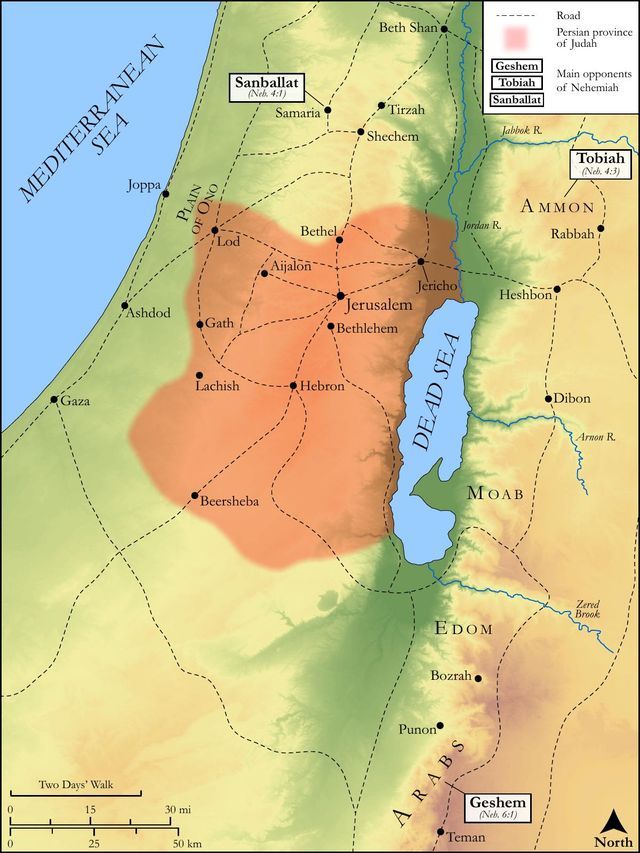
See on the biblical-era map
Study this verse
Public-domain commentary
Matthew Henry
From his Commentary on the Whole Bible. Henry comments on passages, not single verses — this entry covers Nehemiah 6:1–9. His two-level outline is real structure in the source text, so it is rendered as structure.
Two plots upon Nehemiah we have here an account of, how cunningly they were laid by his enemies and how happily frustrated by God's good providence and his prudence.
I.A plot to trepan him into a snare.
The enemies had an account of the good forwardness the work was in, that all the breaches of the wall were made up, so that they considered it as good as done, though at that time the doors of the gates were off the hinges (Neh 6:1); they must therefore now or never, by one bold stroke, take off Nehemiah. They heard how well guarded he was, so that there was no attacking him upon the spot; they will therefore try by all the arts of wheedling to get him among them. Observe,
1.With what hellish subtlety they courted him to meet them, not in any city, lest that should excite a suspicion that they intended to secure him, but in a village in the lot of Benjamin: "Come, let us meet together to consult about the common interests of our provinces." Or they would have him think that they coveted his friendship, and would be glad to be better acquainted with him, in order to a good understanding between them and the settling of a good correspondence. But they thought to do him a mischief. It is probable that he had some secret intelligence given him that they designed to imprison or murder him; or he knew them so well that, without breach of charity, he concluded they aimed at his life, and therefore, when they spoke fair, he believed them not.
2.See with what heavenly wisdom he declined the motion. His God did instruct him to give them that prudent answer by messengers of his own: "I am doing a great work, am very busy, and am loth to let the work stand still while I leave it to come down to you," Neh 6:3. His care was that the work might not cease; he knew it would if he left it ever so little; and why should it cease while I come down to you? He says nothing of his jealousies, nor reproaches them for their treacherous design, but gives them a good reason and one of the true reasons why he would not come. Compliment must always give way to business. Let those that are tempted to idle merry meetings by their vain companions thus answer the temptation, "We have work to do, and must not neglect it." Four times they attacked him with the same solicitation, and he as often returned the same answer, which, we may suppose, was very vexatious to them; for really it was the ceasing of the work that they aimed at, and it would make them despair of breaking the undertaking to see the undertaker so intent upon it. I answered them (says he) after the same manner, Neh 6:4. Note, We must never suffer ourselves to be overcome by the greatest importunity to do any thing sinful or imprudent; but, when we are attacked with the same temptation, must still resist it with the same reason and resolution.
II.A plot to terrify him from his work.
Could they but drive him off, the work would cease of course. This therefore Sanballat attempts, but in vain. 1. he endeavours to possess Nehemiah with an apprehension that his undertaking to build the walls of Jerusalem was generally represented as factious and seditious, and would be resented accordingly at court, Neh 6:5-7. The best men, even in their most innocent and excellent performances, have lain under this imputation. This is written to him in an open letter, as a thing generally known and talked of, that it was reported among the nations, and Gashmu will aver it for truth, that Nehemiah was aiming to make himself king and to shake off the Persian yoke. Note, It is common for that which is the sense only of the malicious to be falsely represented by them as the sense of the many. Now Sanballat pretends to inform Nehemiah of this as a friend, that he might hasten to court to clear himself, or stay his proceedings, for fear they should be thus misconstrued; at least, upon this surmise, he urges him to give him the meeting - "Let us take counsel together how to quell the report," hoping by this means either to take him off, or at least to take him off from his business. Thus were his words softer than oil, and yet war was in his heart, and he hoped, like Judas, to kiss and kill. But surely in vain is the net spread in the sight of any bird. Nehemiah was soon aware what they aimed at, to weaken their hands from the work (Neh 6:9), and therefore not only denied that such things were true, but that they were reported; he was better known than to be thus suspected. 2. Thus he escaped the snare and kept his ground, nor would he be frightened by winds and clouds from sowing and reaping. Suppose it was thus reported, we must never omit known duty merely for fear it should be misconstrued; but, while we keep a good conscience, let us trust God with our good name. But indeed it was not thus reported. God's people, though sufficiently loaded with reproach, yet are not really so low in reputation as some would have them thought to be.
In the midst of his complaint of their malice, in endeavouring to frighten him, and so weaken his hands, he lifts up his heart to Heaven in this short prayer: Now therefore, O God! strengthen my hands. It is the great support and relief of good people that in all their straits and difficulties they have a good God to go to, from whom, by faith and prayer, they may fetch in grace to silence their fears and strengthen their hands when their enemies are endeavouring to fill them with fears and weaken their hands. When, in our Christian work and warfare, we are entering upon any particular services or conflicts, this is a good prayer for us to put up: "I have such a duty to do, such a temptation to grapple with; now therefore, O God! strengthen my hands." Some read it, not as a prayer, but as a holy resolution (for O God is supplied in our translation): Now therefore I will strengthen my hands. Note, Christian fortitude will be sharpened by opposition. Every temptation to draw us from duty should quicken us so much the more to duty.
Historical interpretation
Historical reception
1 surviving comment on this verse from the historical church.
But all these terrify us, etc. Therefore, in the spiritual structure, because the cunning enemy always tries to hinder our hands, let us always strive to strengthen them in good action with divine help.
Continue studying Nehemiah 6:9 across the web’s major study libraries — every link below opens this exact verse, chapter, or book on the destination site.
Read & Compare
 BibleGatewayThis verse in more than 200 translations and 70 languages.
 Bible.comThe YouVersion reader — hundreds of translations, reading plans, and highlights.
 ESV.orgCrossway's official English Standard Version reader.
 NET BibleThe NET translation with 60,000+ translators' notes on every rendering decision.
 STEP BibleTyndale House's free study tool — original text, vocabulary, and scholarly resources.
 BibliaLogos Bible Software's free web reader.
 USCCBThe New American Bible (Revised Edition) with the U.S. bishops' study notes.
Commentaries
 BibleHub CommentariesDozens of classic commentaries on this verse, gathered on one page.
 StudyLightMore than 100 commentary sets — the largest collection on the web.
 BibleRefPlain-English commentary on what this verse means, verse by verse.
 Enduring WordDavid Guzik's free commentary on this chapter, widely used by Bible teachers.
 Bible Study ToolsVerse commentary alongside Greek and Hebrew study aids.
Original Language & Research
- BibleHub InterlinearThe verse word by word — original language, transliteration, and English.
- BibleHub LexiconEvery word's original-language definition and Strong's entry.
 Blue Letter BibleDeep-study tools — Strong's numbers, concordance, and word studies.
 SefariaThe Hebrew text with Rashi and centuries of Jewish commentary.
Sermons, Hymns & Audio


TrulyRandomVerse is not affiliated with these sites and doesn’t control their content. They’re linked because they’re genuinely useful.
Summary
Nehemiah 6:9 captures a pivotal moment in the arduous task of rebuilding Jerusalem's walls, highlighting the intensified psychological warfare employed by Nehemiah's adversaries. Their deliberate strategy was to sow fear and demoralization among the Jewish workers, aiming to weaken their resolve and ultimately halt the divinely ordained project. In response to this insidious opposition, Nehemiah, demonstrating exemplary faithful leadership, immediately turned to God in prayer, seeking supernatural strength to persevere and ensure the successful completion of the sacred task.
Context
ShowHideLiterary Context
Nehemiah 6 marks a significant escalation in the multifaceted opposition faced by Nehemiah and the returning exiles. Following earlier attempts at ridicule, armed conspiracy, and internal strife (as detailed in Nehemiah 4 and Nehemiah 5), Sanballat, Tobiah, and Geshem abandon overt threats in favor of cunning deception and psychological manipulation. This chapter meticulously details a series of treacherous plots: initial attempts to lure Nehemiah away from the safety of the wall for assassination (Nehemiah 6:1-4), followed by false accusations of rebellion against the Persian king, Artaxerxes (Nehemiah 6:5-7). The climax of their strategy involves hiring a false prophet, Shemaiah, to intimidate Nehemiah into seeking refuge in the Temple, an act that would have compromised his integrity and discredited the entire rebuilding effort (Nehemiah 6:10-14). Verse 9 specifically addresses the verbal assault and fear-mongering designed to "weaken their hands," a direct attack on the morale and resolve of the builders. Nehemiah's immediate and prayerful response is entirely characteristic of his leadership, mirroring his profound reliance on God evident from the very outset of his mission, as seen in his initial prayer of confession and petition in Nehemiah 1:4-11.
Historical & Cultural Context
The events chronicled in the book of Nehemiah are set in the post-exilic period, approximately the mid-5th century BC, during the reign of Artaxerxes I of Persia. The Jewish exiles had returned to a Jerusalem that lay in ruins, and the rebuilding of the city walls was far more than a mere construction project; it was a profound act of national and religious restoration. This endeavor symbolized security, identity, and the re-establishment of God's covenant people in their promised land. Such a resurgence was naturally perceived as a significant political and economic threat by neighboring peoples, including the Samaritans (led by Sanballat), Ammonites (Tobiah), and Arabs (Geshem), who had enjoyed regional dominance in Jerusalem's absence. The phrase "weaken their hands" was a widely understood and potent idiom in the ancient Near East, signifying demoralization, loss of resolve, or the inability to act effectively. Psychological tactics like these were incredibly powerful in a world where collective morale was paramount for sustaining large-scale communal projects, military campaigns, or any significant undertaking.
Key Themes
ShowHideNehemiah 6:9 powerfully contributes to several overarching themes woven throughout the book and the broader biblical narrative. Firstly, it vividly illustrates the theme of Perseverance Amidst Opposition, showcasing Nehemiah's unwavering commitment to the divinely appointed task despite relentless and increasingly sophisticated attacks. The verse underscores the truth that the work of God, though fiercely challenged, must and will continue. Secondly, the verse highlights Profound Reliance on God, as Nehemiah's immediate and instinctive response to intimidation is not to devise a human counter-strategy but to offer fervent prayer for divine strength. This exemplifies a deep faith and absolute dependence on God's power, a pervasive theme throughout Scripture, where those who wait on the Lord will renew their strength and find the ability to soar. Thirdly, the enemy's insidious aim to "weaken hands" points directly to the reality of Spiritual Warfare. The opposition was not merely against a physical wall but fundamentally against God's redemptive purposes for His people. The weakening of hands symbolizes a loss of resolve and capability, a common tactic in spiritual battles designed to discourage believers from their calling, echoing the nature of our struggle against spiritual forces as described in Ephesians 6:12. Lastly, Nehemiah's steadfast response serves as a compelling example of Leadership by Example, demonstrating how to confront fear and intimidation with unshakeable faith and prayer rather than succumbing to despair or retaliation.
Exposition and Analysis
ShowHideKey Word Analysis
ShowHideThis primitive root signifies to fear, be terrified, or to stand in awe. In this specific context, it describes the enemy's deliberate and active intent to instill dread, apprehension, and panic in the hearts of the builders. It is not merely a suggestion of potential harm, but a direct psychological assault designed to paralyze the workers through overwhelming fear.
This verb means to slacken, to sink, relax, abandon, or let drop. It vividly conveys a loss of firmness, resolve, or energy. The adversaries' goal was to cause the "hands" (representing effort, ability, and determination) to become slack, to lose their grip on the work, thereby leading to its complete cessation. It implies a profound loss of morale and the very will to continue.
This powerful primitive root means to be strong, firm, courageous, or to prevail. Its semantic range encompasses not only physical robustness but also mental, moral, and spiritual fortitude. Nehemiah's prayer directly counters the enemy's aim, asking God to instill the very strength, courage, and unwavering resolve that the adversaries sought to diminish, enabling perseverance in the face of overwhelming odds and insidious plots.
Verse Breakdown
ShowHide"For they all made us afraid, saying,"
This initial clause identifies the pervasive nature of the opposition ("they all") and their primary method: verbal intimidation and psychological warfare ("saying"). The fear experienced by the builders was a direct consequence of the hostile pronouncements and cunning schemes orchestrated by Nehemiah's adversaries, all meticulously designed to undermine confidence and sow panic.
"Their hands shall be weakened from the work, that it be not done."
This reveals the precise content and malicious intent of the enemy's message. "Hands" here functions as a powerful metonymy for the workers' collective effort, their practical ability, and their steadfast resolve. The desired outcome was unequivocally clear: for the builders to lose heart, abandon their tools, and consequently, for the vital work of rebuilding the wall to cease entirely, leaving Jerusalem vulnerable and the people demoralized.
"Now therefore, [O God], strengthen my hands."
This is Nehemiah's immediate, decisive, and faith-filled response, marked by profound spiritual insight. The phrase "Now therefore" acts as a direct, prayerful counter to the preceding threat. Instead of succumbing to fear, devising a purely human strategy, or retaliating, Nehemiah turns directly to God, requesting divine empowerment. His prayer is not for the enemy to be removed or for the circumstances to change, but for himself and, by extension, his people, to be supernaturally strengthened in their resolve and ability to complete the God-given task, demonstrating absolute dependence on divine power.
Literary Devices
ShowHideNehemiah 6:9 masterfully employs several literary devices to convey its profound message and underscore the spiritual battle at hand. The most prominent is Metonymy, where "hands" are used to represent the comprehensive effort, practical ability, and unwavering resolve of the workers. The enemy's desire to "weaken their hands" is not a literal physical weakening, but a psychological and spiritual assault aimed at demoralizing them to the point of abandoning the crucial work. This is powerfully contrasted by Nehemiah's prayer, "strengthen my hands," which is a heartfelt plea for renewed courage, perseverance, and divine enablement in the face of intense intimidation. The verse also features striking Juxtaposition, setting the enemy's malicious intent to instill fear and weakness against Nehemiah's immediate, faith-filled prayer for strength. This highlights the stark spiritual battle at play and the contrasting sources of power: human malice and deception versus divine enablement and faithfulness. Furthermore, Nehemiah's prayer itself is a form of Direct Address/Prayer, showcasing his intimate, personal, and immediate communion with God, a defining characteristic of his leadership throughout the entire book. The entire scenario serves as a vivid illustration of Psychological Warfare, where the enemy's primary weapon is not physical force but cunning words and schemes designed to undermine morale and sow despair, aiming to halt God's work without a single blow.
Theological and Thematic Connections
ShowHideNehemiah 6:9 powerfully illustrates the enduring biblical truth that God's work, though frequently met with fierce and cunning opposition, will ultimately be accomplished through the divine enablement of His faithful servants. Nehemiah's prayer for strength is not a plea for an easier path or the removal of adversaries, but rather a profound request for the fortitude and perseverance needed to continue in the face of relentless spiritual and psychological attacks. It underscores the fundamental principle that true strength for God's calling comes not from human might, cleverness, or strategic prowess, but from absolute and unwavering reliance on the Lord. This verse serves as a timeless reminder that when we are deeply engaged in God's purposes, and adversaries—whether external forces, internal doubts, or the subtle whispers of the enemy—seek to "weaken our hands" through fear, discouragement, or false accusations, our immediate and most potent response is to turn to the One who alone empowers. God delights in strengthening those who are weak in themselves but strong in Him, ensuring that His kingdom advances despite all obstacles and opposition.
Reflection and Application
ShowHideNehemiah 6:9 offers profound encouragement and a vital blueprint for believers navigating the multifaceted challenges of life and ministry today. We, too, often encounter "enemies" – whether they manifest as external opposition, internal doubts, overwhelming circumstances, or the subtle whispers of the adversary – that relentlessly seek to "weaken our hands" from the work God has called us to do. This weakening can manifest in various forms: debilitating discouragement, relentless criticism, spiritual burnout, the temptation to compromise, or the insidious urge to abandon a difficult but righteous path. Nehemiah's immediate and decisive response provides a crucial model: acknowledge the source and nature of the attack, recognize its ultimate aim to halt God's work, and immediately turn to God for supernatural strength. This isn't about mustering more human effort, grit, or willpower, but about humbly receiving divine empowerment that transcends our natural limitations and enables us to do what we cannot do in our own strength. When faced with the overwhelming nature of a God-given task or the insidious nature of opposition, remembering that our strength comes solely from God allows us to persevere with unwavering faith, knowing that He who began a good work in us will bring it to completion. Our prayer should always echo Nehemiah's: for strengthened hands and unwavering resolve, enabling us to remain faithful to our divine calling, even when fear, doubt, and weariness loom large.
Questions for Reflection
ShowHideFAQ
ShowHideWhat kind of "fear" were the enemies trying to instill, and why was it so dangerous?
ShowHideThe enemies were attempting to instill a deep, pervasive, and demoralizing fear that went far beyond mere physical threat. Their primary goal was psychological warfare: to cause the Jewish people to lose their resolve, their courage, and their will to continue the work of rebuilding the wall. This fear was particularly dangerous because it targeted the very spirit and morale of the builders, aiming to make their "hands" (representing their effort, ability, and determination) "weakened" or slack. If successful, this insidious tactic would have led to the abandonment of the wall-building project, effectively halting God's redemptive work in Jerusalem and undermining the restoration of His people. It was a subtle but profoundly potent attack on morale, arguably more insidious and effective than direct physical assault, as it sought to defeat them from within.
Why did Nehemiah pray for "strengthen my hands" specifically, rather than for the enemies to be removed?
ShowHideNehemiah's prayer for "strengthen my hands" was a direct, precise, and spiritually astute counter to the enemy's specific tactic. The adversaries sought to "weaken their hands," meaning to cause them to lose their grip, their resolve, and their ability to work effectively. By praying "strengthen my hands," Nehemiah was asking God for divine enablement precisely where the enemy sought to disable. This wasn't a prayer for the removal of the problem or the immediate vanquishing of his foes, but for the empowerment to overcome the opposition from within, through renewed divine fortitude. It demonstrated his profound understanding that true strength for God's work comes from God alone, and that perseverance in the face of opposition is a spiritual battle requiring spiritual strength. His focus remained steadfast on completing the task God had given him, rather than being sidetracked by retaliating against his opponents or seeking their demise. This prayer exemplifies a mature faith that seeks God's power to endure and fulfill His purpose, rather than merely wishing for easier circumstances.
Christ-Centered Fulfillment
ShowHideNehemiah's earnest prayer for strengthened hands in the face of overwhelming opposition finds its ultimate fulfillment and deepest redemptive meaning in the person and work of Jesus Christ. While Nehemiah was called to build physical walls for the restoration and security of a nation, Christ came to build His church, a spiritual temple against which the "gates of hell shall not prevail" (Matthew 16:18). Jesus Himself faced relentless and multifaceted opposition throughout His earthly ministry—from the temptations of Satan in the wilderness (Matthew 4:1-11), the constant scrutiny and hostility of the religious establishment, and ultimately, the agonizing suffering and death on the cross. Yet, He never allowed His "hands" to be weakened; instead, He resolutely "set His face to go to Jerusalem" (Luke 9:51), fully empowered by the Father to complete the ultimate redemptive work of salvation. Furthermore, Christ, through the indwelling power of the Holy Spirit, empowers His followers to continue His work in the world. Just as Nehemiah needed divine strength to build the physical walls, believers today are called to build up the body of Christ and advance His kingdom, often encountering discouragement, spiritual attacks, and the world's opposition. The same God who supernaturally strengthened Nehemiah's hands now strengthens ours, enabling us to do "even greater works" through the power of the Spirit who dwells within us (John 14:12). We are commissioned to be His witnesses "to the ends of the earth" (Acts 1:8), and He faithfully promises to complete the good work He began in us until the day of Christ Jesus (Philippians 1:6). Thus, Nehemiah 6:9 points forward to Christ as the inexhaustible source of all spiritual strength, enabling His people to persevere in their God-given tasks until His kingdom fully comes and His will is perfectly accomplished.