


Nehemiah 6:10
Bible text: King James Version (1769 Blayney text) · Public domain
Bible text: King James Version with Strong's numbers · Public domain
Bible text: Berean Standard Bible · Public domain
Bible text: American Standard Version (1901) · Public domain
Bible text: World English Bible, Messianic edition · Public domain
Bible text: Geneva Bible (1599) · Public domain
Bible text: Young's Literal Translation · Public domain
- וַאֲנִיva·'a·niand IH589Conj-w ¦ Pro-1csPronoun Personal 1st Singular common genderוַandאֲנִיI
- בָאתִיVa·tiI wentH935V-Qal-Perf-1csVerb Qal Perfect 1st Singular common gender
- בֵּיתbeit[the] house ofH1004N-mscNoun Singular Masculine Construct
- שְׁמַעְיָהshe·ma'·YahShemaiahH8098N-proper-mNoun Proper Masculine
- בֶןven[the] son ofH1121N-mscNoun Singular Masculine Construct
- דְּלָיָהde·la·YahDelaiahH1806N-proper-mNoun Proper Masculine
- בֶּןben[the] son ofH1121N-mscNoun Singular Masculine Construct
- מְהֵיטַבְאֵלme·hei·tav·'ElMehetabelH4105N-proper-mNoun Proper Masculine
- וְהוּאve·Hu'and heH1931Conj-w ¦ Pro-3msPronoun Personal 3rd Singular Masculineוְandהוּאhe
- עָצוּר'a·Tzur[was] shut upH6113V-Qal-PassPrtcpl-msVerb Qal Participle Passive Singular Masculine Absolute
- וַיֹּאמֶרvai·Yo·merand he saidH559Conj-w ¦ V-Qal-ConsecImperf-3msVerb Qal Consecutive Imperfect 3rd Singular Masculineוַandיֹּאמֶרhe said
- נִוָּעֵדni·va·'Edlet us meetH3259V-Niphal-Imperf-1cpVerb Niphal Imperfect 1st Plural common gender
- אֶל'eltoH413PrepPreposition
- בֵּיתbeit[the] house ofH1004N-mscNoun Singular Masculine Construct
- הָאֱלֹהִיםha·'E·lo·Him<the> GodH430Art ¦ N-mpNoun Plural Masculine Absoluteהָ<the>אֱלֹהִיםGod
- אֶל'eltoH413PrepPreposition
- תּוֹךְTokh[the] middle ofH8432N-mscNoun Singular Masculine Construct
- הַהֵיכָלha·hei·Khalthe templeH1964Art ¦ N-msNoun Singular Masculine Absoluteהַtheהֵיכָלtemple
- וְנִסְגְּרָהve·nis·ge·Rahand let us closeH5462Conj-w ¦ V-Qal-Imperf-1cpVerb Qal Imperfect 1st Plural common genderוְandנִסְגְּרָהlet us close
- דַּלְתוֹתdal·Tot[the] doors ofH1817N-fpcNoun Plural Feminine Construct
- הַהֵיכָלha·hei·Khalthe templeH1964Art ¦ N-msNoun Singular Masculine Absoluteהַtheהֵיכָלtemple
- כִּיkiforH3588PrtParticle Conditional
- בָּאִיםba·'Im[people are] comingH935V-Qal-Prtcpl-mpVerb Qal Participle Plural Masculine Absolute
- לְהָרְגֶךָle·ha·re·Ge·khato kill youH2026Prep-l ¦ V-Qal-Inf ¦ 2msVerb Qal Infinitive Constructלְtoהָרְגֶkillךָyou
- וְלַיְלָהve·Lay·lahand nightH3915Conj-w ¦ N-msNoun Singular Masculine Absoluteוְandלַיְלָהnight
- בָּאִיםba·'Im[people are] comingH935V-Qal-Prtcpl-mpVerb Qal Participle Plural Masculine Absolute
- לְהָרְגֶךָle·ha·re·Ge·khato kill youH2026Prep-l ¦ V-Qal-Inf ¦ 2msVerb Qal Infinitive Constructלְtoהָרְגֶkillךָyou
English is a literal word-by-word gloss of the Hebrew, not the KJV's wording. Why?
This is the original text the KJV's translators worked from — each Hebrew word with its own literal English meaning in this verse, prepared by scholars at Tyndale House, Cambridge. The KJV translates whole sentences, not word by word, so its wording differs: one Hebrew word can become several English words, and the KJV may choose “the LORD” where the gloss reads “Yahweh”. Both are faithful — they answer different questions. For the KJV's own rendering, switch to the KJV text.
Details
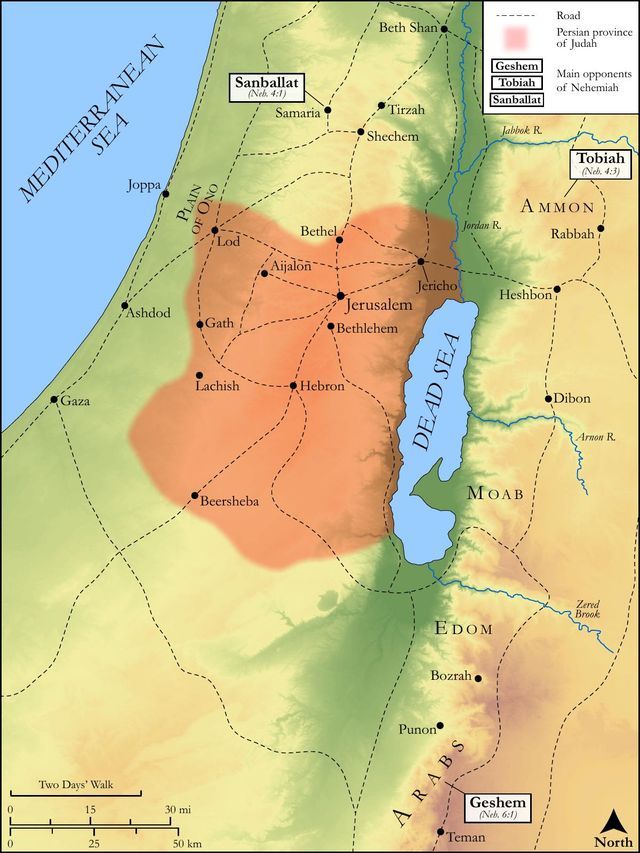
See on the biblical-era map
Study this verse
Public-domain commentary
Matthew Henry
From his Commentary on the Whole Bible. Henry comments on passages, not single verses — this entry covers Nehemiah 6:10–14. His three-level outline is real structure in the source text, so it is rendered as structure.
The Jews' enemies leave no stone unturned, no way untried, to take Nehemiah off from building the wall about Jerusalem. In order to this they had tried to fetch him into the country to them, but in vain; now they try to drive him into the temple for his own safety; let him be any where but at his work. Observing him to be a cautious man, they will endeavour to gain their point by making him cowardly. Observe,
I.How basely the enemies managed this temptation.
1.That which they designed was to bring Nehemiah to do a foolish thing, that they might laugh at him, and insult over him for doing it, and so lessen his interest and influence (Neh 6:13): That I should be afraid, and so they might have matter for an evil report, and might reproach me. This was indeed doing the devil's work, who is men's tempter that he may be their accuser, draws men to sin that he may glory in their shame. The greatest mischief our enemies can do us is to frighten us from our duty and bring us to do what is sinful.
2.The tools they made use of were a pretended prophet and prophetess, whom they hired to persuade Nehemiah to quit his work and retire for his own safety. The pretended prophet was Shemaiah, of whom it is said that he was shut up in his own house, either under pretence of retirement for meditation and to consult the mind of God or to give Nehemiah a sign in like manner to make himself a recluse. It should seem, Nehemiah had a value for him, for he went to his house to consult him, Neh 6:10. Other prophets there were, and one prophetess, Noadiah (Neh 6:14), that were in the interest of the Jews' enemies, pensioners to them and traitors to their country. Whether they pretended to inspiration does not appear; they do not say, Thus saith the Lord, as the false prophets of old did; if not so, yet they would be thought to excel in divine knowledge, and human prudence, and to have uncommon measures of insight and foresight, and were therefore consulted in difficult cases, as prophets had been. These the enemies feed to be of counsel for them. Let us hence take occasion to lament,
(1.)The wickedness of such bad men as these prophets, that ever any should be so perfidious as to betray the cause of God and their country even under the pretence of communion with God and concern for their country.
(2.)The unhappiness of such good men as Nehemiah, who are in danger of being imposed upon by such cheats, and to whom no temptation comes with more force than that which comes under a colour of religion, of revelation and devotion, and is brought by the hand of prophets.
3.The pretence was plausible. These prophets suggested to Nehemiah that the enemies would come and slay him, in the night they would slay him, which he had reason enough to believe was true; they would, if they could, if they durst. They pretended to be much concerned for his safety. The people would be all undone if any harm should come to him; and therefore they very gravely advised him to hide himself in the temple till the danger was over; that was a strong and sacred place, where he would be under the special protection of Heaven, Psa 27:5. If Nehemiah had been prevailed upon to do this, immediately the people would both have left off their work and thrown down their arms, and every one would have shifted for his own safety; and then the enemies might easily, and without opposition, have demolished the works, broken down the wall again, and so gained their point. Though self-preservation is a fundamental principle of the law of nature, yet that is not always the best and wisest counsel which pretends to go upon that principle.
II.See how bravely Nehemiah vanquished this temptation, and came off a conqueror.
1.He immediately resolved not to yield to it, Neh 6:11. See here,
(1.)What his reasonings are: "Should such a man as I flee? Shall I desert God's work, or discourage my own workmen whom I have employed and encouraged? Shall I be over-credulous of report, and over-solicitous about my own life? I that am the governor, on whom so many eyes are, both of friends and foes? Another might flee, but not I. Who is there that being as I am, in my post of honour, and power, and trust, would go into the temple, and lurk there, when business is to be done, yea, though it were to save his life?" Note, When we are tempted to sin we should remember who and what we are, that we may not do any thing unbecoming us, and the profession we make. It is not for kings, O Lemuel! Pro 31:4.
(2.)What was the result of his reasonings. He is at a point: "I will not go in. I will rather die at my work than live in an inglorious retreat from it." Note, Holy courage and magnanimity will engage us, whatever it cost us, never to decline a good work, nor ever to do a bad one.
2.He was immediately aware of what was the rise of it (Neh 6:12): "I perceived that God had not sent him, that he gave this advice, not by any divine direction, ordinary or extraordinary, but with a design against me." The wickedness of such mercenary wretches will sooner or later be brought to light. Two things Nehemiah says he dreaded in that which he was advised to: - (1.) Offending God: That I should be afraid, and do so, and sin. Note, Sin is that which above any thing we should dread; and a good preservative it is against sin to be afraid of nothing but sin. (2.) Shaming himself: That they might reproach me. Note, Next to the sinfulness of sin we should dread the scandalousness of it.
3.He humbly begs of God to reckon with them for their base designs upon him (Neh 6:14): My God, think thou upon Tobiah, and the rest of them, according to their works. As, when he had mentioned his own good services, he did not covetously or ambitiously prescribe to God what reward he should give him, but modestly prayed, Think upon me, my God (Neh 5:19), so here he does not revengefully imprecate any particular judgment upon his enemies, but refers the matter to God. "Thou knowest their hearts, and art the avenger of falsehood and wrong; take cognizance of this cause; judge between me and them, and take what way and time thou mayest please to call them to an account for it." Note, Whatever injuries are done us we must not avenge ourselves, but commit our cause to him that judgeth righteously.
Historical interpretation
Historical reception
1 surviving comment on this verse from the historical church.
And I entered the house of Shemaiah, etc. Assaulted by the treacheries of enemies, Nehemiah entered the house of Shemaiah as though of a friend and brother; but he also found him to be a traitor and enemy, since he had been corrupted by the gifts and friendship of outsiders; for the chosen always have battles without, fears within; not only apostles, but also prophets, lived lives beset by dangers from their kind, dangers from their demands, dangers from false brothers.
Continue studying Nehemiah 6:10 across the web’s major study libraries — every link below opens this exact verse, chapter, or book on the destination site.
Read & Compare
 BibleGatewayThis verse in more than 200 translations and 70 languages.
 Bible.comThe YouVersion reader — hundreds of translations, reading plans, and highlights.
 ESV.orgCrossway's official English Standard Version reader.
 NET BibleThe NET translation with 60,000+ translators' notes on every rendering decision.
 STEP BibleTyndale House's free study tool — original text, vocabulary, and scholarly resources.
 BibliaLogos Bible Software's free web reader.
 USCCBThe New American Bible (Revised Edition) with the U.S. bishops' study notes.
Commentaries
 BibleHub CommentariesDozens of classic commentaries on this verse, gathered on one page.
 StudyLightMore than 100 commentary sets — the largest collection on the web.
 BibleRefPlain-English commentary on what this verse means, verse by verse.
 Enduring WordDavid Guzik's free commentary on this chapter, widely used by Bible teachers.
 Bible Study ToolsVerse commentary alongside Greek and Hebrew study aids.
Original Language & Research
- BibleHub InterlinearThe verse word by word — original language, transliteration, and English.
- BibleHub LexiconEvery word's original-language definition and Strong's entry.
 Blue Letter BibleDeep-study tools — Strong's numbers, concordance, and word studies.
 SefariaThe Hebrew text with Rashi and centuries of Jewish commentary.
Sermons, Hymns & Audio


TrulyRandomVerse is not affiliated with these sites and doesn’t control their content. They’re linked because they’re genuinely useful.
Summary
Nehemiah 6:10 recounts a critical moment when Nehemiah, nearing the completion of Jerusalem's walls, confronts a deceptive plot orchestrated by his adversaries, Sanballat and Tobiah. Through Shemaiah, a supposed prophet feigning confinement, Nehemiah is urged to seek refuge within the sacred confines of the Temple, specifically the Holy Place, under the pretext of an imminent assassination attempt. This cunning scheme aimed to compromise Nehemiah's spiritual integrity, induce fear, and publicly discredit his leadership by compelling him to violate Mosaic law and appear cowardly, thereby undermining the monumental work of restoration.
Context
ShowHideLiterary Context
Nehemiah 6:10 is strategically placed at the climax of the opposition Nehemiah faces, just as the walls of Jerusalem are on the verge of completion. Chapters 4-6 meticulously document the escalating tactics employed by Sanballat, Tobiah, and Geshem. Their initial attempts involved ridicule and scorn, as seen in Nehemiah 4:1-3, followed by overt threats of armed intervention to halt the construction, detailed in Nehemiah 4:7-8. When these external pressures failed, they resorted to repeated invitations to meet in the plain of Ono, shrewdly recognized and refused by Nehemiah as a trap, as recorded in Nehemiah 6:1-4. Having exhausted external means, their strategy shifts to internal subversion and psychological warfare. The false prophecy of Shemaiah, immediately followed by the intimidation attempts of Noadiah and other prophets mentioned in Nehemiah 6:14, represents a desperate, final effort to discredit Nehemiah and sabotage the work before its triumphant dedication.
Historical & Cultural Context
The period following the Babylonian exile was a time of profound national and spiritual reconstruction for the returning Jewish community. The rebuilding of Jerusalem's walls was far more than a civil engineering project; it was a potent symbol of the restoration of God's covenant people, their security, and their distinct identity in a hostile world. Prophets held a revered, though sometimes misused, position in ancient Israel, acting as conduits for divine revelation. However, the biblical record, notably in Jeremiah 23:16, frequently warns against false prophets who spoke from their own imaginations or for personal gain. Crucially, the Temple in Jerusalem was the sacred epicenter of Jewish worship, governed by stringent laws regarding access. Only priests were permitted to enter the Holy Place (heikhal), the inner sanctuary where Shemaiah proposed to meet. For Nehemiah, a governor and a layman, to enter this hallowed space would constitute a grave violation of Mosaic law, specifically concerning the sanctity of the priesthood and the Temple's sacred boundaries, as outlined in Numbers 18:7. Such an act would not only be a sin against God but also a public display of fear and disrespect for divine ordinances, severely damaging his credibility and authority among the people and providing his adversaries with a potent accusation of impiety.
Key Themes
ShowHideNehemiah 6:10 vividly illustrates several foundational themes within the book of Nehemiah and the broader biblical narrative. The theme of Deception and Treachery is paramount, as Shemaiah's "prophecy" is a calculated lie, designed to exploit Nehemiah's commitment to the work and his natural concern for his life. This highlights the insidious nature of spiritual warfare, where enemies often employ seemingly legitimate or even "spiritual" means to undermine faith and integrity. The stark contrast between Fear vs. Faith is central; Shemaiah's message is engineered to induce paralyzing fear, prompting Nehemiah to abandon his trust in God's protection for a humanly devised, yet unlawful, escape. Nehemiah's steadfast refusal exemplifies unwavering Integrity of Leadership, demonstrating that true leaders prioritize unwavering obedience to God's commands over personal safety or popular approval, thereby setting a crucial example for their followers. Finally, the underlying theme of Divine Protection is subtly woven throughout, as Nehemiah's ultimate reliance on God, rather than human schemes, underscores the profound conviction that God is the ultimate refuge for His servants, even amidst dire threats, echoing the sentiment found in Psalm 46:1.
Exposition and Analysis
ShowHideKey Word Analysis
ShowHideDerived from the primitive root H6113 (ʻâtsâr), meaning "to inclose; by analogy, to hold back; also to maintain, rule, assemble." In this context, it describes Shemaiah's state of seclusion. This detail is crucial for the deception, as his confinement would lend an air of urgency and divine authenticity to his message, suggesting he was receiving a direct, unadulterated revelation from God, making his warning more compelling and difficult to dismiss. It implies a staged isolation, perhaps feigning ritual impurity or a prophetic trance.
From H1964 (hêykâl), meaning "a large public building, such as a palace or temple." This word specifically refers to the main sanctuary of the Temple, the Holy Place. This detail is critically important because it clarifies the gravity of Shemaiah's proposition: he was not suggesting a meeting in a general courtyard, but in the inner sanctum accessible only to priests. For Nehemiah, a layman, to enter this area would be a severe transgression of divine law.
From H2026 (hârag), a primitive root meaning "to smite with deadly intent; destroy, kill, murder, put to (death), make (slaughter), slay." The repetition of this verb ("they will come to slay thee; yea, in the night will they come to slay thee") serves to intensify the perceived threat and instill maximum fear. It emphasizes the urgency and immediacy of the danger, designed to panic Nehemiah into a rash, compromising decision. The Hebrew conveys a direct and brutal intent, leaving no room for misinterpretation of the proposed peril.
Verse Breakdown
ShowHide"Afterward I came unto the house of Shemaiah the son of Delaiah the son of Mehetabeel, who [was] shut up;"
This clause sets the scene, identifying Shemaiah by his lineage, which might have lent him a degree of credibility or made him a recognizable figure. The detail that he "was shut up" immediately raises a red flag, hinting at a contrived situation. Nehemiah's visit suggests he was seeking counsel or information, perhaps expecting a genuine prophetic word, highlighting his openness to divine guidance.
"and he said, Let us meet together in the house of God, within the temple, and let us shut the doors of the temple:"
This is the core of Shemaiah's insidious proposal. He suggests a clandestine meeting in the most sacred part of the Temple, the Holy Place, emphasizing the need to "shut the doors" for secrecy and protection. This proposition is crafted to appear as an urgent, life-saving measure, yet it conceals a profound trap: compelling Nehemiah to violate divine law by entering an area forbidden to laypersons.
"for they will come to slay thee; yea, in the night will they come to slay thee."
This final clause provides the fear-mongering justification for Shemaiah's urgent advice. The repeated warning of imminent, nocturnal assassination is a psychological tactic designed to induce panic. The specificity of "in the night" adds to the sense of immediate danger and vulnerability, pressuring Nehemiah to act quickly and without careful deliberation, hoping to override his better judgment and spiritual discernment.
Literary Devices
ShowHideNehemiah 6:10 is rich with literary devices that underscore its theological message. Irony is profoundly present, as Shemaiah, presented as a prophet and seemingly concerned for Nehemiah's life, is in fact a deceiver, using the guise of divine revelation to serve the enemies of God's work. The very place he suggests for refuge, the Temple, would have been the site of Nehemiah's spiritual downfall had he complied. There is a strong element of Foreshadowing, as the intense threat of death here anticipates Nehemiah's later prayer for God to remember the wicked deeds of his enemies and the false prophets, including Shemaiah and Noadiah, in Nehemiah 6:14. Contrast is evident between Shemaiah's fear-inducing counsel and Nehemiah's unwavering courage and spiritual discernment, highlighting the stark difference between human schemes driven by fear and divine wisdom rooted in faith. Finally, the repeated phrase "slay thee" functions as Hyperbole, exaggerating the immediate danger to create a sense of overwhelming panic and urgency, designed to compromise Nehemiah's judgment and lead him into a sinful act.
Theological and Thematic Connections
ShowHideNehemiah 6:10 stands as a powerful testament to the spiritual warfare inherent in God's redemptive work and the indispensable need for unwavering discernment and integrity among His people. It vividly illustrates that opposition to God's kingdom often arises not only from overt external threats but also from insidious internal subversion, frequently disguised as spiritual counsel or well-meaning advice. The passage profoundly underscores the critical importance of evaluating all counsel, even from those claiming spiritual authority, against the clear revelation of God's Word and the timeless principles of righteous living. Nehemiah's resolute refusal to compromise his integrity, even when faced with a perceived direct threat to his life, highlights that true security and lasting peace are found in steadfast obedience to God, not in human schemes or violations of divine law. This episode resonates deeply with broader biblical themes of resisting temptation, discerning between true and false prophets, and trusting implicitly in God's sovereign protection amidst severe adversity.
Reflection and Application
ShowHideThe account of Shemaiah's deception in Nehemiah 6:10 offers profound and enduring lessons for believers navigating a world replete with conflicting voices and relentless pressures. We are constantly confronted with situations designed to instill fear, compromise our core values, or tempt us to take shortcuts that violate God's established principles. Like Nehemiah, we are called to cultivate profound spiritual discernment, carefully weighing all advice—even from seemingly trusted or "spiritual" sources—against the unchanging truth of God's Word and the guiding wisdom of the Holy Spirit. True courage, as exemplified by Nehemiah, is not the absence of fear, but the unwavering resolve to obey God despite it, understanding that our integrity, witness, and faithfulness are infinitely more valuable than temporal safety or personal gain. This passage challenges us to honestly consider what compromises we might be tempted to make when under intense pressure and powerfully reminds us that our ultimate refuge and security are found in steadfast, unwavering obedience to God, who remains eternally faithful to protect and uphold those who walk in His ways.
Questions for Reflection
ShowHideFAQ
ShowHideWhy was Shemaiah "shut up," and what was the significance of this for his deceptive plot?
ShowHideThe KJV text states Shemaiah "was shut up," which implies a state of confinement or seclusion. While it could genuinely refer to ritual impurity, illness, or even house arrest, in the context of the plot, it is most likely that Shemaiah was feigning this seclusion. Being "shut up" would lend an air of urgency and divine authenticity to his "prophecy." It would suggest he was isolated to receive a direct, urgent, and unadulterated divine revelation, making his warning seem more legitimate and pressing. This isolation was a deliberate tactic to create an atmosphere of immediate danger and authenticity around his false message, making it harder for Nehemiah to question its source or intent, thereby pressuring him into a rash decision.
Why was it a sin for Nehemiah, a layman, to enter the Temple's inner sanctuary (the Holy Place)?
ShowHideAccording to Mosaic Law, only priests were permitted to enter the Holy Place (heikhal), the main sanctuary of the Temple, where Shemaiah proposed they meet. Laypersons, even a governor like Nehemiah, were strictly forbidden from entering this sacred area. To do so would be a direct violation of God's commands regarding the sanctity of the Temple and the distinct roles of the priesthood, as explicitly detailed in Numbers 18:7. Such an act would not only be a sin against God but also a public display of disrespect for divine ordinances, undermining Nehemiah's authority, discrediting him in the eyes of the people, and providing his enemies with a legitimate accusation of impiety and fear.
How did Nehemiah discern that Shemaiah was a false prophet and that his advice was a trap?
ShowHideNehemiah's remarkable discernment was rooted in several key factors. First, Shemaiah's advice directly contradicted God's established law regarding Temple access for laypersons. Nehemiah, being deeply familiar with the Torah, knew that a true prophet of God would never counsel a violation of God's own commands. Second, Nehemiah recognized the fear-mongering nature of the message—it was designed to make him act out of panic and self-preservation, not out of faith or obedience. Third, Nehemiah was a man of consistent prayer and deep spiritual insight, habitually seeking God's will. He understood that fleeing into the Temple out of fear would be an act of cowardice, a betrayal of his leadership, and a sign of distrust in God's protection, thereby bringing shame upon himself and the work. He explicitly states in Nehemiah 6:12, "And, lo, I perceived that God had not sent him; but that he pronounced this prophecy against me: for Tobiah and Sanballat had hired him." This indicates a divine revelation of Shemaiah's true motives, confirming Nehemiah's spiritual intuition.
Christ-Centered Fulfillment
ShowHideNehemiah's steadfast refusal to compromise his integrity and his unwavering reliance on God's protection in the face of deceptive threats powerfully foreshadow the perfect example of Jesus Christ. Just as Nehemiah was tempted to flee into the Temple out of fear, Jesus faced similar temptations to abandon His divine mission for personal safety or worldly glory. In the wilderness, Satan audaciously tempted Jesus to throw Himself down from the Temple pinnacle, promising divine protection if He did so (Matthew 4:5-7), a subtle attempt to make Him act presumptuously and compromise His perfect trust in the Father. Jesus, the ultimate Son of God, consistently refused to compromise His Father's will, even when facing the ultimate threat of death on the cross. He did not seek refuge in a physical temple, for He Himself is the true Temple, the very dwelling place of God among humanity, as He declared in John 2:19-21. Unlike Shemaiah's false promise of safety, Jesus offers genuine refuge and eternal security to all who trust in Him, having conquered sin, death, and the insidious schemes of the enemy through His obedient sacrifice (Hebrews 2:14-15). Nehemiah's integrity, though commendable, points to the sinless perfection of Christ, who, though tempted in every way, never sinned (Hebrews 4:15), thereby providing the ultimate example and the only true means of salvation and spiritual security for all humanity.