


Nehemiah 6:11
Bible text: King James Version (1769 Blayney text) · Public domain
Bible text: Berean Standard Bible · Public domain
Bible text: American Standard Version (1901) · Public domain
Bible text: World English Bible, Messianic edition · Public domain
Bible text: Geneva Bible (1599) · Public domain
Bible text: Young's Literal Translation · Public domain
- וָאֹמְרָהva·'o·me·Rahand I said !H559Conj-w ¦ V-Qal-ConsecImperf-1cs ¦ SfxVerb Qal Consecutive Imperfect 1st Singular common genderוָandאֹמְרָI saidה!
- הַאִישׁha·'Ish¿ a manH376Interrog ¦ N-msNoun Singular Masculine Absoluteהַ¿אִישׁa man
- כָּמוֹנִיka·Mo·nilike meH3644Prep ¦ 1csPrepositionכָּמוֹlikeנִיme
- יִבְרָחyiv·Rachwill he fleeH1272V-Qal-Imperf-3msVerb Qal Imperfect 3rd Singular Masculine
- וּמִיu·Miand who?H4310Conj-w ¦ InterrogPronoun Interrogativeוּandמִיwho?
- כָמוֹנִיkha·Mo·ni[is] like meH3644Prep ¦ 1csPrepositionכָמוֹ[is] likeנִיme
- אֲשֶׁר'a·SherwhoH834RelParticle Relative
- יָבוֹאya·Vo'he will goH935V-Qal-Imperf-3msVerb Qal Imperfect 3rd Singular Masculine
- אֶל'elintoH413PrepPreposition
- הַהֵיכָלha·hei·Khalthe templeH1964Art ¦ N-msNoun Singular Masculine Absoluteהַtheהֵיכָלtemple
- וָחָיva·Chaiand he will liveH2421Conj-w ¦ V-Qal-ConsecPerf-3msVerb Qal Consecutive Perfect 3rd Singular Masculineוָandחָיhe will live
- לֹאlo'notH3808NegParticle Negative
- אָבוֹא'a·Vo'I will goH935V-Qal-Imperf-1csVerb Qal Imperfect 1st Singular common gender
English is a literal word-by-word gloss of the Hebrew, not the KJV's wording. Why?
This is the original text the KJV's translators worked from — each Hebrew word with its own literal English meaning in this verse, prepared by scholars at Tyndale House, Cambridge. The KJV translates whole sentences, not word by word, so its wording differs: one Hebrew word can become several English words, and the KJV may choose “the LORD” where the gloss reads “Yahweh”. Both are faithful — they answer different questions. For the KJV's own rendering, switch to the KJV text.
Details
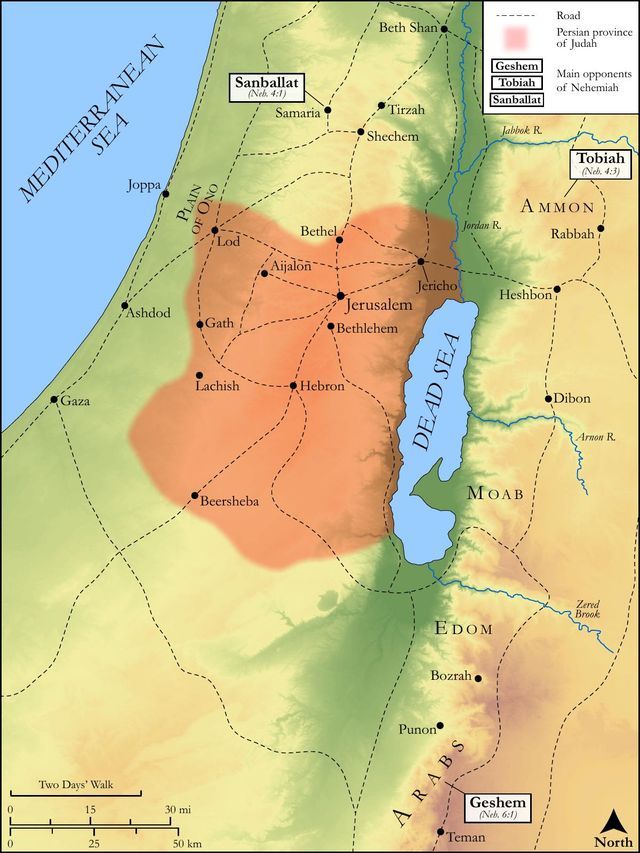
See on the biblical-era map
Study this verse
Public-domain commentary
Matthew Henry
From his Commentary on the Whole Bible. Henry comments on passages, not single verses — this entry covers Nehemiah 6:10–14. His three-level outline is real structure in the source text, so it is rendered as structure.
The Jews' enemies leave no stone unturned, no way untried, to take Nehemiah off from building the wall about Jerusalem. In order to this they had tried to fetch him into the country to them, but in vain; now they try to drive him into the temple for his own safety; let him be any where but at his work. Observing him to be a cautious man, they will endeavour to gain their point by making him cowardly. Observe,
I.How basely the enemies managed this temptation.
1.That which they designed was to bring Nehemiah to do a foolish thing, that they might laugh at him, and insult over him for doing it, and so lessen his interest and influence (Neh 6:13): That I should be afraid, and so they might have matter for an evil report, and might reproach me. This was indeed doing the devil's work, who is men's tempter that he may be their accuser, draws men to sin that he may glory in their shame. The greatest mischief our enemies can do us is to frighten us from our duty and bring us to do what is sinful.
2.The tools they made use of were a pretended prophet and prophetess, whom they hired to persuade Nehemiah to quit his work and retire for his own safety. The pretended prophet was Shemaiah, of whom it is said that he was shut up in his own house, either under pretence of retirement for meditation and to consult the mind of God or to give Nehemiah a sign in like manner to make himself a recluse. It should seem, Nehemiah had a value for him, for he went to his house to consult him, Neh 6:10. Other prophets there were, and one prophetess, Noadiah (Neh 6:14), that were in the interest of the Jews' enemies, pensioners to them and traitors to their country. Whether they pretended to inspiration does not appear; they do not say, Thus saith the Lord, as the false prophets of old did; if not so, yet they would be thought to excel in divine knowledge, and human prudence, and to have uncommon measures of insight and foresight, and were therefore consulted in difficult cases, as prophets had been. These the enemies feed to be of counsel for them. Let us hence take occasion to lament,
(1.)The wickedness of such bad men as these prophets, that ever any should be so perfidious as to betray the cause of God and their country even under the pretence of communion with God and concern for their country.
(2.)The unhappiness of such good men as Nehemiah, who are in danger of being imposed upon by such cheats, and to whom no temptation comes with more force than that which comes under a colour of religion, of revelation and devotion, and is brought by the hand of prophets.
3.The pretence was plausible. These prophets suggested to Nehemiah that the enemies would come and slay him, in the night they would slay him, which he had reason enough to believe was true; they would, if they could, if they durst. They pretended to be much concerned for his safety. The people would be all undone if any harm should come to him; and therefore they very gravely advised him to hide himself in the temple till the danger was over; that was a strong and sacred place, where he would be under the special protection of Heaven, Psa 27:5. If Nehemiah had been prevailed upon to do this, immediately the people would both have left off their work and thrown down their arms, and every one would have shifted for his own safety; and then the enemies might easily, and without opposition, have demolished the works, broken down the wall again, and so gained their point. Though self-preservation is a fundamental principle of the law of nature, yet that is not always the best and wisest counsel which pretends to go upon that principle.
II.See how bravely Nehemiah vanquished this temptation, and came off a conqueror.
1.He immediately resolved not to yield to it, Neh 6:11. See here,
(1.)What his reasonings are: "Should such a man as I flee? Shall I desert God's work, or discourage my own workmen whom I have employed and encouraged? Shall I be over-credulous of report, and over-solicitous about my own life? I that am the governor, on whom so many eyes are, both of friends and foes? Another might flee, but not I. Who is there that being as I am, in my post of honour, and power, and trust, would go into the temple, and lurk there, when business is to be done, yea, though it were to save his life?" Note, When we are tempted to sin we should remember who and what we are, that we may not do any thing unbecoming us, and the profession we make. It is not for kings, O Lemuel! Pro 31:4.
(2.)What was the result of his reasonings. He is at a point: "I will not go in. I will rather die at my work than live in an inglorious retreat from it." Note, Holy courage and magnanimity will engage us, whatever it cost us, never to decline a good work, nor ever to do a bad one.
2.He was immediately aware of what was the rise of it (Neh 6:12): "I perceived that God had not sent him, that he gave this advice, not by any divine direction, ordinary or extraordinary, but with a design against me." The wickedness of such mercenary wretches will sooner or later be brought to light. Two things Nehemiah says he dreaded in that which he was advised to: - (1.) Offending God: That I should be afraid, and do so, and sin. Note, Sin is that which above any thing we should dread; and a good preservative it is against sin to be afraid of nothing but sin. (2.) Shaming himself: That they might reproach me. Note, Next to the sinfulness of sin we should dread the scandalousness of it.
3.He humbly begs of God to reckon with them for their base designs upon him (Neh 6:14): My God, think thou upon Tobiah, and the rest of them, according to their works. As, when he had mentioned his own good services, he did not covetously or ambitiously prescribe to God what reward he should give him, but modestly prayed, Think upon me, my God (Neh 5:19), so here he does not revengefully imprecate any particular judgment upon his enemies, but refers the matter to God. "Thou knowest their hearts, and art the avenger of falsehood and wrong; take cognizance of this cause; judge between me and them, and take what way and time thou mayest please to call them to an account for it." Note, Whatever injuries are done us we must not avenge ourselves, but commit our cause to him that judgeth righteously.
Continue studying Nehemiah 6:11 across the web’s major study libraries — every link below opens this exact verse, chapter, or book on the destination site.
Read & Compare
 BibleGatewayThis verse in more than 200 translations and 70 languages.
 Bible.comThe YouVersion reader — hundreds of translations, reading plans, and highlights.
 ESV.orgCrossway's official English Standard Version reader.
 NET BibleThe NET translation with 60,000+ translators' notes on every rendering decision.
 STEP BibleTyndale House's free study tool — original text, vocabulary, and scholarly resources.
 BibliaLogos Bible Software's free web reader.
 USCCBThe New American Bible (Revised Edition) with the U.S. bishops' study notes.
Commentaries
 BibleHub CommentariesDozens of classic commentaries on this verse, gathered on one page.
 StudyLightMore than 100 commentary sets — the largest collection on the web.
 BibleRefPlain-English commentary on what this verse means, verse by verse.
 Enduring WordDavid Guzik's free commentary on this chapter, widely used by Bible teachers.
 Bible Study ToolsVerse commentary alongside Greek and Hebrew study aids.
Original Language & Research
- BibleHub InterlinearThe verse word by word — original language, transliteration, and English.
- BibleHub LexiconEvery word's original-language definition and Strong's entry.
 Blue Letter BibleDeep-study tools — Strong's numbers, concordance, and word studies.
 SefariaThe Hebrew text with Rashi and centuries of Jewish commentary.
Sermons, Hymns & Audio


TrulyRandomVerse is not affiliated with these sites and doesn’t control their content. They’re linked because they’re genuinely useful.
Summary
Nehemiah 6:11 powerfully encapsulates Nehemiah's unyielding resolve, profound integrity, and discerning faith in the face of a life-threatening and reputation-damaging conspiracy. When a supposed prophet, Shemaiah, attempts to lure him into the Temple's inner sanctuary under the guise of safety, Nehemiah steadfastly refuses, recognizing the ploy as a trap designed to compromise his spiritual standing and undermine the divinely appointed work of rebuilding Jerusalem's walls. His rhetorical question and resolute declaration serve as a timeless testament to prioritizing obedience to God's law over self-preservation or human schemes, demonstrating the unshakeable character required for God-ordained leadership.
Context
ShowHideLiterary Context
Nehemiah 6:11 is situated at a critical juncture in the narrative of Jerusalem's wall reconstruction, marking the culmination of personal attacks against Nehemiah. The preceding chapters detail the relentless and escalating opposition from Sanballat, Tobiah, and Geshem, who employ various tactics—ridicule, threats of military attack, and attempts to distract Nehemiah from the work. Chapter 6 specifically describes a series of increasingly deceptive plots aimed at Nehemiah personally. Prior to verse 11, Nehemiah has already rebuffed four invitations to meet in the plain of Ono, discerning them as attempts to harm him (see Nehemiah 6:1-4). The immediate context of verse 11 is Shemaiah's false prophecy in Nehemiah 6:10, where he advises Nehemiah to hide in the Temple's inner sanctuary to escape an alleged assassination plot. Nehemiah's refusal in verse 11 is immediately followed by his prayer for God to remember his adversaries (Nehemiah 6:14) and the triumphant completion of the wall in a mere fifty-two days, highlighting his unwavering focus and God's enabling power (Nehemiah 6:15-16). This verse is a climax of Nehemiah's personal resistance to temptation and deception, paving the way for the successful conclusion of the building project.
Historical & Cultural Context
The post-exilic period in Judah was marked by vulnerability and a struggle for identity under Persian rule. The rebuilding of Jerusalem's walls was not merely an architectural project but a symbolic act of restoration, signifying the re-establishment of the community's security, distinctiveness, and covenant relationship with God. The adversaries, Sanballat (governor of Samaria), Tobiah (an Ammonite official), and Geshem (an Arab), represented surrounding hostile powers who viewed a strong Jerusalem as a threat to their regional influence. Culturally, the sanctity of the Temple was paramount. The Temple, particularly its inner sanctuary (the hekal), was considered the dwelling place of God's presence. Strict Levitical laws governed who could enter which parts of the Temple. Only priests were permitted into the Holy Place, and only the High Priest, once a year, into the Most Holy Place (the Holy of Holies). For a layman like Nehemiah, a governor but not a priest, to enter the hekal would have been a grave transgression, an act of sacrilege punishable by divine judgment, as famously illustrated by King Uzziah's leprosy for presuming to offer incense. The plot, therefore, aimed not just at Nehemiah's life, but at his spiritual integrity and public reputation, hoping to discredit him as a leader by inducing him to sin against God's law.
Key Themes
ShowHideNehemiah 6:11 powerfully articulates several core themes central to the book of Nehemiah and broader biblical theology. Foremost is Unwavering Resolve and Courage, as Nehemiah's rhetorical question, "Should such a man as I flee?", underscores his profound commitment to his divine calling and his refusal to succumb to fear or intimidation. As a leader, his flight would have signaled cowardice, demoralized the people, and effectively halted God's work, reflecting a boldness rooted in righteousness. This courage is intertwined with Integrity and Obedience to God's Law. Nehemiah's firm declaration, "I will not go in," reveals his deep respect for the sanctity of the Temple and the Mosaic Law, which strictly forbade laymen from entering the inner sanctuary (as seen in Numbers 18:7). He prioritizes spiritual integrity and fidelity to God's commands over perceived self-preservation, demonstrating that true safety lies in obedience. Finally, the verse highlights Spiritual Discernment and Trust in Divine Protection. Nehemiah quickly perceives Shemaiah's "prophecy" as a deceptive trap, not divine counsel. His refusal is an act of faith, trusting that God, who called him to the task, would also provide protection without requiring him to compromise his principles or violate sacred law.
Exposition and Analysis
ShowHideKey Word Analysis
ShowHideThe verb בָּרַח (bârach), meaning "to bolt, i.e. figuratively, to flee suddenly; chase (away); drive away, fain, flee (away), put to flight, make haste, reach, run away, shoot," is employed here in a rhetorical question, "Should such a man as I flee?" It conveys the idea of abandoning one's post or responsibilities out of fear. Nehemiah's use of this word emphasizes the unsuitability of such an action for a leader of his stature and divine calling, highlighting his commitment to stand firm regardless of the danger.
The Hebrew word הֵיכָל (hêykâl) specifically refers to "a large public building, such as a palace or temple." In this context, it denotes the main building of the Temple complex, encompassing the Holy Place and, by extension, the Most Holy Place. It is distinct from the outer courts accessible to all Israelites. For a non-priest like Nehemiah to enter the hêykâl was a severe violation of Mosaic Law, an act of sacrilege that carried grave consequences, as illustrated by the divine judgment on King Uzziah for a similar transgression (2 Chronicles 26:16-21). Nehemiah's refusal underscores his deep reverence for God's holiness and the sanctity of His dwelling place.
The primitive root חָיָה (châyay) means "to live; causatively to revive; live, save life." Here, it is used in the phrase "to save his life," referring to the perceived physical preservation that Shemaiah deceptively offered. Nehemiah's rejection of this proposition demonstrates his understanding that true life and security are not found in violating God's commands or seeking refuge in forbidden places, but in faithful obedience, even when it appears to put one's physical safety at risk.
Verse Breakdown
ShowHide"And I said, Should such a man as I flee?"
Nehemiah responds to Shemaiah's deceptive advice with a rhetorical question that reveals his strong character and profound sense of calling. "Such a man as I" refers to his position as governor, his divine appointment, and his integrity. For a leader entrusted with a monumental, God-ordained task, fleeing from danger would be an act of cowardice, a betrayal of his mission, and a profound disappointment to the people he led. This question highlights his unwavering commitment and refusal to be intimidated.
"and who [is there], that, [being] as I [am], would go into the temple to save his life?"
This second rhetorical question extends Nehemiah's reasoning, emphasizing the sacrilegious nature of Shemaiah's proposal. Nehemiah, as a layman, was strictly forbidden from entering the inner sanctuary of the Temple. To do so, even under the pretext of saving his life, would be a direct violation of God's law and a defilement of the sacred space. He implies that no one of his moral and spiritual standing would commit such an offense, especially not for self-preservation. This underscores his spiritual discernment and his prioritization of obedience over perceived safety.
"I will not go in."
This concise, definitive statement is the resolute conclusion of Nehemiah's deliberation. It is a powerful declaration of his firm decision, rooted in faith, integrity, and obedience to God's law. It signifies his refusal to compromise his spiritual principles, to fall into the enemy's trap, or to abandon his God-given mission. This declaration epitomizes his courage and unwavering commitment to God's will.
Literary Devices
ShowHideNehemiah 6:11 employs several powerful literary devices to convey its message. The most prominent is Rhetorical Question, used twice by Nehemiah: "Should such a man as I flee?" and "who [is there], that, [being] as I [am], would go into the temple to save his life?" These questions are not posed to elicit information but to make a forceful statement, emphasizing the absurdity and unacceptability of the proposed actions for a man of Nehemiah's character and calling. They highlight his unwavering resolve and moral conviction. There is also a strong element of Contrast between the fear-driven advice of Shemaiah and Nehemiah's courageous, faith-driven refusal. The perceived "safety" offered by Shemaiah is contrasted with the true safety found in obedience to God. Furthermore, the Temple functions as a powerful Symbol. It is not merely a building but a symbol of God's holy presence and His divine law. Nehemiah's refusal to enter it, even for self-preservation, symbolizes his ultimate allegiance to God's commands above all earthly concerns, including his own life. The terse, declarative statement "I will not go in" serves as a powerful Climax to his internal reasoning, delivering a definitive and unyielding verdict.
Theological and Thematic Connections
ShowHideNehemiah's resolute stand in Nehemiah 6:11 resonates deeply with core biblical truths about integrity, obedience, and discerning God's will amidst opposition. His refusal to compromise his spiritual principles, even when his life was ostensibly at stake, illustrates that true faith prioritizes faithfulness to God's revealed commands above all else. This act of discernment highlights the critical need for believers to test all counsel, even that which appears to be "spiritual," against the clear teaching of Scripture and the character of God. It affirms that God's protection is found not in human schemes or forbidden shortcuts, but in steadfast obedience to His ways. Nehemiah's leadership here serves as a powerful model for all who are called to serve God, demonstrating that courage is not the absence of fear, but the determination to act righteously despite it.
Reflection and Application
ShowHideNehemiah 6:11 offers timeless lessons for believers navigating a world often hostile to faith and integrity. Nehemiah's unwavering stance challenges us to examine our own commitment to God's calling and His commands. In moments of intense pressure, fear, or deceptive temptation, will we compromise our principles for perceived safety or advantage? Like Nehemiah, we are called to discern the true source of counsel, recognizing that not every suggestion, even if cloaked in spiritual language, aligns with God's will. Our ultimate security and success are found not in human stratagems or forbidden shortcuts, but in unwavering obedience and trust in God's sovereign protection. This verse encourages us to stand firm in our convictions, to guard our integrity fiercely, and to remember that our greatest strength lies in our faithfulness to the One who calls us. It reminds us that true leadership, whether in public life or personal walk, is characterized by a refusal to flee from responsibility or to compromise truth, even when the stakes are incredibly high.
Questions for Reflection
ShowHideFAQ
ShowHideWhy was it so wrong for Nehemiah, a good leader, to enter the Temple for safety?
ShowHideIt was profoundly wrong because Nehemiah was a layman, not a priest. According to Mosaic Law, only priests were permitted to enter the inner sanctuary of the Temple (the hekal), and only the High Priest could enter the Most Holy Place. For a non-priest to enter this sacred area was considered an act of sacrilege and presumption against God's explicit commands, often resulting in severe divine judgment, as exemplified by King Uzziah's leprosy when he violated this sacred boundary. The plot by Shemaiah was designed to lure Nehemiah into this sin, thereby discrediting him in the eyes of the people and God, undermining his authority, and potentially halting the rebuilding project. Nehemiah understood that true safety lay in obedience to God, not in violating His holy laws.
How did Nehemiah know that Shemaiah was a false prophet and that his advice was a trap?
ShowHideNehemiah's discernment stemmed from several factors. First, Shemaiah's advice directly contradicted God's clear law regarding access to the Temple. Nehemiah knew that God would never command or encourage a violation of His own covenant. Second, the nature of the advice—fleeing and hiding—was inconsistent with Nehemiah's character and his divinely appointed mission. Nehemiah was a man of courage and unwavering resolve, not one to abandon his post out of fear. Third, Nehemiah was acutely aware of the ongoing plots by Sanballat, Tobiah, and Geshem to harm him and stop the work. He had already rebuffed several deceptive invitations (see Nehemiah 6:1-4). He likely recognized the pattern of their tactics. Finally, Nehemiah was a man of prayer and deep spiritual sensitivity, constantly seeking God's guidance (e.g., Nehemiah 1:4-11). His immediate recognition of the snare was a testament to his spiritual maturity and reliance on God for wisdom.
What does Nehemiah mean by "Should such a man as I flee?"
ShowHideThis rhetorical question highlights Nehemiah's profound sense of identity and responsibility as a leader chosen by God for a critical mission. "Such a man as I" refers to his position as governor, his divine calling to rebuild Jerusalem's walls, and his reputation for integrity and courage. He implies that for a person of his standing and commitment to God's work, fleeing from danger would be an act of cowardice, a betrayal of his trust, and a profound dishonor to God. It would signal weakness to his enemies and demoralize the people, effectively sabotaging the entire project. This statement underscores his unwavering resolve to fulfill his divine purpose, no matter the personal cost, and his refusal to be intimidated by threats.
Christ-Centered Fulfillment
ShowHideNehemiah's resolute "I will not go in" serves as a profound Old Testament foreshadowing of Christ's perfect obedience and unwavering commitment to His divine mission. While Nehemiah refused to enter a physical temple to save his life, Jesus, the true Temple (as declared in John 2:19-21), willingly entered the ultimate "temple" of human suffering and death, not to save His own life, but to save ours. Nehemiah, a layman, could not enter the Holy Place without sacrilege, yet Jesus, our Great High Priest, entered the true Holy Place—heaven itself—through His own blood, establishing a new and living way for all believers to draw near to God (Hebrews 9:11-12). Nehemiah's integrity prevented him from compromising God's law for self-preservation; Christ's perfect integrity led Him to fulfill all righteousness, enduring the cross and despising its shame, for the joy set before Him (Hebrews 12:2). Nehemiah's courage in the face of death threats pales in comparison to Jesus's unflinching resolve as He set His face toward Jerusalem, knowing the suffering that awaited Him (Luke 9:51). Ultimately, Nehemiah's refusal to compromise points to the One who never compromised, who perfectly obeyed the Father, and whose sacrificial death and resurrection secured not temporary safety, but eternal life for all who believe, forever opening the way to God's presence.