


Nehemiah 6:13
Bible text: King James Version (1769 Blayney text) · Public domain
Bible text: Berean Standard Bible · Public domain
Bible text: American Standard Version (1901) · Public domain
Bible text: World English Bible, Messianic edition · Public domain
Bible text: Geneva Bible (1599) · Public domain
Bible text: Young's Literal Translation · Public domain
- לְמַעַןle·Ma·'anso thatH4616PrtParticle Conditional
- שָׂכוּרsa·Khur[was] hiredH7936V-Qal-PassPrtcpl-msVerb Qal Participle Passive Singular Masculine Absolute
- הוּאHu'heH1931Pro-3msPronoun Personal 3rd Singular Masculine
- לְמַעַןle·ma·'anso thatH4616PrtParticle Conditional
- אִירָא'i·Ra'I may be afraidH3372V-Qal-Imperf-1csVerb Qal Imperfect 1st Singular common gender
- וְאֶעֱשֶׂהve·'e·'e·sehand I may actH6213Conj-w ¦ V-Qal-ConjImperf-1csVerb Qal Conjunction+Imperfect 1st Singular common genderוְandאֶעֱשֶׂהI may act
- כֵּןkenthusH3651AdvAdverb
- וְחָטָאתִיve·cha·Ta·tiand I will sinH2398Conj-w ¦ V-Qal-ConsecPerf-1csVerb Qal Consecutive Perfect 1st Singular common genderוְandחָטָאתִיI will sin
- וְהָיָהve·ha·Yahand it will becomeH1961Conj-w ¦ V-Qal-ConsecPerf-3msVerb Qal Consecutive Perfect 3rd Singular Masculineוְandהָיָהit will become
- לָהֶםla·Hemfor themPrep-l ¦ 3mpSuffix Personal 3rd Plural Masculineלָforהֶםthem
- לְשֵׁםle·Shem<into> a nameH8034Prep-l ¦ N-msNoun Singular Masculine Absoluteלְ<into>שֵׁםa name
- רָעRa'badH7451Adj-msAdjective Singular Masculine Absolute
- לְמַעַןle·Ma·'anso thatH4616PrtParticle Conditional
- יְחָרְפוּנִיye·Cha·re·Fu·nithey may reproach meH2778V-Piel-Imperf-3mp ¦ 1csVerb Piel Imperfect 3rd Plural Masculineיְחָרְפוּthey may reproachנִיme
English is a literal word-by-word gloss of the Hebrew, not the KJV's wording. Why?
This is the original text the KJV's translators worked from — each Hebrew word with its own literal English meaning in this verse, prepared by scholars at Tyndale House, Cambridge. The KJV translates whole sentences, not word by word, so its wording differs: one Hebrew word can become several English words, and the KJV may choose “the LORD” where the gloss reads “Yahweh”. Both are faithful — they answer different questions. For the KJV's own rendering, switch to the KJV text.
Details
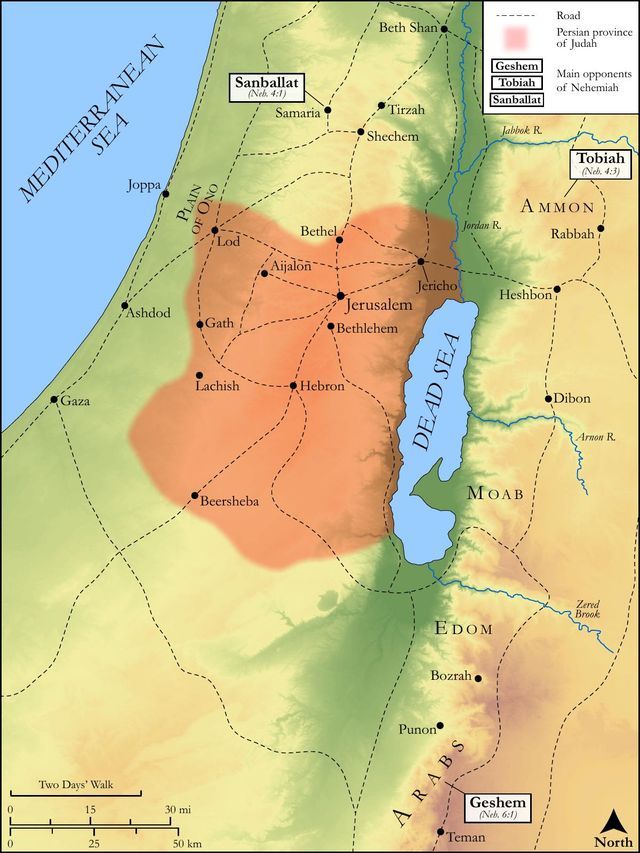
See on the biblical-era map
Study this verse
Public-domain commentary
Matthew Henry
From his Commentary on the Whole Bible. Henry comments on passages, not single verses — this entry covers Nehemiah 6:10–14. His three-level outline is real structure in the source text, so it is rendered as structure.
The Jews' enemies leave no stone unturned, no way untried, to take Nehemiah off from building the wall about Jerusalem. In order to this they had tried to fetch him into the country to them, but in vain; now they try to drive him into the temple for his own safety; let him be any where but at his work. Observing him to be a cautious man, they will endeavour to gain their point by making him cowardly. Observe,
I.How basely the enemies managed this temptation.
1.That which they designed was to bring Nehemiah to do a foolish thing, that they might laugh at him, and insult over him for doing it, and so lessen his interest and influence (Neh 6:13): That I should be afraid, and so they might have matter for an evil report, and might reproach me. This was indeed doing the devil's work, who is men's tempter that he may be their accuser, draws men to sin that he may glory in their shame. The greatest mischief our enemies can do us is to frighten us from our duty and bring us to do what is sinful.
2.The tools they made use of were a pretended prophet and prophetess, whom they hired to persuade Nehemiah to quit his work and retire for his own safety. The pretended prophet was Shemaiah, of whom it is said that he was shut up in his own house, either under pretence of retirement for meditation and to consult the mind of God or to give Nehemiah a sign in like manner to make himself a recluse. It should seem, Nehemiah had a value for him, for he went to his house to consult him, Neh 6:10. Other prophets there were, and one prophetess, Noadiah (Neh 6:14), that were in the interest of the Jews' enemies, pensioners to them and traitors to their country. Whether they pretended to inspiration does not appear; they do not say, Thus saith the Lord, as the false prophets of old did; if not so, yet they would be thought to excel in divine knowledge, and human prudence, and to have uncommon measures of insight and foresight, and were therefore consulted in difficult cases, as prophets had been. These the enemies feed to be of counsel for them. Let us hence take occasion to lament,
(1.)The wickedness of such bad men as these prophets, that ever any should be so perfidious as to betray the cause of God and their country even under the pretence of communion with God and concern for their country.
(2.)The unhappiness of such good men as Nehemiah, who are in danger of being imposed upon by such cheats, and to whom no temptation comes with more force than that which comes under a colour of religion, of revelation and devotion, and is brought by the hand of prophets.
3.The pretence was plausible. These prophets suggested to Nehemiah that the enemies would come and slay him, in the night they would slay him, which he had reason enough to believe was true; they would, if they could, if they durst. They pretended to be much concerned for his safety. The people would be all undone if any harm should come to him; and therefore they very gravely advised him to hide himself in the temple till the danger was over; that was a strong and sacred place, where he would be under the special protection of Heaven, Psa 27:5. If Nehemiah had been prevailed upon to do this, immediately the people would both have left off their work and thrown down their arms, and every one would have shifted for his own safety; and then the enemies might easily, and without opposition, have demolished the works, broken down the wall again, and so gained their point. Though self-preservation is a fundamental principle of the law of nature, yet that is not always the best and wisest counsel which pretends to go upon that principle.
II.See how bravely Nehemiah vanquished this temptation, and came off a conqueror.
1.He immediately resolved not to yield to it, Neh 6:11. See here,
(1.)What his reasonings are: "Should such a man as I flee? Shall I desert God's work, or discourage my own workmen whom I have employed and encouraged? Shall I be over-credulous of report, and over-solicitous about my own life? I that am the governor, on whom so many eyes are, both of friends and foes? Another might flee, but not I. Who is there that being as I am, in my post of honour, and power, and trust, would go into the temple, and lurk there, when business is to be done, yea, though it were to save his life?" Note, When we are tempted to sin we should remember who and what we are, that we may not do any thing unbecoming us, and the profession we make. It is not for kings, O Lemuel! Pro 31:4.
(2.)What was the result of his reasonings. He is at a point: "I will not go in. I will rather die at my work than live in an inglorious retreat from it." Note, Holy courage and magnanimity will engage us, whatever it cost us, never to decline a good work, nor ever to do a bad one.
2.He was immediately aware of what was the rise of it (Neh 6:12): "I perceived that God had not sent him, that he gave this advice, not by any divine direction, ordinary or extraordinary, but with a design against me." The wickedness of such mercenary wretches will sooner or later be brought to light. Two things Nehemiah says he dreaded in that which he was advised to: - (1.) Offending God: That I should be afraid, and do so, and sin. Note, Sin is that which above any thing we should dread; and a good preservative it is against sin to be afraid of nothing but sin. (2.) Shaming himself: That they might reproach me. Note, Next to the sinfulness of sin we should dread the scandalousness of it.
3.He humbly begs of God to reckon with them for their base designs upon him (Neh 6:14): My God, think thou upon Tobiah, and the rest of them, according to their works. As, when he had mentioned his own good services, he did not covetously or ambitiously prescribe to God what reward he should give him, but modestly prayed, Think upon me, my God (Neh 5:19), so here he does not revengefully imprecate any particular judgment upon his enemies, but refers the matter to God. "Thou knowest their hearts, and art the avenger of falsehood and wrong; take cognizance of this cause; judge between me and them, and take what way and time thou mayest please to call them to an account for it." Note, Whatever injuries are done us we must not avenge ourselves, but commit our cause to him that judgeth righteously.
Continue studying Nehemiah 6:13 across the web’s major study libraries — every link below opens this exact verse, chapter, or book on the destination site.
Read & Compare
 BibleGatewayThis verse in more than 200 translations and 70 languages.
 Bible.comThe YouVersion reader — hundreds of translations, reading plans, and highlights.
 ESV.orgCrossway's official English Standard Version reader.
 NET BibleThe NET translation with 60,000+ translators' notes on every rendering decision.
 STEP BibleTyndale House's free study tool — original text, vocabulary, and scholarly resources.
 BibliaLogos Bible Software's free web reader.
 USCCBThe New American Bible (Revised Edition) with the U.S. bishops' study notes.
Commentaries
 BibleHub CommentariesDozens of classic commentaries on this verse, gathered on one page.
 StudyLightMore than 100 commentary sets — the largest collection on the web.
 BibleRefPlain-English commentary on what this verse means, verse by verse.
 Enduring WordDavid Guzik's free commentary on this chapter, widely used by Bible teachers.
 Bible Study ToolsVerse commentary alongside Greek and Hebrew study aids.
Original Language & Research
- BibleHub InterlinearThe verse word by word — original language, transliteration, and English.
- BibleHub LexiconEvery word's original-language definition and Strong's entry.
 Blue Letter BibleDeep-study tools — Strong's numbers, concordance, and word studies.
 SefariaThe Hebrew text with Rashi and centuries of Jewish commentary.
Sermons, Hymns & Audio


TrulyRandomVerse is not affiliated with these sites and doesn’t control their content. They’re linked because they’re genuinely useful.
Summary
Nehemiah 6:13 unveils the calculated and multi-faceted conspiracy orchestrated by Nehemiah's adversaries—Sanballat, Tobiah, and Geshem—who strategically hired the false prophet Shemaiah. Their insidious objective was to induce paralyzing fear in Nehemiah, coercing him into a grave sin by unlawfully seeking refuge within the temple's inner sanctuary. This meticulously planned act would not only compromise his unblemished integrity and spiritual standing but also furnish his enemies with irrefutable "matter for an evil report," empowering them to publicly discredit, shame, and effectively halt the divinely ordained work of rebuilding Jerusalem's walls.
Context
ShowHideLiterary Context
This pivotal verse functions as the culmination of a specific, cunning deceptive plot meticulously detailed in Nehemiah 6:10-12. Shemaiah, posing as a legitimate prophet, attempts to lure Nehemiah into the temple's inner sanctuary under the guise of protecting him from an imminent assassination. Nehemiah, however, endowed with profound spiritual discernment, immediately recognizes the true, malicious intent behind this counsel. He understands that entering the sanctuary as a layman would constitute a direct and egregious violation of God's explicit law, a sin that would not only defile him personally but also provide his relentless enemies with the perfect pretext to utterly discredit his leadership and fatally undermine the entire rebuilding effort. The preceding narrative throughout Nehemiah 6 vividly illustrates the escalating intensity and diverse forms of opposition Nehemiah faced, ranging from overt threats and public ridicule to subtle traps and psychological warfare, all meticulously designed to impede the sacred work.
Historical & Cultural Context
The monumental task of rebuilding Jerusalem's walls in the post-exilic period was far more than a construction project; it symbolized the profound restoration of Israel's national identity, security, and spiritual vitality under Persian rule. This ambitious endeavor faced relentless and often violent opposition from influential neighboring officials such as Sanballat, Tobiah, and Geshem, who perceived a fortified Jerusalem as a direct threat to their regional power and influence. Culturally, the sanctity of the temple was absolutely paramount in ancient Israelite society. Only consecrated priests were permitted to enter the Holy Place, and only the High Priest could enter the Most Holy Place on the Day of Atonement (Leviticus 16:2; Numbers 18:7). For a layman of Nehemiah's standing to violate this sacred boundary would be an act of profound sacrilege, punishable by severe consequences, potentially even death or expulsion from the community. Furthermore, reputation and honor held immense weight in Israel; an "evil report" or "reproach" (Hebrew: cherpah) was an exceptionally potent weapon, capable of irrevocably destroying a person's standing, influence, and legacy within the community. The explicit mention of a "hired" prophet also underscores the unfortunate prevalence of mercenary religious figures who would readily manipulate divine authority for personal gain or political objectives, a phenomenon frequently and vehemently condemned throughout the Old Testament (e.g., Micah 3:11).
Key Themes
ShowHideNehemiah 6:13 profoundly encapsulates several critical and enduring themes. It vividly portrays the pervasive deception and treachery employed by adversaries who are determined to undermine God's work, even to the extent of resorting to false prophecy to achieve their malevolent ends. The primary aim of this plot was to weaponize fear, demonstrating how cunning opponents attempt to paralyze, manipulate, and incapacitate godly leaders by instilling terror and anxiety. Nehemiah's unwavering discernment and resolute refusal to comply with the deceptive counsel powerfully underscore the theme of integrity and obedience to God's immutable law, even when subjected to extreme duress and life-threatening pressure. His steadfast commitment to righteousness prevented him from succumbing to a meticulously crafted trap designed specifically to make him "sin." Finally, the verse powerfully highlights the destructive and corrosive power of slander and reproach, revealing the enemies' ultimate, strategic goal: to engineer a public scandal, irrevocably ruin Nehemiah's impeccable reputation, and thereby utterly discredit the entire rebuilding effort and, by extension, the sovereign God whom he faithfully served. This insidious tactic of character assassination remains a recurring and lamentable theme in biblical narratives depicting opposition to God's people and His divine purposes.
Exposition and Analysis
ShowHideKey Word Analysis
ShowHideThis verb distinctly denotes a mercenary relationship, unequivocally indicating that Shemaiah was paid or otherwise compensated to deliver his deceptive and malicious counsel. It strips away any pretense of divine inspiration or genuine concern, starkly revealing the purely transactional, corrupt, and malevolent nature of his involvement. It signifies a profound betrayal of prophetic integrity for material or political gain, highlighting the deep-seated corruption at the heart of the adversaries' plot.
While yârêʼ can indeed denote a reverent and awe-filled fear of God, in this context, it unequivocally refers to human fear—a paralyzing dread, intimidation, or terror. The enemies' explicit goal was to make Nehemiah succumb to this debilitating fear, hoping it would lead him to abandon his crucial post or make a rash, compromising decision that would jeopardize his mission and integrity. This fear was meticulously designed to break his unwavering resolve and force him into a spiritually and publicly compromising position.
This verb, often translated as "to reproach," "to defy," or "to blaspheme," signifies the act of publicly shaming, insulting, or humiliating someone. It implies casting scorn and mockery upon an individual, often to diminish their standing and influence. The enemies sought not merely to discredit Nehemiah but to utterly humiliate him, making him an object of widespread derision and thereby undermining the morale, trust, and support of those working alongside him on the walls. The ultimate aim was to destroy his reputation and leadership through public disgrace.
Verse Breakdown
ShowHide"Therefore [was] he hired,"
This opening clause immediately exposes the sinister, premeditated, and mercenary nature of the plot. Shemaiah was not acting on divine impulse or genuine prophetic conviction but as a paid agent, a corrupt tool in the hands of Nehemiah's adversaries, Sanballat and Tobiah. This highlights the calculated, unethical, and corrupt means by which the opposition operated, revealing their willingness to subvert even religious authority for their malicious ends.
"that I should be afraid, and do so, and sin,"
This phrase meticulously unpacks the multi-stage, psychological, and spiritual objective of the enemies' scheme. First, they aimed to induce paralyzing fear in Nehemiah, hoping to shatter his resolve and leadership. Second, this fear was intended to compel him to "do so"—that is, to follow Shemaiah's deceptive counsel and flee into the temple. Third, the ultimate and most devastating consequence of this action would be "sin," as a layman entering the sacred inner sanctuary was a grave violation of Levitical law, an act of sacrilege that would defile him and discredit his entire mission.
"and [that] they might have [matter] for an evil report, that they might reproach me."
This final clause reveals the ultimate, strategic, and reputational goal behind the entire, elaborate plot. By causing Nehemiah to sin, his enemies would gain tangible "matter" or irrefutable evidence to create a damaging "evil report"—a public accusation that would irrevocably ruin his reputation and standing. This "evil report" would then serve as the basis to "reproach" him, subjecting him to widespread public shame, ridicule, and profound disgrace, thereby discrediting his divinely appointed leadership, demoralizing the people involved in the rebuilding, and providing a convenient justification for stopping the vital work on Jerusalem's walls.
Literary Devices
ShowHideNehemiah 6:13 masterfully employs several potent literary devices to convey the profound depth of the adversaries' malice and the unwavering integrity of Nehemiah. Irony is strikingly prominent, as a supposed "prophet"—a divinely appointed messenger of God—is explicitly "hired" to deliver a message designed to lead God's faithful servant into grievous sin, representing a direct and heinous perversion of divine communication. This powerfully underscores the deceptive and insidious nature of spiritual warfare. The verse also utilizes a clear cause-and-effect progression or chain of events to meticulously lay out the enemies' calculated plan: being "hired" leads to the intention to make Nehemiah "afraid," which is intended to make him "do so" (flee into the temple), which in turn leads to "sin," which then provides "matter for an evil report," ultimately culminating in "reproach." This logical and sinister progression highlights the calculated and strategic nature of the opposition. Furthermore, the judicious use of strong, emotionally charged words such as "afraid," "sin," "evil report," and "reproach" creates a palpable sense of pathos, emphasizing the intense psychological, spiritual, and reputational pressure Nehemiah courageously faced.
Theological and Thematic Connections
ShowHideNehemiah 6:13 offers profound theological insights into the relentless nature of spiritual warfare and the indispensable character required for leadership in God's redemptive work. It powerfully reveals that opposition to God's kingdom often extends far beyond mere physical threats, encompassing sophisticated psychological manipulation, insidious character assassination, and cunning attempts to induce spiritual compromise. The enemies astutely understood that if they could successfully make Nehemiah sin, they could irrevocably discredit not only him personally but also the divine authority and integrity behind his God-given mission. This underscores the profound theological truth that unwavering integrity and steadfast obedience are absolutely paramount in serving God, as even seemingly minor compromises can provide devastating ammunition for those who seek to undermine His sovereign purposes. Nehemiah's remarkable discernment and unwavering steadfastness stand as an enduring testament to the transformative power of relying on God's immutable law and divine wisdom in the face of the most cunning and deceptive schemes.
Reflection and Application
ShowHideNehemiah 6:13 provides a timeless and invaluable blueprint for understanding the insidious tactics of spiritual adversaries and underscores the paramount importance of unwavering integrity in the life of a believer. In our own lives and ministries, we frequently encounter opposition that seeks to instill fear, subtly tempting us to compromise our deeply held convictions or God's explicit commands. This verse serves as a powerful call to cultivate profound spiritual discernment, enabling us to recognize and resist deceptive counsel, whether it originates from external pressures, the whispers of the world, or internal temptations disguised as self-preservation. Like Nehemiah, we are called to prioritize absolute obedience to God's Word above all else, understanding that even seemingly minor compromises can inadvertently provide "matter for an evil report" that discredits our witness for Christ and hinders the progress of God's work through us. Our steadfastness and unwavering resolve in the face of slander, fear, and temptation not only safeguard our personal integrity but also profoundly glorify God, demonstrating His unfailing power to sustain and empower His faithful servants through any trial or adversity.
Questions for Reflection
ShowHideFAQ
ShowHideWhy was entering the temple inner sanctuary a sin for Nehemiah?
ShowHideFor Nehemiah, who was a layman and the governor, entering the inner sanctuary (specifically, the Holy Place) of the temple would have been a grave and unpardonable sin because it was strictly forbidden by God's explicit law. According to the Mosaic Law, only consecrated priests, who were from the tribe of Levi and the lineage of Aaron, were divinely authorized and permitted to enter the Holy Place to perform sacred duties. Laypersons, under no circumstances, were allowed to cross this sacred boundary. Numbers 18:7 explicitly states, "But you and your sons with you shall attend to your priesthood for everything at the altar and inside the veil; and you shall perform service. I give your priesthood as a gift for service, and the outsider who comes near shall be put to death." This stringent prohibition was divinely designed to protect the holiness of God and the absolute sanctity of His dwelling place. Nehemiah's act would have been an act of profound sacrilege, a direct challenge to God's established order, and a blatant affront to the divinely instituted priestly office.
Who was Shemaiah, and why did he agree to this?
ShowHideShemaiah is introduced as a prophet, specifically "the son of Delaiah, son of Mehetabel" (Nehemiah 6:10). However, Nehemiah swiftly and accurately discerned that he was not a true prophet of God but rather a false one, explicitly "hired" by Sanballat and Tobiah. Shemaiah's primary motivation was undoubtedly mercenary, as the text plainly states he "was hired" (Nehemiah 6:13), strongly implying he was financially compensated or otherwise rewarded to deliver this deceptive prophecy. He willingly acted as a pawn in the enemies' elaborate scheme, leveraging his supposed spiritual authority to manipulate Nehemiah. His counsel was not from God but was meticulously designed to lead Nehemiah into sin and public disgrace, thereby fatally undermining the entire rebuilding effort and the reputation of its leader.
How did Nehemiah discern the plot?
ShowHideNehemiah discerned the insidious plot through a powerful combination of profound spiritual insight, an intimate knowledge of God's law, and a keen understanding of his adversaries' malevolent character. First, he possessed an unshakeable knowledge of God's law: as a layman, he was unequivocally forbidden to enter the temple's inner sanctuary. He knew that a true prophet of God would never advise an act of sin or sacrilege. Second, he recognized the counsel as fundamentally inconsistent with his own character and his divine calling, famously declaring, "Should such a man as I flee? And who is there that, being such as I, would go into the temple to save my life?" (Nehemiah 6:11). He understood that fleeing out of fear would be a profound betrayal of his leadership responsibilities and his unwavering trust in God. Third, and most crucially, he spiritually perceived the true, corrupt motive behind the "prophecy," stating with conviction, "I perceived that God had not sent him, but that he had pronounced the prophecy against me because Tobiah and Sanballat had hired him" (Nehemiah 6:12). His exceptional spiritual discernment allowed him to see through the deceptive religious facade to the malicious and manipulative intent beneath.
Christ-Centered Fulfillment
ShowHideNehemiah's unwavering steadfastness in the face of cunning deception and persistent attempts to lead him into sin profoundly foreshadows the perfect, unblemished integrity of Jesus Christ. Like Nehemiah, Jesus faced relentless and insidious opposition from religious and political adversaries who tirelessly sought to trap Him, discredit His divine ministry, and find "matter for an evil report" to publicly reproach Him (Matthew 22:15-22). False witnesses were maliciously brought against Him (Matthew 26:59-60), and He was constantly slandered and falsely accused of blasphemy or being in league with demonic forces (John 8:48; Mark 3:22). Yet, unlike Nehemiah, who, though righteous, was still capable of sin and had to resist it, Jesus was utterly sinless, incapable of being led astray or succumbing to temptation (Hebrews 4:15). He perfectly fulfilled the very law that Nehemiah sought to uphold. Ultimately, Jesus bore the ultimate "reproach" and "evil report" on the cross, where He, the innocent Lamb of God, was publicly shamed, humiliated, and executed, not for His own sin, but for the sins of humanity (Hebrews 12:2; 2 Corinthians 5:21). His perfect obedience, His unwavering integrity, and His willingness to endure profound shame secured our salvation, demonstrating unequivocally that God's redemptive work, perfectly fulfilled in Christ, cannot be ultimately thwarted or undone by any human or demonic plot.