


Nehemiah 6:14
- זָכְרָהza·khe·Rahremember !H2142V-Qal-Imp-2ms ¦ SfxVerb Qal Imperative 2nd Singular Masculineזָכְרָrememberה!
- אֱלֹהַי'e·lo·Haimy O GodH430N-mpc ¦ 1csNoun Plural Masculine ConstructאֱלֹהַO Godיmy
- לְטוֹבִיָּהle·toi·Yahto TobiahH2900Prep-l ¦ N-proper-mNoun Proper MasculineלְtoטוֹבִיָּהTobiah
- וּלְסַנְבַלַּטu·le·san·va·Latand to SanballatH5571Conj-w ¦ Prep-l ¦ N-proper-mNoun Proper MasculineוּandלְtoסַנְבַלַּטSanballat
- כְּמַעֲשָׂיוke·ma·'a·Savaccording to his worksH4639Prep-k ¦ N-mpc ¦ 3msNoun Plural Masculine Constructכְּaccording toמַעֲשָׂיworksוhis
- אֵלֶּה'E·lehtheseH428PrtParticle Demonstrative
- וְגַםve·Gamand alsoH1571Conj-w ¦ AdvAdverbוְandגַםalso
- לְנוֹעַדְיָהle·no·'ad·Yah<to> NoadiahH5129Prep-l ¦ N-proper-fNoun Proper Feminineלְ<to>נוֹעַדְיָהNoadiah
- הַנְּבִיאָהha·ne·vi·'Ahthe prophetessH5031Art ¦ N-fsNoun Singular Feminine Absoluteהַtheנְּבִיאָהprophetess
- וּלְיֶתֶרu·le·Ye·terand to [the] rest ofH3499Conj-w ¦ Prep-l ¦ N-mscNoun Singular Masculine Constructוּandלְtoיֶתֶר[the] rest of
- הַנְּבִיאִיםha·ne·vi·'Imthe prophetsH5030Art ¦ N-mpNoun Plural Masculine Absoluteהַtheנְּבִיאִיםprophets
- אֲשֶׁר'a·SherwhoH834RelParticle Relative
- הָיוּha·Yuthey wereH1961V-Qal-Perf-3cpVerb Qal Perfect 3rd Plural common gender
- מְיָרְאִיםme·ya·re·'Immaking afraidH3372V-Piel-Prtcpl-mpVerb Piel Participle Plural Masculine Absolute
- אוֹתִי'o·Ti<obj.> meH853DirObjM ¦ 1csParticle Object Indicatorאוֹתִ<obj.>יme
English is a literal word-by-word gloss of the Hebrew, not the KJV's wording. Why?
This is the original text the KJV's translators worked from — each Hebrew word with its own literal English meaning in this verse, prepared by scholars at Tyndale House, Cambridge. The KJV translates whole sentences, not word by word, so its wording differs: one Hebrew word can become several English words, and the KJV may choose “the LORD” where the gloss reads “Yahweh”. Both are faithful — they answer different questions. For the KJV's own rendering, switch to the KJV text.
Details
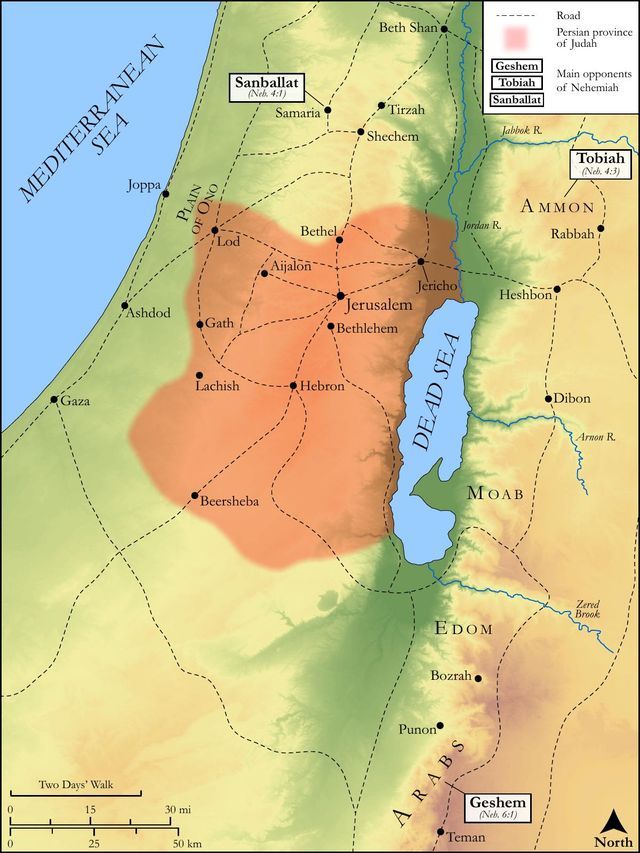
See on the biblical-era map
Study this verse
Public-domain commentary
Matthew Henry
From his Commentary on the Whole Bible. Henry comments on passages, not single verses — this entry covers Nehemiah 6:10–14. His three-level outline is real structure in the source text, so it is rendered as structure.
The Jews' enemies leave no stone unturned, no way untried, to take Nehemiah off from building the wall about Jerusalem. In order to this they had tried to fetch him into the country to them, but in vain; now they try to drive him into the temple for his own safety; let him be any where but at his work. Observing him to be a cautious man, they will endeavour to gain their point by making him cowardly. Observe,
I.How basely the enemies managed this temptation.
1.That which they designed was to bring Nehemiah to do a foolish thing, that they might laugh at him, and insult over him for doing it, and so lessen his interest and influence (Neh 6:13): That I should be afraid, and so they might have matter for an evil report, and might reproach me. This was indeed doing the devil's work, who is men's tempter that he may be their accuser, draws men to sin that he may glory in their shame. The greatest mischief our enemies can do us is to frighten us from our duty and bring us to do what is sinful.
2.The tools they made use of were a pretended prophet and prophetess, whom they hired to persuade Nehemiah to quit his work and retire for his own safety. The pretended prophet was Shemaiah, of whom it is said that he was shut up in his own house, either under pretence of retirement for meditation and to consult the mind of God or to give Nehemiah a sign in like manner to make himself a recluse. It should seem, Nehemiah had a value for him, for he went to his house to consult him, Neh 6:10. Other prophets there were, and one prophetess, Noadiah (Neh 6:14), that were in the interest of the Jews' enemies, pensioners to them and traitors to their country. Whether they pretended to inspiration does not appear; they do not say, Thus saith the Lord, as the false prophets of old did; if not so, yet they would be thought to excel in divine knowledge, and human prudence, and to have uncommon measures of insight and foresight, and were therefore consulted in difficult cases, as prophets had been. These the enemies feed to be of counsel for them. Let us hence take occasion to lament,
(1.)The wickedness of such bad men as these prophets, that ever any should be so perfidious as to betray the cause of God and their country even under the pretence of communion with God and concern for their country.
(2.)The unhappiness of such good men as Nehemiah, who are in danger of being imposed upon by such cheats, and to whom no temptation comes with more force than that which comes under a colour of religion, of revelation and devotion, and is brought by the hand of prophets.
3.The pretence was plausible. These prophets suggested to Nehemiah that the enemies would come and slay him, in the night they would slay him, which he had reason enough to believe was true; they would, if they could, if they durst. They pretended to be much concerned for his safety. The people would be all undone if any harm should come to him; and therefore they very gravely advised him to hide himself in the temple till the danger was over; that was a strong and sacred place, where he would be under the special protection of Heaven, Psa 27:5. If Nehemiah had been prevailed upon to do this, immediately the people would both have left off their work and thrown down their arms, and every one would have shifted for his own safety; and then the enemies might easily, and without opposition, have demolished the works, broken down the wall again, and so gained their point. Though self-preservation is a fundamental principle of the law of nature, yet that is not always the best and wisest counsel which pretends to go upon that principle.
II.See how bravely Nehemiah vanquished this temptation, and came off a conqueror.
1.He immediately resolved not to yield to it, Neh 6:11. See here,
(1.)What his reasonings are: "Should such a man as I flee? Shall I desert God's work, or discourage my own workmen whom I have employed and encouraged? Shall I be over-credulous of report, and over-solicitous about my own life? I that am the governor, on whom so many eyes are, both of friends and foes? Another might flee, but not I. Who is there that being as I am, in my post of honour, and power, and trust, would go into the temple, and lurk there, when business is to be done, yea, though it were to save his life?" Note, When we are tempted to sin we should remember who and what we are, that we may not do any thing unbecoming us, and the profession we make. It is not for kings, O Lemuel! Pro 31:4.
(2.)What was the result of his reasonings. He is at a point: "I will not go in. I will rather die at my work than live in an inglorious retreat from it." Note, Holy courage and magnanimity will engage us, whatever it cost us, never to decline a good work, nor ever to do a bad one.
2.He was immediately aware of what was the rise of it (Neh 6:12): "I perceived that God had not sent him, that he gave this advice, not by any divine direction, ordinary or extraordinary, but with a design against me." The wickedness of such mercenary wretches will sooner or later be brought to light. Two things Nehemiah says he dreaded in that which he was advised to: - (1.) Offending God: That I should be afraid, and do so, and sin. Note, Sin is that which above any thing we should dread; and a good preservative it is against sin to be afraid of nothing but sin. (2.) Shaming himself: That they might reproach me. Note, Next to the sinfulness of sin we should dread the scandalousness of it.
3.He humbly begs of God to reckon with them for their base designs upon him (Neh 6:14): My God, think thou upon Tobiah, and the rest of them, according to their works. As, when he had mentioned his own good services, he did not covetously or ambitiously prescribe to God what reward he should give him, but modestly prayed, Think upon me, my God (Neh 5:19), so here he does not revengefully imprecate any particular judgment upon his enemies, but refers the matter to God. "Thou knowest their hearts, and art the avenger of falsehood and wrong; take cognizance of this cause; judge between me and them, and take what way and time thou mayest please to call them to an account for it." Note, Whatever injuries are done us we must not avenge ourselves, but commit our cause to him that judgeth righteously.
Continue studying Nehemiah 6:14 across the web’s major study libraries — every link below opens this exact verse, chapter, or book on the destination site.
Read & Compare
 BibleGatewayThis verse in more than 200 translations and 70 languages.
 Bible.comThe YouVersion reader — hundreds of translations, reading plans, and highlights.
 ESV.orgCrossway's official English Standard Version reader.
 NET BibleThe NET translation with 60,000+ translators' notes on every rendering decision.
 STEP BibleTyndale House's free study tool — original text, vocabulary, and scholarly resources.
 BibliaLogos Bible Software's free web reader.
 USCCBThe New American Bible (Revised Edition) with the U.S. bishops' study notes.
Commentaries
 BibleHub CommentariesDozens of classic commentaries on this verse, gathered on one page.
 StudyLightMore than 100 commentary sets — the largest collection on the web.
 BibleRefPlain-English commentary on what this verse means, verse by verse.
 Enduring WordDavid Guzik's free commentary on this chapter, widely used by Bible teachers.
 Bible Study ToolsVerse commentary alongside Greek and Hebrew study aids.
Original Language & Research
- BibleHub InterlinearThe verse word by word — original language, transliteration, and English.
- BibleHub LexiconEvery word's original-language definition and Strong's entry.
 Blue Letter BibleDeep-study tools — Strong's numbers, concordance, and word studies.
 SefariaThe Hebrew text with Rashi and centuries of Jewish commentary.
Sermons, Hymns & Audio


TrulyRandomVerse is not affiliated with these sites and doesn’t control their content. They’re linked because they’re genuinely useful.
Summary
Nehemiah 6:14 captures Nehemiah's impassioned prayer for divine intervention and justice against his relentless adversaries, including the political schemers Tobiah and Sanballat, and the spiritual deceivers, the prophetess Noadiah and other false prophets. This profound petition reveals Nehemiah's unwavering faith and dependence on God amidst intense opposition, appealing to the Lord to remember and act decisively upon the wicked deeds of those who sought to instill fear, compromise his integrity, and undermine the sacred work of rebuilding Jerusalem's walls. It powerfully encapsulates his deep trust in God as the ultimate vindicator, protector, and sovereign director of His redemptive purposes.
CONTEXT
ShowHideLiterary Context: This verse is strategically placed as the monumental task of rebuilding Jerusalem's walls approaches its triumphant completion, as noted in Nehemiah 6:15. Chapters 4 through 6 meticulously document the escalating and diverse tactics employed by Nehemiah's formidable enemies, primarily Sanballat, Tobiah, and Geshem. Their initial opposition began with scorn and mockery (Nehemiah 4:1-3), progressed to a concerted military conspiracy to attack Jerusalem (Nehemiah 4:7-8), followed by cunning attempts to lure Nehemiah away from the city for an ambush (Nehemiah 6:1-4). The opposition then escalated to slanderous letters designed to discredit him before the Persian king, accusing him of rebellion (Nehemiah 6:5-9). The immediate preceding context of Nehemiah 6:10-13 reveals the enemies' most insidious tactic: hiring false prophets, including Shemaiah and the "prophetess Noadiah," to deliver intimidating messages, coerce Nehemiah into compromising his integrity by fleeing into the temple (which would have been a sacrilege for a non-priest), and ultimately "put him in fear." Nehemiah's prayer in Nehemiah 6:14 is a direct, resolute response to these multifaceted spiritual, psychological, and political attacks, demonstrating his consistent and unwavering practice of turning to God in every crisis.
Historical & Cultural Context: The events recounted in Nehemiah transpire in the mid-5th century BCE, during the post-exilic period when Judah was a province under the vast Persian Empire. Jerusalem, still vulnerable and partially rebuilt after the Babylonian destruction, was viewed with suspicion and hostility by neighboring governors and peoples. Sanballat, the governor of Samaria, Tobiah, an influential Ammonite official, and Geshem, an Arab chieftain, perceived the rebuilding of Jerusalem's walls as a significant political threat. They feared the re-establishment of a strong, independent Jewish state that could challenge their regional authority or disrupt their vested interests. In the ancient Near East, the role of "prophets"—both genuine and fraudulent—was a common and powerful feature of political and religious life. False prophets were frequently employed by rulers or powerful individuals to manipulate public opinion, deliver fabricated divine messages, or sow fear and confusion among adversaries. Instilling fear (Hebrew yare') was a well-known psychological tactic in ancient warfare and political maneuvering, aiming to break an opponent's morale, resolve, or integrity without direct military confrontation. Nehemiah's prayer acknowledges this complex cultural reality, appealing to a higher divine authority who transcends and judges all human and spiritual machinations.
Key Themes:
Exposition and Analysis
ShowHideKey Word Analysis
ShowHideWhile the literal meaning of zâkar is "to remember" or "to recall," in this specific context, especially when directed toward God concerning the actions of adversaries, it carries a much stronger connotation of remembering for the purpose of active intervention, often implying judgment, retribution, or holding accountable. Nehemiah is not merely asking God to recall the past deeds of his adversaries but to actively engage with them based on their wicked actions against His servant and His divinely appointed work. It is a fervent plea for divine justice and vindication, trusting God to execute His perfect will.
This term refers to an "action," "deed," or "transaction," encompassing both good and bad activities. In Nehemiah 6:14, the reference to "these their works" specifically highlights the cumulative effect of the adversaries' malicious deeds—their mockery, conspiracy, deceit, slander, and attempts at spiritual manipulation. Nehemiah is appealing to God to judge them not merely for their intentions but for the tangible, harmful "works" they have carried out against God's people and His sacred project.
This verb signifies "to fear," "to dread," or "to be terrified," and in its causative form, "to frighten." In Nehemiah 6:14, it precisely emphasizes the psychological and spiritual tactic employed by the enemies: to cause terror or dread in Nehemiah. Their ultimate goal was to paralyze him with fear, hoping that he would compromise his integrity, flee from his post, or abandon the project entirely, thereby halting the work of God. It highlights the enemy's strategy to attack Nehemiah's resolve, his trust in God's protection, and his commitment to the divine mission.
Verse Breakdown
ShowHide"My God, think thou upon Tobiah and Sanballat according to these their works"
Nehemiah begins with a deeply personal and intimate address, "My God," establishing a profound relationship of trust and dependence with the divine. He then appeals for God to "think upon" (i.e., actively deal with and hold accountable) Tobiah and Sanballat, who were the chief political adversaries orchestrating much of the opposition. The crucial phrase "according to these their works" underscores that Nehemiah's plea is based on the observable, persistent, and malicious actions of his enemies—their mockery, conspiracy, deceit, slander, and relentless efforts to undermine God's project and His faithful servant. This is a prayer for righteous retribution based on clearly observed wickedness and injustice.
"and on the prophetess Noadiah, and the rest of the prophets"
This clause broadens the scope of Nehemiah's petition to include those who waged spiritual warfare against him. The specific mention of "prophetess Noadiah" and "the rest of the prophets" indicates that the opposition was not solely political or physical but also involved insidious spiritual deception. These false prophets were tools used to manipulate, demoralize, and coerce Nehemiah, attempting to break his resolve through fabricated divine messages and intimidation, aiming to make him sin or abandon his post.
"that would have put me in fear"
This concluding phrase clarifies the shared, overarching objective of all these adversaries, both political and spiritual. Their ultimate aim was to instill debilitating fear in Nehemiah, hoping to cause him to compromise his faith, flee from danger, or abandon the divinely appointed task of rebuilding Jerusalem's walls. Nehemiah keenly discerns this insidious tactic and prays for God's intervention against it, demonstrating his awareness of the profound spiritual dimension of the conflict and his resolute refusal to succumb to intimidation, instead placing his trust in God's protective power.
Literary Devices
ShowHideThe verse powerfully employs Apostrophe, as Nehemiah directly addresses God in a personal and fervent prayer ("My God"), creating a profound sense of intimacy and immediate appeal to divine authority. The careful listing of "Tobiah and Sanballat" alongside "the prophetess Noadiah, and the rest of the prophets" serves as a form of Enumeration, systematically cataloging the various facets of the opposition, from prominent political leaders to spiritual deceivers. This highlights the comprehensive and multi-pronged nature of the threats Nehemiah faced, emphasizing the pervasive reach of the enemy's schemes. The phrase "put me in fear" uses Hyperbole to underscore the intense psychological pressure and the pervasive nature of the intimidation tactics employed by the enemies, aiming to completely paralyze Nehemiah's will and disrupt the sacred work. This prayer, born out of a deep understanding of the spiritual and physical threats, is a profound act of Supplication, demonstrating Nehemiah's consistent reliance on divine intervention rather than personal retaliation or despair.
Theological and Thematic Connections
ShowHideNehemiah's prayer for divine remembrance and judgment against his adversaries aligns with a consistent biblical theme: God is the righteous judge who sees all actions, both good and evil, and will ultimately bring justice. This is not a prayer for personal vengeance but an appeal to God's character as the one who vindicates His servants and protects His work. It underscores the profound truth that opposition to God's people and purposes is ultimately opposition to God Himself, and He will hold those accountable who defy Him. This also highlights the spiritual dimension of all work undertaken for God, where unseen forces often operate through human agents to hinder divine plans. The confidence that God "thinks upon" the wicked implies His active engagement in history, ensuring that righteousness will ultimately prevail and that His kingdom purposes will not be thwarted by human or spiritual malice. It is a prayer rooted in a deep understanding of God's covenant faithfulness and His commitment to His people.
Reflection and Application
ShowHideNehemiah 6:14 provides a powerful and enduring model for believers facing opposition in their walk of faith or service to God. It teaches us that when we encounter resistance, intimidation, or spiritual attacks while pursuing God's will, our first and most potent response should be fervent prayer. Instead of succumbing to fear, retaliating in the flesh, or becoming discouraged, we are called to bring our adversaries and their insidious schemes before the Lord, trusting in His perfect justice and His unwavering commitment to His purposes. This prayer reminds us that God sees every hidden motive and every overt act of opposition, and He is fully capable of dealing with it in His time and in His way. Our role is to remain steadfast in faith, discerning the spiritual nature of the conflict, and continuing faithfully in the work He has assigned us, knowing that He is our ultimate protector and vindicator. Nehemiah's example encourages us to cultivate a habit of immediate and fervent prayer when faced with challenges, confident that God hears and acts on behalf of His children and His kingdom, ensuring that His will prevails despite all opposition.
Questions for Reflection
ShowHideFAQ
ShowHideWhy does Nehemiah pray for God to "think upon" his enemies rather than praying for their conversion or repentance?
ShowHideNehemiah's prayer to "think upon" (Hebrew, zâkar) his enemies, particularly in this context, is a plea for divine justice and accountability, not necessarily a curse or a prayer for their immediate destruction. It's an appeal to God as the righteous judge to deal with those who actively and persistently oppose His work and His people, especially when their actions are characterized by deceit, intimidation, and spiritual manipulation. While the Bible certainly encourages prayer for enemies and their repentance (e.g., Matthew 5:44), there are also numerous instances where righteous individuals appeal to God for vindication and justice against those who persistently defy Him and His purposes (e.g., many psalms, such as Psalm 7:9). Nehemiah's primary concern is the progress of God's work and the protection of His people, and he trusts God to administer justice perfectly, knowing that God's justice is always righteous, whether it ultimately leads to repentance, restraint, or judgment. This prayer acknowledges God's sovereignty over all human actions and His commitment to upholding righteousness.
Christ-Centered Fulfillment
ShowHideNehemiah's prayer in Nehemiah 6:14 finds its ultimate fulfillment and deeper meaning in the person and work of Jesus Christ and the nature of spiritual warfare in the New Covenant. Just as Nehemiah faced relentless opposition and intimidation from external foes and false prophets seeking to "put him in fear" and deter him from building the physical wall, Jesus Himself endured the schemes of religious leaders, the political powers of His day, and the spiritual forces of darkness who sought to undermine His mission and ultimately crucify Him. The cross, though appearing as a defeat to human eyes, was God's ultimate act of "thinking upon" the works of sin and Satan, decisively judging them and securing a complete victory over all principalities and powers (Colossians 2:15). Believers, as followers of Christ, are called to participate in building God's spiritual kingdom, which is the Church, and like Nehemiah, we will face spiritual opposition from "the rulers, against the authorities, against the cosmic powers over this present darkness, against the spiritual forces of evil in the heavenly places" (Ephesians 6:12). However, our ultimate trust is in Christ, who has already triumphed over every foe. We pray for God's justice, knowing that He will ultimately "think upon" every unrighteous deed and bring all things into submission under Christ's feet (1 Corinthians 15:25). Our perseverance amidst intimidation is rooted not in our own strength but in the finished work of Christ and the promise of His glorious return, when all enemies will be finally subdued, and His righteous kingdom fully established for eternity (Revelation 19:11-16).