


2 Timothy 4:15
- ὃνhonwhomG3739R-ASMRelative pronoun Accusative Singular Masculine
- καὶkaialsoG2532CONJConjunction
- σὺsuyou yourselfG4771P-2NSPersonal pronoun Nominative 2nd Singular
- φυλάσσου·phulassoudo yourself beware ofG5442V-PMM-2SVerb Present Middle Imperative 2nd Singular
- λίανlianexceedinglyG3029ADVAdverb
- γὰρgarforG1063CONJConjunction
- ἀντέστηantestēhas opposedG436V-2AAI-3SVerb 2nd Aorist Active Indicative 3rd Singular
- τοῖςtois<the>G3588T-DPMDefinite article Dative Plural Masculine
- ἡμετέροιςhēmeteroisour ownG1473S-1PDPMPossessive pronoun Dative 1st Person Plural Masculine
- λόγοιςlogoismessageG3056N-DPMNoun Dative Plural Masculine
English is a literal word-by-word gloss of the Greek, not the KJV's wording. Why?
This is the original text the KJV's translators worked from — each Greek word with its own literal English meaning in this verse, prepared by scholars at Tyndale House, Cambridge. The KJV translates whole sentences, not word by word, so its wording differs: one Greek word can become several English words, and the KJV may choose “charity” where the gloss reads “love”. Both are faithful — they answer different questions. For the KJV's own rendering, switch to the KJV text.
Details
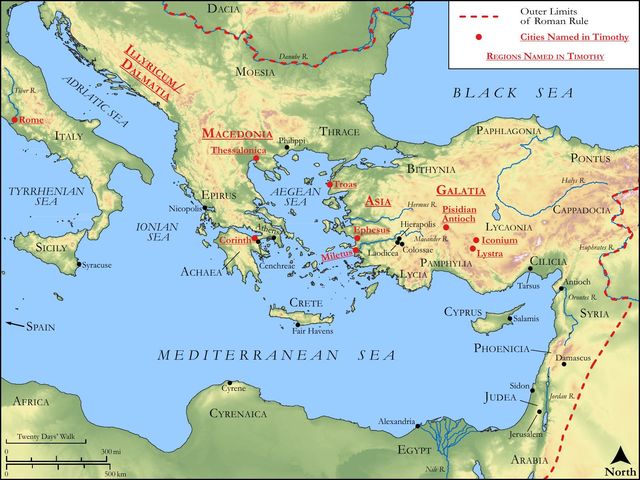
See on the biblical-era map

Study this verse
Public-domain commentary
Matthew Henry
From his Commentary on the Whole Bible. Henry comments on passages, not single verses — this entry covers 2 Timothy 4:9–15.
Here are divers particular matters which Paul mentions to Timothy, now at the closing of the epistle. 1. He bids him hasten to him, if possible (Ti2 4:9): So thy diligence to come shortly to me. For Timothy was an evangelist, one who was not a fixed pastor of any one place, but attended the motions of the apostles, to build upon their foundation. Paul wanted Timothy's company and help; and the reason he gives is because several had left him (Ti2 4:10); one from an ill principle, namely, Demas, who abides under an ill name for it: Demas hath forsaken me, having loved this present world. He quitted Paul and his interest, either for fear of suffering (because Paul was now a prisoner, and he was afraid o coming into trouble upon his account) or being called off from his ministry by secular affairs, in which he entangled himself; his first love to Christ and his gospel was forsaken and forgotten, and he fell in love with the world. Note, Love to this present world is often the cause of apostasy from the truths and ways of Jesus Christ. He has gone off, has departed to Thessalonica, called thither perhaps by trade, or by some other worldly business. Crescens had gone one way and Titus another way. Luke however remained with Paul (Ti2 4:11, Ti2 4:12), and was not this enough? Paul did not think it so; he loved the company of his friends. 2. He speaks respectfully concerning Mark: He is profitable to me for the ministry. It is supposed that this Mark was he about whom Paul and Barnabas had contended, Act 15:39. Paul would not take him with him to the work, because he had once flinched and drawn back: but now, says he, Take Mark, and bring him with thee. By this it appears that Paul was now reconciled to Mark, and had a better opinion of him than he had had formerly. This teaches us to be of a forgiving spirit; we must not therefore disclaim for ever making use of those that are profitable and useful, though they may have done amiss. 3. Paul orders Timothy to come to him, bids him as he came through Troas to bring with him thence those things which he had left behind him there (Ti2 4:13), the cloak he had left there, which, it may be, Paul had the more occasion for in a cold prison. It is probable that it was the habit Paul usually wore, a plain dress. Some read it, the roll of parchment I left at Troas; others, the desk that I left. Paul was guided by divine inspiration, and yet he would have his books with him. Whereas he had exhorted Timothy to give attendance to reading, so he did himself, though he was now ready to be offered. As long as we live, we must be still learning. But especially the parchments, which some think were the originals of his epistles; others think they were the skins of which he made his tents, whereby he obtained a livelihood, working with his own hands. 4. He mentions Alexander, and the mischief that he had done him, Ti2 4:14, Ti2 4:15. This is he who is spoken of Act 19:33. It should seem, he had been a professor of the Christian religion, a forward professor, for he was there particularly maligned by the worshippers of Diana, and yet he did Paul much evil. Paul was in as much danger from false brethren (Co2 11:26) as from open enemies. Paul foretels that God would reckon with him. It is a prophetical denunciation of the just judgment of God that would befall him: The Lord will reward him according to his works. He cautions Timothy to take heed of him: "Of whom be thou aware also, that he do not, under pretence of friendship, betray thee to mischief." It is dangerous having any thing to do with those who would be enemies to such a man as Paul. Observe, (1.) Some who were once Paul's hearers and admirers did not give him reason to remember them with much pleasure; for one forsook him, and another did him much evil, and greatly withstood his words. Yet, (2.) At the same time he mentions some with pleasure; the badness of some did not make him forget the goodness of others; such as Timothy, Titus, Mark, and Luke. (3.) The apostle has left a brand on the names and memory of two persons; the one is Demas, who forsook him, having loved the present world, and the other is Alexander, who greatly withstood his words. (4.) God will reward evil-doers, particularly apostates, according to their works. (5.) Of such as are of Alexander's spirit and temper we should beware; for they will do us no good, but all the mischief that is in their power.
Historical interpretation
Six Centuries of Reception
2 surviving comments on this verse. Each one is dated, so this reads as a timeline rather than a list.
Select a marker to jump to its quote. Markers stagger vertically where authors wrote within a few decades of each other.
"Alexander the coppersmith did me much evil; the Lord reward him according to his works." Here he again makes mention of his trial, not wishing merely to censure and accuse the man, but to prepare his disciple for the conflicts, that he might bear them firmly. Though they be mean and contemptible persons, and without honor, who cause these trials, they ought all, he says, to be borne with fortitude. For he who suffers wrong from any great personage, receives no little distinction from the superiority of him who does the wrong. But he who is injured by a vile and abject person, suffers the greater annoyance. "He did me much evil," he says, that is, he persecuted me in various ways. But these things will not go unpunished! For the Lord will reward him according to his works. As he said above: "What persecutions I endured, but out of them all the Lord delivered me." (2 Tim iii. 11.) So also here he consoles his disciples by a double consideration, that he himself had suffered wrong, and that the other would be rewarded for his evil deeds. Not that the Saints rejoice in the punishment of their persecutors, but that the cause of the Gospel required it, and the weaker would derive consolation from it. "Of whom be thou ware also; for he hath greatly withstood our words." That is, he is hostile to us, and opposes us. He has not said, Revenge, punish, expel him, although by the grace given him he might have so done, but he does no such thing; nor does he arm Timothy against him, but only commands him to avoid him, leaving vengeance to God, and for the consolation of the weaker he has said that He will reward him, which is a prophecy rather than an imprecation.
Alexander the coppersmith did me much harm; the Lord will repay him according to his deeds. Beware of him yourself, for he strongly opposed our words.
Paul also showed Timothy to endure bravely the troubles from common people. For it is painful to be wronged, especially by common people.
the Lord will repay him. Not because Paul was pleased with the punishment, but because for the sake of the weaker among the believers, those who were excessively opposing had to suffer badly, so that they would not despise the weakness of the preaching.
according to his deeds. Or that it is a prophecy of things to come, not a curse.
Beware of him yourself. Paul did not say, Punish, punish (for it was also permitted for Timothy to do this through the spirit), but, Beware. Do you see that he does not allow punishment? But the "Beware" is like a warning.
opposed our words. That is, to those of the preaching.
Continue studying 2 Timothy 4:15 across the web’s major study libraries — every link below opens this exact verse, chapter, or book on the destination site.
Read & Compare
 BibleGatewayThis verse in more than 200 translations and 70 languages.
 Bible.comThe YouVersion reader — hundreds of translations, reading plans, and highlights.
 ESV.orgCrossway's official English Standard Version reader.
 NET BibleThe NET translation with 60,000+ translators' notes on every rendering decision.
 STEP BibleTyndale House's free study tool — original text, vocabulary, and scholarly resources.
 BibliaLogos Bible Software's free web reader.
 USCCBThe New American Bible (Revised Edition) with the U.S. bishops' study notes.
Commentaries
 BibleHub CommentariesDozens of classic commentaries on this verse, gathered on one page.
 StudyLightMore than 100 commentary sets — the largest collection on the web.
 BibleRefPlain-English commentary on what this verse means, verse by verse.
 Enduring WordDavid Guzik's free commentary on this chapter, widely used by Bible teachers.
 Bible Study ToolsVerse commentary alongside Greek and Hebrew study aids.
Original Language & Research
- BibleHub InterlinearThe verse word by word — original language, transliteration, and English.
- BibleHub LexiconEvery word's original-language definition and Strong's entry.
 Blue Letter BibleDeep-study tools — Strong's numbers, concordance, and word studies.
 CNTR CollationThe earliest Greek manuscripts of this verse, collated letter by letter.
Sermons, Hymns & Audio


TrulyRandomVerse is not affiliated with these sites and doesn’t control their content. They’re linked because they’re genuinely useful.
Summary
In this final, urgent letter, the Apostle Paul issues a solemn warning to his beloved protégé, Timothy, concerning an individual named Alexander the coppersmith. Paul instructs Timothy to "be thou ware" (be on guard or watch out) for Alexander, explaining that this individual had "greatly withstood our words," indicating a significant and active opposition to Paul's apostolic teaching and the gospel message. This verse underscores the necessity of discernment and vigilance in ministry, protecting both the leader and the flock from those who actively undermine the truth of Christ.
Context
ShowHideLiterary Context
This verse is situated within Paul's second epistle to Timothy, his final known letter, penned from a Roman prison shortly before his martyrdom. The overarching tone of the letter is one of urgency, exhortation, and pastoral instruction, as Paul passes the torch of ministry to Timothy. Immediately preceding 2 Timothy 4:15, 2 Timothy 4:14 explicitly names "Alexander the coppersmith" as the individual in question, stating that he "did me much evil." This direct identification highlights the personal nature of the warning while also emphasizing its broader implications for Timothy's ministry. Paul's instructions here are part of a larger section (beginning in 2 Timothy 4:9) where he gives specific directives regarding his immediate needs, future ministry plans, and warnings about various individuals, both faithful companions and adversaries. The warning about Alexander serves as a concrete example of the spiritual dangers Timothy would face in his calling.
Historical & Cultural Context
Paul's imprisonment in Rome (likely his second, more severe imprisonment) meant he was isolated and facing imminent execution. The early Christian movement was a minority religion, often viewed with suspicion or hostility by Roman authorities and sometimes by Jewish communities. Within the nascent church itself, false teachers and those who opposed apostolic doctrine were a constant threat, as evidenced throughout Paul's epistles. Alexander the coppersmith's identity is debated among scholars; he might be the Alexander involved in the riot at Ephesus (Acts 19:33), or the one delivered to Satan by Paul alongside Hymenaeus for blasphemy (1 Timothy 1:20). Regardless of his precise prior history, he was clearly a known and active antagonist to Paul's ministry. His trade as a "coppersmith" suggests he was a craftsman, possibly a prominent figure in his community, which could have lent weight to his opposition. The warning reflects the real-world dangers faced by early Christian leaders from those who actively sought to undermine the gospel's spread.
Key Themes
ShowHideThis verse powerfully contributes to several key themes prevalent in 2 Timothy and Paul's broader theology. Firstly, it underscores the theme of Discernment and Vigilance, urging believers, especially leaders, to "be thou ware" and recognize those who pose a threat to sound doctrine and spiritual well-being. This aligns with Paul's consistent call for believers to be discerning, as seen in passages like 1 Thessalonians 5:21 which instructs us to "test all things; hold fast what is good." Secondly, the verse highlights the reality of Opposition to the Gospel. Alexander's active resistance ("greatly withstood our words") exemplifies the inevitable spiritual warfare that accompanies the proclamation of truth. This is a recurring motif in Paul's ministry, where he frequently encountered adversaries who sought to discredit his message or person, reminding us that the path of faith often involves conflict, as articulated in Ephesians 6:12 regarding wrestling against spiritual forces. Finally, the warning serves as an act of Pastoral Protection, demonstrating a spiritual leader's responsibility to guard the flock and those under their charge from harmful influences. Paul's concern for Timothy's safety and the purity of the gospel he preached reflects the shepherd's heart, echoing Christ's own warnings about false prophets in Matthew 7:15-20.
Exposition and Analysis
ShowHideKey Word Analysis
ShowHideThis verb means "to watch," "to be on guard," or "to keep oneself." It implies active vigilance and caution, often with the intent to protect or preserve. In this context, it's a direct command to Timothy to exercise careful discernment and take protective measures against Alexander. It's not merely passive awareness but an active state of readiness.
Derived from anti (against) and hístēmi (to stand), this word literally means "to stand against" or "to oppose." It denotes active resistance, confrontation, or antagonism. The use of this verb indicates that Alexander's opposition was not a passive disagreement but a deliberate, demonstrated effort to counter or undermine Paul's teachings and ministry.
While literally meaning "something said" or "a word," in this theological context, lógos often carries the weight of "message," "teaching," "doctrine," or even "the gospel." Paul is not merely referring to casual conversation but to the substance of his apostolic preaching and the truth of the Christian faith. Alexander's opposition was therefore directed against the very core of Paul's ministry and the divine message he proclaimed.
Verse Breakdown
ShowHide"Of whom be thou ware also;"
This opening clause serves as an urgent and direct pastoral command from Paul to Timothy. "Of whom" refers back to Alexander the coppersmith, explicitly named in the preceding verse. The imperative "be thou ware" (from phylássō) instructs Timothy to be vigilant, cautious, and on guard against this individual. The "also" suggests that Alexander is another in a line of challenges or individuals Timothy must be wary of, fitting into the broader context of Paul's warnings against false teachers and adversaries. This is a protective measure, not an instigation to hostility, but a call to spiritual discernment.
"for he hath greatly withstood our words."
This clause provides the crucial justification for Paul's warning. The conjunction "for" (gár) introduces the reason. Alexander's actions are described as having "greatly withstood" (from anthístēmi and lían meaning "much" or "exceedingly"). This signifies a strong, active, and perhaps public opposition. The object of his resistance is "our words," which, as analyzed above, refers to Paul's teachings, his apostolic message, and the gospel itself. This was not a minor disagreement but a significant, deliberate, and harmful antagonism against the truth Paul proclaimed, necessitating a clear warning to Timothy.
Literary Devices
ShowHideThe verse employs several significant literary devices. Primarily, it functions as a direct Admonition or Pastoral Warning, characteristic of Paul's epistles where he frequently advises his protégés on handling challenges in ministry. The use of the imperative "be thou ware" lends a sense of urgency and direct Instruction. The phrase "greatly withstood" utilizes Hyperbole or Emphasis to underscore the severity and intensity of Alexander's opposition, highlighting that his actions were not trivial but profoundly antagonistic. Furthermore, the verse serves as a Case Study or Exemplum, providing a concrete example of the kind of opposition Timothy (and future ministers) would face, thereby making the abstract concept of spiritual warfare tangible and relatable. The personal nature of the warning, naming Alexander, adds to its immediacy and impact, making it a powerful piece of Pastoral Communication.
Theological and Thematic Connections
ShowHideThe warning concerning Alexander the coppersmith resonates deeply with the biblical understanding of spiritual warfare and the nature of truth. It underscores that the proclamation of the gospel is never without opposition, often from unexpected sources or those who once seemed aligned with the faith. This opposition is not merely against human words but against the divine message itself, reflecting a deeper spiritual conflict. The necessity for discernment, therefore, becomes a theological imperative, rooted in the understanding that the church must guard the purity of its doctrine and the integrity of its mission against those who seek to corrupt or undermine it. This vigilance is an act of love for God's truth and for the souls of believers, ensuring that the flock is protected from spiritual harm.
Reflection and Application
ShowHidePaul's warning to Timothy about Alexander the coppersmith remains profoundly relevant for believers today. It calls us to cultivate spiritual discernment, recognizing that not everyone who claims to be a part of the faith, or who operates in proximity to ministry, truly upholds biblical truth. We are challenged to be "ware" – to be watchful, cautious, and discerning – not out of suspicion or cynicism, but out of a genuine desire to protect the integrity of the gospel and the spiritual well-being of the community. This requires a deep grounding in Scripture, a reliance on the Holy Spirit for wisdom, and the courage to address harmful influences, whether they manifest as false doctrine, divisive behavior, or active opposition to God's work. While we are called to love all people, we are also instructed to be wise as serpents and harmless as doves (Matthew 10:16) when dealing with those who actively work against God's truth. The ultimate goal is not condemnation of individuals, but the preservation of truth and the protection of the flock, ensuring that the message of Christ is neither diluted nor undermined.
Questions for Reflection
ShowHideFAQ
ShowHideWho was Alexander the coppersmith, and what was his significance?
ShowHideAlexander the coppersmith is an individual mentioned by Paul in 2 Timothy 4:14-15. While his exact identity is not definitively known, he was clearly a significant adversary to Paul's ministry. Some scholars suggest he might be the Alexander mentioned in Acts 19:33 as a Jewish man put forward by the crowd during the Ephesian riot, or possibly one of the individuals (along with Hymenaeus) whom Paul "delivered to Satan" for blasphemy in 1 Timothy 1:20. Regardless, his significance lies in his active and strong opposition ("greatly withstood our words") to Paul's preaching and the gospel message, making him a tangible example of the challenges faced by early Christian leaders. Paul's warning about him highlights the need for vigilance against those who undermine the faith.
What does "he hath greatly withstood our words" imply about Alexander's actions?
ShowHideThis phrase implies that Alexander's opposition was not passive disagreement but an active, intense, and perhaps public antagonism against Paul's teachings and the gospel. The Greek word for "withstood" (anthístēmi) means "to stand against" or "to oppose," indicating a deliberate and confrontational stance. The adverb "greatly" (lían) emphasizes the severity and extent of his resistance. This suggests Alexander actively tried to counter, discredit, or undermine Paul's preaching, possibly through false teaching, slander, or direct confrontation, causing significant harm to Paul's ministry and potentially to the church. It was a serious threat that warranted a direct warning to Timothy.
How can believers apply this warning today without becoming judgmental or overly suspicious?
ShowHideApplying this warning requires discernment rather than suspicion. It calls believers to be grounded in biblical truth (2 Timothy 3:16-17), so they can recognize when "words" (teachings or messages) deviate from sound doctrine. The goal is to protect the integrity of the gospel and the spiritual well-being of the community, not to condemn individuals. This means evaluating teachings and actions against the standard of Scripture, praying for wisdom (James 1:5), and exercising caution with those who consistently promote division, undermine core Christian beliefs, or actively work against the church's mission. It's about being "wise as serpents and harmless as doves" (Matthew 10:16), discerning threats while maintaining a spirit of love and grace towards all.
Christ-Centered Fulfillment
ShowHidePaul's urgent warning to Timothy about Alexander the coppersmith, who "greatly withstood our words," finds its ultimate fulfillment and resolution in the person and work of Jesus Christ. Christ himself is the embodiment of "the Word" (lógos), as declared in John 1:1-5, the very truth that Alexander and others opposed. Throughout His earthly ministry, Jesus faced relentless opposition from those who "withstood" His words and sought to undermine His authority, from the religious leaders to the forces of darkness. Yet, Christ perfectly fulfilled His mission, demonstrating that truth will ultimately prevail against all resistance. His life, death, and resurrection represent the definitive victory over all spiritual principalities and powers, including those that manifest through human adversaries like Alexander. Believers are called to "be ware" not in their own strength, but by relying on Christ, who is the Way, the Truth, and the Life (John 14:6). In Him, we find the discernment needed to identify false teachings (Colossians 2:8) and the courage to stand firm in the face of opposition, knowing that the ultimate victory belongs to the Lamb of God, who will return to conquer all His foes (Revelation 19:11-16). Thus, the warning to Timothy is not a call to fear, but an exhortation to vigilance rooted in the triumphant sovereignty of Christ.