


Luke 13:33
- πλὴνplēnButG4133CONJConjunction
- δεῖdeiit behoovesG1163V-PAI-3SVerb Present Active Indicative 3rd Singular
- μεmeMeG3165P-1ASPersonal pronoun Accusative 1st Singular
- σήμερονsēmerontodayG4594ADVAdverb
- καὶkaiandG2532CONJConjunction
- αὔριονauriontomorrowG839ADVAdverb
- καὶkaiandG2532CONJConjunction
- τῇtēato the [day]G3588T-DSFDefinite article Dative Singular Feminine
- ἐχομένῃechomenēfollowingG2192V-PMP-DSFVerb Present Middle Participle Dative Singular Feminine
- πορεύεσθαιporeuesthaito proceedG4198V-PNNVerb Present Middle Or Passive Deponent Infinitive
- ὅτιhotiforG3754CONJConjunction
- οὐκouknotG3756PRT-NNegative Particle Negative
- ἐνδέχεταιendechetaiit is possible [for]G1735V-PNI-3SVerb Present Middle Or Passive Deponent Indicative 3rd Singular
- προφήτηνprophētēna prophetG4396N-ASMNoun Accusative Singular Masculine
- ἀπολέσθαιapolesthaito perishG622V-2AMNVerb 2nd Aorist Middle Infinitive
- ἔξωexōoutside ofG1854PREPPreposition
- ἸερουσαλήμIerousalēmJerusalemG2419N-GSF-LNoun Genitive Singular Feminine Location
English is a literal word-by-word gloss of the Greek, not the KJV's wording. Why?
This is the original text the KJV's translators worked from — each Greek word with its own literal English meaning in this verse, prepared by scholars at Tyndale House, Cambridge. The KJV translates whole sentences, not word by word, so its wording differs: one Greek word can become several English words, and the KJV may choose “charity” where the gloss reads “love”. Both are faithful — they answer different questions. For the KJV's own rendering, switch to the KJV text.
Details
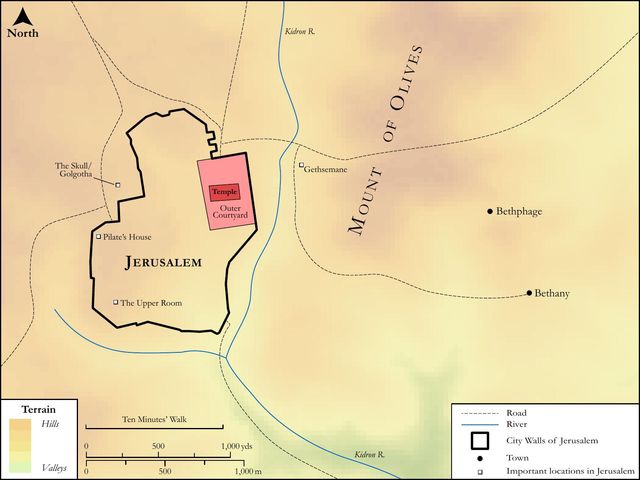
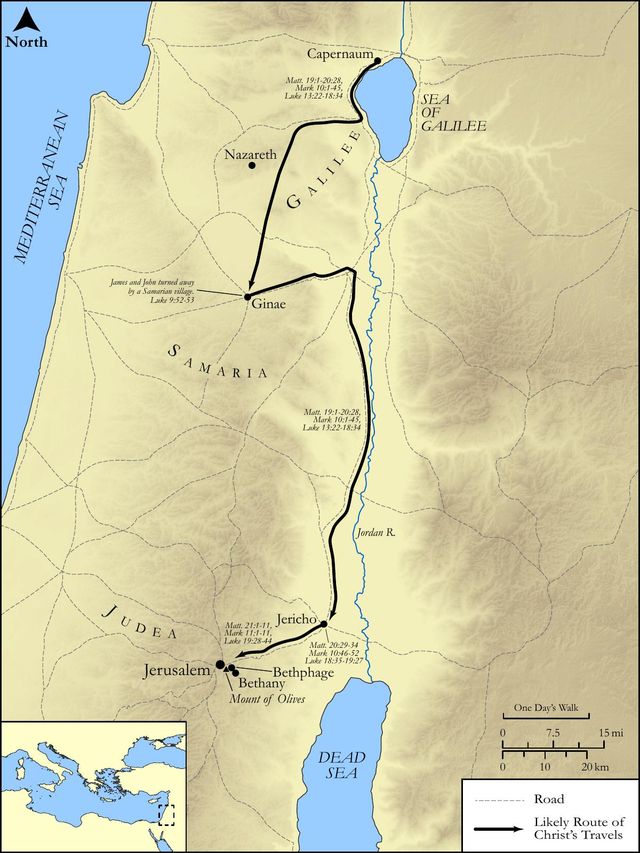
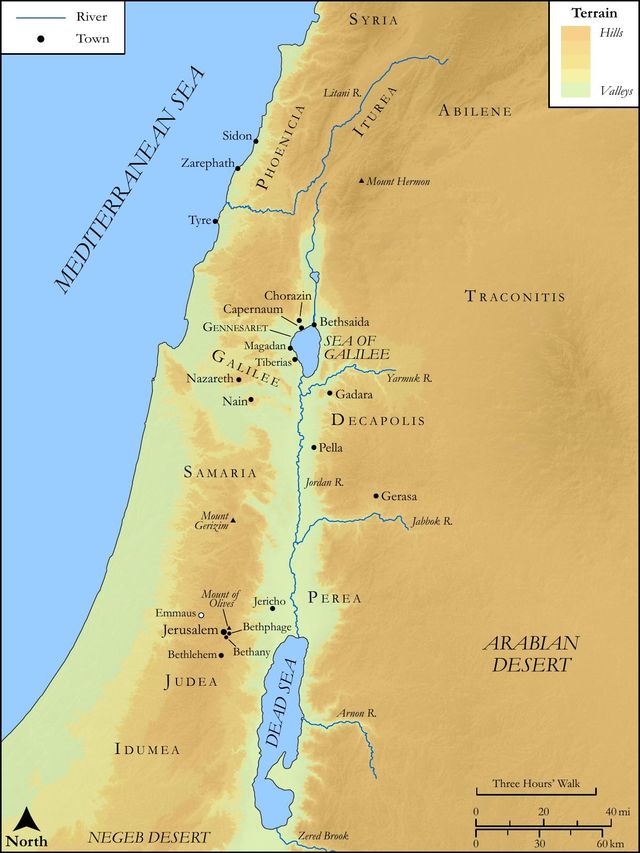
See on the biblical-era maps
Study this verse
Public-domain commentary
Matthew Henry
From his Commentary on the Whole Bible. Henry comments on passages, not single verses — this entry covers Luke 13:31–35.
Here is, I. A suggestion to Christ of his danger from Herod, now that he was in Galilee, within Herod's jurisdiction (Luk 13:31): Certain of the Pharisees (for there were those of that sect dispersed all the nation over) came to Christ, pretending friendship and a concern for his safety, and said, Get thee out of this country, and depart hence, for otherwise Herod will kill thee, as he did John. Some think that these Pharisees had no ground at all for this, that Herod had not given out any words to this purport, but that they framed this lie, to drive him out of Galilee, where he had a great and growing interest, and to drive him into Judea, where they knew there were those that really sought his life. But, Christ's answer being directed to Herod himself, it should seem that the Pharisees had ground for what they said, and that Herod was enraged against Christ, and designed him a mischief, for the honourable testimony he had borne to John Baptist, and to the doctrine of repentance which John preached. Herod was willing to get rid of Christ out of his dominions; and, when he durst not put him to death, he hoped to frighten him away by sending him this threatening message.
II.His defiance of Herod's rage and the Pharisees' too; he fears neither the one nor the other:
Go you, and tell that fox so, Luk 13:32. In calling him a fox, he gives him his true character; for he was subtle as a fox, noted for his craft, and treachery, and baseness, and preying (as they say of a fox) furthest from his own den. And, though it is a black and ugly character, yet it did not ill become Christ to give it to him, nor was it in him a violation of that law, Thou shalt not speak evil of the ruler of thy people. For Christ was a prophet, and prophets always had a liberty of speech in reproving princes and great men. Nay, Christ was more than a prophet, he was a king, he was King of kings, and the greatest of men were accountable to him, and therefore it became him to call this proud king by his own name; but it is not to be drawn into an example by us. "Go, and tell that fox, yea, and this fox too" (for so it is in the original, tē alōpeki tautē); "that Pharisee, whoever he is, that whispers this in my ear, let him know that I do not fear him, nor regard his menaces. For," 1. "I know that I must die, and must die shortly; I expect it, and count upon it, the third day," that is, "very shortly; my hour is at hand." Note, It will help us very much above the fear of death, and of them that have the power of death, to make death familiar to us, to expect it, think of it, and converse with it, and see it at the door. "If Herod should kill me, he will not surprise me." 2. "I know that death will be not only no prejudice to me, but that it will be my preferment; and therefore tell him I do not fear him; when I die, I shall be perfected. I shall then have finished the hardest part of my undertaking; I shall have completed my business;" teleioumai - I shall be consecrated. When Christ dies, he is said to have sanctified himself; he consecrated himself to his priestly office with his own blood. 3. "I know that neither he nor any one else can kill me till I have done my work. Go, and tell him that I value not his impotent rage. I will cast out devils, and do cures, today and tomorrow," that is, "now and for some little space of time yet to come, in spite of him and all his threats. I must walk, I must go on in my intended journey, and it is not in his power to hinder me. I must go about, as I do, preaching and healing, today, and tomorrow, and the day following." Note, It is good for us to look upon the time we have before us as but a little, two or three days perhaps may be the utmost, that we may thereby be quickened to do the work of the day in its day. And it is a comfort to us, in reference to the power and malice of our enemies, that they can have no power to take us off as long as God has any work for us to do. The witnesses were not slain till they had finished their testimony. 4. "I know that Herod can do me no harm, not only because my time is not yet come, but because the place appointed for my death is Jerusalem, which is not within his jurisdiction: It cannot be that a prophet perish out of Jerusalem," that is, "any where but at Jerusalem." If a true prophet was put to death, he was prosecuted as a false prophet. Now none undertook to try prophets, and to judge concerning them, but the great sanhedrim, which always sat at Jerusalem; it was a cause which the inferior courts did not take cognizance of, and therefore, if a prophet be put to death, it must be at Jerusalem.
III.His lamentation for Jerusalem, and his denunciation of wrath against that city, Luk 13:34, Luk 13:35.
This we had Mat 23:37-39. Perhaps this was not said now in Galilee, but the evangelist, not designing to bring it in in its proper place, inserts it here, upon occasion of Christ's mentioning his being put to death at Jerusalem.
Note, 1. The wickedness of persons and places that more eminently than others profess religion and relation to God is in a particular manner provoking and grieving to the Lord Jesus. How pathetically does he speak of the sin and ruin of that holy city! O Jerusalem! Jerusalem! 2. Those that enjoy great plenty of the means of grace, if they are not profited by them, are often prejudiced against them. They that would not hearken to the prophets, nor welcome those whom God had sent to them, killed them, and stoned them. If men's corruptions are not conquered, they are provoked. 3. Jesus Christ has shown himself willing, freely willing, to receive and entertain poor souls that come to him, and put themselves under his protection: How often would I have gathered thy children together, as a hen gathereth her brood under her wings, with such care and tenderness! 4. The reason why sinners are not protected and provided for by the Lord Jesus, as the chickens are by the hen, is because they will not: I would, I often would, and ye would not. Christ's willingness aggravates sinners' unwillingness, and leaves their blood upon their own heads. 5. The house that Christ leaves is left desolate. The temple, though richly adorned, though greatly frequented, is yet desolate if Christ has deserted it. He leaves it to them; they had made an idol of it, and let them take it to themselves, and make their best of it, Christ will trouble it no more. 6. Christ justly withdraws from those that drive him from them. They would not be gathered by him, and therefore, saith he, "You shall not see me, you shall not hear me, any more," as Moses said to Pharaoh, when he forbade him his presence, Exo 10:28, Exo 10:29. 7. The judgment of the great day will effectually convince unbelievers that would not now be convinced: "Then you will say, Blessed is he that cometh," that is, "you will be glad to be among those that say so, and will not see me to be the Messiah till then when it is too late."
Historical interpretation
Nine Centuries of Reception
7 surviving comments on this verse. Each one is dated, so this reads as a timeline rather than a list.
Select a marker to jump to its quote. Markers stagger vertically where authors wrote within a few decades of each other.
It was prophetic that Moses had given [the Israelites] the order to offer their sacrifices in one single place—there to offer the lamb in sacrifice and [there] to accomplish an image of the redemption. Herod did not kill [the Lord] with the infants of Bethlehem, nor did the Nazarenes when they hurled him down from the mountain, since it was not possible for him to die outside of Jerusalem. For it cannot be that a prophet should perish outside of Jerusalem. Take note that although it was Jerusalem that killed him, nevertheless Herod and Nazareth were united with regard to his death, and vengeance will be required of both for his death. Learn also from this that not only will vengeance for his blood be required of the inhabitants of Jerusalem, but also everyone who saw and denied him will be convicted for having killed him. In saying “between the sanctuary and the altar,” he has indeed shown their perversity, in that they did not respect even the place of atonement. The words, “How often would I have gathered your children together,” are similar to these, “See, these three years I have come, seeking fruit on this fig tree, and I find none.”
(in Esaiam c. 16. §. 301.) He compared also the sons of Jerusalem to birds in the net, as if He said, Birds who are used to fly in the air are caught by the treacherous devices of the catchers, but thou shalt be as a chicken in want of another's protection; when thy mother then has fled away, thou art taken from thy nest as too weak to defend thyself, too feeble to fly; as it follows, Behold, your house is left unto you desolate.
The preceding words of our Lord roused the Pharisees to anger. For they perceived that the people were now smitten in their hearts, and eagerly receiving His faith. For fear then of losing their office as rulers of the people, and lacking their gains, with pretended love for Him, they persuade Him to depart from hence, as it is said, The same day there came certain of the Pharisees, saying unto him, Get thee out and depart hence, for Herod will kill thee: but Christ, who searcheth the heart and the reins, answers them meekly and under figure. Hence it follows, And he said unto them, Go ye and tell that fox.
Or else the discourse seems to change here, and not to refer so much to the character of Herod as some think, as to the lies of the Pharisees. For He almost represents the Pharisees themselves to be standing near, when He said, Go tell this fox, as it is in the Greek. Therefore he commanded them to say that which might rouse the multitude of Pharisees. Behold, said He, I cast out devils, and I do cures to day and to morrow, and on the third day I shall be perfected. He promises to do what was displeasing to the Jews, namely, to command the evil spirits, and deliver the sick from disease, until in His own person He should undergo the suffering of the cross. But because the Pharisees thought that He who was the Lord of hosts, feared the hand of Herod. He refutes this, saying, Nevertheless I must walk to day and to morrow, and the day following. When He says must, He by no means implies a necessity imposed upon Him, but rather that He walked where He liked according to the inclination of His will, until He should come to the end of the dreadful cross, the time of which Christ shows to be now drawing near, when He says, To day and to morrow.
Because of his wiles and stratagems He calls Herod a fox, which is an animal full of craft, concealing itself in a ditch because of snares, having a noisome smell, never walking in straight paths, all which things belong to heretics, of whom Herod is a type, who endeavours to destroy Christ (that is, the humility of the Christian faith) in the hearts of believers.
In calling upon Jerusalem, He addresses not the stones and buildings of the city, but the dwellers therein, and He weeps over it with the affection of a father.
Now He who aptly had called Herod a fox, who was plotting His death, compares Himself to a bird, for foxes are ever lying in wait for birds.
The city itself which He had called the nest, He now calls the house of the Jews; for when our Lord was slain, the Romans came, and plundering it as a deserted nest, took away both their place, nation, and kingdom.
Ye shall not see, that is, unless ye have worked repentance, and confessed Me to be the Son of the Father Almighty, ye shall not see My face at the second coming.
Nevertheless, I must walk today and tomorrow, and the next day, for it is not possible for a prophet to perish outside of Jerusalem. Therefore, what he says, I cast out demons, and accomplish healings today and tomorrow, and on the third day I am perfected (Luke XIII), is referred to his body which is the Church. For demons are cast out, when the Gentiles believe in him, forsaking ancestral superstitions: and healings are accomplished, when life is lived according to his precepts, after renouncing the devil and this world until the end of the resurrection. By which, as if on the third day, it will be perfected to fullness like the angels, that is, the Church will be perfected through the immortality of the body.
As if He says, What think ye of My death? Behold, a little while, and it will come to pass. But by the words, To day and to morrow, are signified many days; as we also are wont to say in common conversation, "To day and to morrow such a thing takes place," not that it happens in that interval of time. And to explain more clearly the words of the Gospel, you must not understand them to be, I must walk to day and to morrow, but place a stop after to day and to morrow, then add, and walk on the day following, as frequently in reckoning we are accustomed to say, "The Lord's day and the day after, and on the third I will go out," as if by reckoning two, to denote the third. So also our Lord speaks as if calculating, I must do so to day, and so to morrow, and then afterward on the third day I must go to Jerusalem.
But because they said unto Him, Depart from hence, for Herod seeks to kill thee, speaking in Galilee where Herod reigned, He shows that not in Galilee, but in Jerusalem it had been fore-ordained that He should suffer. Hence it follows, For it can not be that a prophet perish out of Jerusalem. When thou hearest, It can not be (or it is not fitting) that a prophet should perish out of Jerusalem, think not that any violent constraint was imposed upon the Jews, but He says this seasonably with reference to their eager desire after blood; just as if any one seeing a most savage robber, should say, the road on which this robber lurks can not be without bloodshed to travellers. So also no where else but in the abode of robbers must the Lord of the prophets perish. For accustomed to the blood of His prophets, they will also kill the Lord; as it follows, O Jerusalem, Jerusalem, which killest the prophets.
Or your house, (that is, temple,) as if He says, As long as there was virtue in you, it was my temple, but after that you made it a den of thieves, it was no more my house but yours. Or by house He meant the whole Jewish nation, according to the Psalm, O house of Jacob, bless ye the Lord, (Psalm 135:20.) by which he shows that it was He Himself who governed them, and took them out of the hand of their enemies. It follows, And verily I say unto you, &c.
For then also will they unwillingly confess Him to be their Lord and Saviour, when there shall be no departure hence. But in saying, Ye shall not see me until he shall come, &c. does not signify that present hour, but the time of His cross; as if He says, When ye have crucified Me, ye shall no more see Me until I come again.
(Severus.) But the repetition of the name also shows the rebuke to be severe. For she who knew God, how does she persecute God's ministers?
Continue studying Luke 13:33 across the web’s major study libraries — every link below opens this exact verse, chapter, or book on the destination site.
Read & Compare
 BibleGatewayThis verse in more than 200 translations and 70 languages.
 Bible.comThe YouVersion reader — hundreds of translations, reading plans, and highlights.
 ESV.orgCrossway's official English Standard Version reader.
 NET BibleThe NET translation with 60,000+ translators' notes on every rendering decision.
 STEP BibleTyndale House's free study tool — original text, vocabulary, and scholarly resources.
 BibliaLogos Bible Software's free web reader.
 USCCBThe New American Bible (Revised Edition) with the U.S. bishops' study notes.
Commentaries
 BibleHub CommentariesDozens of classic commentaries on this verse, gathered on one page.
 StudyLightMore than 100 commentary sets — the largest collection on the web.
 BibleRefPlain-English commentary on what this verse means, verse by verse.
 Enduring WordDavid Guzik's free commentary on this chapter, widely used by Bible teachers.
 Bible Study ToolsVerse commentary alongside Greek and Hebrew study aids.
Original Language & Research
- BibleHub InterlinearThe verse word by word — original language, transliteration, and English.
- BibleHub LexiconEvery word's original-language definition and Strong's entry.
 Blue Letter BibleDeep-study tools — Strong's numbers, concordance, and word studies.
 CNTR CollationThe earliest Greek manuscripts of this verse, collated letter by letter.
Sermons, Hymns & Audio


TrulyRandomVerse is not affiliated with these sites and doesn’t control their content. They’re linked because they’re genuinely useful.
Summary
In Jesus declares His unwavering commitment to His divinely appointed path, asserting that He "must walk" towards Jerusalem despite the threat from Herod Antipas. This statement underscores His sovereign control over His own destiny and timing, emphasizing that His ultimate sacrifice as a prophet, like those before Him, is inextricably linked to the city of Jerusalem, the very place where God's messengers have historically been rejected and put to death.
Context
ShowHideLiterary Context
This verse is part of a larger narrative in Luke's Gospel where Jesus is resolutely journeying towards Jerusalem, the place of His passion. Immediately preceding Luke 13:33, some Pharisees warn Jesus that Herod Antipas seeks to kill Him (Luke 13:31). Jesus' response, calling Herod a "fox" and declaring His necessary work of healing and casting out demons "to day and to morrow, and the third day" (Luke 13:32), sets the stage for the profound statement in Luke 13:33. The verse also directly prefaces Jesus' poignant lament over Jerusalem in Luke 13:34-35, reinforcing the city's tragic role in the history of God's prophets and its ultimate rejection of the Messiah. This entire section highlights Jesus' divine authority and His determined march towards His redemptive purpose in the capital city.
Historical & Cultural Context
Herod Antipas, the tetrarch of Galilee and Perea, was known for his cunning and ruthlessness, exemplified by his execution of John the Baptist (Luke 3:19-20). His desire to kill Jesus reflects the political and religious tensions of the time, as Jesus' growing popularity challenged both Roman authority and the Jewish religious establishment. Jerusalem, as the religious and political center of Judaism, held immense significance. It was the seat of the Temple, the Sanhedrin, and the destination for all major Jewish festivals. Culturally, there was a deeply ingrained pattern of prophetic rejection and persecution within Israel's history, often culminating in the prophets' deaths in or near Jerusalem. Jesus' statement about a prophet perishing "out of Jerusalem" taps into this historical memory, acknowledging the city's tragic reputation as the slayer of God's messengers, a theme echoed in other prophetic warnings (e.g., Jeremiah 26:20-23).
Key Themes
ShowHideLuke 13:33 powerfully articulates several key themes central to Luke's Gospel and the broader biblical narrative. Firstly, it underscores Divine Sovereignty and Necessity: Jesus' use of "I must walk" (Greek dei) signifies a divine imperative, not a human choice, emphasizing that His path and ultimate fate are part of God's predetermined plan, unthwarted by human threats. Secondly, the verse highlights Prophetic Destiny and Suffering: Jesus identifies Himself with the long line of prophets who suffered and were rejected, foreshadowing His own impending passion. The phrase "it cannot be that a prophet perish out of Jerusalem" encapsulates the tragic historical pattern of Jerusalem rejecting and killing God's messengers, a pattern Jesus Himself will fulfill as the ultimate Prophet. Thirdly, it demonstrates Unwavering Resolve and Courage: Despite knowing the certain suffering and death that await Him in Jerusalem, Jesus exhibits profound courage and an unshakeable determination to complete His ministry and fulfill God's redemptive purpose, setting an example for His disciples to follow the path of costly obedience (Luke 9:23).
Exposition and Analysis
ShowHideKey Word Analysis
ShowHideThis impersonal verb signifies a divine necessity or obligation. It conveys that Jesus' actions are not merely a personal choice or a human compulsion, but an expression of what is divinely appointed and inescapable for the fulfillment of God's redemptive plan. It implies a sense of destiny and divine imperative, highlighting that His journey and ultimate sacrifice are part of God's sovereign will, not subject to human interference or fear.
This verb means "to destroy fully," "to perish," or "to lose." In this context, it refers to the violent death of a prophet. Jesus uses it to describe the fate awaiting Him in Jerusalem, linking His impending death to the historical pattern of prophets being killed in the holy city. It underscores the severity and finality of the rejection that God's messengers, including Jesus Himself, faced.
The capital of Palestine, Jerusalem is more than just a geographical location here; it functions as a symbolic representation of the religious and political heart of Israel. It is the city where God's presence was uniquely manifested in the Temple, yet tragically, it was also the place that consistently rejected and killed God's prophets. Jesus' specific mention of Jerusalem highlights its paradoxical role as both the holy city and the place of prophetic martyrdom, setting the stage for His lament over its spiritual blindness.
Verse Breakdown
ShowHide"Nevertheless I must walk to day, and to morrow, and the day following"
This clause reveals Jesus' resolute determination and divine timetable. "Nevertheless" (G4133 plḗn) indicates a strong contrast to Herod's threat, asserting that external dangers will not deter Him. The phrase "I must walk" (G1163 deî + G4198 poreúomai) conveys a divine imperative; Jesus is not merely choosing to go but is compelled by God's will. The temporal progression "to day, and to morrow, and the day following" is a Semitic idiom for a short, definite period of time, emphasizing that His ministry, including healing and teaching, will continue uninterrupted until its divinely appointed climax in Jerusalem.
"for it cannot be that a prophet perish out of Jerusalem."
This clause provides the reason for Jesus' unwavering journey towards the capital. The phrase "it cannot be" (G3756 ou + G1735 endéchetai) expresses an impossibility or an unlikelihood based on established pattern. It is a profound, ironic statement rooted in Jerusalem's tragic history. The city, meant to be the center of God's worship and revelation, had become notorious as the place where God's prophets were rejected, persecuted, and killed. Jesus, the greatest Prophet, acknowledges that His own death will fulfill this sorrowful pattern, making Jerusalem the inevitable location for His ultimate sacrifice.
Literary Devices
ShowHideLuke 13:33 is rich with literary artistry. Irony is prominent, as Jesus' statement about prophets perishing in Jerusalem is both a historical observation and a chilling prophecy of His own fate. The very city that should welcome God's messengers is the one that destroys them. There is also strong Foreshadowing, as Jesus explicitly points to His impending death in Jerusalem, setting the tone for the passion narrative that dominates the latter part of Luke's Gospel. The phrase "to day, and to morrow, and the day following" functions as a Merism, a figure of speech where two contrasting parts represent a whole, indicating a short, definite period of time until His mission's culmination. Furthermore, Symbolism is at play with Jerusalem not merely as a geographical location but as a symbol of Israel's historical rejection of God's messengers and its spiritual blindness, a theme Jesus will lament over in the subsequent verses (Luke 13:34-35).
Theological and Thematic Connections
ShowHideLuke 13:33 profoundly underscores the theme of divine sovereignty and the necessity of Christ's suffering. Jesus' declaration of "I must walk" signifies that His journey to Jerusalem and His ultimate death were not accidental or forced by human adversaries, but were part of God's predetermined plan for salvation. This verse highlights Jesus' self-awareness as the climactic prophet in a long line of God's messengers who faced rejection and persecution, culminating in His own sacrificial death in Jerusalem. It reveals the paradox of God's chosen city becoming the place of His Son's crucifixion, a testament to humanity's deep-seated rebellion against divine truth, yet simultaneously the very place where God's redemptive plan would be fully realized through the atoning work of Christ.
Reflection and Application
ShowHideLuke 13:33 offers a powerful model of faithful obedience and unwavering resolve in the face of certain suffering. Jesus' commitment to His divine purpose, even when it led to His death, challenges believers to consider the true cost of following Christ. It reminds us that our lives, like His, are part of a larger divine narrative, and that God's purposes will ultimately prevail, regardless of human opposition or perceived threats. This verse encourages us to trust in God's sovereign timing and plan, even when the path is difficult or leads through hardship. It calls us to persevere in our God-given callings, knowing that our ultimate security and fulfillment are found in faithfully walking the path He has set before us, rather than seeking to avoid discomfort or danger. It also serves as a sobering reminder of the consequences of rejecting God's truth and His messengers, urging us to respond with humility and repentance to the divine invitations we receive.
Questions for Reflection
ShowHideFAQ
ShowHideWhy does Jesus say "I must walk to day, and to morrow, and the day following"?
ShowHideJesus' statement "I must walk to day, and to morrow, and the day following" signifies His divinely appointed schedule and unwavering commitment to His mission. The Greek word for "must" (G1163 deî) indicates a divine necessity or obligation, not merely a personal choice. It means His actions are compelled by God's will and are essential for the fulfillment of God's redemptive plan. The phrase "to day, and to morrow, and the day following" is a common Semitic idiom for a short, definite period of time, emphasizing that He will continue His ministry of healing and teaching for the appointed duration before His ultimate journey to Jerusalem for His crucifixion (Luke 13:32).
What is the significance of Jerusalem in this verse?
ShowHideJerusalem holds profound significance in Luke 13:33. It is referred to as the city where "a prophet perish out of Jerusalem." Historically, Jerusalem was the spiritual and political capital of Israel, the place where the Temple stood and where God's presence was uniquely manifested. However, it also had a tragic history of rejecting and killing God's prophets, as Jesus laments in Matthew 23:37. Jesus' statement is deeply ironic; the city that should have been the most receptive to God's messengers became the place of their martyrdom. By declaring that He, too, must "perish out of Jerusalem," Jesus identifies Himself with this long line of rejected prophets, simultaneously prophesying His own impending death in the city and highlighting its unique, sorrowful role in salvation history.
Did Herod Antipas truly want to kill Jesus?
ShowHideWhile the Pharisees' warning in Luke 13:31 suggests Herod Antipas wanted to kill Jesus, Jesus' response in Luke 13:32, calling Herod a "fox," indicates that Jesus saw Herod's threat as cunning but ultimately ineffectual against His divine timetable. Herod had previously executed John the Baptist (Luke 3:19-20) and was known for his suspicious and volatile nature. It is plausible Herod felt threatened by Jesus' growing influence. However, Jesus' statement in Luke 13:33 asserts that His fate was not in Herod's hands, but divinely predetermined to culminate in Jerusalem, not at the whim of a regional ruler.
Christ-Centered Fulfillment
ShowHideLuke 13:33 powerfully foreshadows the Christ-centered fulfillment of God's redemptive plan. Jesus' declaration, "I must walk to day, and to morrow, and the day following: for it cannot be that a prophet perish out of Jerusalem," reveals His self-awareness as the ultimate Prophet whose suffering and death were not a tragic accident but a divine necessity. His journey to Jerusalem, the city notorious for killing prophets, was the deliberate fulfillment of Old Testament prophecies concerning the Suffering Servant (Isaiah 53). Jesus, the Lamb of God (John 1:29), willingly embraced this path, knowing that His death in Jerusalem would be the climactic act of atonement for the sins of the world. His "perishing" was not an end but the means to new life, for through His crucifixion and resurrection, He conquered sin and death, opening the way for all who believe to receive eternal salvation. Thus, Jerusalem, the place of prophetic martyrdom, became the stage for the greatest act of divine love and the ultimate triumph of God's redemptive purpose, demonstrating that even humanity's darkest acts of rejection were woven into God's perfect plan for our salvation (Acts 2:23).