


Nehemiah 12:43
Bible text: King James Version (1769 Blayney text) · Public domain
Bible text: King James Version with Strong's numbers · Public domain
Bible text: Berean Standard Bible · Public domain
Bible text: American Standard Version (1901) · Public domain
Bible text: World English Bible, Messianic edition · Public domain
Bible text: Geneva Bible (1599) · Public domain
Bible text: Young's Literal Translation · Public domain
- וַיִּזְבְּחוּvai·yiz·be·Chuand they sacrificedH2076Conj-w ¦ V-Qal-ConsecImperf-3mpVerb Qal Consecutive Imperfect 3rd Plural Masculineוַandיִּזְבְּחוּthey sacrificed
- בַיּוֹםvai·yomon the dayH3117Prep-b ¦ N-msNoun Singular Masculine Absoluteבַon theיּוֹםday
- הַהוּאHa·hu'<the> thatH1931Art ¦ Pro-3msPronoun Personal 3rd Singular Masculineהַ<the>הוּאthat
- זְבָחִיםze·va·ChimsacrificesH2077N-mpNoun Plural Masculine Absolute
- גְּדוֹלִיםge·do·LimgreatH1419Adj-mpAdjective Plural Masculine Absolute
- וַיִּשְׂמָחוּvai·yis·Ma·chuand they rejoicedH8055Conj-w ¦ V-Qal-ConsecImperf-3mpVerb Qal Consecutive Imperfect 3rd Plural Masculineוַandיִּשְׂמָחוּthey rejoiced
- כִּיkiforH3588PrtParticle Conditional
- הָאֱלֹהִיםha·'E·lo·Him<the> GodH430Art ¦ N-mpNoun Plural Masculine Absoluteהָ<the>אֱלֹהִיםGod
- שִׂמְּחָםsi·me·Chamhe had made rejoice themH8055V-Piel-Perf-3ms ¦ 3mpVerb Piel Perfect 3rd Singular Masculineשִׂמְּחָhe had made rejoiceםthem
- שִׂמְחָהsim·ChahjoyH8057N-fsNoun Singular Feminine Absolute
- גְדוֹלָהge·do·LahgreatH1419Adj-fsAdjective Singular Feminine Absolute
- וְגַםve·Gamand alsoH1571Conj-w ¦ AdvAdverbוְandגַםalso
- הַנָּשִׁיםha·na·Shimthe womenH802Art ¦ N-mpNoun Plural Masculine Absoluteהַtheנָּשִׁיםwomen
- וְהַיְלָדִיםve·hay·la·Dimand the childrenH3206Conj-w ¦ Art ¦ N-mpNoun Plural Masculine Absoluteוְandהַtheיְלָדִיםchildren
- שָׂמֵחוּsa·Me·chuthey rejoicedH8055V-Qal-Perf-3cpVerb Qal Perfect 3rd Plural common gender
- וַתִּשָּׁמַעva·ti·sha·Ma'and it was heardH8085Conj-w ¦ V-Niphal-ConsecImperf-3fsVerb Niphal Consecutive Imperfect 3rd Singular Feminineוַandתִּשָּׁמַעit was heard
- שִׂמְחַתsim·Chat[the] rejoicing ofH8057N-fscNoun Singular Feminine Construct
- יְרוּשָׁלִַםye·ru·sha·LimJerusalemH3389N-properNoun Proper Location
- מֵרָחוֹקme·ra·Chokfrom a distanceH7350Prep-m ¦ Adj-msAdjective Singular Masculine Absoluteמֵfromרָחוֹקa distance
English is a literal word-by-word gloss of the Hebrew, not the KJV's wording. Why?
This is the original text the KJV's translators worked from — each Hebrew word with its own literal English meaning in this verse, prepared by scholars at Tyndale House, Cambridge. The KJV translates whole sentences, not word by word, so its wording differs: one Hebrew word can become several English words, and the KJV may choose “the LORD” where the gloss reads “Yahweh”. Both are faithful — they answer different questions. For the KJV's own rendering, switch to the KJV text.
Details
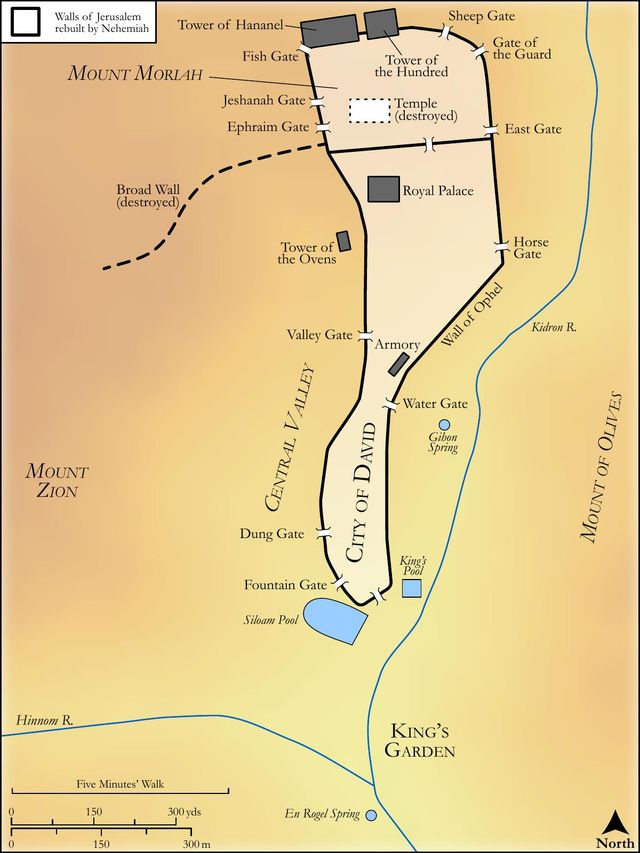
See on the biblical-era map
Study this verse
Public-domain commentary
Matthew Henry
From his Commentary on the Whole Bible. Henry comments on passages, not single verses — this entry covers Nehemiah 12:27–43.
We have read of the building of the wall of Jerusalem with a great deal of fear and trembling; we have here an account of the dedicating of it with a great deal of joy and triumph. Those that sow in tears shall thus reap.
I.We must enquire what was the meaning of this dedication of the wall; we will suppose it to include the dedication of the city too (continens pro contentothe thing containing for the thing contained), and therefore it was not done till the city was pretty well replenished, Neh 11:1. It was a solemn thanksgiving to God for his great mercy to them in the perfecting of this undertaking, of which they were the more sensible because of the difficulty and opposition they had met with in it. 2. They hereby devoted the city in a peculiar manner to God and to his honour, and took possession of it for him and in his name. All our cities, all our houses, must have holiness to the Lord written upon them; but this city was (so as never any other was) a holy city, the city of the great King (Psa 48:2 and Mat 5:35): it had been so ever since God chose it to put his name there, and as such, it being now refitted, it was afresh dedicated to God by the builders and inhabitants, in token of their acknowledgment that they were his tenants, and their desire that it might still be is and that the property of it might never be altered. Whatever is done for their safety, ease, and comfort, must be designed for God's honour and glory. 3. They hereby put the city and its walls under the divine protection, owning that unless the Lord kept the city the walls were built in vain. When this city was in possession of the Jebusites, they committed the guardianship of it to their gods, though they were blind and lame ones, Sa2 5:6. With much more reason do the people of God commit it to his keeping who is all-wise and almighty. The superstitious founders of cities had an eye to the lucky position of the heavens (see Mr. Gregory's works, p. 29, etc.); but these pious founders had an eye to God only, to his providence, and not to fortune.
II.We must observe with what solemnity it was performed, under the direction of Neh 1:1-11.
The Levites from all parts of the country were summoned to attend. The city must be dedicated to God, and therefore his ministers must be employed in the dedicating of it, and the surrender must pass through their hands. When those solemn feasts were over (ch. 8 and 9) they went home to their respective posts, to mind their cures in the country; but now their presence and assistance were again called for. 2. Pursuant to this summons, there was a general rendezvous of all the Levites, Neh 12:28, Neh 12:29. Observe in what method they proceeded. (1.) They purified themselves, Neh 12:30. We are concerned to cleanse our hands, and purify our hearts, when any work for God is to pass through them. They purified themselves and then the people. Those that would be instrumental to sanctify others must sanctify themselves, and set themselves apart for God, with purity of mind and sincerity of intention. Then they purified the gates and the wall. Then may we expect comfort when we are prepared to receive it. To the pure all things are pure (Tit 1:15); and, to those who are sanctified, houses and tables, and all their creature comforts and enjoyments, are sanctified, Ti1 4:4, Ti1 4:5. This purification was performed, it is probable, by sprinkling the water of purifying (or of separation, as it is called, Num 19:9) on themselves and the people, the walls and the gates - a type of the blood of Christ, with which our consciences being purged from dead works, we become fit to serve the living God (Heb 9:14) and to be his care. (2.) The princes, priests, and Levites, walked round upon the wall in two companies, with musical instruments, to signify the dedication of it all to God, the whole circuit of it (Neh 12:36); so that it is likely they sung psalms as they went along, to the praise and glory of God. This procession is here largely described. They had a rendezvous at one certain lace, where they divided themselves into two companies. Half of the princes, with several priests and Levites, went on the right hand, Ezra leading their van, Neh 12:36. The other half of the princes and priests, who gave thanks likewise, went to the left hand, Nehemiah bringing up the rear, Neh 12:38. At length both companies met in the temple, where they joined their thanksgivings, Neh 12:40. The crowd of people, it is likely, walked on the ground, some within the wall and others without, one end of this ceremony being to affect them with the mercy they were giving thanks for, and to perpetuate the remembrance of it among them. Processions, for such purposes, have their use. (3.) The people greatly rejoiced, Neh 12:43. While the princes, priests, and Levites, testified their joy and thankfulness by great sacrifices, sound of trumpet, musical instruments, and songs of praise, the common people testified theirs by loud shouts, which were heard afar off, further than the more harmonious sound of their songs and music: and these shouts, coming from a sincere and hearty joy, are here taken notice of; for God overlooks not, but graciously accepts, the honest zealous services of mean people, though there is in them little of art and they are far from being fine. It is observed that the women and children rejoiced; and their hosannas were not despised, but recorded to their praise. All that share in public mercies ought to join in public thanksgivings. The reason given is that God had made them rejoice with great joy. He had given them both matter for joy and hearts to rejoice; his providence had made them safe and easy, and then his grace made them cheerful and thankful. The baffled opposition of their enemies, no doubt, added to their joy and mixed triumph with it. Great mercies call for the most solemn returns of praise, in the courts of the Lord's house, in the midst of thee, O Jerusalem!
Historical interpretation
Historical reception
2 surviving comments on this verse. Each one is dated, so this reads as a timeline rather than a list.
And they sacrificed great victims on that day, etc. On that day of perpetual light (about which Zachariah said: And there shall be one day which is known to the Lord, not day nor night: that is, removed from the experience of passing times) the chosen sacrifice great victims to the Lord, namely those which the Psalmist, tasting in the hope of future things, said: You have broken my bonds, I will offer to you the sacrifice of praise (Psalm 115). He also rightly shows where he hoped to sacrifice this victim, when he immediately adds: I will pay my vows to the Lord in the courts of the house of the Lord, in the presence of all his people, in the midst of you, Jerusalem. For in the midst of Jerusalem we render our vows to God in the presence of all his people, when in the heavenly homeland with the entire assembly of saints gathered, we offer him those praises for which we now groan and which we daily long for with a desire for grace.
For God had made them rejoice with great joy, etc. These things truly pertain to the edification of that holy city which is in the future, in which God is the king who gladdens His citizens with His presence, indeed with great joy; hence, when the king was born in the flesh, the angel appearing to the shepherds said: Behold, I bring you good tidings of great joy, which will be to all people (Luke 2). This is in clear distinction from human joy, which is both small and transient; and therefore, the wise should consider it of little value. However, in that joy which God grants to His city, it is well mentioned that the wives of the citizens, together with their children, also rejoiced; because at the time of the resurrection, not only those who had either preached the word or steadfastly endured in the works of faith will receive the great reward of their great labors, but also the weaker ones, those who shared the same faith, will rejoice together with them in the same reception of eternal life. For the Lord blessed all those who feared Him, the small together with the great (Psalm 115). This dedication can also be understood in this life metaphorically, in some chosen ones, who, having purified the eye of the heart, are worthy to contemplate part of the joys which the whole Church will fully receive in the future, like Isaiah, Ezekiel, Daniel, and the other prophets; like the apostles (Matthew 17), who rejoiced to see the Lord glorified on the holy mountain; like Paul (2 Corinthians 12), who was worthy to be caught up into paradise and the third heaven; like John in the Apocalypse, who, the higher they ascended into the lofty heights of the heavenly city, the more clearly they took care to sing the praises of the Lord and always to offer Him the greatest sacrifices of good works.
Continue studying Nehemiah 12:43 across the web’s major study libraries — every link below opens this exact verse, chapter, or book on the destination site.
Read & Compare
 BibleGatewayThis verse in more than 200 translations and 70 languages.
 Bible.comThe YouVersion reader — hundreds of translations, reading plans, and highlights.
 ESV.orgCrossway's official English Standard Version reader.
 NET BibleThe NET translation with 60,000+ translators' notes on every rendering decision.
 STEP BibleTyndale House's free study tool — original text, vocabulary, and scholarly resources.
 BibliaLogos Bible Software's free web reader.
 USCCBThe New American Bible (Revised Edition) with the U.S. bishops' study notes.
Commentaries
 BibleHub CommentariesDozens of classic commentaries on this verse, gathered on one page.
 StudyLightMore than 100 commentary sets — the largest collection on the web.
 BibleRefPlain-English commentary on what this verse means, verse by verse.
 Enduring WordDavid Guzik's free commentary on this chapter, widely used by Bible teachers.
 Bible Study ToolsVerse commentary alongside Greek and Hebrew study aids.
Original Language & Research
- BibleHub InterlinearThe verse word by word — original language, transliteration, and English.
- BibleHub LexiconEvery word's original-language definition and Strong's entry.
 Blue Letter BibleDeep-study tools — Strong's numbers, concordance, and word studies.
 SefariaThe Hebrew text with Rashi and centuries of Jewish commentary.
Sermons, Hymns & Audio


TrulyRandomVerse is not affiliated with these sites and doesn’t control their content. They’re linked because they’re genuinely useful.
Summary
Nehemiah 12:43 vividly portrays a moment of overwhelming, divinely-orchestrated jubilation during the dedication of Jerusalem's newly rebuilt walls. This verse marks the triumphant culmination of arduous labor, unwavering perseverance, and miraculous divine intervention, resulting in a profound, corporate joy that permeated every segment of the community—men, women, and children—and resonated far beyond the city's boundaries, serving as a powerful testament to God's faithfulness, His restorative power, and the spiritual renewal of His people.
Context
ShowHideLiterary Context
Nehemiah 12:43 serves as the climactic conclusion to the detailed account of the dedication ceremony for the rebuilt walls of Jerusalem, a monumental event extensively described throughout Nehemiah 12. Following the miraculous completion of the wall in a mere fifty-two days, despite intense and persistent opposition (Nehemiah 6:15), the people gathered for a grand and solemn celebration. The chapter meticulously outlines the procession of two large thanksgiving choirs, led by Ezra and Nehemiah, who marched along the top of the newly consecrated wall in opposite directions, ultimately converging at the Temple. This elaborate procession, accompanied by a symphony of musical instruments, the offering of significant sacrifices, and communal worship, transcended a mere civic event; it was a profound act of spiritual recommitment and heartfelt thanksgiving. The extraordinary joy described in verse 43 represents the emotional and spiritual apex of this entire dedication, signifying not only the successful physical restoration of the city but, more importantly, the spiritual renewal and re-establishment of its inhabitants, building upon the earlier covenant renewal under Ezra's leadership in Nehemiah 8.
Historical & Cultural Context
This verse is situated in the post-exilic period, approximately 445 BC, following the return of the Jewish exiles from their seventy-year captivity in Babylon. For generations, Jerusalem had lain in desolate ruins, its protective walls broken and its gates burned, leaving its inhabitants vulnerable to enemies and deeply demoralized. The arduous task of rebuilding these walls, undertaken under the inspired and resolute leadership of Nehemiah, was far more than a mere construction project; it was a profound symbolic act of national and spiritual rebirth. In Israel, city walls were indispensable for security, defining civic identity, and representing the strength, prosperity, and sovereignty of a community. Their successful completion meant not only physical protection from adversaries but also the re-establishment of a distinct Jewish identity and autonomy in their ancestral homeland. The "great sacrifices" offered were central to Israelite worship and covenant practice, signifying atonement, thanksgiving, and the renewal of their covenant relationship with God, performed at the newly restored Temple. The communal nature of the celebration, explicitly involving "wives also and the children," reflects the deep-seated cultural value of family and corporate participation in religious festivals and national triumphs, emphasizing that the joy was universally shared across all generations.
Key Themes
ShowHideNehemiah 12:43 powerfully encapsulates several overarching themes prevalent throughout the book of Nehemiah and the broader Old Testament narrative. Foremost is the sovereignty and faithfulness of God, who orchestrates events, empowers His people, and enables them to accomplish seemingly impossible tasks, as profoundly evidenced by the declaration "for God had made them rejoice." This divine enablement underscores that true, deep-seated joy is ultimately a gift from the Lord, not merely a fleeting human emotion or a product of circumstances. Another critical theme is restoration and renewal, encompassing both the physical rebuilding of the walls and the spiritual revitalization of the people, highlighted by their recommitment to the Law (as seen in Nehemiah 9). The overwhelming joy described is a direct and overflowing outcome of witnessing God's promises of restoration fulfilled after years of desolation and despair. The verse also underscores the vital importance of corporate worship and communal celebration, demonstrating how shared thanksgiving and praise unify a people, strengthening their collective identity and faith. Finally, the vivid image that "the joy of Jerusalem was heard even afar off" speaks powerfully to the theme of God's glory as a witness to the nations, illustrating that the blessings bestowed upon His people are intended to be a visible and audible testimony to the surrounding world, drawing attention to the power, presence, and character of the God of Israel.
Exposition and Analysis
ShowHideKey Word Analysis
ShowHideThis adjective, appearing twice in the verse ("great sacrifices," "great joy"), signifies magnitude, importance, and intensity. It describes something large, mighty, or exceeding in measure. In the context of "great sacrifices," it implies offerings of significant quantity and quality, reflecting the depth of the people's gratitude and devotion. When applied to "great joy," it emphasizes an overwhelming, profound, and pervasive gladness that transcended ordinary happiness, indicating a divine measure of exhilaration.
This primitive root verb, used both descriptively ("they rejoiced") and causatively ("God had made them rejoice"), denotes a state of deep gladness, blithesomeness, or glee. It often carries connotations of celebration, festivity, and divine favor. Its repetition underscores the pervasive and intense nature of the emotion felt by the entire community. When God is the one "making them rejoice," it highlights His active role in infusing this profound happiness, signifying that their joy was not merely a human response but a divinely inspired experience.
This noun, derived from the verb sâmach, refers to the state of blithesomeness or glee itself, often in a context of religious or festival celebration. Its use here, especially in the phrase "great joy," emphasizes the overwhelming and overflowing nature of the gladness experienced. It is a robust, celebratory joy that springs from a sense of well-being, divine deliverance, and the fulfillment of God's promises, distinguishing it from fleeting happiness.
Verse Breakdown
ShowHide"Also that day they offered great sacrifices,"
This opening clause immediately establishes the context of the day as one of solemn worship and profound gratitude. The "great sacrifices" signify not only the quantity but also the sincerity and magnitude of their thanksgiving and devotion. These offerings were a tangible expression of their acknowledgment of God's hand in their success and their desire for His continued favor, central to their covenant relationship.
"and rejoiced:"
This simple yet powerful declaration introduces the central theme of the verse. It confirms that the sacrifices were accompanied by genuine, heartfelt gladness, indicating a spiritual state of elation that was a natural outflow of their worship and recognition of God's goodness.
"for God had made them rejoice with great joy:"
This is the theological core of the verse, providing the divine explanation for their extraordinary gladness. The joy was not self-generated or merely circumstantial; it was a direct, supernatural gift and active work of God. The phrase "great joy" (Hebrew: simchah gəḏōlâ) intensifies the description, indicating an overwhelming, overflowing happiness that transcended ordinary human emotion, underscoring that God's active involvement ensured the depth and authenticity of their celebration.
"the wives also and the children rejoiced:"
This crucial detail highlights the comprehensive and inclusive nature of the celebration. The joy was not confined to the men who had labored on the wall or the religious leaders. It permeated every household and generation, underscoring the corporate unity and shared experience of divine blessing. The participation of women and children signifies a complete communal embrace of the restoration and the accompanying spiritual revival, emphasizing that God's blessing touched every part of society.
"so that the joy of Jerusalem was heard even afar off."
This concluding clause emphasizes the extraordinary magnitude and public nature of their joy. The sound of their celebration was so immense that it reached beyond the city limits, serving as an audible testimony to surrounding regions. This hyperbole underscores the overwhelming nature of their gladness and suggests that God's blessing on His people was meant to be a visible and audible witness to the world, proclaiming His power and faithfulness to all who would hear.
Literary Devices
ShowHideNehemiah 12:43 is rich in literary devices that amplify its profound message of divine joy and communal celebration. The most prominent is Repetition, particularly of the root for "rejoice" (śāmach and its noun form śimchah). The verb "rejoiced" appears multiple times, and the noun "joy" appears twice, culminating in the emphatic phrase "rejoice with great joy." This deliberate repetition creates a powerful sense of overwhelming, pervasive gladness, underscoring that joy was the dominant and defining emotion of the day, and that its source was singular and divine. Hyperbole is also vividly evident in the concluding phrase, "so that the joy of Jerusalem was heard even afar off." While the celebration was undoubtedly loud and enthusiastic, this exaggeration emphasizes the extraordinary intensity and widespread nature of the jubilation, suggesting it was almost supernaturally loud, serving as a powerful, undeniable testimony to the surrounding nations. The verse also employs a clear sense of Cause and Effect, where the offering of sacrifices and, more significantly, the divine act of "making them rejoice" directly lead to the widespread and audibly expressed joy, highlighting the theological connection between worship, divine blessing, and communal celebration.
Theological and Thematic Connections
ShowHideNehemiah 12:43 profoundly illustrates that genuine, lasting joy is ultimately a divine gift, flowing from God's faithfulness and His active presence in the lives of His people. This joy is not merely a fleeting emotion tied to circumstances, but a deep spiritual state rooted in the recognition of God's sovereign work of restoration and deliverance. It demonstrates that corporate worship and communal celebration are vital expressions of gratitude and a powerful witness to the world. When God's people celebrate His goodness with such unbridled enthusiasm, it serves as a powerful testament to His character and His covenant promises, inviting others to acknowledge His greatness and the source of true happiness.
Reflection and Application
ShowHideNehemiah 12:43 offers timeless lessons for believers today, reminding us that true joy is a profound spiritual gift, not merely a fleeting emotion dependent on circumstances. Just as the Israelites celebrated God's faithfulness in completing the walls, we are called to intentionally acknowledge and celebrate God's completed works in our own lives and communities. This involves cultivating a spirit of profound gratitude, recognizing that even in our greatest achievements and triumphs, it is God who empowers, enables, and brings them to fruition. Our joy, when genuinely rooted in God and expressed corporately, becomes a powerful, attractive witness to a world desperately searching for lasting happiness and meaning. Furthermore, the explicit inclusion of "wives also and the children" underscores the critical importance of intergenerational participation in worship and celebration, emphasizing the vital need to pass on the experience of God's goodness and faithfulness to future generations, ensuring that the legacy of faith, gratitude, and joy continues to thrive.
Questions for Reflection
ShowHideFAQ
ShowHideWhy is the source of their joy explicitly stated as God?
ShowHideThe text emphasizes "for God had made them rejoice" to highlight that their overwhelming joy was not merely a natural emotional response to a successful human endeavor, but a supernatural gift and direct work of God. This underscores a foundational biblical truth: true, profound, and lasting joy ultimately originates from God's presence, blessing, and faithfulness. It elevates the celebration from a mere human triumph to a divinely orchestrated outpouring of gladness, attributing all glory to Him. This theological statement prevents the people from taking credit for their own happiness and firmly grounds their experience in God's sovereign grace, much like the psalmist declares, "You have put more joy in my heart than when their grain and new wine abound" (Psalm 4:7).
What is the significance of "wives also and the children rejoiced"?
ShowHideThe specific mention of "wives also and the children" is highly significant because it emphasizes the comprehensive and inclusive nature of the celebration. It shows that the joy was not limited to the men who had labored on the wall or the religious leaders, but permeated every household and generation within the community. This detail highlights the corporate unity of the people in their thanksgiving and the shared experience of God's blessing. It underscores that God's work of restoration impacts the entire family unit and that worship and celebration are meant to be intergenerational, passing on the legacy of faith and God's goodness to future generations, echoing the communal praise called for in Psalm 148:12-13.
How does this joy relate to the rebuilding of the walls?
ShowHideThe joy described in Nehemiah 12:43 is the spiritual and emotional climax of the physical rebuilding of Jerusalem's walls. The walls represented security, identity, and the restoration of God's people in their land after exile. Their completion, against immense opposition and under divine favor, was a tangible sign of God's faithfulness to His covenant promises. The joy, therefore, was a direct and overflowing response to witnessing God's promise of restoration fulfilled. It was a celebration of both physical security and spiritual renewal, a testament to God's power to bring order out of chaos and to establish His people firmly in their place, much like the joy expressed at the laying of the Temple foundation in Ezra 3:10-13.
Christ-Centered Fulfillment
ShowHideNehemiah 12:43, with its profound emphasis on God as the source of "great joy" for His restored people, finds its ultimate and most glorious fulfillment in Jesus Christ. The joy experienced by the Israelites, though immense and divinely given, was a foretaste of the infinitely greater and eternal joy found in salvation through Christ. He is the ultimate "wall-builder," not of physical stones, but of a spiritual temple, the Church, where believers are built together into a dwelling place for God by the Spirit, with Christ Jesus Himself as the cornerstone (Ephesians 2:19-22). The sacrifices offered in Nehemiah's day, though great, pointed forward to the single, perfect, and ultimate sacrifice of the Lamb of God, who takes away the sin of the world. Through His atoning work on the cross, Christ brings about a spiritual restoration far grander than any physical rebuilding, reconciling humanity to God and ushering in the new covenant. The "great joy" that God poured out on Jerusalem is now available to all who believe, for the joy of the Lord is our strength (Nehemiah 8:10), and it is a supernatural fruit of the Holy Spirit's presence within believers (Galatians 5:22). Jesus promised His disciples a joy that no one could take away, a joy made full in Him (John 15:11; John 16:24). The celebration of Jerusalem's restored walls thus foreshadows the ultimate, eternal celebration of the heavenly Jerusalem, where God will dwell with His people, and there will be no more sorrow, crying, or pain, only unending joy in His glorious presence (Revelation 21:3-4). Therefore, the profound joy of Nehemiah 12:43 is a beautiful echo of the deep, Christ-centered joy that characterizes the redeemed people of God, living in the reality of His saving work and the sure promise of His glorious return.