


Joshua 22:19
Bible text: King James Version (1769 Blayney text) · Public domain
Bible text: King James Version with Strong's numbers · Public domain
Bible text: Berean Standard Bible · Public domain
Bible text: American Standard Version (1901) · Public domain
Bible text: World English Bible, Messianic edition · Public domain
Bible text: Geneva Bible (1599) · Public domain
Bible text: Young's Literal Translation · Public domain
- וְאַךְve·'Akhand surelyH389Conj-w ¦ AdvAdverbוְandאַךְsurely
- אִם'imifH518PrtParticle Conditional
- טְמֵאָהte·me·'Ah[is] uncleanH2931Adj-fsAdjective Singular Feminine Absolute
- אֶרֶץ'E·retz[the] land ofH776N-fscNoun Singular Feminine Construct
- אֲחֻזַּתְכֶם'a·chu·zat·Khemyour possessionH272N-fsc ¦ 2mpNoun Singular Feminine Constructאֲחֻזַּתְpossessionכֶםyour
- עִבְרוּ'iv·Rupass overH5674V-Qal-Imp-2mpVerb Qal Imperative 2nd Plural Masculine
- לָכֶםla·Khemfor <the> yourselvesPrep-l ¦ 2mpSuffix Personal 2nd Plural Masculineלָfor <the>כֶםyourselves
- אֶל'elintoH413PrepPreposition
- אֶרֶץ'E·retz[the] land ofH776N-fscNoun Singular Feminine Construct
- אֲחֻזַּת'a·chu·Zat[the] possession ofH272N-fscNoun Singular Feminine Construct
- יְהוָהYah·wehYahwehH3068N-properNoun Proper Title
- אֲשֶׁר'a·SherwhereH834RelParticle Relative
- שָׁכַןsha·khanit dwellsH7931V-Qal-Perf-3msVerb Qal Perfect 3rd Singular Masculine
- שָׁםshamthereH8033AdvAdverb
- מִשְׁכַּןmish·Kan[the] tabernacle ofH4908N-mscNoun Singular Masculine Construct
- יְהוָהYah·wehYahwehH3068N-properNoun Proper Title
- וְהֵאָחֲזוּve·he·'a·cha·Zuand have possessionsH270Conj-w ¦ V-Niphal-Imp-2mpVerb Niphal Imperative 2nd Plural Masculineוְandהֵאָחֲזוּhave possessions
- בְּתוֹכֵנוּbe·to·Khe·nuin midst of usH8432Prep-b ¦ N-msc ¦ 1cpNoun Singular Masculine Constructבְּinתוֹכֵmidst ofנוּus
- וּבַיהוָהvu·ba·Yah·wehand against YahwehH3068Conj-w ¦ Prep-b ¦ N-properNoun Proper TitleוּandבַagainstיהוָהYahweh
- אַל'almay notH408NegParticle Negative
- תִּמְרֹדוּtim·Ro·duyou rebelH4775V-Qal-Imperf-2mpVerb Qal Imperfect 2nd Plural Masculine
- וְאֹתָנוּve·'o·Ta·nuand <with the> usH854Conj-w ¦ Prep ¦ 1cpPreposition Definiteוְandאֹתָ<with the>נוּus
- אֶל'eltoH413PrepPreposition
- תִּמְרֹדוּtim·Ro·dumay you rebelH4775V-Qal-Imperf-2mpVerb Qal Imperfect 2nd Plural Masculine
- בִּבְנֹתְכֶםbiv·no·te·Khemwhen build youH1129Prep-b ¦ V-Qal-Inf ¦ 2mpVerb Qal Infinitive Constructבִּwhenבְנֹתְbuildכֶםyou
- לָכֶםla·Khemfor <the> yourselvesPrep-l ¦ 2mpSuffix Personal 2nd Plural Masculineלָfor <the>כֶםyourselves
- מִזְבֵּחַmiz·Be·achan altarH4196N-msNoun Singular Masculine Absolute
- מִבַּלְעֲדֵיmi·bal·'a·Dei<from> exceptH1107Prep-m ¦ Adj-cscAdjective Numerical Singular common gender Constructמִ<from>בַּלְעֲדֵיexcept
- מִזְבַּחmiz·Bach[the] altar ofH4196N-mscNoun Singular Masculine Construct
- יְהוָהYah·wehYahwehH3068N-properNoun Proper Title
- אֱלֹהֵינוּ'e·lo·Hei·nuour GodH430N-mpc ¦ 1cpNoun Plural Masculine ConstructאֱלֹהֵיGodנוּour
English is a literal word-by-word gloss of the Hebrew, not the KJV's wording. Why?
This is the original text the KJV's translators worked from — each Hebrew word with its own literal English meaning in this verse, prepared by scholars at Tyndale House, Cambridge. The KJV translates whole sentences, not word by word, so its wording differs: one Hebrew word can become several English words, and the KJV may choose “the LORD” where the gloss reads “Yahweh”. Both are faithful — they answer different questions. For the KJV's own rendering, switch to the KJV text.
Details
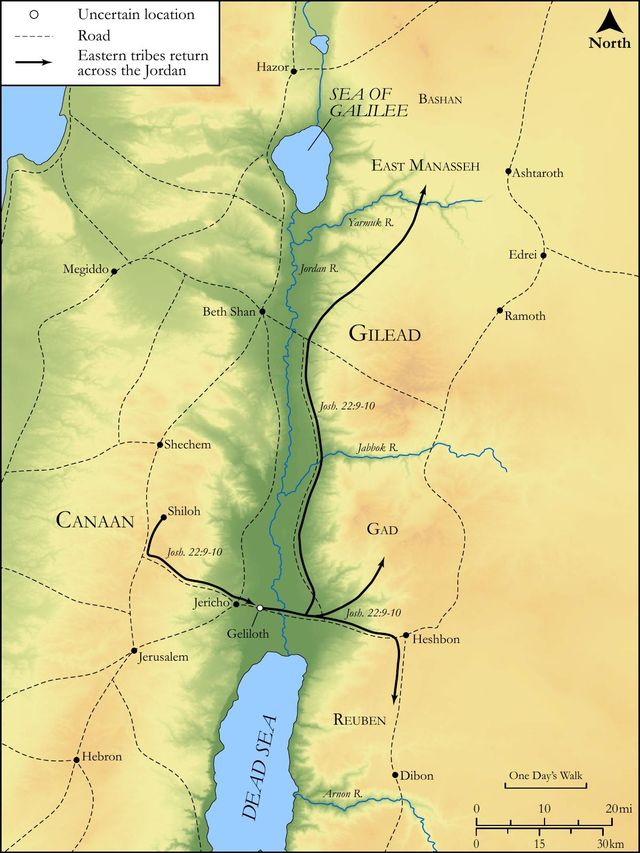
See on the biblical-era map
Study this verse
Continue studying Joshua 22:19 across the web’s major study libraries — every link below opens this exact verse, chapter, or book on the destination site.
Read & Compare
 BibleGatewayThis verse in more than 200 translations and 70 languages.
 Bible.comThe YouVersion reader — hundreds of translations, reading plans, and highlights.
 ESV.orgCrossway's official English Standard Version reader.
 NET BibleThe NET translation with 60,000+ translators' notes on every rendering decision.
 STEP BibleTyndale House's free study tool — original text, vocabulary, and scholarly resources.
 BibliaLogos Bible Software's free web reader.
 USCCBThe New American Bible (Revised Edition) with the U.S. bishops' study notes.
Commentaries
 BibleHub CommentariesDozens of classic commentaries on this verse, gathered on one page.
 StudyLightMore than 100 commentary sets — the largest collection on the web.
 BibleRefPlain-English commentary on what this verse means, verse by verse.
 Enduring WordDavid Guzik's free commentary on this chapter, widely used by Bible teachers.
 Bible Study ToolsVerse commentary alongside Greek and Hebrew study aids.
Original Language & Research
- BibleHub InterlinearThe verse word by word — original language, transliteration, and English.
- BibleHub LexiconEvery word's original-language definition and Strong's entry.
 Blue Letter BibleDeep-study tools — Strong's numbers, concordance, and word studies.
 SefariaThe Hebrew text with Rashi and centuries of Jewish commentary.
Sermons, Hymns & Audio


TrulyRandomVerse is not affiliated with these sites and doesn’t control their content. They’re linked because they’re genuinely useful.
Summary
Joshua 22:19 encapsulates a critical moment of theological and national tension following Israel's conquest of Canaan, as the western tribes, led by Phinehas, confront the Transjordanian tribes (Reuben, Gad, and half-Manasseh) regarding their construction of a large altar east of the Jordan. This verse articulates the profound concern of the western tribes for Israel's spiritual purity and covenant unity, offering the Transjordanian tribes the radical option to resettle in the "clean" land west of the Jordan, where the Tabernacle resided, if their own inheritance was deemed ritually impure. Simultaneously, it delivers a stark warning against rebellion against the LORD and the collective covenant, emphasizing the grave implications of establishing a rival place of worship that could fracture the nation's allegiance to its one true God and central sanctuary.
Context
ShowHideLiterary Context
Joshua 22 marks a pivotal transition in the book, moving from the conquest and land division to the challenges of maintaining national and spiritual unity. Following the successful campaigns and the allocation of tribal inheritances, Joshua honorably discharges the Transjordanian tribes—Reuben, Gad, and the half-tribe of Manasseh—to return to their homes east of the Jordan River, having faithfully fulfilled their vow to assist their brethren in battle against the Canaanites, as recorded in Joshua 22:1-6. As they journey homeward, they erect a large, conspicuous altar by the Jordan. This act immediately sparks alarm and outrage among the western tribes, who interpret it as an act of apostasy and direct rebellion against the LORD, a perceived violation of the Mosaic Law's strict injunction for a single central sanctuary for all legitimate sacrificial worship, as detailed in Deuteronomy 12:5-7. Joshua 22:19 forms a central part of the stern rebuke delivered by a delegation, led by Phinehas, sent from Shiloh to confront the eastern tribes, expressing their profound fear that this perceived transgression would bring divine wrath upon the entire community, echoing past national sins.
Historical & Cultural Context
Ancient Israelite society, as divinely prescribed through the Mosaic Law, was founded upon the exclusive worship of Yahweh as the one true God. This monotheistic framework mandated a singular, divinely appointed location for sacrificial worship—initially the Tabernacle, which at this time was situated at Shiloh, as explicitly stated in Joshua 18:1, and later the Temple in Jerusalem. This centralization was not merely a logistical arrangement but a theological imperative, crucial for maintaining doctrinal purity, fostering national unity, and preventing the insidious creep of syncretism or idolatry, which were constant temptations from the pagan nations round about. The concept of the land itself could be considered ritually "clean" or "unclean," depending on its association with God's presence, the purity of worship practiced within it, or the defiling practices of its inhabitants. The western tribes' extraordinary offer to share their "clean" land underscores their deep concern for ritual purity and their underlying apprehension that the Transjordanian land might be considered ritually "unclean" due to its geographical distance from the Tabernacle or its proximity to pagan influences, thereby hindering proper, acceptable worship.
Key Themes
ShowHideThe passage powerfully articulates several foundational themes within Israelite theology. Foremost is the imperative of national and spiritual unity under God, emphasizing the non-negotiable requirement of a single, unified worship system to prevent fragmentation and apostasy. It highlights the pervasive fear of idolatry and covenant unfaithfulness that deeply permeated Israelite consciousness, a fear rooted in devastating historical precedents such as the golden calf incident and the severe consequences of Baal worship. The western tribes' profound concern for the eastern tribes' spiritual well-being, even extending to the offer of shared land, vividly demonstrates a strong commitment to communal responsibility and inter-tribal solidarity in upholding the covenant. Finally, the repeated, emphatic warning against "rebellion" underscores the gravity with which any deviation from God's prescribed worship was viewed—not merely as simple disobedience but as a direct challenge to divine authority and an existential threat to the entire nation's standing before God, echoing the dire consequences seen in the incident at Peor or the devastating rebellion of Korah in Numbers 16.
Exposition and Analysis
ShowHideKey Word Analysis
ShowHideThis term (H2931, טָמֵא) denotes a state of ritual impurity that renders a person, object, or place unfit for sacred use or for approaching God's holy presence. It is a broad concept encompassing various forms of defilement (e.g., contact with a corpse, certain skin diseases, bodily discharges). In this context, the western tribes are not necessarily accusing the Transjordanian land of literal defilement, but rather suggesting a theological possibility: that its geographical separation from the Tabernacle and its proximity to pagan territories might render it ritually "unclean" in a way that would impede proper, acceptable covenant worship. This highlights the deep Israelite understanding of land purity as intrinsically tied to God's presence and His prescribed worship.
The verb (H4775, מָרַד) is a strong term signifying open defiance, revolt, or apostasy. It implies a deliberate breaking away from legitimate authority, whether human or divine. Here, it is used twice, first in "rebel not against the LORD," indicating a direct affront to God's sovereignty and covenant commands, and then "nor rebel against us," implying a rebellion against the unified Israelite community and its established religious order. The repetition underscores the extreme gravity of the perceived offense and the severe consequences associated with such an act in Israelite theology, which viewed rebellion against God's commands as a direct challenge to His kingship.
This preposition (H1107, בִּלְעֲדֵי) means "except," "without," or "besides." In this specific context, "beside the altar of the LORD our God" carries a strong connotation of rivalry or competition, implying not merely a separate altar, but one that stands in opposition to or as an alternative to the one legitimate altar at the Tabernacle. It suggests an attempt to establish a parallel, unauthorized worship site, which was seen as a direct affront to God's command for a singular, central place of worship and a threat to the nation's spiritual integrity.
Verse Breakdown
ShowHide"Notwithstanding, if the land of your possession [be] unclean, [then] pass ye over unto the land of the possession of the LORD, wherein the LORD'S tabernacle dwelleth, and take possession among us:"
This clause reveals the western tribes' profound concern and their radical, albeit well-intentioned, proposed solution to what they perceived as a spiritual crisis. They offer a startling alternative: if the Transjordanian land is somehow ritually defiled or unsuitable for proper worship due to its distance from the central sanctuary, then the eastern tribes should abandon their inheritance and resettle among the western tribes. This demonstrates their unwavering commitment to the centrality of the Tabernacle (then at Shiloh, the "land of the possession of the LORD") as the sole legitimate place for national worship and atonement, believing that proximity to God's dwelling was essential for covenant faithfulness and ritual purity.
"but rebel not against the LORD, nor rebel against us, in building you an altar beside the altar of the LORD our God."
This is the core accusation and the stern warning. The construction of a second altar is explicitly equated with "rebellion" (מָרַד), a term carrying immense theological weight. To "rebel against the LORD" means to defy His direct commands regarding worship and His unique sovereignty over Israel. To "rebel against us" implies a breaking of national unity, a challenge to the collective covenant relationship with God, and a threat to the entire community's well-being. The phrase "beside the altar of the LORD our God" highlights the perceived rivalry—not merely another altar, but one that stands in opposition or competition to the one legitimate altar at the Tabernacle, threatening to splinter Israel's worship and allegiance.
Literary Devices
ShowHideThe passage employs several potent literary devices to convey its urgent and grave message. Direct Address is prominently used by Phinehas to confront the eastern tribes directly, creating an immediate sense of gravity and accountability. The repeated use of the verb "rebel" (מָרַד) serves as a powerful instance of Repetition (specifically, anaphora if at the beginning of clauses, but here a general emphasis on the core accusation), underscoring the severe nature of the perceived offense and its implications for both divine authority and national unity. The phrase "land of the possession of the LORD" functions as a Metonymy for the land where the Tabernacle resides and where God's presence is uniquely manifested, contrasting it sharply with the potentially "unclean" Transjordanian territory. The entire speech, of which this verse is a part, is a form of Exhortation and Warning, designed to persuade the eastern tribes to abandon their perceived rebellion and return to covenant faithfulness, emphasizing the dire consequences of their actions.
Theological and Thematic Connections
ShowHideJoshua 22:19 profoundly underscores the Old Testament emphasis on the singularity and centrality of worship for the people of Israel. The construction of a rival altar, even if intended for good, was seen as a direct challenge to God's command for one central sanctuary, a principle vital for maintaining the nation's spiritual purity and unity. This incident highlights the deep concern within Israel for covenant fidelity and the severe consequences of perceived apostasy, demonstrating how quickly a misunderstanding could escalate into a theological crisis. The western tribes' offer to share their "clean" land reveals a profound understanding of the land's sacred character as intrinsically linked to God's dwelling place and the proper performance of atonement. Ultimately, the passage serves as a powerful reminder of the importance of clear communication, communal accountability, and unwavering devotion to God's prescribed ways of worship to preserve the integrity of His people and prevent division.
Reflection and Application
ShowHideThe confrontation in Joshua 22:19 offers timeless lessons for believers today concerning unity, understanding, and faithful worship within the community of faith. Just as the western tribes were zealous for the honor of God and the purity of Israel's worship, we are called to be vigilant against anything that might compromise biblical truth or create unnecessary division within the body of Christ. This passage reminds us that our actions, even those with seemingly good intentions, can be misinterpreted and cause significant strife if not communicated clearly and aligned with established biblical principles. It challenges us to prioritize the unity of the Spirit in the bond of peace, seeking understanding and reconciliation before judgment. We are invited to reflect on whether our own "altars" of personal preference, secondary doctrines, or even well-meaning initiatives ever threaten to overshadow the central "altar" of Christ's perfect sacrifice and the shared worship of God. Our ultimate allegiance must be to the Lord and His revealed will, always striving to build up the church in love and truth, rather than creating fractures or undermining the collective witness to a watching world.
Questions for Reflection
ShowHideFAQ
ShowHideWhy was building another altar considered "rebellion" if the eastern tribes claimed it was for remembrance?
ShowHideThe Mosaic Law, particularly as detailed in Deuteronomy 12, explicitly commanded Israel to worship God at one designated central sanctuary where the Tabernacle (and later the Temple) resided. This divine decree was established to prevent idolatry, syncretism (the blending of religious beliefs), and the fragmentation of worship that could lead to spiritual apostasy. Building another altar, regardless of the eastern tribes' stated intent, was perceived by the western tribes as a direct violation of this fundamental command, an act of defiance against God's established order, and a dangerous move towards establishing a rival place of worship. Even if the eastern tribes' intentions were pure (which they later explained in Joshua 22:26-29 as a memorial, not for sacrifice), the act itself carried the appearance of rebellion and threatened the theological and national unity of Israel.
What does "if the land of your possession be unclean" mean in this context?
ShowHideIn ancient Israelite thought, "unclean" (Hebrew: ṭāmē') referred to a state of ritual impurity that rendered a person, object, or place unfit for sacred activities or for approaching God. The western tribes' offer in Joshua 22:19 suggests a theological concern that the land east of the Jordan, being geographically distant from the Tabernacle and potentially influenced by surrounding pagan nations, might be considered ritually compromised or less conducive to proper covenant worship. They were not necessarily making an accusation of actual defilement, but rather presenting a hypothetical scenario out of deep spiritual concern for their brethren. They offered to share their "clean" land (west of the Jordan, where the Tabernacle was located at Shiloh, as mentioned in Joshua 18:1) as a solution, demonstrating their belief that proximity to God's dwelling place was essential for maintaining ritual purity and covenant faithfulness.
Christ-Centered Fulfillment
ShowHideJoshua 22:19, with its profound emphasis on a singular, central place of worship and the grave warning against rebellion, finds its ultimate Christ-centered fulfillment in the New Covenant. The Old Testament Tabernacle, and later the Temple, served as a powerful type and shadow of the ultimate "dwelling place of the LORD" found in the person of Jesus Christ. He is the true and perfect Tabernacle, the very presence of God "tabernacling" among humanity. The deep concern for a "clean" land, where God's presence resided and atonement was made, is fully realized and surpassed in Christ, who, through His perfect and once-for-all sacrifice, cleanses us from all sin and makes us holy, enabling us to approach God directly and confidently (Hebrews 9:11-14). Furthermore, the unity of Israel, so fiercely protected in this passage, is perfectly realized in the New Testament church, which is the spiritual body of Christ, built upon the foundation of the apostles and prophets, with Christ Jesus himself as the chief cornerstone (Ephesians 2:19-22). Any "rebellion" against God's established way of worship, which in the Old Covenant was building a rival altar, is now understood as a rejection of Christ, who is the only way to the Father. Our worship under the New Covenant is no longer tied to a physical location or a single altar but is to be offered "in spirit and truth" (John 4:23-24), centered entirely on the person and redemptive work of Jesus, who is both our High Priest and our ultimate sacrifice, forever uniting us to God.