


Joshua 22:20
Bible text: King James Version (1769 Blayney text) · Public domain
Bible text: King James Version with Strong's numbers · Public domain
Bible text: Berean Standard Bible · Public domain
Bible text: American Standard Version (1901) · Public domain
Bible text: World English Bible, Messianic edition · Public domain
Bible text: Geneva Bible (1599) · Public domain
Bible text: Young's Literal Translation · Public domain
- הֲלוֹאha·Lo'¿ notH3808Interrog ¦ NegParticle Negativeהֲ¿לוֹאnot
- עָכָן'a·KhanAchanH5912N-proper-mNoun Proper Masculine
- בֶּןben[the] son ofH1121N-mscNoun Singular Masculine Construct
- זֶרַחZe·rachZerahH2226N-proper-mNoun Proper Masculine
- מָעַלMa·'aldid he act unfaithfullyH4603V-Qal-Perf-3msVerb Qal Perfect 3rd Singular Masculine
- מַעַלma·'alunfaithfulnessH4604N-msNoun Singular Masculine Absolute
- בַּחֵרֶםba·Che·remin the devoted thing[s]H2764Prep-b ¦ N-msNoun Singular Masculine Absoluteבַּin theחֵרֶםdevoted thing[s]
- וְעַלve·'aland towardsH5921Conj-w ¦ PrepPrepositionוְandעַלtowards
- כָּלkolallH3605N-mscNoun Singular Masculine Construct
- עֲדַת'a·Dat[the] congregation ofH5712N-fscNoun Singular Feminine Construct
- יִשְׂרָאֵלYis·ra·'ElIsraelH3478N-properNoun Proper Location
- הָיָהHa·yahit wasH1961V-Qal-Perf-3msVerb Qal Perfect 3rd Singular Masculine
- קָצֶףKa·tzefangerH7110N-msNoun Singular Masculine Absolute
- וְהוּאve·Hu'and heH1931Conj-w ¦ Pro-3msPronoun Personal 3rd Singular Masculineוְandהוּאhe
- אִישׁ'ish[was] a manH376N-msNoun Singular Masculine Absolute
- אֶחָד'e·ChadoneH259Adj-fsAdjective Numerical Singular Feminine Absolute
- לֹאlo'notH3808NegParticle Negative
- גָוַעga·Va'did he die?H1478V-Qal-Perf-3msVerb Qal Perfect 3rd Singular Masculine
- בַּעֲוֹנוֹba·'a·vo·Nofor his iniquityH5771Prep-b ¦ N-msc ¦ 3msNoun Singular Masculine Constructבַּforעֲוֹנiniquityוֹhis
English is a literal word-by-word gloss of the Hebrew, not the KJV's wording. Why?
This is the original text the KJV's translators worked from — each Hebrew word with its own literal English meaning in this verse, prepared by scholars at Tyndale House, Cambridge. The KJV translates whole sentences, not word by word, so its wording differs: one Hebrew word can become several English words, and the KJV may choose “the LORD” where the gloss reads “Yahweh”. Both are faithful — they answer different questions. For the KJV's own rendering, switch to the KJV text.
Details
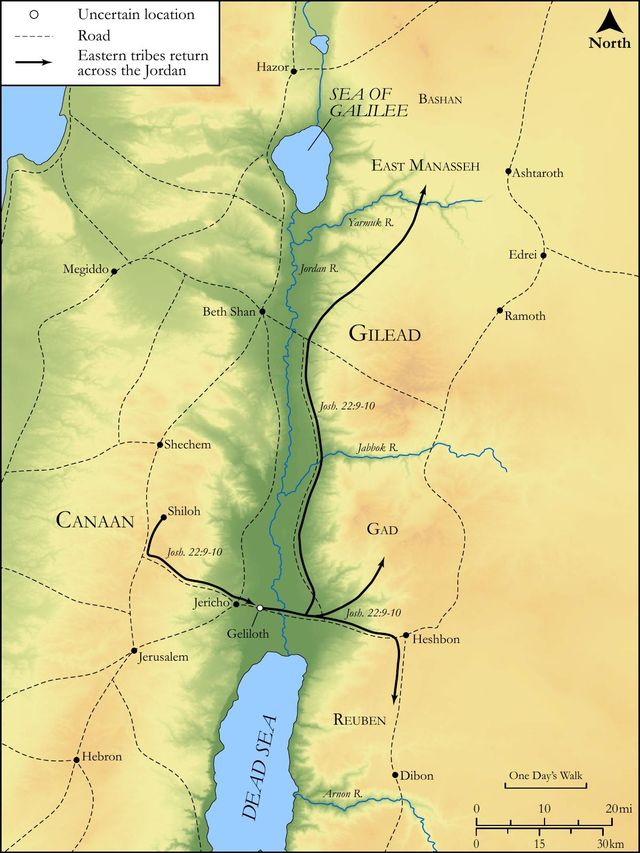
See on the biblical-era map
Study this verse
Continue studying Joshua 22:20 across the web’s major study libraries — every link below opens this exact verse, chapter, or book on the destination site.
Read & Compare
 BibleGatewayThis verse in more than 200 translations and 70 languages.
 Bible.comThe YouVersion reader — hundreds of translations, reading plans, and highlights.
 ESV.orgCrossway's official English Standard Version reader.
 NET BibleThe NET translation with 60,000+ translators' notes on every rendering decision.
 STEP BibleTyndale House's free study tool — original text, vocabulary, and scholarly resources.
 BibliaLogos Bible Software's free web reader.
 USCCBThe New American Bible (Revised Edition) with the U.S. bishops' study notes.
Commentaries
 BibleHub CommentariesDozens of classic commentaries on this verse, gathered on one page.
 StudyLightMore than 100 commentary sets — the largest collection on the web.
 BibleRefPlain-English commentary on what this verse means, verse by verse.
 Enduring WordDavid Guzik's free commentary on this chapter, widely used by Bible teachers.
 Bible Study ToolsVerse commentary alongside Greek and Hebrew study aids.
Original Language & Research
- BibleHub InterlinearThe verse word by word — original language, transliteration, and English.
- BibleHub LexiconEvery word's original-language definition and Strong's entry.
 Blue Letter BibleDeep-study tools — Strong's numbers, concordance, and word studies.
 SefariaThe Hebrew text with Rashi and centuries of Jewish commentary.
Sermons, Hymns & Audio


TrulyRandomVerse is not affiliated with these sites and doesn’t control their content. They’re linked because they’re genuinely useful.
Summary
Joshua 22:20 presents a powerful rhetorical question posed by Phinehas to the Transjordanian tribes, serving as a stark and urgent reminder of the devastating corporate consequences that can arise from individual sin. It specifically references Achan's egregious transgression involving the "accursed thing," which provoked divine wrath upon the entire congregation of Israel, demonstrating unequivocally that one man's iniquity could lead to widespread suffering, defeat, and even death, not solely for the perpetrator but for the whole community. This historical precedent underscores the critical and enduring importance of covenant faithfulness, communal purity, and collective accountability for the spiritual and physical well-being of God's people.
Context
ShowHideLiterary Context
Joshua 22:20 is situated within a high-stakes confrontation between the Cisjordanian (western) and Transjordanian (eastern) tribes of Israel. Following the successful conquest of Canaan, the tribes of Reuben, Gad, and half-Manasseh were returning to their allotted inheritance east of the Jordan River. Their construction of a large, conspicuous altar near the Jordan was immediately perceived by the western tribes as a grave act of apostasy or rebellion against the Lord, threatening the sacred unity of Israel and their covenant relationship with God. The Law of Moses commanded exclusive worship of Yahweh at a single, designated central sanctuary, initially the tabernacle in Shiloh. Phinehas, the son of Eleazar the high priest, along with ten princes, was dispatched to confront them. His impassioned speech, commencing in Joshua 22:16, strategically appeals to recent, painful instances of Israel's unfaithfulness and the severe, communal consequences that followed. The specific reference to Achan's sin in Joshua chapter 7 is a powerful rhetorical device, designed to impress upon the Transjordanian tribes the profound gravity of their perceived transgression and the very real potential for swift and devastating corporate judgment.
Historical & Cultural Context
The historical backdrop is the immediate post-conquest period, during the nascent stages of Israel's settlement in the Promised Land. The nation of Israel was understood not merely as a collection of individuals but as a singular, unified, covenantal entity, bound to Yahweh by a solemn agreement established at Mount Sinai. This covenant mandated exclusive worship of Yahweh and adherence to His laws, with the tabernacle serving as the central locus of worship and divine presence. Building an unauthorized altar was a direct challenge to this covenantal structure, potentially signaling a move towards idolatry, a schism in the unified worship of God, or an attempt to establish an independent cultus. The concept of corporate solidarity was deeply ingrained in Israelite thought and jurisprudence; the actions of an individual, particularly in matters of covenant fidelity or defilement, could have profound and far-reaching repercussions for the entire community. The cherem (accursed thing) was a specific cultural-religious concept integral to holy war, where spoils of war were either utterly destroyed or consecrated exclusively to God; violating this divine command was considered a profound sacrilege, directly affronting God's holiness and sovereignty.
Key Themes
ShowHideThe verse powerfully highlights several core theological and narrative themes crucial to understanding Israel's covenant relationship with God. First, Corporate Responsibility and Solidarity is paramount, demonstrating unequivocally that individual sin, particularly against God's explicit commands, can bring devastating consequences upon the entire community. This was vividly illustrated by Israel's humiliating defeat at Ai and the death of thirty-six men due to Achan's sin, as detailed in Joshua 7:5. Second, the Severity of Sin against God's Holiness is profoundly emphasized, especially concerning the "accursed thing" (cherem), which was divinely set apart for God's exclusive use or utter destruction. Transgressing this command was not merely an act of theft but a profound act of faithlessness (ma'al) against God's holiness and covenant, incurring severe divine displeasure. Third, the passage underscores the vital importance of Learning from History, as the wise leaders of Israel strategically employ a recent, painful historical event to caution against potential future transgressions, illustrating the enduring and instructive lessons derived from God's past judgments. Finally, the overarching concern driving Phinehas's confrontation is the Preservation of Covenant Faithfulness and Unity, as the Cisjordanian tribes genuinely feared that the unauthorized altar would inevitably lead to widespread apostasy and divine wrath, thereby jeopardizing the very foundation of their national identity and the divine protection promised through their obedience to the covenant, as warned in Deuteronomy 28:15.
Exposition and Analysis
ShowHideKey Word Analysis
ShowHideFrom an unused root meaning to trouble; troublesome; Akan, an Israelite. This individual, from the tribe of Judah, became infamous for his act of disobedience at Jericho. His name, possibly derived from a root meaning "trouble," became a poignant symbol of the calamity and divine judgment he brought upon the entire Israelite community. His deliberate act of taking devoted items from Jericho directly violated God's explicit command, leading to Israel's defeat at Ai and his subsequent execution along with his family.
From mâʻal; treachery, i.e. sin; falsehood, grievously, sore, transgression, trespass, [idiom] very. This term signifies an act of unfaithfulness, a breach of trust, or a profound sacrilege against God. It is far more than a simple sin; it implies a deliberate violation of a sacred duty or covenant obligation, particularly in dealing with holy things or God's property. Achan's maʻal was not merely theft, but a profound betrayal of Israel's covenant with God, treating what God had declared cherem as common plunder.
Or (Zechariah 14:11) חֶרֶם; from חָרָם; physical (as shutting in) a net (either literally or figuratively); usually a doomed object; abstractly extermination; (ac-) curse(-d, -d thing), dedicated thing, things which should have been utterly destroyed, (appointed to) utter destruction, devoted (thing), net. This refers to something "devoted" or "set apart" for utter destruction or for exclusive dedication to God, often in the context of holy war. Items under cherem were considered taboo for human possession, and to take or appropriate them was a profound violation of God's holiness and a direct affront to His sovereignty, incurring severe divine judgment.
Verse Breakdown
ShowHide"Did not Achan the son of Zerah commit a trespass in the accursed thing"
This is a powerful rhetorical question, designed not to elicit information but to make an undeniable point and evoke a shared memory. Phinehas reminds the Transjordanian tribes of a recent, painful, and well-known historical event where Achan's deliberate act of sacrilege—taking items from Jericho that God had declared cherem—was a profound breach of covenant faithfulness. The question implies that the Transjordanian tribes should already know and remember this, and thus understand the inherent gravity of their own perceived transgression in building the altar.
"and wrath fell on all the congregation of Israel?"
This clause highlights the severe and inescapable corporate consequence of Achan's individual sin. God's "wrath" (divine judgment and displeasure) was not confined to Achan alone but extended to the entire community of Israel. This was powerfully evidenced by Israel's inexplicable defeat at Ai, where thirty-six men died, and the subsequent distress, fear, and temporary withdrawal of God's favor that gripped the entire nation until the sin was identified and purged. This demonstrates the profound principle of corporate solidarity and accountability within the covenant community.
"and that man perished not alone in his iniquity."
This final clause underscores the far-reaching and devastating impact of Achan's sin. His "perishing" (his death by stoning, along with his family and possessions) was a direct and just consequence of his "iniquity" (moral crookedness, guilt, and the punishment due to it). The phrase "not alone" is a powerful litotes, subtly emphasizing that the repercussions extended far beyond Achan himself, affecting the entire congregation through defeat, loss of life, and the temporary withdrawal of God's blessing, until the sin was decisively dealt with and purged from the community.
Literary Devices
ShowHideJoshua 22:20 employs several powerful literary devices to convey its urgent message. The most prominent is the Rhetorical Question, "Did not Achan...?" which is used to emphasize a well-known historical fact and its undeniable implications, compelling the audience to acknowledge the truth without needing an explicit answer. This serves as a strong persuasive tool, forcing the Transjordanian tribes to confront the potential repercussions of their actions. The verse also utilizes Allusion, directly referencing the well-known and traumatic narrative of Achan's sin from Joshua chapter 7, assuming the audience's familiarity with the intricate details and devastating consequences. This specific allusion functions as an Exemplum, providing a concrete historical example to illustrate a profound moral and theological principle—in this case, the devastating corporate consequences of individual sin and unfaithfulness. Furthermore, the phrasing contains an element of Litotes (understatement for rhetorical effect) in "perished not alone," which subtly but powerfully emphasizes the extensive and communal nature of the judgment, implying that many did suffer and perish alongside him in various ways, highlighting the widespread impact of Achan's transgression.
Theological and Thematic Connections
ShowHideJoshua 22:20 profoundly illustrates the theological principle of corporate solidarity and accountability within the covenant community of Israel. God viewed Israel as a unified, holy entity, and therefore, the sin of an individual, particularly one involving a direct breach of covenant like Achan's, could defile the entire nation and provoke divine wrath upon all. This concept underscores God's absolute holiness, His demand for purity within His people, and the interconnectedness of all members within the covenant body. It teaches that sin is never merely a private affair but carries communal ramifications, emphasizing the collective responsibility to maintain covenant faithfulness and spiritual integrity. The historical example serves as a perpetual, sobering warning against complacency in sin and a fervent call to vigilance in preserving the spiritual health and purity of the community. It highlights that God's judgment, while just, is also a purifying act intended to restore His people to a right relationship with Him.
Reflection and Application
ShowHideJoshua 22:20 offers profound and enduring lessons for believers today, reminding us that while we live under the glorious grace of the New Covenant, the principle of interconnectedness within the body of Christ remains vitally important. Our individual choices and actions, whether in faithfulness or disobedience, can have ripple effects that extend far beyond ourselves, impacting our families, local churches, and the broader Christian community. This truth calls for a deep sense of personal accountability, integrity, and spiritual vigilance, recognizing that our walk with God contributes significantly to the collective witness, spiritual health, and purity of the church. It also underscores the profound seriousness of sin in God's eyes, prompting us to cultivate a holy fear of the Lord and a commitment to genuine repentance and confession when we fall short. Just as the Israelites were quick to address a perceived threat to their covenant purity, so too should Christian communities be vigilant against spiritual drift, compromise, and unconfessed sin, and be willing to engage in loving, biblical correction and restoration, ensuring the purity and effective testimony of the church for God's glory in the world.
Questions for Reflection
ShowHideFAQ
ShowHideWhat exactly was the "accursed thing" (cherem) that Achan took?
ShowHideThe "accursed thing" (Hebrew: cherem) refers to items from Jericho that God had commanded to be utterly destroyed or consecrated exclusively to His treasury, not to be taken as plunder by the Israelites. Specifically, Achan confessed to taking a beautiful Babylonian garment, two hundred shekels of silver, and a wedge of gold weighing fifty shekels (Joshua 7:21). These items were considered "devoted" to God, meaning they were set apart from common use, and to appropriate them was a profound act of sacrilege against God's holiness and His specific command (Joshua 6:18).
Why did God's wrath fall on all the congregation of Israel for Achan's individual sin?
ShowHideGod's wrath fell on all Israel because, in the Old Covenant, Israel was considered a single, corporate entity, a "holy nation" (Exodus 19:6). Achan's sin was not merely a private transgression; it was a breach of the covenant by a member of the covenant community, which defiled the entire body and brought corporate guilt. God's absolute holiness demanded that sin within His people be dealt with immediately and decisively, and until it was purged, the entire nation remained under His displeasure, as powerfully evidenced by their humiliating defeat at Ai (Joshua 7:5). This profound principle demonstrates the deep interconnectedness and solidarity within the covenant people, where the actions of one could profoundly affect the well-being and standing of all before God.
Christ-Centered Fulfillment
ShowHideJoshua 22:20, with its stark portrayal of corporate judgment due to individual sin, powerfully foreshadows the ultimate and perfect solution to humanity's universal corporate plight found exclusively in Jesus Christ. Achan's sin brought a devastating curse upon Israel, leading to communal death and defeat, vividly illustrating the pervasive, defiling, and destructive nature of sin that affects all humanity. Yet, in the New Covenant, we witness a radical and glorious reversal: Jesus Christ, the spotless Lamb of God, became the ultimate "accursed thing" for us. He bore the full weight of humanity's collective sin and the righteous wrath of God on the cross, becoming a curse in our place so that we might be completely redeemed from the curse of the law and receive the blessing of Abraham (Galatians 3:13). Just as Achan's sin brought corporate death and separation from God's favor, Christ's perfect obedience and sacrificial death brought corporate life, justification, and righteousness to all who believe (Romans 5:18-19). He, "who knew no sin, became sin for us, so that in him we might become the righteousness of God" (2 Corinthians 5:21). In Christ, the principle of corporate solidarity is transformed and perfected; individual believers are now united as one body in Him (1 Corinthians 12:27), and His perfect righteousness is imputed to all who are in Him, thereby fulfilling the deepest need for a holy, undefiled, and reconciled people before a holy God.