


Numbers 10:30
Bible text: King James Version (1769 Blayney text) · Public domain
Bible text: Berean Standard Bible · Public domain
Bible text: American Standard Version (1901) · Public domain
Bible text: World English Bible, Messianic edition · Public domain
Bible text: Geneva Bible (1599) · Public domain
Bible text: Young's Literal Translation · Public domain
- וַיֹּאמֶרvai·Yo·merand he saidH559Conj-w ¦ V-Qal-ConsecImperf-3msVerb Qal Consecutive Imperfect 3rd Singular Masculineוַandיֹּאמֶרhe said
- אֵלָיו'e·Lavto himH413Prep ¦ 3msPreposition Definiteאֵלָיtoוhim
- לֹאlo'notH3808NegParticle Negative
- אֵלֵךְ'e·LekhI will goH1980V-Qal-Imperf-1csVerb Qal Imperfect 1st Singular common gender
- כִּיkithatH3588PrtParticle Conditional
- אִם'imexceptH518PrtParticle Conditional
- אֶל'eltoH413PrepPreposition
- אַרְצִי'ar·Tzimy own landH776N-csc ¦ 1fsNoun Singular common gender Constructאַרְצִown landיmy
- וְאֶלve·'eland toH413Conj-w ¦ PrepPrepositionוְandאֶלto
- מוֹלַדְתִּיmo·lad·Timy kindredH4138N-fsc ¦ 1csNoun Singular Feminine Constructמוֹלַדְתִּkindredיmy
- אֵלֵךְ'e·LekhI will goH1980V-Qal-Imperf-1csVerb Qal Imperfect 1st Singular common gender
English is a literal word-by-word gloss of the Hebrew, not the KJV's wording. Why?
This is the original text the KJV's translators worked from — each Hebrew word with its own literal English meaning in this verse, prepared by scholars at Tyndale House, Cambridge. The KJV translates whole sentences, not word by word, so its wording differs: one Hebrew word can become several English words, and the KJV may choose “the LORD” where the gloss reads “Yahweh”. Both are faithful — they answer different questions. For the KJV's own rendering, switch to the KJV text.
Details
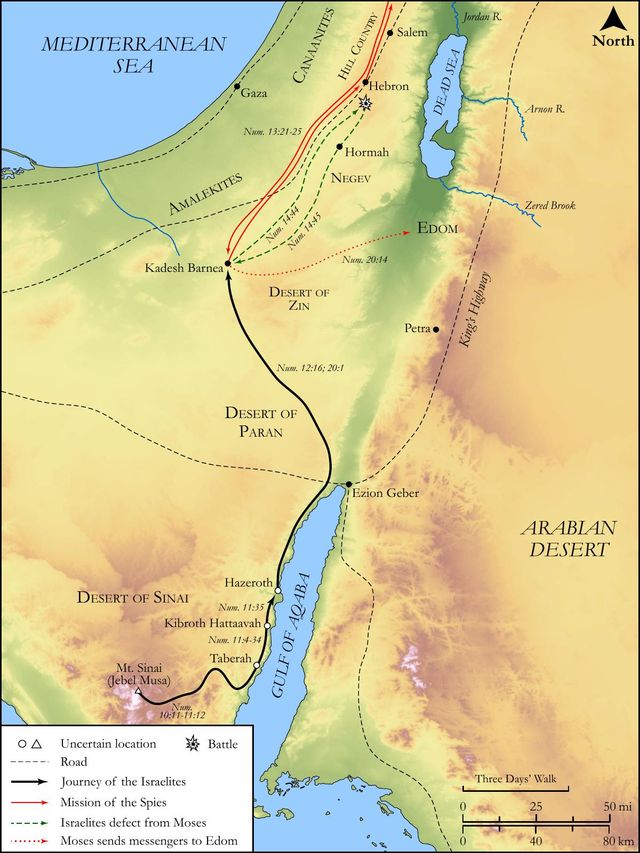
See on the biblical-era map
Study this verse
Public-domain commentary
Matthew Henry
From his Commentary on the Whole Bible. Henry comments on passages, not single verses — this entry covers Numbers 10:29–36. His four-level outline is real structure in the source text, so it is rendered as structure.
Here is, I. An account of what passed between Moses and Hobab, now upon this advance which the camp of Israel made towards Canaan. Some think that Hobab was the same with Jethro, Moses's father-in-law, and that the story, Ex. 18, should come in here; it seems more probable that Hobab was the son of Jethro, alias Reuel, or Raguel (Exo 2:18), and that when the father, being aged, went to his own land (Exo 18:27), he left his son Hobab with Moses, as Barzillai left Chimham with David; and the same word signifies both a father-in-law and a brother-in-law. Now this Hobab staid contentedly with Israel while they encamped at mount Sinai, near his own country; but, now that they were removing, he was for going back to his own country and kindred, and his father's house. Here is, 1. The kind invitation Moses gives him to go forward with them to Canaan, Num 10:29. He tempts him with a promise that they would certainly be kind to him, and puts God's word in for security: The Lord hath spoken good concerning Israel. As if he had said, "Come, cast in thy lot among us, and thou shalt fare as we fare; and we have the promise of God that we shall fare well." Note, Those that are bound for the heavenly Canaan should invite and encourage all their friends to go along with them, for we shall have never the less of the treasures of the covenant, and the joys of heaven, for others coming in to share with us. And what argument can be more powerful with us to take God's people for our people than this, that God hath spoken good concerning them? It is good having fellowship with those that have fellowship with God (Jo1 1:3), and going with those with whom God is, Zac 8:23. 2. Hobab's inclination, and present resolution, to go back to his own country, Num 10:30. One would have thought that he who had seen so much of the special presence of God with Israel, and such surprising tokens of his favour to them, would not have needed much invitation to embark with them. But his refusal must be imputed to the affection he had for his native air and soil, which was not overpowered, as it ought to have been, by a believing regard to the promise of God and a value for covenant blessings. He was indeed a son of Abraham's loins (for the Midianites descended from Abraham by Keturah), but not an heir of Abraham's faith (Heb 11:8), else he would not have given Moses this answer. Note, The things of this world, which are seen, draw strongly from the pursuit of the things of the other world, which are not seen. The magnetic virtue of this earth prevails with most people above the attractives of heaven itself. 3. The great importunity Moses used with him to alter his resolution, Num 10:31, Num 10:32. He urges, (1.) That he might be serviceable to them: "We are to encamp in the wilderness" (a country well known to Hobab), "and thou mayest be to us instead of eyes, not to show us where we must encamp, nor what way we must march" (which the cloud was to direct), "but to show us the conveniences and inconveniences of the place we march through and encamp in, that we may make the best use we can of the conveniences, and the best fence we can against the inconveniences." Note, It will very well consist with our trust in God's providence to make use of the help of our friends in those things wherein they are capable of being serviceable to us. Even those that were led by miracle must not slight the ordinary means of direction. Some think that Moses suggests this to Hobab, not because he expected much benefit from his information, but to please him with the thought of being some way useful to so great a body, and so to draw him on with them, by inspiring him with an ambition to obtain that honour. Calvin gives quite another sense of this place, very agreeably with the original, which yet I do not find taken notice of by any since. "Leave us not, I pray thee, but come along, to share with us in the promised land, for therefore hast thou known our encampment in the wilderness, and hast been to us instead of eyes; and we cannot make thee amends for sharing with us in our hardships, and doing us so many good offices, unless thou go with us to Canaan. Surely for this reason thou didst set out with us that thou mightest go on with us." Note, Those that have begun well should use that as a reason for their persevering, because otherwise they lose the benefit and recompence of all they have done and suffered. (2.) That they would be kind to him: What goodness the Lord shall do to us, the same we will do to thee, Num 10:32. Note, [1.] We can give only what we receive. We can do no more service and kindness to our friends than God is pleased to put it into the power of our hand to do. This is all we dare promise, to do good as God shall enable us. [2.] Those that share with God's Israel in their labours and hardships shall share with them in their comforts and honours. Those that are wiling to take their lot with them in the wilderness shall have their lot with them in Canaan; if we suffer with them we shall reign with them, Ti2 2:12; Luk 22:28, Luk 22:29.
We do not find any reply that Hobab here made to Moses, and therefore we hope that his silence gave consent, and he did not leave them, but that, when he perceived he might be useful, he preferred that before the gratifying of his own inclination; in this case he left us a good example. And we find (Jdg 1:16; Sa1 15:6) that his family was no loser by it.
II.An account of the communion between God and Israel in this removal.
They left the mount of the Lord (Num 10:33), that Mount Sinai where they had seen his glory and heard his voice, and had been taken into covenant with him (they must not expect that such appearances of God to them as they had there been blessed with should be constant); they departed from that celebrated mountain, which we never read of in scripture any more, unless with reference to these past stories; now farewell, Sinai; Zion is the mountain of which God has said. This is my rest for ever (Psa 132:14), and of which we must say so. But when they left the mount of the Lord they took with them the ark of the covenant of the Lord, by which their stated communion with God was to be kept up. For,
1.By it God did direct their paths. The ark of the covenant went before them, some think in place, at least in this removal; others think only in influence; though it was carried in the midst of the camp, yet the cloud that hovered over it directed all their motions. The ark (that is, the God of the ark) is said to search out a resting place for them; not that God's infinite wisdom and knowledge need to make searches, but every place they were directed to was as convenient for them as if the wisest man they had among them had been employed to go before them, and mark out their camp to the best advantage. thus Canaan is said to be a land which God spied out, Eze 20:6.
2.By it they did in all their ways acknowledge God, looking upon it as a token of God's presence; when that moved, or rested, they had their eye up unto God. Moses, as the mouth of the congregation, lifted up a prayer, both at the removing and at the resting of the ark; thus their going out and coming in were sanctified by prayer, and it is an example to us to begin and end every day's journey, and every day's work, with prayer.
(1.)Here is his prayer when the ark set forward: Rise up, Lord, and let thy enemies be scattered, Num 10:35. They were now in a desolate country, but they were marching towards an enemy's country, and their dependence was upon God for success and victory in their wars, as well as for direction and supply in the wilderness. David used this prayer long after (Psa 68:1), for he also fought the Lords' battles. Note,
[1.]There are those in the world that are enemies to God, and haters of him: secret and open enemies; enemies to his truths, his laws, his ordinances, his people.
[2.]The scattering and defeating of God's enemies is a thing to be earnestly desired, and believingly expected, by all the Lord's people. This prayer is a prophecy. Those that persist in rebellion against God are hasting towards their own ruin.
[3.]For the scattering and defeating of God's enemies, there needs no more but God's arising. When God arose to judgment, the work was soon done, Psa 76:8, Psa 76:9. "Rise, Lord, as the sun riseth to scatter the shadows of the night." Christ's rising from the dead scattered his enemies, Psa 68:18.
(2.)His prayer when the ark rested, Num 10:36.
[1.]That God would cause his people to rest. So some read it, "Return, O Lord, the many thousands of Israel, return them to their rest again after this fatigue." Thus it is said (Isa 63:14), The Spirit of the Lord caused him to rest. Thus he prays that God would give Israel success and victory abroad, and peace and tranquillity at home.
[2.]That God himself would take up his rest among them. So we read it: Return to the thousands of Israel, the ten thousand thousand, so the word is. Note, First, The church of God is a great body; there are many thousands belonging to God's Israel. Secondly, We ought in our prayers to concern ourselves for this body. Thirdly, The welfare and happiness of the Israel of God consist in the continual presence of God among them. Their safety consists not in their numbers, though they are thousands, many thousands, but in the favour of God, and his gracious return to them and residence with them. These thousands are cyphers; he is the figure: and upon this account, Happy art thou, O Israel! who is like unto thee, O people!
Continue studying Numbers 10:30 across the web’s major study libraries — every link below opens this exact verse, chapter, or book on the destination site.
Read & Compare
 BibleGatewayThis verse in more than 200 translations and 70 languages.
 Bible.comThe YouVersion reader — hundreds of translations, reading plans, and highlights.
 ESV.orgCrossway's official English Standard Version reader.
 NET BibleThe NET translation with 60,000+ translators' notes on every rendering decision.
 STEP BibleTyndale House's free study tool — original text, vocabulary, and scholarly resources.
 BibliaLogos Bible Software's free web reader.
 USCCBThe New American Bible (Revised Edition) with the U.S. bishops' study notes.
Commentaries
 BibleHub CommentariesDozens of classic commentaries on this verse, gathered on one page.
 StudyLightMore than 100 commentary sets — the largest collection on the web.
 BibleRefPlain-English commentary on what this verse means, verse by verse.
 Enduring WordDavid Guzik's free commentary on this chapter, widely used by Bible teachers.
 Bible Study ToolsVerse commentary alongside Greek and Hebrew study aids.
Original Language & Research
- BibleHub InterlinearThe verse word by word — original language, transliteration, and English.
- BibleHub LexiconEvery word's original-language definition and Strong's entry.
 Blue Letter BibleDeep-study tools — Strong's numbers, concordance, and word studies.
 SefariaThe Hebrew text with Rashi and centuries of Jewish commentary.
Sermons, Hymns & Audio


TrulyRandomVerse is not affiliated with these sites and doesn’t control their content. They’re linked because they’re genuinely useful.
Summary
Numbers 10:30 records Hobab's initial, resolute refusal to accompany the Israelites on their momentous journey from Mount Sinai towards the Promised Land, despite Moses' earnest invitation and the promise of sharing in God's blessings. This verse powerfully illustrates the inherent tension between the comfort and security of one's familiar homeland and the radical call to embark on a journey of faith into the unknown, underscoring the profound human freedom to choose one's path even when presented with a divine opportunity.
Context
ShowHideLiterary Context
This verse is strategically placed within the narrative of the Israelites' long-anticipated departure from Mount Sinai, a pivotal moment marking the transition from encampment and law-giving to active movement towards Canaan. Numbers 10 initiates the wilderness journey, signaling the end of a nearly year-long period where the Law was received and the Tabernacle established. Moses' direct and compelling invitation to Hobab in Numbers 10:29 immediately precedes Hobab's firm and unambiguous refusal in verse 30. The subsequent verses (Numbers 10:31-32) reveal Moses' persistence, highlighting the practical value Hobab, a Midianite, could offer as an experienced guide in the unfamiliar desert terrain, coupled with the promise of sharing in God's goodness. This significant exchange sets a foundational tone for the challenges, divine guidance, and human responses that will characterize the arduous wilderness wanderings.
Historical & Cultural Context
Hobab is identified as the son of Reuel (also known as Jethro), who was Moses' father-in-law, making Hobab Moses' brother-in-law. The Midianites, a nomadic people inhabiting the desert regions to the east of the Gulf of Aqaba, possessed invaluable knowledge of desert survival, including routes, water sources, and tribal movements. This expertise explains Moses' earnest desire for Hobab's assistance. Among the tribes of Midian and Israel alike, the concepts of "kindred" (Hebrew: môwledeth) and "land" (Hebrew: ʼerets) held immense, almost sacred, significance. They were inextricably linked to one's identity, security, ancestral heritage, and social standing. To leave one's ancestral land and family was a profound disruption, often perceived as a loss of identity and security. Returning to one's familial and ancestral roots was a deeply ingrained cultural imperative, frequently outweighing the allure of new, albeit divinely promised, opportunities, especially those involving a perilous journey into an uncertain future.
Key Themes
ShowHideNumbers 10:30 contributes significantly to several overarching themes within the book of Numbers and the broader Pentateuch. Firstly, it vividly portrays the tension between divine calling and human reluctance, a recurring motif seen in figures like Abraham, who was called to leave his kindred and father's house for an unknown land, or the Israelites themselves, who frequently longed for the perceived security of Egypt. Secondly, the verse underscores the enduring principle of human free will in responding to God's invitations; despite the clear promise of blessing and participation in God's covenant, individuals retain the agency to decline. Thirdly, Moses' persistent invitation to Hobab demonstrates the inclusive nature of God's covenant, extending an opportunity for those outside the immediate Israelite community to partake in God's blessings, subtly foreshadowing a broader redemptive plan for all peoples. Finally, the exchange introduces the theme of dependence on divine guidance versus human reliance, as Moses initially seeks Hobab's practical expertise, yet the narrative implicitly reminds the reader that God ultimately remains the supreme and sufficient guide for His people.
Exposition and Analysis
ShowHideKey Word Analysis
ShowHideThis primitive root (H3212) carries a broad semantic range, encompassing "to walk," "to go," and "to depart." In Hobab's declaration, "I will not go," it signifies a decisive refusal to embark on the journey with Israel. It is a rejection of the proposed path, implying a choice to remain stationary or to move in an alternative direction. The repetition of this root in "I will depart" (also yâlak) emphasizes his firm intention to move away from Israel's trajectory, highlighting a conscious decision to separate from their divinely-ordained movement.
Derived from a root meaning "to be firm," this word (H776) refers broadly to "the earth" or, more specifically, a "land" or "country." For Hobab, "mine own land" signifies his ancestral territory, the physical domain of his heritage, and a place of familiarity and security. It represents the known, established world to which he belongs, contrasting sharply with the unknown, divinely-promised land towards which Israel is headed. This choice underscores a preference for tangible, present security over future, promised inheritance.
This term (H4138), stemming from the root "to beget," denotes "nativity," "birthplace," "lineage," or "family." Hobab's desire to return to "my kindred" emphasizes the profound pull of familial ties, ancestral roots, and the community of his birth. In the tribes of that day, one's identity was deeply intertwined with family and clan. This word highlights the strong emotional and social bonds that motivate Hobab's decision, prioritizing the comfort and belonging of his blood relatives over the invitation to join a new, divinely-formed community.
Verse Breakdown
ShowHide"And he said unto him,"
This simple introductory clause establishes the immediate context of dialogue, indicating Hobab's direct verbal response to Moses' preceding invitation. It sets the stage for a personal and significant exchange between the two men.
"I will not go;"
This is Hobab's unequivocal and firm refusal. The brevity and directness of this statement convey a decisive and immediate rejection of Moses' proposition to join the Israelites on their journey. It leaves no room for ambiguity, signaling a clear choice to decline the invitation.
"but I will depart to mine own land,"
Hobab here clarifies his alternative intention and destination. The verb "depart" (Hebrew: 'ashuv, related to yâlak) implies a turning back or returning to a previous state or location. His destination, "mine own land," explicitly states his desire to return to his familiar and ancestral territory, signifying a preference for the known security and comfort of his origins over the uncertainty of the journey with Israel.
"and to my kindred."
This final phrase powerfully reinforces Hobab's motivation, underscoring the deep familial ties that are drawing him back. His "kindred" represents his immediate and extended family, the community of his birth and upbringing. This highlights the powerful pull of familial loyalty and the desire to remain connected to his people, which, for Hobab, evidently outweighed the promise of a share in Israel's future blessings.
Literary Devices
ShowHideThe primary literary device employed in Numbers 10:30 is Direct Speech, which immediately conveys Hobab's firm, personal, and unambiguous refusal. This directness enhances the dramatic tension that arises from Moses' hopeful invitation in the preceding verse and Hobab's immediate rejection, making his decision clear and impactful to the reader. Furthermore, a clear Contrast is established within the verse: the contrast between the unknown, divinely-promised journey with Israel and the familiar, secure return to "mine own land, and to my kindred." This highlights the universal human inclination towards comfort, security, and established identity over the challenges and uncertainties inherent in a journey of faith. While not explicitly stated in this verse, a subtle Irony is present when considering the broader biblical narrative, as later accounts (e.g., Judges 1:16) suggest that Hobab's descendants, the Kenites, did eventually settle among Israel, implying a future integration and participation despite this initial refusal.
Theological and Thematic Connections
ShowHideHobab's initial refusal in Numbers 10:30 serves as a poignant reminder of the inherent tension between human will and divine invitation. While God's plan for Israel's journey was sovereign and assured, individuals retained the profound freedom to accept or reject participation in that unfolding purpose. This highlights a consistent biblical truth: following God often requires surrendering the comfort of the familiar for the uncertainty of faith, a theme consistently present throughout Scripture from Abraham's call to the disciples' radical obedience. Hobab's deep attachment to his land and kindred represents a common human struggle to prioritize earthly security, identity, and comfort over spiritual promises and the demands of a divine calling. Yet, Moses' persistent invitation, even after initial refusal, demonstrates God's gracious desire for the inclusion of outsiders into His covenant blessings, foreshadowing His broader redemptive plan that transcends ethnic and national boundaries. The eventual integration of the Kenites (Hobab's descendants) among Israel, as seen in later books, suggests that while individual responses may vary, God's long-term purposes of inclusion and blessing can still unfold across generations, demonstrating His patient and persistent grace.
Reflection and Application
ShowHideNumbers 10:30 offers profound insights for contemporary believers navigating their own faith journeys. Hobab's decision to prioritize the familiar comfort of his homeland and family over the adventurous, divinely-led journey of Israel prompts us to engage in honest self-examination: what "land" or "kindred"—whether it be financial security, social standing, personal comfort zones, well-meaning family expectations, or even deeply ingrained habits—might be holding us back from fully embracing God's call or stepping into a new season of faith? The verse reminds us that following God often demands a willingness to step into the unknown, trusting in His provision and guidance even when the path is unclear or requires significant personal sacrifice. Furthermore, Moses' persistent invitation to Hobab, despite his initial refusal, serves as a powerful model for our own evangelistic efforts and our approach to discipleship. We are called to extend the invitation to partake in God's kingdom with genuine hospitality, generosity, and persistent love, understanding that while some may initially decline, the door to God's grace remains open. His Spirit can work over time, even across generations, to draw people into His fold, demonstrating His patience and sovereign power.
Questions for Reflection
ShowHideFAQ
ShowHideWho was Hobab, and what was his relationship to Moses?
ShowHideHobab was a Midianite, identified in Numbers 10:29 as the son of Reuel (also known as Jethro), who was Moses' father-in-law. This means Hobab was Moses' brother-in-law. He belonged to a nomadic tribe known for their extensive knowledge of the desert terrain, including routes, water sources, and tribal movements, which is precisely why Moses valued his potential guidance during the Israelites' wilderness journey. His family, the Kenites, had a long-standing and significant relationship with the Israelites, dating back to Moses' time in Midian, as seen in Exodus 2:16-21.
Did Hobab eventually join the Israelites, or did he return to his own land?
ShowHideWhile Numbers 10:30 clearly records Hobab's initial refusal, the broader biblical narrative strongly suggests that he, or at least his descendants, eventually did accompany Israel. Numbers 10:31-32 shows Moses' continued persistence in inviting him. Later passages, such as Judges 1:16 and Judges 4:11, explicitly state that the Kenites, identified as descendants of Hobab, settled among the Israelites and maintained a close, often beneficial, relationship with them. This indicates either that Hobab himself eventually relented and joined the journey, or that his family followed later, demonstrating a long-term integration into the Israelite community and their shared destiny.
Christ-Centered Fulfillment
ShowHideNumbers 10:30, with Hobab's initial reluctance to join Israel's divinely-ordained journey, finds its profound Christ-centered fulfillment in the ultimate, universal invitation extended by God through Jesus Christ, and the diverse responses to it. Just as Moses invited Hobab to share in the blessings and inheritance of the Promised Land, Jesus issues a radical and transformative call to "follow me" (Matthew 4:19), offering an inheritance far surpassing any earthly land – eternal life, spiritual blessings, and a place in God's eternal kingdom. Hobab's deep attachment to his "own land, and to my kindred" powerfully mirrors the pervasive human tendency to cling to worldly comforts, familiar identities, and earthly relationships, which can often hinder individuals from embracing the radical demands of authentic discipleship. Jesus Himself spoke directly to this cost, emphasizing that true discipleship might require a willingness to leave behind even family and earthly attachments for the sake of the Kingdom (Luke 14:26). Yet, the eventual inclusion of Hobab's descendants, the Kenites, among Israel foreshadows the breaking down of all barriers—ethnic, social, and spiritual—between Jew and Gentile through Christ's atoning work on the cross (Ephesians 2:14). In Christ, a new spiritual family is forged, welcoming all who believe, regardless of their earthly origins or initial reluctance. In Him, believers find their true "land" and "kindred" in the body of Christ, the Church, where there is "neither Jew nor Gentile, neither slave nor free, nor is there male and female, for you are all one in Christ Jesus" (Galatians 3:28).