


1 Samuel 21:10
Bible text: King James Version (1769 Blayney text) · Public domain
Bible text: Berean Standard Bible · Public domain
Bible text: American Standard Version (1901) · Public domain
Bible text: World English Bible, Messianic edition · Public domain
Bible text: Geneva Bible (1599) · Public domain
Bible text: Young's Literal Translation · Public domain
- וַיָּקָםvai·Ya·komand he aroseH6965Conj-w ¦ V-Qal-ConsecImperf-3msVerb Qal Consecutive Imperfect 3rd Singular Masculineוַandיָּקָםhe arose
- דָּוִדda·VidDavidH1732N-proper-mNoun Proper Masculine
- וַיִּבְרַחvai·yiv·Rachand he fledH1272Conj-w ¦ V-Qal-ConsecImperf-3msVerb Qal Consecutive Imperfect 3rd Singular Masculineוַandיִּבְרַחhe fled
- בַּיּוֹםbai·yomon the dayH3117Prep-b ¦ N-msNoun Singular Masculine Absoluteבַּon theיּוֹםday
- הַהוּאha·Hu'<the> thatH1931Art ¦ Pro-3msPronoun Personal 3rd Singular Masculineהַ<the>הוּאthat
- מִפְּנֵיmi·pe·Neifrom beforeH6440Prep-m ¦ N-mpcNoun Plural Masculine Constructמִfromפְּנֵיbefore
- שָׁאוּלsha·'UlSaulH7586N-proper-mNoun Proper Masculine
- וַיָּבֹאvai·ya·Vo'and he wentH935Conj-w ¦ V-Qal-ConsecImperf-3msVerb Qal Consecutive Imperfect 3rd Singular Masculineוַandיָּבֹאhe went
- אֶל'eltoH413PrepPreposition
- אָכִישׁ'a·KhishAchishH397N-proper-mNoun Proper Masculine
- מֶלֶךְMe·lekh[the] king ofH4428N-mscNoun Singular Masculine Construct
- גַּתGatGathH1661N-properNoun Proper Location
English is a literal word-by-word gloss of the Hebrew, not the KJV's wording. Why?
This is the original text the KJV's translators worked from — each Hebrew word with its own literal English meaning in this verse, prepared by scholars at Tyndale House, Cambridge. The KJV translates whole sentences, not word by word, so its wording differs: one Hebrew word can become several English words, and the KJV may choose “the LORD” where the gloss reads “Yahweh”. Both are faithful — they answer different questions. For the KJV's own rendering, switch to the KJV text.
Details
See on the biblical-era map
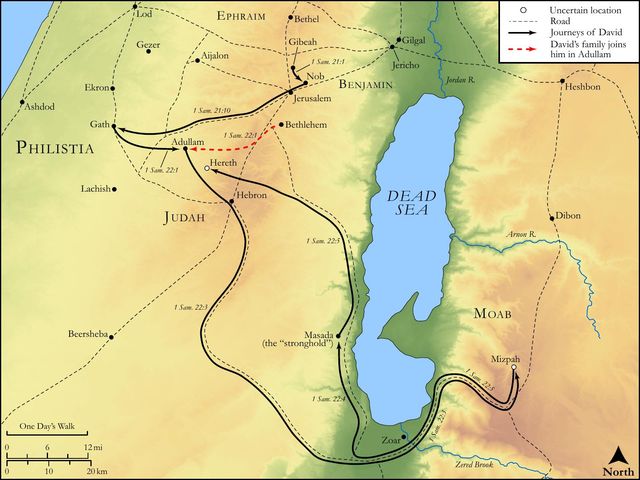
Study this verse
Public-domain commentary
Matthew Henry
From his Commentary on the Whole Bible. Henry comments on passages, not single verses — this entry covers 1 Samuel 21:10–15.
David, though king elect, is here an exile - designed to be master of vast treasures, yet just now begging his bread - anointed to the crown, and yet here forced to flee from his country. Thus do God's providences sometimes seem to run counter to his promises, for the trial of his people's faith, and the glorifying of his name, in the accomplishment of his counsels, notwithstanding the difficulties that lay in the way. Here is, 1. David's flight into the land of the Philistines, where he hoped to be hid, and to remain undiscovered in the court or camp of Achish king of Gath, Sa1 21:10. Israel's darling is necessitated to quit the land of Israel, and he that was the Philistine's great enemy (upon I know not what inducements) goes to seek for shelter among them. It should seem that as, though the Israelites loved him, yet the king of Israel had a personal enmity to him, which obliged him to leave his own country, so, though the Philistines hated him, yet the king of Gath had a personal kindness for him, valuing his merit, and perhaps the more for his killing Goliath of Gath, who, it may be, had been no friend to Achish. To him David now went directly, as to one he could confide in, as afterwards (Sa1 27:2, Sa1 27:3), and Achish would not have protected him but that he was afraid of disobliging his own people. God's persecuted people have often found better usage from Philistines than from Israelites, in the Gentile theatres than in the Jewish synagogues. The king of Judah imprisoned Jeremiah, and the king of Babylon set him at liberty. 2. The disgust which the servants of Achish took at his being there, and their complaint of it to Achish (Sa1 21:11): "Is not this David? Is not this he that has triumphed over the Philistines? witness that burden of the song which was so much talked of, Saul has slain his thousands, but David, this very man, his ten thousands. Nay, Is not this he that (if our intelligence from the land of Israel be true) is, or is to be, king of the land?" As such, "he must be an enemy to our country; and is it safe or honourable for us to protect or entertain such a man?" Achish perhaps had intimated to them that it would be policy to entertain David, because he was now an enemy to Saul, and he might be hereafter a friend to them. It is common for the outlaws of a nation to be sheltered by the enemies of that nation. But the servants of Achish objected to his politics, and thought it not at all fit that he should stay among them. 3. The fright which this put David into. Though he had some reason to put confidence in Achish, yet, when he perceived the servants of Achish jealous of him, he began to be afraid that Achish would be obliged to deliver him up to them, and he was sorely afraid (Sa1 21:12), and perhaps he was the more apprehensive of his own danger, when he was thus discovered, because he wore Goliath's sword, which, we may suppose, was well known in Gath, and with which he had reason to expect they would cut off his head, as he had cut off Goliath's with it. David now learned by experience what he has taught us (Psa 118:9), that it is better to trust in the Lord than to put confidence in princes. Men of high degree are a lie, and, if we make them our hope, they may prove our fear. It was at this time that David penned Psalm 55 (Michtam, a golden psalm), when the Philistines took him in Gath, where having shown before God his distresses, he resolves (Psa 55:3), "What time I am afraid I will trust in thee; and therefore (Psa 55:11) will not be afraid what man can do unto me, no, not the sons of giants." 4. The course he took to get out of their hands: He feigned himself mad, Sa1 21:13. He used the gestures and fashions of a natural fool, or one that had gone out of his wits, supposing they would be ready enough to believe that the disgrace he had fallen into, and the troubles he was now in, had driven him distracted. This dissimulation of his cannot be justified (it was a mean thing thus to disparage himself, and inconsistent with truth thus to misrepresent himself, and therefore not becoming the honour and sincerity of such a man as David); yet it may in some degree be excused, for it was not a downright lie and it was like a stratagem in war, by which he imposed upon his enemies for the preservation of his own life. What David did here in pretence and for his own safety, which made it partly excusable, drunkards do really, and only to gratify a base lust: they made fools of themselves and change their behaviour; their words and actions commonly are either as silly and ridiculous as an idiot's or as furious and outrageous as a madman's, which has often made me wonder that ever men of sense and honour should allow themselves in it. 5. His escape by this means, Sa1 21:14, Sa1 21:15. I am apt to think Achish was aware that the delirium was but counterfeit, but, being desirous to protect David (as we find afterwards he was very kind to him, even when the lord of the Philistines favoured him not, Sa1 28:1, Sa1 28:2; Sa1 29:6), he pretended to his servants that he really thought he was mad, and therefore had reason to question whether it was David or no; or, if it were, they need not fear him, what harm could he do them now that his reason had departed from him? They suspected that Achish was inclined to entertain him: "Not I," says he. "He is a madman. I'll have nothing to do with him. You need not fear that I should employ him, or give him any countenance." He humours the thing well enough when he asks, "Have I need of madmen? Shall this fool come into my house? I will show him no kindness, but then you shall do him no hurt, for, if he be a madmen, he is to be pitied." He therefore drove him away, as it is in the title of Ps. 34, which David penned upon this occasion, and an excellent psalm it is, and shows that he did not change his spirit when he changed his behaviour, but even in the greatest difficulties and hurries his heart was fixed, trusting in the Lord; and he concludes that psalm with this assurance, that none of those that trust in God shall be desolate, though they may be, as he now was, solitary and distressed, persecuted, but not forsaken.
Historical interpretation
Historical reception
1 surviving comment on this verse from the historical church.
Every kind of honour and happiness was bestowed upon you, and then was fulfilled that which is written, "My beloved ate and drank, and was enlarged and became fat, and kicked." [Deuteronomy 32:15] Hence flowed emulation and envy, strife and sedition, persecution and disorder, war and captivity. So the worthless rose up against the honoured, those of no reputation against such as were renowned, the foolish against the wise, the young against those advanced in years. For this reason righteousness and peace are now far departed from you, inasmuch as every one abandons the fear of God, and has become blind in His faith, neither walks in the ordinances of His appointment, nor acts a part becoming a Christian, but walks after his own wicked lusts, resuming the practice of an unrighteous and ungodly envy, by which death itself entered into the world. [Wisdom 2:24]
For thus it is written: "And it came to pass after certain days, that Cain brought of the fruits of the earth a sacrifice unto God; and Abel also brought of the firstlings of his sheep, and of the fat thereof. And God had respect to Abel and to his offerings, but Cain and his sacrifices He did not regard. And Cain was deeply grieved, and his countenance fell. And God said to Cain, Why are you grieved, and why is your countenance fallen? If you offer rightly, but do not divide rightly, have you not sinned? Be at peace: your offering returns to yourself, and you shall again possess it. And Cain said to Abel his brother, Let us go into the field. And it came to pass, while they were in the field, that Cain rose up against Abel his brother, and slew him." [Genesis 4:3-8] You see, brethren, how envy and jealousy led to the murder of a brother. Through envy, also, our father Jacob fled from the face of Esau his brother [Genesis 27:41-45]. Envy made Joseph be persecuted unto death, and to come into bondage. [Genesis 37:18-28] Envy compelled Moses to flee from the face of Pharaoh king of Egypt, when he heard these words from his fellow-countryman, "Who made you a judge or a ruler over us? Will you kill me, as you killed the Egyptian yesterday?" [Exodus 2:14] On account of envy, Aaron and Miriam had to make their abode without the camp. [Numbers 12:14-15] Envy brought down Dathan and Abiram alive to Hades, through the sedition which they excited against God's servant Moses. [Numbers 16:33] Through envy, David not only underwent the hatred of foreigners, but was also persecuted by Saul king of Israel. [1 Samuel 21:10-15]
Continue studying 1 Samuel 21:10 across the web’s major study libraries — every link below opens this exact verse, chapter, or book on the destination site.
Read & Compare
 BibleGatewayThis verse in more than 200 translations and 70 languages.
 Bible.comThe YouVersion reader — hundreds of translations, reading plans, and highlights.
 ESV.orgCrossway's official English Standard Version reader.
 NET BibleThe NET translation with 60,000+ translators' notes on every rendering decision.
 STEP BibleTyndale House's free study tool — original text, vocabulary, and scholarly resources.
 BibliaLogos Bible Software's free web reader.
 USCCBThe New American Bible (Revised Edition) with the U.S. bishops' study notes.
Commentaries
 BibleHub CommentariesDozens of classic commentaries on this verse, gathered on one page.
 StudyLightMore than 100 commentary sets — the largest collection on the web.
 BibleRefPlain-English commentary on what this verse means, verse by verse.
 Enduring WordDavid Guzik's free commentary on this chapter, widely used by Bible teachers.
 Bible Study ToolsVerse commentary alongside Greek and Hebrew study aids.
Original Language & Research
- BibleHub InterlinearThe verse word by word — original language, transliteration, and English.
- BibleHub LexiconEvery word's original-language definition and Strong's entry.
 Blue Letter BibleDeep-study tools — Strong's numbers, concordance, and word studies.
 SefariaThe Hebrew text with Rashi and centuries of Jewish commentary.
Sermons, Hymns & Audio


TrulyRandomVerse is not affiliated with these sites and doesn’t control their content. They’re linked because they’re genuinely useful.
Summary
1 Samuel 21:10 vividly portrays a pivotal moment in David's life as a hunted fugitive, detailing his desperate flight from King Saul. Driven by profound fear for his life, the anointed future king makes the astonishing and counter-intuitive decision to seek refuge in Gath, a major Philistine city and the very home of Goliath, underscoring the extreme pressure and perilous circumstances he faced. This act marks a new, more dangerous phase in his exile, forcing him into the territory of his sworn enemies.
Context
ShowHideLiterary Context
This verse immediately follows David's perilous stop at Nob, where he feigned a mission from Saul to obtain the sacred showbread and Goliath's sword from Ahimelech the priest, as recounted in 1 Samuel 21:1-9. This desperate act, born of necessity, would later have tragic repercussions for the priests of Nob, orchestrated by Doeg the Edomite at Saul's command, a devastating event described in 1 Samuel 22:9-19. David's flight to Gath is a direct continuation of his efforts to evade Saul's relentless pursuit, which began after Saul's escalating jealousy following David's military successes and the women's songs of praise, as detailed in 1 Samuel 18:6-9. His life is now characterized by constant movement, a profound lack of security, and a stark contrast to his earlier position as a celebrated warrior and royal musician.
Historical & Cultural Context
At this period, Israel was a nascent monarchy, continuously contending with its powerful Philistine neighbors. Gath was one of the five major Philistine city-states, a formidable stronghold and a significant center of military power. For David, the celebrated slayer of Goliath of Gath, as recorded in 1 Samuel 17:4, to seek asylum there was an act of extreme desperation, bordering on suicidal audacity. Culturally, seeking asylum with an enemy king was a dangerous gamble, relying on the slim hope that the enemy of one's enemy might be considered a friend, or at least a temporary protector. However, it also placed David in a position of immense vulnerability, entirely at the mercy of a foreign monarch. This period also vividly reflects the volatile nature of Saul's reign, marked by increasing paranoia and irrational behavior, which drove even his most loyal servants to such desperate measures.
Key Themes
ShowHideThe verse powerfully conveys themes of fear and desperation, as David's flight is explicitly "for fear of Saul." Despite his anointing by Samuel in 1 Samuel 16:13 and his past victories, David experiences profound human terror, leading him to make a choice driven by survival instinct rather than strategic advantage. This highlights that even great figures of faith are not immune to intense emotional distress. Another key theme is seeking refuge in unlikely places, as David's decision to go to Gath is profoundly counter-intuitive and reveals the dire extent of his flight from Saul, forcing him into the territory of his historical enemies. This act sets the stage for David's subsequent feigned madness in Gath, described in 1 Samuel 21:13, a desperate ploy to escape detection and harm. Ultimately, even amidst David's flawed and fear-driven choices, the overarching theme of God's providence amidst human weakness is evident, as this period of exile and hardship serves to refine David and prepare him for his future kingship, demonstrating God's continued protection and guidance.
Exposition and Analysis
ShowHideKey Word Analysis
ShowHideDavid, the youngest son of Jesse, is the central figure. His name, derived from a root meaning "loving," ironically contrasts with his current state of being unloved and hunted by King Saul. The mention of his name here underscores the tragic reversal of fortune for the one chosen by God to be Israel's next king, now reduced to a fugitive.
This primitive root signifies "to bolt" or "to flee suddenly and urgently." It conveys a sense of immediate, rapid, and often desperate movement away from danger. The use of bârach here emphasizes the speed and necessity of David's departure, driven by the immediacy and overwhelming nature of Saul's threat, rather than a planned strategic retreat.
While pânîym literally means "face," in this context, when combined with the preposition "for," it functions idiomatically to mean "for fear of" or "from the presence of." It indicates that David's flight was a direct consequence of his terror of Saul's presence and murderous intent. This highlights the profound psychological impact of Saul's relentless pursuit on David, reducing him to a state of raw apprehension.
Gath was one of the five principal Philistine cities, a formidable stronghold and a symbol of Israel's long-standing enemy. The very name evokes the memory of Goliath, the champion David famously defeated. David's choice of Gath as a refuge underscores the extreme and ironic desperation of his situation, as he seeks safety in the heart of enemy territory.
Verse Breakdown
ShowHide"And David arose, and fled that day"
This phrase emphasizes the immediacy and decisiveness of David's action. Having just left Nob, the threat from Saul was ever-present and growing, demanding an urgent response. "That day" suggests a non-negotiable departure, leaving no time for deliberation or alternative plans. It portrays David as a man on the run, constantly reacting to imminent danger. The verb "arose" (qûwm) indicates a decisive, immediate action, a sudden departure.
"for fear of Saul,"
This clause explicitly states the motivation behind David's flight. It is not a strategic withdrawal or a planned relocation, but a direct consequence of his profound terror of King Saul. Saul's irrational jealousy and murderous intent had become so overwhelming that David's primary concern was immediate survival, leading him to make an otherwise unthinkable choice. This human fear is a stark reality for the anointed king.
"and went to Achish the king of Gath."
This is the most striking and ironic detail of the verse. Gath was a major Philistine city, and the Philistines were Israel's sworn enemies. Furthermore, David himself had famously killed Goliath, a champion from Gath, as recorded in 1 Samuel 17:4. His decision to seek asylum with Achish, the Philistine king, underscores the extreme desperation of his situation. It was a gamble born of terror, a last resort for a man with nowhere else to turn within Israel's borders, highlighting the depth of his predicament.
Literary Devices
ShowHideThe verse employs several potent literary devices to convey David's desperate plight. Irony is profoundly prominent, as David, the celebrated slayer of Goliath and Israel's champion against the Philistines, is now forced to seek refuge in the very heart of enemy territory, specifically in Gath, Goliath's hometown. This dramatic reversal of fortune highlights the depth of his desperation and the tragic absurdity of his circumstances. Pathos is also powerfully evoked, as the explicit mention of David fleeing "for fear of Saul" elicits deep sympathy for the anointed king-in-waiting, revealing his profound vulnerability and the human cost of Saul's escalating madness. Furthermore, the narrative choice to have David go to Gath serves as significant foreshadowing, setting the stage for his subsequent feigned madness in 1 Samuel 21:13 and his later, more strategic, albeit still precarious, interactions with the Philistines during his extended exile, as chronicled in 1 Samuel 27:1-12.
Theological and Thematic Connections
ShowHide1 Samuel 21:10 offers a stark portrayal of human vulnerability and the intensity of fear, even for those chosen by God. David, despite his anointing and past triumphs, is not exempt from the crushing weight of terror. This episode reminds us that faith does not negate human emotion or the reality of danger. However, it also subtly underscores God's sovereign hand, even in David's seemingly misguided and fear-driven decisions. This period of exile and hardship, though born of desperation, served as a crucible for David, refining his character, teaching him dependence on God, and preparing him for the immense responsibilities of kingship. It demonstrates that God can work through our weaknesses and even our moments of panic, guiding us through perilous paths to fulfill His purposes.
Reflection and Application
ShowHideDavid's flight to Gath, driven by raw fear, offers a profoundly relatable image of a person at their breaking point. It reminds us that even the most courageous and divinely appointed individuals can experience overwhelming terror and make desperate, human choices. This narrative invites us to cultivate empathy for those in leadership, recognizing their shared humanity and susceptibility to fear. More importantly, it challenges us to consider our own responses when faced with overwhelming threats or seemingly insurmountable obstacles. While David's initial impulse was fear, his subsequent actions (feigning madness, composing psalms) demonstrate a continued, albeit imperfect, reliance on God's providence. We are called to remember that God's presence is unwavering, even in our moments of weakness or when our choices are less than ideal. Our ultimate refuge is not in strategic maneuvering or unlikely alliances, but in the steadfast love and power of God, who can work through any circumstance, refining our character and guiding us toward His ultimate purposes.
Questions for Reflection
ShowHideFAQ
ShowHideWas David's decision to flee to Gath a sign of a lack of faith?
ShowHideWhile David's flight was explicitly "for fear of Saul," indicating a very human response of terror, it's more complex than a simple lack of faith. It represents a moment of extreme desperation where survival instincts took over. However, even in this seemingly unspiritual act, God's providence was at work. This period of exile and hardship, including his time in Gath, served to humble David, teach him reliance on God in dire circumstances, and prepare him for his future kingship. It's a testament to God's ability to work through imperfect human choices and even moments of weakness. David's subsequent actions, such as composing psalms that reflect on God's deliverance during this time (e.g., Psalm 34 and Psalm 56), demonstrate that his underlying trust in God remained, even amidst his fear.
Christ-Centered Fulfillment
ShowHideDavid's desperate flight to Gath, an enemy city, for fear of Saul, foreshadows a deeper theological truth about refuge and the nature of kingship. David, the anointed king, is rejected by his own people's reigning monarch and forced into exile, seeking safety in the most unlikely and dangerous of places. This mirrors, in a profound way, the ultimate King, Jesus Christ. While David fled in fear, Jesus, the true Son of David, willingly entered a world hostile to Him, not out of fear, but out of perfect love and obedience to the Father's will, as described in Philippians 2:6-8. He became a "man of sorrows, and acquainted with grief," as prophesied in Isaiah 53:3, often having "nowhere to lay his head" (Matthew 8:20). Unlike David, who experienced fear and made imperfect choices, Jesus faced the ultimate terror of Gethsemane (Matthew 26:39) with perfect trust and obedience, submitting to the Father's will even unto death on the cross. He is the ultimate refuge, the one who took on our fears and weaknesses (Hebrews 4:15) so that we might find true peace and safety in Him, the King who conquers not by fleeing, but by perfectly fulfilling God's redemptive plan (John 14:27).