


1 Samuel 21:9
Bible text: King James Version (1769 Blayney text) · Public domain
Bible text: King James Version with Strong's numbers · Public domain
Bible text: Berean Standard Bible · Public domain
Bible text: American Standard Version (1901) · Public domain
Bible text: World English Bible, Messianic edition · Public domain
Bible text: Geneva Bible (1599) · Public domain
Bible text: Young's Literal Translation · Public domain
- וַיֹּאמֶרvai·Yo·merand he saidH559Conj-w ¦ V-Qal-ConsecImperf-3msVerb Qal Consecutive Imperfect 3rd Singular Masculineוַandיֹּאמֶרhe said
- הַכֹּהֵןha·ko·Henthe priestH3548Art ¦ N-msNoun Singular Masculine Absoluteהַtheכֹּהֵןpriest
- חֶרֶבche·Rev[the] sword ofH2719N-fscNoun Singular Feminine Construct
- גָּלְיָתgal·YatGoliathH1555N-proper-mNoun Proper Masculine
- הַפְּלִשְׁתִּיha·pe·lish·Tithe PhilistineH6430Art ¦ N-msNoun Gentilic Singular Masculine AbsoluteהַtheפְּלִשְׁתִּיPhilistine
- אֲשֶׁר'a·SherwhomH834RelParticle Relative
- הִכִּיתָhi·Ki·tayou struck downH5221V-Hiphil-Perf-2msVerb Hiphil Perfect 2nd Singular Masculine
- בְּעֵמֶקbe·'E·mekin [the] valley ofH6010Prep-b ¦ N-mscNoun Singular Masculine Constructבְּinעֵמֶק[the] valley of
- הָאֵלָהha·'e·Lah<the> ElahH425Art ¦ N-fsNoun Singular Feminine Absoluteהָ<the>אֵלָהElah
- הִנֵּהhi·nehhere!H2009PrtParticle Interjection
- הִיאhi'itH1931Pro-3fsPronoun Personal 3rd Singular Feminine
- לוּטָהlu·Tah[is] wrappedH3874V-Qal-PassPrtcpl-fsVerb Qal Participle Passive Singular Feminine Absolute
- בַשִּׂמְלָהva·sim·Lahin the cloakH8071Prep-b ¦ N-fsNoun Singular Feminine Absoluteבַin theשִּׂמְלָהcloak
- אַחֲרֵי'a·cha·ReibehindH310Adj-mpcAdjective Numerical Plural Masculine Construct
- הָאֵפוֹדha·'e·fOdthe ephodH646Art ¦ N-msNoun Singular Masculine Absoluteהָtheאֵפוֹדephod
- אִם'imifH518PrtParticle Conditional
- אֹתָהּ'o·Tah<obj.> itH853DirObjM ¦ 3fsParticle Object Indicatorאֹתָ<obj.>הּit
- תִּקַּחti·kachyou will takeH3947V-Qal-Imperf-2msVerb Qal Imperfect 2nd Singular Masculine
- לְךָle·Khafor <the> yourselfPrep-l ¦ 2msSuffix Personal 2nd Singular Masculineלְfor <the>ךָyourself
- קָחKachtake [it]H3947V-Qal-Imp-2msVerb Qal Imperative 2nd Singular Masculine
- כִּיkiforH3588PrtParticle Conditional
- אֵין'einthere notH369N-mscNoun Singular Masculine Construct
- אַחֶרֶת'a·Che·ret[is] anotherH312Adj-fsAdjective Singular Feminine Absolute
- זוּלָתָהּzu·la·Tahexcept itH2108N-fsc ¦ 3fsNoun Singular Feminine Constructזוּלָתָexceptהּit
- בָּזֶהba·Zehin this [place]H2088Prep-b ¦ PrtParticle Demonstrativeבָּinזֶהthis [place]
- וַיֹּאמֶרvai·Yo·merand he saidH559Conj-w ¦ V-Qal-ConsecImperf-3msVerb Qal Consecutive Imperfect 3rd Singular Masculineוַandיֹּאמֶרhe said
- דָּוִדda·VidDavidH1732N-proper-mNoun Proper Masculine
- אֵין'einthere notH369N-mscNoun Singular Masculine Construct
- כָּמוֹהָka·Mo·ha[is] like itH3644Prep ¦ 3fsPreposition Definiteכָּמוֹ[is] likeהָit
- תְּנֶנָּהte·Ne·nahgive itH5414V-Qal-Imp-2ms ¦ 3fsVerb Qal Imperative 2nd Singular Masculineתְּנֶgiveנָּהit
- לִּיLito <the> mePrep-l ¦ 1csSuffix Personal 1st Singular common genderלִּto <the>יme
English is a literal word-by-word gloss of the Hebrew, not the KJV's wording. Why?
This is the original text the KJV's translators worked from — each Hebrew word with its own literal English meaning in this verse, prepared by scholars at Tyndale House, Cambridge. The KJV translates whole sentences, not word by word, so its wording differs: one Hebrew word can become several English words, and the KJV may choose “the LORD” where the gloss reads “Yahweh”. Both are faithful — they answer different questions. For the KJV's own rendering, switch to the KJV text.
Details
See on the biblical-era map
Study this verse
Public-domain commentary
Matthew Henry
From his Commentary on the Whole Bible. Henry comments on passages, not single verses — this entry covers 1 Samuel 21:1–9. His four-level outline is real structure in the source text, so it is rendered as structure.
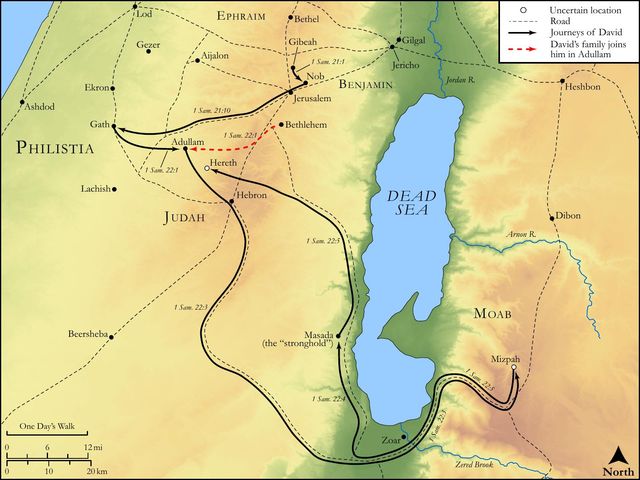
Here, I. David, in distress, flies in the tabernacle of God, now pitched at Nob, supposed to be a city in the tribe of Benjamin. Since Shiloh was forsaken, the tabernacle was often removed, though the ark still remained at Kirjath-jearim. Hither David came in his flight from Saul's fury (Sa1 21:1), and applied to Ahimelech the priest. Samuel the prophet could not protect him, Jonathan the prince could not. He therefore has recourse next to Ahimelech the priest. He foresees he must now be an exile, and therefore comes to the tabernacle, 1. To take an affecting leave of it, for he knows not when he shall see it again, and nothing will be more afflictive to him in his banishment than his distance from the house of God, and his restraint from public ordinances, as appears by many of his psalms. He had given an affectionate farewell to his friend Jonathan, and cannot go till he has given the like to the tabernacle. 2. To enquire of the Lord there, and to beg direction from him in the way both of duty and safety, his case being difficult and dangerous. That this was his business appears Sa1 22:10, where it is said that Ahimelech enquired of the Lord for him, as he had done formerly, Sa1 21:15. It is a great comfort to us in a day of trouble that we have a God to go to, to whom we may open our case, and from whom we may ask and expect direction.
II.Ahimelech the priest is surprised to see him in so poor an equipage; having heard that he had fallen into disgrace at court, he looked shy upon him, as most are apt to do upon their friends when the world frowns upon them. He was afraid of incurring Saul's displeasure by entertaining him, and took notice how mean a figure he now made to what he used to make: Why art thou alone? He had some with him (as appears Mar 2:26), but they were only his own servants; he had none of the courtiers, no persons of quality with him, as he used to have at other times, when he came to enquire of the Lord. He says (Psa 42:4) he was wont to go with a multitude to the house of God; and, having now but two or three with him, Ahimelech might well ask, Why art thou alone? He that was suddenly advanced from the solitude of a shepherd's life to the crowd and hurries of the camp is now as soon reduced to the desolate condition of an exile and is alone like a sparrow on the housetop, such charges are there in this world and so uncertain are its smiles! Those that are courted today may be deserted tomorrow.
III.David, under pretence of being sent by Saul upon public services, solicits Ahimelech to supply his present wants, Sa1 21:2, Sa1 21:3.
1.Here David did not behave like himself. He told Ahimelech a gross untruth, that Saul had ordered him business to despatch, that his attendants were dismissed to such a place, and that he was charged to observe secresy and therefore durst not communicate it, no, not to the priest himself. This was all false. What shall we say to this? The scripture does not conceal it, and we dare not justify it. It was ill done, and proved of bad consequence; for it occasioned the death of the priests of the Lord, as David reflected upon it afterwards with regret, Sa1 22:22. It was needless for him thus to dissemble with the priest, for we may suppose that, if he had told him the truth, he would have sheltered and relieved him as readily as Samuel did, and would have known the better how to advise him and enquire of God for him. People should be free with their faithful ministers. David was a man of great faith and courage, and yet now both failed him, and he fell thus foully through fear and cowardice, and both owing to the weakness of his faith. Had he trusted God aright, he would not have used such a sorry sinful shift as this for his own preservation. It is written, not for our imitation, no, not in the greatest straits, but for our admonition. Let him that thinks he stands take heed lest he fall; and let us all pray daily, Lord, lead us not into temptation. Let us all take occasion from this to lament,
(1.)The weakness and infirmity of good men; the best are not perfect on this side heaven. There may be true grace where yet there are many failings.
(2.)The wickedness of bad times, which forces good men into such straits as prove temptations too strong for them. Oppression makes a wise man do foolishly.
2.Two things David begged of Ahimelech, bread and a sword.
(1.)He wanted bread: five loaves, Sa1 21:3. Travelling was then troublesome, when men generally carried their provisions with them in kind, having little money and no public houses, else David would not now have had to seek for bread. It seems David had known the seed of the righteous begging bread occasionally, but not constantly, Psa 37:25. Now,
[1.]The priest objected that he had none but hallowed bread, show-bread, which had stood a week on the golden table in the sanctuary, and was taken thence for the use of the priests and their families, Sa1 21:4. It seems the priest kept no good house, but wanted either a heart to be hospitable or provisions wherewithal to be so. Ahimelech thinks that the young men that attended David might not eat of this bread unless they had for some time abstained from women, even from their own wives; this was required at the giving of the law (Exo 19:15), but otherwise we never find this made the matter of any ceremonial purity on the one side or pollution on the other, and therefore the priest here seems to be over-nice, not to say superstitious.
[2.]David pleads that he and those that were with him, in this case of necessity, might lawfully eat of the hallowed bread, for they were not only able to answer his terms of keeping from women for three days past, but the vessels (that is, the bodies) of the young men were holy, being possessed in sanctification and honour at all times (Th1 4:4, Th1 4:5), and therefore God would take particular care of them, that they wanted not necessary supports, and would have his priest to do so. Being thus holy, holy things were not forbidden them. Poor and pious Israelites were in effect priests to God, and, rather than be starved, might feed on the bread which was appropriated to the priests. Believers are spiritual priests, and the offerings of the Lord shall be their inheritance; they eat the bread of their God. He pleads that the bread is in a manner common, now that what was primarily the religious use of it is over; especially (as our margin reads it) where there is other bread (hot, Sa1 21:6) sanctified that day in the vessel, and put in the room of it upon the table. This was David's plea, and the Son of David approves it, and shows from it that mercy is to be preferred to sacrifice, that ritual observance must give way to moral duties, and that may be done in a case of an urgent providential necessity which may not otherwise be done. He brings it to justify his disciples in plucking the ears of corn on the sabbath day, for which the Pharisees censured them, Mat 12:3, Mat 12:4.
[3.]Ahimelech hereupon supplies him: He gave him hallowed bread (Sa1 21:6), and some think it was about this that he enquired of the Lord, Sa1 22:10. As a faithful servant he would not dispose of his master's provisions without his master's leave. This bread, we may suppose, was the more agreeable to David for its being hallowed, so precious were all sacred things to him. The show-bread was but twelve loaves in all, yet out of these he gave David five (Sa1 21:3), though they had no more in the house; but he trusted Providence.
(2.)He wanted a sword. Persons of quality, though officers of the army, did not then wear their swords so constantly as now they do, else surely David would not have been without one. It was a wonder that Jonathan did not furnish him with his, as he had before done, Sa1 18:4. However, it happened that he had now no weapons with him, the reason of which he pretends to be because he came away in haste, Sa1 21:8. Those that are furnished with the sword of the Spirit and the shield of faith cannot be disarmed of them, nor need they, at any time, to be at a loss. But the priests, it seems, had no swords: the weapons of their warfare were not carnal. There was not a sword to be found about the tabernacle but the sword of Goliath, which was laid up behind the ephod, as a monument of the glorious victory David obtained over him. Probably David had an eye to that when he asked the priest to help him with a sword; for, that being mentioned, O! says he, there is none like that, give it to me, Sa1 21:9. He could not use Saul's armour, for he had not proved it; but this sword of Goliath he had made trial of and done execution with. By this it appears that he was now well grown in strength and stature, that he could wear and wield such a sword as that. God had taught his hands to war, so that he could do wonders, Psa 18:34. Two things we may observe concerning this sword: - [1.] That God had graciously given it to him, as a pledge of his singular favour; so that whenever he drew it, nay, whenever he looked upon it, it would be a great support to his faith, by bringing to mind that great instance of the particular care and countenance of the divine providence respecting him. [2.] That he had gratefully given it back to God, dedicating it to him and to his honour as a token of his thankfulness; and now in his distress it stood him greatly in stead. Note, What we devote to God's praise, and serve him with, is most likely to redound, one way or other, to our own comfort and benefit. What we gave we have.
Thus was David well furnished with arms and victuals; but it fell out very unhappily that there was one of Saul's servants then attending before the Lord, Doeg by name, that proved a base traitor both to David and Ahimelech. He was by birth an Edomite (Sa1 21:7), and though proselyted to the Jewish religion, to get the preferment he now had under Saul, yet he retained the ancient and hereditary enmity of Edom to Israel. He was master of the herds, which perhaps was then a place of as much honour as master of the horse is now. Some occasion or other he had at this time to wait on the priest, either to be purified from some pollution or to pay some vow; but, whatever his business was, it is said, he was detained before the Lord. He must attend and could not help it, but he was sick of the service, snuffed at it, and said, What a weariness is it! Mal 1:13. He would rather have been any where else than before the Lord, and therefore, instead of minding the business he came about, was plotting to do David a mischief and to be revenged on Ahimelech for detaining him. God's sanctuary could never secure such wolves in sheep's clothing. See Gal 2:4.
Historical interpretation
Historical reception
1 surviving comment on this verse from the historical church.
And the priest said: Behold the sword of Goliath the Philistine, etc. The apostles said to Christ, teachers seeking against the kingdom of the world: Behold men accustomed to battle for the devil with perverse doctrines for a long time, whom you have overcome in the humility of the cross, are entangled in the trappings of the first transgression, far removed from the garments or ornaments of the priesthood, that is, works worthy of divine sight; if you wish to release them from these same trappings, and promote them to the rank of preaching truth, we know this is due to your power, not to our virtue or piety. For there is no mortal on earth who was not immediately subjected to the service of this kingdom upon being born, because the corrupted root, once defiled, could only produce branches of a corrupted progeny. And the Lord said: No one is better equipped to refute doctrines of vanity than those who were once imbued with them and accustomed to defend them against the Church: from their number, whom I already know to have been snatched from the hands of the devil, I will make teachers and bishops of the Church through teaching and baptizing. The title of Psalm 34 aptly recalls this choice, which reads: A Psalm of David, when he changed his behavior before Abimelech, who drove him away, and he departed. For he changed his behavior by declaring a false reason for his journey and concealing the true one. This can be interpreted as the Lord changing his appearance before the apostles, either by appearing immortal after the glory of the resurrection, having previously been seen as mortal before the agony of the passion; or by commanding them to go and teach and baptize all nations (Matthew 28), whereas shortly before he had instructed them to preach only to Judea, avoiding the ways of the Gentiles and the cities of the Samaritans; but he sent them out to preach everywhere, himself cooperating and confirming the word by the accompanying signs (Mark 16), and he himself departed by the triumph of his ascension, returning to heaven. And in the same Psalm, the Lord himself testifies in the first part that he continuously blesses the Father, admonishing his meek ones—the apostles—to persevere with him in preaching his praise, who had delivered him from the tribulation of passion and death. In the second part, he declares the rewards for the faithful's conversion, especially encouraging them to the feast of that most sweet bread, which in the present reading he receives sanctified, to be shared with his own in the kingdom of the Father. In the third part, he admonishes his boys as if they were his children, from whom they should abstain from impurities when approaching this bread. In the fourth part, he says the just will be delivered from all tribulations, and the impious will suffer due punishments. These things have been briefly stated by way of summary, so that every reader may recognize how excellently and harmoniously Scripture always and everywhere concurs with itself. And if anyone wishes to object that the priest to whom David came was called Ahimelech, not Abimelech, we respond that he had two names, not according to our opinion, but according to the inscription of another Psalm, which states: When Doeg the Edomite came and told Saul, and said to him: David has come to the house of Abimelech (Psalm 52). And even by this name the glory of the saints is not improperly shown, for it means "My Father's kingdom." They are the ones of whom the Lord spoke the parable of the kingdom: A certain nobleman went into a far country to receive a kingdom for himself, and to return (Luke 19). That is, Christ the man, departing from the bosom of the Father, went to men who had distanced themselves from his grace by sinning, to make them worthy of his reign, and to return with them to the joys of eternal peace. And concerning whom the Apostle, preaching the glory of the resurrection, had said: Christ the firstfruits, then those who belong to Christ at his coming, then the end; he added and said: When he hands over the kingdom to God the Father (1 Corinthians 15), that is, when he leads those saints he redeemed to the vision of the Father to be glorified.
Continue studying 1 Samuel 21:9 across the web’s major study libraries — every link below opens this exact verse, chapter, or book on the destination site.
Read & Compare
 BibleGatewayThis verse in more than 200 translations and 70 languages.
 Bible.comThe YouVersion reader — hundreds of translations, reading plans, and highlights.
 ESV.orgCrossway's official English Standard Version reader.
 NET BibleThe NET translation with 60,000+ translators' notes on every rendering decision.
 STEP BibleTyndale House's free study tool — original text, vocabulary, and scholarly resources.
 BibliaLogos Bible Software's free web reader.
 USCCBThe New American Bible (Revised Edition) with the U.S. bishops' study notes.
Commentaries
 BibleHub CommentariesDozens of classic commentaries on this verse, gathered on one page.
 StudyLightMore than 100 commentary sets — the largest collection on the web.
 BibleRefPlain-English commentary on what this verse means, verse by verse.
 Enduring WordDavid Guzik's free commentary on this chapter, widely used by Bible teachers.
 Bible Study ToolsVerse commentary alongside Greek and Hebrew study aids.
Original Language & Research
- BibleHub InterlinearThe verse word by word — original language, transliteration, and English.
- BibleHub LexiconEvery word's original-language definition and Strong's entry.
 Blue Letter BibleDeep-study tools — Strong's numbers, concordance, and word studies.
 SefariaThe Hebrew text with Rashi and centuries of Jewish commentary.
Sermons, Hymns & Audio


TrulyRandomVerse is not affiliated with these sites and doesn’t control their content. They’re linked because they’re genuinely useful.
Summary
In 1 Samuel 21:9, David, a desperate fugitive from King Saul, arrives at Nob, the city of priests, seeking provisions and a weapon. The high priest Ahimelech reveals that the only available sword is the very weapon David used to slay Goliath, which had been preserved as a sacred trophy within the sanctuary. David's immediate and emphatic request for this specific sword transcends mere practical need, highlighting its profound symbolic significance as a tangible reminder of God's past deliverance and a powerful emblem of future victory for the future king.
Context
ShowHideLiterary Context
This verse is intricately woven into a critical narrative segment detailing David's flight from King Saul, whose paranoia has escalated into a relentless pursuit to kill him. Having recently feigned madness before Achish in Gath, a desperate act to secure his safety, David arrives at Nob, the designated city for the tabernacle and its attendant priests. Here, he employs deception, claiming to be on a secret mission for Saul, to procure consecrated bread for himself and his weary men, as recounted in 1 Samuel 21:1-6. Following this, David requests a weapon (1 Samuel 21:8), which leads directly to Ahimelech's revelation about Goliath's sword in this verse. The ominous presence of Doeg the Edomite, Saul's chief herdsman, who was "detained before the LORD" (1 Samuel 21:7), casts a long, dark shadow over the entire encounter. This detail chillingly foreshadows the tragic massacre of the priests of Nob, instigated by Doeg's report to Saul, a horrific event detailed in 1 Samuel 22. The entire episode underscores David's perilous circumstances, his reliance on God's provision even through morally ambiguous means, and the escalating, deadly conflict with Saul.
Historical & Cultural Context
Nob held significant religious importance as a priestly city, serving as a central location for the tabernacle and its priestly functions following the destruction of Shiloh. The "ephod," a sacred priestly garment mentioned in the verse, was a crucial component of priestly attire, often associated with the Urim and Thummim, instruments used for discerning divine guidance. The act of storing Goliath's sword "behind the ephod" was not arbitrary; it signified its status as a consecrated trophy, a spoil of war dedicated to God as a perpetual memorial of His miraculous intervention. Among the nations, weapons seized from defeated enemies, particularly from champions, were frequently displayed in temples or sanctuaries as powerful symbols of victory and divine favor, as the Philistines later put Saul's armour in the house of Ashtaroth. David, having emerged as a national hero through his defeat of Goliath, would have had his trophy preserved with immense reverence. His desperate need for a weapon at this juncture dramatically highlights the precarious and challenging life of an outlaw, forced to rely on unconventional and often dangerous means for survival and protection, far removed from the king's court and his own established resources.
Key Themes
ShowHideThis passage powerfully illuminates several profound themes. Divine Providence and Provision are central, as God sovereignly orchestrates an unexpected and perfectly symbolic supply for David's immediate need, even amidst his dire circumstances and human deception. The availability of Goliath's sword serves as a potent reminder of God's past faithfulness and a tangible symbol of His continued protection for David, providing a much-needed weapon in a time of extreme vulnerability. This directly connects to the theme of the Symbolism of Victory: Goliath's sword is far more than a mere weapon; it is the very instrument that sealed David's most iconic victory over the Philistine champion, as vividly recounted in 1 Samuel 17:50-51. Reclaiming this sword would undoubtedly provide a powerful psychological and spiritual boost for David, reminding him of God's past deliverance and empowering him for future challenges. It was a tangible trophy of God's power working through him. Furthermore, the theme of David's Faith and Resourcefulness is clearly evident in his immediate recognition of the sword's unique value ("There is none like that") and his readiness to rely on God's past provision to navigate his present dangers. The narrative also subtly introduces the theme of The Consequences of Deception, as David's lies to Ahimelech, though born of desperation, tragically contribute to the devastating fate of the priests of Nob.
Exposition and Analysis
ShowHideKey Word Analysis
ShowHideThis term, derived from a root suggesting "drought" or "destruction," refers to a cutting instrument, encompassing a knife, dagger, or sword. In this context, it specifically denotes the weapon of Goliath. The priest's identification of this particular "sword" immediately evokes the epic victory in the Valley of Elah, transforming it from a generic weapon into a symbol of divine empowerment and a tangible trophy of God's decisive intervention through David.
This proper noun refers to the Philistine giant whom David famously defeated. The priest's explicit mention of "Goliath" directly links the sword to David's most celebrated act of faith and courage, instantly recalling the miraculous nature of that victory. This identification emphasizes the sword's unique provenance and its profound significance as a memorial to God's power demonstrated through His chosen servant.
This primitive root means "to strike" or "to slay," indicating a decisive and often violent act. The priest's precise phrasing, "whom thou slewest in the valley of Elah," serves as an undeniable confirmation of the sword's authenticity and its direct connection to David's past triumph. It underscores the definitive nature of David's victory over Goliath, a victory divinely enabled and now providentially recalled in David's moment of need.
This term designates a sacred priestly garment, specifically the high priest's shoulder-piece, often associated with the Urim and Thummim used for seeking divine guidance. The fact that Goliath's sword was preserved "behind the ephod" signifies its placement in a highly consecrated and honorable location within the sanctuary at Nob. This positioning elevates the sword from a mere weapon to a sacred artifact, a memorial to God's intervention and a symbol of His power, indicating the reverence with which the priests regarded this trophy of divine victory.
Verse Breakdown
ShowHide"And the priest said, The sword of Goliath the Philistine, whom thou slewest in the valley of Elah, behold, it [is here] wrapped in a cloth behind the ephod"
Ahimelech, the high priest, responds to David's urgent request for a weapon by revealing the presence of a specific, profoundly significant sword. He identifies it unequivocally as Goliath's, explicitly linking it to David's past, divinely empowered victory in the Valley of Elah. The detailed description that it was "wrapped in a cloth behind the ephod" highlights its careful preservation as a sacred trophy, not casually stored but reverently kept in a place of utmost honor within the sanctuary, signifying its status as a consecrated memorial to God's great deliverance.
"if thou wilt take that, take [it]: for [there is] no other save that here."
Ahimelech presents this unique sword as the only available option, underscoring David's desperate situation and the limited resources of the sanctuary for arming a fugitive. This statement emphasizes the providential nature of the sword's availability; it is precisely the weapon with the most profound symbolic meaning for David's current circumstances, yet it is offered as a practical necessity, highlighting God's provision in an unexpected way.
"And David said, [There is] none like that; give it me."
David's immediate and emphatic response reveals his profound understanding of the sword's significance. He recognizes its unparalleled value, not merely as a sharp weapon, but as a tangible reminder of God's past faithfulness and the divine power that had worked through him. This statement is a declaration of faith and recognition, acknowledging that this particular sword—the instrument of his greatest victory—is the most fitting and empowering weapon for his present and future challenges, symbolizing God's continued presence and power in his life.
Literary Devices
ShowHideThe passage is profoundly enriched by Symbolism. Goliath's sword transcends its identity as a mere weapon; it becomes a potent symbol of God's past deliverance, David's divine anointing, and the extraordinary power that works through seemingly ordinary or unexpected instruments. Its careful preservation within the sanctuary, specifically "behind the ephod," further imbues it with sacred significance, transforming it into a consecrated trophy of God's victory rather than just a discarded piece of war equipment. There is also a striking element of Irony present in this scene: David, the future king and the celebrated hero who single-handedly defeated Israel's greatest enemy, is now a desperate fugitive, forced to rely on the very weapon that marked his meteoric rise to prominence. This dramatic reversal of fortune powerfully underscores the precariousness of his current position. Furthermore, the retrieval of the sword can be seen as potent Foreshadowing, hinting at the numerous future battles David will fight, not only against physical adversaries but also the internal struggles of leadership and the relentless, ongoing conflict with Saul. It strongly suggests that David will continue to rely on the same divine strength and provision that enabled his initial, iconic victory over Goliath.
Theological and Thematic Connections
ShowHideThis pivotal encounter with Goliath's sword powerfully illustrates God's sovereign providence, even amidst human desperation and the complexities of David's deception. It serves as a profound reminder to believers that God frequently employs past victories and provisions to equip us for present and future challenges. The sword functions as a tangible "memorial stone" of God's unwavering faithfulness, a powerful reminder that the same God who delivered David from the formidable giant is the very God who will sustain and protect him through his perilous flight from Saul. This principle extends directly to the spiritual life of every believer: actively remembering God's past faithfulness and the "swords" of victory He has provided (whether His Word, His Spirit, or specific divine interventions in our lives) can profoundly bolster our faith and instill courage when confronting new adversaries or trials.
Reflection and Application
ShowHideDavid's re-acquisition of Goliath's sword in a moment of extreme vulnerability offers profound and enduring lessons for believers navigating their own trials and uncertainties. Just as David was providentially re-equipped with a potent symbol of God's past victory, we are frequently called to remember and draw strength from God's faithfulness in our own lives. When confronted with new fears, overwhelming uncertainties, or intense spiritual battles, actively recalling how God has powerfully delivered us before can significantly bolster our faith and provide the necessary courage for the present challenge. The "sword of Goliath" can represent our past triumphs, God's specific and miraculous answers to prayer, or even the spiritual weapons He has already graciously given us, such as His living Word, to overcome adversity. God often uses what He has already provided to meet our current needs, powerfully reminding us that His power is utterly sufficient, even in our moments of greatest weakness and desperation. This passage profoundly encourages us to actively recall, meditate on, and celebrate God's past goodness, allowing those cherished memories to fuel our trust and empower us to face whatever lies ahead, secure in the knowledge that the same faithful God who fought for us before will assuredly fight for us again.
Questions for Reflection
ShowHideFAQ
ShowHideWhy was Goliath's sword kept in the sanctuary at Nob?
ShowHideGoliath's sword was kept in the sanctuary as a consecrated trophy of God's victory, serving as a powerful and enduring memorial to the miraculous deliverance He provided through David against the Philistine champion. Among the nations, significant spoils of war, especially those from decisive victories, were often dedicated to deities in their temples as offerings or as tangible symbols of divine favor and power. Its presence in the sanctuary at Nob, a prominent priestly city, signified its sacred, consecrated status and served as a national treasure, a testament to God's direct and powerful intervention in the Valley of Elah.
What is the significance of the sword being "behind the ephod"?
ShowHideThe detail that the sword was "behind the ephod" is profoundly significant. The ephod was a sacred priestly garment, specifically the high priest's shoulder-piece, often associated with the Urim and Thummim, which were used for seeking divine counsel and discerning God's will. Placing Goliath's sword "behind" or in close proximity to such a sacred item indicates that it was kept in a place of utmost honor, reverence, and sanctity within the sanctuary. This careful preservation suggests that the sword was not merely stored away, but reverently guarded as a sacred object, perhaps even displayed or consulted in connection with seeking God's guidance, thereby underscoring its profound symbolic value as a consecrated instrument of God's victory rather than just a discarded weapon.
Christ-Centered Fulfillment
ShowHideThe narrative of David retrieving Goliath's sword in a moment of desperate need finds its ultimate and profound fulfillment in Jesus Christ, the true and greater David. While David's victory over Goliath was a physical triumph, foreshadowing his kingship and God's power working through him, Jesus' victory is spiritual and eternally decisive, overcoming the ultimate enemies of humanity: sin, death, and the devil. Unlike David, who required a physical weapon, Jesus accomplished His decisive victory not through a sword of steel, but through His perfect obedience, His sacrificial death on the cross, and His glorious resurrection. His "weapon" was His unwavering faithfulness, His self-giving love, and the indomitable power of God's Spirit. Just as Goliath's sword symbolized God's past deliverance for David, the cross of Christ stands as the definitive and eternal symbol of God's ultimate deliverance for all humanity, triumphing over the "principalities and powers" of darkness (Colossians 2:15). Jesus, the spotless Lamb of God, disarmed the spiritual forces of evil, rendering powerless "him who had the power of death, that is, the devil" (Hebrews 2:14-15). He is the one who truly wields the "sharp two-edged sword" of His Word, coming forth from His mouth to strike down the nations (Revelation 19:15), signifying His ultimate authority, righteous judgment, and sovereign reign. In Christ, we find our ultimate provision and the absolute assurance that the victory achieved on the cross is eternally sufficient for every battle we face, equipping us not with physical weapons, but with the full spiritual armor of God.