


1 Samuel 21:8
Bible text: King James Version (1769 Blayney text) · Public domain
Bible text: King James Version with Strong's numbers · Public domain
Bible text: Berean Standard Bible · Public domain
Bible text: American Standard Version (1901) · Public domain
Bible text: World English Bible, Messianic edition · Public domain
Bible text: Geneva Bible (1599) · Public domain
Bible text: Young's Literal Translation · Public domain
- וַיֹּאמֶרvai·Yo·merand he saidH559Conj-w ¦ V-Qal-ConsecImperf-3msVerb Qal Consecutive Imperfect 3rd Singular Masculineוַandיֹּאמֶרhe said
- דָּוִדda·VidDavidH1732N-proper-mNoun Proper Masculine
- לַאֲחִימֶלֶךְla·'a·chi·Me·lekhto AhimelechH288Prep-l ¦ N-proper-mNoun Proper MasculineלַtoאֲחִימֶלֶךְAhimelech
- וְאִיןve·'Inand where?H371Conj-w ¦ InterrogParticle Interrogativeוְandאִיןwhere?
- יֶשׁyeshthereH3426Adj-csAdjective Numerical Singular common gender Absolute
- פֹּהpohhereH6311AdvAdverb
- תַחַתta·chatunderH8478N-mscNoun Singular Masculine Construct
- יָדְךָya·de·Khayour handH3027N-csc ¦ 2msNoun Singular common gender Constructיָדְhandךָyour
- חֲנִיתcha·Nit[is] a spearH2595N-fsNoun Singular Feminine Absolute
- אוֹ'ovorH176ConjConjunction
- חָרֶבCha·reva swordH2719N-fsNoun Singular Feminine Absolute
- כִּיkiforH3588PrtParticle Conditional
- גַםgambothH1571AdvAdverb
- חַרְבִּיchar·Bimy swordH2719N-fsc ¦ 1csNoun Singular Feminine Constructחַרְבִּswordיmy
- וְגַםve·gam<and> as well asH1571Conj-w ¦ AdvAdverbוְ<and>גַםas well as
- כֵּלַיke·Laimy weaponsH3627N-mpc ¦ 1csNoun Plural Masculine Constructכֵּלַweaponsיmy
- לֹאlo'notH3808NegParticle Negative
- לָקַחְתִּיla·Kach·tiI tookH3947V-Qal-Perf-1csVerb Qal Perfect 1st Singular common gender
- בְיָדִיve·ya·Diin my handH3027Prep-b ¦ N-csc ¦ 1csNoun Singular common gender Constructבְinיָדִhandיmy
- כִּיkiforH3588PrtParticle Conditional
- הָיָהha·Yahit wasH1961V-Qal-Perf-3msVerb Qal Perfect 3rd Singular Masculine
- דְבַרde·var[the] matter ofH1697N-mscNoun Singular Masculine Construct
- הַמֶּלֶךְha·Me·lekhthe kingH4428Art ¦ N-msNoun Singular Masculine Absoluteהַtheמֶּלֶךְking
- נָחוּץna·ChutzurgentH5169V-Qal-PassPrtcpl-msVerb Qal Participle Passive Singular Masculine Absolute
English is a literal word-by-word gloss of the Hebrew, not the KJV's wording. Why?
This is the original text the KJV's translators worked from — each Hebrew word with its own literal English meaning in this verse, prepared by scholars at Tyndale House, Cambridge. The KJV translates whole sentences, not word by word, so its wording differs: one Hebrew word can become several English words, and the KJV may choose “the LORD” where the gloss reads “Yahweh”. Both are faithful — they answer different questions. For the KJV's own rendering, switch to the KJV text.
Details
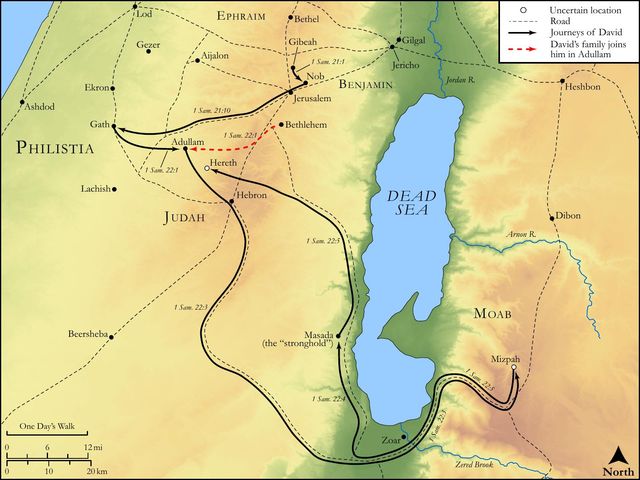
See on the biblical-era map
Study this verse
Public-domain commentary
Matthew Henry
From his Commentary on the Whole Bible. Henry comments on passages, not single verses — this entry covers 1 Samuel 21:1–9. His four-level outline is real structure in the source text, so it is rendered as structure.
Here, I. David, in distress, flies in the tabernacle of God, now pitched at Nob, supposed to be a city in the tribe of Benjamin. Since Shiloh was forsaken, the tabernacle was often removed, though the ark still remained at Kirjath-jearim. Hither David came in his flight from Saul's fury (Sa1 21:1), and applied to Ahimelech the priest. Samuel the prophet could not protect him, Jonathan the prince could not. He therefore has recourse next to Ahimelech the priest. He foresees he must now be an exile, and therefore comes to the tabernacle, 1. To take an affecting leave of it, for he knows not when he shall see it again, and nothing will be more afflictive to him in his banishment than his distance from the house of God, and his restraint from public ordinances, as appears by many of his psalms. He had given an affectionate farewell to his friend Jonathan, and cannot go till he has given the like to the tabernacle. 2. To enquire of the Lord there, and to beg direction from him in the way both of duty and safety, his case being difficult and dangerous. That this was his business appears Sa1 22:10, where it is said that Ahimelech enquired of the Lord for him, as he had done formerly, Sa1 21:15. It is a great comfort to us in a day of trouble that we have a God to go to, to whom we may open our case, and from whom we may ask and expect direction.
II.Ahimelech the priest is surprised to see him in so poor an equipage; having heard that he had fallen into disgrace at court, he looked shy upon him, as most are apt to do upon their friends when the world frowns upon them. He was afraid of incurring Saul's displeasure by entertaining him, and took notice how mean a figure he now made to what he used to make: Why art thou alone? He had some with him (as appears Mar 2:26), but they were only his own servants; he had none of the courtiers, no persons of quality with him, as he used to have at other times, when he came to enquire of the Lord. He says (Psa 42:4) he was wont to go with a multitude to the house of God; and, having now but two or three with him, Ahimelech might well ask, Why art thou alone? He that was suddenly advanced from the solitude of a shepherd's life to the crowd and hurries of the camp is now as soon reduced to the desolate condition of an exile and is alone like a sparrow on the housetop, such charges are there in this world and so uncertain are its smiles! Those that are courted today may be deserted tomorrow.
III.David, under pretence of being sent by Saul upon public services, solicits Ahimelech to supply his present wants, Sa1 21:2, Sa1 21:3.
1.Here David did not behave like himself. He told Ahimelech a gross untruth, that Saul had ordered him business to despatch, that his attendants were dismissed to such a place, and that he was charged to observe secresy and therefore durst not communicate it, no, not to the priest himself. This was all false. What shall we say to this? The scripture does not conceal it, and we dare not justify it. It was ill done, and proved of bad consequence; for it occasioned the death of the priests of the Lord, as David reflected upon it afterwards with regret, Sa1 22:22. It was needless for him thus to dissemble with the priest, for we may suppose that, if he had told him the truth, he would have sheltered and relieved him as readily as Samuel did, and would have known the better how to advise him and enquire of God for him. People should be free with their faithful ministers. David was a man of great faith and courage, and yet now both failed him, and he fell thus foully through fear and cowardice, and both owing to the weakness of his faith. Had he trusted God aright, he would not have used such a sorry sinful shift as this for his own preservation. It is written, not for our imitation, no, not in the greatest straits, but for our admonition. Let him that thinks he stands take heed lest he fall; and let us all pray daily, Lord, lead us not into temptation. Let us all take occasion from this to lament,
(1.)The weakness and infirmity of good men; the best are not perfect on this side heaven. There may be true grace where yet there are many failings.
(2.)The wickedness of bad times, which forces good men into such straits as prove temptations too strong for them. Oppression makes a wise man do foolishly.
2.Two things David begged of Ahimelech, bread and a sword.
(1.)He wanted bread: five loaves, Sa1 21:3. Travelling was then troublesome, when men generally carried their provisions with them in kind, having little money and no public houses, else David would not now have had to seek for bread. It seems David had known the seed of the righteous begging bread occasionally, but not constantly, Psa 37:25. Now,
[1.]The priest objected that he had none but hallowed bread, show-bread, which had stood a week on the golden table in the sanctuary, and was taken thence for the use of the priests and their families, Sa1 21:4. It seems the priest kept no good house, but wanted either a heart to be hospitable or provisions wherewithal to be so. Ahimelech thinks that the young men that attended David might not eat of this bread unless they had for some time abstained from women, even from their own wives; this was required at the giving of the law (Exo 19:15), but otherwise we never find this made the matter of any ceremonial purity on the one side or pollution on the other, and therefore the priest here seems to be over-nice, not to say superstitious.
[2.]David pleads that he and those that were with him, in this case of necessity, might lawfully eat of the hallowed bread, for they were not only able to answer his terms of keeping from women for three days past, but the vessels (that is, the bodies) of the young men were holy, being possessed in sanctification and honour at all times (Th1 4:4, Th1 4:5), and therefore God would take particular care of them, that they wanted not necessary supports, and would have his priest to do so. Being thus holy, holy things were not forbidden them. Poor and pious Israelites were in effect priests to God, and, rather than be starved, might feed on the bread which was appropriated to the priests. Believers are spiritual priests, and the offerings of the Lord shall be their inheritance; they eat the bread of their God. He pleads that the bread is in a manner common, now that what was primarily the religious use of it is over; especially (as our margin reads it) where there is other bread (hot, Sa1 21:6) sanctified that day in the vessel, and put in the room of it upon the table. This was David's plea, and the Son of David approves it, and shows from it that mercy is to be preferred to sacrifice, that ritual observance must give way to moral duties, and that may be done in a case of an urgent providential necessity which may not otherwise be done. He brings it to justify his disciples in plucking the ears of corn on the sabbath day, for which the Pharisees censured them, Mat 12:3, Mat 12:4.
[3.]Ahimelech hereupon supplies him: He gave him hallowed bread (Sa1 21:6), and some think it was about this that he enquired of the Lord, Sa1 22:10. As a faithful servant he would not dispose of his master's provisions without his master's leave. This bread, we may suppose, was the more agreeable to David for its being hallowed, so precious were all sacred things to him. The show-bread was but twelve loaves in all, yet out of these he gave David five (Sa1 21:3), though they had no more in the house; but he trusted Providence.
(2.)He wanted a sword. Persons of quality, though officers of the army, did not then wear their swords so constantly as now they do, else surely David would not have been without one. It was a wonder that Jonathan did not furnish him with his, as he had before done, Sa1 18:4. However, it happened that he had now no weapons with him, the reason of which he pretends to be because he came away in haste, Sa1 21:8. Those that are furnished with the sword of the Spirit and the shield of faith cannot be disarmed of them, nor need they, at any time, to be at a loss. But the priests, it seems, had no swords: the weapons of their warfare were not carnal. There was not a sword to be found about the tabernacle but the sword of Goliath, which was laid up behind the ephod, as a monument of the glorious victory David obtained over him. Probably David had an eye to that when he asked the priest to help him with a sword; for, that being mentioned, O! says he, there is none like that, give it to me, Sa1 21:9. He could not use Saul's armour, for he had not proved it; but this sword of Goliath he had made trial of and done execution with. By this it appears that he was now well grown in strength and stature, that he could wear and wield such a sword as that. God had taught his hands to war, so that he could do wonders, Psa 18:34. Two things we may observe concerning this sword: - [1.] That God had graciously given it to him, as a pledge of his singular favour; so that whenever he drew it, nay, whenever he looked upon it, it would be a great support to his faith, by bringing to mind that great instance of the particular care and countenance of the divine providence respecting him. [2.] That he had gratefully given it back to God, dedicating it to him and to his honour as a token of his thankfulness; and now in his distress it stood him greatly in stead. Note, What we devote to God's praise, and serve him with, is most likely to redound, one way or other, to our own comfort and benefit. What we gave we have.
Thus was David well furnished with arms and victuals; but it fell out very unhappily that there was one of Saul's servants then attending before the Lord, Doeg by name, that proved a base traitor both to David and Ahimelech. He was by birth an Edomite (Sa1 21:7), and though proselyted to the Jewish religion, to get the preferment he now had under Saul, yet he retained the ancient and hereditary enmity of Edom to Israel. He was master of the herds, which perhaps was then a place of as much honour as master of the horse is now. Some occasion or other he had at this time to wait on the priest, either to be purified from some pollution or to pay some vow; but, whatever his business was, it is said, he was detained before the Lord. He must attend and could not help it, but he was sick of the service, snuffed at it, and said, What a weariness is it! Mal 1:13. He would rather have been any where else than before the Lord, and therefore, instead of minding the business he came about, was plotting to do David a mischief and to be revenged on Ahimelech for detaining him. God's sanctuary could never secure such wolves in sheep's clothing. See Gal 2:4.
Historical interpretation
Historical reception
1 surviving comment on this verse from the historical church.
But David said to Ahimelech, "If you have a spear or a sword here at hand, etc." The Savior urges the apostles to train their listeners not only to learn but also to teach the word of life, by which He Himself can conquer the world, because He delayed sending preachers of the Gospel throughout the world, who would always fight for the Church against the aerial powers, instead of the angelic virtues through which the law was ordained in the hand of the Mediator. For the word of the king was pressing, that is, the enormity of human depravity, which preferred to reign by neglecting God, compelled that not angels, whose spiritual glory they could not see due to habitual carnal life, but mortal men alike to them should be sent to instruct them, who would proclaim to them to turn from vanity to the living God; who, if they had never sinned, would now rejoice in the familiar fellowship of angelic light.
Continue studying 1 Samuel 21:8 across the web’s major study libraries — every link below opens this exact verse, chapter, or book on the destination site.
Read & Compare
 BibleGatewayThis verse in more than 200 translations and 70 languages.
 Bible.comThe YouVersion reader — hundreds of translations, reading plans, and highlights.
 ESV.orgCrossway's official English Standard Version reader.
 NET BibleThe NET translation with 60,000+ translators' notes on every rendering decision.
 STEP BibleTyndale House's free study tool — original text, vocabulary, and scholarly resources.
 BibliaLogos Bible Software's free web reader.
 USCCBThe New American Bible (Revised Edition) with the U.S. bishops' study notes.
Commentaries
 BibleHub CommentariesDozens of classic commentaries on this verse, gathered on one page.
 StudyLightMore than 100 commentary sets — the largest collection on the web.
 BibleRefPlain-English commentary on what this verse means, verse by verse.
 Enduring WordDavid Guzik's free commentary on this chapter, widely used by Bible teachers.
 Bible Study ToolsVerse commentary alongside Greek and Hebrew study aids.
Original Language & Research
- BibleHub InterlinearThe verse word by word — original language, transliteration, and English.
- BibleHub LexiconEvery word's original-language definition and Strong's entry.
 Blue Letter BibleDeep-study tools — Strong's numbers, concordance, and word studies.
 SefariaThe Hebrew text with Rashi and centuries of Jewish commentary.
Sermons, Hymns & Audio


TrulyRandomVerse is not affiliated with these sites and doesn’t control their content. They’re linked because they’re genuinely useful.
Summary
1 Samuel 21:8 captures David's desperate and vulnerable state as he flees from King Saul's relentless pursuit. Having arrived alone and unarmed at Nob, the city of priests, David cunningly requests a weapon from Ahimelech, the high priest, fabricating a story that he is on an urgent, secret mission for King Saul, which required such haste that he could not bring his own arms. This moment reveals David's resourcefulness and fear, setting the stage for subsequent tragic events.
Context
ShowHideLiterary Context
This verse is situated within a critical turning point in David's life, marking his transition from Saul's trusted general to a hunted fugitive. Having narrowly escaped Saul's repeated attempts on his life, aided by Jonathan 1 Samuel 20, David is now on the run. He arrives at Nob, the tabernacle city, alone and in dire need of provisions and protection. His initial interaction with Ahimelech in 1 Samuel 21:1-2 establishes his deceptive narrative of being on "the king's business." Verse 8 specifically addresses his need for a weapon, reinforcing the fabricated urgency and secrecy of his mission, ultimately leading to him receiving Goliath's sword, which was stored there 1 Samuel 21:9. This deception, though seemingly minor, would later have devastating consequences for the priests of Nob, as recounted in 1 Samuel 22.
Historical & Cultural Context
Nob was a city designated for priests, serving as a sanctuary where the tabernacle and its sacred objects were housed, including the showbread and the sword of Goliath. In ancient Israelite society, the high priest, like Ahimelech, held significant religious and social authority. David's request for a weapon from a priest, rather than a military commander, highlights his extreme isolation and desperation. The concept of "the king's business" (מְלֶאכֶת הַמֶּלֶךְ, mela'khet hammelekh) would have immediately conveyed a sense of official urgency and importance, making David's excuse plausible to Ahimelech. Furthermore, a warrior like David would never typically travel unarmed, making his fabricated reason for lacking a weapon crucial to his deception. His flight into Gath immediately after 1 Samuel 21:10 underscores the perilous nature of his situation, seeking refuge even among the Philistines.
Key Themes
ShowHideDavid's desperate flight from Saul's wrath introduces several profound themes. First, it highlights David's desperation and resourcefulness in the face of mortal danger. Unarmed and alone, he employs cunning and deception to survive, demonstrating a pragmatic, albeit morally compromised, approach to his predicament. Second, the passage underscores the weight and tragic consequences of deception. David's lie, born of necessity, ultimately leads to the massacre of the priests of Nob by Doeg the Edomite at Saul's command 1 Samuel 22:18-19. This serves as a stark reminder that even seemingly small deceptions can have far-reaching and devastating effects. Third, it powerfully illustrates divine providence amidst human frailty. Despite David's fear-driven deceit and moral lapse, God's overarching plan for him to become king continues to unfold. This period of hardship and flight was formative for David, shaping his character and deepening his reliance on God, a reliance often expressed in his later Psalms, such as Psalm 34 or Psalm 57.
Exposition and Analysis
ShowHideKey Word Analysis
ShowHideThe Hebrew words חֲנִית (chănîyth, H2595) for "spear" and חֶרֶב (chereb, H2719) for "sword" are generic terms for common military weapons. David's specific request for either indicates his immediate need for any form of self-defense. As a renowned warrior, his unarmed state was highly unusual and dangerous, emphasizing the extreme circumstances of his flight. The pairing of these terms highlights his fundamental need for the tools of his trade, which he had been forced to abandon due to the suddenness of his escape.
The phrase מְלֶאכֶת הַמֶּלֶךְ (dâbâr hammelek, H1697 for dâbâr and H4428 for melek) literally means "word/matter of the king" or "affair of the king." It implies an official, urgent, and often secret undertaking directly commissioned by the monarch. By using this phrase, David lends an air of legitimate authority and critical importance to his fabricated story, making his lack of provisions and weapons seem plausible due to the supposed haste and secrecy required by the king. This phrase would have immediately commanded respect and cooperation from Ahimelech.
The Hebrew word חָפוּץ (nâchats, H5169) conveys a sense of urgency, being "in a hurry" or "pressed for time." David uses this word to explain why he is alone and unarmed. He implies that the "king's business" was so pressing and sudden that he had no time to gather his usual retinue or even his personal weapons. This detail serves to justify his unusual appearance and lack of preparedness, further cementing the credibility of his deceptive narrative to Ahimelech.
Verse Breakdown
ShowHide"And David said unto Ahimelech, And is there not here under thine hand spear or sword?"
David's opening question is direct and urgent, immediately conveying his desperate need for a weapon. The phrase "under thine hand" indicates possession or availability, suggesting that Ahimelech, as a high priest in charge of the sanctuary, might have access to such items, perhaps spoils of war dedicated to God. This question highlights David's vulnerability and his immediate priority: self-preservation.
"for I have neither brought my sword nor my weapons with me,"
This clause provides the reason for David's query – his complete lack of personal armament. As a seasoned warrior, traveling without weapons was not only unusual but extremely dangerous. This admission underscores the suddenness and urgency of his flight from Saul, confirming his status as a fugitive. It also sets up the justification for his fabricated story.
"because the king's business required haste."
This final clause is the crux of David's deception. He attributes his unarmed state and solitary journey to an urgent, secret mission from King Saul. This false pretense is designed to elicit sympathy and cooperation from Ahimelech without revealing his true situation as a hunted man. The "haste" part of the excuse explains why he is unprepared, making his story seem plausible in the context of a sudden royal command.
Literary Devices
ShowHideThe passage employs several key literary devices. Irony is prominent, as David, the divinely anointed future king and renowned warrior who famously slew Goliath, is now reduced to a desperate fugitive, unarmed and relying on a lie for survival. The "king's business" he claims to be on is ironically his own desperate flight from the current king, Saul. There is also an element of foreshadowing, as David's deception, though seemingly a pragmatic survival tactic, tragically sets in motion the events that lead to the brutal massacre of the priests of Nob by Doeg the Edomite in 1 Samuel 22, revealing the far-reaching and devastating consequences of even well-intentioned lies. Furthermore, the narrative presents a stark contrast between David's previous triumphs and his current state of vulnerability and moral compromise, highlighting the profound pressures he is enduring.
Theological and Thematic Connections
ShowHideDavid's desperate plea for a weapon, cloaked in deception, offers a poignant glimpse into the complexities of human faith and frailty under extreme duress. While God had clearly chosen and anointed David, this passage reveals that even God's chosen instruments are not immune to fear, poor judgment, and moral compromise. David's lie, born out of a genuine threat to his life, highlights the tension between trusting divine providence and resorting to human cunning. The narrative does not condone David's deception but rather records it, allowing the subsequent tragic events (the massacre of the priests) to underscore the gravity and far-reaching consequences of such actions. Ultimately, the passage points to God's unwavering faithfulness, even when His people falter, demonstrating His ability to work through imperfect vessels to accomplish His sovereign purposes.
Reflection and Application
ShowHideDavid's predicament in 1 Samuel 21:8 serves as a powerful and sobering reminder of the immense pressures that can lead individuals to compromise their integrity. In moments of extreme fear, desperation, or perceived necessity, the line between truth and deception can become blurred. While David's life was genuinely threatened, his choice to lie, though seemingly pragmatic for survival, set in motion a chain of events with devastating consequences for innocent lives. This narrative challenges us to consider our own responses when faced with difficult choices. Do we trust God's provision and protection even when circumstances seem dire, or do we resort to cunning and dishonesty? The story encourages us to cultivate a deep reliance on God's faithfulness, believing that He can deliver us without requiring us to sacrifice our integrity. It also prompts us to reflect on the long-term impact of our choices, recognizing that even small deviations from truth can have unforeseen and tragic ripple effects. Ultimately, while David faltered, his story is also one of God's enduring grace, demonstrating that even through human weakness and sin, God can continue to work His purposes, calling us to repentance and renewed trust.
Questions for Reflection
ShowHideFAQ
ShowHideWhy did David lie to Ahimelech?
ShowHideDavid lied to Ahimelech primarily out of fear and desperation. He was a fugitive fleeing from King Saul, who was actively seeking to kill him. David was alone, unarmed, and hungry. He needed provisions and a weapon to survive, but revealing his true status as an outlaw would have put Ahimelech and the priests in danger, and likely would have resulted in them refusing to help him. Therefore, he fabricated a story about being on an urgent, secret "king's business" to secure the necessary aid without exposing his perilous situation.
What were the consequences of David's deception?
ShowHideThe consequences of David's deception were severe and tragic. The most direct and devastating outcome was the massacre of the priests of Nob. Doeg the Edomite, an official of Saul, witnessed David's interaction with Ahimelech. Later, when Saul learned of the priests' aid to David, Doeg reported it, falsely accusing the priests of conspiring with David. This led Saul to command Doeg to slaughter Ahimelech and 85 other priests of Nob, along with their families and livestock, as recounted in 1 Samuel 22:9-19. While David's lie was born of necessity, it inadvertently led to the death of many innocent people.
Does God approve of David's lie?
ShowHideThe biblical narrative records David's actions without explicitly condoning his deception. While God's sovereign plan for David's kingship continued to unfold despite this moral lapse, the tragic consequences that followed—particularly the massacre of the priests—serve as a powerful indictment of the lie. The Bible consistently teaches that God values truth and integrity (Proverbs 12:22), and that deception, even when seemingly justified by circumstances, can have devastating ripple effects. This episode highlights that even righteous individuals can make sinful choices, and God's overarching purposes are achieved not because of, but often in spite of, human sin.
Christ-Centered Fulfillment
ShowHideDavid's desperate flight and his reliance on deception in 1 Samuel 21:8 offer a profound contrast and foreshadowing of Christ. David, the anointed king of Israel, is seen here as a vulnerable, hunted fugitive, forced to resort to human cunning for survival. This mirrors, in a fallen way, the rejection and persecution that the true Anointed One, Jesus Christ, would face. However, where David faltered in truth, Christ perfectly embodied it. Jesus, the Son of God, though facing ultimate rejection and persecution, never resorted to deception or self-preservation through compromise. His "Father's business" (Luke 2:49) was always to do the will of God, even to the point of death on a cross, offering His life as a perfect sacrifice without blemish or deceit (Hebrews 4:15). David's urgent need for a physical weapon points to humanity's spiritual defenselessness against sin and death, a need perfectly met by Christ, who is our ultimate "shield and great reward" (Genesis 15:1) and the "armor of God" in whom we stand firm (Ephesians 6:10-17). Ultimately, David's sin of deception and the tragic consequences it wrought are covered by the perfect righteousness and atoning sacrifice of Christ, who "knew no sin, so that in Him we might become the righteousness of God" (2 Corinthians 5:21).