


1 Samuel 27:7
Bible text: King James Version (1769 Blayney text) · Public domain
Bible text: Berean Standard Bible · Public domain
Bible text: American Standard Version (1901) · Public domain
Bible text: World English Bible, Messianic edition · Public domain
Bible text: Geneva Bible (1599) · Public domain
Bible text: Young's Literal Translation · Public domain
- וַיְהִיvay·Hiand it wasH1961Conj-w ¦ V-Qal-ConsecImperf-3msVerb Qal Consecutive Imperfect 3rd Singular Masculineוַandיְהִיit was
- מִסְפַּרmis·Par[the] number ofH4557N-mscNoun Singular Masculine Construct
- הַיָּמִיםhai·ya·Mimthe daysH3117Art ¦ N-mpNoun Plural Masculine Absoluteהַtheיָּמִיםdays
- אֲשֶׁר'a·SherwhichH834RelParticle Relative
- יָשַׁבya·Shavhe dweltH3427V-Qal-Perf-3msVerb Qal Perfect 3rd Singular Masculine
- דָּוִדda·VidDavidH1732N-proper-mNoun Proper Masculine
- בִּשְׂדֵהbis·Dehin [the] region ofH7704Prep-b ¦ N-mscNoun Singular Masculine Constructבִּinשְׂדֵה[the] region of
- פְלִשְׁתִּיםfe·lish·Tim[the] PhilistinesH6430N-mpNoun Gentilic Plural Masculine Absolute
- יָמִיםya·MimdaysH3117N-mpNoun Plural Masculine Absolute
- וְאַרְבָּעָהve·'ar·ba·'Ahand fourH702Conj-w ¦ N-csNoun Singular common gender Absoluteוְandאַרְבָּעָהfour
- חֳדָשִׁיםcho·da·ShimmonthsH2320N-mpNoun Plural Masculine Absolute
English is a literal word-by-word gloss of the Hebrew, not the KJV's wording. Why?
This is the original text the KJV's translators worked from — each Hebrew word with its own literal English meaning in this verse, prepared by scholars at Tyndale House, Cambridge. The KJV translates whole sentences, not word by word, so its wording differs: one Hebrew word can become several English words, and the KJV may choose “the LORD” where the gloss reads “Yahweh”. Both are faithful — they answer different questions. For the KJV's own rendering, switch to the KJV text.
Details
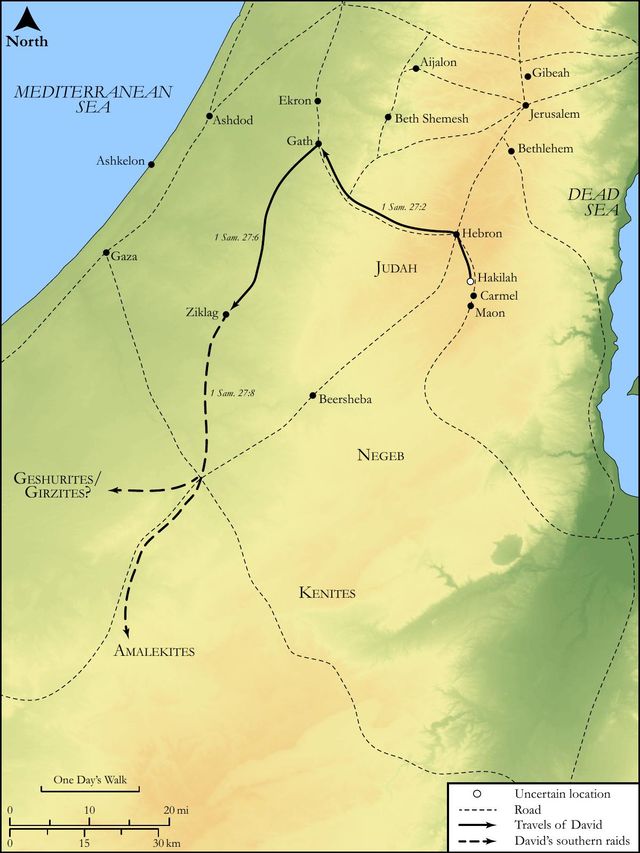
See on the biblical-era map
Study this verse
Public-domain commentary
Matthew Henry
From his Commentary on the Whole Bible. Henry comments on passages, not single verses — this entry covers 1 Samuel 27:1–7. His three-level outline is real structure in the source text, so it is rendered as structure.
Here is, I. The prevalency of David's fear, which was the effect of the weakness of his faith (Sa1 27:1): He said to his heart (so it may be read), in his communings with it concerning his present condition, I shall now perish one day by the hand of Saul. He represented to himself the restless rage and malice of Saul (who could not be wrought into a reconciliation) and the treachery of his own countrymen, witness that of the Ziphites, once and again; he looked upon his own forces, and observed how few they were, and that no recruits had come in to him for a great while, nor could he perceive that he got any ground; and hence, in a melancholy mood, he draws this dark conclusion: I shall one day perish by the hand of Saul. But, O thou of little faith! wherefore dost thou doubt? Was he not anointed to be king? Did not that imply an assurance that he should be preserved to the kingdom? Though he had no reason to trust Saul's promises, had he not all the reason in the world to trust the promises of God? His experience of the particular care Providence took of him ought to have encouraged him. He that has delivered does and will. But unbelief is a sin that easily besets even good men. When without are fightings, within are fears, and it is a hard matter to get over them. Lord, increase our faith!
II.The resolution he came to hereupon.
Now that Saul had, for this time, returned to his place, he determined to take this opportunity of retiring into the Philistines' country. Consulting his own heart only, and not the ephod or the prophet, he concludes, There is nothing better for me than that I should speedily escape into the land of the Philistines. Long trials are in danger of tiring the faith and patience even of very good men. Now,
1.Saul was an enemy to himself and his kingdom in driving David to this extremity. He weakened his own interest when he expelled from his service, and forced into the service of his enemies, so great a general as David was, and so brave a regiment as he had the command of.
2.David was no friend to himself in taking this course. God had appointed him to set up his standard in the land of Judah, Sa1 22:5. There God had wonderfully preserved him, and employed him sometimes for the good of his country; why then should he think of deserting his post? How could he expect the protection of the God of Israel if he went out of the borders of the land of Israel? Could he expect to be safe among the Philistines, out of whose hands he had lately escaped so narrowly by feigning himself mad? Would he receive obligations from those now whom he knew he must not return kindness to when he should come to be king, but be under an obligation to make war upon? Hereby he would gratify his enemies, who bade him go and serve other gods that they might have wherewith to reproach him, and very much weaken the hands of his friends, who would not have wherewith to answer that reproach. See what need we have to pray, Lord, lead us not into temptation.
III.The kind reception he had at Gath.
Achish bade him welcome, partly out of generosity, being proud of entertaining so brave a man, partly out of policy, hoping to engage him for ever to his service, and that his example would invite many more to desert and come over to him. No doubt he gave David a solemn promise of protection, which he could rely upon when he could not trust Saul's promises. We may blush to think that the word of a Philistine should go further than the word of an Israelite, who, if an Israelite indeed, would be without guile, and that the city of Gath should be a place of refuge for a good man when the cities of Israel refuse him a safe abode. David,
1.Brought his men with him (Sa1 27:2) that they might guard him, and might themselves be safe where he was, and to recommend himself the more to Achish, who hoped to have service out of him.
2.He brought his family with him, his wives and his household, so did all his men, Sa1 27:2, Sa1 27:3. Masters of families ought to take care of those that are committed to them, to protect and provide for those of their own house, and to dwell with them as men of knowledge.
IV.Saul's desisting from the further prosecution of him (Sa1 27:4):
He sought no more again for him; this intimates that notwithstanding the professions of repentance he had lately made, if he had had David in his reach, he would have aimed another blow. But, because he dares not come where he is, he resolves to let him alone. Thus many seem to leave their sins, but really their sins leave them; they would persist in them if they could. Saul sought no more for him, contenting himself with his banishment, since he could not have his blood, and hoping, it may be (as he had done, Sa1 18:25), that he would, some time or other, fall by the hand of the Philistines; and, though he would rather have the pleasure of destroying him himself, yet, if they do it, he will be satisfied, so that it be done effectually.
V.David's removal from Gath to Ziklag.
1.David's request for leave to remove was prudent and very modest, Sa1 27:5.
(1.)It was really prudent. David knew what it was to be envied in the court of Saul, and had much more reason to fear in the court of Achish, and therefore declines preferment there, and wishes for a settlement in the country, where he might be private, more within himself, and less in other people's way. In a town of his own he might have the more free exercise of his religion, and keep his men better to it, and not have his righteous soul vexed, as it was at Gath, with the idolatries of the Philistines.
(2.)As it was presented to Achish it was very modest. He does not prescribe to him what place he should assign him, only begs it may be in some town in the country, where he pleased (beggars must not be choosers); but he gives this for a reason, "Why should thy servant dwell in the royal city, to crowd thee, and disoblige those about thee?" Note, Those that would stand fast must not covet to stand high; and humble souls aim not to dwell in royal cities.
2.The grant which Achish made to him, upon that request, was very generous and kind (Sa1 27:6, Sa1 27:7): Achish gave him Ziklag. Hereby,
(1.)Israel recovered their ancient right; for Ziklag was in the lot of the tribe of Judah (Jos 15:31), and afterwards, out of that lot, was assigned, with some other cities, to Simeon, Jos 19:5. But either it was never subdued, or the Philistines had, in some struggle with Israel, made themselves masters of it. Perhaps they had got it unjustly, and Achish, being a man of sense and honour, took this occasion to restore it. The righteous God judgeth righteously.
(2.)David gained a commodious settlement, not only at a distance from Gath, but bordering upon Israel, where he might keep up a correspondence with his own countrymen, and whither they might resort to him at the revolution that was now approaching. Though we do not find that he augmented his forces at all while Saul lived (for, Sa1 30:10, he had but his six hundred men), yet, immediately after Saul's death, that was the rendezvous of his friends. Nay, it should seem, while he kept himself close because of Saul, multitudes resorted to him, at least to assure him of their sincere intentions, 1 Chr. 12:1-22. And this further advantage David gained, that Ziklag was annexed to the crown, at least the royalty of it pertained to the kings of Judah, ever after, Sa1 27:6. Note, There is nothing lost by humility and modesty, and a willingness to retire. Real advantages follow those that flee from imaginary honours. Here David continued for some days, even four months, as it may very well be read (Sa1 27:7), or some days above four months: the Septuagint reads it, some months; so long he waited for the set time of his accession to the throne; for he that believeth shall not make haste.
Historical interpretation
Historical reception
1 surviving comment on this verse from the historical church.
Now the number of days that David lived in the land of the Philistines, etc. There was, is, and will be a time of Christ's dwelling in the Church of the Gentiles, until he fills the four corners of the world with the complete light of his heavenly grace, until he pours the light of the Gospel, which is contained in the unanimous variety of the four books, into the believing hearts of the Gentiles. And note that David, coming to the Philistines, begins to dwell in Geth; but soon, with Achis' permission, he turns to Siceleg: because, coming to the Gentiles in the disciples, Christ, first pressed by the winepress of pressures by the unbelievers, finally after many grapes of the martyrs pressed, he approached to instruct those who among the dregs and wine of intellectual innkeepers, that is, those teaching various senses, knew how to judge.
Continue studying 1 Samuel 27:7 across the web’s major study libraries — every link below opens this exact verse, chapter, or book on the destination site.
Read & Compare
 BibleGatewayThis verse in more than 200 translations and 70 languages.
 Bible.comThe YouVersion reader — hundreds of translations, reading plans, and highlights.
 ESV.orgCrossway's official English Standard Version reader.
 NET BibleThe NET translation with 60,000+ translators' notes on every rendering decision.
 STEP BibleTyndale House's free study tool — original text, vocabulary, and scholarly resources.
 BibliaLogos Bible Software's free web reader.
 USCCBThe New American Bible (Revised Edition) with the U.S. bishops' study notes.
Commentaries
 BibleHub CommentariesDozens of classic commentaries on this verse, gathered on one page.
 StudyLightMore than 100 commentary sets — the largest collection on the web.
 BibleRefPlain-English commentary on what this verse means, verse by verse.
 Enduring WordDavid Guzik's free commentary on this chapter, widely used by Bible teachers.
 Bible Study ToolsVerse commentary alongside Greek and Hebrew study aids.
Original Language & Research
- BibleHub InterlinearThe verse word by word — original language, transliteration, and English.
- BibleHub LexiconEvery word's original-language definition and Strong's entry.
 Blue Letter BibleDeep-study tools — Strong's numbers, concordance, and word studies.
 SefariaThe Hebrew text with Rashi and centuries of Jewish commentary.
Sermons, Hymns & Audio


TrulyRandomVerse is not affiliated with these sites and doesn’t control their content. They’re linked because they’re genuinely useful.
Summary
This verse serves as a precise chronological anchor, revealing that David's period of refuge and strategic operations within the Philistine territory of Gath and Ziklag spanned "a full year and four months." This extended duration vividly underscores the relentless intensity of King Saul's persecution, the desperate circumstances David faced, and the complex, often morally ambiguous, means by which God sovereignly preserved and prepared His anointed king during a crucial season of waiting and development before his ultimate ascension to the throne of Israel.
Context
ShowHideLiterary Context
1 Samuel 27:7 functions as a critical temporal marker within the broader narrative of David's flight from Saul. It immediately follows David's decisive, albeit desperate, conclusion that he would "perish one day by the hand of Saul" (1 Samuel 27:1) and his subsequent flight to Achish, King of Gath. This marked a significant departure from his previous nomadic life as a fugitive within the wildernesses of Judah. The narrative preceding this verse details Achish's granting of Ziklag to David and his 600 men, providing them with a secure base of operations (1 Samuel 27:6). The verses immediately following 1 Samuel 27:7 elaborate on David's deceptive raids against non-Israelite tribes (the Geshurites, Girzites, and Amalekites), all while convincing Achish that his attacks were directed against Judah, thereby securing his position and resources within Philistia (1 Samuel 27:8-12). This entire period culminates in David's precarious involvement with the Philistine army preparing for battle against Israel, from which he is ultimately dismissed by the Philistine lords due to their distrust (1 Samuel 29).
Historical & Cultural Context
David's flight to the Philistines, Israel's perennial and most formidable enemies, was an act of extreme desperation, vividly illustrating the relentless intensity of Saul's pursuit. Among the nations, it was a recognized practice for political exiles or fugitives to seek asylum with rival kings, often becoming servants or mercenaries in exchange for protection and a safe haven. Achish's acceptance of David into Gath, and particularly his granting of Ziklag, reflects this established custom. Ziklag, strategically located on the southern border of Judah, allowed David to operate on the fringes of both Philistine and Israelite territories, a precarious but advantageous position. David's subsequent deceptive raids were a pragmatic, albeit ethically complex, means of survival, providing provisions for his large company while simultaneously maintaining his credibility with Achish and weakening Israel's true adversaries. This period also highlights the ongoing geopolitical tension and power struggles between the nascent Israelite monarchy and the well-established Philistine city-states, a conflict that would profoundly shape the early united monarchy.
Key Themes
ShowHideThe precise duration specified in 1 Samuel 27:7 contributes significantly to several overarching themes in 1 Samuel. Firstly, it powerfully underscores the theme of God's Sovereign Providence Amidst Human Imperfection. While David's decision to seek refuge among the Philistines and his subsequent deception present moral complexities, the narrative consistently portrays God's unwavering hand preserving His anointed one, even in seemingly compromising and ethically ambiguous situations. This prolonged period in exile served as a crucial crucible for David's character, leadership, and strategic acumen, preparing him for the immense responsibilities of kingship. Secondly, the "full year and four months" emphasizes the theme of Divine Timing and the Duration of Waiting. It highlights the extended nature of David's trials and the prolonged period of uncertainty he endured before he could assume his rightful place as king. This reinforces the profound theological truth that God's plans unfold according to His perfect timing, often requiring immense patience and steadfast endurance from His servants. Finally, it speaks to the theme of Desperation and Unexpected Refuge, illustrating the extreme measures to which even God's chosen can be driven by relentless persecution, and the surprising sources of protection God can provide, even among enemies, as previously seen when David feigned madness before Achish in 1 Samuel 21:10-15.
Exposition and Analysis
ShowHideKey Word Analysis
ShowHideThe central figure of the narrative, David, is identified by name. This emphasizes that despite his desperate circumstances and his dwelling among Israel's enemies, he remains God's chosen and anointed king. His identity here anchors the narrative to God's ongoing covenant promises and the unfolding of His plan for Israel's monarchy, even in this unlikely setting.
This verb signifies more than a fleeting visit; it implies settling, residing, or inhabiting. David and his 600 men, along with their families, established a life in Ziklag, indicating a degree of permanence and the development of routines, albeit routines that involved deceptive military expeditions. This word underscores the settled nature of their exile, highlighting the prolonged and established presence in Philistine territory.
While commonly translated as "day," in this context, and especially when combined with "months," yôwm refers to a full year, indicating a significant duration. Its presence alongside "time" (also yôwm in the KJV with Strong's H3117, though H4557 is also present for 'time') and "months" emphasizes the precise and extended nature of David's stay. This specific chronological detail highlights the considerable portion of David's life as a fugitive that was spent in this particular, precarious refuge, underscoring the severity of his circumstances and the long period of waiting.
Verse Breakdown
ShowHide"And the time that David dwelt"
This opening clause immediately establishes the focus on the duration of David's stay. It sets a precise chronological marker, emphasizing that David's presence in Philistine territory was not brief or incidental, but a significant and extended period of his life as a fugitive. The emphasis is on David's active residence and the passage of time.
"in the country of the Philistines"
This phrase specifies the exact geographical and political location of David's dwelling. It highlights the deeply ironic and desperate nature of his refuge – seeking asylum among Israel's traditional and most formidable enemies. This location also implies the profound strategic and moral complexities David navigated, as he operated within a foreign power structure while still aiming to protect his people and prepare for his destiny as Israel's king.
"was a full year and four months"
This is the precise chronological detail that forms the core of the verse. It quantifies the duration of David's stay, emphasizing its considerable length and exactness. This extended period underscores the severity of Saul's relentless persecution, the depth of David's desperation, and the prolonged waiting period before God's promises concerning his kingship would be fulfilled. It signifies a significant season of testing, learning, and strategic development for David, all under the sovereign hand of God.
Literary Devices
ShowHideThe primary literary device at play in 1 Samuel 27:7 is Chronological Marking. The precise mention of "a full year and four months" serves as a definitive temporal anchor within the narrative, providing a clear sense of the passage of time and the prolonged nature of David's exile. This specific detail lends a historical and realistic feel to the account, emphasizing the endurance required of David during this arduous period. Furthermore, there is a strong element of Irony in David, the future king of Israel, finding refuge and operating from within the territory of Israel's most formidable enemies. This ironic situation highlights the depths of his desperation and God's unexpected and often paradoxical ways of preserving His chosen. The verse also functions as a subtle form of Foreshadowing, as this extended period of waiting, testing, and strategic maneuvering among the Philistines is a critical preparatory phase for David's eventual ascension to the throne, hinting at the complex and often challenging path to divine fulfillment.
Theological and Thematic Connections
ShowHideThe precise duration of David's stay in Philistia, "a full year and four months," serves as a powerful testament to God's sovereign preservation and providential timing, even when His chosen instruments are operating in morally ambiguous or desperate circumstances. This period of exile, though fraught with deception and living among enemies, was not outside God's control. Rather, it was a crucial crucible that refined David's leadership, deepened his reliance on God, and strategically positioned him for the next phase of his calling. It highlights that God's faithfulness is not contingent on human perfection, but rather on His unchanging character and His commitment to His covenant promises. This extended waiting period also underscores the theme that God's plans unfold in His perfect timing, often requiring seasons of patience and endurance before promises are realized.
Reflection and Application
ShowHideThe specific mention of "a full year and four months" in 1 Samuel 27:7 offers profound lessons for believers navigating seasons of waiting, uncertainty, or even "exile" from ideal circumstances. David, God's anointed, was forced into a prolonged period of living among his enemies, relying on cunning and deception to survive. This reminds us that God's path for us is not always straightforward or comfortable; sometimes, it involves difficult, morally ambiguous, or seemingly unproductive seasons. Yet, even in these extended, challenging times, God remains sovereign, actively working to preserve, refine, and prepare us. This verse encourages us to trust in God's overarching plan, even when our immediate path seems unclear or less than ideal, recognizing that He can use unexpected circumstances and even our imperfect choices to further His purposes. It calls us to cultivate patience and endurance, believing that just as David's long sojourn prepared him for kingship, our own seasons of waiting are part of God's perfect timing and preparation for what lies ahead.
Questions for Reflection
ShowHideFAQ
ShowHideWhy did David choose to dwell in the country of the Philistines, Israel's enemies?
ShowHideDavid's decision to dwell in the country of the Philistines was an act of extreme desperation, driven by the relentless and irrational pursuit of King Saul. David concluded that he would "perish one day by the hand of Saul" (1 Samuel 27:1) and saw no other viable option for survival within Israelite territory. By seeking refuge with Achish, King of Gath, David was leveraging a common practice among the nations where political exiles or fugitives sought asylum with rival kings. This provided him and his 600 men with a measure of safety and a base of operations (Ziklag) that Saul's forces would be unlikely to invade. It was a pragmatic, albeit morally complex, choice born out of a dire situation.
Was David's decision to live among the Philistines and engage in deception a lapse in his faith?
ShowHideDavid's period in Philistia presents a complex theological and ethical challenge. While God had anointed David as king (1 Samuel 16:13), and David had previously shown great faith in confronting Goliath (1 Samuel 17), his actions here—fleeing to enemies and engaging in deception (raiding non-Israelite tribes while telling Achish he was attacking Judah, 1 Samuel 27:8-12)—do not reflect the highest ideals of faith or integrity. The text does not explicitly condemn David's actions here, but it also doesn't present them as exemplary. Instead, it portrays the reality of a human leader under immense pressure. Theologically, it demonstrates God's sovereignty and patience: God continued to preserve and prepare David despite his imperfect choices, showing that His plan is not derailed by human weakness. This period served as a crucible for David's character, refining his leadership and reliance on God, even as he navigated morally ambiguous terrain.
What is the significance of the precise duration ("a full year and four months") mentioned in the verse?
ShowHideThe precise duration of "a full year and four months" is significant for several reasons. Firstly, it lends historical accuracy and weight to the narrative, emphasizing that this was a real, extended period in David's life, not a brief interlude. Secondly, it underscores the intensity and prolonged nature of Saul's persecution; David was not merely hiding for a few weeks but was forced into a lengthy exile. Thirdly, it highlights the theme of divine timing and patient endurance. This long period of waiting, operating from a foreign land, and developing strategic skills was crucial for David's preparation for kingship. It demonstrates that God's plans often unfold over extended periods, requiring perseverance and trust, even when the path is difficult or indirect. This duration also sets the stage for the narrative's climax, as David's time in Philistia ends just before Saul's final battle and death (1 Samuel 31).
Christ-Centered Fulfillment
ShowHideDavid's "full year and four months" of exile in the land of the Philistines, marked by desperation, strategic maneuvering, and a prolonged season of waiting, powerfully foreshadows aspects of Christ's own journey. Just as David, God's anointed king, was rejected by the reigning authority (Saul) and forced into a period of suffering and apparent displacement, so too was Jesus, the true King of Israel, rejected by His own people and religious leaders, becoming a "man of sorrows, and acquainted with grief" (Isaiah 53:3). David's time among the Philistines, enemies of Israel, can be seen as a type of Christ's descent into the "country of the enemy" – entering a world hostile to God to secure salvation. Furthermore, David's patient endurance through this extended period of waiting, trusting that God would ultimately establish him as king, points to Christ's perfect submission to the Father's will, enduring the cross and the grave, knowing that His ultimate enthronement and reign were assured (Philippians 2:8-11). David's preservation by God during this precarious time, despite his own imperfections, ultimately finds its perfect fulfillment in Jesus, who, though tempted in every way, was without sin (Hebrews 4:15), and whose suffering and waiting culminated not in an earthly throne, but in eternal kingship over all creation, bringing true refuge and deliverance to all who trust in Him (Revelation 19:16).