


1 Samuel 30:3
Bible text: King James Version (1769 Blayney text) · Public domain
Bible text: Berean Standard Bible · Public domain
Bible text: American Standard Version (1901) · Public domain
Bible text: World English Bible, Messianic edition · Public domain
Bible text: Geneva Bible (1599) · Public domain
Bible text: Young's Literal Translation · Public domain
- וַיָּבֹאvai·ya·Vo'and he cameH935Conj-w ¦ V-Qal-ConsecImperf-3msVerb Qal Consecutive Imperfect 3rd Singular Masculineוַandיָּבֹאhe came
- דָוִדda·VidDavidH1732N-proper-mNoun Proper Masculine
- וַאֲנָשָׁיוva·'a·na·Shavand his menH582Conj-w ¦ N-mpc ¦ 3msNoun Plural Masculine Constructוַandאֲנָשָׁיmenוhis
- אֶל'eltoH413PrepPreposition
- הָעִירha·'Irthe cityH5892Art ¦ N-fsNoun Singular Feminine Absoluteהָtheעִירcity
- וְהִנֵּהve·hi·Nehand there!H2009Conj-w ¦ PrtParticle Interjectionוְandהִנֵּהthere!
- שְׂרוּפָהse·ru·Fah[it was] burnedH8313V-Qal-PassPrtcpl-fsVerb Qal Participle Passive Singular Feminine Absolute
- בָּאֵשׁba·'Eshwith <the> fireH784Prep-b ¦ N-csNoun Singular common gender Absoluteבָּwith <the>אֵשׁfire
- וּנְשֵׁיהֶםu·ne·shei·Hemand their wivesH802Conj-w ¦ N-mpc ¦ 3mpNoun Plural Masculine Constructוּandנְשֵׁיwivesהֶםtheir
- וּבְנֵיהֶםu·ve·nei·Hemand their sonsH1121Conj-w ¦ N-mpc ¦ 3mpNoun Plural Masculine Constructוּandבְנֵיsonsהֶםtheir
- וּבְנֹתֵיהֶםu·ve·no·tei·Hemand their daughtersH1323Conj-w ¦ N-fpc ¦ 3mpNoun Plural Feminine Constructוּandבְנֹתֵיdaughtersהֶםtheir
- נִשְׁבּוּnish·Buthey had been taken captiveH7617V-Niphal-Perf-3cpVerb Niphal Perfect 3rd Plural common gender
English is a literal word-by-word gloss of the Hebrew, not the KJV's wording. Why?
This is the original text the KJV's translators worked from — each Hebrew word with its own literal English meaning in this verse, prepared by scholars at Tyndale House, Cambridge. The KJV translates whole sentences, not word by word, so its wording differs: one Hebrew word can become several English words, and the KJV may choose “the LORD” where the gloss reads “Yahweh”. Both are faithful — they answer different questions. For the KJV's own rendering, switch to the KJV text.
Details
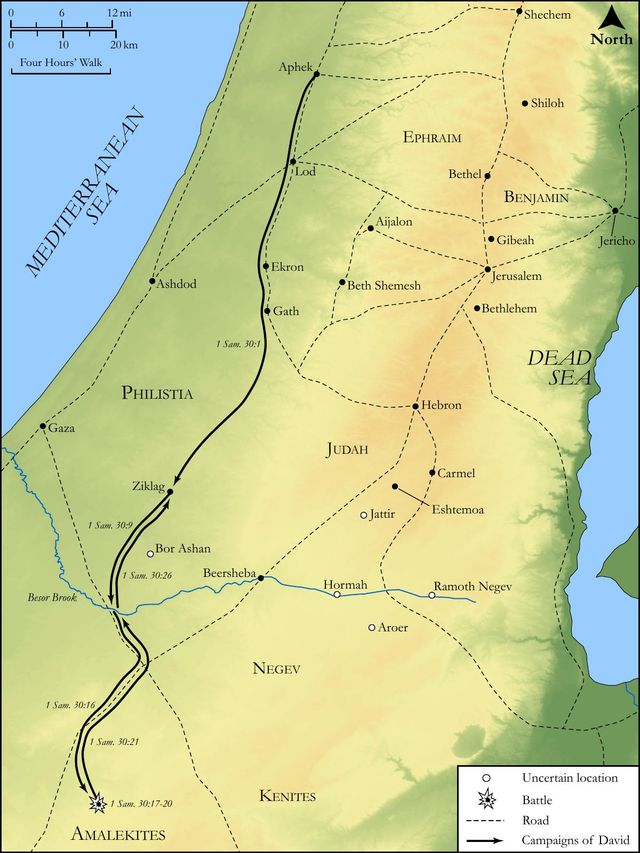
See on the biblical-era map
Study this verse
Public-domain commentary
Matthew Henry
From his Commentary on the Whole Bible. Henry comments on passages, not single verses — this entry covers 1 Samuel 30:1–6. His two-level outline is real structure in the source text, so it is rendered as structure.
Here we have, I. The descent which the Amalekites made upon Ziklag in David's absence, and the desolations they made there. They surprised the city when it was left unguarded, plundered it, burnt it, and carried all the women and children captives, Sa1 30:1, Sa1 30:2. They intended, by this to revenge the like havoc that David had lately made of them and their country, Sa1 27:8. He that had made so many enemies ought not to have left his own concerns so naked and defenceless. Those that make bold with others must expect that others will make as bold with them and provide accordingly. Now observe in this, 1. The cruelty of Saul's pity (as it proved) in sparing the Amalekites; if he had utterly destroyed them, as he ought to have done, these would not have been in being to do this mischief. 2. How David was corrected for being so forward to go with the Philistines against Israel. God showed him that he had better have staid at home and looked after his own business. When we go abroad in the way of our duty we may comfortably hope that God will take care of our families in our absence, but not otherwise. 3. How wonderfully God inclined the hearts of these Amalekites to carry the women and children away captives, and not to kill them. When David invaded them he put all to the sword (Sa1 27:9), and no reason can be given why they did not retaliate upon this city, but that God restrained them; for he has all hearts in his hands, and says to the fury of the most cruel men, Hitherto thou shalt come, and no further. Whether they spared them to lead them in triumph, or to sell them, or to use them for slaves, God's hand must be acknowledged, who designed to make use of the Amalekites for the correction, not for the destruction, of the house of David.
II.The confusion and consternation that David and his men were in when they found their houses in ashes and their wives and children gone into captivity. Three days' march they had from the camp of the Philistines to Ziklag, and now that they came thither weary, but hoping to find rest in their houses and joy in their families, behold a black and dismal scene was presented to them (Sa1 30:3), which made them all weep (David himself not excepted), though they were men of war, till they had no more power to weep, Sa1 30:4. The mention of David's wives, Ahinoam and Abigail, and their being carried captive, intimates that this circumstance went nearer his heart than any thing else. Note, It is no disparagement to the boldest and bravest spirits to lament the calamities of relations and friends. Observe,
1.This trouble came upon them when they were absent. It was the ancient policy of Amalek to take Israel at an advantage.
2.It met them at their return, and, for aught that appears, their own eyes gave them the first intelligence of it. Note, When we go abroad we cannot foresee what evil tidings may meet us when we come home again. The going out may be very cheerful, and yet the coming in be very doleful. Boast not thyself therefore of tomorrow, nor of tonight either, for thou knowest not what a day, or a piece of a day, may bring forth, Pro 27:1. If, when we come off a journey, we find our tabernacles in peace, and not laid waste as David here found his, let the Lord be praised for it.
III.The mutiny and murmuring of David's men against him (Sa1 30:6):
David was greatly distressed, for, in the midst of all his losses, his own people spoke of stoning him,
1.Because they looked upon him as the occasion of their calamities, by the provocation he had given the Amalekites, and his indiscretion in leaving Ziklag without a garrison in it. Thus apt are we, when we are in trouble, to fly into a rage against those who are in any way the occasion of our trouble, while we overlook the divine providence, and have not that regard to the operations of God's hand in it which would silence our passions, and make us patient.
2.Because now they began to despair of that preferment which they had promised themselves in following David. They hoped ere this to have been all princes; and now to find themselves all beggars was such a disappointment to them as made them grow outrageous, and threaten the life of him on whom, under God, they had the greatest dependence. What absurdities will not ungoverned passions plunge men into? This was a sore trial to the man after God's own heart, and could not but go very near him. Saul had driven him from his country, the Philistines had driven him from their camp, the Amalekites had plundered his city, his wives were taken prisoners, and now, to complete his woe, his own familiar friends, in whom he trusted, whom he had sheltered, and who did eat of his bread, instead of sympathizing with him and offering him any relief, lifted up the heel against him and threatened to stone him. Great faith must expect such severe exercises. But it is observable that David was reduced to this extremity just before his accession to the throne. At this very time, perhaps, the stroke was struck which opened the door to his advancement. Things are sometimes at the worst with the church and people of God just before they begin to mend.
IV.David's pious dependence upon the divine providence and grace in this distress:
But David encouraged himself in the Lord his God. His men fretted at their loss. The soul of the people was bitter, so the word is. Their own discontent and impatience added wormwood and gall to the affliction and misery, and made their case doubly grievous. But 1. David bore it better, though he had more reason than any of them to lament it; they gave liberty to their passions, but he set his graces on work, and by encouraging himself in God, while they dispirited each other, he kept his spirit calm and sedate. Or, 2. There may be a reference to the threatening words his men gave out against him. They spoke of stoning him; but he, not offering to avenge the affront, nor terrified by their menaces, encouraged himself in the Lord his God, believed, and considered with application to his present case, the power and providence of God, his justice and goodness, the method he commonly takes of bringing low and then raising up, his care of his people that serve him and trust in him, and the particular promises he had made to him of bringing him safely to the throne; with these considerations he supported himself, not doubting but the present trouble would end well. Note, Those that have taken the Lord for their God may take encouragement from their relation to him in the worst of times. It is the duty and interest of all good people, whatever happens, to encourage themselves in God as their Lord and their God, assuring themselves that he can and will bring light out of darkness, peace out of trouble, and good out of evil, to all that love him and are the called according to his purpose, Rom 8:28. It was David's practice, and he had the comfort of it, What time I am afraid I will trust in thee. When he was at his wits' end he was not at his faith's end.
Historical interpretation
Historical reception
1 surviving comment on this verse from the historical church.
When David and his men came to the city, etc. The Lord, arriving in His elect and Catholic teachers, and seeing the towers and roofs of the Church once shining, leveled to the ground by heretical discourse, first, as is proper, beseeches the Father with tears and prayers for its restoration, and then promptly begins the task of restoration as well. The doctors lament for the churches and souls entrusted to them, which they had brought forth and nurtured for God, corrupted from the simplicity of faith for a time, due to the delayed help of Christ; this is to say, with the advent of David delayed for a time, their wives and children were taken captive. For if His assisting grace were present, they certainly could not have been corrupted.
Continue studying 1 Samuel 30:3 across the web’s major study libraries — every link below opens this exact verse, chapter, or book on the destination site.
Read & Compare
 BibleGatewayThis verse in more than 200 translations and 70 languages.
 Bible.comThe YouVersion reader — hundreds of translations, reading plans, and highlights.
 ESV.orgCrossway's official English Standard Version reader.
 NET BibleThe NET translation with 60,000+ translators' notes on every rendering decision.
 STEP BibleTyndale House's free study tool — original text, vocabulary, and scholarly resources.
 BibliaLogos Bible Software's free web reader.
 USCCBThe New American Bible (Revised Edition) with the U.S. bishops' study notes.
Commentaries
 BibleHub CommentariesDozens of classic commentaries on this verse, gathered on one page.
 StudyLightMore than 100 commentary sets — the largest collection on the web.
 BibleRefPlain-English commentary on what this verse means, verse by verse.
 Enduring WordDavid Guzik's free commentary on this chapter, widely used by Bible teachers.
 Bible Study ToolsVerse commentary alongside Greek and Hebrew study aids.
Original Language & Research
- BibleHub InterlinearThe verse word by word — original language, transliteration, and English.
- BibleHub LexiconEvery word's original-language definition and Strong's entry.
 Blue Letter BibleDeep-study tools — Strong's numbers, concordance, and word studies.
 SefariaThe Hebrew text with Rashi and centuries of Jewish commentary.
Sermons, Hymns & Audio


TrulyRandomVerse is not affiliated with these sites and doesn’t control their content. They’re linked because they’re genuinely useful.
Summary
1 Samuel 30:3 vividly portrays the devastating scene that greeted David and his loyal men upon their return to Ziklag. After a providential dismissal from the Philistine army, they discovered their city utterly consumed by fire and their families—wives, sons, and daughters—abducted. This moment of profound shock and desolation marks a critical turning point, plunging David and his followers into the depths of despair before catalyzing a remarkable demonstration of faith and divine intervention, setting the stage for one of the most significant recoveries in David's early career.
Context
ShowHideLiterary Context
This verse is strategically placed at a pivotal juncture in David's wilderness years, immediately following his dismissal from King Achish's Philistine army, which was preparing to battle Israel. David and his men had been living in Ziklag, a city granted to them by Achish, for over a year, having fled from Saul's relentless pursuit (1 Samuel 27:6-7). Their absence from Ziklag, while divinely orchestrated to prevent them from fighting against their own people, left their settlement vulnerable. The subsequent verses detail the profound grief of David and his men, who "lifted up their voice and wept, until they had no more power to weep" (1 Samuel 30:4), the men's bitter resentment towards David, even contemplating stoning him (1 Samuel 30:6), and David's remarkable act of strengthening himself in the Lord his God (1 Samuel 30:6), setting the stage for divine inquiry and a successful pursuit and recovery.
Historical & Cultural Context
The Amalekites, a nomadic, predatory tribe, were long-standing enemies of Israel, known for their opportunistic raids and cruelty, a legacy stretching back to the wilderness wanderings (Exodus 17:8-16). Their attack on Ziklag was characteristic of ancient tribal warfare, where settlements were often burned, and inhabitants, particularly women and children, were carried off as plunder or slaves. This practice served both to weaken the enemy and to enrich the raiding party. David's location in Ziklag, a border town on the edge of Philistine territory and the Negev, made it particularly susceptible to such incursions. The destruction of the city and the abduction of families represented not just a material loss but a profound cultural and personal catastrophe, as family lineage, community stability, and the continuity of one's name were paramount in Israel.
Key Themes
ShowHideThis verse powerfully introduces themes of devastation and loss, depicting the sudden and overwhelming ruin that can befall even those under divine protection. It underscores the vulnerability of human existence and the harsh realities of life in a fallen world, where even those under divine favor can experience profound suffering. The immediate shock and subsequent grief foreshadow the testing of faith that David and his men would endure, highlighting the critical juncture where human despair meets divine intervention. Furthermore, it sets the stage for the theme of divine restoration, as the narrative quickly shifts from utter ruin to God's guidance leading to the recovery of all that was lost, emphasizing God's faithfulness even in the midst of human failure and suffering (1 Samuel 30:8-19). This incident also serves to highlight David's leadership, both in his initial despair and his subsequent spiritual resolve, demonstrating how a true leader turns to God in crisis.
Exposition and Analysis
ShowHideKey Word Analysis
ShowHideThis term refers to a fortified settlement, a place guarded by a watch. In this context, "the city" is Ziklag, which David and his men had been granted by King Achish. The destruction of this "city" signifies not merely the loss of dwellings but the complete obliteration of their secure base, their communal home, and their sense of stability, rendering them utterly displaced and vulnerable.
This verb denotes a complete and destructive conflagration, emphasizing that Ziklag was not merely damaged but utterly consumed by fire. The passive voice ("it was burned") highlights the devastating action of an external force, leaving no doubt about the thoroughness of the Amalekite assault. It conveys a sense of total ruin, signaling the loss of all their physical possessions and the complete destruction of their established life.
This verb specifically refers to the act of transporting individuals into captivity, particularly in the context of warfare, often involving women and children for plunder or enslavement. This highlights the deeply personal and agonizing aspect of the loss. Their loved ones were not merely killed but violently abducted, facing an uncertain and terrifying future of forced servitude or worse. This brutal reality of ancient warfare adds immense psychological torment to David and his men's physical and material loss.
Verse Breakdown
ShowHide"So David and his men came to the city"
This clause establishes the immediate action and setting. David and his 600 loyal followers, having been dismissed by the Philistine lords, are returning to their base at Ziklag. The mundane act of "coming to the city" sets up a dramatic contrast with the horror they are about to discover, building a sense of impending dread for the informed reader.
"and, behold, [it was] burned with fire"
The interjection "behold" signals a sudden, shocking revelation, drawing the reader into the immediate, visceral experience of David and his men. The sight of their home, Ziklag, reduced to ashes by fire, is the first crushing blow. This visual immediately communicates total destruction, the loss of their physical dwellings, and the tangible evidence of a violent, recent attack, leaving them without shelter or security.
"and their wives, and their sons, and their daughters, were taken captives"
This final, devastating clause reveals the most grievous loss. The enumeration of "wives," "sons," and "daughters" emphasizes the deeply personal and familial nature of the catastrophe, highlighting that the very fabric of their lives—their families, their future generations—had been violently torn away. The phrase "taken captives" indicates abduction, not death, which, while offering a glimmer of hope for recovery, also implies a terrifying and uncertain fate for their loved ones, adding immense psychological torment to their physical loss.
Literary Devices
ShowHideThe verse employs several powerful literary devices to convey the profound impact of the event. Pathos is immediately evident, as the stark description of a burned city and abducted families evokes profound sorrow and sympathy for David and his men, inviting the reader to share in their grief. The use of "behold" acts as a dramatic interjection, abruptly shifting the narrative tone from expectation to shock, drawing the reader directly into the characters' sudden, horrifying realization of disaster. This abrupt revelation also serves as potent foreshadowing, hinting at the deep despair that will follow in 1 Samuel 30:4 and setting the stage for David's subsequent spiritual struggle and ultimate triumph. There is also a subtle but powerful irony in the situation: David was providentially spared from fighting against his own people, only to return home and find his own family and community utterly devastated, highlighting the complex interplay of divine will, human suffering, and the unexpected turns of providence.
Theological and Thematic Connections
ShowHide1 Samuel 30:3 serves as a stark reminder that even those in God's favor are not exempt from profound suffering and loss. It powerfully illustrates the reality of living in a fallen world, where unexpected devastation can strike, challenging faith and resilience. This moment of utter ruin for David foreshadows the testing of all believers, demonstrating that trials are not necessarily indicators of divine displeasure but can be crucibles for spiritual growth and deeper reliance on God. The verse sets the stage for David's subsequent response, which becomes a paradigm for how to navigate despair: turning to the Lord for strength and guidance, even when all human hope seems lost. It underscores the theological truth that God's sovereignty is at work even in the midst of chaos and that His purposes can unfold through human suffering, ultimately leading to His glory and the good of His people.
Reflection and Application
ShowHideThe scene at Ziklag is a poignant mirror for the unexpected crises and profound losses that can ambush us in life. It reminds us that even when we believe we are walking in God's will, circumstances beyond our control can bring about devastating personal and communal suffering. This verse invites us to acknowledge the raw, human experience of grief and despair that accompanies such loss, recognizing that it is a natural and valid response. However, it also implicitly challenges us to consider where we turn when our world is burned and our loved ones are taken. Just as David was stripped of everything, forcing him to look beyond himself, we too are often driven to our knees in such moments. This passage encourages us to cultivate a deep, abiding faith that can be accessed even in the darkest hours, prompting us to seek God's strength and direction when our own resources are utterly depleted. It is in these crucible moments that our faith is truly refined and our reliance on the Lord is deepened, preparing us for the restoration and new beginnings that God often brings forth from the ashes.
Questions for Reflection
ShowHideFAQ
ShowHideWhy were David and his men away from Ziklag, leaving it vulnerable?
ShowHideDavid and his men were away from Ziklag because they had been summoned by King Achish of Gath to join the Philistine army in a battle against Israel. This was a complex and morally compromising situation for David, as it would have forced him to fight against his own people. Providentially, the other Philistine lords distrusted David and insisted that he and his men be sent back to Ziklag (1 Samuel 29:6-11). While this divine intervention spared David from fighting Israel, their absence left Ziklag undefended, allowing the Amalekites, opportunistic enemies of Israel, to launch their devastating raid.
Christ-Centered Fulfillment
ShowHideThe desolation of Ziklag and the profound loss experienced by David and his men, though a moment of intense suffering, ultimately foreshadows the greater suffering and subsequent triumph found in Christ. David, as a type of Christ, experiences a stripping away of all earthly security—home, family, and even the loyalty of his men—mirroring the ultimate self-emptying of Jesus, who "had nowhere to lay his head" (Matthew 8:20) and was ultimately abandoned by His disciples in His hour of greatest need (Matthew 26:56). Just as David, in his deepest despair, "strengthened himself in the Lord his God" (1 Samuel 30:6) and subsequently recovered all that was lost, so too does Christ, through His death on the cross, endure the ultimate loss and desolation, bearing the sin of the world, only to rise in glorious victory. His resurrection is the ultimate recovery, not just of what was lost, but of eternal life and reconciliation for all who believe, conquering sin and death once and for all (Romans 6:4). In Christ, believers find a leader who has known the depths of suffering and loss, yet through whom all things are ultimately restored and made new, offering a hope far greater than any earthly restoration, a promise of a new heaven and a new earth where God will wipe away every tear (Revelation 21:4-5).