


1 Samuel 4:13
Bible text: King James Version (1769 Blayney text) · Public domain
Bible text: King James Version with Strong's numbers · Public domain
Bible text: Berean Standard Bible · Public domain
Bible text: American Standard Version (1901) · Public domain
Bible text: World English Bible, Messianic edition · Public domain
Bible text: Geneva Bible (1599) · Public domain
Bible text: Young's Literal Translation · Public domain
- וַיָּבוֹאvai·ya·Vo'and he cameH935Conj-w ¦ V-Qal-ConsecImperf-3msVerb Qal Consecutive Imperfect 3rd Singular Masculineוַandיָּבוֹאhe came
- וְהִנֵּהve·hi·Nehand there!H2009Conj-w ¦ PrtParticle Interjectionוְandהִנֵּהthere!
- עֵלִי'E·liEliH5941N-proper-mNoun Proper Masculine
- יֹשֵׁבyo·Shev[was] sittingH3427V-Qal-Prtcpl-msVerb Qal Participle Singular Masculine Absolute
- עַל'alonH5921PrepPreposition
- הַכִּסֵּאha·ki·Se'the seatH3678Art ¦ N-msNoun Singular Masculine Absoluteהַtheכִּסֵּאseat
- יַדyach[the] side ofH3027N-cscNoun Singular common gender Construct
- דֶּרֶךְde·rekh[the] roadH1870N-csNoun Singular common gender Absolute
- מְצַפֶּהme·tza·PehwatchingH6822V-Piel-Prtcpl-msVerb Piel Participle Singular Masculine Absolute
- כִּיkiforH3588PrtParticle Conditional
- הָיָהha·Yahit wasH1961V-Qal-Perf-3msVerb Qal Perfect 3rd Singular Masculine
- לִבּוֹli·Bohis heartH3820N-msc ¦ 3msNoun Singular Masculine Constructלִבּheartוֹhis
- חָרֵדcha·RedtremblingH2730Adj-msAdjective Singular Masculine Absolute
- עַל'alonH5921PrepPreposition
- אֲרוֹן'a·Ron[the] ark ofH727N-mscNoun Singular Masculine Construct
- הָאֱלֹהִיםha·'E·lo·Him<the> GodH430Art ¦ N-mpNoun Plural Masculine Absoluteהָ<the>אֱלֹהִיםGod
- וְהָאִישׁve·ha·'Ishand the manH376Conj-w ¦ Art ¦ N-msNoun Singular Masculine Absoluteוְandהָtheאִישׁman
- בָּאba'he cameH935V-Qal-Perf-3msVerb Qal Perfect 3rd Singular Masculine
- לְהַגִּידle·ha·Gidto tellH5046Prep-l ¦ V-Hiphil-InfVerb Hiphil Infinitive Constructלְtoהַגִּידtell
- בָּעִירba·'Irin the cityH5892Prep-b ¦ N-fsNoun Singular Feminine Absoluteבָּin theעִירcity
- וַתִּזְעַקva·tiz·'Akand it cried outH2199Conj-w ¦ V-Qal-ConsecImperf-3fsVerb Qal Consecutive Imperfect 3rd Singular Feminineוַandתִּזְעַקit cried out
- כָּלkolallH3605N-mscNoun Singular Masculine Construct
- הָעִירha·'Irthe cityH5892Art ¦ N-fsNoun Singular Feminine Absoluteהָtheעִירcity
English is a literal word-by-word gloss of the Hebrew, not the KJV's wording. Why?
This is the original text the KJV's translators worked from — each Hebrew word with its own literal English meaning in this verse, prepared by scholars at Tyndale House, Cambridge. The KJV translates whole sentences, not word by word, so its wording differs: one Hebrew word can become several English words, and the KJV may choose “the LORD” where the gloss reads “Yahweh”. Both are faithful — they answer different questions. For the KJV's own rendering, switch to the KJV text.
Details
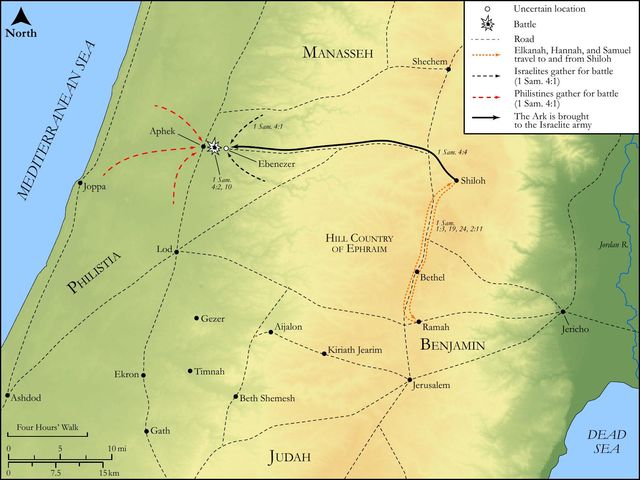
See on the biblical-era map
Study this verse
Public-domain commentary
Matthew Henry
From his Commentary on the Whole Bible. Henry comments on passages, not single verses — this entry covers 1 Samuel 4:12–18. His two-level outline is real structure in the source text, so it is rendered as structure.
Tidings are here brought to Shiloh of the fatal issue of their battle with the Philistines. Bad news flies fast. This soon spread through all Israel; every man that fled to his tent brought it, with too plain a proof of it, to his neighbours. But no place was so nearly concerned as Shiloh. Thither therefore an express posted away immediately; it was a man of Benjamin; the Jews fancy it was Saul. He rent his clothes, and put earth upon his head, by these signs to proclaim the sorrowful news to all that saw him as he ran, and to show how much he himself was affected with it, Sa1 4:12. He went straight to Shiloh with it; and here we are told,
I.How the city received it.
Eli sat in the gate (Sa1 4:13, Sa1 4:18), but the messenger was loth to tell him first, and therefore passed him by, and told it in the city, with all the aggravating circumstances; and now both the ears of every one that heard it tingled, as was foretold, Sa1 3:11. Their hearts trembled, and every face gathered blackness. All the city cried out (Sa1 3:13), and well they might, for, besides that this was a calamity to all Israel, it was a particular loss to Shiloh, and the ruin of that place; for, though the ark was soon rescued out of the hands of the Philistines, yet it never returned to Shiloh again; their candlestick was removed out of its place, because they had left their first love, and their city dwindled, and sunk, and came to nothing. Now God forsook the tabernacle of Shiloh, they having driven him from them; and the tribe of Ephraim, which had for 340 years been blessed with the presence of the ark in it, lost the honour (Psa 78:60, Psa 78:67), and, some time after, it was transferred to the tribe of Judah, the Mount Sion which he loved, as it follows there (Psa 78:68), because the men of Shiloh knew not the day of their visitation. This abandoning of Shiloh Jerusalem is long afterwards reminded of, and told to take warning by. Jer 7:12, "Go see what I did to Shiloh. From this day, this fatal day, let the desolations of Shiloh be dated." They had therefore reason enough to cry out when they heard that the ark was taken.
II.What a fatal blow it was to old Eli. Let us see,
1.With what fear he expected the tidings. Though old, and blind, and heavy, yet he could not keep his chamber when he was sensible the glory of Israel lay at stake, but placed himself by the way-side, to receive the first intelligence; for his heart trembled for the ark of God, Sa1 4:13. His careful thoughts represented to him what a dishonour it would be to God, and what an irreparable loss to Israel, if the ark should fall into the Philistines' hands, with what profane triumphs the tidings would be told in Gath and published in the streets of Ashkelon. He also apprehended what imminent danger there was of it. Israel had forfeited the ark (his own sons especially) and the Philistines would aim at it; and now the threatening comes to his mind, that he should see an enemy in God's habitation (Sa1 2:32); and perhaps his own heart reproached him for not using his authority to prevent the carrying of the ark into the camp. All these things made him tremble. Note, All good men lay the interests of God's church nearer their hearts than any secular interest or concern of their own, and cannot but be in pain and fear for them if at any time they are in peril. How can we be easy if the ark be not safe?
2.With what grief he received the tidings. Though he could not see, he could hear the tumult and crying of the city, and perceived it to be the voice of lamentation, and mourning, and woe; like a careful magistrate, he asks, What means the noise of this tumult? Sa1 4:14. He is told there is an express come from the army, who relates the story to him very distinctly, and with great confidence, having himself been an eye-witness of it, Sa1 4:16, Sa1 4:17. The account of the defeat of the army, and the slaughter of a great number of the soldiers, was very grievous to him as a judge; the tidings of the death of his two sons, of whom he had been so indulgent, and who, he had reason to fear, died impenitent, touched him in a tender part as a father; yet it was not for these that his heart trembled: there is a greater concern upon his spirit, which swallows up the less; he does not interrupt the narrative with any passionate lamentations for his sons, like David for Absalom, but waits for the end of the story, not doubting but that the messenger, being an Israelite, would, without being asked, say something of the ark; and if he could but have said, "Yet the ark of God is safe, and we are bringing that home," his joy for that would have overcome his grief for all the other disasters, and have made him easy; but, when the messenger concludes his story with, The ark of God is taken, he is struck to the heart, his spirits fail, and, it should seem, he swooned away, fell off his seat, and partly with the fainting, and partly with the fall, he died immediately, and never spoke a word more. His heart was broken first, and then his neck. So fell the high priest and judge of Israel, so fell his heavy head when he had lived within two of 100 years, so fell the crown from his head when he had judged Israel about forty years: thus did his sun set under a cloud, thus were the folly and wickedness of those sons of his, whom he had indulged, his ruin at last. Thus does God sometimes set marks of his displeasure in this life upon good men who have misconducted themselves, that others may hear, and fear, and take warning. A man may die miserably and yet not die eternally, may come to an untimely end and yet the end be peace. Dr. Lightfoot observes that Eli died the death of an unredeemed ass, whose neck was to be broken, Exo 13:13. Yet we must observe, to Eli's praise, that it was the loss of the ark that was his death, not the slaughter of his sons. He does, in effect, say, "Let me fall with the ark, for what pious Israelite can live with any comfort when God's ordinances are removed?" Farewell all in this world, even life itself, if the ark be gone.
Historical interpretation
Historical reception
2 surviving comments on this verse. Each one is dated, so this reads as a timeline rather than a list.
But when that man had entered, he announced to the city, etc. The teacher evangelized, and the listener repented. For upon hearing the crime they had committed in the slaughter of the Savior, the Jews were pierced to the heart and said to Peter and the other apostles: "What shall we do, brothers?" (Acts 2).
And when that man arrived, Eli was sitting, etc. When the teacher of the New Testament appeared in Judea, having torn the garment of the letter, the old priesthood still sat on the chair of Moses, although it had lost its light; but against Christ, who is the way, the truth, and the life. For he feared, as indeed happened, that if he were rejected, the grace of Christ might pass to the Gentiles.
Continue studying 1 Samuel 4:13 across the web’s major study libraries — every link below opens this exact verse, chapter, or book on the destination site.
Read & Compare
 BibleGatewayThis verse in more than 200 translations and 70 languages.
 Bible.comThe YouVersion reader — hundreds of translations, reading plans, and highlights.
 ESV.orgCrossway's official English Standard Version reader.
 NET BibleThe NET translation with 60,000+ translators' notes on every rendering decision.
 STEP BibleTyndale House's free study tool — original text, vocabulary, and scholarly resources.
 BibliaLogos Bible Software's free web reader.
 USCCBThe New American Bible (Revised Edition) with the U.S. bishops' study notes.
Commentaries
 BibleHub CommentariesDozens of classic commentaries on this verse, gathered on one page.
 StudyLightMore than 100 commentary sets — the largest collection on the web.
 BibleRefPlain-English commentary on what this verse means, verse by verse.
 Enduring WordDavid Guzik's free commentary on this chapter, widely used by Bible teachers.
 Bible Study ToolsVerse commentary alongside Greek and Hebrew study aids.
Original Language & Research
- BibleHub InterlinearThe verse word by word — original language, transliteration, and English.
- BibleHub LexiconEvery word's original-language definition and Strong's entry.
 Blue Letter BibleDeep-study tools — Strong's numbers, concordance, and word studies.
 SefariaThe Hebrew text with Rashi and centuries of Jewish commentary.
Sermons, Hymns & Audio


TrulyRandomVerse is not affiliated with these sites and doesn’t control their content. They’re linked because they’re genuinely useful.
Summary
1 Samuel 4:13 vividly portrays Eli, the elderly high priest, consumed by an intense and specific anxiety as he sits by the wayside, awaiting news from the battlefront. His profound dread is centered not on the military outcome or his sons' safety, but on the sacred Ark of God, which has been taken into battle. The arrival of a messenger, bearing news, immediately triggers a collective, despairing outcry from the entire city, signaling a catastrophic national defeat and the perceived loss of God's presence, a direct fulfillment of divine judgment upon Eli's house and Israel.
Context
ShowHideLiterary Context
This verse serves as a dramatic turning point within a narrative of escalating crisis for Israel and the house of Eli. The preceding chapters, particularly 1 Samuel 2 and 1 Samuel 3, meticulously detail the spiritual corruption of Eli's sons, Hophni and Phinehas, and the solemn divine judgment pronounced against Eli's priestly lineage due to his failure to restrain their wickedness. Chapter 4 opens with Israel's initial defeat by the Philistines, leading to the elders' ill-conceived decision to bring the Ark of the Covenant from Shiloh into battle, a move rooted in superstition rather than genuine faith. Eli's anxious vigil in 1 Samuel 4:13 is thus not merely a general concern for the war, but a palpable manifestation of the impending fulfillment of these dire prophecies, setting the stage for the devastating news that culminates in the death of Eli and his sons, and the capture of the Ark, as detailed in 1 Samuel 4:17-18.
Historical & Cultural Context
The historical backdrop is the turbulent period of the Judges, transitioning into the early monarchy, characterized by Israel's struggle for stability amidst constant threats from surrounding peoples. The Philistines, a formidable "Sea People" who had settled the coastal plain, possessed superior iron weaponry and military organization, posing a significant challenge to Israel's tribal confederacy. Culturally, "sitting by the wayside" was a common and strategic practice for elders, judges, or those awaiting vital information, as roads served as primary conduits for news and public interaction. The Ark of the Covenant was the preeminent sacred object in Israel, symbolizing God's throne, His covenant presence, and His dwelling among His people, as meticulously prescribed in Exodus 25. Its removal from Shiloh, the central sanctuary, for military purposes represented a profound deviation from its intended function, reflecting a deep-seated spiritual malaise where the symbol was treated as a magical charm rather than a sacred representation of the holy God.
Key Themes
ShowHide1 Samuel 4:13 powerfully contributes to several overarching themes within the book of 1 Samuel. Firstly, it underscores the consequences of spiritual negligence and unfaithfulness, particularly in leadership. Eli's failure to discipline his sons directly precipitates the divine judgment that is now unfolding. Secondly, the verse highlights the centrality and sacredness of the Ark of the Covenant as the tangible manifestation of God's presence, yet simultaneously exposes the profound danger of treating sacred objects superstitiously rather than with genuine reverence and obedience to the God they represent. The collective "cried out" from the city further emphasizes the theme of national despair and the profound impact of divine judgment, signaling a loss far greater than a military defeat—the perceived loss of God's manifest presence and favor. This theme is tragically reinforced by the subsequent naming of Ichabod, meaning "the glory has departed," in 1 Samuel 4:21-22.
Exposition and Analysis
ShowHideKey Word Analysis
ShowHideRooted in the verb "to tremble" or "to be afraid," this word conveys a deep, visceral sense of dread, alarm, or profound agitation. It describes an intense, gripping apprehension that affects one's entire being, far beyond a slight tremor of fear. In Eli's case, it emphasizes the overwhelming spiritual and emotional burden he carried, particularly concerning the sacred Ark and the catastrophic implications of its potential capture for Israel's relationship with God. This "trembling" is a physical manifestation of his internal knowledge that divine judgment, long prophesied against his house, was now imminent and unavoidable.
The phrase "by the wayside" combines derek (road, path) with yâd (hand, side), literally meaning "by the hand of the road." Derek signifies a trodden path or road, often used for travel and communication. Yâd here functions idiomatically to denote "side" or "alongside." Together, they precisely locate Eli in a public, accessible place where news would arrive. This choice of location underscores Eli's desperate anticipation and his role as a public figure awaiting critical national news.
This primitive root signifies a loud, urgent cry, often indicative of distress, lament, or an appeal for help. Here, it describes the collective, immediate, and overwhelming wail that erupts from the entire city upon hearing the devastating news. It communicates the profound shock, grief, and despair that gripped the community, signifying a national catastrophe that transcended mere military defeat, pointing to a deeper spiritual loss and the perceived abandonment by God.
Verse Breakdown
ShowHide"And when he came, lo, Eli sat upon a seat by the wayside watching:"
This initial clause establishes the setting and Eli's posture of anxious anticipation. "He came" refers to the unnamed messenger from the battlefront, whose arrival is the catalyst for the verse's climax. Eli's position "upon a seat by the wayside" is strategically chosen, as roads were the primary arteries for news and public gathering, highlighting his desperate vigil. His "watching" implies an intense, focused observation, underscoring his profound concern and the gravity of the moment.
"for his heart trembled for the ark of God."
This explanatory clause immediately reveals the specific and profound object of Eli's intense anxiety. His fear is not primarily for the lives of his sons, Hophni and Phinehas, or even the general outcome of the battle, but specifically for the sacred Ark of God, the supreme symbol of God's presence and covenant with Israel. This highlights the Ark's immense theological significance to Eli and his deep, albeit perhaps belated, understanding of the catastrophic implications if it were to fall into enemy hands. His "trembling heart" is a physical manifestation of his deep spiritual dread and premonition of divine judgment.
"And when the man came into the city, and told [it], all the city cried out."
This final clause depicts the immediate and widespread reaction to the messenger's news. The "man" is the same messenger who has just arrived. The collective "cried out" signifies a universal wail of lament and despair that erupts from the entire urban population, indicating the overwhelming magnitude of the disaster. This public outcry serves as a powerful auditory signal of the national catastrophe, confirming Eli's worst fears even before the full details of the defeat and the Ark's capture are explicitly articulated.
Literary Devices
ShowHideThe verse employs several powerful literary devices to heighten its dramatic impact and convey its theological weight. Foreshadowing is prominent, as Eli's intense anxiety and the city's collective "cried out" immediately signal that the news is catastrophic, preparing the reader for the devastating report that follows. There is a profound irony in Eli's deep concern for the Ark, the very symbol of God's presence, when his own household, particularly his sons, have so grievously dishonored God's actual presence and commands through their corrupt practices. The parallelism between Eli's personal "trembling heart" and the city's collective "cried out" emphasizes the widespread nature of the impending disaster, moving from individual dread to national lament, suggesting a shared and profound spiritual crisis. The vivid imagery of Eli sitting by the roadside, combined with the powerful auditory impact of the city's wail, creates a strong sense of pathos and dramatic tension, drawing the reader into the scene of national grief.
Theological and Thematic Connections
ShowHideThis verse powerfully illustrates the profound consequences of spiritual decline and the weight of divine judgment. Eli's trembling heart and the city's outcry are not merely reactions to a military defeat, but a visceral response to the perceived loss of God's manifest presence and favor, symbolized by the Ark. It underscores the principle that God's holiness cannot be trifled with, nor can His covenant be presumed upon when His people, especially their leaders, are living in open disobedience. The tragic events unfolding are the direct fulfillment of earlier prophecies against Eli's house, demonstrating God's unwavering commitment to His word, whether in blessing or judgment. The loss of the Ark, though temporary, served as a stark, painful lesson about the true nature of God's presence – it is conditional upon faithfulness, not a magical charm or a guarantee of victory irrespective of moral and spiritual state.
Reflection and Application
ShowHide1 Samuel 4:13 serves as a profound spiritual mirror, inviting us to examine the objects of our deepest anxieties and the state of our spiritual leadership, both personal and communal. Eli's trembling heart for the Ark, while commendable in its reverence for God's symbol, stands in stark contrast to his earlier failure to address the profound spiritual corruption within his own household and priesthood. This highlights the critical importance of internal spiritual integrity over external religious symbols or rituals. We are called to cultivate a genuine reverence for God Himself, not merely for religious objects or practices, and to understand that His presence is not a given or a magical charm, but is intimately tied to our obedience, faithfulness, and pursuit of holiness. Furthermore, the city's collective outcry reminds us that the spiritual health of a community profoundly impacts its well-being. When spiritual leaders fail to uphold righteousness, or when a community treats God's presence as a guarantee rather than a sacred trust, the entire community can suffer significant consequences. This verse challenges us to consider where our true security lies: in external forms of religion, or in a vibrant, obedient, and humble relationship with the living God.
Questions for Reflection
ShowHideFAQ
ShowHideWhy was Eli so concerned specifically about the Ark, more than his sons or the battle?
ShowHideEli's primary concern for the Ark of God stemmed from its profound theological significance to Israel. The Ark was not merely a religious artifact; it was the tangible symbol of God's covenant presence among His people, His throne, and the very place where He communed with Israel, as described in Exodus 25:22. Its capture by the Philistines would signify the departure of God's glory from Israel, a far greater catastrophe than a military defeat or the loss of his wicked sons. Eli, despite his personal failings in disciplining his children, understood the spiritual implications of losing this sacred object. This impending disaster had been forewarned in prophecies against his house, particularly in 1 Samuel 3:11-14, which spoke of God's judgment and the end of his priestly line. His trembling heart reflected a deep, albeit perhaps late, realization of the impending divine judgment and the spiritual desolation it would bring upon the nation, a loss of God's manifest favor.
Christ-Centered Fulfillment
ShowHide1 Samuel 4:13, with its depiction of Eli's trembling heart for the Ark and the city's lament, powerfully foreshadows the ultimate concern for God's presence and the profound grief over its perceived loss, which finds its true and perfect resolution in Jesus Christ. The Ark, as the dwelling place of God's presence among His people, pointed forward to Christ, who is the true and ultimate embodiment of God with us, "Immanuel" (Matthew 1:23). While Eli trembled for a physical box, Jesus, as the true High Priest, perfectly upheld God's honor and presence, not through a material object, but through His very person and perfect obedience. The "glory departing" (Ichabod, 1 Samuel 4:21) from Israel due to sin and unfaithfulness is reversed in Christ, through whom God's glory is fully revealed and permanently dwells among His people (John 1:14). The collective outcry of the city over the loss of the Ark finds its ultimate echo in the lament for a fallen world and the separation from God caused by sin, a separation that Jesus bridged through His atoning sacrifice. He is the Lamb of God who takes away the sin of the world (John 1:29), making true reconciliation and the permanent indwelling of God's Spirit possible for all who believe (Ephesians 2:19-22). Thus, the anxiety over a lost symbol gives way to the joyous reality of God's enduring presence in Christ, our true Ark, eternal dwelling place, and the source of all true glory.