


1 Samuel 4:16
Bible text: King James Version (1769 Blayney text) · Public domain
Bible text: Berean Standard Bible · Public domain
Bible text: American Standard Version (1901) · Public domain
Bible text: World English Bible, Messianic edition · Public domain
Bible text: Geneva Bible (1599) · Public domain
Bible text: Young's Literal Translation · Public domain
- וַיֹּאמֶרvai·Yo·merand he saidH559Conj-w ¦ V-Qal-ConsecImperf-3msVerb Qal Consecutive Imperfect 3rd Singular Masculineוַandיֹּאמֶרhe said
- הָאִישׁha·'Ishthe manH376Art ¦ N-msNoun Singular Masculine Absoluteהָtheאִישׁman
- אֶל'eltoH413PrepPreposition
- עֵלִי'e·LiEliH5941N-proper-mNoun Proper Masculine
- אָנֹכִי'a·no·KhiIH595Pro-1csPronoun Personal 1st Singular common gender
- הַבָּאha·Ba'[am] the [one who] comesH935Art ¦ V-Qal-Prtcpl-msVerb Qal Participle Singular Masculine Absoluteהַ[am] theבָּא[one who] comes
- מִןminfromH4480PrepPreposition
- הַמַּעֲרָכָהha·ma·'a·ra·Khahthe battle lineH4634Art ¦ N-fsNoun Singular Feminine Absoluteהַtheמַּעֲרָכָהbattle line
- וַאֲנִיva·'a·Niand IH589Conj-w ¦ Pro-1csPronoun Personal 1st Singular common genderוַandאֲנִיI
- מִןminfromH4480PrepPreposition
- הַמַּעֲרָכָהha·ma·'a·ra·Khahthe battle lineH4634Art ¦ N-fsNoun Singular Feminine Absoluteהַtheמַּעֲרָכָהbattle line
- נַסְתִּיNas·tiI have fledH5127V-Qal-Perf-1csVerb Qal Perfect 1st Singular common gender
- הַיּוֹםhai·Yomthis dayH3117Art ¦ N-msNoun Singular Masculine Absoluteהַthisיּוֹםday
- וַיֹּאמֶרvai·Yo·merand he saidH559Conj-w ¦ V-Qal-ConsecImperf-3msVerb Qal Consecutive Imperfect 3rd Singular Masculineוַandיֹּאמֶרhe said
- מֶהmehwhat?H4100InterrogPronoun Interrogative
- הָיָהha·Yahwas itH1961V-Qal-Perf-3msVerb Qal Perfect 3rd Singular Masculine
- הַדָּבָרha·da·Varthe wordH1697Art ¦ N-msNoun Singular Masculine Absoluteהַtheדָּבָרword
- בְּנִיbe·Nimy O sonH1121N-msc ¦ 1csNoun Singular Masculine ConstructבְּנִO sonיmy
English is a literal word-by-word gloss of the Hebrew, not the KJV's wording. Why?
This is the original text the KJV's translators worked from — each Hebrew word with its own literal English meaning in this verse, prepared by scholars at Tyndale House, Cambridge. The KJV translates whole sentences, not word by word, so its wording differs: one Hebrew word can become several English words, and the KJV may choose “the LORD” where the gloss reads “Yahweh”. Both are faithful — they answer different questions. For the KJV's own rendering, switch to the KJV text.
Details
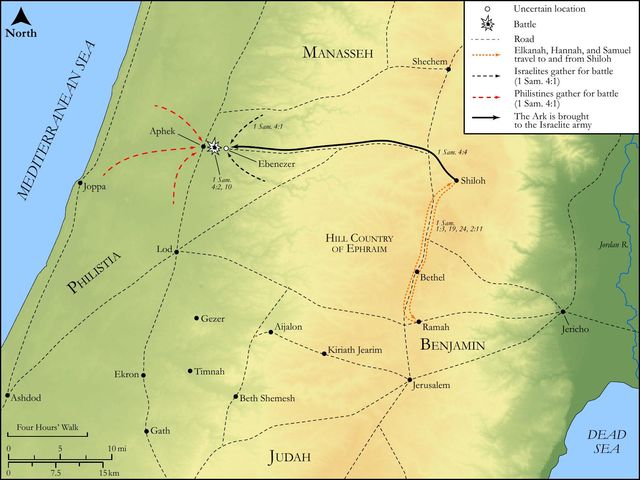
See on the biblical-era map
Study this verse
Public-domain commentary
Matthew Henry
From his Commentary on the Whole Bible. Henry comments on passages, not single verses — this entry covers 1 Samuel 4:12–18. His two-level outline is real structure in the source text, so it is rendered as structure.
Tidings are here brought to Shiloh of the fatal issue of their battle with the Philistines. Bad news flies fast. This soon spread through all Israel; every man that fled to his tent brought it, with too plain a proof of it, to his neighbours. But no place was so nearly concerned as Shiloh. Thither therefore an express posted away immediately; it was a man of Benjamin; the Jews fancy it was Saul. He rent his clothes, and put earth upon his head, by these signs to proclaim the sorrowful news to all that saw him as he ran, and to show how much he himself was affected with it, Sa1 4:12. He went straight to Shiloh with it; and here we are told,
I.How the city received it.
Eli sat in the gate (Sa1 4:13, Sa1 4:18), but the messenger was loth to tell him first, and therefore passed him by, and told it in the city, with all the aggravating circumstances; and now both the ears of every one that heard it tingled, as was foretold, Sa1 3:11. Their hearts trembled, and every face gathered blackness. All the city cried out (Sa1 3:13), and well they might, for, besides that this was a calamity to all Israel, it was a particular loss to Shiloh, and the ruin of that place; for, though the ark was soon rescued out of the hands of the Philistines, yet it never returned to Shiloh again; their candlestick was removed out of its place, because they had left their first love, and their city dwindled, and sunk, and came to nothing. Now God forsook the tabernacle of Shiloh, they having driven him from them; and the tribe of Ephraim, which had for 340 years been blessed with the presence of the ark in it, lost the honour (Psa 78:60, Psa 78:67), and, some time after, it was transferred to the tribe of Judah, the Mount Sion which he loved, as it follows there (Psa 78:68), because the men of Shiloh knew not the day of their visitation. This abandoning of Shiloh Jerusalem is long afterwards reminded of, and told to take warning by. Jer 7:12, "Go see what I did to Shiloh. From this day, this fatal day, let the desolations of Shiloh be dated." They had therefore reason enough to cry out when they heard that the ark was taken.
II.What a fatal blow it was to old Eli. Let us see,
1.With what fear he expected the tidings. Though old, and blind, and heavy, yet he could not keep his chamber when he was sensible the glory of Israel lay at stake, but placed himself by the way-side, to receive the first intelligence; for his heart trembled for the ark of God, Sa1 4:13. His careful thoughts represented to him what a dishonour it would be to God, and what an irreparable loss to Israel, if the ark should fall into the Philistines' hands, with what profane triumphs the tidings would be told in Gath and published in the streets of Ashkelon. He also apprehended what imminent danger there was of it. Israel had forfeited the ark (his own sons especially) and the Philistines would aim at it; and now the threatening comes to his mind, that he should see an enemy in God's habitation (Sa1 2:32); and perhaps his own heart reproached him for not using his authority to prevent the carrying of the ark into the camp. All these things made him tremble. Note, All good men lay the interests of God's church nearer their hearts than any secular interest or concern of their own, and cannot but be in pain and fear for them if at any time they are in peril. How can we be easy if the ark be not safe?
2.With what grief he received the tidings. Though he could not see, he could hear the tumult and crying of the city, and perceived it to be the voice of lamentation, and mourning, and woe; like a careful magistrate, he asks, What means the noise of this tumult? Sa1 4:14. He is told there is an express come from the army, who relates the story to him very distinctly, and with great confidence, having himself been an eye-witness of it, Sa1 4:16, Sa1 4:17. The account of the defeat of the army, and the slaughter of a great number of the soldiers, was very grievous to him as a judge; the tidings of the death of his two sons, of whom he had been so indulgent, and who, he had reason to fear, died impenitent, touched him in a tender part as a father; yet it was not for these that his heart trembled: there is a greater concern upon his spirit, which swallows up the less; he does not interrupt the narrative with any passionate lamentations for his sons, like David for Absalom, but waits for the end of the story, not doubting but that the messenger, being an Israelite, would, without being asked, say something of the ark; and if he could but have said, "Yet the ark of God is safe, and we are bringing that home," his joy for that would have overcome his grief for all the other disasters, and have made him easy; but, when the messenger concludes his story with, The ark of God is taken, he is struck to the heart, his spirits fail, and, it should seem, he swooned away, fell off his seat, and partly with the fainting, and partly with the fall, he died immediately, and never spoke a word more. His heart was broken first, and then his neck. So fell the high priest and judge of Israel, so fell his heavy head when he had lived within two of 100 years, so fell the crown from his head when he had judged Israel about forty years: thus did his sun set under a cloud, thus were the folly and wickedness of those sons of his, whom he had indulged, his ruin at last. Thus does God sometimes set marks of his displeasure in this life upon good men who have misconducted themselves, that others may hear, and fear, and take warning. A man may die miserably and yet not die eternally, may come to an untimely end and yet the end be peace. Dr. Lightfoot observes that Eli died the death of an unredeemed ass, whose neck was to be broken, Exo 13:13. Yet we must observe, to Eli's praise, that it was the loss of the ark that was his death, not the slaughter of his sons. He does, in effect, say, "Let me fall with the ark, for what pious Israelite can live with any comfort when God's ordinances are removed?" Farewell all in this world, even life itself, if the ark be gone.
Continue studying 1 Samuel 4:16 across the web’s major study libraries — every link below opens this exact verse, chapter, or book on the destination site.
Read & Compare
 BibleGatewayThis verse in more than 200 translations and 70 languages.
 Bible.comThe YouVersion reader — hundreds of translations, reading plans, and highlights.
 ESV.orgCrossway's official English Standard Version reader.
 NET BibleThe NET translation with 60,000+ translators' notes on every rendering decision.
 STEP BibleTyndale House's free study tool — original text, vocabulary, and scholarly resources.
 BibliaLogos Bible Software's free web reader.
 USCCBThe New American Bible (Revised Edition) with the U.S. bishops' study notes.
Commentaries
 BibleHub CommentariesDozens of classic commentaries on this verse, gathered on one page.
 StudyLightMore than 100 commentary sets — the largest collection on the web.
 BibleRefPlain-English commentary on what this verse means, verse by verse.
 Enduring WordDavid Guzik's free commentary on this chapter, widely used by Bible teachers.
 Bible Study ToolsVerse commentary alongside Greek and Hebrew study aids.
Original Language & Research
- BibleHub InterlinearThe verse word by word — original language, transliteration, and English.
- BibleHub LexiconEvery word's original-language definition and Strong's entry.
 Blue Letter BibleDeep-study tools — Strong's numbers, concordance, and word studies.
 SefariaThe Hebrew text with Rashi and centuries of Jewish commentary.
Sermons, Hymns & Audio


TrulyRandomVerse is not affiliated with these sites and doesn’t control their content. They’re linked because they’re genuinely useful.
Summary
1 Samuel 4:16 captures a moment of profound dread and impending national catastrophe, as a lone, disheveled messenger from the battlefield confronts the aged and anxious High Priest Eli. The messenger's terse, repetitive declaration confirms his identity as a survivor who has just fled the catastrophic engagement with the Philistines. Eli's immediate, trembling inquiry, "What is there done, my son?" underscores his deep foreboding, particularly concerning the fate of the Ark of God and his two sons, setting the stage for the devastating news that will unravel the nation's spiritual and political stability and culminate in his own death.
Context
ShowHideLiterary Context
This verse serves as the narrative fulcrum in a highly suspenseful sequence. It immediately follows the dramatic arrival of the messenger, whose torn clothes and dust-covered head are potent visual cues of disaster, signaling a major defeat for Israel, as described in 1 Samuel 4:12. The preceding narrative has meticulously built suspense around Eli, who, despite his advanced age and blindness, sits by the wayside, his heart "trembling for the ark of God" (1 Samuel 4:13). The sudden outcry from the city has already prompted Eli's urgent question, "What meaneth the noise of this tumult?" (1 Samuel 4:14). The messenger's words in verse 16 are his direct, albeit initially evasive, response to Eli's inquiry, designed to prepare the aged priest for the full, horrific truth that will be revealed in the subsequent verses, leading to Eli's tragic demise (1 Samuel 4:17-18). This interaction thus marks the narrative pivot from anxious anticipation to the crushing reality of divine judgment.
Historical & Cultural Context
The conflict described in 1 Samuel 4 occurs during a tumultuous period in Israel's history, marking the waning days of the Judges and the persistent threat of the Philistines. These Philistines were a powerful, technologically advanced seafaring people who had settled on the coastal plain and frequently dominated Israel. Culturally, the tearing of clothes and placing dust on one's head were universally recognized in Israel as signs of extreme grief, calamity, or mourning, immediately communicating the gravity of the messenger's news before he even spoke. Eli's position as High Priest and Judge placed him at the spiritual and civic head of Israel, making the news of the Ark's capture and the army's defeat a profound blow to both his personal authority and the nation's spiritual identity. The Israelites' decision to bring the Ark of the Covenant into battle (1 Samuel 4:3-4) reflects a superstitious belief that the Ark, as a physical symbol of God's presence, would guarantee victory, rather than relying on genuine repentance and a right relationship with God.
Key Themes
ShowHideThis verse powerfully contributes to several overarching themes in 1 Samuel. Firstly, it highlights the consequences of disobedience and spiritual complacency, particularly within Eli's household, which had been warned of impending judgment for their wickedness and dishonor of God (1 Samuel 2:27-36). The catastrophic defeat and the capture of the Ark are direct manifestations of this divine judgment. Secondly, it underscores the theme of divine sovereignty over human institutions and symbols. The Ark, though sacred, was not a magical talisman; its capture demonstrates that God is not bound by human expectations or rituals, and He will not be manipulated. The narrative also emphasizes the transition of leadership from the corrupt priestly line of Eli to a new era, eventually leading to the rise of Samuel and the monarchy, a period of significant change for Israel's governance and spiritual direction (1 Samuel 7:15-17).
Exposition and Analysis
ShowHideKey Word Analysis
ShowHideThis term (H376) refers to an individual male person. In this context, it emphasizes the singular nature of the messenger, highlighting his solitary survival and the weight of the news he carries. He is not merely a soldier, but "the man" who embodies the disaster, a singular point of contact between the horrific battle and the anxious high priest.
Used twice in this verse (H4634), this word means "an arrangement," "a pile," or specifically "a military array." Its repetition underscores the messenger's direct and desperate escape from the heart of the conflict. It signifies not merely a military unit but the entire Israelite encampment and battle formation, implying a complete rout rather than an orderly retreat. The messenger's origin "out of the army" establishes his eyewitness credibility and the immediate, personal nature of his experience of the disaster.
This primitive root (H5127) means "to flit," "vanish away," or "escape." The messenger's declaration, "I fled to day out of the army," is a stark admission of defeat and personal survival. It conveys urgency, desperation, and the sheer chaos of the battlefield. It implies that the situation was so dire that the only option was to run for one's life, leaving behind the fallen. This word choice immediately communicates the gravity of the situation to Eli, hinting at a total collapse of the Israelite forces.
Eli's address (H1121) is a common term of endearment or respectful address from an elder to a younger man, especially in a position of authority. While it reflects Eli's paternal concern and perhaps a desire to soften the impending blow, it also highlights his vulnerability and the personal nature of the tragedy about to unfold. It underscores the patriarchal structure of Israelite society and Eli's role as a father figure to the nation, even as his own sons were a source of national spiritual decay.
Verse Breakdown
ShowHide"And the man said unto Eli, I [am] he that came out of the army"
The messenger, having just arrived with visible signs of distress, immediately identifies himself as a direct participant and survivor of the battle. This opening statement is designed to establish his authority and the firsthand nature of the news he carries, preparing Eli for the weight of his report and confirming his unique position as the bearer of this dreadful intelligence.
"and I fled to day out of the army"
This second clause reinforces and intensifies the first. The repetition of "out of the army" combined with the verb "fled" paints a vivid picture of a chaotic, desperate escape from a losing battle. It confirms that the Israelite forces were not merely defeated but utterly routed, forcing the messenger to abandon the field in disarray and highlighting the immediacy and personal cost of the disaster.
"And he said, What is there done, my son?"
Eli's question, prompted by the messenger's appearance and the city's outcry, reveals his profound anxiety and foreboding. The phrase "What is there done?" (Hebrew: מַה הַדָּבָר הַזֶּה הָיָה, mah haddavar hazzeh hayah - "What is this thing that has happened?") is an urgent plea for information, indicating his acute awareness that something terrible has occurred. His use of "my son" reflects both his general paternal nature and perhaps a subconscious plea for a less devastating answer, even as his heart trembles for the Ark and his own biological sons.
Literary Devices
ShowHideThe passage employs several potent Literary Devices to heighten the drama and emotional impact. Repetition is evident in the messenger's declaration, "I [am] he that came out of the army, and I fled to day out of the army." This repetition of "out of the army" emphasizes the messenger's origin and the dire nature of his escape, underscoring the completeness of the Israelite defeat and the personal trauma experienced. Dramatic Irony pervades the scene, as the reader is already aware of the catastrophic losses—the death of Eli's sons and the capture of the Ark—while Eli remains in agonizing suspense, his question "What is there done?" highlighting his tragic ignorance of the full extent of the disaster. The scene is imbued with profound Pathos, evoking pity for the blind, aged Eli, whose physical vulnerability mirrors his spiritual and national fragility. His trembling heart and desperate plea for information create a palpable sense of sorrow for his impending doom. Finally, the messenger's appearance and initial words serve as powerful Foreshadowing, hinting at the immense tragedy that is about to unfold, creating a palpable sense of dread and suspense before the full report is delivered.
Theological and Thematic Connections
ShowHideThis pivotal verse serves as a stark reminder of the consequences of spiritual negligence and the solemnity of divine judgment. Eli's family, specifically his sons Hophni and Phinehas, had consistently dishonored God through their corrupt practices at the tabernacle, turning the Lord's offerings into a contemptible thing. This moral decay within the priesthood, coupled with Eli's failure to restrain his sons effectively, led to God's pronouncement of judgment upon his house. The defeat by the Philistines and the capture of the Ark are not mere military misfortunes but direct manifestations of God's righteous indignation and His commitment to uphold His own holiness. This event underscores that God's presence, symbolized by the Ark, is not a guarantee of protection when His people are in rebellion; rather, it can be a witness against them, demonstrating that true security lies in obedience, not in religious symbols alone.
Reflection and Application
ShowHideThe scene in 1 Samuel 4:16 powerfully illustrates the human experience of dreading inevitable bad news and the profound impact of catastrophic events. Eli's trembling heart and desperate inquiry resonate with our own anxieties when faced with uncertainty or the intuitive sense that something terrible has occurred. For believers, this passage serves as a sobering reminder that spiritual complacency and unaddressed sin, whether personal or corporate, carry severe consequences. It challenges us to examine our own lives and communities for areas where we might be dishonoring God, failing to uphold righteousness, or relying on outward forms of religion rather than genuine, obedient faith. True security and blessing come not from religious symbols or traditions, but from a vibrant, humble, and obedient relationship with the living God. We are called to heed God's warnings, to live with integrity, and to trust in His character even when circumstances are dire, knowing that His ultimate purposes will prevail and that He is sovereign even over our defeats.
Questions for Reflection
ShowHideFAQ
ShowHideWhy was Eli so anxious specifically about the Ark of God?
ShowHideEli's anxiety for the Ark of God (1 Samuel 4:13) stemmed from its immense theological and national significance. The Ark was the most sacred object in Israel, representing God's very presence among His people, the throne of His invisible glory, and the place where He communed with His High Priest. Its capture would signify not just a military defeat but a profound spiritual catastrophe, implying God's withdrawal or judgment upon Israel. Eli knew that his own sons, Hophni and Phinehas, were with the Ark, further intensifying his personal dread for their fate and the sacred object they were meant to protect.
What is the significance of the messenger's attire and initial statement?
ShowHideThe messenger's torn clothes and dust-covered head (1 Samuel 4:12) were universally recognized in Israel as signs of extreme grief, calamity, and mourning. These visual cues immediately communicated the gravity of the disaster before he even spoke a word. His initial statement, "I [am] he that came out of the army, and I fled to day out of the army," served to establish his identity as a direct, eyewitness survivor of the battle, lending immediate credibility to the devastating news he was about to deliver. The repetition of "out of the army" underscored the completeness of the rout and his desperate escape.
What does Eli's address "my son" reveal about his character or the situation?
ShowHideEli's use of "my son" (Hebrew: bên) is a common term of address from an elder to a younger man, often conveying endearment, respect, or a paternal tone. In this context, it reveals Eli's deep, personal concern, even amidst his profound anxiety over the battle's outcome. It highlights his role as a father figure to the nation, despite his failure to discipline his own biological sons. The address also underscores the personal tragedy that is about to unfold for Eli, as the messenger is about to deliver news that will directly impact his family and his life, particularly concerning his sons Hophni and Phinehas.
Christ-Centered Fulfillment
ShowHideThe tragic scene in 1 Samuel 4:16, where the old covenant system under Eli is crumbling due to sin and divine judgment, powerfully foreshadows the need for a new and perfect High Priest. Eli, despite his office, was unable to secure Israel's salvation or prevent the capture of the Ark, symbolizing God's presence. This failure points to the inadequacy of human leadership and the temporary nature of the Old Covenant's rituals and symbols. In contrast, Jesus Christ is the ultimate and perfect High Priest, not from the flawed line of Aaron but "after the order of Melchizedek" (Hebrews 7:11). He does not merely represent God's presence; He is God incarnate, the true "Ark" of God's covenant with humanity, the dwelling place of God among His people (John 1:14). Unlike the physical Ark, which could be captured and offered no ultimate protection from sin's consequences, Jesus, through His once-for-all sacrifice, secured eternal salvation and a permanent dwelling of God's Spirit within believers (Hebrews 9:11-14). The devastating news delivered to Eli highlights the dire consequences of a broken covenant and human failure, but the good news of the Gospel proclaims that through Jesus, we have a new covenant, a perfect High Priest, and an unfailing hope that transcends any earthly defeat or judgment (Hebrews 8:6). He is the one who truly takes away the sin of the world, offering genuine security and restoration that no human leader or religious symbol could ever provide (John 1:29), establishing a kingdom that cannot be shaken (Hebrews 12:28).