


1 Samuel 4:15
Bible text: King James Version (1769 Blayney text) · Public domain
Bible text: Berean Standard Bible · Public domain
Bible text: American Standard Version (1901) · Public domain
Bible text: World English Bible, Messianic edition · Public domain
Bible text: Geneva Bible (1599) · Public domain
Bible text: Young's Literal Translation · Public domain
- וְעֵלִיve·'e·Liand EliH5941Conj-w ¦ N-proper-mNoun Proper MasculineוְandעֵלִיEli
- בֶּןben[was] a son ofH1121N-mscNoun Singular Masculine Construct
- תִּשְׁעִיםtish·'ImninetyH8673N-mpNoun Plural Masculine Absolute
- וּשְׁמֹנֶהu·she·mo·Nehand eightH8083Conj-w ¦ N-csNoun Singular common gender Absoluteוּandשְׁמֹנֶהeight
- שָׁנָהsha·Nahyear[s]H8141N-fsNoun Singular Feminine Absolute
- וְעֵינָיוve·'ei·Navand his eyesH5869Conj-w ¦ N-fdc ¦ 3msNoun Dual Feminine Constructוְandעֵינָיeyesוhis
- קָמָהKa·mahit was setH6965V-Qal-Perf-3fsVerb Qal Perfect 3rd Singular Feminine
- וְלֹאve·Lo'and notH3808Conj-w ¦ NegParticle Negativeוְandלֹאnot
- יָכוֹלya·Kholhe was ableH3201V-Qal-Perf-3msVerb Qal Perfect 3rd Singular Masculine
- לִרְאוֹתlir·'otto seeH7200Prep-l ¦ V-Qal-InfVerb Qal Infinitive Constructלִtoרְאוֹתsee
English is a literal word-by-word gloss of the Hebrew, not the KJV's wording. Why?
This is the original text the KJV's translators worked from — each Hebrew word with its own literal English meaning in this verse, prepared by scholars at Tyndale House, Cambridge. The KJV translates whole sentences, not word by word, so its wording differs: one Hebrew word can become several English words, and the KJV may choose “the LORD” where the gloss reads “Yahweh”. Both are faithful — they answer different questions. For the KJV's own rendering, switch to the KJV text.
Details
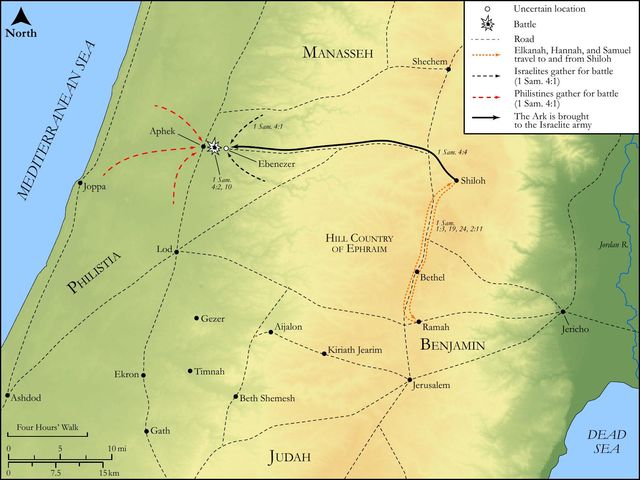
See on the biblical-era map
Study this verse
Public-domain commentary
Matthew Henry
From his Commentary on the Whole Bible. Henry comments on passages, not single verses — this entry covers 1 Samuel 4:12–18. His two-level outline is real structure in the source text, so it is rendered as structure.
Tidings are here brought to Shiloh of the fatal issue of their battle with the Philistines. Bad news flies fast. This soon spread through all Israel; every man that fled to his tent brought it, with too plain a proof of it, to his neighbours. But no place was so nearly concerned as Shiloh. Thither therefore an express posted away immediately; it was a man of Benjamin; the Jews fancy it was Saul. He rent his clothes, and put earth upon his head, by these signs to proclaim the sorrowful news to all that saw him as he ran, and to show how much he himself was affected with it, Sa1 4:12. He went straight to Shiloh with it; and here we are told,
I.How the city received it.
Eli sat in the gate (Sa1 4:13, Sa1 4:18), but the messenger was loth to tell him first, and therefore passed him by, and told it in the city, with all the aggravating circumstances; and now both the ears of every one that heard it tingled, as was foretold, Sa1 3:11. Their hearts trembled, and every face gathered blackness. All the city cried out (Sa1 3:13), and well they might, for, besides that this was a calamity to all Israel, it was a particular loss to Shiloh, and the ruin of that place; for, though the ark was soon rescued out of the hands of the Philistines, yet it never returned to Shiloh again; their candlestick was removed out of its place, because they had left their first love, and their city dwindled, and sunk, and came to nothing. Now God forsook the tabernacle of Shiloh, they having driven him from them; and the tribe of Ephraim, which had for 340 years been blessed with the presence of the ark in it, lost the honour (Psa 78:60, Psa 78:67), and, some time after, it was transferred to the tribe of Judah, the Mount Sion which he loved, as it follows there (Psa 78:68), because the men of Shiloh knew not the day of their visitation. This abandoning of Shiloh Jerusalem is long afterwards reminded of, and told to take warning by. Jer 7:12, "Go see what I did to Shiloh. From this day, this fatal day, let the desolations of Shiloh be dated." They had therefore reason enough to cry out when they heard that the ark was taken.
II.What a fatal blow it was to old Eli. Let us see,
1.With what fear he expected the tidings. Though old, and blind, and heavy, yet he could not keep his chamber when he was sensible the glory of Israel lay at stake, but placed himself by the way-side, to receive the first intelligence; for his heart trembled for the ark of God, Sa1 4:13. His careful thoughts represented to him what a dishonour it would be to God, and what an irreparable loss to Israel, if the ark should fall into the Philistines' hands, with what profane triumphs the tidings would be told in Gath and published in the streets of Ashkelon. He also apprehended what imminent danger there was of it. Israel had forfeited the ark (his own sons especially) and the Philistines would aim at it; and now the threatening comes to his mind, that he should see an enemy in God's habitation (Sa1 2:32); and perhaps his own heart reproached him for not using his authority to prevent the carrying of the ark into the camp. All these things made him tremble. Note, All good men lay the interests of God's church nearer their hearts than any secular interest or concern of their own, and cannot but be in pain and fear for them if at any time they are in peril. How can we be easy if the ark be not safe?
2.With what grief he received the tidings. Though he could not see, he could hear the tumult and crying of the city, and perceived it to be the voice of lamentation, and mourning, and woe; like a careful magistrate, he asks, What means the noise of this tumult? Sa1 4:14. He is told there is an express come from the army, who relates the story to him very distinctly, and with great confidence, having himself been an eye-witness of it, Sa1 4:16, Sa1 4:17. The account of the defeat of the army, and the slaughter of a great number of the soldiers, was very grievous to him as a judge; the tidings of the death of his two sons, of whom he had been so indulgent, and who, he had reason to fear, died impenitent, touched him in a tender part as a father; yet it was not for these that his heart trembled: there is a greater concern upon his spirit, which swallows up the less; he does not interrupt the narrative with any passionate lamentations for his sons, like David for Absalom, but waits for the end of the story, not doubting but that the messenger, being an Israelite, would, without being asked, say something of the ark; and if he could but have said, "Yet the ark of God is safe, and we are bringing that home," his joy for that would have overcome his grief for all the other disasters, and have made him easy; but, when the messenger concludes his story with, The ark of God is taken, he is struck to the heart, his spirits fail, and, it should seem, he swooned away, fell off his seat, and partly with the fainting, and partly with the fall, he died immediately, and never spoke a word more. His heart was broken first, and then his neck. So fell the high priest and judge of Israel, so fell his heavy head when he had lived within two of 100 years, so fell the crown from his head when he had judged Israel about forty years: thus did his sun set under a cloud, thus were the folly and wickedness of those sons of his, whom he had indulged, his ruin at last. Thus does God sometimes set marks of his displeasure in this life upon good men who have misconducted themselves, that others may hear, and fear, and take warning. A man may die miserably and yet not die eternally, may come to an untimely end and yet the end be peace. Dr. Lightfoot observes that Eli died the death of an unredeemed ass, whose neck was to be broken, Exo 13:13. Yet we must observe, to Eli's praise, that it was the loss of the ark that was his death, not the slaughter of his sons. He does, in effect, say, "Let me fall with the ark, for what pious Israelite can live with any comfort when God's ordinances are removed?" Farewell all in this world, even life itself, if the ark be gone.
Historical interpretation
Historical reception
1 surviving comment on this verse from the historical church.
Now Eli was ninety-eight years old, etc. The legal priesthood at that time lacked two perfections that lead to life, namely faith and works. Therefore his eyes, that is, his announcements, were clouded in understanding, and they could not see Christ in the law. For there was a veil over their heart, which is removed in Christ.
Continue studying 1 Samuel 4:15 across the web’s major study libraries — every link below opens this exact verse, chapter, or book on the destination site.
Read & Compare
 BibleGatewayThis verse in more than 200 translations and 70 languages.
 Bible.comThe YouVersion reader — hundreds of translations, reading plans, and highlights.
 ESV.orgCrossway's official English Standard Version reader.
 NET BibleThe NET translation with 60,000+ translators' notes on every rendering decision.
 STEP BibleTyndale House's free study tool — original text, vocabulary, and scholarly resources.
 BibliaLogos Bible Software's free web reader.
 USCCBThe New American Bible (Revised Edition) with the U.S. bishops' study notes.
Commentaries
 BibleHub CommentariesDozens of classic commentaries on this verse, gathered on one page.
 StudyLightMore than 100 commentary sets — the largest collection on the web.
 BibleRefPlain-English commentary on what this verse means, verse by verse.
 Enduring WordDavid Guzik's free commentary on this chapter, widely used by Bible teachers.
 Bible Study ToolsVerse commentary alongside Greek and Hebrew study aids.
Original Language & Research
- BibleHub InterlinearThe verse word by word — original language, transliteration, and English.
- BibleHub LexiconEvery word's original-language definition and Strong's entry.
 Blue Letter BibleDeep-study tools — Strong's numbers, concordance, and word studies.
 SefariaThe Hebrew text with Rashi and centuries of Jewish commentary.
Sermons, Hymns & Audio


TrulyRandomVerse is not affiliated with these sites and doesn’t control their content. They’re linked because they’re genuinely useful.
Summary
First Samuel 4:15 powerfully depicts the extreme physical frailty of Eli, Israel's high priest and judge, at the precipice of receiving catastrophic news. His advanced age of ninety-eight years underscores his vulnerability and the twilight of his long tenure, while the description of his severely diminished eyesight not only details his physical incapacitation but also serves as a poignant symbolic prelude to the spiritual and national disaster about to unfold, highlighting the profound consequences of his past negligence and the impending divine judgment upon his house and the nation.
Context
ShowHideLiterary Context
This verse is strategically positioned within the dramatic narrative of 1 Samuel 4, serving as a critical transitional moment that heightens tension and foreshadows tragedy. Immediately preceding it, the chapter details Israel's devastating defeat by the Philistines and the capture of the Ark of the Covenant, an event of unparalleled theological and national significance. Verse 15 meticulously sets the stage for the arrival of a lone messenger from the battlefield in the very next verse, who will deliver the crushing news of Israel's rout, the Ark's capture, and the deaths of Eli's two wicked sons, Hophni and Phinehas. Eli's described physical state—his extreme age and profound visual impairment—underscores his vulnerability and prepares the reader for the immediate and fatal impact of the shocking revelation upon an already weakened figure, making his subsequent collapse and death in 1 Samuel 4:18 a direct and tragic consequence of the news concerning the Ark.
Historical & Cultural Context
Eli functioned as both high priest and judge in Israel during a tumultuous period marked by spiritual apostasy and political instability, preceding the establishment of the monarchy. The high priesthood was a hereditary office, tracing its lineage back to Aaron, and conferred immense spiritual authority, serving as the primary mediator between God and the people. As judge, Eli also wielded significant civil and judicial power, making him the central figure of Israelite society. His age of ninety-eight was exceptionally advanced for the era, signifying a long life but also extreme physical decline, indicative of a leadership that had perhaps outlived its vigor. The Philistines, a formidable seafaring people, posed a constant military threat to Israel, often challenging their borders and security with superior weaponry and organization. The Ark of the Covenant, seized by the Philistines in this chapter, was Israel's most sacred cultic object, symbolizing God's manifest presence among His people. Its capture represented an unprecedented national and theological catastrophe, reflecting God's severe judgment on Israel's sin and, specifically, on Eli's corrupt household, as previously and explicitly warned in divine prophecies found in 1 Samuel 2:27-36 and 1 Samuel 3:11-14.
Key Themes
ShowHideThis verse profoundly contributes to several overarching themes woven throughout the book of 1 Samuel. Firstly, it highlights Physical Decline and Frailty, emphasizing the natural limitations of human life, particularly in advanced age. Eli's extreme longevity and impaired vision starkly underscore his vulnerability and incapacity, contrasting sharply with the robust and decisive leadership required in times of national crisis. Secondly, it powerfully introduces the theme of Symbolic Blindness, where Eli's literal inability to "see" serves as a potent metaphor for his spiritual failure to discern and decisively act against the egregious sins of his sons, Hophni and Phinehas, despite receiving clear divine warnings. This spiritual inertia led to profound moral decay within the priesthood and the nation, as vividly detailed in 1 Samuel 2:12-17. Finally, the verse functions as a potent Foreshadowing of Judgment, meticulously setting the immediate scene for the climactic and tragic events of 1 Samuel 4, where the cumulative consequences of Eli's negligence and his sons' wickedness culminate in national defeat, the loss of the Ark, and the demise of Eli's priestly line, thereby fulfilling the prophecies of divine judgment against his house found in 1 Samuel 3:13.
Exposition and Analysis
ShowHideKey Word Analysis
ShowHideThis word (H5869) literally means "eye" and can refer to the physical organ of sight. However, as the Strong's data indicates, it can also be used figuratively to denote "outward appearance," "countenance," "sight," or even "knowledge" and "discernment." In Eli's case, while it primarily describes his literal physical impairment, its figurative potential adds a layer of meaning, hinting at his spiritual inability to perceive and act upon the truth of God's will and the corruption within his own family.
The Hebrew root (H6965) translated "dim" is qûwm, which primarily means "to rise," "to stand," or "to establish." However, in specific contexts, as noted in the Strong's data, it can idiomatically mean "to be dim" or "to be faint." This usage here describes a state of weakening or fading, indicating a progressive loss of visual acuity rather than sudden or complete blindness. It emphasizes Eli's gradual physical decline, mirroring the slow but sure decline of his household and the spiritual state of Israel under his leadership.
The Hebrew verb (H3201) yâkôl means "to be able," "can," or "could." When used in the negative, as it is here ("could not see"), it signifies an absolute inability or lack of power. This highlights Eli's complete physical incapacitation regarding his sight, reinforcing the severity of his condition. Beyond the literal, it subtly underscores his moral and spiritual inability to effectively govern and discipline, which ultimately led to the tragic events of the chapter.
Verse Breakdown
ShowHide"Now Eli was ninety and eight years old;"
This initial clause immediately establishes Eli's advanced age, presenting him as a figure at the very end of his natural life. At ninety-eight, he is depicted as profoundly elderly and physically frail, highlighting his diminished capacity for active leadership, especially in a time of national crisis. This detail sets a somber and vulnerable tone, suggesting a leader whose time, both physically and in terms of effective authority, is drawing to a close. It underscores the precariousness of Israel's spiritual leadership at this critical juncture.
"and his eyes were dim, that he could not see."
This second clause provides the specific detail of Eli's severe physical impairment. His "dim" eyes indicate a profound visual impairment, likely near-blindness, which would have significantly hindered his ability to navigate his surroundings or perform duties requiring clear sight. Beyond the literal physical state, this phrase carries immense symbolic weight. It powerfully implies a spiritual blindness or lack of discernment in Eli, who, despite his role as high priest, failed to "see" the rampant wickedness of his sons and the spiritual decline of Israel, even after receiving explicit divine warnings. This physical condition thus becomes a poignant metaphor for his moral and spiritual failings, setting the stage for the tragic consequences of his negligence and the impending divine judgment.
Literary Devices
ShowHideThe verse employs several potent literary devices to convey its profound meaning. Symbolism is paramount, as Eli's physical blindness ("his eyes were dim, that he could not see") serves as a powerful and multi-layered metaphor for his spiritual and moral blindness. Despite his esteemed position as high priest and judge, he failed to "see" and decisively confront the rampant sin within his own family and the sacred sanctuary, leading directly to divine judgment upon his house. This literal physical impairment thus underscores his spiritual incapacity to discern and act decisively according to God's righteous will. Furthermore, the verse masterfully uses Foreshadowing, as Eli's extreme frailty and failing sight immediately precede the arrival of the messenger bearing news of national disaster and profound personal tragedy. His physical state prepares the reader for his subsequent collapse and death upon hearing the news, making his demise a direct and inevitable consequence of the catastrophic revelation. There is also a strong element of Irony present, as the high priest, who was divinely appointed to be the spiritual guide and "seer" for the nation, is depicted as literally and spiritually blind, unable to perceive the impending judgment or the profound corruption flourishing under his very nose.
Theological and Thematic Connections
ShowHideThe depiction of Eli's physical and spiritual state in 1 Samuel 4:15 resonates deeply with broader biblical themes concerning the nature of leadership, the necessity of spiritual discernment, and the severe consequences of spiritual negligence. Eli's physical blindness serves as a stark and tragic symbol of his spiritual inability to confront sin within his own household and to fulfill his priestly duties with integrity and courage. This profound failure to "see" and act decisively led directly to divine judgment, demonstrating unequivocally that God holds leaders, whether in the church, family, or society, accountable for their stewardship and the spiritual health of those under their care. The passage underscores the critical importance of spiritual vigilance, active discernment, and the inherent dangers of complacency or compromise, reminding us that true leadership demands not merely physical presence but keen spiritual insight and courageous action in upholding God's righteous standards.
Reflection and Application
ShowHideEli's story, particularly his physical and spiritual state as depicted in 1 Samuel 4:15, offers profound and timeless lessons for believers today. It serves as a powerful and sobering reminder that spiritual discernment is not an automatic endowment, even for those in positions of religious authority or long-standing faith. Just as Eli's physical sight failed him in his old age, we must remain vigilant and actively guard against spiritual dullness, apathy, or compromise that can insidiously prevent us from discerning God's will, recognizing sin, and courageously confronting it—whether in our own lives, within our families, or in the communities we are called to influence. The tragic outcome for Eli's family and the nation of Israel highlights the immense responsibility inherent in all forms of leadership, be it in the home, the church, or the workplace, to exercise spiritual vigilance, accountability, and courageous discipline. Inaction, spiritual complacency, and moral compromise can have severe, far-reaching, and generational consequences. This passage challenges each of us to regularly examine our own spiritual "eyesight," ensuring that we are not blinded by comfort, fear, worldly concerns, or personal convenience, but are instead keenly attuned to God's truth, His Spirit's leading, and are willing to act upon His will, even when such action is difficult or unpopular.
Questions for Reflection
ShowHideFAQ
ShowHideWhy is Eli's age and physical condition emphasized at this specific point in the narrative?
ShowHideEli's age of ninety-eight and his dimming eyesight are emphasized in 1 Samuel 4:15 to underscore his extreme physical vulnerability and incapacitation just before he receives the most devastating news of his life: the defeat of Israel, the capture of the Ark of the Covenant, and the deaths of his two sons. This deliberate detail heightens the dramatic tension, making his subsequent collapse and death in 1 Samuel 4:18 a direct and tragic consequence of the shock. Furthermore, his physical blindness serves as a powerful symbol for his spiritual blindness and failure to act decisively against the wickedness of his sons, which had been prophesied earlier in 1 Samuel 2:27-36 and 1 Samuel 3:11-14. The emphasis on his frailty highlights the end of an era of compromised leadership and the severe consequences of his negligence.
What is the symbolic significance of Eli's "dim" eyes?
ShowHideThe "dim" eyes of Eli in 1 Samuel 4:15 carry significant symbolic weight beyond mere physical impairment. While literally indicating his failing eyesight, they powerfully represent his spiritual and moral blindness. As high priest and judge, Eli was meant to be a spiritual guide for Israel, discerning God's will and upholding His laws. However, he failed to "see" the rampant corruption of his own sons, Hophni and Phinehas, who were desecrating the sanctuary and exploiting the people (1 Samuel 2:12-17). Despite receiving explicit divine warnings (1 Samuel 2:27-36), Eli's response was inadequate, demonstrating a critical lack of spiritual insight and decisive action. Thus, his physical blindness serves as a poignant metaphor for his spiritual inability to perceive and confront sin, ultimately leading to the downfall of his house and national tragedy.
Christ-Centered Fulfillment
ShowHideEli's physical and spiritual blindness in 1 Samuel 4:15 stands in stark and profound contrast to the perfect vision, unwavering discernment, and righteous authority of Jesus Christ, our great High Priest. Eli, though a divinely appointed priest, tragically failed to "see" and decisively address the pervasive sin within his own household, leading directly to divine judgment and the temporary, symbolic loss of God's manifest presence (represented by the Ark of the Covenant). In stark contrast, Jesus, the true and eternal High Priest, is never spiritually blind; His eyes are described as "like a flame of fire" (Revelation 1:14), symbolizing His penetrating insight, perfect discernment, and righteous judgment. He perfectly discerns the will of God and confronts sin with absolute righteousness and divine authority. Unlike Eli, whose priestly line was cut off due to unfaithfulness and corruption, Jesus's priesthood is "forever according to the order of Melchizedek" (Hebrews 7:17), an unchangeable and eternal ministry. Where Eli's failure brought about national defeat and the tragic demise of his sons, Jesus's perfect obedience, sinless life, and ultimate sacrificial death bring salvation, reconciliation, and eternal life to all who believe, for He is the Lamb of God, who takes away the sin of the world! His perfect vision and unwavering commitment to God's will offer a priesthood of grace, truth, and eternal redemption that Eli's earthly, flawed ministry could only dimly foreshadow.