


Judges 21:10
Bible text: King James Version (1769 Blayney text) · Public domain
Bible text: King James Version with Strong's numbers · Public domain
Bible text: Berean Standard Bible · Public domain
Bible text: American Standard Version (1901) · Public domain
Bible text: World English Bible, Messianic edition · Public domain
Bible text: Geneva Bible (1599) · Public domain
Bible text: Young's Literal Translation · Public domain
- וַיִּשְׁלְחוּvai·yish·le·chuand they sentH7971Conj-w ¦ V-Qal-ConsecImperf-3mpVerb Qal Consecutive Imperfect 3rd Plural Masculineוַandיִּשְׁלְחוּthey sent
- שָׁםshamthereH8033AdvAdverb
- הָעֵדָהha·'e·Dahthe congregationH5712Art ¦ N-fsNoun Singular Feminine Absoluteהָtheעֵדָהcongregation
- שְׁנֵיםshe·neimtwo [plus]H8147N-cdNoun Dual common gender Absolute
- עָשָׂר'a·SartenH6240N-csNoun Singular common gender Absolute
- אֶלֶף'E·lefthousandH505N-csNoun Singular common gender Absolute
- אִישׁ'ishmanH376N-msNoun Singular Masculine Absolute
- מִבְּנֵיmi·be·Neifrom [the] sons ofH1121Prep-m ¦ N-mpcNoun Plural Masculine Constructמִfromבְּנֵי[the] sons of
- הֶחָיִלhe·Cha·yil<the> strengthH2428Art ¦ N-msNoun Singular Masculine Absoluteהֶ<the>חָיִלstrength
- וַיְצַוּוּvay·tza·Vuand they commandedH6680Conj-w ¦ V-Piel-ConsecImperf-3mpVerb Piel Consecutive Imperfect 3rd Plural Masculineוַandיְצַוּוּthey commanded
- אוֹתָם'o·Tam<obj.> themH853DirObjM ¦ 3mpParticle Object Indicatorאוֹתָ<obj.>םthem
- לֵאמֹרle·Mor<to> sayingH559Prep-l ¦ V-Qal-InfVerb Qal Infinitive Constructלֵ<to>אמֹרsaying
- לְכוּLe·khugoH1980V-Qal-Imp-2mpVerb Qal Imperative 2nd Plural Masculine
- וְהִכִּיתֶםve·hi·ki·Temand you will strikeH5221Conj-w ¦ V-Hiphil-ConsecPerf-2mpVerb Hiphil Consecutive Perfect 2nd Plural Masculineוְandהִכִּיתֶםyou will strike
- אֶת'et<obj.>H853DirObjMParticle Object Indicator
- יוֹשְׁבֵיyo·she·Vei[the] inhabitants ofH3427V-Qal-Prtcpl-mpVerb Qal Participle Plural Masculine Construct
- יָבֵשׁya·VeshJabeshH3003N-properNoun Proper Location
- גִּלְעָדgil·'AdGileadH1568N-properNoun Proper Location
- לְפִיle·fito [the] mouth ofH6310Prep-l ¦ N-mscNoun Singular Masculine Constructלְtoפִי[the] mouth of
- חֶרֶבChe·rev[the] swordH2719N-fsNoun Singular Feminine Absolute
- וְהַנָּשִׁיםve·ha·na·Shimand the womenH802Conj-w ¦ Art ¦ N-mpNoun Plural Masculine Absoluteוְandהַtheנָּשִׁיםwomen
- וְהַטָּףve·ha·Tafand the little one[s]H2945Conj-w ¦ Art ¦ N-msNoun Singular Masculine Absoluteוְandהַtheטָּףlittle one[s]
English is a literal word-by-word gloss of the Hebrew, not the KJV's wording. Why?
This is the original text the KJV's translators worked from — each Hebrew word with its own literal English meaning in this verse, prepared by scholars at Tyndale House, Cambridge. The KJV translates whole sentences, not word by word, so its wording differs: one Hebrew word can become several English words, and the KJV may choose “the LORD” where the gloss reads “Yahweh”. Both are faithful — they answer different questions. For the KJV's own rendering, switch to the KJV text.
Details
See on the biblical-era maps
Study this verse
Public-domain commentary
Matthew Henry
From his Commentary on the Whole Bible. Henry comments on passages, not single verses — this entry covers Judges 21:1–15. His three-level outline is real structure in the source text, so it is rendered as structure.
We may observe in these verses,
I.The ardent zeal which the Israelites had expressed against the wickedness of the men of Gibeah, as it was countenanced by the tribe of Benjamin. Occasion is here given to mention two instances of their zeal on this occasion, which we did not meet with before: - 1. While the general convention of the states was gathering together, and was waiting for a full house before they would proceed, they bound themselves with the great execration, which they called the Cherum, utterly to destroy all those cities that should not send in their representatives and their quota of men upon this occasion, or had sentenced those to that curse who should thus refuse (Jdg 21:5); for they would look upon such refusers as having no indignation at the crime committed, no concern for the securing of the nation from God's judgments by the administration of justice, nor any regard to the authority of a common consent, by which they were summoned to meet. 2. When they had met and heard the cause they made another solemn oath that none of all the thousands of Israel then present, nor any of those whom they represented (not intending to bind their posterity), should, if they could help it, marry a daughter to a Benjamite, Jdg 21:1. This was made an article of the war, not with any design to extirpate the tribe, but because in general they would treat those who were then actors and abettors of this villany in all respects as they treated the devoted nations of Canaan, whom they were not only obliged to destroy, but with whom they were forbidden to marry; and because, in particular, they judged those unworthy to match with a daughter of Israel that had been so very barbarous and abusive to one of the tender sex, than which nothing could be done more base and villainous, nor a more certain indication given of a mind perfectly lost to all honour and virtue. We may suppose that the Levite's sending the mangled pieces of his wife'[s body to the several tribes helped very much to inspire them with all this fury, and much more than a bare narrative of the fact, though ever so well attested, would have done, so much does the eye affect the heart.
II.The deep concern which the Israelites did express for the destruction of the tribe of Benjamin when it was accomplished. Observe,
1.The tide of their anger at Benjamin's crime did not run so high and so strong before but the tide of their grief for Benjamin's destruction ran as high and as strong after: They repented for Benjamin their brother, Jdg 21:6, Jdg 21:15. They did not repent of their zeal against the sin; there is a holy indignation against sin, the fruit of godly sorrow, which is to salvation, not to be repented of, Co2 7:10, Co2 7:11. But they repented of the sad consequences of what they had done, that they had carried the matter further than was either just or necessary. It would have been enough to destroy all they found in arms; they needed not to have cut off the husbandmen and shepherds, the women and children. Note,
(1.)There may be over-doing in well-doing. Great care must be taken in the government of our zeal, lest that which seemed supernatural in its causes prove unnatural in its effects. That is no good divinity which swallows up humanity. Many a war is ill ended which was well begun.
(2.)Even necessary justice is to be done with compassion. God does not punish with delight, nor should men.
(3.)Strong passions make work for repentance. What we say and do in a heat our calmer thoughts commonly wish undone again.
(4.)In a civil war (according to the usage of the Romans) no victories ought to be celebrated with triumphs, because, which soever side gets, the community loses, as here there is a tribe cut off from Israel. What the better is the body for one member's crushing another? Now,
2.How did they express their concern?
(1.)By their grief for the breach that was made. They came to the house of God, for thither they brought all their doubts, all their counsels, all their cares, and all their sorrows. There was to be heard on this occasion, not the voice of joy and praise, but only that of lamentation, and mourning, and woe: They lifted up their voices and wept sore (Jdg 21:2), not so much for the 40,000 whom they had lost (these would not be so much missed out of eleven tribes), but for the entire destruction of one whole tribe; for this was the complaint they poured out before God (Jdg 21:3): There is one tribe lacking. God had taken care of every tribe; their number twelve was that which they were known by; every tribe had his station appointed in the camp, and his stone in the high priest's breast-plate; every tribe had his blessing both from Jacob and Moses; and it would be an intolerable reproach to them if they should drop any out of this illustrious jury, and lose one out of twelve, especially Benjamin, the youngest, who was particularly dear to Jacob their common ancestor, and whom all the rest ought to have been in a particular manner tender of. Benjamin is not; what then will become of Jacob? Benjamin is become a Benoni, the son of the right hand a son of sorrow! In this trouble they built an altar, not in competition, but in communion with the appointed altar at the door of the tabernacle, which was not large enough to contain all the sacrifices they designed; for they offered burnt offerings and peace offerings, to give thanks for their victory, yet to atone for their own folly in the pursuit of it, and to implore the divine favour in their present strait. Every thing that grieves us should bring us to God.
(2.)By their amicable treaty with the poor distressed refugees that were hidden in the rock Rimmon, to whom they sent an act of indemnity, assuring them, upon the public faith, that they would now no longer treat them as enemies, but receive them as brethren, Jdg 21:13. The falling out of friends should thus be the renewing of friendship. Even those that have sinned, if at length they repent, must be forgiven and comforted, Co2 2:7.
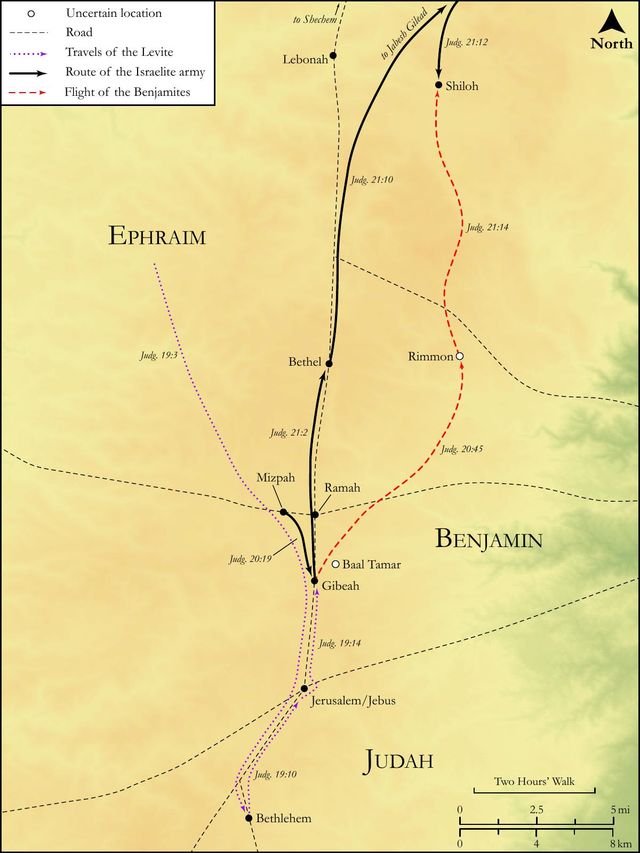
(3.)By the care they took to provide wives for them, that their tribe might be built up again, and the ruins of it repaired. Had the men of Israel sought themselves, they would have been secretly pleased with the extinguishing of the families of Benjamin, because then the land allotted to them would escheat to the rest of the tribes, ob defectum sanguinis - for want of heirs, and be easily seized for want of occupants; but those have not the spirit of Israelites who aim to raise themselves upon the ruins of their neighbours. They were so far from any design of this kind that all heads were at work to find out ways and means for the rebuilding of this tribe. All the women and children of Benjamin were slain: they had sworn not to marry their daughters to any of them; it was against the divine law that they should match with the Canaanites; to oblige them to that would be, in effect, to bid them go and serve other gods. What must they do then for wives for them? While the poor distressed Benjamites that were hidden in the rock feared their brethren were contriving to ruin them, they were at the same time upon a project to prefer them; and it was this: - [1.] There was a piece of necessary justice to be done upon the city of Jabesh-Gilead, which belonged to the tribe of Gad, on the other side Jordan. It was found upon looking over the muster-roll (which was taken, Jdg 20:2) that none appeared from that city upon the general summons (Jdg 21:8, Jdg 21:9), and it was then resolved, before it appeared who were absent, that whatever city of Israel should be guilty of such a contempt of the public authority and interest that city should be an anathema; Jabesh-Gilead lies under that severe sentence, which might by no means be dispensed with. Those that had spared the Canaanites in many places, who were devoted to destruction by the divine command, could not find in their hearts to spare their brethren that were devoted by their own curse. Why did they not now send men to root the Jebusites out of Jerusalem, to avoid whom the poor Levite had been forced to go to Gibeah? Jdg 19:11, Jdg 19:12. Men are commonly more zealous to support their own authority than God's. A detachment is therefore sent of 12,000 men, to execute the sentence upon Jabesh-Gilead. Having found that when the whole body of the army went against Gibeah the people were thought too many for God to deliver them into their hands, on this expedition they sent but a few, Jdg 21:10. Their commission is to put all to the sword, men, women, and children (Jdg 21:11), according to that law (Lev 27:29), Whatsoever is devoted of men, by those that have power to do it, shall surely be put to death. [2.] An expedient is hence formed for providing the Benjamites with wives. When Moses sent the same number of men to avenge the Lord on Midian, the same orders were given as here, that all married women should be slain with their husbands, as one with them, but that the virgins should be saved alive, Num 31:17, Num 31:18. That precedent was sufficient to support the distinction here made between a wife and a virgin, Jdg 21:11, Jdg 21:12. 400 virgins that were marriageable were found in Jabesh-Gilead, and these were married to so many of the surviving Benjamites, Jdg 21:14. Their fathers were not present when the vow was made not to marry with Benjamites, so that they were not under any colour of obligation by it: and besides, being a prey taken in war, they were at the disposal of the conquerors. Perhaps the alliance now contracted between Benjamin and Jabesh-Gilead made Saul, who was a Benjamite, the more concerned for that place (Sa1 11:4), though then inhabited by new families.
Continue studying Judges 21:10 across the web’s major study libraries — every link below opens this exact verse, chapter, or book on the destination site.
Read & Compare
 BibleGatewayThis verse in more than 200 translations and 70 languages.
 Bible.comThe YouVersion reader — hundreds of translations, reading plans, and highlights.
 ESV.orgCrossway's official English Standard Version reader.
 NET BibleThe NET translation with 60,000+ translators' notes on every rendering decision.
 STEP BibleTyndale House's free study tool — original text, vocabulary, and scholarly resources.
 BibliaLogos Bible Software's free web reader.
 USCCBThe New American Bible (Revised Edition) with the U.S. bishops' study notes.
Commentaries
 BibleHub CommentariesDozens of classic commentaries on this verse, gathered on one page.
 StudyLightMore than 100 commentary sets — the largest collection on the web.
 BibleRefPlain-English commentary on what this verse means, verse by verse.
 Enduring WordDavid Guzik's free commentary on this chapter, widely used by Bible teachers.
 Bible Study ToolsVerse commentary alongside Greek and Hebrew study aids.
Original Language & Research
- BibleHub InterlinearThe verse word by word — original language, transliteration, and English.
- BibleHub LexiconEvery word's original-language definition and Strong's entry.
 Blue Letter BibleDeep-study tools — Strong's numbers, concordance, and word studies.
 SefariaThe Hebrew text with Rashi and centuries of Jewish commentary.
Sermons, Hymns & Audio


TrulyRandomVerse is not affiliated with these sites and doesn’t control their content. They’re linked because they’re genuinely useful.
Summary
Judges 21:10 records a chilling decree by the Israelite congregation: to dispatch twelve thousand of their most valiant warriors to utterly annihilate the inhabitants of Jabesh-gilead, including women and children. This extreme measure was not directed at an external foe but was a self-devised, desperate attempt to resolve a profound internal crisis—the near extinction of the tribe of Benjamin due to a preceding civil war, and the complication of a rash oath preventing the other tribes from providing wives for the surviving Benjamite men. The verse starkly illuminates the moral and spiritual anarchy rampant in Israel during a period defined by a severe lack of righteous, centralized leadership and a pervasive tendency for individuals and the collective to act according to their own flawed judgment rather than divine command.
Context
ShowHideLiterary Context
Judges 21:10 is situated within the grim appendix of the Book of Judges (chapters 17-21), which serves as a stark and sobering commentary on the profound moral and spiritual decline of Israel during this chaotic period. Specifically, it follows the devastating civil war between the united tribes of Israel and the tribe of Benjamin, ignited by the horrific rape and murder of the Levite's concubine in Gibeah, as detailed in Judges 19. This brutal conflict, recounted in Judges 20, resulted in the near annihilation of Benjamin, leaving only 600 surviving men (Judges 20:47). The immediate preceding verses of Judges 21 reveal Israel's profound distress over the potential extinction of a tribe and their desperate attempts to find wives for the Benjamite survivors, complicated by a solemn, rash oath made at Mizpah: "There shall not any of us give his daughter unto Benjamin to wife" (Judges 21:1). The targeting of Jabesh-gilead thus emerges as a calculated, albeit brutal, "solution" to this self-inflicted dilemma, born out of their desperate need to preserve the twelve-tribe structure.
Historical & Cultural Context
The Book of Judges depicts Israel during a transitional period between the conquest of Canaan and the establishment of the monarchy. This era was characterized by a loose tribal confederacy, lacking a centralized government or consistent spiritual leadership. The recurring refrain, "In those days there was no king in Israel: every man did that which was right in his own eyes" (Judges 17:6, Judges 21:25), perfectly encapsulates the prevailing anarchy and moral relativism. Vows, especially those made communally and before God, were considered extremely binding in ancient Israelite culture, even if rashly made. The failure of Jabesh-gilead to participate in the communal assembly at Mizpah and the subsequent war was seen as a grave breach of corporate responsibility and a violation of the solemn oath, making them liable for severe punishment according to the prevailing understanding of covenant loyalty and communal solidarity. This context highlights the Israelites' desperate attempt to uphold one aspect of their perceived obligations (the oath) while grossly violating others (mercy, justice, and the sanctity of Israelite life).
Key Themes
ShowHideJudges 21:10 powerfully contributes to several overarching themes in the Book of Judges. First, it underscores the profound moral and spiritual decline of Israel, demonstrating how a society without righteous leadership can descend into horrifying acts of violence and ethical compromise, even in pursuit of seemingly "good" ends (preserving a tribe). Second, it highlights the devastating consequences of rash oaths and human-devised solutions to divine problems; the initial vow created an impossible situation that led to further bloodshed and moral degradation, a pattern seen throughout the book. Third, despite the horrific means, the underlying motivation reveals a deep-seated concern for the preservation of Israel's covenant identity as twelve tribes, reflecting a paradoxical adherence to their national identity even as their actions contradicted God's moral law. This desperate clinging to a structural ideal, even at the cost of moral integrity, is a tragic irony. Finally, the entire narrative serves as a powerful argument for the necessity of righteous leadership and adherence to God's revealed law, contrasting sharply with the chaotic results of "every man doing what was right in his own eyes" (Judges 21:25), a theme that resonates throughout the book's conclusion.
Exposition and Analysis
ShowHideKey Word Analysis
ShowHideThis term (H5712) refers to the assembled community or "assembly" of Israel. Its use here is significant, indicating that the decision to attack Jabesh-gilead was not merely an act of a few rogue individuals but a corporate decision made by the representatives of the Israelite tribes. This highlights the collective responsibility and the widespread moral compromise that had permeated the entire nation during this period, where even communal action could be deeply flawed and contrary to God's character.
The KJV "valiantest" (H2428) translates the Hebrew ḥayil, which denotes strength, might, valor, or military prowess. Sending "twelve thousand men of the valiantest" (H1121, H2428) signifies that Israel committed its most capable and courageous warriors to this task. This emphasizes the seriousness and determination with which they pursued their self-appointed mission, deploying their best resources for a morally questionable endeavor, underscoring the depth of their commitment to their flawed solution.
This is a common and chilling biblical idiom, literally meaning "mouth of the sword" (H6310, H2719). It signifies complete and utter destruction, implying no survivors. The phrase underscores the ruthlessness and totality of the command given to the Israelite forces, indicating a directive for a genocidal act against Jabesh-gilead, with the explicit inclusion of "women and children" (H802, H2945). This idiom highlights the extreme nature of the violence sanctioned by the congregation.
Verse Breakdown
ShowHide"And the congregation sent thither twelve thousand men of the valiantest"
This opening clause establishes the authority behind the command – the collective "congregation" of Israel, representing the united tribes. The deployment of "twelve thousand men of the valiantest" underscores the significant military might and strategic intent behind this action. It was not a small skirmish but a major military operation (H7971, H8147, H6240, H505, H376), indicating the gravity with which the Israelites viewed the problem of the Benjamite wives and the perceived offense of Jabesh-gilead. This commitment of their elite forces reveals the depth of their desperation and resolve.
"and commanded them, saying, Go and smite the inhabitants of Jabeshgilead with the edge of the sword"
This is the core directive (H6680, H559, H3212, H5221), a command for total annihilation. The phrase "smite... with the edge of the sword" (H3427, H3003, H1568, H6310, H2719) is a powerful idiom for complete destruction, implying no quarter given. It reveals the ruthless pragmatism of the Israelite leadership, willing to resort to extreme violence against a fellow Israelite city (albeit one that violated communal solidarity) to resolve their self-imposed crisis. This demonstrates a chilling willingness to sacrifice one group of Israelites for the perceived good of another.
"with the women and the children"
This chilling addition (H802, H2945) specifies the scope of the destruction, explicitly including non-combatants. While such acts were tragically common in ancient warfare, their inclusion here highlights the moral nadir to which Israel had descended. It demonstrates a society so desperate and morally compromised that it would sanction the slaughter of innocent women and children to secure wives for another tribe, revealing a profound disconnect from the Mosaic Law's principles of justice and mercy, especially towards fellow Israelites. This detail underscores the profound ethical bankruptcy of the period.
Literary Devices
ShowHideThe narrative of Judges 21:10 employs several potent literary devices to underscore its grim message. Irony is profoundly present, as the very people chosen by God to be a light to the nations, governed by divine law, resort to horrific violence against a fellow Israelite city, including its most vulnerable, all to preserve the tribal identity that is foundational to their covenant. This "solution" to a problem created by a rash oath is deeply ironic, demonstrating how human attempts to rectify self-inflicted wounds without divine guidance often lead to further moral compromise and a spiraling descent into sin. The phrase "smite... with the edge of the sword" functions as a strong idiom for total destruction, emphasizing the ruthlessness of the command, even though the narrative later reveals that 400 virgins were intentionally spared from this total annihilation. This selective application of the command highlights the pragmatic, rather than purely destructive, intent behind the action, revealing a calculated cruelty. Furthermore, the juxtaposition of "twelve thousand men of the valiantest" with the morally abhorrent task they are commanded to perform starkly contrasts their military prowess with their ethical bankruptcy. Ultimately, this passage, like the entire appendix of Judges, serves as a powerful foreshadowing of the desperate need for a righteous king in Israel, one who would govern according to God's laws and bring order and justice to a society adrift in moral anarchy, setting the stage for the books of Samuel.
Theological and Thematic Connections
ShowHideJudges 21:10, though a dark passage, offers profound theological and thematic connections. It illustrates the devastating consequences of a society that abandons divine authority and operates by its own flawed moral compass, where "every man did that which was right in his own eyes" (Judges 21:25). The narrative highlights the danger of rash vows made without seeking God's counsel, demonstrating how such commitments, even if initially well-intentioned, can lead to a cascade of further sin and violence. The Israelites' desperate attempt to preserve the twelve-tribe structure, even through horrific means, implicitly points to God's overarching sovereign plan to maintain the lineage through which the Messiah would come, demonstrating His faithfulness even amidst human unfaithfulness. This passage serves as a stark reminder that human ingenuity, when detached from divine wisdom and righteous leadership, often produces morally grotesque "solutions" that violate God's character and commands, ultimately emphasizing the urgent need for God's redemptive intervention and the establishment of a righteous king who would truly lead His people in justice and righteousness.
Reflection and Application
ShowHideThe grim account of Judges 21:10 serves as a powerful cautionary tale for all generations, revealing the tragic depths to which humanity can sink when moral and spiritual foundations erode. It challenges us to critically examine our own decisions, both individual and communal, ensuring they are rooted in God's unchanging truth rather than expediency or self-interest. This passage compels us to consider the profound impact of leadership, or the lack thereof, on a society's moral fabric. It reminds us that even when faced with seemingly intractable problems, resorting to ungodly means to achieve a desired outcome inevitably leads to further brokenness and compromise. Instead, we are called to seek divine wisdom, exercise discernment, and uphold ethical principles, even when it seems difficult or counter-cultural. The narrative underscores the vital importance of living by God's Word, which provides a clear standard for righteousness, justice, and mercy, preventing us from "doing what is right in our own eyes" and falling into similar cycles of sin and despair. It calls us to a higher standard, rooted in the character of God, rather than the shifting sands of human pragmatism.
Questions for Reflection
ShowHideFAQ
ShowHideWhy was Jabesh-gilead targeted specifically, and what was their offense?
ShowHideJabesh-gilead was targeted because they failed to participate in the solemn assembly of Israel at Mizpah and the subsequent war against Benjamin (Judges 21:5). The other tribes had sworn a great oath that any city that did not come to the assembly would be put to death. This absence was considered a grave breach of communal solidarity and a violation of the corporate vow. Their destruction, with the sparing of virgins, was then seen as a "solution" to provide wives for the surviving Benjamite men without breaking the oath that the other tribes would not give their own daughters to Benjamin (Judges 21:1).
How does this event reflect the overall theme of "no king in Israel" in the Book of Judges?
ShowHideThis event is a prime example of the chaos and moral decay that resulted from the lack of a central, righteous authority in Israel, a theme explicitly stated multiple times in the book (Judges 17:6, Judges 18:1, Judges 19:1, Judges 21:25). Without a king who would govern according to God's law, the people, including their leaders, were left to their own devices, making decisions based on expediency and human logic rather than divine wisdom. The horrific actions against Jabesh-gilead demonstrate the tragic consequences of a society where "every man did that which was right in his own eyes," leading to cycles of violence, moral compromise, and a profound departure from God's covenant standards, ultimately highlighting the desperate need for a divinely appointed king.
Christ-Centered Fulfillment
ShowHideThe disturbing narrative of Judges 21:10, steeped in human depravity and the desperate attempts to rectify self-inflicted wounds, profoundly underscores the need for a true and righteous King, ultimately fulfilled in Jesus Christ. The Israelites' frantic efforts to preserve the twelve tribes, even through morally reprehensible means, implicitly points to God's overarching sovereign plan to maintain the lineage through which the Messiah would come. Despite their sin and chaos, God's covenant promises remained steadfast, ensuring the continuity of Israel until the arrival of the promised Seed, demonstrating His faithfulness even when His people were faithless. Jesus, unlike the flawed and self-serving leaders of Judges, is the perfect King who rules not by the "edge of the sword" but by divine love and truth (John 18:36). He is the ultimate solution to humanity's deepest moral dilemmas, not through violence and compromise, but through His perfect obedience and atoning sacrifice. Where Israel struggled under the weight of rash vows and self-righteousness, Christ perfectly fulfilled the law (Matthew 5:17) and offered Himself as the spotless Lamb of God, who takes away the sin of the world!. He is the one who brings true order and peace, not by human ingenuity or brutal force, but by establishing His kingdom in the hearts of those who follow Him, leading them in righteousness and justice, a stark contrast to the tragic "every man did what was right in his own eyes" (Judges 21:25) that characterized the era of the Judges.