


Isaiah 36:16
Bible text: King James Version (1769 Blayney text) · Public domain
Bible text: King James Version with Strong's numbers · Public domain
Bible text: Berean Standard Bible · Public domain
Bible text: American Standard Version (1901) · Public domain
Bible text: World English Bible, Messianic edition · Public domain
Bible text: Geneva Bible (1599) · Public domain
Bible text: Young's Literal Translation · Public domain
- אַל'almay notH408NegParticle Negative
- תִּשְׁמְעוּtish·me·'Uyou listenH8085V-Qal-Imperf-2mpVerb Qal Imperfect 2nd Plural Masculine
- אֶל'eltoH413PrepPreposition
- חִזְקִיָּהוּchiz·ki·Ya·huHezekiahH2396N-proper-mNoun Proper Masculine
- כִּיkiforH3588PrtParticle Conditional
- כֹהkhohthusH3541AdvAdverb
- אָמַר'a·Marhe saysH559V-Qal-Perf-3msVerb Qal Perfect 3rd Singular Masculine
- הַמֶּלֶךְha·Me·lekhthe king ofH4428Art ¦ N-mscNoun Singular Masculine Constructהַtheמֶּלֶךְking of
- אַשּׁוּר'a·ShurAssyriaH804N-properNoun Proper Location
- עֲשׂוּ'a·sumakeH6213V-Qal-Imp-2mpVerb Qal Imperative 2nd Plural Masculine
- אִתִּי'i·Tiwith meH854Prep ¦ 1csPrepositionאִתִּwithיme
- בְרָכָהve·ra·Khaha blessingH1293N-fsNoun Singular Feminine Absolute
- וּצְאוּu·tze·'Uand come outH3318Conj-w ¦ V-Qal-Imp-2mpVerb Qal Imperative 2nd Plural Masculineוּandצְאוּcome out
- אֵלַי'e·Laito meH413Prep ¦ 1csPrepositionאֵלַtoיme
- וְאִכְלוּve·'ikh·Luand eatH398Conj-w ¦ V-Qal-Imp-2mpVerb Qal Imperative 2nd Plural Masculineוְandאִכְלוּeat
- אִישׁ'isheveryoneH376N-msNoun Singular Masculine Absolute
- גַּפְנוֹgaf·Nohis own vineH1612N-csc ¦ 3msNoun Singular common gender Constructגַּפְנown vineוֹhis
- וְאִישׁve·'Ishand everyoneH376Conj-w ¦ N-msNoun Singular Masculine Absoluteוְandאִישׁeveryone
- תְּאֵנָתוֹte·'e·na·Tohis own fig treeH8384N-fsc ¦ 3msNoun Singular Feminine Constructתְּאֵנָתown fig treeוֹhis
- וּשְׁתוּu·she·Tuand drinkH8354Conj-w ¦ V-Qal-Imp-2mpVerb Qal Imperative 2nd Plural Masculineוּandשְׁתוּdrink
- אִישׁ'isheveryoneH376N-msNoun Singular Masculine Absolute
- מֵיmei[the] water ofH4325N-mpcNoun Plural Masculine Construct
- בוֹרוֹvo·Rohis own cisternH953N-msc ¦ 3msNoun Singular Masculine Constructבוֹרown cisternוֹhis
English is a literal word-by-word gloss of the Hebrew, not the KJV's wording. Why?
This is the original text the KJV's translators worked from — each Hebrew word with its own literal English meaning in this verse, prepared by scholars at Tyndale House, Cambridge. The KJV translates whole sentences, not word by word, so its wording differs: one Hebrew word can become several English words, and the KJV may choose “the LORD” where the gloss reads “Yahweh”. Both are faithful — they answer different questions. For the KJV's own rendering, switch to the KJV text.
Details
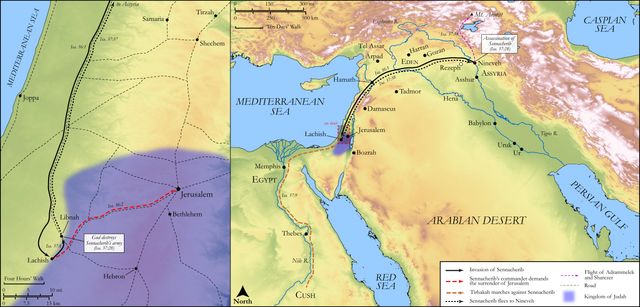
See on the biblical-era map
Study this verse
Public-domain commentary
Matthew Henry
From his Commentary on the Whole Bible. Henry comments on passages, not single verses — this entry covers Isaiah 36:11–22.
We may hence learn these lessons: - 1. That, while princes and counsellors have public matters under debate, it is not fair to appeal to the people. It was a reasonable motion which Hezekiah's plenipotentiaries made, that this parley should be held in a language which the people did not understand (Isa 36:11), because reasons of state are secret things and ought to be kept secret, the vulgar being incompetent judges of them. It is therefore an unfair practice, and not doing as men would be done by, to incense subjects against their rulers by base insinuations. 2. Proud and haughty scorners, the fairer they are spoken to, commonly speak the fouler. Nothing could be said more mildly and respectfully than that which Hezekiah's agents said to Rabshakeh. Besides that the thing itself was just which they desired, they called themselves his servants, they petitioned for it: Speak, we pray thee; but this made him the more spiteful and imperious. To give rough answers to those who give us soft answers is one way of rendering evil for good; and those are wicked indeed, and it is to be feared incurable, with whom that which usually turns away wrath does but make bad worse. 3. When Satan would tempt men from trusting in God, and cleaving to him, he does so by insinuating that in yielding to him they may better their condition; but it is a false suggestion, and grossly absurd, and therefore to be rejected with the utmost abhorrence. When the world and the flesh say to us, "Make an agreement with us and come out to us, submit to our dominion and come into our interests, and you shall eat every one of his own vine," they do but deceive us, promising liberty when they would lead us into the basest captivity and slavery. One might as well take Rabshakeh's word as theirs for kind usage and fair quarter; therefore, when they speak fair, believe them not. Let them say what they will, there is no land like the land of promise, the holy land. 4. Nothing can be more absurd in itself, nor a greater affront to the true and living God, than to compare him with the gods of the heathen; as if he could do no more for the protection of his worshippers than they can for the protection of theirs, and as if the God of Israel could as easily be mastered as the gods of Hamath and Arphad, whereas they are vanity and a lie. They are nothing; he is the great I AM: they are the creatures of men's fancy and the works of men's hands; he is the Creator of all things. 5. Presumptuous sinners are ready to think that, because they have been too hard for their fellow-creatures, they are therefore a match for their Creator. This and the other nation they have subdued, and therefore the Lord himself shall not deliver Jerusalem out of their hand. But, though the potsherds may strive with the potsherds of the earth, let them not strive with the potter. 6. It is sometimes prudent not to answer a fool according to his folly. Hezekiah's command was, "Answer him not; it will but provoke him to rail and blaspheme yet more and more; leave it to God to stop his mouth, for you cannot." They had reason enough on their side, but it would be hard to speak it to such an unreasonable adversary without a mixture of passion; and, if they should fall a railing like him, Rabshakeh would be much too hard for them at that weapon. 7. It becomes the people of God to lay to heart the dishonour done to God by the blasphemies of wicked men, though they do not think it prudent to reply to those blasphemies. Though they answered him not a word, yet they rent their clothes, in a holy zeal for the glory of God's name and a holy indignation at the contempt put upon it. They tore their garments when they heard blasphemy, as taking no pleasure in their own ornaments when God's honour suffered.
Historical interpretation
Historical reception
2 surviving comments on this verse. Each one is dated, so this reads as a timeline rather than a list.
Immediately then, he supplemented this threat with an enticement in order to deceive with counterpromises and temptations those whom he had not conquered with terror, saying on behalf of the king of the Assyrians: “Make peace with me and come to me,” or as we read in the book of Kings: “Do with me what is useful and come to me.” Both have the same meaning. Do, he said, what is to your own advantage and it will accrue to your blessing. In other words: Bless the king of Assyria and praise him, and confess him to be your lord that you might receive a reward. Also, live in your cities and enjoy your crops until I return from Egypt or until I restore captured Libnah. After I come, I will take you to a land much like your own, with grain and wine and oil. But he did not give a name for this land because he could not find an equal to the Promised Land. Yet he promised it nevertheless, for everyone desires to be in the land of his birth. Some think the land that he promised was Media, which has terrain similar in both location and foliage to that of Judea. Then he added: “Where is the god of Hamath and of Arpad and of Sepharvaim? Have they delivered Samaria from my hand?” This shows that Samaria will be subject to them for all of its days and therefore that it should be taken. If, he said, we were easily victorious over the ten tribes who had the protection of so many gods, how much more easily will we conquer you, even lonely Jerusalem, which has the protection of only one God?
(Vers. 16 seqq.) Join me in blessing, and come out to me, and each one eat his own vineyard, and each one eat his own fig tree, and each one drink the water of his own cistern, until I come and take you to a land, which is like your own land: a land of wheat and wine, a land of bread and vineyards. Do not let Hezekiah disturb you, saying: The Lord will deliver us. Have the gods of the nations ever delivered each one his own land from the hand of the king of Assyria? This is what is read in the Book of Kings: 'Do with me what is beneficial, and come out to me' (2 Kings 18:31). Therefore, the meaning is the same. 'Do what is profitable for you,' he says, 'and may it contribute to your blessing.' Whether he is saying this: 'Bless the Assyrian king and praise him, and confess the Lord, so that you may obtain rewards, and until I return from Egypt, or when Lobna is captured, I will return. Dwell in your city and enjoy your possessions.' Later, however, I will come and lead you to a land that is similar to your land, with wheat, wine, and oil. It does not mention the name of the region, because it could not find an equivalent land promise: but it promises similarity. For each person desires what they were born into. Some think that the land of Media is promised to them, which had a similarity to the land of Judaea, both in location and in crops. And this is what he brings up.
Continue studying Isaiah 36:16 across the web’s major study libraries — every link below opens this exact verse, chapter, or book on the destination site.
Read & Compare
 BibleGatewayThis verse in more than 200 translations and 70 languages.
 Bible.comThe YouVersion reader — hundreds of translations, reading plans, and highlights.
 ESV.orgCrossway's official English Standard Version reader.
 NET BibleThe NET translation with 60,000+ translators' notes on every rendering decision.
 STEP BibleTyndale House's free study tool — original text, vocabulary, and scholarly resources.
 BibliaLogos Bible Software's free web reader.
 USCCBThe New American Bible (Revised Edition) with the U.S. bishops' study notes.
Commentaries
 BibleHub CommentariesDozens of classic commentaries on this verse, gathered on one page.
 StudyLightMore than 100 commentary sets — the largest collection on the web.
 BibleRefPlain-English commentary on what this verse means, verse by verse.
 Enduring WordDavid Guzik's free commentary on this chapter, widely used by Bible teachers.
 Bible Study ToolsVerse commentary alongside Greek and Hebrew study aids.
Original Language & Research
- BibleHub InterlinearThe verse word by word — original language, transliteration, and English.
- BibleHub LexiconEvery word's original-language definition and Strong's entry.
 Blue Letter BibleDeep-study tools — Strong's numbers, concordance, and word studies.
 SefariaThe Hebrew text with Rashi and centuries of Jewish commentary.
Sermons, Hymns & Audio


TrulyRandomVerse is not affiliated with these sites and doesn’t control their content. They’re linked because they’re genuinely useful.
Summary
Isaiah 36:16 captures a critical juncture during the Assyrian siege of Jerusalem, where the Rabshakeh, King Sennacherib's chief envoy, employs sophisticated psychological warfare to break the will of Judah's inhabitants. He strategically bypasses King Hezekiah's authority, directly addressing the people with a deceptive offer of immediate peace and material comfort. This proposition, cloaked in the appealing imagery of individual prosperity and security, aims to sow disunity and fear, presenting a seemingly pragmatic alternative to Hezekiah's call for faithful resistance, thereby subtly leading them towards subjugation under Assyrian rule.
Context
ShowHideLiterary Context
This verse is deeply embedded within the dramatic narrative of Sennacherib's invasion of Judah, specifically detailing the psychological warfare tactics employed by the Assyrian Rabshakeh outside Jerusalem's walls. The broader context of Isaiah 36 and Isaiah 37 recounts the escalating Assyrian threat, King Hezekiah's unwavering prayer, and the Lord's miraculous deliverance of Jerusalem. The Rabshakeh's speech, delivered in Hebrew to ensure widespread understanding among the common people, directly follows his initial demands for unconditional surrender and precedes Hezekiah's fervent appeal to the Lord for divine intervention. By directly addressing the populace and bypassing Hezekiah's officials, the Rabshakeh's words in this passage are a calculated attempt to sow discord, fear, and distrust among the people, thereby eroding their resolve and their faith in their king and their God. This pivotal historical account is also paralleled in the historical books of 2 Kings 18 and 2 Chronicles 32, highlighting its significance in Israel's history.
Historical & Cultural Context
The events described in Isaiah 36-39 are precisely dated to 701 BC, during the reign of King Hezekiah of Judah, a period when the Neo-Assyrian Empire, under the formidable Sennacherib, had reached the zenith of its power and territorial expansion. Assyria was infamous among the nations for its brutal and efficient military campaigns, which frequently included ruthless siege tactics, mass deportations of conquered peoples, and sophisticated psychological warfare. Officials like the Rabshakeh (a title, not a personal name, meaning "chief cupbearer" or "chief officer") were often multilingual and strategically deployed to demoralize besieged cities by speaking the local language and making enticing, yet deceptive, offers. The promise of "eating from one's own vine and fig tree" and "drinking from one's own cistern" was a deeply resonant cultural symbol of peace, prosperity, and individual security in ancient Israel. This imagery represented a life free from external threats, where one could enjoy the fruits of one's labor and live undisturbed on one's land, as famously depicted in descriptions of Solomon's reign of peace in 1 Kings 4:25. The Rabshakeh's appropriation of this cherished and deeply meaningful imagery was a meticulously calculated move to appeal to the people's innate desire for stability and comfort, cleverly contrasting it with the perceived hardships and dangers of continued resistance under Hezekiah.
Key Themes
ShowHideIsaiah 36:16 contributes profoundly to several overarching theological and narrative themes prevalent within the book of Isaiah and the broader prophetic corpus. Firstly, it starkly highlights the contrast between human wisdom and divine faithfulness. The Rabshakeh's pragmatic, worldly offer, rooted in human logic and self-preservation, stands in direct opposition to King Hezekiah's unwavering trust in Yahweh, a trust that is ultimately and dramatically vindicated by God's miraculous intervention in Isaiah 37:36. Secondly, the verse powerfully underscores the theme of deceptive peace versus true security. The Assyrian "agreement" promises immediate comfort and a cessation of hostilities, yet it is a false peace that would inevitably lead to ultimate subjugation, forced displacement, and exile. This contrasts sharply with the genuine, lasting, and divinely-granted peace and security that God offers His people. This theme aligns perfectly with the broader prophetic critique found throughout Isaiah against relying on foreign alliances or human strength rather than exclusive trust in God, a recurring warning exemplified in passages like Isaiah 30:1-7. Thirdly, this passage vividly exemplifies the battle for allegiance and trust. The Rabshakeh's direct challenge to the people's loyalty to Hezekiah is, by extension, a challenge to their loyalty to God, forcing them to choose between a seemingly easy path of surrender to worldly power and the difficult, yet ultimately redemptive, path of faith and obedience to the Lord. This central theme of choosing between worldly might and divine protection is a cornerstone of the book of Isaiah, which consistently calls Judah back to exclusive trust in the Lord of Hosts.
Exposition and Analysis
ShowHideKey Word Analysis
ShowHideWhile this Hebrew term often signifies "blessing" or "benediction" in a positive, divine sense, the Rabshakeh's usage here is a cynical and manipulative twisting of its meaning. In this context, it refers to a favorable arrangement, a present, or a tribute offered to secure a beneficial outcome from a superior power. The Rabshakeh is offering a "blessing" of peace and prosperity, but it is a deceptive blessing, contingent upon Judah's surrender and submission to Assyrian dominion. This highlights the Assyrian official's cunning use of language, perverting a term typically associated with divine favor into a worldly, self-serving proposition designed to disarm and entice.
And H8384 respectively. These terms are not merely agricultural references but profound cultural and symbolic representations of agricultural prosperity, personal security, and peace in ancient Israel. The idiom "to sit under one's own vine and fig tree" (as seen in Micah 4:4) was the quintessential expression of a tranquil, secure, and prosperous existence, free from the ravages of war and oppression. The Rabshakeh's promise to allow each person to "eat ye every one of his vine, and every one of his fig tree" directly appeals to this deeply ingrained cultural ideal, offering a false sense of autonomy, stability, and well-being under the guise of Assyrian "protection."
A cistern is a crucial pit or reservoir, typically hewn from rock, used for collecting and storing precious rainwater. It was absolutely essential for survival in the arid climate of Judah, especially during a siege. Therefore, the cistern symbolizes self-sufficiency, vital provision, and the ability to sustain life independently. The Rabshakeh's promise to "drink ye every one the waters of his own cistern" powerfully reinforces his appeal to individual comfort and the guaranteed satisfaction of fundamental needs, suggesting that surrender will ensure a stable, self-sustaining life, free from the dire hardships of siege or the uncertainties of exile.
Verse Breakdown
ShowHide"Hearken not to Hezekiah:"
This is a direct, emphatic imperative command from the Rabshakeh, strategically designed to immediately undermine the authority, credibility, and leadership of King Hezekiah. It represents a calculated attempt to bypass the king's legitimate rule and appeal directly to the common people, thereby isolating Hezekiah and eroding the vital trust between him and his subjects. The Assyrian official astutely recognizes that Hezekiah's call for continued resistance is deeply rooted in his faith in Yahweh, and by discrediting the king, he seeks to dismantle the people's spiritual and national resolve.
"for thus saith the king of Assyria,"
This powerful introductory phrase serves to establish the ultimate, unchallengeable authority behind the Rabshakeh's words: Sennacherib, the formidable and universally feared king of Assyria. It is a declarative statement of imperial might, intended to impress upon the besieged people the overwhelming power of their adversary and the perceived futility of any further resistance. The Rabshakeh is not speaking on his own accord but as the authoritative voice of a conquering empire, thereby adding immense weight, intimidation, and an aura of inevitability to his subsequent offer.
"Make [an agreement] with me [by] a present, and come out to me:"
This clause articulates the core of the Assyrian proposition: a demand for immediate and unconditional surrender. The KJV's translation "make an agreement... by a present" renders the Hebrew "make a blessing with me" (עֲשׂוּ אִתִּי בְרָכָה). This is a euphemism for paying a heavy tribute or entering into a covenant of complete submission to Assyria. "Come out to me" is a direct invitation to surrender, to leave the relative safety of Jerusalem's walls and place themselves entirely under Assyrian authority. While presented as a cessation of hostilities, it would inevitably lead to subjugation, not genuine peace or freedom.
"and eat ye every one of his vine, and every one of his fig tree,"
This is the enticing, yet profoundly deceptive, promise of material comfort and personal security. The Rabshakeh skillfully paints a vivid picture of individual prosperity, where each person will supposedly retain their land and enjoy its abundant produce. This powerful imagery taps into the deep-seated desire for a stable, agrarian life, free from the ravages of war and famine. It is a highly effective psychological tactic, offering the immediate gratification of basic needs and personal comfort as a compelling incentive for surrender, starkly contrasting it with the deprivation, suffering, and danger of a prolonged siege.
"and drink ye every one the waters of his own cistern;"
This final promise further reinforces the alluring idea of self-sufficiency, guaranteed provision, and the satisfaction of essential resources. Access to one's own water supply, particularly during a siege, was absolutely critical for survival and a symbol of independence. By promising this, the Rabshakeh assures the people that their most fundamental needs will be met under Assyrian rule, further sweetening the deceptive offer and appealing directly to their most basic survival instincts and desires for comfort.
Literary Devices
ShowHideThe Rabshakeh's speech in Isaiah 36:16 is a masterclass in Propaganda and Psychological Warfare. He skillfully employs Ethos by speaking with the perceived authority of the mighty King Sennacherib of Assyria, thereby establishing his credibility and the weight of his words. He then leverages Pathos by directly appealing to the people's deepest fears of starvation, siege, and death, while simultaneously tapping into their innate desires for peace, security, and personal comfort, powerfully conveyed through the vivid Imagery of "vine, fig tree, and cistern." The core of his offer is profoundly Ironic, as the promise of individual prosperity and lasting peace under Assyrian rule is a thinly veiled prelude to forced exile, cultural annihilation, and complete subjugation, directly contradicting the very ideal of freedom and security it evokes. Furthermore, the imperative command "Hearken not to Hezekiah" is a direct Ad Hominem attack, meticulously designed to undermine the king's credibility, sow discord among the besieged population, and ultimately isolate the leadership from the people, thereby weakening their collective resolve.
Theological and Thematic Connections
ShowHideIsaiah 36:16 serves as a profound theological lesson concerning the nature of true security and the deceptive allure of worldly promises. The Rabshakeh's offer, though superficially appealing and seemingly pragmatic, represents a false peace that demands a fundamental compromise of faith and ultimately leads to spiritual and physical bondage. This passage powerfully underscores the enduring biblical truth that genuine peace, abundant provision, and lasting security originate solely from trusting in God's sovereign power and unwavering faithfulness, rather than from capitulating to the demands of oppressive worldly systems or their enticing, yet ultimately empty, guarantees. It vividly highlights the perpetual spiritual battle between relying on human strength, wisdom, and political maneuvering versus clinging steadfastly to divine promises, a critical theme echoed throughout Scripture concerning the faithful posture of God's people in the face of overwhelming odds.
Reflection and Application
ShowHideThe Rabshakeh's cunning and psychologically astute offer in Isaiah 36:16 resonates deeply with the myriad temptations and compromises we face in our contemporary lives. We are frequently presented with seemingly "easy" solutions or "blessings" that promise immediate comfort, security, or relief from hardship, but which subtly require us to compromise our faith, abandon our core principles, or diminish our absolute trust in God. These worldly enticements, much like the Assyrian offer, often skillfully appeal to our most basic desires for safety, material provision, and freedom from suffering, painting a vivid picture of peace that is contingent upon our surrender to something other than God's perfect will. This profound passage calls us to cultivate a robust spiritual discernment, to critically evaluate the numerous voices and alluring offers that constantly compete for our allegiance, and to remember with unwavering conviction that true, lasting peace and ultimate security are found only in steadfast faith in the Lord, even when the path of obedience appears difficult, uncertain, or fraught with perceived peril. It serves as a powerful reminder that God's deliverance and provision often manifest not through capitulation to worldly powers, but through courageous and unwavering reliance on His omnipotent power and unfailing promises.
Questions for Reflection
ShowHideFAQ
ShowHideWhat was the Rabshakeh's primary goal in making this offer?
ShowHideThe Rabshakeh's primary goal was to strategically demoralize the people of Jerusalem and decisively undermine their trust in King Hezekiah, thereby compelling them to surrender the city without the need for a prolonged and costly siege. By speaking directly in Hebrew and presenting seemingly attractive terms of individual prosperity and peace, he aimed to create internal division, sow seeds of fear, and foster a sense of hopelessness among the populace. His intention was to make the people believe that capitulation to Assyria was their only viable option for survival and well-being, directly contradicting Hezekiah's courageous call for faith in divine deliverance and resolute resistance.
Why is the imagery of "vine, fig tree, and cistern" significant in this context?
ShowHideThe imagery of "eating from one's own vine and fig tree" and "drinking from one's own cistern" (as vividly depicted in passages like 1 Kings 4:25 and Micah 4:4) was a profoundly powerful and deeply cherished symbol of peace, prosperity, and individual security in ancient Israel. It represented an idyllic life free from the ravages of war, where one could enjoy the fruits of one's labor and have secure access to essential resources on one's own land without external threat. The Rabshakeh's cunning use of this deeply resonant imagery was a sophisticated psychological tactic, designed to appeal directly to the people's most fundamental desires for stability, comfort, and autonomy, while skillfully masking the true intent of subjugation, forced displacement, and eventual exile under Assyrian rule.
Christ-Centered Fulfillment
ShowHideIsaiah 36:16, with its vivid portrayal of a deceptive offer of worldly peace and superficial provision, finds its ultimate fulfillment and profound contrast in the person and redemptive work of Jesus Christ. The Rabshakeh's promise of "eating from one's own vine and fig tree" and "drinking from one's own cistern" is revealed as a counterfeit of the true sustenance, security, and abundant life found exclusively in Christ. Jesus declares Himself to be the "true vine" (John 15:1), through whom all believers receive spiritual nourishment, bear eternal fruit, and find their spiritual vitality. He also offers "living water" (John 4:10 and John 7:37-38), a spiritual provision that eternally satisfies the deepest thirst of the human soul, utterly unlike the temporary and ultimately unsatisfying relief offered by a physical cistern or worldly promises. The Rabshakeh's insidious call to "hearken not to Hezekiah" but to surrender to a foreign, oppressive power powerfully foreshadows the world's constant temptation to reject Christ's supreme lordship and to seek false security, fleeting comfort, or empty promises in earthly systems, ideologies, or false gospels. In stark contrast, Jesus unequivocally calls His followers to trust in Him alone for true and lasting peace, a peace that transcends all worldly understanding and which the world cannot possibly give or take away (John 14:27). He exposes the lies and empty promises of the "prince of this world" (John 14:30) and offers genuine freedom, abundant life (John 10:10), and eternal security to all who place their unwavering trust in Him, the true King and ultimate source of all provision.