


1 Kings 11:27
Bible text: King James Version (1769 Blayney text) · Public domain
Bible text: King James Version with Strong's numbers · Public domain
Bible text: Berean Standard Bible · Public domain
Bible text: American Standard Version (1901) · Public domain
Bible text: World English Bible, Messianic edition · Public domain
Bible text: Geneva Bible (1599) · Public domain
Bible text: Young's Literal Translation · Public domain
- וְזֶהve·Zehand thisH2088Conj-w ¦ PrtParticle Demonstrativeוְandזֶהthis
- הַדָּבָרha·da·Var[is] the reasonH1697Art ¦ N-msNoun Singular Masculine Absoluteהַ[is] theדָּבָרreason
- אֲשֶׁר'a·SherwhyH834RelParticle Relative
- הֵרִיםhe·Rimhe raisedH7311V-Hiphil-Perf-3msVerb Hiphil Perfect 3rd Singular Masculine
- יָדyada handH3027N-csNoun Singular common gender Absolute
- בַּמֶּלֶךְba·Me·lekhon the kingH4428Prep-b ¦ N-msNoun Singular Masculine Absoluteבַּon theמֶּלֶךְking
- שְׁלֹמֹהshe·lo·MohSolomonH8010N-proper-mNoun Proper Masculine
- בָּנָהba·Nahhe builtH1129V-Qal-Perf-3msVerb Qal Perfect 3rd Singular Masculine
- אֶת'et<obj.>H853DirObjMParticle Object Indicator
- הַמִּלּוֹאha·mi·Lo'the MilloH4407Art ¦ N-msNoun Singular Masculine AbsoluteהַtheמִּלּוֹאMillo
- סָגַרsa·Garhe closed upH5462V-Qal-Perf-3msVerb Qal Perfect 3rd Singular Masculine
- אֶת'et<obj.>H853DirObjMParticle Object Indicator
- פֶּרֶץPe·retz[the] breach ofH6556N-mscNoun Singular Masculine Construct
- עִיר'ir[the] city ofH5892N-fscNoun Singular Feminine Construct
- דָּוִדda·VidDavidH1732N-proper-mNoun Proper Masculine
- אָבִיו'a·Vivhis fatherH1N-msc ¦ 3msNoun Singular Masculine Constructאָבִיfatherוhis
English is a literal word-by-word gloss of the Hebrew, not the KJV's wording. Why?
This is the original text the KJV's translators worked from — each Hebrew word with its own literal English meaning in this verse, prepared by scholars at Tyndale House, Cambridge. The KJV translates whole sentences, not word by word, so its wording differs: one Hebrew word can become several English words, and the KJV may choose “the LORD” where the gloss reads “Yahweh”. Both are faithful — they answer different questions. For the KJV's own rendering, switch to the KJV text.
Details
See on the biblical-era maps
Study this verse
Public-domain commentary
Matthew Henry
From his Commentary on the Whole Bible. Henry comments on passages, not single verses — this entry covers 1 Kings 11:26–40. His four-level outline is real structure in the source text, so it is rendered as structure.
We have here the first mention of that infamous name Jeroboam the son of Nebat, that made Israel to sin; he is here brought upon the stage as an adversary to Solomon, whom God had expressly told (Kg1 11:11) that he would give the greatest part of his kingdom to his servant, and Jeroboam was the man. We have here an account,
I.Of his extraction, Kg1 11:26.
He was of the tribe of Ephraim, he next in honour to Judah. His mother was a widow, to whom Providence had made up the loss of a husband in a son that was active and ingenious, and (we may suppose) a great support and comfort to her.
II.Of his elevation.
It was Solomon's wisdom, when he had work to do, to employ proper persons in it. He observed Jeroboam to be a very industrious young man, one that minded his business, took a pleasure in it, and did it with all his might, and therefore he gradually advanced him, till at length he made him receiver-general for the two tribes of Ephraim and Manasseh, or perhaps put him into an office equivalent to that of lord-lieutenant of those two counties, for he was ruler of the burden, or tribute, that is, either of the taxes or of the militia of the house of Joseph. Note, Industry is the way to preferment. Seest thou a man diligent in his business, that will take care and pains, and go through with it? he shall stand before kings, and not always be on the level with mean men. Observe a difference between David, and both his predecessor and his successor: when Saul saw a valiant man he took him to himself (Sa1 14:52); when Solomon saw an industrious man he preferred him; but David's eyes were upon the faithful in the land, that they might dwell with him: if he saw a godly man, he preferred him, for he was a man after God's own heart, whose countenance beholds the upright.
III.Of his designation to the government of the ten tribes after the death of Solomon.
Some think he was himself plotting against Solomon, and contriving to rise to the throne, that he was turbulent and aspiring. The Jews say that when he was employed by Solomon in building Millo he took opportunities of reflecting upon Solomon as oppressive to his people, and suggesting that which would alienate them from his government. It is not indeed probable that he should say much to that purport, for Solomon would have got notice of it, and it would have hindered his preferment; but it is plainly intimated that he had it in his thoughts, for the prophet tells him (Kg1 11:37), Thou shalt reign according to all that thy soul desireth. But this was the cause, or rather this was the story, of the lifting up of his hand against the king: Solomon made him ruler over the tribes of Joseph, and, as he was going to take possession of his government, he was told by a prophet in God's name that he should be king, which emboldened him to aim high, and in some instances to oppose the king and give him vexation.
1.The prophet by whom this message was sent was Ahijah of Shiloh; we shall read of him again, Kg1 14:2. It seems, Shiloh was not so perfectly forsaken and forgotten of God but that, in remembrance of the former days, it was blessed with a prophet. He delivered his message to Jeroboam in the way, his servants being probably ordered to retire, as in a like case (Sa1 9:27), when Samuel delivered his message to Saul. God's word was not the less sacred and sure for being delivered to him thus obscurely, under a hedge it may be.
2.The sign by which it was represented to him was the rending of a garment into twelve pieces, and giving him ten, Kg1 11:30, Kg1 11:31. It is not certain whether the garment was Jeroboam's, as is commonly taken for granted, or Ahijah's, which is more probable: He (that is, the prophet) had clad himself with a new garment, on purpose that he might with it give him a sign. The rending of the kingdom from Saul was signified by the rending of Samuel's mantle, not Saul's, Sa1 15:27, Sa1 15:28. And it was more significant to give Jeroboam ten pieces of that which was not his own before than of that which was. The prophets, both true and false, used such signs, even in the New Testament, as Agabus, Act 21:10, Act 21:11.
3.The message itself, which is very particular,
(1.)He assures him that he shall be king over ten of the twelve tribes of Israel, Kg1 11:31. The meanness of his extraction and employment shall be no hindrance to his advancement, when the God of Israel says (by whom kings reign), I will give ten tribes unto thee.
(2.)He tells him the reason; not for his good character or deserts, but for the chastising of Solomon's apostasy: "Because he, and his family, and many of his people with him, have forsaken me, and worshipped other gods," Kg1 11:33. It was because they had done ill, not because he was likely to do much better. Thus Israel must know that it is not for their righteousness that they are made masters of Canaan, but for the wickedness of the Canaanites, Deu 9:4. Jeroboam did not deserve so good a post, but Israel deserved so bad a prince. In telling him that the reason why he rent the kingdom from the house of Solomon was because they had forsaken God, he warns him to take heed of sinning away his preferment in like manner.
(3.)He limits his expectations to the ten tribes only, and to them in reversion after the death of Solomon, lest he should aim at the whole and give immediate disturbance to Solomon's government. He is here told,
[1.]That two tribes (called here one tribe, because little Benjamin was in a manner lost in the thousands of Judah) should remain sure to the house of David, and he must never make any attempt upon them: He shall have one tribe (Kg1 11:32), and again (Kg1 11:36), That David may have a lamp, that is, a shining name and memory (Psa 132:17), and his family, as a royal family, may not be extinct. He must not think that David was rejected, as Saul was. No, God would not take his loving-kindness from him, as he did from Saul. The house of David must be supported and kept in reputation, for all this, because out of it the Messiah must arise. Destroy it not, for that blessing is in it.
[2.]That Solomon must keep possession during his life, Kg1 11:34, Kg1 11:35. Jeroboam therefore must not offer to dethrone him, but wait with patience till his day shall come to fall. Solomon shall be prince, all the days of his life, not for his own sake (he had forfeited his crown to the justice of God), but for David my servant's sake, because he kept my commandments. Children that do not tread in their parents' steps yet often fare the better in this world for their good parents' piety.
(4.)He gives him to understand that he will be upon his good behaviour. The grant of the crown must run quamdiu se bene gesserit - during good behaviour. "If thou wilt do what is right in my sight, I will build thee a sure house, and not otherwise" (Kg1 11:38), intimating that, if he forsook God, even his advancement to the throne would in time lay his family in the dust; whereas the seed of David, though afflicted, should not be afflicted for ever (Kg1 11:39), but should flourish again, as it did in many of the illustrious kings of Judah, who reigned in glory when Jeroboam's family was extirpated.
IV.Jeroboam's flight into Egypt, Kg1 11:40.
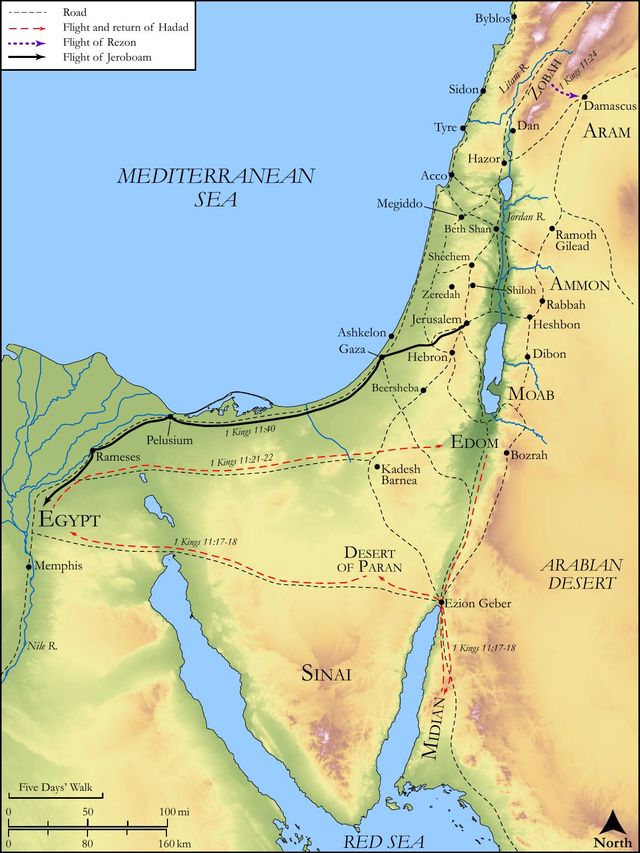
In some way or other Solomon came to know of all this, probably from Jeroboam's own talk of it; he could not conceal it as Saul did, nor keep his own counsel; if he had, he might have staid in his country, and been preparing there for his future advancement; but letting it be known,
1.Solomon foolishly sought to kill his successor. Had not he taught others that, whatever devices are in men's hearts, the counsel of the Lord shall stand? And yet does he himself think to defeat that counsel?
2.Jeroboam prudently withdrew into Egypt. Though God's promise would have secured him any where, yet he would use means for his own preservation, and was content to live in exile and obscurity for a while, being sure of a kingdom at last. And shall not we be so, who have a better kingdom in reserve?
Continue studying 1 Kings 11:27 across the web’s major study libraries — every link below opens this exact verse, chapter, or book on the destination site.
Read & Compare
 BibleGatewayThis verse in more than 200 translations and 70 languages.
 Bible.comThe YouVersion reader — hundreds of translations, reading plans, and highlights.
 ESV.orgCrossway's official English Standard Version reader.
 NET BibleThe NET translation with 60,000+ translators' notes on every rendering decision.
 STEP BibleTyndale House's free study tool — original text, vocabulary, and scholarly resources.
 BibliaLogos Bible Software's free web reader.
 USCCBThe New American Bible (Revised Edition) with the U.S. bishops' study notes.
Commentaries
 BibleHub CommentariesDozens of classic commentaries on this verse, gathered on one page.
 StudyLightMore than 100 commentary sets — the largest collection on the web.
 BibleRefPlain-English commentary on what this verse means, verse by verse.
 Enduring WordDavid Guzik's free commentary on this chapter, widely used by Bible teachers.
 Bible Study ToolsVerse commentary alongside Greek and Hebrew study aids.
Original Language & Research
- BibleHub InterlinearThe verse word by word — original language, transliteration, and English.
- BibleHub LexiconEvery word's original-language definition and Strong's entry.
 Blue Letter BibleDeep-study tools — Strong's numbers, concordance, and word studies.
 SefariaThe Hebrew text with Rashi and centuries of Jewish commentary.
Sermons, Hymns & Audio


TrulyRandomVerse is not affiliated with these sites and doesn’t control their content. They’re linked because they’re genuinely useful.
Summary
First Kings 11:27 precisely identifies the immediate, practical grievance that ignited Jeroboam's rebellion against King Solomon, directly attributing it to Solomon's extensive and burdensome public works projects. While the ultimate divine reason for the kingdom's division stemmed from Solomon's widespread idolatry and disobedience, this verse highlights the tangible human discontent arising from the heavy demands of labor and resources, specifically focusing on the construction and repair of the Millo and the fortifications of the City of David.
Context
ShowHideLiterary Context
This verse serves as the direct explanation for the "cause" mentioned in 1 Kings 11:26. It immediately follows the introduction of Jeroboam, an able and diligent Ephraimite, whom Solomon had appointed to oversee the compulsory labor force of the house of Joseph. While the preceding verses, particularly 1 Kings 11:9-13, establish God's judgment against Solomon due to his apostasy and idolatry, this verse provides the concrete, human-level catalyst for the divine judgment to manifest. It bridges the theological reason for the kingdom's tearing away with the socio-political unrest that facilitated it, setting the stage for the dramatic division of the monarchy detailed in 1 Kings 12.
Historical & Cultural Context
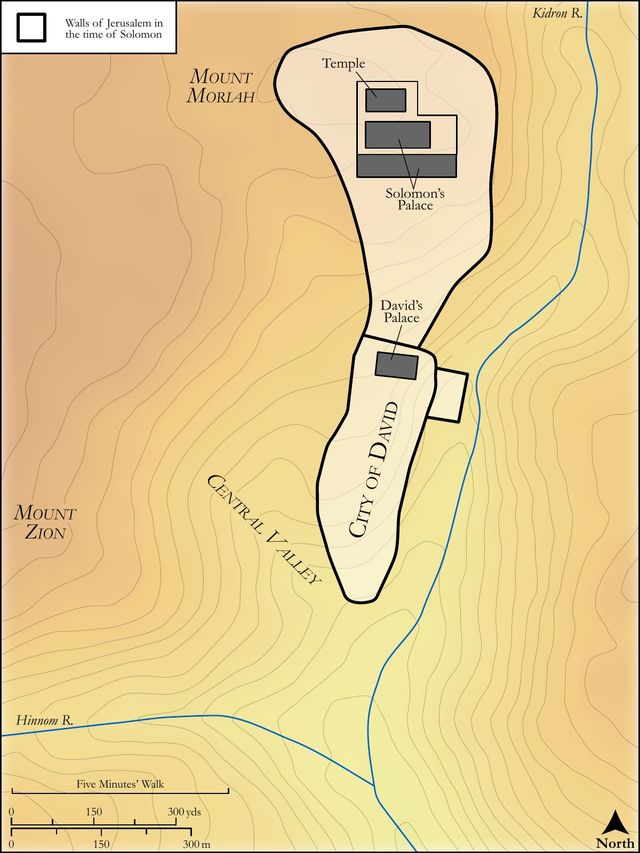
Solomon's reign, though renowned for its peace, prosperity, and wisdom, was also characterized by monumental building projects, including the Temple, his lavish palace, and extensive fortifications across the kingdom. These endeavors required immense resources, primarily financed through heavy taxation and, crucially, a system of forced labor (corvée or conscripted labor). While some labor might have been voluntary or paid, a significant portion was compulsory, especially for non-Israelites, but increasingly levied on Israelites themselves as the projects grew. The "Millo" was a massive structural fill or terrace, likely part of the fortifications of the City of David in ancient Jerusalem, designed to strengthen its defenses, particularly on the vulnerable eastern slope. Both King David (2 Samuel 5:9) and Solomon worked on this strategic defense. The ongoing nature of such projects, and the burden they placed on the populace, particularly the northern tribes who felt disproportionately taxed and conscripted, fueled widespread resentment.
Key Themes
ShowHideThis verse powerfully contributes to several key themes within 1 Kings. It highlights the consequences of disobedience and oppression: While God's primary reason for tearing the kingdom from Solomon was his idolatry (1 Kings 11:4), the means by which this judgment unfolds involve human agency and grievance. Solomon's oppressive labor policies, though perhaps intended for national strength, became a practical outworking of his spiritual failure, illustrating how even righteous intentions can be corrupted by unjust means. Furthermore, it underscores the burden of royal ambition: Solomon's grand vision for his kingdom, manifested in his building programs, inadvertently created a heavy yoke for his people. This verse reveals how unchecked ambition, even for seemingly noble purposes, can lead to popular discontent and ultimately undermine the very stability it seeks to achieve. Finally, it clearly identifies the seeds of division: The practical grievance over forced labor and burdensome projects, as identified here, provided the fertile ground for Jeroboam's rebellion and became the explicit complaint raised by the people to Rehoboam in 1 Kings 12:4, directly precipitating the tragic division of the united monarchy into the northern kingdom of Israel and the southern kingdom of Judah.
Exposition and Analysis
ShowHideKey Word Analysis
ShowHideThis word refers to a "matter (as spoken of) or thing," and adverbially, "a cause." In this context, it precisely identifies the specific action or reason that led to Jeroboam's rebellion. It points to the concrete, human-perceived grievance that served as the catalyst for the uprising against Solomon's rule.
This term denotes "a rampart (as filled in), i.e., the citadel." The Millo was a significant defensive and structural feature of Jerusalem, likely a terraced fill system that strengthened the city's fortifications, particularly on its vulnerable eastern slope. Its construction and ongoing maintenance represented a massive undertaking, symbolizing the immense labor and resource demands of Solomon's building projects.
This root verb means "to shut up" or "to close up," but figuratively also "to repair." In this verse, it specifically refers to the act of mending or restoring the structural weaknesses or damage in the fortifications of the City of David. This indicates that Solomon's projects were not only about new construction but also about continuous, burdensome maintenance, further contributing to the people's discontent.
Verse Breakdown
ShowHide"And this [was] the cause that he lifted up [his] hand against the king:"
This opening clause establishes a direct causal link, stating that the subsequent details explain why Jeroboam rebelled against King Solomon. The idiom "lifted up his hand" signifies an act of open defiance, insurrection, or revolt, indicating a transition from mere discontent to active opposition against the reigning monarch.
"Solomon built Millo,"
This phrase specifies one of the key construction projects that contributed to the widespread grievance. The building of the Millo, a massive and strategically important fortification in Jerusalem, would have required an enormous amount of forced labor and resources, placing a significant burden on the populace.
"[and] repaired the breaches of the city of David his father."
This clause indicates that Solomon's burdensome projects extended beyond new construction to include the continuous maintenance and restoration of existing fortifications. "Breaches" refers to structural weaknesses or damage in the walls of Jerusalem. This ongoing demand for labor, for both new builds and repairs, exacerbated the people's resentment and provided fertile ground for Jeroboam's rebellion.
Literary Devices
ShowHideThe verse employs several literary devices to convey its message effectively. Irony is prominent, as Solomon's grand building projects, intended to solidify and glorify his kingdom, ironically become the very cause of its internal strife and eventual division. His efforts to strengthen the physical defenses of the "city of David his father" ultimately weaken the spiritual and political unity of David's kingdom. The phrase "lifted up his hand" is a well-known idiom, succinctly conveying the act of rebellion without needing lengthy explanation. Furthermore, the verse functions as a form of foreshadowing, directly linking the specific grievance to the imminent and dramatic division of the kingdom, which will unfold in the subsequent chapters, demonstrating how human discontent can become the practical instrument of divine judgment.
Theological and Thematic Connections
ShowHideThis verse powerfully illustrates the interplay between divine sovereignty and human responsibility, and the consequences of leadership that prioritizes ambition over the well-being of the people. While God had already decreed the tearing of the kingdom from Solomon's line due to his idolatry (1 Kings 11:11-13), this verse shows how human actions and grievances become the tangible means through which divine judgment is executed. Solomon's oppressive labor practices, driven by his desire for grand monuments and fortifications, created a climate of resentment that Jeroboam could exploit. This serves as a timeless theological lesson: even seemingly successful or divinely appointed leaders can fall short in their stewardship of the people, and such failures can have profound, kingdom-altering consequences, leading to division and suffering.
Reflection and Application
ShowHideFirst Kings 11:27 serves as a profound cautionary tale for all forms of leadership, whether in the public square, the church, or the home. It reminds us that even grand visions and ambitious projects, if pursued without genuine care for the burdens placed upon those being led, can breed resentment, division, and ultimately undermine the very foundations one seeks to build. Leaders must cultivate a deep empathy for the people they serve, ensuring that their plans are balanced with justice, equity, and a commitment to well-being, not just impressive achievements. Unchecked ambition, a disregard for the struggles of others, or a reliance on oppressive means, even for seemingly noble ends, can lead to the erosion of trust and the eventual collapse of unity. This verse challenges us to consider not just the what of our endeavors, but the how, recognizing that the means often shape the ends and that true strength comes from the flourishing of those under one's care, not merely from monumental accomplishments.
Questions for Reflection
ShowHideFAQ
ShowHideWhat was the "Millo" and why was its construction so significant to Jeroboam's rebellion?
ShowHideThe "Millo" (Hebrew, millôwʾ') was a massive structural fill or terraced rampart, a key part of the fortifications of ancient Jerusalem, specifically the City of David. It was designed to strengthen the city's defenses, particularly on its vulnerable eastern slope. Its construction and repair were monumental undertakings that required immense resources and, crucially, a vast amount of forced labor (corvée). While Solomon's building projects, including the Millo, were intended to glorify God and strengthen the kingdom, the heavy taxation and compulsory labor they demanded placed an unbearable burden on the people, especially the northern tribes. This widespread discontent over the oppressive labor policies became the immediate, tangible "cause" for Jeroboam's rebellion, providing him with a popular grievance to rally support against Solomon's rule, as highlighted in 1 Kings 11:27.
How did Solomon's building projects, despite their grandeur, contribute to the division of the kingdom?
ShowHideSolomon's building projects, though impressive and including the glorious Temple, were financed through heavy taxation and maintained through a system of forced labor. This system, known as corvée, became increasingly burdensome on the Israelite population, particularly the northern tribes who felt disproportionately affected. While the projects showcased Solomon's wealth and power, they also created deep-seated resentment and a sense of oppression among the people. This verse explicitly states that the construction and repair of the Millo and the City of David's breaches were the "cause" for Jeroboam's rebellion. This practical grievance, combined with God's prophetic judgment against Solomon for his idolatry (1 Kings 11:11-13), created the perfect storm for the kingdom's division. When Solomon's son Rehoboam refused to lighten the people's burden (1 Kings 12:4), the northern tribes revolted and crowned Jeroboam as their king, leading directly to the tragic split of the united monarchy.
Christ-Centered Fulfillment
ShowHideThe narrative of Solomon's reign, culminating in the division foreshadowed by the discontent over his building projects, finds its ultimate Christ-centered fulfillment in stark contrast. Solomon, though wise and glorious, built a kingdom through human effort and, ultimately, through burdensome labor and oppressive policies that led to division. His physical "repairs" to the City of David could not mend the spiritual breaches in his own heart or the social fractures in his kingdom. In contrast, Jesus Christ is the true and perfect King, who builds His eternal kingdom not through forced labor or heavy taxation, but through self-sacrifice and grace. He is the ultimate "repairer of the breach" (Isaiah 58:12), not of physical walls, but of the broken relationship between God and humanity through His atoning work on the cross. While Solomon's ambition led to the tearing apart of the earthly kingdom, Christ's mission is to unite all things in Himself (Ephesians 1:10). He builds His church, His spiritual temple, not with stones and forced labor, but with living stones—believers united by His Spirit and grace (1 Peter 2:5). Unlike Solomon, whose reign ended in apostasy and division, Christ's reign is eternal, just, and brings true peace and unity to all who follow Him (Ephesians 2:14-16).