


1 Kings 11:26
- וְיָרָבְעָםve·ya·ra·ve·'Amand JeroboamH3379Conj-w ¦ N-proper-mNoun Proper MasculineוְandיָרָבְעָםJeroboam
- בֶּןben[the] son ofH1121N-mscNoun Singular Masculine Construct
- נְבָטne·VatNebatH5028N-proper-mNoun Proper Masculine
- אֶפְרָתִי'ef·ra·Tian EphrathiteH673N-msNoun Gentilic Singular Masculine Absolute
- מִןminfromH4480PrepPreposition
- הַצְּרֵדָהha·tze·re·Dah<the> ZeredahH6868Art ¦ N-properNoun Proper Locationהַ<the>צְּרֵדָהZeredah
- וְשֵׁםve·Shemand [the] name ofH8034Conj-w ¦ N-mscNoun Singular Masculine Constructוְandשֵׁם[the] name of
- אִמּוֹ'i·Mohis motherH517N-fsc ¦ 3msNoun Singular Feminine Constructאִמּmotherוֹhis
- צְרוּעָהtze·ru·'Ah[was] ZeruahH6871N-proper-fNoun Proper Feminine
- אִשָּׁה'i·Shaha womanH802N-fsNoun Singular Feminine Absolute
- אַלְמָנָה'al·ma·Naha widowH490N-fsNoun Singular Feminine Absolute
- עֶבֶד'E·veda servantH5650N-msNoun Singular Masculine Absolute
- לִשְׁלֹמֹהlish·lo·Mohof SolomonH8010Prep-l ¦ N-proper-mNoun Proper MasculineלִofשְׁלֹמֹהSolomon
- וַיָּרֶםvai·Ya·remand he raisedH7311Conj-w ¦ V-Hiphil-ConsecImperf-3msVerb Hiphil Consecutive Imperfect 3rd Singular Masculineוַandיָּרֶםhe raised
- יָדyada handH3027N-csNoun Singular common gender Absolute
- בַּמֶּלֶךְba·Me·lekhon the kingH4428Prep-b ¦ N-msNoun Singular Masculine Absoluteבַּon theמֶּלֶךְking
English is a literal word-by-word gloss of the Hebrew, not the KJV's wording. Why?
This is the original text the KJV's translators worked from — each Hebrew word with its own literal English meaning in this verse, prepared by scholars at Tyndale House, Cambridge. The KJV translates whole sentences, not word by word, so its wording differs: one Hebrew word can become several English words, and the KJV may choose “the LORD” where the gloss reads “Yahweh”. Both are faithful — they answer different questions. For the KJV's own rendering, switch to the KJV text.
Details
See on the biblical-era map
Study this verse
Public-domain commentary
Matthew Henry
From his Commentary on the Whole Bible. Henry comments on passages, not single verses — this entry covers 1 Kings 11:26–40. His four-level outline is real structure in the source text, so it is rendered as structure.
We have here the first mention of that infamous name Jeroboam the son of Nebat, that made Israel to sin; he is here brought upon the stage as an adversary to Solomon, whom God had expressly told (Kg1 11:11) that he would give the greatest part of his kingdom to his servant, and Jeroboam was the man. We have here an account,
I.Of his extraction, Kg1 11:26.
He was of the tribe of Ephraim, he next in honour to Judah. His mother was a widow, to whom Providence had made up the loss of a husband in a son that was active and ingenious, and (we may suppose) a great support and comfort to her.
II.Of his elevation.
It was Solomon's wisdom, when he had work to do, to employ proper persons in it. He observed Jeroboam to be a very industrious young man, one that minded his business, took a pleasure in it, and did it with all his might, and therefore he gradually advanced him, till at length he made him receiver-general for the two tribes of Ephraim and Manasseh, or perhaps put him into an office equivalent to that of lord-lieutenant of those two counties, for he was ruler of the burden, or tribute, that is, either of the taxes or of the militia of the house of Joseph. Note, Industry is the way to preferment. Seest thou a man diligent in his business, that will take care and pains, and go through with it? he shall stand before kings, and not always be on the level with mean men. Observe a difference between David, and both his predecessor and his successor: when Saul saw a valiant man he took him to himself (Sa1 14:52); when Solomon saw an industrious man he preferred him; but David's eyes were upon the faithful in the land, that they might dwell with him: if he saw a godly man, he preferred him, for he was a man after God's own heart, whose countenance beholds the upright.
III.Of his designation to the government of the ten tribes after the death of Solomon.
Some think he was himself plotting against Solomon, and contriving to rise to the throne, that he was turbulent and aspiring. The Jews say that when he was employed by Solomon in building Millo he took opportunities of reflecting upon Solomon as oppressive to his people, and suggesting that which would alienate them from his government. It is not indeed probable that he should say much to that purport, for Solomon would have got notice of it, and it would have hindered his preferment; but it is plainly intimated that he had it in his thoughts, for the prophet tells him (Kg1 11:37), Thou shalt reign according to all that thy soul desireth. But this was the cause, or rather this was the story, of the lifting up of his hand against the king: Solomon made him ruler over the tribes of Joseph, and, as he was going to take possession of his government, he was told by a prophet in God's name that he should be king, which emboldened him to aim high, and in some instances to oppose the king and give him vexation.
1.The prophet by whom this message was sent was Ahijah of Shiloh; we shall read of him again, Kg1 14:2. It seems, Shiloh was not so perfectly forsaken and forgotten of God but that, in remembrance of the former days, it was blessed with a prophet. He delivered his message to Jeroboam in the way, his servants being probably ordered to retire, as in a like case (Sa1 9:27), when Samuel delivered his message to Saul. God's word was not the less sacred and sure for being delivered to him thus obscurely, under a hedge it may be.
2.The sign by which it was represented to him was the rending of a garment into twelve pieces, and giving him ten, Kg1 11:30, Kg1 11:31. It is not certain whether the garment was Jeroboam's, as is commonly taken for granted, or Ahijah's, which is more probable: He (that is, the prophet) had clad himself with a new garment, on purpose that he might with it give him a sign. The rending of the kingdom from Saul was signified by the rending of Samuel's mantle, not Saul's, Sa1 15:27, Sa1 15:28. And it was more significant to give Jeroboam ten pieces of that which was not his own before than of that which was. The prophets, both true and false, used such signs, even in the New Testament, as Agabus, Act 21:10, Act 21:11.
3.The message itself, which is very particular,
(1.)He assures him that he shall be king over ten of the twelve tribes of Israel, Kg1 11:31. The meanness of his extraction and employment shall be no hindrance to his advancement, when the God of Israel says (by whom kings reign), I will give ten tribes unto thee.
(2.)He tells him the reason; not for his good character or deserts, but for the chastising of Solomon's apostasy: "Because he, and his family, and many of his people with him, have forsaken me, and worshipped other gods," Kg1 11:33. It was because they had done ill, not because he was likely to do much better. Thus Israel must know that it is not for their righteousness that they are made masters of Canaan, but for the wickedness of the Canaanites, Deu 9:4. Jeroboam did not deserve so good a post, but Israel deserved so bad a prince. In telling him that the reason why he rent the kingdom from the house of Solomon was because they had forsaken God, he warns him to take heed of sinning away his preferment in like manner.
(3.)He limits his expectations to the ten tribes only, and to them in reversion after the death of Solomon, lest he should aim at the whole and give immediate disturbance to Solomon's government. He is here told,
[1.]That two tribes (called here one tribe, because little Benjamin was in a manner lost in the thousands of Judah) should remain sure to the house of David, and he must never make any attempt upon them: He shall have one tribe (Kg1 11:32), and again (Kg1 11:36), That David may have a lamp, that is, a shining name and memory (Psa 132:17), and his family, as a royal family, may not be extinct. He must not think that David was rejected, as Saul was. No, God would not take his loving-kindness from him, as he did from Saul. The house of David must be supported and kept in reputation, for all this, because out of it the Messiah must arise. Destroy it not, for that blessing is in it.
[2.]That Solomon must keep possession during his life, Kg1 11:34, Kg1 11:35. Jeroboam therefore must not offer to dethrone him, but wait with patience till his day shall come to fall. Solomon shall be prince, all the days of his life, not for his own sake (he had forfeited his crown to the justice of God), but for David my servant's sake, because he kept my commandments. Children that do not tread in their parents' steps yet often fare the better in this world for their good parents' piety.
(4.)He gives him to understand that he will be upon his good behaviour. The grant of the crown must run quamdiu se bene gesserit - during good behaviour. "If thou wilt do what is right in my sight, I will build thee a sure house, and not otherwise" (Kg1 11:38), intimating that, if he forsook God, even his advancement to the throne would in time lay his family in the dust; whereas the seed of David, though afflicted, should not be afflicted for ever (Kg1 11:39), but should flourish again, as it did in many of the illustrious kings of Judah, who reigned in glory when Jeroboam's family was extirpated.
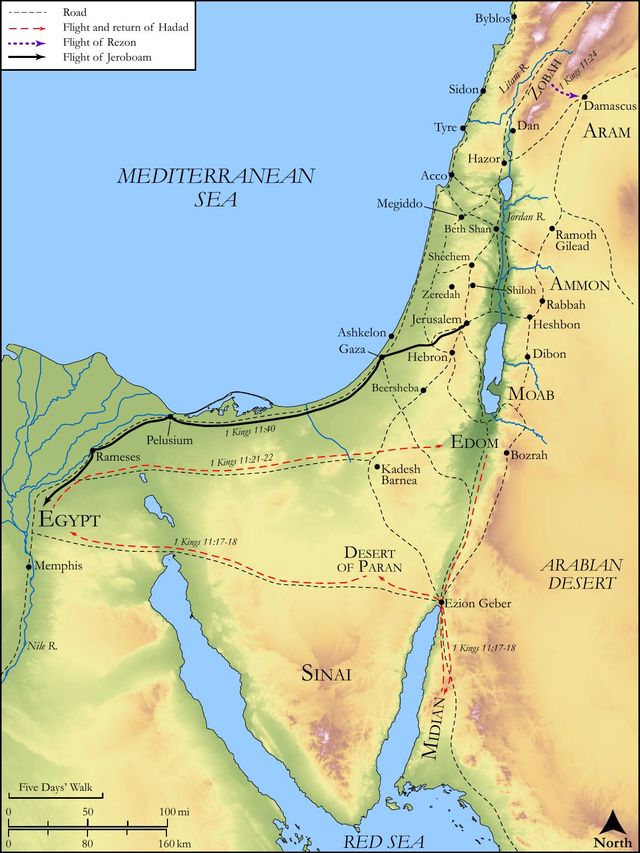
IV.Jeroboam's flight into Egypt, Kg1 11:40.
In some way or other Solomon came to know of all this, probably from Jeroboam's own talk of it; he could not conceal it as Saul did, nor keep his own counsel; if he had, he might have staid in his country, and been preparing there for his future advancement; but letting it be known,
1.Solomon foolishly sought to kill his successor. Had not he taught others that, whatever devices are in men's hearts, the counsel of the Lord shall stand? And yet does he himself think to defeat that counsel?
2.Jeroboam prudently withdrew into Egypt. Though God's promise would have secured him any where, yet he would use means for his own preservation, and was content to live in exile and obscurity for a while, being sure of a kingdom at last. And shall not we be so, who have a better kingdom in reserve?
Continue studying 1 Kings 11:26 across the web’s major study libraries — every link below opens this exact verse, chapter, or book on the destination site.
Read & Compare
 BibleGatewayThis verse in more than 200 translations and 70 languages.
 Bible.comThe YouVersion reader — hundreds of translations, reading plans, and highlights.
 ESV.orgCrossway's official English Standard Version reader.
 NET BibleThe NET translation with 60,000+ translators' notes on every rendering decision.
 STEP BibleTyndale House's free study tool — original text, vocabulary, and scholarly resources.
 BibliaLogos Bible Software's free web reader.
 USCCBThe New American Bible (Revised Edition) with the U.S. bishops' study notes.
Commentaries
 BibleHub CommentariesDozens of classic commentaries on this verse, gathered on one page.
 StudyLightMore than 100 commentary sets — the largest collection on the web.
 BibleRefPlain-English commentary on what this verse means, verse by verse.
 Enduring WordDavid Guzik's free commentary on this chapter, widely used by Bible teachers.
 Bible Study ToolsVerse commentary alongside Greek and Hebrew study aids.
Original Language & Research
- BibleHub InterlinearThe verse word by word — original language, transliteration, and English.
- BibleHub LexiconEvery word's original-language definition and Strong's entry.
 Blue Letter BibleDeep-study tools — Strong's numbers, concordance, and word studies.
 SefariaThe Hebrew text with Rashi and centuries of Jewish commentary.
Sermons, Hymns & Audio


TrulyRandomVerse is not affiliated with these sites and doesn’t control their content. They’re linked because they’re genuinely useful.
Summary
First Kings 11:26 introduces Jeroboam, son of Nebat, a pivotal figure whose rebellion against King Solomon was a divinely orchestrated consequence of Solomon's profound idolatry. This verse meticulously details Jeroboam's background as an Ephrathite from Zereda and a former trusted servant of Solomon, even noting his mother's status as a widow. It culminates in the stark declaration that he "lifted up his hand against the king," a decisive act that sets the stage for the tragic division of the united monarchy and the subsequent history of two separate kingdoms, Israel and Judah.
Context
ShowHideLiterary Context
This verse is strategically positioned within the larger narrative of King Solomon's spiritual decline and the unfolding consequences of his disobedience. Immediately preceding it, God explicitly declares His intention to tear the kingdom from Solomon's hand, leaving only one tribe for the sake of David and Jerusalem, as detailed in 1 Kings 11:11-13. Jeroboam is presented as one of the "adversaries" God raises up, alongside Hadad the Edomite and Rezon of Zobah, to fulfill this divine judgment, a narrative thread explored in 1 Kings 11:14-25. The introduction of Jeroboam here directly foreshadows the prophetic encounter with Ahijah the Shilonite, who explicitly commissions Jeroboam to rule over ten tribes of Israel, as prophesied in 1 Kings 11:29-39, thereby establishing him as the primary agent of the kingdom's division. This verse transitions the narrative from Solomon's personal failures to the broader political and theological ramifications for the entire nation.
Historical & Cultural Context
Solomon's reign, though celebrated for its peace and prosperity, was also characterized by the implementation of heavy taxation and forced labor (corvée) to fund his ambitious building projects, including the temple, his palace, and various fortifications. This significant burden disproportionately affected the northern tribes, who felt increasingly alienated from the Davidic dynasty centered in Jerusalem. Jeroboam's position as "Solomon's servant," likely an overseer of forced labor for the house of Joseph, as indicated in 1 Kings 11:28, would have given him direct exposure to, and perhaps sympathy for, the widespread discontent among the northern populace. His identification as an "Ephrathite of Zereda" links him to the powerful tribe of Ephraim, which had historically vied for leadership among the tribes and felt overlooked by Judah's dominance. The mention of his mother, Zeruah, as a widow, might subtly emphasize his humble origins, making his eventual rise to challenge the king even more remarkable and indicative of divine intervention.
Key Themes
ShowHideThis verse powerfully contributes to several overarching themes in 1 Kings. Firstly, it underscores the theme of Divine Judgment and Sovereignty, demonstrating that even human rebellion and political upheaval are ultimately orchestrated by God to fulfill His declared will concerning Solomon's idolatry and the conditional nature of the Davidic covenant for the king's personal obedience, as seen in 1 Kings 11:9-13. Secondly, it highlights Human Rebellion and Ambition, as Jeroboam's act of "lifting up his hand" signifies a deliberate, hostile challenge to royal authority, likely fueled by his own aspirations and the widespread discontent with Solomon's oppressive policies. Thirdly, it serves as the crucial introduction to The Seeds of Division, presenting the figure who will become the first king of the Northern Kingdom of Israel, thereby initiating the irreparable split of the united monarchy established by David and Solomon. This division is a central theological and political event that profoundly shapes the remainder of the Old Testament narrative.
Exposition and Analysis
ShowHideKey Word Analysis
ShowHideThis term (H673) identifies Jeroboam as belonging to Ephraim, a dominant and influential tribe in the northern kingdom. Ephraim was a traditional rival to Judah for leadership among the tribes of Israel. Highlighting his tribal origin immediately signals a potential source of political tension and sets the stage for the eventual secession of the northern tribes, who would largely coalesce around Ephraimite leadership.
This word (H5650) describes Jeroboam's prior position as an official or administrator within Solomon's government. He was not an outsider but an insider, trusted with significant responsibilities, perhaps overseeing public works or forced labor, particularly for the "house of Joseph" (Ephraim and Manasseh) as mentioned in 1 Kings 11:28. This background suggests he possessed administrative skills, influence, and an intimate knowledge of the kingdom's operations and vulnerabilities, making his rebellion all the more impactful.
This word (H3027) is a key component of the idiom "lifted up his hand." In this context, "hand" signifies power, means, and direction. The phrase "lifted up his hand" (H7311, H3027) is a powerful Hebrew idiom signifying an act of rebellion, revolt, or hostile opposition against a superior authority. It implies more than mere verbal dissent; it suggests a significant challenge, often involving a conspiracy, an attempted coup, or an armed uprising. In this context, it clearly communicates the serious and defiant nature of Jeroboam's actions against the reigning monarch, Solomon, marking a direct challenge to the divinely established Davidic kingship.
Verse Breakdown
ShowHide"And Jeroboam the son of Nebat"
This introduces the central figure, Jeroboam, by his name and patronymic, immediately establishing his identity as the protagonist of this pivotal moment in Israelite history.
"an Ephrathite of Zereda"
This clause provides Jeroboam's tribal affiliation (Ephraim) and his hometown (Zereda), rooting him geographically and tribally in the northern territories, which would later form the bulk of his kingdom. This detail is crucial for understanding the political dynamics of the impending division.
"Solomon's servant"
This describes Jeroboam's previous relationship and status under King Solomon, highlighting his insider position and the trust (or at least utility) Solomon placed in him before the rebellion. This makes his subsequent actions all the more significant.
"whose mother's name [was] Zeruah, a widow woman"
This seemingly minor detail offers a glimpse into Jeroboam's personal background, possibly emphasizing his humble origins or the fact that he lacked a powerful patriarchal lineage. This detail makes his rise to power even more remarkable and can be seen as indicative of God's sovereign hand elevating the humble.
"even he lifted up [his] hand against the king"
This climactic clause states the central action of the verse: Jeroboam's direct and defiant rebellion against King Solomon. The emphatic phrase "even he" underscores the unexpected or significant nature of this rebellion emanating from a trusted servant, marking a profound challenge to the established order.
Literary Devices
ShowHideThe verse employs several literary devices to convey its profound significance. Foreshadowing is prominent, as the introduction of Jeroboam and his act of rebellion directly anticipates the division of the kingdom, which is the major narrative arc following Solomon's reign. There is a strong element of Irony, given that Jeroboam, described as "Solomon's servant," is the very individual who "lifts up his hand" against his master, highlighting the unexpected nature of the threat from within Solomon's own administration. The precise details of Jeroboam's background (Ephrathite, servant, widow's son) serve to establish his character and context, utilizing Characterization to prepare the reader for his future, divinely appointed yet ultimately flawed, role. Finally, the use of the Idiom "lifted up his hand" succinctly and powerfully communicates the act of rebellion, immediately conveying the gravity and hostile nature of Jeroboam's actions without needing lengthy explanation.
Theological and Thematic Connections
ShowHideThe emergence of Jeroboam and his rebellion in 1 Kings 11:26 is not merely a political coup but a direct outworking of God's sovereign judgment against King Solomon's profound idolatry and unfaithfulness. While Jeroboam's actions are presented as human rebellion and ambition, the broader narrative context reveals them as instruments in God's hand to fulfill His declared will. This highlights the theological truth that even in the midst of human sin, ambition, and political upheaval, God remains in control, orchestrating events to accomplish His purposes and enforce the consequences of disobedience. The division of the kingdom, initiated by this rebellion, serves as a stark reminder of the conditional nature of the Davidic covenant for the individual king's obedience, even as the promise of an enduring dynasty for David's line remains unconditionally secure.
Reflection and Application
ShowHideThe introduction of Jeroboam and his rebellion offers profound lessons for believers today. Solomon's tragic decline, despite his unparalleled wisdom and initial faithfulness, serves as a sobering reminder that even those greatly blessed by God are not immune to the insidious creep of spiritual compromise and idolatry. His story underscores the critical importance of sustained vigilance, humility, and unwavering devotion to the Lord throughout one's life, lest a good beginning lead to a devastating end. Furthermore, Jeroboam's role, though divinely appointed for judgment, also highlights the dangers of unchecked ambition and the potential for human actions, even those fulfilling God's purposes, to be marred by sin. His later establishment of idolatrous worship in the Northern Kingdom demonstrates how a legitimate rise to power can be corrupted by a desire to secure one's own position rather than faithfully serving God. This narrative calls us to examine our own hearts, ensuring that our actions, whether in leadership or daily life, are motivated by pure devotion to God and not by self-serving ambition, and to remain faithful even when circumstances seem to justify compromise.
Questions for Reflection
ShowHideFAQ
ShowHideWho was Jeroboam before he lifted his hand against the king?
ShowHideBefore his rebellion, Jeroboam was a capable and trusted administrator in King Solomon's government. 1 Kings 11:28 states that "Jeroboam was a mighty man of valor: and Solomon seeing the young man that he was industrious, he made him ruler over all the charge of the house of Joseph." This indicates he was in charge of the forced labor or public works for the tribes of Ephraim and Manasseh, a position that would have given him significant influence and insight into the discontent among the northern tribes due to Solomon's heavy burdens.
Why did Jeroboam rebel against Solomon?
ShowHideJeroboam's rebellion was a complex event with both divine and human motivations. From God's perspective, it was a direct judgment against Solomon's idolatry and unfaithfulness. The prophet Ahijah had already prophesied to Jeroboam that God would tear ten tribes from Solomon's kingdom and give them to Jeroboam, as recorded in 1 Kings 11:29-39. From a human perspective, Jeroboam likely capitalized on the widespread discontent among the northern tribes due to Solomon's oppressive policies, heavy taxation, and forced labor. His position as an overseer of these laborers would have made him privy to their grievances, and his own ambition, fueled by the prophetic word, led him to challenge the king's authority.
What was the immediate outcome of Jeroboam's rebellion mentioned in 1 Kings 11?
ShowHideFollowing his initial act of rebellion, Jeroboam was forced to flee from King Solomon. 1 Kings 11:40 states that "Solomon sought therefore to kill Jeroboam. And Jeroboam arose, and fled into Egypt, unto Shishak king of Egypt, and was in Egypt until the death of Solomon." He remained in exile until Solomon's death, after which he was called back by the northern tribes to negotiate with Solomon's son, Rehoboam, a negotiation that ultimately led to the kingdom's division and Jeroboam becoming the first king of the Northern Kingdom of Israel, as recounted in 1 Kings 12:1-20.
Christ-Centered Fulfillment
ShowHideThe narrative of Jeroboam's rebellion against King Solomon, rooted in Solomon's failure and leading to the division of the kingdom, profoundly highlights the human need for a perfect, faithful King. Solomon, despite his unparalleled wisdom and initial glory, ultimately failed to maintain his covenant fidelity, turning his heart from the Lord and leading to the tearing away of the kingdom. Jeroboam, though divinely appointed as an instrument of judgment, himself quickly succumbed to political expediency and led his people into grievous idolatry with the golden calves, further demonstrating the inherent fallenness and unreliability of human kingship, as detailed in 1 Kings 12:28-30. This brokenness and division in the earthly monarchy point forward to Jesus Christ, the true Son of David, who alone fulfills God's kingly ideal. Unlike Solomon, Christ never turns His heart from God; He is perfectly obedient, even to death on a cross, as described in Philippians 2:8. Unlike Jeroboam, He never leads His people into idolatry but continually calls them to worship the one true God. He is the ultimate "servant," not one who rebels against God, but one who perfectly submits to the Father's will, even "lifting up His hand" in sacrifice to establish an eternal kingdom that will never be divided, as prophesied in Luke 1:32-33. Through His atoning work, Christ breaks down the dividing wall of hostility caused by sin, uniting Jew and Gentile into one new humanity, establishing a spiritual kingdom that transcends earthly divisions and perfectly fulfills God's promises of an everlasting, undivided reign, a reality celebrated in Ephesians 2:14. He is the faithful King who brings true peace and unity, where all human kings have failed.