


Ruth 1:2
Bible text: King James Version (1769 Blayney text) · Public domain
Bible text: King James Version with Strong's numbers · Public domain
Bible text: Berean Standard Bible · Public domain
Bible text: American Standard Version (1901) · Public domain
Bible text: World English Bible, Messianic edition · Public domain
Bible text: Geneva Bible (1599) · Public domain
Bible text: Young's Literal Translation · Public domain
- וְשֵׁםve·Shemand [the] name ofH8034Conj-w ¦ N-mscNoun Singular Masculine Constructוְandשֵׁם[the] name of
- הָאִישׁha·'Ishthe manH376Art ¦ N-msNoun Singular Masculine Absoluteהָtheאִישׁman
- אֱלִימֶלֶךְ'eli·Me·lekh[was] ElimelechH458N-proper-mNoun Proper Masculine
- וְשֵׁםve·Shemand [the] name ofH8034Conj-w ¦ N-mscNoun Singular Masculine Constructוְandשֵׁם[the] name of
- אִשְׁתּוֹ'ish·Tohis wifeH802N-fsc ¦ 3msNoun Singular Feminine Constructאִשְׁתּwifeוֹhis
- נָעֳמִיno·'o·Mi[was] NaomiH5281N-proper-fNoun Proper Feminine
- וְשֵׁםve·Shemand [the] name ofH8034Conj-w ¦ N-mscNoun Singular Masculine Constructוְandשֵׁם[the] name of
- שְׁנֵיshe·nei[the] twoH8147N-cdcNoun Dual common gender Construct
- בָנָיוva·Navhis sonsH1121N-mpc ¦ 3msNoun Plural Masculine Constructבָנָיsonsוhis
- מַחְלוֹןmach·Lon[was] MahlonH4248N-proper-mNoun Proper Masculine
- וְכִלְיוֹןve·khil·yOnand KilionH3630Conj-w ¦ N-proper-mNoun Proper MasculineוְandכִלְיוֹןKilion
- אֶפְרָתִים'ef·ra·TimEphrathitesH673N-mpNoun Gentilic Plural Masculine Absolute
- מִבֵּיתmi·Beitfrom Beth-H1035Prep-m ¦ N-properNoun Proper LocationמִfromבֵּיתBeth-
- לֶחֶםLe·chem-lehemH1035N-properNoun Proper Location
- יְהוּדָהye·hu·DahJudahH3063N-properNoun Proper Location
- וַיָּבֹאוּvai·ya·Vo·'uand they cameH935Conj-w ¦ V-Qal-ConsecImperf-3mpVerb Qal Consecutive Imperfect 3rd Plural Masculineוַandיָּבֹאוּthey came
- שְׂדֵיse·dei[the] region<s> ofH7704N-mpcNoun Plural Masculine Construct
- מוֹאָבmo·'AvMoabH4124N-properNoun Proper Location
- וַיִּהְיוּvai·yih·yuand they wereH1961Conj-w ¦ V-Qal-ConsecImperf-3mpVerb Qal Consecutive Imperfect 3rd Plural Masculineוַandיִּהְיוּthey were
- שָׁםShamthereH8033AdvAdverb
English is a literal word-by-word gloss of the Hebrew, not the KJV's wording. Why?
This is the original text the KJV's translators worked from — each Hebrew word with its own literal English meaning in this verse, prepared by scholars at Tyndale House, Cambridge. The KJV translates whole sentences, not word by word, so its wording differs: one Hebrew word can become several English words, and the KJV may choose “the LORD” where the gloss reads “Yahweh”. Both are faithful — they answer different questions. For the KJV's own rendering, switch to the KJV text.
Details
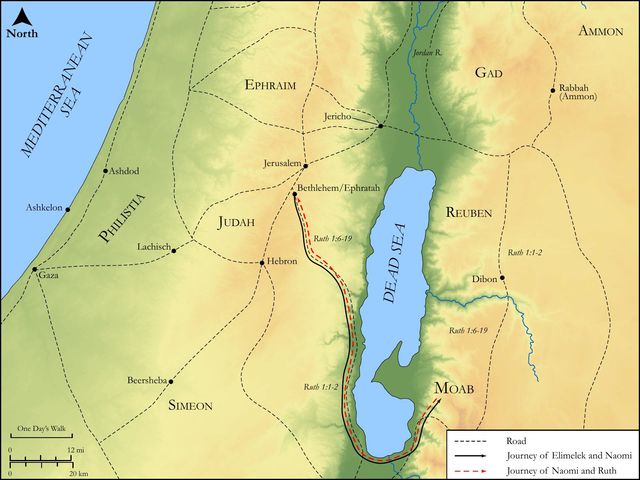
See on the biblical-era map
Study this verse
Public-domain commentary
Matthew Henry
From his Commentary on the Whole Bible. Henry comments on passages, not single verses — this entry covers Ruth 1:1–5. His two-level outline is real structure in the source text, so it is rendered as structure.
The first words give all the date we have of this story. It was in the days when the judges ruled (Rut 1:1), not in those disorderly times when there was no king in Israel; but under which of the judges these things happened we are not told, and the conjectures of the learned are very uncertain. It must have been towards the beginning of the judges' time, for Boaz, who married Ruth, was born of Rahab, who received the spies in Joshua's time. Some think it was in the days of Ehud, others of Deborah; the learned bishop Patrick inclines to think it was in the days of Gideon, because in his days only we read of a famine by the Midianites' invasion, Jdg 6:3, Jdg 6:4. While the judges were ruling, some one city and some another, Providence takes particular cognizance of Bethlehem, and has an eye to a King, to Messiah himself, who should descend from two Gentile mothers, Rahab and Ruth. Here is,
I.A famine in the land, in the land of Canaan, that land flowing with milk and honey.
This was one of the judgments which God had threatened to bring upon them for their sins, Lev 26:19, Lev 26:20. He has many arrows in his quiver. In the days of the judges they were oppressed by their enemies; and, when by that judgment they were not reformed, God tried this, for when he judges he will overcome. When the land had rest, yet it had not plenty; even in Bethlehem, which signifies the house of bread, there was scarcity. A fruitful land is turned into barrenness, to correct and restrain the luxury and wantonness of those that dwell therein.
II.An account of one particular family distressed in the famine; it is that of Elimelech.
His name signifies my God a king, agreeable to the state of Israel when the judges ruled, for the Lord was their King, and comfortable to him and his family in their affliction, that God was theirs and that he reigns for ever. His wife was Naomi, which signifies my amiable or pleasant one. But his sons' names were Mahlon and Chilion, sickness and consumption, perhaps because weakly children, and not likely to be long-lived. Such are the productions of our pleasant things, weak and infirm, fading and dying.
III.The removal of this family from Bethlehem into the country of Moab on the other side Jordan, for subsistence, because of the famine, Rut 1:1, Rut 1:2. It seems there was plenty in the country of Moab when there was scarcity of bread in the land of Israel. Common gifts of providence are often bestowed in greater plenty upon those that are strangers to God than upon those that know and worship him. Moab is at ease from his youth, while Israel is emptied from vessel to vessel (Jer 48:11), not because God loves Moabites better, but because they have their portion in this life. Thither Elimelech goes, not to settle for ever, but to sojourn for a time, during the dearth, as Abraham, on a similar occasion, went into Egypt, and Isaac into the land of the Philistines. Now here,
1.Elimelech's care to provide for his family, and his taking his wife and children with him, were without doubt commendable. If any provide not for his own, he hath denied the faith, Ti1 5:8. When he was in his straits he did not forsake his house, go seek his fortune himself, and leave his wife and children to shift for their own maintenance; but, as became a tender husband and a loving father, where he went he took them with him, not as the ostrich, Job 39:16. But,
2.I see not how his removal into the country of Moab, upon this occasion, could be justified. Abraham and Isaac were only sojourners in Canaan, and it was agreeable to their condition to remove; but the seed of Israel were now fixed, and ought not to remove into the territories of the heathen. What reason had Elimelech to go more than any of his neighbours? If by any ill husbandry he had wasted his patrimony, and sold his land or mortgaged it (as it should seem, Rut 4:3, Rut 4:4), which brought him into a more necessitous condition than others, the law of God would have obliged his neighbours to relieve him (Lev 25:35); but that was not his case, for he went out full, Rut 1:21. By those who tarried at home it appears that the famine was not so extreme but that there was sufficient to keep life and soul together; and his charge was but small, only two sons. But if he could not be content with the short allowance that his neighbours took up with, and in the day of famine could not be satisfied unless he kept as plentiful a table as he had done formerly, if he could not live in hope that there would come years of plenty again in due time, or could not with patience wait for those years, it was his fault, and he did by it dishonour God and the good land he had given them, weaken the hands of his brethren, with whom he should have been willing to take his lot, and set an ill example to others. If all should do as he did Canaan would be dispeopled. Note, It is an evidence of a discontented, distrustful, unstable spirit, to be weary of the place in which God hath set us, and to be for leaving it immediately whenever we meet with any uneasiness or inconvenience in it. It is folly to think of escaping that cross which, being laid in our way, we ought to take up. It is our wisdom to make the best of that which is, for it is seldom that changing our place is mending it. Or, if he would remove, why to the country of Moab? If he had made enquiry, it is probable he would have found plenty in some of the tribes of Israel, those, for instance, on the other side Jordan, that bordered on the land of Moab; if he had had that zeal for God and his worship, and that affection for his brethren which became an Israelite, he would not have persuaded himself so easily to go and sojourn among Moabites.
IV.The marriage of his two sons to two of the daughters of Moab after his death, Rut 1:4.
All agree that this was ill done. The Chaldee says, They transgressed the decree of the word of the Lord in taking strange wives. If they would not stay unmarried till their return to the land of Israel, they were not so far off but that they might have fetched themselves wives thence. Little did Elimelech think, when he went to sojourn in Moab, that ever his sons would thus join in affinity with Moabites. But those that bring young people into bad acquaintance, and take them out of the way of public ordinances, though they may think them well-principled and armed against temptation, know not what they do, nor what will be the end thereof. It does not appear that the women they married were proselyted to the Jewish religion, for Orpah is said to return to her gods (Rut 1:15); the gods of Moab were hers still. It is a groundless tradition of the Jews that Ruth was the daughter of Eglon king of Moab, yet the Chaldee paraphrast inserts it; but this and their other tradition, which he inserts likewise, cannot agree, that Boaz who married Ruth was the same with Ibzan, who judged Israel 200 years after Eglon's death, Jdg 12:1-15.
V.The death of Elimelech and his two sons, and the disconsolate condition Naomi was thereby reduced to.
Her husband died (Rut 1:3) and her two sons (Rut 1:5) soon after their marriage, and the Chaldee says, Their days were shortened, because they transgressed the law in marrying strange wives. See here,
1.That wherever we go we cannot out-run death, whose fatal arrows fly in all places.
2.That we cannot expect to prosper when we go out of the way of our duty. He that will save his life by any indirect course shall lose it.
3.That death, when it comes into a family, often makes breach upon breach. One is taken away to prepare another to follow soon after; one is taken away, and that affliction is not duly improved, and therefore God sends another of the same kind. When Naomi had lost her husband she took so much the more complacency and put so much the more confidence in her sons. Under the shadow of these surviving comforts she thinks she shall live among the heathen, and exceedingly glad she was of these gourds; but behold they wither presently, green and growing up in the morning, cut down and dried up before night, buried soon after they were married, for neither of them left any children. So uncertain and transient are all our enjoyments here. It is therefore our wisdom to make sure of those comforts that will be made sure and of which death cannot rob us. But how desolate was the condition, and how disconsolate the spirit, of poor Naomi, when the woman was left of her two sons and her husband! When these two things, loss of children and widowhood, come upon her in a moment, come upon her in their perfection, by whom shall she be comforted? Isa 47:9; Isa 51:19. It is God alone who has wherewithal to comfort those who are thus cast down.
Historical interpretation
Historical reception
3 surviving comments on this verse. Each one is dated, so this reads as a timeline rather than a list.
Select a marker to jump to its quote. Markers stagger vertically where authors wrote within a few decades of each other.
Therefore, if we acknowledge that Thamar is described in the genealogies on account of a mystery in the Lord's generations, we must also certainly not consider Ruth to be overlooked for the same reason: about whom the holy Apostle seems to have had an understanding, when he foresaw through the Spirit that the calling of the Gentiles was to be celebrated by the Gospel, saying that the Law is not made for the just, but for the unjust (1 Timothy 1:9). For how did Ruth, being a foreigner, marry a Jew? And by what reasoning did the evangelist think that the mention of a union should be made in the birth of Christ, which was forbidden by the series of laws? Therefore, did the Savior not originate from a legitimate generation (Deut. XXIII, 3)? It seems to be contrary unless we adhere to the apostolic belief, for the law was not established for the righteous, but for the unrighteous. And since she is a foreigner and a Moabite (especially since the law of Moses prohibited these marriages, and the Moabites were excluded from the Church; for it is written: Moabites shall not enter the Church of the Lord even to the third and fourth generation, and forever), how then did she enter into the Church if not because she was holy and blameless in her conduct, above the law? For if the Law was given to the impious and sinners, certainly Ruth, who surpassed the definition of the Law, and entered into the Church, and became an Israelite, and deserved to be counted among the greater ones of the Lord's family, because of the choice of her mind and not her body, is a great example for us, because in her the figure of our entrance into the Church of the Lord, who are gathered from the nations, preceded. Let us therefore imitate her; so that because she deserved this prerogative of being admitted into her society by her manners, as history teaches: we also, because of the choice of our manners, may be counted among the Church of the Lord, with the support of our merits.
For when the Israelites were afflicted by famine in the earlier days of the Judges, a man named Elimelech from the city of Bethlehem in Judah, where Christ was born, went to live in the land of Moab with his wife and two sons. His sons took Moabite wives, one named Orpah and the other named Ruth, and they lived there for about ten years before they died. But after her husband and sons died, the woman, left alone and without her own family, heard that God had visited Israel and she decided to return home. She urged her daughters-in-law to go back to their families as well. One concession: but Ruth stayed with her mother-in-law. When her mother-in-law said to her, 'Look, your sister-in-law has gone back to her people and her gods; go back with her,' Ruth replied, 'Do not press me to leave you and to turn back from following you. Where you go, I will go; where you lodge, I will lodge. Your people shall be my people, and your God my God. Where you die, I will die—there will I be buried.' (Ruth 1:15, 17). And so the two arrived at Bethlehem. Therefore, when Boaz, the great-grandfather of David, learned of these customs, as well as the respect towards the mother-in-law, the devotion towards the deceased, and the religiousness towards God, according to the law of Moses, in order to raise up the offspring of the deceased, he chose her as his wife.
You call to mind Blaesilla’s companionship, her conversation and her endearing ways; and you cannot endure the thought that you have lost them all. I pardon you the tears of a mother, but I ask you to restrain your grief. When I think of the parent, I cannot blame you for weeping, but when I think of the Christian and the recluse, the mother disappears from my view. Your wound is still fresh, and any touch of mine, however gentle, is more likely to inflame than to heal it. Yet why do you not try to overcome by reason a grief which time must inevitably assuage? Naomi, fleeing because of famine to the land of Moab, there lost her husband and her sons. Yet when she was thus deprived of her natural protectors, Ruth, a stranger, never left her side. And see what a great thing it is to comfort a lonely woman: Ruth, for her reward, is made an ancestor of Christ. Consider the great trials which Job endured, and you will see that you are over-delicate. Amid the ruins of his house, the pains of his sores, his countless bereavements, and, last of all, the snares laid for him by his wife, he still lifted up his eyes to heaven and maintained his patience unbroken. I know what you are going to say “All this befell him as a righteous man, to try his righteousness.” Well, choose which alternative you please. Either you are holy, in which case God is putting your holiness to the proof; or else you are a sinner, in which case you have no right to complain. For if so, you endure far less than your deserts.
The Hebrews’ tradition is that this is he in whose time the sun stood still, on account of those who did not keep the law, so that, when they had seen such a miracle, they should turn to the Lord God. And because they scorned to do such a thing, therefore the famine grew worse, and he who seemed foremost in the tribe of Judah not only was expelled from his native land with his wife and sons, made helpless by famine, but even continued in that same exile with his sons.
Continue studying Ruth 1:2 across the web’s major study libraries — every link below opens this exact verse, chapter, or book on the destination site.
Read & Compare
 BibleGatewayThis verse in more than 200 translations and 70 languages.
 Bible.comThe YouVersion reader — hundreds of translations, reading plans, and highlights.
 ESV.orgCrossway's official English Standard Version reader.
 NET BibleThe NET translation with 60,000+ translators' notes on every rendering decision.
 STEP BibleTyndale House's free study tool — original text, vocabulary, and scholarly resources.
 BibliaLogos Bible Software's free web reader.
 USCCBThe New American Bible (Revised Edition) with the U.S. bishops' study notes.
Commentaries
 BibleHub CommentariesDozens of classic commentaries on this verse, gathered on one page.
 StudyLightMore than 100 commentary sets — the largest collection on the web.
 BibleRefPlain-English commentary on what this verse means, verse by verse.
 Enduring WordDavid Guzik's free commentary on this chapter, widely used by Bible teachers.
 Bible Study ToolsVerse commentary alongside Greek and Hebrew study aids.
Original Language & Research
- BibleHub InterlinearThe verse word by word — original language, transliteration, and English.
- BibleHub LexiconEvery word's original-language definition and Strong's entry.
 Blue Letter BibleDeep-study tools — Strong's numbers, concordance, and word studies.
 SefariaThe Hebrew text with Rashi and centuries of Jewish commentary.
Sermons, Hymns & Audio


TrulyRandomVerse is not affiliated with these sites and doesn’t control their content. They’re linked because they’re genuinely useful.
Summary
Ruth 1:2 introduces the core family of the narrative: Elimelech, his wife Naomi, and their two sons, Mahlon and Chilion. Identified as Ephrathites from Bethlehemjudah, this verse chronicles their desperate migration from their homeland to the country of Moab, a drastic measure taken in response to the severe famine described in the preceding verse. It establishes the initial setting for the unfolding drama of loss, resilience, and eventual redemption, highlighting the family's search for sustenance outside the promised land.
Context
ShowHideLiterary Context
Ruth 1:2 immediately follows Ruth 1:1, which sets the historical stage ("in the days when the judges ruled") and identifies the precipitating crisis (a severe famine in Judah). Verse 2 then introduces the specific family unit—Elimelech, Naomi, Mahlon, and Chilion—whose journey and subsequent trials form the narrative's emotional and theological core. This verse establishes their departure from Bethlehem, a move that will lead to profound personal loss but ultimately, through God's sovereign hand, to the remarkable story of Ruth and the lineage of David. The phrase "and continued there" subtly foreshadows that what might have been intended as a temporary sojourn became a prolonged stay, leading to deeper entanglements and unforeseen consequences, including the deaths of Elimelech and his sons, as detailed in Ruth 1:3-5.
Historical & Cultural Context
The period "when the judges ruled" (c. 1375-1050 BC) was characterized by spiritual apostasy, social instability, and frequent cycles of sin, judgment, repentance, and deliverance, as depicted throughout the Book of Judges. Famines were common divine judgments for Israel's disobedience (Deuteronomy 28:23-24). Bethlehemjudah, meaning "house of bread" and located in the tribal territory of Judah, ironically suffers from a lack of food, forcing its inhabitants to seek sustenance elsewhere. The destination, Moab, was a Transjordanian kingdom east of the Dead Sea, historically antagonistic towards Israel. The Moabites were descendants of Lot, Abraham's nephew (Genesis 19:37), but their hostility during the Exodus led to a Mosaic prohibition against them entering the assembly of the Lord for ten generations (Deuteronomy 23:3-6). For an Israelite family to migrate to Moab, while a pragmatic response to famine, carried significant cultural and religious implications, suggesting a desperate situation that compelled them to cross a profound boundary.
Key Themes
ShowHideThis verse introduces several pivotal themes. Firstly, Providence in Crisis is subtly present; while the famine is a judgment, it also serves as the catalyst for a series of events through which God's redemptive plan will unfold. Secondly, the theme of Covenant Loyalty vs. Survival is highlighted by the family's departure from the promised land to a pagan nation, raising questions about their trust in God's provision within the covenant. Thirdly, the Significance of Names is powerfully introduced. Elimelech ("My God is King"), Naomi ("My Pleasantness"), Mahlon ("Sickly"), and Chilion ("Pining" or "Failing") all bear names that will prove to be profoundly ironic or tragically prophetic in light of their future experiences in Moab, foreshadowing the sorrow and bitterness Naomi will express later in Ruth 1:20-21.
Exposition and Analysis
ShowHideKey Word Analysis
ShowHideMeaning "My God is King." This name carries a profound irony. While it declares God's sovereignty, Elimelech's decision to leave the promised land due to famine, rather than trusting in God's provision within the covenant, might suggest a practical lapse in faith or a desperate act of survival that overrides theological conviction. His name stands in stark contrast to his actions, which lead his family away from the land where God is explicitly King.
Meaning "My pleasantness" or "pleasant." This name establishes her initial character or the hope associated with her. However, her future experiences in Moab, marked by the deaths of her husband and sons, will lead her to a profound transformation, prompting her to request a change of name to "Mara" (bitter) in Ruth 1:20, highlighting the tragic irony of her original name in light of her suffering.
A compound name meaning "house of bread of Judah." This designation emphasizes the family's origin in the tribal territory of Judah and the ironic nature of their departure. The place known for bread is now experiencing famine, forcing its inhabitants to seek sustenance elsewhere. This geographical detail firmly grounds the family within Israel's covenant heritage, making their subsequent migration to a foreign land even more poignant.
The land east of the Dead Sea, historically antagonistic to Israel. The very act of migrating to Moab was a significant step for an Israelite family, given the Deuteronomic prohibition against Moabites entering the assembly of the Lord (Deuteronomy 23:3). This geographical move signifies not just a physical relocation but a departure from the covenant land and its protections, placing the family in a potentially compromising spiritual environment, driven by extreme necessity.
Verse Breakdown
ShowHide"And the name of the man [was] Elimelech, and the name of his wife Naomi, and the name of his two sons Mahlon and Chilion"
This opening clause immediately introduces the main characters and their family unit. The naming of each individual is significant, as discussed in the Key Word Analysis, foreshadowing their roles and fates within the narrative. The KJV's bracketed "was" correctly implies the verb "to be," making the identification clear.
"Ephrathites of Bethlehemjudah"
This phrase precisely identifies their origin. "Ephrathite" refers to an inhabitant of Ephrathah, an ancient name for Bethlehem (Genesis 35:19). "Bethlehemjudah" further specifies its location within the tribal territory of Judah, grounding the family firmly within the covenant land and its heritage, making their subsequent departure even more poignant.
"And they came into the country of Moab, and continued there"
This final clause describes their migration and the duration of their stay. "Came into" (Hebrew, bôwʼ) indicates their arrival as outsiders seeking refuge. The crucial phrase "and continued there" (Hebrew, wayyihyû šām) implies a prolonged residence beyond an initial temporary intent. This extended stay in Moab is critical, as it leads to the deaths of the men and the subsequent intermarriage of the sons with Moabite women, setting the stage for the book's central conflict and resolution.
Literary Devices
ShowHideRuth 1:2 employs several key literary devices. Irony is prominent, particularly in the names and the location. Bethlehem, meaning "house of bread," ironically experiences a famine, forcing its inhabitants to leave. The names Elimelech ("My God is King") and Naomi ("My Pleasantness") stand in stark contrast to the tragic events and bitter experiences that await them in Moab. Furthermore, the potential meanings of Mahlon ("sickly") and Chilion ("pining" or "failing") serve as powerful Foreshadowing, hinting at their premature deaths, which are quickly confirmed in subsequent verses. The simple phrase "and continued there" acts as a subtle but potent form of Foreshadowing, indicating that what began as a temporary sojourn became a prolonged stay with significant, unforeseen, and ultimately tragic consequences for the family, setting the stage for the dramatic return of Naomi and Ruth.
Theological and Thematic Connections
ShowHideRuth 1:2, while seemingly a simple statement of fact, is rich with theological implications. It highlights the human response to crisis, often leading to decisions that, while pragmatic for survival, may inadvertently lead one away from the covenant community or into compromising situations. The famine, a divine judgment, becomes the catalyst for a journey that tests faith and reveals God's overarching providence, even through human missteps. The family's departure from "Bethlehemjudah" to "Moab" symbolizes a move from the promised land of God's covenant presence to a land associated with paganism and hostility towards Israel. Yet, it is precisely in this "foreign" land that God begins to weave the threads of His redemptive plan, ultimately bringing a Moabite woman, Ruth, into the lineage of Israel's greatest king and, eventually, the Messiah. This verse subtly introduces the theme of God's sovereign hand working through human choices and even human suffering to accomplish His divine purposes.
Reflection and Application
ShowHideRuth 1:2 serves as a powerful reminder that life's crises often force us to make difficult decisions, sometimes leading us into unfamiliar or even challenging environments. Elimelech's family, facing a severe famine, chose to seek sustenance outside the promised land. While their move to Moab was a natural human response to hardship, it carried significant spiritual and cultural implications, ultimately leading to profound loss. This verse invites us to consider our own responses to adversity: Do we trust God's provision even when circumstances seem dire, or do we prioritize immediate survival at the expense of our spiritual grounding? The story of Ruth, beginning with this initial migration, ultimately demonstrates that even when we stray or face the consequences of difficult choices, God's sovereign hand can redeem our circumstances, bringing unexpected blessings and fulfilling His purposes in ways we could never foresee. It encourages us to seek God's wisdom in all decisions, especially in times of duress, recognizing that our choices have long-term ripple effects, yet also trusting in His unfailing grace to work all things for good. Our "Bethlehem" may be experiencing a "famine," but God remains sovereign, capable of providing even in the most unlikely "Moabs."
Questions for Reflection
ShowHideFAQ
ShowHideWhy did Elimelech's family leave Bethlehemjudah for Moab?
ShowHideRuth 1:2 states that they left Bethlehemjudah because of a severe famine in the land, as mentioned in Ruth 1:1. Their migration to Moab was a desperate measure to find food and sustain their lives in a period of great scarcity and hardship. While Bethlehem was known as the "house of bread," the famine rendered it incapable of providing for its inhabitants, forcing them to seek provision elsewhere.
What was the significance of an Israelite family moving to Moab?
ShowHideMoving to Moab was a highly significant and potentially controversial decision for an Israelite family. Moab was a foreign, pagan nation with a long history of antagonism towards Israel, stemming from their lack of hospitality during the Exodus and their involvement in Balaam's attempt to curse Israel (Numbers 22-24). Furthermore, Mosaic Law explicitly prohibited Moabites from entering the assembly of the Lord for ten generations (Deuteronomy 23:3-6). Therefore, Elimelech's family's move represented a departure from the covenant land and its spiritual protections, placing them in a culturally and religiously compromising environment, driven by extreme necessity.
Christ-Centered Fulfillment
ShowHideRuth 1:2, by detailing the family's flight from famine in "Bethlehemjudah" to the foreign land of Moab, subtly foreshadows humanity's spiritual condition and God's redemptive plan in Christ. The famine in Bethlehem, the "house of bread," speaks to the spiritual emptiness and lack of true nourishment in a world separated from God, a condition that ultimately led humanity into spiritual exile. Elimelech's family's journey to Moab, a land of outsiders and historical enemies, mirrors the universal human experience of being alienated from God due to sin, dwelling in a "foreign land" of spiritual death. However, it is in this very foreign land that God's plan begins to unfold, as a Moabite woman, Ruth, is introduced. Her eventual return to Bethlehem and her inclusion into the lineage of David (and ultimately, Christ) powerfully prefigures the gospel's universal reach. Jesus, the true Bread of Life, comes from Bethlehem, not to flee famine, but to satisfy the spiritual hunger of all humanity. He breaks down the wall of hostility between Jew and Gentile (Ephesians 2:14), bringing those who were once "aliens and strangers" into the household of God (Ephesians 2:19). Just as Ruth, a Moabite, is grafted into Israel's covenant family, so too are Gentiles grafted into the spiritual family of God through faith in Christ, demonstrating God's boundless grace that transcends all human boundaries and brings those from the "country of Moab" into the eternal "Bethlehem" of His presence.