


1 Kings 11:25
Bible text: King James Version (1769 Blayney text) · Public domain
Bible text: Berean Standard Bible · Public domain
Bible text: American Standard Version (1901) · Public domain
Bible text: World English Bible, Messianic edition · Public domain
Bible text: Geneva Bible (1599) · Public domain
Bible text: Young's Literal Translation · Public domain
- וַיְהִיvay·Hiand he wasH1961Conj-w ¦ V-Qal-ConsecImperf-3msVerb Qal Consecutive Imperfect 3rd Singular Masculineוַandיְהִיhe was
- שָׂטָןsa·Tanan adversaryH7854N-msNoun Singular Masculine Absolute
- לְיִשְׂרָאֵלle·Yis·ra·'Elof IsraelH3478Prep-l ¦ N-properNoun Proper LocationלְofיִשְׂרָאֵלIsrael
- כָּלkolallH3605N-mscNoun Singular Masculine Construct
- יְמֵיye·Mei[the] days ofH3117N-mpcNoun Plural Masculine Construct
- שְׁלֹמֹהshe·lo·MohSolomonH8010N-proper-mNoun Proper Masculine
- וְאֶתve·'Etand <obj.>H854Conj-w ¦ PrepPrepositionוְandאֶת<obj.>
- הָרָעָהha·ra·'Ah<the> harmH7451Art ¦ N-fsNoun Singular Feminine Absoluteהָ<the>רָעָהharm
- אֲשֶׁר'a·SherwhichH834RelParticle Relative
- הֲדָדha·DadHadadH1908N-proper-mNoun Proper Masculine
- וַיָּקָץvai·Ya·kotzand he loathedH6973Conj-w ¦ V-Qal-ConsecImperf-3msVerb Qal Consecutive Imperfect 3rd Singular Masculineוַandיָּקָץhe loathed
- בְּיִשְׂרָאֵלbe·Yis·ra·'El<in> IsraelH3478Prep-b ¦ N-properNoun Proper Locationבְּ<in>יִשְׂרָאֵלIsrael
- וַיִּמְלֹךְvai·yim·Lokhand he reignedH4427Conj-w ¦ V-Qal-ConsecImperf-3msVerb Qal Consecutive Imperfect 3rd Singular Masculineוַandיִּמְלֹךְhe reigned
- עַל'aloverH5921PrepPreposition
- אֲרָם'a·RamAramH758N-properNoun Proper Location
English is a literal word-by-word gloss of the Hebrew, not the KJV's wording. Why?
This is the original text the KJV's translators worked from — each Hebrew word with its own literal English meaning in this verse, prepared by scholars at Tyndale House, Cambridge. The KJV translates whole sentences, not word by word, so its wording differs: one Hebrew word can become several English words, and the KJV may choose “the LORD” where the gloss reads “Yahweh”. Both are faithful — they answer different questions. For the KJV's own rendering, switch to the KJV text.
Details
See on the biblical-era maps
Study this verse
Public-domain commentary
Matthew Henry
From his Commentary on the Whole Bible. Henry comments on passages, not single verses — this entry covers 1 Kings 11:14–25. His three-level outline is real structure in the source text, so it is rendered as structure.
While Solomon kept closely to God and to his duty there was no adversary nor evil occurrent (Kg1 5:4), nothing to create him any disturbance or uneasiness in the least; but here we have an account of two adversaries that appeared against him, inconsiderable, and that could not have done any thing worth taking notice of if Solomon had not first made God his enemy. What hurt could Hadad or Rezon have done to so great and powerful a king as Solomon was if he had not, by sin, made himself mean and weak? And then those little people menace and insult him. If God be on our side, we need not fear the greatest adversary; but, if he be against us, he can made us fear the least, and the very grasshopper shall be a burden. Observe,
I.Both these adversaries God stirred up, Kg1 11:14, Kg1 11:23.
Though they themselves were moved by principles of ambition or revenge, God made use of them to serve his design of correcting Solomon. The principal judgment threatened was deferred, namely, the rending of the kingdom from him, but he himself was made to fee the smart of the rod, for his greater humiliation. Note, Whoever are, in any way, adversaries to us, we must take notice of the hand of God stirring them up to be so, as he bade Shimei curse David; we must look through the instruments of our trouble to the author of it and hear the Lord's controversy in it.
II.Both these adversaries had the origin of their enmity to Solomon and Israel laid in David's time, and in his conquests of their respective countries, Kg1 11:15, Kg1 11:24. Solomon had the benefit and advantage of his father's successes both in the enlargement of his dominion and the increase of his treasure, and would never have known any thing but the benefit of them if he had kept closely to God; but now he finds evils to balance the advantages, and that David had made himself enemies, who were thorns in his sides. Those that are too free in giving provocation ought to consider that perhaps it may be remembered in time to come and returned with interest to theirs after them; having so few friends in this world, it is our wisdom not to make ourselves more enemies than we needs must.
1.Hadad, an Edomite, was an adversary to Solomon. We are not told what he did against him, nor which way he gave him disturbance, only, in general, that he was an adversary to him: but we are told,
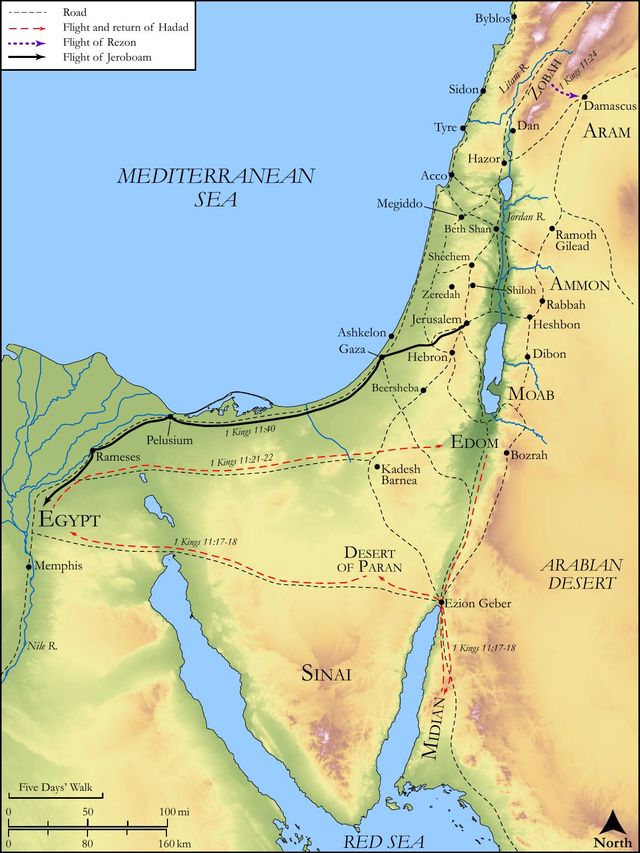
(1.)What induced him to bear Solomon a grudge. David had conquered Edom, Sa2 8:14. Joab put all the males to the sword, Kg1 11:15, Kg1 11:16. A terrible execution he made, avenging on Edom their old enmity to Israel, yet perhaps with too great a severity. From this general slaughter, while Joab was burying the slain (for he left not any alive of their own people to bury them, and buried they must be, or they would be an annoyance to the country, Eze 39:12), Hadad, a branch of the royal family, then a little child, was taken and preserved by some of the king's servants, and conveyed to Egypt, Kg1 11:17. They halted by the way, in Midian first, and then in Paran, where they furnished themselves with men, not to fight for them or force their passage, but to attend them, that their young master might go into Egypt with an equipage agreeable to his quality. There he was kindly sheltered and entertained by Pharaoh, as a distressed prince, as well provided for, and so recommended himself that, in process of time, he married the queen's sister (Kg1 11:19), and by her had a child, which the queen herself conceived such a kindness for that she brought him up in Pharaoh's house, among the king's children.
(2.)What enabled him to do Solomon a mischief. Upon the death of David and Joab, he returned to his own country, in which, it should seem, he settled and remained quiet while Solomon continued wise and watchful for the public good, but from which he had opportunity of making inroads upon Israel when Solomon, having sinned away his wisdom as Samson did his strength (and in the same way), grew careless of public affairs, was off his guard himself, and had forfeited the divine protection. What vexation Hadad gave to Solomon we are not here told, but only how loth Pharaoh was to part with him and how earnestly he solicited his stay (Kg1 11:22): What hast thou lacked with me? "Nothing," says Hadad; "but let me go to my own country, my native air, my native soil." Peter Martyr has a pious reflection upon this: "Heaven is our home, and we ought to keep up a holy affection to that, and desire towards it, even when the world, the place of our banishment, smiles most upon us." Does it ask, What have you lacked, that you are so willing to be gone? We may answer, "Nothing that the world can do for us; but still let us go thither, where our hope, and honour, and treasure are."
2.Rezon, a Syrian, was another adversary to Solomon. When David conquered the Syrians, he headed the remains, lived at large by spoil and rapine, till Solomon grew careless, and then he got possession of Damascus, reigned there (Kg1 11:24) and over the country about (Kg1 11:25), and he created troubles to Israel, probably in conjunction with Hadad, all the days of Solomon (namely, after his apostasy), or he was an enemy to Israel during all Solomon's reign, and upon all occasions vented his then impotent malice against them, but till Solomon's revolt, when his defence had departed from him, he could not do them any mischief. It is said of him that he abhorred Israel. Other princes loved and admired Israel and Solomon, and courted their friendship, but here was one that abhorred them. The greatest and best of princes and people, however much they may in general be respected, will yet perhaps be hated and abhorred by some.
Continue studying 1 Kings 11:25 across the web’s major study libraries — every link below opens this exact verse, chapter, or book on the destination site.
Read & Compare
 BibleGatewayThis verse in more than 200 translations and 70 languages.
 Bible.comThe YouVersion reader — hundreds of translations, reading plans, and highlights.
 ESV.orgCrossway's official English Standard Version reader.
 NET BibleThe NET translation with 60,000+ translators' notes on every rendering decision.
 STEP BibleTyndale House's free study tool — original text, vocabulary, and scholarly resources.
 BibliaLogos Bible Software's free web reader.
 USCCBThe New American Bible (Revised Edition) with the U.S. bishops' study notes.
Commentaries
 BibleHub CommentariesDozens of classic commentaries on this verse, gathered on one page.
 StudyLightMore than 100 commentary sets — the largest collection on the web.
 BibleRefPlain-English commentary on what this verse means, verse by verse.
 Enduring WordDavid Guzik's free commentary on this chapter, widely used by Bible teachers.
 Bible Study ToolsVerse commentary alongside Greek and Hebrew study aids.
Original Language & Research
- BibleHub InterlinearThe verse word by word — original language, transliteration, and English.
- BibleHub LexiconEvery word's original-language definition and Strong's entry.
 Blue Letter BibleDeep-study tools — Strong's numbers, concordance, and word studies.
 SefariaThe Hebrew text with Rashi and centuries of Jewish commentary.
Sermons, Hymns & Audio


TrulyRandomVerse is not affiliated with these sites and doesn’t control their content. They’re linked because they’re genuinely useful.
Summary
1 Kings 11:25 vividly portrays Rezon as a relentless and enduring adversary to Israel throughout the latter half of King Solomon's reign, highlighting his profound animosity and established dominion over Syria. This verse serves as a stark testament to the immediate and tangible consequences of Solomon's spiritual decline and idolatry, illustrating God's righteous judgment in raising external threats to dismantle the peace and security that once defined his kingdom, thereby foreshadowing the eventual division of the united monarchy.
Context
ShowHideLiterary Context
This verse is strategically positioned within 1 Kings 11, a pivotal chapter that irrevocably alters the trajectory of King Solomon's narrative. Following an era of unparalleled wisdom, immense wealth, and profound peace, the text reveals Solomon's heart turning away from the Lord, primarily due to the corrupting influence of his numerous foreign wives who led him into idolatry and the worship of pagan deities (1 Kings 11:1-8). As a direct and severe consequence of this profound disobedience, God unequivocally declares that He will tear the kingdom away from Solomon's son, though not entirely, out of respect for the covenant made with David (1 Kings 11:9-13). Rezon is introduced as the second of two significant adversaries providentially raised by God against Solomon, immediately following the account of Hadad the Edomite (1 Kings 11:14-22). The deliberate placement of these external threats directly after the description of Solomon's apostasy powerfully underscores the swift, tangible, and severe repercussions of covenant unfaithfulness.
Historical & Cultural Context
Rezon's historical background, elaborated in 1 Kings 11:23-24, identifies him as a former officer of Hadadezer, the powerful king of Zobah. He fled when King David decisively conquered Zobah, effectively subjugating the Aramean states (2 Samuel 8:3-8). This deep-seated historical animosity, stemming from David's earlier military campaigns that had brought the Aramean kingdoms under Israelite dominion, provides the crucial cultural and political backdrop for Rezon's profound "abhorrence" for Israel. Syria, particularly Aram-Damascus, was a strategically vital region situated directly north of Israel, controlling essential trade routes and access to Mesopotamia. Rezon's successful establishment of his independent kingdom in Damascus meant that Israel now faced a formidable and deeply hostile power directly on its northern border. This dramatic shift from a period of regional dominance and secure borders under David and early Solomon to one of constant threat and vulnerability vividly illustrates the severe geopolitical consequences that flowed directly from Solomon's spiritual decline.
Key Themes
ShowHideThis verse profoundly contributes to several overarching theological and narrative themes prevalent in 1 Kings and the broader Deuteronomistic History. Firstly, it serves as a powerful illustration of Divine Judgment and Consequences, demonstrating God's unwavering faithfulness to His covenant, which encompasses both promised blessings for obedience and stipulated curses for disobedience, as meticulously outlined in Deuteronomy 28. Solomon's profound sin directly precipitates the emergence of these adversaries, thereby shattering the peace and prosperity that were the hallmarks of his early reign. Secondly, the emphatic phrase "all the days of Solomon" underscores the theme of Persistent Adversity, highlighting that the repercussions of sin are not fleeting or transient but can endure for extended periods, serving as a constant, painful reminder of God's displeasure and the broken covenant relationship. Finally, Rezon's rise to power, despite his personal vendetta, powerfully exemplifies God's Sovereignty. Even the seemingly independent actions of foreign kings and hostile nations are ultimately orchestrated or permitted by God to fulfill His divine purposes, including the righteous discipline of His people and the precise execution of His prophetic word, as seen in the broader narrative of God using nations as instruments of judgment, even against His own people, as articulated in Isaiah 10:5-7.
Exposition and Analysis
ShowHideKey Word Analysis
ShowHideThis noun, derived from the verbal root śāṭan meaning "to oppose, accuse, be an adversary," precisely describes Rezon's role in relation to Israel. While famously transliterated as "Satan" when referring to the arch-demonic entity, here it denotes a human opponent, accuser, or obstacle. Its application to Rezon emphasizes his persistent, active, and formidable opposition to Israel, portraying him as a continuous source of trouble and a direct instrument of divine judgment against King Solomon. It underscores his function as a significant impediment to Israel's peace and prosperity.
This verb signifies a profound emotional response of loathing, detestation, or disgust, indicating a deep-seated aversion. When applied to Rezon, it goes far beyond mere political or strategic opposition, revealing a visceral and intense animosity he harbored towards Israel. This profound hatred likely stemmed from the historical subjugation of his homeland, Zobah, by King David, making his opposition highly personal, deeply ingrained, and relentlessly pursued. This word powerfully conveys the severity and depth of the existential threat Rezon posed to the kingdom of Israel.
This primitive root verb means "to reign," and inceptively, "to ascend the throne." Its use here confirms Rezon's established authority and legitimate dominion over Syria (Aram-Damascus). It indicates that his opposition was not merely that of a roving bandit leader, but of a sovereign king with the power and resources to wage sustained conflict against Israel. This detail emphasizes the tangible and institutionalized nature of the threat, highlighting that Solomon's kingdom now faced a formidable, state-level adversary on its northern border.
Verse Breakdown
ShowHide"And he was an adversary to Israel all the days of Solomon"
This opening clause immediately establishes Rezon's consistent, enduring, and pervasive role as an enemy of God's people. The phrase "all the days of Solomon" is particularly significant, signifying that this was not a temporary skirmish or fleeting threat, but a continuous, nagging, and debilitating presence that plagued the latter, declining years of Solomon's reign. This persistent adversity stands in stark contrast to the unparalleled peace and security that had been promised to a faithful king and enjoyed during the early years of his rule, powerfully underscoring the lasting and pervasive impact of Solomon's profound disobedience.
"beside the mischief that Hadad [did]"
This parenthetical yet crucial remark clarifies that Rezon was not the sole adversary afflicting Israel but operated concurrently and independently of Hadad the Edomite, who had also been raised up by God as an instrument of judgment (1 Kings 11:14). The Hebrew word for "mischief" (רָעָה, rā‘āh) encompasses meanings such as evil, trouble, harm, or calamity. This phrase indicates that the kingdom faced multiple, simultaneous, and diverse threats from different directions, intensifying the pervasive sense of divine displeasure and the rapid erosion of the kingdom's once-secure peace and prosperity.
"and he abhorred Israel"
This phrase delves into the deep, personal, and visceral animosity that Rezon harbored towards Israel. It transcends mere strategic rivalry or political ambition, indicating a profound and intense hatred that fueled his actions and made his opposition particularly relentless and bitter. This "abhorrence" is deeply rooted in the historical context of King David's conquests, which had subjugated Rezon's homeland, Zobah, thereby transforming Rezon into a vengeful and deeply motivated instrument in the hands of God's judgment, driven by his own bitter experiences and desire for retribution.
"and reigned over Syria"
This concluding clause precisely specifies Rezon's sphere of influence, power, and geographical base of operations. His established reign over Syria (specifically Aram-Damascus) meant that Israel now had a hostile, well-organized, and militarily capable kingdom directly on its northern border. This posed a continuous and significant military, political, and economic threat, disrupting trade routes and forcing Israel into a posture of constant defense. This geographical and political detail powerfully underscores the tangible, immediate, and far-reaching consequences of Solomon's apostasy for the security and integrity of his once-unified and prosperous kingdom.
Literary Devices
ShowHideThe verse employs several potent literary devices to convey its profound theological and narrative message. Parallelism is subtly evident in the mention of Rezon's actions occurring "beside the mischief that Hadad [did]," creating a dual image of divine judgment being executed through multiple, distinct adversaries. This reinforces the overarching idea that God's sovereign hand was actively involved in raising up opposition against Solomon. Foreshadowing is also a prominent element, as Rezon's persistent opposition and the fracturing of Solomon's previously unchallenged peace subtly yet powerfully hint at the greater, more catastrophic division of the united kingdom that would ultimately occur under the reign of Rehoboam, Solomon's son (1 Kings 11:11-13). The narrative skillfully utilizes Contrast by juxtaposing the earlier, glorious descriptions of Solomon's unparalleled wisdom, wealth, and widespread peace with the sudden and persistent emergence of these formidable threats, thereby underscoring the dramatic and tragic shift in his reign directly attributable to his profound unfaithfulness. Finally, the deliberate use of the term "śāṭân" for "adversary" carries a subtle yet significant Symbolism, linking Rezon's earthly, human opposition to the broader spiritual reality of opposition against God's people and His divine purposes, even if Rezon himself is not presented as a demonic entity in this specific context.
Theological and Thematic Connections
ShowHide1 Kings 11:25 stands as a stark and sobering reminder of the principle of divine retribution and the inviolable nature of God's covenant. While God's promises to David concerning an enduring dynasty were unconditional and eternal (2 Samuel 7:12-16), the blessings, peace, and prosperity enjoyed by individual kings and the nation were profoundly contingent upon their faithful obedience to the Mosaic Covenant. Solomon's profound apostasy directly triggered God's righteous anger and judgment, leading Him to explicitly declare, "I will surely tear the kingdom from you" and to "raise up an adversary against Solomon" (1 Kings 11:11-14). Rezon, driven by his personal hatred and desire for vengeance against Israel, unwittingly became a powerful instrument in God's sovereign hands, demonstrating that even the actions of wicked men and hostile nations can be divinely employed to accomplish God's overarching purposes, whether in the form of righteous judgment, discipline, or the intricate outworking of His redemptive plan. This verse powerfully illustrates that sin has tangible, often painful, and far-reaching consequences, disrupting not only spiritual peace but also national security, political stability, and material prosperity.
Reflection and Application
ShowHideThe narrative of Rezon's rise as a persistent adversary against King Solomon offers a profound and enduring lesson for believers in every generation. Solomon, once lauded as the wisest and most blessed king, ultimately succumbed to spiritual compromise and idolatry, leading directly to divine judgment and the emergence of persistent external threats. This serves as a powerful and sobering warning: no amount of past blessing, accumulated wisdom, or spiritual gifting can inoculate us from the severe consequences of unfaithfulness. Our walk with God is not a one-time event but a continuous, dynamic journey requiring vigilant self-examination, intentional obedience to His commands, and unwavering devotion to Him alone. When we, like Solomon, turn away from God's commands, even through subtle compromises or seemingly minor deviations, we inadvertently open doors to various forms of "adversaries" in our lives—whether they manifest as internal turmoil, fractured relationships, financial difficulties, or external opposition—thereby disrupting the profound peace and abundant blessing God earnestly desires for us. Understanding that God takes our sin seriously and will act to bring about His righteous justice, often through unexpected and uncomfortable means, should profoundly motivate us to cultivate a heart of consistent faithfulness, humble repentance, and unwavering alignment with His divine will, ensuring our lives remain firmly rooted in Him.
Questions for Reflection
ShowHideFAQ
ShowHideWho was Rezon, and why was he an adversary to Israel?
ShowHideRezon was a Syrian chieftain who successfully established himself as the king of Aram-Damascus. According to 1 Kings 11:23-24, he was a former officer who had defected from Hadadezer, the king of Zobah, when King David conquered Zobah. After David's death and during the latter part of Solomon's reign, Rezon rallied a band of men, seized control of Damascus, and founded his own independent kingdom. His animosity towards Israel was deeply personal and vengeful, stemming from David's earlier subjugation of his homeland. However, the biblical narrative explicitly states that his rise as a persistent adversary was ultimately orchestrated and permitted by God as a direct consequence of King Solomon's widespread idolatry and profound disobedience, serving as a divine judgment against the king and his kingdom.
How does Rezon's rise relate to God's promises to David?
ShowHideRezon's rise, along with that of Hadad the Edomite, powerfully highlights the inherent tension between God's unconditional covenant promise to David concerning an enduring dynasty and an eternal throne (2 Samuel 7:12-16) and the conditional blessings and judgments that would befall individual kings based on their obedience or disobedience. While God promised David that his throne would be established forever, He also clearly warned that if his descendants sinned, they would face discipline and chastisement, though the foundational covenant itself would not be broken or revoked (Psalm 89:30-34). Solomon's profound unfaithfulness directly led to God raising up adversaries like Rezon, demonstrating that while the kingdom would not be entirely torn away from David's line (as a remnant would remain), its peace, unity, and security would be severely disrupted and diminished as a direct consequence of sin (1 Kings 11:11-13). Thus, Rezon's persistent opposition was a tangible manifestation of God's righteous discipline, fulfilling His prophetic word while simultaneously preserving the ultimate, enduring promise to David's royal line.
Christ-Centered Fulfillment
ShowHideThe account of Rezon, the persistent adversary providentially raised against King Solomon, finds its ultimate and profound Christ-centered fulfillment in several critical ways. Solomon, despite being endowed with unparalleled wisdom and immense blessings, tragically failed to maintain the peace and security of his kingdom due to his own spiritual compromise and idolatry, leading directly to the emergence of formidable external enemies. In stark contrast, Jesus Christ stands as the true and perfectly obedient Son of David, the King who flawlessly fulfills every aspect of God's will and covenant (Hebrews 4:15). He faced the ultimate adversary, Satan, not merely a human opponent, and through His sacrificial death on the cross and triumphant resurrection, He decisively triumphed over all spiritual principalities and powers, disarming them and leading them captive in His glorious procession (Colossians 2:15). While Solomon's reign ended with persistent threats and the fracturing of his kingdom, Christ's eternal reign ushers in a perfect, unshakable kingdom of everlasting peace, security, and righteousness for all who place their faith and trust in Him, a kingdom where the true adversary is utterly defeated and ultimately cast into eternal judgment (Revelation 20:10). Jesus assures His followers, "In the world you will have tribulation. But take heart; I have overcome the world" (John 16:33), demonstrating that unlike Solomon, He provides ultimate victory, enduring peace, and eternal security over all adversaries, both seen and unseen.