


1 Kings 11:28
Bible text: King James Version (1769 Blayney text) · Public domain
Bible text: King James Version with Strong's numbers · Public domain
Bible text: Berean Standard Bible · Public domain
Bible text: American Standard Version (1901) · Public domain
Bible text: World English Bible, Messianic edition · Public domain
Bible text: Geneva Bible (1599) · Public domain
Bible text: Young's Literal Translation · Public domain
- וְהָאִישׁve·ha·'Ishand the manH376Conj-w ¦ Art ¦ N-msNoun Singular Masculine Absoluteוְandהָtheאִישׁman
- יָרָבְעָםya·ra·ve·'AmJeroboamH3379N-proper-mNoun Proper Masculine
- גִּבּוֹרgi·Bor[was] a mighty [man] ofH1368N-mscNoun Singular Masculine Construct
- חָיִלCha·yilstrengthH2428N-msNoun Singular Masculine Absolute
- וַיַּרְאvai·Yar'and he sawH7200Conj-w ¦ V-Qal-ConsecImperf-3msVerb Qal Consecutive Imperfect 3rd Singular Masculineוַandיַּרְאhe saw
- שְׁלֹמֹהshe·lo·MohSolomonH8010N-proper-mNoun Proper Masculine
- אֶת'et<obj.>H853DirObjMParticle Object Indicator
- הַנַּעַרha·Na·'arthe young manH5288Art ¦ N-msNoun Singular Masculine Absoluteהַtheנַּעַרyoung man
- כִּיkithatH3588PrtParticle Conditional
- עֹשֵׂה'o·Seh[was] doingH6213V-Qal-Prtcpl-msVerb Qal Participle Singular Masculine Construct
- מְלָאכָהme·la·KhahworkH4399N-fsNoun Singular Feminine Absolute
- הוּאHu'heH1931Pro-3msPronoun Personal 3rd Singular Masculine
- וַיַּפְקֵדvai·yaf·Kedand he appointedH6485Conj-w ¦ V-Hiphil-ConsecImperf-3msVerb Hiphil Consecutive Imperfect 3rd Singular Masculineוַandיַּפְקֵדhe appointed
- אֹתוֹ'o·To<obj.> himH853DirObjM ¦ 3msParticle Object Indicatorאֹת<obj.>וֹhim
- לְכָלle·kholto allH3605Prep-l ¦ N-mscNoun Singular Masculine Constructלְtoכָלall
- סֵבֶלSe·vel[the] forced labor ofH5447N-mscNoun Singular Masculine Construct
- בֵּיתbeit[the] house ofH1004N-mscNoun Singular Masculine Construct
- יוֹסֵףyo·SefJosephH3130N-proper-mNoun Proper Masculine
English is a literal word-by-word gloss of the Hebrew, not the KJV's wording. Why?
This is the original text the KJV's translators worked from — each Hebrew word with its own literal English meaning in this verse, prepared by scholars at Tyndale House, Cambridge. The KJV translates whole sentences, not word by word, so its wording differs: one Hebrew word can become several English words, and the KJV may choose “the LORD” where the gloss reads “Yahweh”. Both are faithful — they answer different questions. For the KJV's own rendering, switch to the KJV text.
Details
See on the biblical-era maps

Study this verse
Public-domain commentary
Matthew Henry
From his Commentary on the Whole Bible. Henry comments on passages, not single verses — this entry covers 1 Kings 11:26–40. His four-level outline is real structure in the source text, so it is rendered as structure.
We have here the first mention of that infamous name Jeroboam the son of Nebat, that made Israel to sin; he is here brought upon the stage as an adversary to Solomon, whom God had expressly told (Kg1 11:11) that he would give the greatest part of his kingdom to his servant, and Jeroboam was the man. We have here an account,
I.Of his extraction, Kg1 11:26.
He was of the tribe of Ephraim, he next in honour to Judah. His mother was a widow, to whom Providence had made up the loss of a husband in a son that was active and ingenious, and (we may suppose) a great support and comfort to her.
II.Of his elevation.
It was Solomon's wisdom, when he had work to do, to employ proper persons in it. He observed Jeroboam to be a very industrious young man, one that minded his business, took a pleasure in it, and did it with all his might, and therefore he gradually advanced him, till at length he made him receiver-general for the two tribes of Ephraim and Manasseh, or perhaps put him into an office equivalent to that of lord-lieutenant of those two counties, for he was ruler of the burden, or tribute, that is, either of the taxes or of the militia of the house of Joseph. Note, Industry is the way to preferment. Seest thou a man diligent in his business, that will take care and pains, and go through with it? he shall stand before kings, and not always be on the level with mean men. Observe a difference between David, and both his predecessor and his successor: when Saul saw a valiant man he took him to himself (Sa1 14:52); when Solomon saw an industrious man he preferred him; but David's eyes were upon the faithful in the land, that they might dwell with him: if he saw a godly man, he preferred him, for he was a man after God's own heart, whose countenance beholds the upright.
III.Of his designation to the government of the ten tribes after the death of Solomon.
Some think he was himself plotting against Solomon, and contriving to rise to the throne, that he was turbulent and aspiring. The Jews say that when he was employed by Solomon in building Millo he took opportunities of reflecting upon Solomon as oppressive to his people, and suggesting that which would alienate them from his government. It is not indeed probable that he should say much to that purport, for Solomon would have got notice of it, and it would have hindered his preferment; but it is plainly intimated that he had it in his thoughts, for the prophet tells him (Kg1 11:37), Thou shalt reign according to all that thy soul desireth. But this was the cause, or rather this was the story, of the lifting up of his hand against the king: Solomon made him ruler over the tribes of Joseph, and, as he was going to take possession of his government, he was told by a prophet in God's name that he should be king, which emboldened him to aim high, and in some instances to oppose the king and give him vexation.
1.The prophet by whom this message was sent was Ahijah of Shiloh; we shall read of him again, Kg1 14:2. It seems, Shiloh was not so perfectly forsaken and forgotten of God but that, in remembrance of the former days, it was blessed with a prophet. He delivered his message to Jeroboam in the way, his servants being probably ordered to retire, as in a like case (Sa1 9:27), when Samuel delivered his message to Saul. God's word was not the less sacred and sure for being delivered to him thus obscurely, under a hedge it may be.
2.The sign by which it was represented to him was the rending of a garment into twelve pieces, and giving him ten, Kg1 11:30, Kg1 11:31. It is not certain whether the garment was Jeroboam's, as is commonly taken for granted, or Ahijah's, which is more probable: He (that is, the prophet) had clad himself with a new garment, on purpose that he might with it give him a sign. The rending of the kingdom from Saul was signified by the rending of Samuel's mantle, not Saul's, Sa1 15:27, Sa1 15:28. And it was more significant to give Jeroboam ten pieces of that which was not his own before than of that which was. The prophets, both true and false, used such signs, even in the New Testament, as Agabus, Act 21:10, Act 21:11.
3.The message itself, which is very particular,
(1.)He assures him that he shall be king over ten of the twelve tribes of Israel, Kg1 11:31. The meanness of his extraction and employment shall be no hindrance to his advancement, when the God of Israel says (by whom kings reign), I will give ten tribes unto thee.
(2.)He tells him the reason; not for his good character or deserts, but for the chastising of Solomon's apostasy: "Because he, and his family, and many of his people with him, have forsaken me, and worshipped other gods," Kg1 11:33. It was because they had done ill, not because he was likely to do much better. Thus Israel must know that it is not for their righteousness that they are made masters of Canaan, but for the wickedness of the Canaanites, Deu 9:4. Jeroboam did not deserve so good a post, but Israel deserved so bad a prince. In telling him that the reason why he rent the kingdom from the house of Solomon was because they had forsaken God, he warns him to take heed of sinning away his preferment in like manner.
(3.)He limits his expectations to the ten tribes only, and to them in reversion after the death of Solomon, lest he should aim at the whole and give immediate disturbance to Solomon's government. He is here told,
[1.]That two tribes (called here one tribe, because little Benjamin was in a manner lost in the thousands of Judah) should remain sure to the house of David, and he must never make any attempt upon them: He shall have one tribe (Kg1 11:32), and again (Kg1 11:36), That David may have a lamp, that is, a shining name and memory (Psa 132:17), and his family, as a royal family, may not be extinct. He must not think that David was rejected, as Saul was. No, God would not take his loving-kindness from him, as he did from Saul. The house of David must be supported and kept in reputation, for all this, because out of it the Messiah must arise. Destroy it not, for that blessing is in it.
[2.]That Solomon must keep possession during his life, Kg1 11:34, Kg1 11:35. Jeroboam therefore must not offer to dethrone him, but wait with patience till his day shall come to fall. Solomon shall be prince, all the days of his life, not for his own sake (he had forfeited his crown to the justice of God), but for David my servant's sake, because he kept my commandments. Children that do not tread in their parents' steps yet often fare the better in this world for their good parents' piety.
(4.)He gives him to understand that he will be upon his good behaviour. The grant of the crown must run quamdiu se bene gesserit - during good behaviour. "If thou wilt do what is right in my sight, I will build thee a sure house, and not otherwise" (Kg1 11:38), intimating that, if he forsook God, even his advancement to the throne would in time lay his family in the dust; whereas the seed of David, though afflicted, should not be afflicted for ever (Kg1 11:39), but should flourish again, as it did in many of the illustrious kings of Judah, who reigned in glory when Jeroboam's family was extirpated.
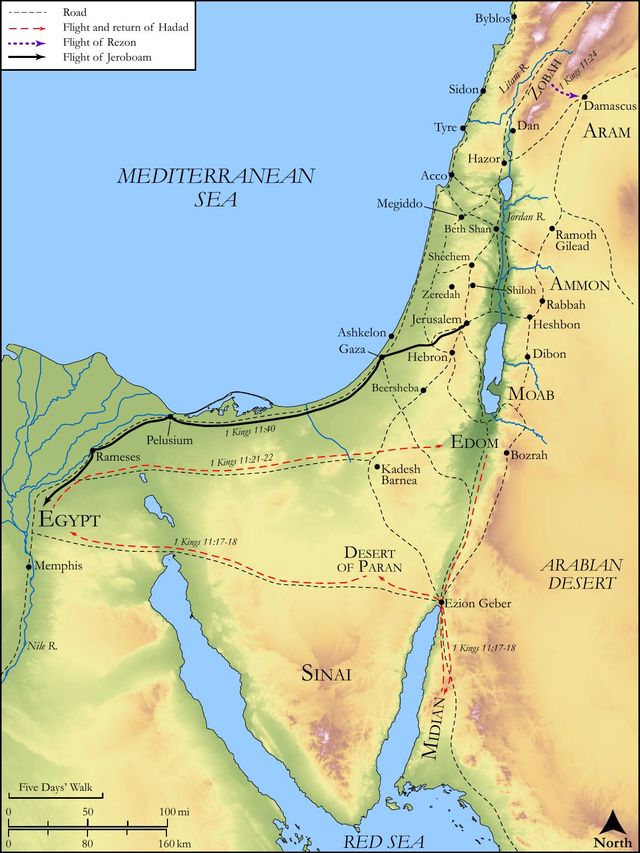
IV.Jeroboam's flight into Egypt, Kg1 11:40.
In some way or other Solomon came to know of all this, probably from Jeroboam's own talk of it; he could not conceal it as Saul did, nor keep his own counsel; if he had, he might have staid in his country, and been preparing there for his future advancement; but letting it be known,
1.Solomon foolishly sought to kill his successor. Had not he taught others that, whatever devices are in men's hearts, the counsel of the Lord shall stand? And yet does he himself think to defeat that counsel?
2.Jeroboam prudently withdrew into Egypt. Though God's promise would have secured him any where, yet he would use means for his own preservation, and was content to live in exile and obscurity for a while, being sure of a kingdom at last. And shall not we be so, who have a better kingdom in reserve?
Continue studying 1 Kings 11:28 across the web’s major study libraries — every link below opens this exact verse, chapter, or book on the destination site.
Read & Compare
 BibleGatewayThis verse in more than 200 translations and 70 languages.
 Bible.comThe YouVersion reader — hundreds of translations, reading plans, and highlights.
 ESV.orgCrossway's official English Standard Version reader.
 NET BibleThe NET translation with 60,000+ translators' notes on every rendering decision.
 STEP BibleTyndale House's free study tool — original text, vocabulary, and scholarly resources.
 BibliaLogos Bible Software's free web reader.
 USCCBThe New American Bible (Revised Edition) with the U.S. bishops' study notes.
Commentaries
 BibleHub CommentariesDozens of classic commentaries on this verse, gathered on one page.
 StudyLightMore than 100 commentary sets — the largest collection on the web.
 BibleRefPlain-English commentary on what this verse means, verse by verse.
 Enduring WordDavid Guzik's free commentary on this chapter, widely used by Bible teachers.
 Bible Study ToolsVerse commentary alongside Greek and Hebrew study aids.
Original Language & Research
- BibleHub InterlinearThe verse word by word — original language, transliteration, and English.
- BibleHub LexiconEvery word's original-language definition and Strong's entry.
 Blue Letter BibleDeep-study tools — Strong's numbers, concordance, and word studies.
 SefariaThe Hebrew text with Rashi and centuries of Jewish commentary.
Sermons, Hymns & Audio


TrulyRandomVerse is not affiliated with these sites and doesn’t control their content. They’re linked because they’re genuinely useful.
Summary
First Kings 11:28 introduces Jeroboam, an Ephraimite, as a man of exceptional capability and diligence whom King Solomon recognized and appointed to a significant administrative role. This verse highlights Solomon's discernment in identifying talent, as he placed Jeroboam in charge of the burdensome labor and affairs of the powerful northern tribes, specifically the "house of Joseph," a strategic move that would, unbeknownst to Solomon, position Jeroboam as a key figure in the impending division of the Israelite kingdom.
Context
ShowHideLiterary Context
This verse is strategically placed within 1 Kings chapter 11, a pivotal chapter detailing the tragic decline of King Solomon's reign. Following a glorious beginning, Solomon's heart was turned away from the Lord by his numerous foreign wives, leading him into idolatry and disobedience, as detailed in 1 Kings 11:1-8. As a direct consequence of this apostasy, God declared that He would tear the kingdom from Solomon's hand, allowing only one tribe to remain for the sake of David and Jerusalem, a divine decree found in 1 Kings 11:9-13. The chapter then introduces three adversaries God raised against Solomon: Hadad the Edomite (1 Kings 11:14-22), Rezon of Zobah (1 Kings 11:23-25), and finally, Jeroboam, whom this verse describes. The immediate verses following 1 Kings 11:28 detail the prophet Ahijah's dramatic prophecy to Jeroboam, explicitly revealing God's plan to give him ten tribes of Israel (1 Kings 11:29-39). Thus, 1 Kings 11:28 serves as the narrative bridge, establishing Jeroboam's character and administrative prominence before his divine election is unveiled.
Historical & Cultural Context
Solomon's reign, while marked by immense wealth and wisdom, also involved extensive building projects, including the Temple, his palace, and numerous cities, which demanded significant labor and resources. This often translated into heavy taxation and forced labor (corvée) levied upon the Israelite tribes. The "house of Joseph" refers to the powerful and populous northern tribes of Ephraim and Manasseh, who held significant territory and influence in the central highlands of Israel. Historically, these tribes, particularly Ephraim, had often vied for leadership with Judah. Being put "over all the charge" (or "burden") of these tribes meant Jeroboam was in a position of considerable administrative authority, overseeing their contributions, labor, or tribute. This role would have given him intimate knowledge of their grievances, their economic situations, and their leadership structures, effectively preparing him for his future role as their king. The cultural context also includes the practice of kings discerning and appointing capable individuals to high office, a common administrative strategy among the kings of that day, where rulers sought competent administrators to manage their vast kingdoms.
Key Themes
ShowHideThis verse contributes to several overarching themes in 1 Kings. Firstly, it underscores the theme of Divine Judgment and Sovereignty, as God, in His justice, begins to orchestrate the fulfillment of His word against Solomon, even using Solomon's own administrative decisions to set the stage for the kingdom's division. This is a direct consequence of Solomon's disobedience, as seen in 1 Kings 11:11. Secondly, it highlights the Intersection of Human Agency and Divine Purpose. Jeroboam's natural abilities—his "valour" and "industrious" nature—were clearly evident and recognized by Solomon, yet these very human qualities served as the foundation upon which God's larger prophetic plan would unfold, leading to the prophecy in 1 Kings 11:29-39. Thirdly, the verse subtly introduces the Seeds of Division. While seemingly a benign administrative appointment, placing an Ephraimite in charge of the powerful northern tribes (the "house of Joseph") gave him influence and familiarity with the very people he would soon lead in rebellion against Solomon's successor, Rehoboam. This foreshadows the deep-seated tribal tensions that would ultimately fracture the united monarchy, a process detailed in 1 Kings chapter 12. Finally, it touches on the theme of Leadership and Discernment, showing Solomon's ability to recognize talent, even as his spiritual discernment regarding God's will had waned.
Exposition and Analysis
ShowHideKey Word Analysis
ShowHideThe KJV phrase "mighty man of valour" translates the Hebrew gibbôwr chayil (H1368, H2428). While gibbôwr denotes a "powerful" or "warrior" type, chayil (H2428) specifically refers to "force," "strength," "virtue," or "valor." It describes someone who is not merely physically strong but also highly effective, successful, and resourceful in their endeavors, encompassing competence and even moral excellence. In this context, it portrays Jeroboam as a man of significant personal qualities, perhaps even military or administrative prowess, making him a formidable and respected figure.
The KJV translates "industrious" from the Hebrew phrase ʻâsâh mᵉlâʼkâh (H6213, H4399), which literally means "to do work" or "to perform work." The noun mᵉlâʼkâh (H4399) refers to "employment," "work," or "business," often implying a skillful or diligent execution of a task. This highlights Jeroboam's diligence, active engagement, and efficiency in his tasks. He was not merely capable but also applied himself rigorously to his duties, a quality that would naturally impress a king seeking competent administrators for his vast projects.
The term "charge" (H5447, çêbel) refers to a "load," "burden," or "task." In the context of Solomon's reign, it often denotes the heavy administrative and labor demands placed on the populace for his extensive building programs. To be made "ruler over all the charge of the house of Joseph" meant Jeroboam was put in a position of significant authority and oversight over the labor, tribute, or administrative duties levied upon the powerful northern tribes of Ephraim and Manasseh. This was a sensitive and potentially unpopular role, requiring a capable and strong leader.
Verse Breakdown
ShowHide"And the man Jeroboam [was] a mighty man of valour:"
This opening clause immediately introduces Jeroboam as a person of remarkable strength, courage, and competence. The description sets him apart as an individual of significant personal qualities, preparing the reader for his subsequent rise to prominence. It establishes his inherent capability, independent of any divine appointment, which Solomon would later recognize.
"and Solomon seeing the young man that he was industrious,"
This part of the verse highlights King Solomon's observation and discernment. Despite his spiritual decline, Solomon retained the practical wisdom to recognize talent and diligence in his subjects. Jeroboam's "industrious" nature—his hard work, efficiency, and dedication—was clearly evident to the king, marking him as a valuable asset for the administration. This demonstrates Solomon's practical leadership, even if his spiritual leadership was faltering.
"he made him ruler over all the charge of the house of Joseph."
This final clause details Jeroboam's specific appointment. Being placed in authority over the "charge" (burden or administrative duties) of the "house of Joseph" (the powerful tribes of Ephraim and Manasseh) was a highly significant position. It gave Jeroboam direct oversight of the northern tribes, their resources, and their grievances, effectively establishing his influence and familiarity with the very people he was destined to lead as king of the divided northern kingdom. This appointment, seemingly a reward for merit, was unwittingly a step in God's plan to fulfill His judgment against Solomon.
Literary Devices
ShowHideThe verse employs several literary devices to convey its profound significance. Characterization is evident in the swift and impactful description of Jeroboam as a "mighty man of valour" and "industrious," immediately establishing him as a capable and significant figure. This concise portrayal sets the stage for his pivotal role in the narrative. Foreshadowing is subtly woven into the description of Jeroboam's qualities and his specific appointment. By placing him over the "house of Joseph," the text implicitly hints at his future leadership of the northern tribes, preparing the reader for the prophetic declaration that immediately follows in the chapter. There is also a strong element of Irony: Solomon, in his earthly wisdom, recognizes and promotes a talented individual, yet in doing so, he unwittingly facilitates the very judgment God has pronounced upon his kingdom. His discernment of human capability ironically contributes to the unraveling of his own legacy, highlighting the contrast between human plans and divine sovereignty.
Theological and Thematic Connections
ShowHide1 Kings 11:28 powerfully illustrates the intricate interplay between human agency and divine sovereignty. Even amidst Solomon's spiritual decline and God's declared judgment, the Lord uses human recognition of skill and diligence to advance His purposes. Jeroboam's natural gifts were not accidental; they were part of God's providential preparation for his role in the coming division. This demonstrates that God can raise up individuals from unexpected places, equipping them with the necessary qualities, and positioning them, sometimes through seemingly secular appointments, to fulfill His overarching plan. The verse also underscores the consequences of disobedience: Solomon's sin led to the tearing of the kingdom, and Jeroboam's rise is a direct instrument of that judgment, even if Solomon's initial motivation was practical administration.
Reflection and Application
ShowHide1 Kings 11:28 offers profound insights for both individuals and leaders today. For individuals, Jeroboam's story reminds us of the value of diligence, competence, and hard work. His "industrious" nature was recognized and rewarded, demonstrating that applying oneself faithfully to tasks, even seemingly mundane ones, can open doors to greater opportunities. Our natural gifts and developed skills are not merely for personal gain but can be instruments in God's larger, often unseen, purposes. For leaders, the verse emphasizes the importance of discerning and empowering capable individuals. Solomon, despite his spiritual failings, still possessed the practical wisdom to identify and utilize talent. However, it also serves as a poignant warning: while human wisdom in leadership is valuable, it must be submitted to divine wisdom and spiritual integrity. Solomon's spiritual compromise led to judgment, and even his well-intended administrative decisions became part of that judgment. Leaders must ensure that their appointments and strategies align with God's will, recognizing that even seemingly beneficial actions can have unforeseen and far-reaching consequences when spiritual foundations are compromised. We are called to be faithful stewards of our abilities and positions, always seeking God's glory and purposes above our own.
Questions for Reflection
ShowHideFAQ
ShowHideWho was Jeroboam before this appointment?
ShowHideJeroboam was an Ephraimite, the son of Nebat, from Zeredah. He was a servant of King Solomon. While the text doesn't explicitly detail his prior role, it implies he was already involved in Solomon's administration, likely overseeing some aspect of the king's extensive building projects or labor forces. His characterization as a "mighty man of valour" and "industrious" suggests he had already proven himself capable and effective in his previous duties, leading to Solomon's recognition and promotion.
What was the "house of Joseph" and why was it significant?
ShowHideThe "house of Joseph" refers collectively to the powerful and numerous tribes of Ephraim and Manasseh, who were descendants of Joseph. These tribes occupied significant territory in the central and northern parts of the land of Israel and were often seen as the leaders of the northern tribal confederation. Historically, Ephraim had been a dominant tribe, sometimes rivaling Judah for preeminence. Being made "ruler over all the charge" (or burden) of these tribes meant Jeroboam was in a position of immense administrative authority, overseeing their contributions, labor, and affairs. This was a politically sensitive and strategically important role, as these northern tribes were often resentful of the heavy demands placed upon them by the Jerusalem-centric monarchy of Solomon. This appointment gave Jeroboam a direct connection to, and influence over, the very tribes he would later lead as king of the northern kingdom of Israel.
How does this verse relate to the division of the kingdom?
ShowHideThis verse is a crucial preparatory step for the division of the united monarchy, which occurs in 1 Kings chapter 12. Solomon's appointment of Jeroboam, a capable Ephraimite, to oversee the powerful northern tribes of the "house of Joseph," inadvertently placed Jeroboam in a position of familiarity and influence with the very people who would later form the bulk of the northern kingdom under his leadership. It demonstrates God's sovereign hand at work, using Solomon's own administrative decisions to set the stage for the fulfillment of His judgment against Solomon's house, as prophesied by Ahijah immediately after this verse (1 Kings 11:29-39). Thus, Jeroboam's rise to prominence here is not just a recognition of his talent, but a divinely orchestrated step towards the kingdom's fracture.
Christ-Centered Fulfillment
ShowHideThe rise of Jeroboam, a "mighty man of valour" and "industrious" worker, to a position of authority, though ultimately leading to the division of Israel, subtly points to the need for a perfect King and a unified, eternal kingdom. Solomon, despite his initial wisdom, was flawed; his discernment in appointing Jeroboam was overshadowed by his own spiritual decline, leading to a fragmented kingdom. In stark contrast, Jesus Christ is the true and ultimate "mighty man of valour," not merely in human strength or administrative skill, but in divine power and perfect righteousness. He is the one who "works until now" (John 5:17) and perfectly accomplishes the will of His Father (John 4:34). Unlike Jeroboam, who led a divided people, Christ came to gather all the scattered children of God into one flock (John 10:16), uniting Jew and Gentile under His headship (Ephesians 1:10). His kingdom is not torn by sin or human failing, but is an everlasting dominion that will never be destroyed (Daniel 7:14). Jeroboam's temporary rise and the subsequent division of Israel underscore humanity's desperate need for the perfect, unifying, and eternally righteous reign of the Son of David, Jesus Christ, who truly takes away the "burden" of sin and establishes a kingdom of peace and justice without end (Isaiah 9:6-7).