


2 Chronicles 32:17
Bible text: King James Version (1769 Blayney text) · Public domain
Bible text: King James Version with Strong's numbers · Public domain
Bible text: Berean Standard Bible · Public domain
Bible text: American Standard Version (1901) · Public domain
Bible text: World English Bible, Messianic edition · Public domain
Bible text: Geneva Bible (1599) · Public domain
Bible text: Young's Literal Translation · Public domain
- וּסְפָרִיםu·se·fa·Rimand lettersH5612Conj-w ¦ N-mpNoun Plural Masculine Absoluteוּandסְפָרִיםletters
- כָּתַבka·Tavhe wroteH3789V-Qal-Perf-3msVerb Qal Perfect 3rd Singular Masculine
- לְחָרֵףle·cha·Refto tauntH2778Prep-l ¦ V-Piel-InfVerb Piel Infinitive Constructלְtoחָרֵףtaunt
- לַיהוָהla·Yah·weh<to> YahwehH3068Prep-l ¦ N-properNoun Proper Titleלַ<to>יהוָהYahweh
- אֱלֹהֵי'e·lo·Hei[the] God ofH430N-mpcNoun Plural Masculine Construct
- יִשְׂרָאֵלYis·ra·'ElIsraelH3478N-properNoun Proper Location
- וְלֵאמֹרve·le·Morand to sayH559Conj-w ¦ Prep-l ¦ V-Qal-InfVerb Qal Infinitive Constructוְandלֵtoאמֹרsay
- עָלָיו'a·Lavon himH5921Prep ¦ 3msPrepositionעָלָיonוhim
- לֵאמֹרle·Mor<to> sayingH559Prep-l ¦ V-Qal-InfVerb Qal Infinitive Constructלֵ<to>אמֹרsaying
- כֵּאלֹהֵיke·lo·Heilike [the] gods ofH430Prep-k ¦ N-mpcNoun Plural Masculine Constructכֵּlikeאלֹהֵי[the] gods of
- גּוֹיֵgo·Ye[the] nations ofH1471N-mpcNoun Plural Masculine Construct
- הָאֲרָצוֹתha·'a·ra·tzOtthe landsH776Art ¦ N-fpNoun Plural Feminine Absoluteהָtheאֲרָצוֹתlands
- אֲשֶׁר'a·SherwhichH834RelParticle Relative
- לֹאlo'notH3808NegParticle Negative
- הִצִּילוּhi·Tzi·luthey deliveredH5337V-Hiphil-Perf-3cpVerb Hiphil Perfect 3rd Plural common gender
- עַמָּם'a·Mamtheir peopleH5971N-msc ¦ 3mpNoun Singular Masculine Constructעַמָּpeopleםtheir
- מִיָּדִיmi·ya·Difrom my handH3027Prep-m ¦ N-csc ¦ 1csNoun Singular common gender Constructמִfromיָּדִhandיmy
- כֵּןkensoH3651AdvAdverb
- לֹאlo'notH3808NegParticle Negative
- יַצִּילya·Tzilhe will deliverH5337V-Hiphil-Imperf-3msVerb Hiphil Imperfect 3rd Singular Masculine
- אֱלֹהֵי'e·lo·Hei[the] God ofH430N-mpcNoun Plural Masculine Construct
- יְחִזְקִיָּהוּye·chiz·ki·Ya·huHezekiahH2396N-proper-mNoun Proper Masculine
- עַמּוֹa·Mohis peopleH5971N-msc ¦ 3msNoun Singular Masculine Constructעַמּpeopleוֹhis
- מִיָּדִיmi·ya·Difrom my handH3027Prep-m ¦ N-csc ¦ 1csNoun Singular common gender Constructמִfromיָּדִhandיmy
English is a literal word-by-word gloss of the Hebrew, not the KJV's wording. Why?
This is the original text the KJV's translators worked from — each Hebrew word with its own literal English meaning in this verse, prepared by scholars at Tyndale House, Cambridge. The KJV translates whole sentences, not word by word, so its wording differs: one Hebrew word can become several English words, and the KJV may choose “the LORD” where the gloss reads “Yahweh”. Both are faithful — they answer different questions. For the KJV's own rendering, switch to the KJV text.
Details
See on the biblical-era maps
Study this verse
Public-domain commentary
Matthew Henry
From his Commentary on the Whole Bible. Henry comments on passages, not single verses — this entry covers 2 Chronicles 32:9–23. His three-level outline is real structure in the source text, so it is rendered as structure.
This story of the rage and blasphemy of Sennacherib, Hezekiah's prayer, and the deliverance of Jerusalem by the destruction of the Assyrian army, we had more at large in the book of Kings, 2 Kings 18 and 19. It is contracted here, yet large enough to show these three things: -
I.The impiety and malice of the church's enemies.
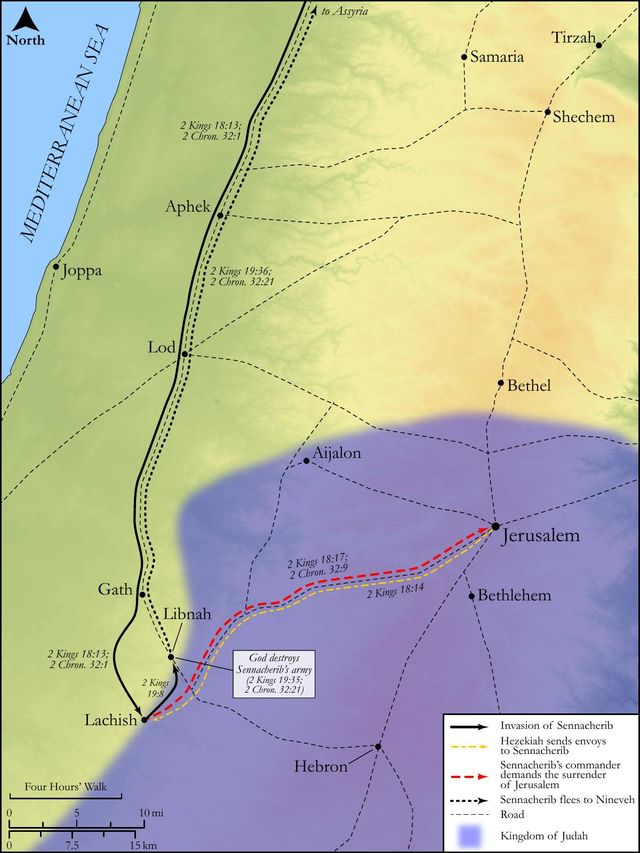
Sennacherib has his hands full in besieging Lachish (Ch2 32:9), but hears that Hezekiah is fortifying Jerusalem and encouraging his people to stand it out; and therefore, before he come in person to besiege it, he sends messengers to make speeches, and he himself writes letters to frighten Hezekiah and his people into a surrender of the city. See,
1.His great malice against the king of Judah, in endeavouring to withdraw his subjects from their allegiance to him. He did not treat with Hezekiah as a man of honour would have done, nor propose fair terms to him, but used mean and base artifices, unbecoming a crowned head, to terrify the common people and persuade them to desert him. he represented Hezekiah as one who designed to deceive his subjects into their ruin and betray them to famine and thirst (Ch2 32:11), as one who had done them great wrong and exposed them already to the divine displeasure by taking away the high places and altars (Ch2 32:12), and who, against the common interest of his people, held out against a force that would certainly be their ruin, Ch2 32:15.
2.His great impiety against the God of Israel, the God of Jerusalem he is called (Ch2 32:19), because that was the place he had chosen to put his name there, and because that was the place which was now threatened by the enemy and which the divine Providence had under its special protection. This proud blasphemer compared the great Jehovah, the Maker of heaven and earth, with the dunghill gods of the nations, the work of men's hands, and thought him no more able to deliver his worshippers than they were to deliver theirs (Ch2 32:19), as if an infinite and eternal Spirit had no more wisdom and power than a stone or the stock of a tree. He boasted of his triumphs over the gods of the nations, that they could none of them protect their people (Ch2 32:13-15), and thence inferred not only, How shall your God deliver you? (Ch2 32:14), but, as if he were inferior to them all, How much less shall your God deliver you? as if he were less able to help than any of them. Thus did they rail, rail in writing (which, being more deliberate, is so much the worse), on the Lord God of Israel, as if he were a cipher and an empty name, like all the rest, Ch2 32:17. Sennacherib, in the instructions he gave, said more than enough; but, as if his blasphemies had been too little, his servants, who learned insolence from their master, spoke yet more than he bade them against the Lord God and his servant Hezekiah, Ch2 32:16. And God resents what is said against his servants, and will reckon for it, as well as what is said against himself. All this was intended to frighten the people from their hope in God, which David's enemies sought to take him off from (Psa 11:1; Psa 42:10), saying, There is no help for him in God, Psa 3:2; Psa 71:11. Thus they hoped to take the city by weakening the hands of those that should defend it. Satan, in his temptations, aims to destroy our faith in God's all-sufficiency, knowing that he shall gain his point if he can do that; as we keep our ground if our faith fail not, Luk 22:32.
II.The duty as well as the interest of the church's friends, and that is in the day of distress to pray and cry to Heaven.
So Hezekiah did, and the prophet Isaiah, Ch2 32:20. It was a happy time when the king and the prophet joined thus in prayer. Is any troubled? Is any terrified? Let him pray. So we engage God for us; so we encourage ourselves in him. Praying to God is here called crying to Heaven, because we are, in prayer, to eye him as our Father in heaven, whence he beholds the children of men, and where he has prepared his throne.
III.The power and goodness of the church's God.
He is able both to control his enemies, be they ever so high, and to relieve his friends, be they ever so low.
1.As the blasphemies of his enemies engage him against them (Deu 32:27), so the prayers of his people engage him for them. They did so here.
(1.)The army of the Assyrians was cut off by the sword of an angel, which triumphed particularly in the slaughter of the mighty men of valour, and the leaders and captains, who defied the sword of any man. God delights to abase the proud and secure. The Targum says, The Word of the Lord (the eternal Word) sent Gabriel to do this execution, and that it was done with lightning, and in the passover night: that was the night in which the angel destroyed the first-born of Egypt. But that was not all.
(2.)The king of the Assyrians, having received this disgrace, was cut off by the sword of his own sons. Those that came forth of his own bowels slew him, Ch2 32:21. Thus was he mortified first, and then murdered - shamed first, and then slain. Evil pursues sinners; and, when they escape one mischief, they run upon another unseen.
2.By this work of wonder,
(1.)God was glorified, as the protector of his people. Thus he saved Jerusalem, not only from the hand of Sennacherib, but from the hand of all others, Ch2 32:22; for such a deliverance as this was an earnest of much mercy in store; and he guided them, that is, he guarded them, on every side. God defends his people by directing them, shows them what they should do, and so saves them from what is designed or done against them. For this many brought gifts unto the Lord, when they saw the great power of God in the defence of his people. Strangers were thereby induced to supplicate his favour and enemies to deprecate his wrath, and both brought gifts to his temple, in token of their care and desire.
(2.)Hezekiah was magnified as the favourite and particular care of Heaven. Many brought presents to him (Ch2 32:22, Ch2 32:23), in token of the honour they had for him, and to make an interest in him. By the favour of God enemies are lost and friends gained.
Continue studying 2 Chronicles 32:17 across the web’s major study libraries — every link below opens this exact verse, chapter, or book on the destination site.
Read & Compare
 BibleGatewayThis verse in more than 200 translations and 70 languages.
 Bible.comThe YouVersion reader — hundreds of translations, reading plans, and highlights.
 ESV.orgCrossway's official English Standard Version reader.
 NET BibleThe NET translation with 60,000+ translators' notes on every rendering decision.
 STEP BibleTyndale House's free study tool — original text, vocabulary, and scholarly resources.
 BibliaLogos Bible Software's free web reader.
 USCCBThe New American Bible (Revised Edition) with the U.S. bishops' study notes.
Commentaries
 BibleHub CommentariesDozens of classic commentaries on this verse, gathered on one page.
 StudyLightMore than 100 commentary sets — the largest collection on the web.
 BibleRefPlain-English commentary on what this verse means, verse by verse.
 Enduring WordDavid Guzik's free commentary on this chapter, widely used by Bible teachers.
 Bible Study ToolsVerse commentary alongside Greek and Hebrew study aids.
Original Language & Research
- BibleHub InterlinearThe verse word by word — original language, transliteration, and English.
- BibleHub LexiconEvery word's original-language definition and Strong's entry.
 Blue Letter BibleDeep-study tools — Strong's numbers, concordance, and word studies.
 SefariaThe Hebrew text with Rashi and centuries of Jewish commentary.
Sermons, Hymns & Audio


TrulyRandomVerse is not affiliated with these sites and doesn’t control their content. They’re linked because they’re genuinely useful.
Summary
2 Chronicles 32:17 profoundly illustrates the zenith of Sennacherib's audacious blasphemy against the God of Israel during his siege of Jerusalem. Through formal letters, the Assyrian king directly challenged the Lord, contemptuously equating Him with the impotent deities of conquered nations and boasting that Hezekiah's God would no more deliver His people than other gods had rescued theirs. This pivotal verse not only intensifies the psychological warfare against Judah but also sets the stage for a dramatic divine intervention, starkly contrasting human pride with God's incomparable sovereignty and absolute power.
Context
ShowHideLiterary Context
This verse is strategically placed within the narrative of Sennacherib's invasion of Judah, serving as a critical escalation following his initial military successes and the psychological warfare waged against King Hezekiah and the people of Jerusalem. Earlier in the chapter, Sennacherib's field commander, Rabshakeh, had already delivered similar verbal taunts, attempting to demoralize the city's inhabitants and undermine their trust in the Lord and King Hezekiah, as detailed in 2 Chronicles 32:9-16. Verse 17 signifies a shift from mere verbal threats to formal, written correspondence, underscoring the Assyrian king's personal investment in the psychological assault and his direct, recorded challenge to the divine. The immediate literary context following this verse is Hezekiah's and Isaiah's fervent prayer for deliverance, found in 2 Chronicles 32:20, which directly precedes God's miraculous intervention and the subsequent deliverance of Jerusalem.
Historical & Cultural Context
The events described in 2 Chronicles 32:17 occurred around 701 BC, a period when the Neo-Assyrian Empire, under Sennacherib, reigned as the dominant superpower of that day. Assyrian imperial policy was not limited to military conquest; it heavily relied on psychological warfare, mass deportations, and the systematic humiliation of conquered nations' gods and cultures. Sennacherib's boast that "the gods of the nations of [other] lands have not delivered their people out of mine hand" reflects a belief common among the nations that military victory indicated the superiority of the conqueror's gods over the defeated nation's deities. Assyrian annals, such as the Taylor Prism, corroborate Sennacherib's extensive campaigns in Judah, detailing his capture of numerous fortified cities and his siege of Jerusalem, though notably omitting the miraculous divine intervention that led to his withdrawal. This cultural backdrop highlights the profound arrogance of Sennacherib's challenge, as he applied a pagan worldview to the unique God of Israel.
Key Themes
ShowHide2 Chronicles 32:17 powerfully contributes to several overarching themes within 2 Chronicles and the broader Old Testament. Firstly, it highlights the theme of Divine Sovereignty vs. Human Arrogance. Sennacherib's prideful challenge to the Lord is a quintessential example of human hubris attempting to usurp or deny God's ultimate authority, a theme consistently found in narratives of God's judgment against proud rulers, such as Pharaoh's defiance in Exodus 5:2. Secondly, the verse underscores the Uniqueness and Incomparability of the God of Israel. Sennacherib's fatal error was equating the living God, the self-existent LORD, with the lifeless idols of other nations, a distinction central to Israelite theology as articulated in passages like Psalm 115:3-7. Finally, it sets the stage for the theme of Divine Deliverance in the Face of Impossibility, demonstrating that God's power is not limited by overwhelming human threats but is rather magnified in such circumstances, reinforcing the message of trust and dependence on Him, echoing the sentiment in Psalm 46:1.
Exposition and Analysis
ShowHideKey Word Analysis
ShowHideThis verb, derived from H2778, signifies more than mere speaking against; it denotes a direct act of defaming, blaspheming, reproaching, or upbraiding with contempt and scorn. In Sennacherib's context, it describes his intentional and deeply offensive insult aimed at the very character and power of the LORD God of Israel, treating Him as an object of derision and attempting to strip Him of His honor and authority.
This sacred name, H3068, identifies the self-Existent or Eternal God, the unique national God of Israel. By "railing on the LORD," Sennacherib directly challenges the one true God, distinguishing Him from the generic "God" (H430, ʼĕlôhîym) of other nations. His blasphemy is particularly egregious because it targets the incomparable, covenant-keeping God of Israel, attempting to reduce His infinite power to the finite limitations of pagan deities.
This primitive root, H5337, means to snatch away, rescue, save, or preserve. Sennacherib uses it to boast about the inability of other nations' gods to "deliver" their people from his grasp. By presumptuously applying this same inability to the God of Hezekiah, he directly challenges God's power to intervene and save His people from an overwhelming military force. The profound irony lies in the fact that the LORD's ability to "deliver" His people is precisely what is about to be miraculously demonstrated, proving His unique and ultimate power.
Verse Breakdown
ShowHide"He wrote also letters to rail on the LORD God of Israel,"
This clause reveals Sennacherib's method of attack: formal, written correspondence. This choice made his blasphemy official, widespread, and enduring, serving as a potent psychological weapon intended to demoralize Jerusalem. The explicit target was "the LORD God of Israel," indicating a direct, personal assault on God's divine authority, reputation, and unique identity, not merely on Hezekiah or his people.
"and to speak against him, saying,"
This phrase further clarifies the content and intent of the letters. It wasn't just a military threat but a verbal assault, a direct challenge and insult to God Himself. The following quotation contains the precise nature of this blasphemy, setting out Sennacherib's arrogant comparison.
"As the gods of the nations of [other] lands have not delivered their people out of mine hand,"
Sennacherib's boast is rooted in his extensive past conquests. He had successfully overthrown numerous nations and their respective deities, viewing his military victories as conclusive proof of his own supremacy and the impotence of their gods. This statement reflects the belief of the nations, where national gods were believed to fight for their people, and defeat implied the god's weakness, subjugation, or even non-existence.
"so shall not the God of Hezekiah deliver his people out of mine hand."
This is the core of Sennacherib's blasphemous challenge. He applies the same logic of his past victories to the God of Israel, reducing the incomparable, self-existent LORD to the level of defeated, powerless idols. By referring to Him as "the God of Hezekiah," he attempts to diminish God's universal sovereignty, implying He is merely a local deity tied to a specific king, thereby gravely underestimating His true nature and omnipotent power.
Literary Devices
ShowHide2 Chronicles 32:17 masterfully employs several potent literary devices to heighten the narrative's tension and underscore its theological message. Most prominently, the verse features profound Blasphemy, as Sennacherib directly insults and demeans the God of Israel, equating Him with the lifeless, impotent gods of conquered nations. This act of verbal assault is a central driver of the narrative's dramatic conflict. The verse also utilizes stark Contrast, setting up a direct opposition between the perceived powerlessness of "the gods of the nations" and the implied impotence of the "God of Hezekiah" in Sennacherib's arrogant estimation. This contrast serves to highlight the dramatic divine intervention that immediately follows, emphasizing the unique and incomparable nature of the true God. Furthermore, there is a profound sense of Dramatic Irony at play. The reader, aware of God's power and the subsequent miraculous deliverance, understands that Sennacherib's confident pronouncement will be utterly overturned, making his boast deeply ironic. His Hyperbole regarding his own invincibility and the universal failure of other gods serves to inflate his pride, setting him up for an even greater, divinely orchestrated fall.
Theological and Thematic Connections
ShowHideSennacherib's audacious challenge in 2 Chronicles 32:17 is a profound theological statement, albeit one steeped in error and hubris. It forces a direct confrontation between human pride and divine sovereignty, echoing a recurring biblical theme that God alone is supreme and that any attempt to diminish His power or equate Him with created things is an affront to His holiness. This specific incident serves as a powerful demonstration that God's identity is not defined by human limitations or the outcomes of earthly conflicts, but by His inherent, unchanging nature as the Almighty Creator and Deliverer. The narrative vividly illustrates that the Lord is not merely "the God of Hezekiah," a localized deity, but the God of all creation, whose power transcends all human and demonic opposition, and who actively intervenes on behalf of His covenant people to vindicate His own name and glory.
Reflection and Application
ShowHide2 Chronicles 32:17 offers timeless insights for believers facing overwhelming opposition. Just as Sennacherib's letters sought to demoralize Jerusalem by undermining their trust in God, so too do we often encounter "letters" of doubt, fear, and despair in our lives—whether from external pressures, internal struggles, or the insidious schemes of the enemy. These challenges frequently attempt to diminish God's character, question His power, or equate Him with the impotent "gods" of human strength, worldly systems, or even our own perceived limitations. This verse serves as a potent reminder that our God is utterly unique and incomparable, not bound by human logic or the failures of false idols. Our confidence must not be in our own ability to withstand or overcome, but in the absolute sovereignty and delivering power of the Lord. When faced with seemingly insurmountable obstacles, we are called to emulate Hezekiah's response: to turn to God in fervent prayer, trusting that He will vindicate His name and deliver His people, often in ways that defy human expectation and amplify His glory.
Questions for Reflection
ShowHideFAQ
ShowHideWhy did Sennacherib send letters instead of just relying on his army?
ShowHideSennacherib's decision to send letters, as described in 2 Chronicles 32:17, was a calculated and sophisticated move in his broader strategy of psychological warfare. While his army was formidable and had already conquered many cities in Judah, he aimed to achieve victory over Jerusalem without a costly direct assault, which could deplete his resources and manpower. Letters served several crucial purposes: they formalized his demands and threats, reaching a wider audience within the city, including the common people, not just King Hezekiah. This amplified the demoralizing effect, aiming to break the city's will to resist and incite surrender from within. By directly challenging "the LORD God of Israel" and equating Him with defeated pagan deities, Sennacherib sought to undermine the very foundation of Jerusalem's hope and resilience—their faith in God. This tactic was common among the nations in war, where the humiliation of a nation's god was considered part of its total subjugation, as seen in similar accounts in 2 Kings 18 and Isaiah 36.
Christ-Centered Fulfillment
ShowHideSennacherib's blasphemous challenge in 2 Chronicles 32:17, where he equates the God of Israel with impotent idols, finds its ultimate reversal and fulfillment in the person and redemptive work of Jesus Christ. Just as the Assyrian king's boast was met with divine, miraculous intervention that demonstrated God's unparalleled power to deliver His people from a seemingly invincible foe, so too does Christ embody the supreme and unique power of God over all spiritual and physical adversaries. Sennacherib's defeat foreshadows the ultimate triumph of God over all forces that "rail on" Him and seek to enslave humanity. In Christ, we behold the true Lamb of God, who, unlike the powerless gods of the nations, actively "takes away the sin of the world!" (John 1:29). His resurrection from the dead is the definitive proof that the God of Israel is not like the defeated deities, but possesses ultimate authority over death itself and all its dominion (Acts 2:24). Through Christ, believers are delivered not just from physical enemies, but from the dominion of sin, death, and the spiritual forces of darkness that once held humanity captive, having been "delivered... from the domain of darkness and transferred... to the kingdom of his beloved Son" (Colossians 1:13-14). Thus, Sennacherib's arrogant challenge serves as a powerful foil to highlight the incomparable and saving power of God, fully revealed and actualized in the victorious reign of Jesus Christ, our deliverer and King.