


2 Chronicles 32:20
- וַיִּתְפַּלֵּלvai·yit·pa·Leland he prayedH6419Conj-w ¦ V-Hithpael-ConsecImperf-3msVerb Hithpael Consecutive Imperfect 3rd Singular Masculineוַandיִּתְפַּלֵּלhe prayed
- יְחִזְקִיָּהוּye·chiz·ki·Ya·huHezekiahH2396N-proper-mNoun Proper Masculine
- הַמֶּלֶךְha·Me·lekhthe kingH4428Art ¦ N-msNoun Singular Masculine Absoluteהַtheמֶּלֶךְking
- וִישַׁעְיָהוּvi·sha'·Ya·huand IsaiahH3470Conj-w ¦ N-proper-mNoun Proper MasculineוִandישַׁעְיָהוּIsaiah
- בֶןven[the] son ofH1121N-mscNoun Singular Masculine Construct
- אָמוֹץ'a·MotzAmozH531N-proper-mNoun Proper Masculine
- הַנָּבִיאha·na·Vi'the prophetH5030Art ¦ N-msNoun Singular Masculine Absoluteהַtheנָּבִיאprophet
- עַל'alonH5921PrepPreposition
- זֹאתZotthisH2063PrtParticle Demonstrative
- וַיִּזְעֲקוּvai·yiz·'a·Kuand they cried outH2199Conj-w ¦ V-Qal-ConsecImperf-3mpVerb Qal Consecutive Imperfect 3rd Plural Masculineוַandיִּזְעֲקוּthey cried out
- הַשָּׁמָיִםha·sha·Ma·yimthe heavensH8064Art ¦ N-mpNoun Plural Masculine Absoluteהַtheשָּׁמָיִםheavens
English is a literal word-by-word gloss of the Hebrew, not the KJV's wording. Why?
This is the original text the KJV's translators worked from — each Hebrew word with its own literal English meaning in this verse, prepared by scholars at Tyndale House, Cambridge. The KJV translates whole sentences, not word by word, so its wording differs: one Hebrew word can become several English words, and the KJV may choose “the LORD” where the gloss reads “Yahweh”. Both are faithful — they answer different questions. For the KJV's own rendering, switch to the KJV text.
Details
See on the biblical-era map
Study this verse
Public-domain commentary
Matthew Henry
From his Commentary on the Whole Bible. Henry comments on passages, not single verses — this entry covers 2 Chronicles 32:9–23. His three-level outline is real structure in the source text, so it is rendered as structure.
This story of the rage and blasphemy of Sennacherib, Hezekiah's prayer, and the deliverance of Jerusalem by the destruction of the Assyrian army, we had more at large in the book of Kings, 2 Kings 18 and 19. It is contracted here, yet large enough to show these three things: -
I.The impiety and malice of the church's enemies.
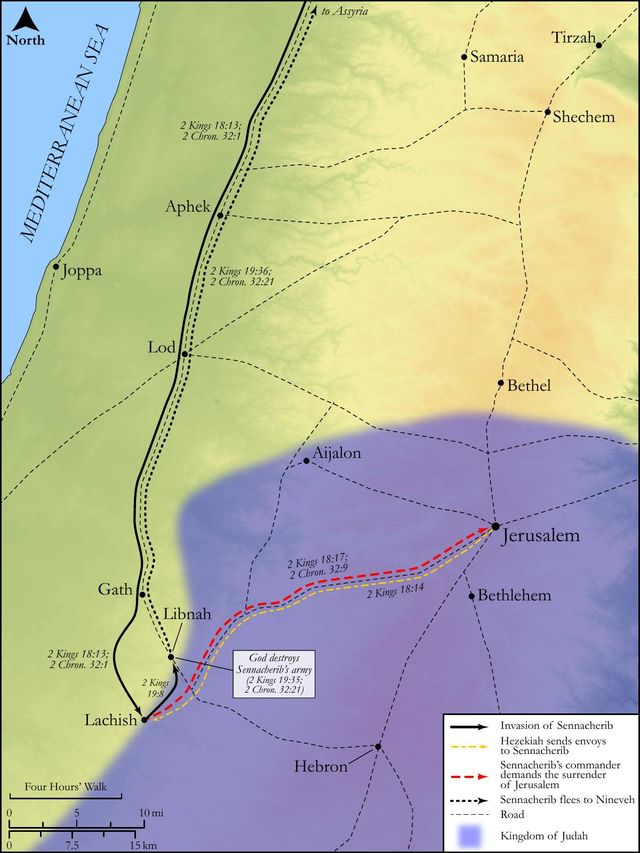
Sennacherib has his hands full in besieging Lachish (Ch2 32:9), but hears that Hezekiah is fortifying Jerusalem and encouraging his people to stand it out; and therefore, before he come in person to besiege it, he sends messengers to make speeches, and he himself writes letters to frighten Hezekiah and his people into a surrender of the city. See,
1.His great malice against the king of Judah, in endeavouring to withdraw his subjects from their allegiance to him. He did not treat with Hezekiah as a man of honour would have done, nor propose fair terms to him, but used mean and base artifices, unbecoming a crowned head, to terrify the common people and persuade them to desert him. he represented Hezekiah as one who designed to deceive his subjects into their ruin and betray them to famine and thirst (Ch2 32:11), as one who had done them great wrong and exposed them already to the divine displeasure by taking away the high places and altars (Ch2 32:12), and who, against the common interest of his people, held out against a force that would certainly be their ruin, Ch2 32:15.
2.His great impiety against the God of Israel, the God of Jerusalem he is called (Ch2 32:19), because that was the place he had chosen to put his name there, and because that was the place which was now threatened by the enemy and which the divine Providence had under its special protection. This proud blasphemer compared the great Jehovah, the Maker of heaven and earth, with the dunghill gods of the nations, the work of men's hands, and thought him no more able to deliver his worshippers than they were to deliver theirs (Ch2 32:19), as if an infinite and eternal Spirit had no more wisdom and power than a stone or the stock of a tree. He boasted of his triumphs over the gods of the nations, that they could none of them protect their people (Ch2 32:13-15), and thence inferred not only, How shall your God deliver you? (Ch2 32:14), but, as if he were inferior to them all, How much less shall your God deliver you? as if he were less able to help than any of them. Thus did they rail, rail in writing (which, being more deliberate, is so much the worse), on the Lord God of Israel, as if he were a cipher and an empty name, like all the rest, Ch2 32:17. Sennacherib, in the instructions he gave, said more than enough; but, as if his blasphemies had been too little, his servants, who learned insolence from their master, spoke yet more than he bade them against the Lord God and his servant Hezekiah, Ch2 32:16. And God resents what is said against his servants, and will reckon for it, as well as what is said against himself. All this was intended to frighten the people from their hope in God, which David's enemies sought to take him off from (Psa 11:1; Psa 42:10), saying, There is no help for him in God, Psa 3:2; Psa 71:11. Thus they hoped to take the city by weakening the hands of those that should defend it. Satan, in his temptations, aims to destroy our faith in God's all-sufficiency, knowing that he shall gain his point if he can do that; as we keep our ground if our faith fail not, Luk 22:32.
II.The duty as well as the interest of the church's friends, and that is in the day of distress to pray and cry to Heaven.
So Hezekiah did, and the prophet Isaiah, Ch2 32:20. It was a happy time when the king and the prophet joined thus in prayer. Is any troubled? Is any terrified? Let him pray. So we engage God for us; so we encourage ourselves in him. Praying to God is here called crying to Heaven, because we are, in prayer, to eye him as our Father in heaven, whence he beholds the children of men, and where he has prepared his throne.
III.The power and goodness of the church's God.
He is able both to control his enemies, be they ever so high, and to relieve his friends, be they ever so low.
1.As the blasphemies of his enemies engage him against them (Deu 32:27), so the prayers of his people engage him for them. They did so here.
(1.)The army of the Assyrians was cut off by the sword of an angel, which triumphed particularly in the slaughter of the mighty men of valour, and the leaders and captains, who defied the sword of any man. God delights to abase the proud and secure. The Targum says, The Word of the Lord (the eternal Word) sent Gabriel to do this execution, and that it was done with lightning, and in the passover night: that was the night in which the angel destroyed the first-born of Egypt. But that was not all.
(2.)The king of the Assyrians, having received this disgrace, was cut off by the sword of his own sons. Those that came forth of his own bowels slew him, Ch2 32:21. Thus was he mortified first, and then murdered - shamed first, and then slain. Evil pursues sinners; and, when they escape one mischief, they run upon another unseen.
2.By this work of wonder,
(1.)God was glorified, as the protector of his people. Thus he saved Jerusalem, not only from the hand of Sennacherib, but from the hand of all others, Ch2 32:22; for such a deliverance as this was an earnest of much mercy in store; and he guided them, that is, he guarded them, on every side. God defends his people by directing them, shows them what they should do, and so saves them from what is designed or done against them. For this many brought gifts unto the Lord, when they saw the great power of God in the defence of his people. Strangers were thereby induced to supplicate his favour and enemies to deprecate his wrath, and both brought gifts to his temple, in token of their care and desire.
(2.)Hezekiah was magnified as the favourite and particular care of Heaven. Many brought presents to him (Ch2 32:22, Ch2 32:23), in token of the honour they had for him, and to make an interest in him. By the favour of God enemies are lost and friends gained.
Continue studying 2 Chronicles 32:20 across the web’s major study libraries — every link below opens this exact verse, chapter, or book on the destination site.
Read & Compare
 BibleGatewayThis verse in more than 200 translations and 70 languages.
 Bible.comThe YouVersion reader — hundreds of translations, reading plans, and highlights.
 ESV.orgCrossway's official English Standard Version reader.
 NET BibleThe NET translation with 60,000+ translators' notes on every rendering decision.
 STEP BibleTyndale House's free study tool — original text, vocabulary, and scholarly resources.
 BibliaLogos Bible Software's free web reader.
 USCCBThe New American Bible (Revised Edition) with the U.S. bishops' study notes.
Commentaries
 BibleHub CommentariesDozens of classic commentaries on this verse, gathered on one page.
 StudyLightMore than 100 commentary sets — the largest collection on the web.
 BibleRefPlain-English commentary on what this verse means, verse by verse.
 Enduring WordDavid Guzik's free commentary on this chapter, widely used by Bible teachers.
 Bible Study ToolsVerse commentary alongside Greek and Hebrew study aids.
Original Language & Research
- BibleHub InterlinearThe verse word by word — original language, transliteration, and English.
- BibleHub LexiconEvery word's original-language definition and Strong's entry.
 Blue Letter BibleDeep-study tools — Strong's numbers, concordance, and word studies.
 SefariaThe Hebrew text with Rashi and centuries of Jewish commentary.
Sermons, Hymns & Audio


TrulyRandomVerse is not affiliated with these sites and doesn’t control their content. They’re linked because they’re genuinely useful.
Summary
2 Chronicles 32:20 captures a pivotal moment of national crisis for Judah, where King Hezekiah and the prophet Isaiah, confronted by the overwhelming Assyrian threat and Sennacherib's blasphemous taunts against Yahweh, united in fervent, desperate prayer to heaven. This verse powerfully encapsulates their profound reliance on divine intervention rather than human strength or military might, setting the stage for God's miraculous and unparalleled deliverance of Jerusalem.
Context
ShowHideLiterary Context
This verse serves as the dramatic turning point in the narrative of Sennacherib's invasion of Judah. The preceding verses (2 Chronicles 32:1-8) detail Hezekiah's diligent preparations for defense, including fortifying Jerusalem and organizing his army, yet these efforts are ultimately shown to be insufficient against the vast Assyrian power. The immediate context, 2 Chronicles 32:9-19, vividly portrays Sennacherib's psychological warfare, particularly his envoys' public mockery of Judah's God and their attempts to undermine the people's faith and loyalty to Hezekiah. Sennacherib's blasphemous letters and taunts, specifically highlighted in 2 Chronicles 32:19, directly precede and precipitate the desperate, unified prayer of Hezekiah and Isaiah. This prayer is presented as the direct catalyst for God's miraculous intervention, which immediately follows in 2 Chronicles 32:21, where the angel of the Lord annihilates the Assyrian army. The Chronicler meticulously emphasizes this cause-and-effect relationship, highlighting that divine sovereignty and responsive power are unleashed through the earnest supplication of His faithful servants. Parallel accounts, offering additional details and perspectives, are found in 2 Kings 19 and Isaiah 37.
Historical & Cultural Context
The late 8th century BCE was a period dominated by the formidable Neo-Assyrian Empire, renowned for its brutal military conquests, efficient administration, and sophisticated psychological warfare. Sennacherib's campaign against Judah in 701 BCE was a critical part of Assyria's broader strategy to consolidate control over the Levant, a region vital for trade routes and resources. Jerusalem, though fortified by King Hezekiah, was a relatively small city-state facing an empire that had already subjugated numerous powerful nations, including the northern kingdom of Israel. Culturally, the Assyrians regularly attributed their military successes to the superiority of their gods, and Sennacherib's taunts were deliberately designed to demoralize Judah by asserting the impotence of Yahweh compared to the victorious Assyrian deities. For Hezekiah, a king celebrated for his extensive religious reforms and efforts to centralize the worship of Yahweh in Judah, this crisis was not merely a military confrontation but a profound theological challenge to God's honor and covenant faithfulness. His decision to turn to Isaiah, God's appointed prophet, for counsel and prayer was a testament to his deep piety and his understanding of the ultimate source of divine authority and deliverance, standing in stark contrast to many previous kings of Judah who often relied on political alliances or succumbed to idolatry.
Key Themes
ShowHideThis verse powerfully contributes to several overarching themes within the book of 2 Chronicles and the broader biblical narrative. Firstly, it profoundly underscores the theme of Prayer in Crisis, demonstrating that in the face of overwhelming human power and seemingly insurmountable odds, the ultimate and most effective recourse for God's people is fervent, corporate prayer to Him. Hezekiah and Isaiah's actions exemplify a radical reliance on divine power over military might or human strategy, a concept echoed throughout scripture, as seen in Psalm 20:7 which contrasts reliance on chariots and horses with trust in the name of the Lord. Secondly, the Sovereignty of God is a dominant and recurring theme. Despite Sennacherib's boasts and the vastness of his seemingly invincible empire, the narrative ultimately reveals God's absolute control over all nations, rulers, and historical events, a truth consistently affirmed in the prophetic books, such as Isaiah 40:23. Thirdly, the Importance of Righteous Leadership is vividly highlighted, as Hezekiah, a king who "did what was good and right and faithful before the Lord his God" (2 Chronicles 31:20), unites with God's prophet, Isaiah, to seek divine intervention. Their combined spiritual authority and shared faith model the kind of leadership God blesses, emphasizing that true national security and prosperity are rooted in devotion and obedience to the Lord.
Exposition and Analysis
ShowHideKey Word Analysis
ShowHideFrom the root H6419 (פָּלַל), meaning "to judge (officially or mentally); by extension, to intercede, pray." In this context, the verb form (Hithpael, vayitpallelū') signifies a deliberate, intentional act of addressing God, often with a sense of self-judgment or self-evaluation before the divine presence. It implies a formal, earnest appeal, a turning to God as the ultimate judge and deliverer, acknowledging His authority and seeking His intervention. The reflexive nature of the Hithpael stem suggests a deep, personal engagement in the act of prayer, a pouring out of oneself before God.
From the root H2199 (זָעַק), meaning "to shriek (from anguish or danger); by analogy, (as a herald) to announce or convene publicly." Unlike pâlal, which can be a quiet, contemplative prayer, zâʻaq denotes a loud, urgent, and often distressed appeal, indicative of extreme desperation and immediate need. It conveys a sense of alarm and an urgent plea for rescue from a dire situation. The combination with pâlal emphasizes that their prayer was not merely formal or intellectual but deeply heartfelt, intense, and born out of profound anguish and urgency, reflecting the gravity of the existential threat.
(שָׁמַיִם), the dual of an unused singular, meaning "the sky (as aloft; the dual perhaps alluding to the visible arch in which the clouds move, as well as to the higher ether where the celestial bodies revolve)." While literally referring to the visible sky, in biblical theology, "heaven" frequently serves as a metonymy for God Himself, or for God's dwelling place, from which He exercises His divine power and sovereignty. To "cry to heaven" is to appeal directly to the ultimate divine authority, acknowledging that only God, who resides in the heavens, possesses the power to intervene in such an insurmountable earthly crisis. It signifies a direct, unmediated appeal to the transcendent God, the ruler of the cosmos.
Verse Breakdown
ShowHide"And for this [cause] Hezekiah the king"
The phrase "for this cause" directly links their prayer to the preceding narrative, specifically Sennacherib's blasphemous taunts against Yahweh and the existential threat to Jerusalem. Hezekiah, identified as "the king," bore the ultimate responsibility for the nation's well-being and spiritual integrity. His role here is not merely as a political or military leader but as the spiritual head of Judah, demonstrating his personal piety and his profound understanding that national deliverance depended entirely on divine favor and intervention.
"and the prophet Isaiah the son of Amoz"
The inclusion of Isaiah, God's appointed prophet and messenger, highlights the crucial unity of spiritual and political authority in seeking God's face during this dire crisis. Isaiah was God's mouthpiece, providing divine counsel, assurance, and prophetic insight throughout the Assyrian siege. Their joint prayer signifies a collective, authoritative appeal to God, demonstrating that both the throne (represented by Hezekiah) and the prophetic office (represented by Isaiah) were aligned in their absolute reliance on the Lord, presenting a unified front of faith.
"prayed and cried to heaven"
This clause encapsulates the intensity, nature, and direction of their supplication. The dual verbs "prayed" (pâlal) and "cried" (zâʻaq) convey both a deliberate, intercessory appeal and a desperate, urgent cry for help, indicating a prayer born of both deep reflection and profound anguish. Their prayer was directed "to heaven," signifying that their appeal was made directly to God, the sovereign ruler of the universe, acknowledging that only He possessed the power and authority to deliver them from the seemingly insurmountable Assyrian threat and to vindicate His own name.
Literary Devices
ShowHideThe verse employs several literary devices to convey its powerful message and emotional intensity. Juxtaposition is powerfully evident in the stark contrast between the immense, blasphemous power of Sennacherib's Assyrian army and the humble, desperate prayer of two men—a king and a prophet—turning to an unseen God. This highlights the profound theological point that God's power far surpasses any earthly might or military prowess. The use of two distinct but complementary verbs, "prayed" and "cried," constitutes Synonymous Parallelism, intensifying the description of their supplication. It emphasizes the earnestness, urgency, and depth of their appeal, suggesting it was not a casual request but a fervent, heart-wrenching plea born of extreme desperation. Furthermore, "heaven" serves as a potent Metonymy for God Himself, or more precisely, for God's divine throne, authority, and dwelling place. By crying "to heaven," Hezekiah and Isaiah are appealing directly to the ultimate divine power, underscoring God's transcendence and His capacity to intervene from His celestial abode. This also sets up the powerful Dramatic Irony that unfolds in the subsequent verses, where the reader is aware that God will miraculously intervene, while Sennacherib remains oblivious to the true, ultimate power to which Hezekiah and Isaiah appeal.
Theological and Thematic Connections
ShowHideThis pivotal verse profoundly illustrates the biblical principle that genuine reliance on God in times of extreme crisis is met with divine intervention. It underscores that human wisdom, military might, or political maneuvering are ultimately insufficient when faced with overwhelming odds. Instead, the united, fervent prayer of righteous leaders, acknowledging God's sovereignty and seeking His deliverance, is the true pathway to salvation and vindication. The narrative emphasizes that God is not a distant or indifferent deity but one who hears the desperate cries of His people and acts decisively on their behalf, often in miraculous ways that defy human explanation and logic. This event serves as a powerful testament to God's faithfulness to His covenant promises and His unwavering commitment to defend His people and His own honor against those who defy Him, demonstrating His active presence and power in the affairs of humanity.
Reflection and Application
ShowHide2 Chronicles 32:20 offers a timeless and profound blueprint for navigating overwhelming challenges, both personal and communal, in any generation. In a world often characterized by anxiety, fear, and a pervasive tendency to rely solely on human solutions or self-sufficiency, Hezekiah and Isaiah's example calls believers to a radical and unwavering dependence on God. When faced with situations that seem insurmountable—whether personal crises, national dilemmas, spiritual attacks, or seemingly impossible circumstances—our first and most potent response should be fervent, united prayer. This passage reminds us that God is not limited by our circumstances, the magnitude of our problems, or the power of our adversaries. It encourages us to humble ourselves, confess our helplessness, and "cry to heaven" with absolute trust in His omnipotence and unwavering faithfulness. The combined prayer of the king and prophet also highlights the immense importance of corporate prayer and the transformative power of spiritual leaders uniting in supplication, demonstrating that there is profound strength, divine favor, and demonstrable impact in collective intercession. It challenges each of us to cultivate a life of deep, persistent prayer, recognizing it not as a last resort, but as our primary, most effective, and divinely ordained weapon in every spiritual and earthly battle.
Questions for Reflection
ShowHideFAQ
ShowHideWhy did both King Hezekiah and the prophet Isaiah pray together?
ShowHideThe joint prayer of King Hezekiah and the prophet Isaiah underscores the critical importance of both political and spiritual leadership uniting in a time of national crisis. Hezekiah, as king, was the temporal head of Judah, responsible for its defense and the well-being of his people. Isaiah, as God's prophet, was the divine messenger, providing spiritual guidance and speaking God's authoritative word to the nation. Their combined prayer demonstrated a complete and unified reliance on God from all levels of authority within Judah. It showed that the king, despite his diligent military preparations, understood that true deliverance ultimately came from the Lord, and that the prophet, God's direct representative, was aligned with the king in seeking divine intervention. This unity presented a powerful, unified front of faith before God, emphasizing that the entire nation, through its key leaders, was turning to the Lord for salvation from Sennacherib's blasphemous threats and overwhelming military power, as described in 2 Chronicles 32:19.
What was the "cause" for their desperate prayer, and what was the outcome?
ShowHideThe "cause" for their desperate prayer was the dire national emergency brought about by the Assyrian King Sennacherib's invasion and siege of Jerusalem. Specifically, it was triggered by Sennacherib's relentless psychological warfare, including his blasphemous taunts and letters, where he mocked Judah's God, Yahweh, claiming that the Lord was no more capable of delivering Jerusalem than the gods of other conquered nations had been able to save their people (2 Chronicles 32:10-19). This was not merely a military threat but a direct assault on the honor, power, and sovereignty of God Himself. Faced with this existential and spiritual crisis, Hezekiah and Isaiah "prayed and cried to heaven." The outcome was nothing short of miraculous: God heard their fervent prayer. In 2 Chronicles 32:21, an angel of the Lord supernaturally struck down 185,000 Assyrian soldiers in one night, forcing Sennacherib to retreat in shame and ultimately meet his end in his own land. This dramatic divine intervention saved Jerusalem, vindicated God's name, and demonstrated His absolute power over all earthly rulers and empires.
Christ-Centered Fulfillment
ShowHide2 Chronicles 32:20, with its depiction of King Hezekiah and the prophet Isaiah crying out to heaven in a moment of national existential threat, finds its ultimate fulfillment and deepest meaning in the person and redemptive work of Jesus Christ. Hezekiah's fervent intercession for his people, made in a time of profound distress, powerfully foreshadows Christ, the ultimate and eternal Intercessor, who continually pleads on behalf of His church before the Father's throne (Hebrews 7:25). Just as Hezekiah and Isaiah cried out in desperation, Jesus Himself, in His earthly ministry, "offered up prayers and supplications, with loud cries and tears" (Hebrews 5:7), most profoundly in the agony of the Garden of Gethsemane (Matthew 26:39) and on the cross, crying out to His Father in the depths of His suffering. The miraculous deliverance of Jerusalem from Sennacherib's overwhelming power points to Christ's far greater and decisive victory over the ultimate enemies of humanity: sin, death, and the devil. Through His perfect life, atoning death, and glorious resurrection, Jesus has secured eternal deliverance for all who believe, providing a salvation infinitely more profound, comprehensive, and lasting than any earthly rescue. In Christ, believers are empowered to "cry to heaven" with absolute confidence, knowing that their prayers are heard and answered through His name and by His indwelling Spirit (John 14:13-14), and that He, our great High Priest, ever lives to make intercession for us, ensuring our access to the Father's grace and power (Romans 8:34).