


2 Chronicles 32:9
Bible text: King James Version (1769 Blayney text) · Public domain
Bible text: King James Version with Strong's numbers · Public domain
Bible text: Berean Standard Bible · Public domain
Bible text: American Standard Version (1901) · Public domain
Bible text: World English Bible, Messianic edition · Public domain
Bible text: Geneva Bible (1599) · Public domain
Bible text: Young's Literal Translation · Public domain
- אַחַר'A·charafterH310Adj-mscAdjective Numerical Singular Masculine Construct
- זֶהZehthisH2088PrtParticle Demonstrative
- שָׁלַחSha·lachhe sentH7971V-Qal-Perf-3msVerb Qal Perfect 3rd Singular Masculine
- סַנְחֵרִיבsan·che·RivSennacheribH5576N-proper-mNoun Proper Masculine
- מֶלֶךְMe·lekh[the] king ofH4428N-mscNoun Singular Masculine Construct
- אַשּׁוּר'a·ShurAssyriaH804N-properNoun Proper Location
- עֲבָדָיו'a·va·Davhis servantsH5650N-mpc ¦ 3msNoun Plural Masculine Constructעֲבָדָיservantsוhis
- יְרוּשָׁלַיְמָהye·Ru·sha·Lay·mahJerusalem towardsH3389N-proper ¦ SfxNoun Proper LocationיְרוּשָׁלַיְמָJerusalemהtowards
- וְהוּאve·Hu'and heH1931Conj-w ¦ Pro-3msPronoun Personal 3rd Singular Masculineוְandהוּאhe
- עַל'al[was] atH5921PrepPreposition
- לָכִישׁla·KhishLachishH3923N-properNoun Proper Location
- וְכָלve·kholand allH3605Conj-w ¦ N-mscNoun Singular Masculine Constructוְandכָלall
- מֶמְשַׁלְתּוֹmem·shal·Tohis imperial mightH4475N-fsc ¦ 3msNoun Singular Feminine Constructמֶמְשַׁלְתּimperial mightוֹhis
- עִמּוֹi·Mo[was] with himH5973Prep ¦ 3msPrepositionעִמּ[was] withוֹhim
- עַל'altoH5921PrepPreposition
- יְחִזְקִיָּהוּye·chiz·ki·Ya·huHezekiahH2396N-proper-mNoun Proper Masculine
- מֶלֶךְMe·lekh[the] king ofH4428N-mscNoun Singular Masculine Construct
- יְהוּדָהye·hu·DahJudahH3063N-properNoun Proper Location
- וְעַלve·'aland toH5921Conj-w ¦ PrepPrepositionוְandעַלto
- כָּלkolallH3605N-mscNoun Singular Masculine Construct
- יְהוּדָהye·hu·DahJudahH3063N-properNoun Proper Location
- אֲשֶׁר'a·SherwhichH834RelParticle Relative
- בִּירוּשָׁלִַםbi·ru·sha·Lim[was] in JerusalemH3389Prep-b ¦ N-properNoun Proper Locationבִּ[was] inירוּשָׁלִַםJerusalem
- לֵאמֹרle·Mor<to> sayingH559Prep-l ¦ V-Qal-InfVerb Qal Infinitive Constructלֵ<to>אמֹרsaying
English is a literal word-by-word gloss of the Hebrew, not the KJV's wording. Why?
This is the original text the KJV's translators worked from — each Hebrew word with its own literal English meaning in this verse, prepared by scholars at Tyndale House, Cambridge. The KJV translates whole sentences, not word by word, so its wording differs: one Hebrew word can become several English words, and the KJV may choose “the LORD” where the gloss reads “Yahweh”. Both are faithful — they answer different questions. For the KJV's own rendering, switch to the KJV text.
Details
See on the biblical-era maps
Study this verse
Public-domain commentary
Matthew Henry
From his Commentary on the Whole Bible. Henry comments on passages, not single verses — this entry covers 2 Chronicles 32:9–23. His three-level outline is real structure in the source text, so it is rendered as structure.
This story of the rage and blasphemy of Sennacherib, Hezekiah's prayer, and the deliverance of Jerusalem by the destruction of the Assyrian army, we had more at large in the book of Kings, 2 Kings 18 and 19. It is contracted here, yet large enough to show these three things: -
I.The impiety and malice of the church's enemies.
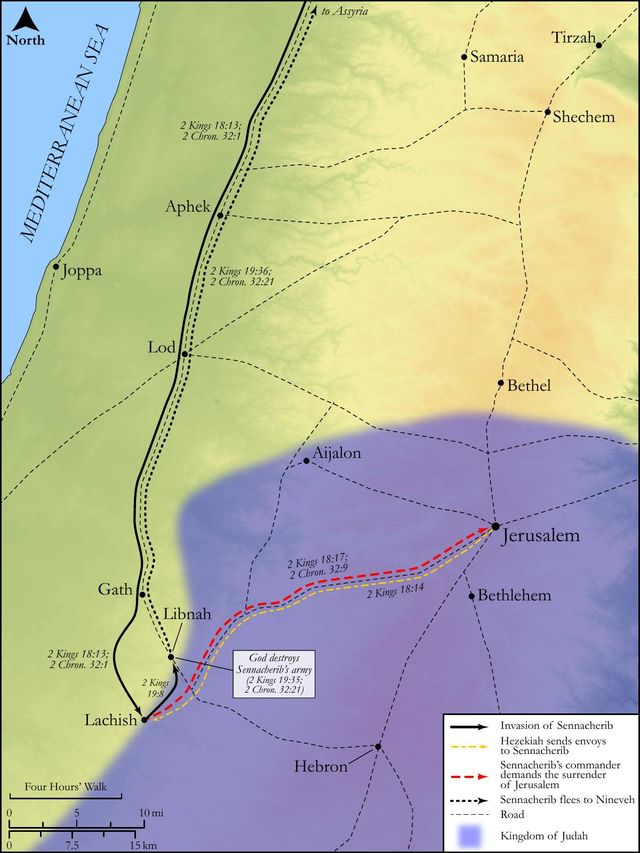
Sennacherib has his hands full in besieging Lachish (Ch2 32:9), but hears that Hezekiah is fortifying Jerusalem and encouraging his people to stand it out; and therefore, before he come in person to besiege it, he sends messengers to make speeches, and he himself writes letters to frighten Hezekiah and his people into a surrender of the city. See,
1.His great malice against the king of Judah, in endeavouring to withdraw his subjects from their allegiance to him. He did not treat with Hezekiah as a man of honour would have done, nor propose fair terms to him, but used mean and base artifices, unbecoming a crowned head, to terrify the common people and persuade them to desert him. he represented Hezekiah as one who designed to deceive his subjects into their ruin and betray them to famine and thirst (Ch2 32:11), as one who had done them great wrong and exposed them already to the divine displeasure by taking away the high places and altars (Ch2 32:12), and who, against the common interest of his people, held out against a force that would certainly be their ruin, Ch2 32:15.
2.His great impiety against the God of Israel, the God of Jerusalem he is called (Ch2 32:19), because that was the place he had chosen to put his name there, and because that was the place which was now threatened by the enemy and which the divine Providence had under its special protection. This proud blasphemer compared the great Jehovah, the Maker of heaven and earth, with the dunghill gods of the nations, the work of men's hands, and thought him no more able to deliver his worshippers than they were to deliver theirs (Ch2 32:19), as if an infinite and eternal Spirit had no more wisdom and power than a stone or the stock of a tree. He boasted of his triumphs over the gods of the nations, that they could none of them protect their people (Ch2 32:13-15), and thence inferred not only, How shall your God deliver you? (Ch2 32:14), but, as if he were inferior to them all, How much less shall your God deliver you? as if he were less able to help than any of them. Thus did they rail, rail in writing (which, being more deliberate, is so much the worse), on the Lord God of Israel, as if he were a cipher and an empty name, like all the rest, Ch2 32:17. Sennacherib, in the instructions he gave, said more than enough; but, as if his blasphemies had been too little, his servants, who learned insolence from their master, spoke yet more than he bade them against the Lord God and his servant Hezekiah, Ch2 32:16. And God resents what is said against his servants, and will reckon for it, as well as what is said against himself. All this was intended to frighten the people from their hope in God, which David's enemies sought to take him off from (Psa 11:1; Psa 42:10), saying, There is no help for him in God, Psa 3:2; Psa 71:11. Thus they hoped to take the city by weakening the hands of those that should defend it. Satan, in his temptations, aims to destroy our faith in God's all-sufficiency, knowing that he shall gain his point if he can do that; as we keep our ground if our faith fail not, Luk 22:32.
II.The duty as well as the interest of the church's friends, and that is in the day of distress to pray and cry to Heaven.
So Hezekiah did, and the prophet Isaiah, Ch2 32:20. It was a happy time when the king and the prophet joined thus in prayer. Is any troubled? Is any terrified? Let him pray. So we engage God for us; so we encourage ourselves in him. Praying to God is here called crying to Heaven, because we are, in prayer, to eye him as our Father in heaven, whence he beholds the children of men, and where he has prepared his throne.
III.The power and goodness of the church's God.
He is able both to control his enemies, be they ever so high, and to relieve his friends, be they ever so low.
1.As the blasphemies of his enemies engage him against them (Deu 32:27), so the prayers of his people engage him for them. They did so here.
(1.)The army of the Assyrians was cut off by the sword of an angel, which triumphed particularly in the slaughter of the mighty men of valour, and the leaders and captains, who defied the sword of any man. God delights to abase the proud and secure. The Targum says, The Word of the Lord (the eternal Word) sent Gabriel to do this execution, and that it was done with lightning, and in the passover night: that was the night in which the angel destroyed the first-born of Egypt. But that was not all.
(2.)The king of the Assyrians, having received this disgrace, was cut off by the sword of his own sons. Those that came forth of his own bowels slew him, Ch2 32:21. Thus was he mortified first, and then murdered - shamed first, and then slain. Evil pursues sinners; and, when they escape one mischief, they run upon another unseen.
2.By this work of wonder,
(1.)God was glorified, as the protector of his people. Thus he saved Jerusalem, not only from the hand of Sennacherib, but from the hand of all others, Ch2 32:22; for such a deliverance as this was an earnest of much mercy in store; and he guided them, that is, he guarded them, on every side. God defends his people by directing them, shows them what they should do, and so saves them from what is designed or done against them. For this many brought gifts unto the Lord, when they saw the great power of God in the defence of his people. Strangers were thereby induced to supplicate his favour and enemies to deprecate his wrath, and both brought gifts to his temple, in token of their care and desire.
(2.)Hezekiah was magnified as the favourite and particular care of Heaven. Many brought presents to him (Ch2 32:22, Ch2 32:23), in token of the honour they had for him, and to make an interest in him. By the favour of God enemies are lost and friends gained.
Continue studying 2 Chronicles 32:9 across the web’s major study libraries — every link below opens this exact verse, chapter, or book on the destination site.
Read & Compare
 BibleGatewayThis verse in more than 200 translations and 70 languages.
 Bible.comThe YouVersion reader — hundreds of translations, reading plans, and highlights.
 ESV.orgCrossway's official English Standard Version reader.
 NET BibleThe NET translation with 60,000+ translators' notes on every rendering decision.
 STEP BibleTyndale House's free study tool — original text, vocabulary, and scholarly resources.
 BibliaLogos Bible Software's free web reader.
 USCCBThe New American Bible (Revised Edition) with the U.S. bishops' study notes.
Commentaries
 BibleHub CommentariesDozens of classic commentaries on this verse, gathered on one page.
 StudyLightMore than 100 commentary sets — the largest collection on the web.
 BibleRefPlain-English commentary on what this verse means, verse by verse.
 Enduring WordDavid Guzik's free commentary on this chapter, widely used by Bible teachers.
 Bible Study ToolsVerse commentary alongside Greek and Hebrew study aids.
Original Language & Research
- BibleHub InterlinearThe verse word by word — original language, transliteration, and English.
- BibleHub LexiconEvery word's original-language definition and Strong's entry.
 Blue Letter BibleDeep-study tools — Strong's numbers, concordance, and word studies.
 SefariaThe Hebrew text with Rashi and centuries of Jewish commentary.
Sermons, Hymns & Audio


TrulyRandomVerse is not affiliated with these sites and doesn’t control their content. They’re linked because they’re genuinely useful.
Summary
Second Chronicles 32:9 marks a critical juncture in the narrative of King Hezekiah's reign, immediately following his diligent preparations for Jerusalem's defense against the impending Assyrian invasion. This verse details the strategic maneuver by Sennacherib, the formidable king of Assyria, who, while personally engaged in the siege of the crucial city of Lachish, dispatched his envoys to Jerusalem. Their mission was to deliver a demoralizing message to King Hezekiah and the entire populace of Judah, initiating a calculated psychological assault designed to break their will before any direct military engagement, thereby setting the stage for a profound test of faith and the ultimate demonstration of divine intervention.
Context
ShowHideLiterary Context
This verse functions as a pivotal narrative transition within 2 Chronicles 32. It directly follows Hezekiah's comprehensive and faithful preparations for the Assyrian threat, which included strengthening Jerusalem's fortifications, securing its water supply, and, most significantly, spiritually fortifying his people with words of unwavering faith, reminding them that "there is a greater power with us than with him" (2 Chronicles 32:7). Verse 9 then shifts the narrative focus to the aggressor, Sennacherib, detailing his immediate actions and the commencement of his psychological warfare. It precisely sets the stage for the verbose and taunting message delivered by Sennacherib's servants in the subsequent verses (2 Chronicles 32:10-19), a message that Hezekiah and the prophet Isaiah powerfully counter with fervent prayer and prophetic assurance, ultimately culminating in God's miraculous and decisive deliverance.
Historical & Cultural Context
The late 8th century BCE was unequivocally dominated by the Neo-Assyrian Empire, a ruthless military superpower renowned for its brutal conquest strategies, forced deportations, and sophisticated psychological tactics. Sennacherib's campaign against Judah in 701 BCE was a significant part of his broader effort to suppress widespread revolts across the Levant, reasserting Assyrian hegemony. Lachish, explicitly mentioned as Sennacherib's current operational base, was a heavily fortified and strategically vital city located in the Shephelah region, southwest of Jerusalem. Its eventual fall, vividly depicted in monumental Assyrian reliefs found at Nineveh, served as a stark and terrifying demonstration of Sennacherib's overwhelming military might and a dire warning to other defiant cities. Culturally, it was a common and effective practice for powerful ancient empires to employ psychological warfare—sending intimidating messages, boasting of their past conquests, and demanding unconditional surrender—prior to committing to a full-scale siege. This tactic aimed to break the enemy's will and induce capitulation without incurring the costly casualties and resource expenditure of a direct military assault. This historical backdrop underscores the immense and existential pressure faced by Hezekiah and Judah, who stood against the most formidable military force of their era.
Key Themes
ShowHideThis verse powerfully introduces and reinforces several critical themes that permeate the entire chapter and the broader historical narrative of Judah. Firstly, it unmistakably underscores the Imminent Threat and the overwhelming power of human adversaries, vividly portraying the vastness of Sennacherib's "power" poised menacingly against Jerusalem. Secondly, it highlights the theme of Psychological Warfare, as Sennacherib's calculated dispatch of servants to deliver a message, rather than immediately launching a direct military assault, clearly demonstrates an attempt to demoralize the inhabitants and induce surrender through fear and intimidation, a common and effective tactic in ancient warfare. Finally, and most profoundly, the verse meticulously sets the stage for a profound Test of Divine Faith. Despite Hezekiah's extensive and diligent human preparations, the odds against Jerusalem were seemingly insurmountable, forcing the king and his people to confront the stark reality that their ultimate hope and deliverance lay not in their formidable fortifications or their limited military strength, but solely in the faithfulness and omnipotence of God. This theme culminates dramatically in the miraculous divine intervention described later in the chapter, where God utterly defeats the Assyrian army (2 Chronicles 32:21-22).
Exposition and Analysis
ShowHideKey Word Analysis
ShowHideThis seemingly simple temporal adverb (H310) acts as a crucial narrative connector, immediately linking Sennacherib's aggressive maneuver to Hezekiah's preceding actions of fortifying Jerusalem and spiritually preparing his people (2 Chronicles 32:1-8). It signifies a direct consequence or calculated response to Hezekiah's defiance and Judah's renewed trust in God, emphasizing that the Assyrian threat was not an isolated event but a direct challenge to their faith and sovereignty.
The mention of Lachish (H3923) is profoundly significant. This city was a major fortified stronghold in Judah, second only to Jerusalem in strategic importance and defensive capability. Its capture by Sennacherib, a monumental military achievement vividly documented in Assyrian reliefs at Nineveh, underscored the overwhelming might of the Assyrian war machine. By stating that Sennacherib was besieging Lachish "with all his power," the text not only specifies his physical location but also dramatically amplifies the psychological pressure on Jerusalem, signaling the near-certainty of Lachish's fall and the impending doom for Judah's capital.
This term (H4475), translated as "power" in the phrase "all his power," denotes rule, dominion, or government. Here, it emphasizes the overwhelming and concentrated military might of Sennacherib's empire. It refers to his entire army, his full military resources, and his complete strategic focus. The implication is that Jerusalem was not facing a mere raiding party but the full, devastating force of the Neo-Assyrian Empire, making the human odds against Judah appear utterly insurmountable and thereby highlighting the immense magnitude of faith required of Hezekiah and his people.
Verse Breakdown
ShowHide"After this did Sennacherib king of Assyria send his servants to Jerusalem,"
This opening clause establishes the primary action and identifies the formidable instigator. "After this" precisely links the event to Hezekiah's diligent preparations, indicating Sennacherib's strategic and calculated response. The "sending of servants" (or envoys/messengers) signifies the deliberate initiation of a campaign of diplomatic and psychological warfare, rather than an immediate military assault, aiming to demoralize the city's inhabitants and leadership before any direct physical confrontation.
"(but he [himself laid siege] against Lachish, and all his power with him,)"
This crucial parenthetical statement provides vital immediate context. It clarifies that Sennacherib was not personally at Jerusalem but was actively engaged in the siege of Lachish, a major Judahite stronghold. The phrase "all his power with him" powerfully underscores the vastness and concentrated nature of the Assyrian military force, emphasizing that the full, devastating might of the empire was already deep within Judahite territory and actively conquering its key strongholds, sending an unmistakable message of impending doom and futility of resistance to Jerusalem.
"unto Hezekiah king of Judah, and unto all Judah that [were] at Jerusalem, saying,"
This final clause precisely specifies the intended recipients of Sennacherib's intimidating message: King Hezekiah, as the reigning monarch and the leader responsible for Judah's defense, and "all Judah that were at Jerusalem," encompassing the entire populace gathered within the city walls. This comprehensive address indicates that the message was meticulously designed to undermine both the leadership's resolve and the morale of the common people, meticulously preparing them for the full force of Sennacherib's taunts and demands that follow in the subsequent verses.
Literary Devices
ShowHideThe verse employs several significant literary devices to enhance its dramatic impact and convey its underlying message. Parenthesis is prominently used with the clause "(but he [himself laid siege] against Lachish, and all his power with him,)", which provides crucial explanatory information about Sennacherib's immediate location and the overwhelming scale of his force. This interruption of the main narrative flow offers vital context, creating a sense of Dramatic Irony, as the reader is made acutely aware of Sennacherib's overwhelming power and strategic positioning, thereby intensifying the tension for the audience who anticipates the divine outcome, while the characters within the narrative face an unknown and terrifying future. Furthermore, the calculated act of sending messengers with a verbal challenge and demand for surrender, rather than an immediate military attack, is a classic form of Psychological Warfare, meticulously designed to instill fear, sow discord, and weaken resolve before a physical confrontation. The phrase "all his power" also functions as a form of Hyperbole, emphasizing the immense, almost unimaginable, scale of the Assyrian army, thereby highlighting the seemingly impossible odds faced by Jerusalem and setting the stage for God's miraculous and unparalleled intervention.
Theological and Thematic Connections
ShowHide2 Chronicles 32:9 serves as a stark and powerful reminder of the pervasive reality of spiritual warfare and the testing of faith that believers often face. Just as Sennacherib, a formidable earthly power, sought to intimidate and conquer Judah through overwhelming force and psychological tactics, so too do spiritual adversaries seek to overwhelm believers with fear, doubt, and seemingly insurmountable odds. The verse vividly highlights the profound contrast between finite human might ("all his power") and infinite divine sovereignty. Even after Hezekiah's diligent and extensive human preparations, the threat remained overwhelmingly disproportionate, forcing an absolute reliance on God alone. This narrative powerfully illustrates that God often allows His people to confront situations where human strength is demonstrably insufficient, precisely to demonstrate His unique, incomparable power and unwavering faithfulness. It underscores the profound theological truth that true security, ultimate deliverance, and enduring peace are found not in fortifications, military prowess, or human ingenuity, but solely in God's protective hand and His immutable covenant promises, which transcend and overcome any earthly threat.
Reflection and Application
ShowHideThis verse introduces a moment of profound and existential crisis, where the overwhelming power of an enemy is brought to bear, not just physically, but with a calculated psychological assault. For believers today, 2 Chronicles 32:9 speaks directly to those moments in life when, despite our best efforts, diligent preparations, and faithful obedience, we find ourselves facing our own "Sennacheribs"—overwhelming challenges, seemingly insurmountable problems, or intimidating adversaries that threaten to crush our spirit, erode our faith, and steal our peace. These could manifest as devastating financial crises, debilitating health battles, complex relational conflicts, or intense spiritual attacks. Just as Sennacherib sought to demoralize Hezekiah and Judah from his strategic position at Lachish, our spiritual adversaries often employ insidious psychological tactics, whispering doubts into our minds, magnifying our fears, and attempting to convince us that our defenses are futile and our God is insufficient or absent. This verse calls us to recognize the sobering reality of the threat, but more importantly, to remember that the true battle is often for our hearts and minds, for our trust and our hope. It profoundly prompts us to look beyond the immediate, visible power of the enemy and to anchor our unwavering hope in the unseen, yet infinitely greater, power of God, who is eternally capable of delivering us from any "Lachish" and protecting our "Jerusalem."
Questions for Reflection
ShowHideFAQ
ShowHideWhy was Sennacherib at Lachish and not directly at Jerusalem when he sent his servants?
ShowHideSennacherib's presence at Lachish, a major fortified city southwest of Jerusalem, was a highly strategic military decision. By besieging Lachish with "all his power," he was demonstrating his overwhelming military might and the futility of resistance to the other cities of Judah, including Jerusalem. Lachish was a vital stronghold, and its inevitable fall would send a clear and terrifying message across the region. Sending servants from Lachish to Jerusalem served as a potent form of psychological warfare; it allowed Sennacherib to demand surrender and demoralize the inhabitants without immediately committing his entire army to a potentially costly and prolonged siege of Jerusalem, which was exceptionally well-defended due to Hezekiah's recent and extensive preparations (2 Chronicles 32:5-6).
What was the purpose of sending servants with a message instead of launching an immediate attack?
ShowHideThe primary purpose of sending messengers with a taunting and intimidating message (as vividly detailed in 2 Chronicles 32:10-19) was psychological warfare. Sennacherib aimed to break the morale of King Hezekiah and the people of Jerusalem, convincing them that resistance was futile, their God was powerless to save them, and surrender was their only viable option. This calculated tactic was designed to achieve victory without the heavy casualties, extensive resource expenditure, and potential delays of a direct assault, hoping to induce fear and prompt a capitulation before a full-scale siege was even necessary.
How does this verse set the stage for the theme of divine deliverance in 2 Chronicles 32?
ShowHide2 Chronicles 32:9 vividly portrays the overwhelming human threat facing Jerusalem, emphasizing Sennacherib's "all his power" and his strategic, conquering position at Lachish. This extreme human disadvantage and the seemingly insurmountable odds are precisely what magnify God's subsequent miraculous intervention. By highlighting the apparent hopelessness of the situation from a human perspective, the verse sets a dramatic and desperate backdrop against which God's ultimate and decisive deliverance of Jerusalem (2 Chronicles 32:21-22) shines even brighter, powerfully underscoring the overarching theme that true salvation and victory come not by human strength, military might, or strategic genius, but solely by the sovereign power and unwavering faithfulness of the Lord.
Christ-Centered Fulfillment
ShowHideThe historical account of Sennacherib's overwhelming power and his calculated psychological assault on Jerusalem in 2 Chronicles 32:9 finds profound Christ-centered fulfillment in the New Testament. Sennacherib, with "all his power," represents the formidable spiritual enemies that humanity faces: the dominion of sin, the sting of death, and the deceptive power of the devil. Just as Sennacherib sought to conquer Jerusalem through intimidation and overwhelming force, these spiritual adversaries seek to enslave and destroy humanity, whispering lies and magnifying fear. However, the ultimate King, Jesus Christ, faced these enemies not by fortifying earthly walls or engaging in conventional warfare, but by entering into the very domain of death itself. Through His sacrificial crucifixion and glorious resurrection, Christ decisively disarmed the principalities and powers, triumphing over them by the cross (Colossians 2:15). He is the true and perfect Deliverer who, unlike Hezekiah who relied on God's intervention, is God Himself, actively conquering the spiritual "Lachish" of sin and death. He delivers His people from the fear of death and the power of the devil, setting captives free (Hebrews 2:14-15). Therefore, when believers today face seemingly insurmountable "Sennacheribs" in their lives, they are called to remember that the decisive victory has already been secured by the Lamb of God, who takes away the sin of the world (John 1:29), and that in Christ, we are more than conquerors through Him who loved us (Romans 8:37-39).