


2 Chronicles 32:12
Bible text: King James Version (1769 Blayney text) · Public domain
Bible text: King James Version with Strong's numbers · Public domain
Bible text: Berean Standard Bible · Public domain
Bible text: American Standard Version (1901) · Public domain
Bible text: World English Bible, Messianic edition · Public domain
Bible text: Geneva Bible (1599) · Public domain
Bible text: Young's Literal Translation · Public domain
- הֲלֹאha·lo'¿ notH3808Interrog ¦ NegParticle Negativeהֲ¿לֹאnot
- הוּאhu'thatH1931Pro-3msPronoun Personal 3rd Singular Masculine
- יְחִזְקִיָּהוּye·chiz·ki·Ya·huHezekiahH2396N-proper-mNoun Proper Masculine
- הֵסִירhe·Sirdid he removeH5493V-Hiphil-Perf-3msVerb Hiphil Perfect 3rd Singular Masculine
- אֶת'et<obj.>H853DirObjMParticle Object Indicator
- בָּמֹתָיוba·mo·Tavhis high placesH1116N-fpc ¦ 3msNoun Plural Feminine Constructבָּמֹתָיhigh placesוhis
- וְאֶתve·'Etand <obj.>H853Conj-w ¦ DirObjMParticle Object Indicatorוְandאֶת<obj.>
- מִזְבְּחֹתָיוmiz·be·cho·Tavhis altarsH4196N-fpc ¦ 3msNoun Plural Feminine Constructמִזְבְּחֹתָיaltarsוhis
- וַיֹּאמֶרvai·Yo·merand did he say?H559Conj-w ¦ V-Qal-ConsecImperf-3msVerb Qal Consecutive Imperfect 3rd Singular Masculineוַandיֹּאמֶרdid he say?
- לִיהוּדָהli·hu·Dahto JudahH3063Prep-l ¦ N-properNoun Proper LocationלִtoיהוּדָהJudah
- וְלִירוּשָׁלִַםve·li·ru·sha·Limand to JerusalemH3389Conj-w ¦ Prep-l ¦ N-properNoun Proper LocationוְandלִtoירוּשָׁלִַםJerusalem
- לֵאמֹרle·Mor<to> sayingH559Prep-l ¦ V-Qal-InfVerb Qal Infinitive Constructלֵ<to>אמֹרsaying
- לִפְנֵיlif·Nei<to> beforeH6440Prep-l ¦ N-mpcNoun Plural Masculine Constructלִ<to>פְנֵיbefore
- מִזְבֵּחַmiz·Be·achan altarH4196N-msNoun Singular Masculine Absolute
- אֶחָד'e·ChadoneH259N-fsNoun Singular Feminine Absolute
- תִּשְׁתַּחֲווּtish·ta·cha·Vuyou will bow downH7812V-Hithpael-Imperf-2mpVerb Hithpael Imperfect 2nd Plural Masculine
- וְעָלָיוve·'a·Lavand on itH5921Conj-w ¦ Prep ¦ 3msPrepositionוְandעָלָיonוit
- תַּקְטִירוּtak·Ti·ruyou will make smokeH6999V-Hiphil-Imperf-2mpVerb Hiphil Imperfect 2nd Plural Masculine
English is a literal word-by-word gloss of the Hebrew, not the KJV's wording. Why?
This is the original text the KJV's translators worked from — each Hebrew word with its own literal English meaning in this verse, prepared by scholars at Tyndale House, Cambridge. The KJV translates whole sentences, not word by word, so its wording differs: one Hebrew word can become several English words, and the KJV may choose “the LORD” where the gloss reads “Yahweh”. Both are faithful — they answer different questions. For the KJV's own rendering, switch to the KJV text.
Details
See on the biblical-era maps
Study this verse
Public-domain commentary
Matthew Henry
From his Commentary on the Whole Bible. Henry comments on passages, not single verses — this entry covers 2 Chronicles 32:9–23. His three-level outline is real structure in the source text, so it is rendered as structure.
This story of the rage and blasphemy of Sennacherib, Hezekiah's prayer, and the deliverance of Jerusalem by the destruction of the Assyrian army, we had more at large in the book of Kings, 2 Kings 18 and 19. It is contracted here, yet large enough to show these three things: -
I.The impiety and malice of the church's enemies.
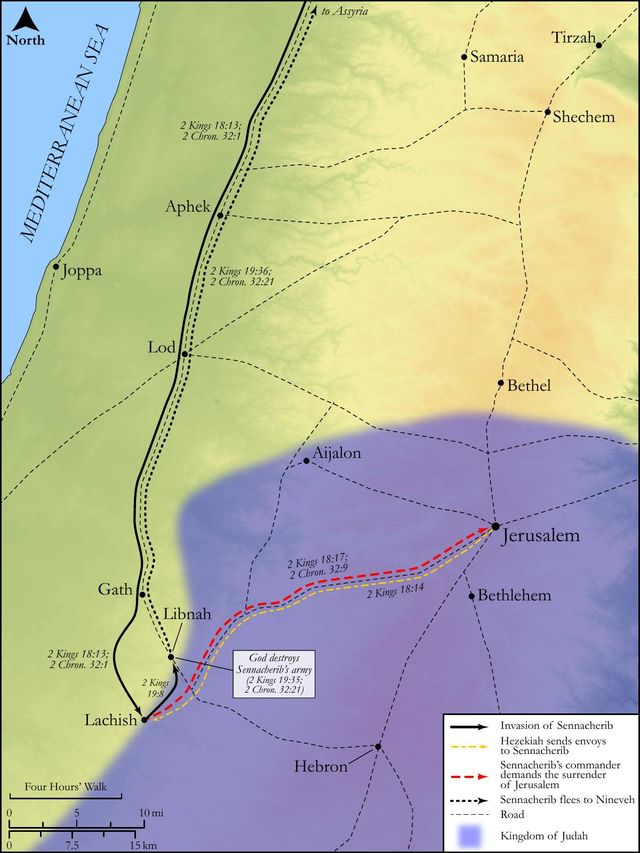
Sennacherib has his hands full in besieging Lachish (Ch2 32:9), but hears that Hezekiah is fortifying Jerusalem and encouraging his people to stand it out; and therefore, before he come in person to besiege it, he sends messengers to make speeches, and he himself writes letters to frighten Hezekiah and his people into a surrender of the city. See,
1.His great malice against the king of Judah, in endeavouring to withdraw his subjects from their allegiance to him. He did not treat with Hezekiah as a man of honour would have done, nor propose fair terms to him, but used mean and base artifices, unbecoming a crowned head, to terrify the common people and persuade them to desert him. he represented Hezekiah as one who designed to deceive his subjects into their ruin and betray them to famine and thirst (Ch2 32:11), as one who had done them great wrong and exposed them already to the divine displeasure by taking away the high places and altars (Ch2 32:12), and who, against the common interest of his people, held out against a force that would certainly be their ruin, Ch2 32:15.
2.His great impiety against the God of Israel, the God of Jerusalem he is called (Ch2 32:19), because that was the place he had chosen to put his name there, and because that was the place which was now threatened by the enemy and which the divine Providence had under its special protection. This proud blasphemer compared the great Jehovah, the Maker of heaven and earth, with the dunghill gods of the nations, the work of men's hands, and thought him no more able to deliver his worshippers than they were to deliver theirs (Ch2 32:19), as if an infinite and eternal Spirit had no more wisdom and power than a stone or the stock of a tree. He boasted of his triumphs over the gods of the nations, that they could none of them protect their people (Ch2 32:13-15), and thence inferred not only, How shall your God deliver you? (Ch2 32:14), but, as if he were inferior to them all, How much less shall your God deliver you? as if he were less able to help than any of them. Thus did they rail, rail in writing (which, being more deliberate, is so much the worse), on the Lord God of Israel, as if he were a cipher and an empty name, like all the rest, Ch2 32:17. Sennacherib, in the instructions he gave, said more than enough; but, as if his blasphemies had been too little, his servants, who learned insolence from their master, spoke yet more than he bade them against the Lord God and his servant Hezekiah, Ch2 32:16. And God resents what is said against his servants, and will reckon for it, as well as what is said against himself. All this was intended to frighten the people from their hope in God, which David's enemies sought to take him off from (Psa 11:1; Psa 42:10), saying, There is no help for him in God, Psa 3:2; Psa 71:11. Thus they hoped to take the city by weakening the hands of those that should defend it. Satan, in his temptations, aims to destroy our faith in God's all-sufficiency, knowing that he shall gain his point if he can do that; as we keep our ground if our faith fail not, Luk 22:32.
II.The duty as well as the interest of the church's friends, and that is in the day of distress to pray and cry to Heaven.
So Hezekiah did, and the prophet Isaiah, Ch2 32:20. It was a happy time when the king and the prophet joined thus in prayer. Is any troubled? Is any terrified? Let him pray. So we engage God for us; so we encourage ourselves in him. Praying to God is here called crying to Heaven, because we are, in prayer, to eye him as our Father in heaven, whence he beholds the children of men, and where he has prepared his throne.
III.The power and goodness of the church's God.
He is able both to control his enemies, be they ever so high, and to relieve his friends, be they ever so low.
1.As the blasphemies of his enemies engage him against them (Deu 32:27), so the prayers of his people engage him for them. They did so here.
(1.)The army of the Assyrians was cut off by the sword of an angel, which triumphed particularly in the slaughter of the mighty men of valour, and the leaders and captains, who defied the sword of any man. God delights to abase the proud and secure. The Targum says, The Word of the Lord (the eternal Word) sent Gabriel to do this execution, and that it was done with lightning, and in the passover night: that was the night in which the angel destroyed the first-born of Egypt. But that was not all.
(2.)The king of the Assyrians, having received this disgrace, was cut off by the sword of his own sons. Those that came forth of his own bowels slew him, Ch2 32:21. Thus was he mortified first, and then murdered - shamed first, and then slain. Evil pursues sinners; and, when they escape one mischief, they run upon another unseen.
2.By this work of wonder,
(1.)God was glorified, as the protector of his people. Thus he saved Jerusalem, not only from the hand of Sennacherib, but from the hand of all others, Ch2 32:22; for such a deliverance as this was an earnest of much mercy in store; and he guided them, that is, he guarded them, on every side. God defends his people by directing them, shows them what they should do, and so saves them from what is designed or done against them. For this many brought gifts unto the Lord, when they saw the great power of God in the defence of his people. Strangers were thereby induced to supplicate his favour and enemies to deprecate his wrath, and both brought gifts to his temple, in token of their care and desire.
(2.)Hezekiah was magnified as the favourite and particular care of Heaven. Many brought presents to him (Ch2 32:22, Ch2 32:23), in token of the honour they had for him, and to make an interest in him. By the favour of God enemies are lost and friends gained.
Continue studying 2 Chronicles 32:12 across the web’s major study libraries — every link below opens this exact verse, chapter, or book on the destination site.
Read & Compare
 BibleGatewayThis verse in more than 200 translations and 70 languages.
 Bible.comThe YouVersion reader — hundreds of translations, reading plans, and highlights.
 ESV.orgCrossway's official English Standard Version reader.
 NET BibleThe NET translation with 60,000+ translators' notes on every rendering decision.
 STEP BibleTyndale House's free study tool — original text, vocabulary, and scholarly resources.
 BibliaLogos Bible Software's free web reader.
 USCCBThe New American Bible (Revised Edition) with the U.S. bishops' study notes.
Commentaries
 BibleHub CommentariesDozens of classic commentaries on this verse, gathered on one page.
 StudyLightMore than 100 commentary sets — the largest collection on the web.
 BibleRefPlain-English commentary on what this verse means, verse by verse.
 Enduring WordDavid Guzik's free commentary on this chapter, widely used by Bible teachers.
 Bible Study ToolsVerse commentary alongside Greek and Hebrew study aids.
Original Language & Research
- BibleHub InterlinearThe verse word by word — original language, transliteration, and English.
- BibleHub LexiconEvery word's original-language definition and Strong's entry.
 Blue Letter BibleDeep-study tools — Strong's numbers, concordance, and word studies.
 SefariaThe Hebrew text with Rashi and centuries of Jewish commentary.
Sermons, Hymns & Audio


TrulyRandomVerse is not affiliated with these sites and doesn’t control their content. They’re linked because they’re genuinely useful.
Summary
This verse captures the audacious taunt of the Assyrian field commander, Rabshakeh, during Sennacherib's siege of Jerusalem. He accuses King Hezekiah of offending his God by removing local "high places" and altars, consolidating worship to a single altar in Jerusalem. Intended to undermine Judah's faith and loyalty, this accusation ironically highlights Hezekiah's righteous reforms, which were, in fact, acts of obedience to Yahweh's covenant commands for centralized and pure worship. The Assyrians, operating from a polytheistic worldview, fundamentally misunderstood the unique nature of Israel's God and the principles of true worship, believing that Hezekiah's fidelity was an act of sacrilege.
CONTEXT
ShowHideExposition and Analysis
ShowHideKey Word Analysis
ShowHideFrom an unused root meaning "to be high," this term refers to elevated places or shrines, often built on hills or mounds, where religious rituals and sacrifices were performed. While some might have been dedicated to Yahweh, many were associated with Canaanite idolatry or unauthorized worship that deviated from the Mosaic Law's command for a single, central place of worship. Hezekiah's destruction of these was an act of covenant faithfulness, aimed at purifying Judah's religious practices.
This numeral, meaning "united" or "one," emphasizes the singularity and exclusivity of the altar. In the context of the Mosaic Law, it underscores the principle of monotheistic worship—the worship of the one true God, Yahweh—at His one designated sanctuary, the Temple in Jerusalem. Rabshakeh's mention of "one altar" inadvertently highlights the unique, non-polytheistic nature of Israel's faith.
Derived from a root meaning "to sacrifice," this word denotes a structure upon which sacrifices were offered to a deity. In this verse, it refers both to the illegitimate altars on the "high places" that Hezekiah removed and, crucially, to the single, legitimate altar of burnt offering located within the Jerusalem Temple. The contrast between the multiplicity of pagan altars and the singularity of Yahweh's altar is central to the theological conflict.
Verse Breakdown
ShowHide"Hath not the same Hezekiah taken away his high places and his altars"
This rhetorical question, posed by Rabshakeh, is framed as an accusation. From the Assyrian polytheistic perspective, removing numerous altars would be seen as an act of disrespect or limitation towards a deity, potentially angering it and causing it to withdraw favor. This clause deliberately misrepresents Hezekiah's righteous actions, which were in accordance with God's commands, as impious.
"and commanded Judah and Jerusalem, saying, Ye shall worship before one altar"
This part of the accusation highlights Hezekiah's command for centralized worship at the Jerusalem Temple. For the Assyrians, this would seem illogical and restrictive, as they believed more altars meant more access to various gods or greater favor from one's own god. For Hezekiah, however, it was strict obedience to the Mosaic Law, which mandated exclusive worship of Yahweh at His chosen sanctuary.
"and burn incense upon it?"
This final clause reinforces the command for exclusive and centralized worship at the Jerusalem Temple. By consolidating all legitimate sacrificial and incense offerings to this single location, Hezekiah was purifying Judah's worship. This act, which was an expression of deep fidelity to Yahweh, the Assyrian commander, steeped in his own polytheistic religious worldview, could only interpret as an offense to God, thereby attempting to sow discord and fear among the people of Judah.
Literary Devices
ShowHideThe primary literary device at play in this verse is Irony. Rabshakeh intends to accuse Hezekiah of impiety and foolishness, suggesting that his religious reforms have angered his God and led to Jerusalem's precarious situation. However, from the divine and biblical perspective, Hezekiah's actions were precisely what Yahweh commanded and desired—a return to pure, centralized worship. Thus, what the enemy presents as a weakness is, in fact, an act of profound strength and faithfulness, inadvertently highlighting Hezekiah's righteousness. This also functions as Psychological Warfare, as Rabshakeh's speech is designed to demoralize the people of Judah by twisting their king's virtuous deeds into a cause for their impending doom, aiming to break their morale and trust in God's protection. Furthermore, there is clear Misrepresentation of truth, as Rabshakeh either ignorantly or deliberately distorts the nature of Yahweh and the requirements of His covenant, viewing them through a pagan lens that cannot grasp the concept of exclusive monotheistic worship.
Theological and Thematic Connections
ShowHideThis verse powerfully underscores the nature of true worship: it is not defined by human preferences, convenience, or the proliferation of shrines, but by obedience to God's specific commands and His revealed will. Hezekiah's reforms, though misunderstood and maligned by the world, were a testament to his unwavering commitment to covenant fidelity and a courageous stand against syncretism. The Assyrian taunt reveals a fundamental theological clash: the world's polytheistic, pragmatic view of divinity versus Israel's unique monotheistic, covenantal relationship with Yahweh, who demands exclusive devotion and prescribed worship. God's ultimate deliverance of Jerusalem, despite the overwhelming odds and the enemy's psychological warfare, serves as a powerful vindication of Hezekiah's faithfulness and the truth that obedience, even when it appears foolish or counter-intuitive to the world, is the pathway to divine favor and protection.
Reflection and Application
ShowHideThis passage serves as a potent reminder that what the world perceives as weakness, foolishness, or even an offense can, in God's eyes, be an act of profound faith and righteousness. Believers today may face similar accusations or misunderstandings when they strive to obey God's commands, especially when those commands run contrary to popular opinion, cultural norms, or worldly wisdom. It challenges us to critically examine our own worship practices, ensuring they are aligned with God's Word and not influenced by syncretistic tendencies or the desire for worldly approval. Just as Hezekiah removed the "high places" from Judah, we are called to identify and remove any "high places"—idols, distractions, or unauthorized practices—from our lives and churches that divert our exclusive devotion from the one true God. In times of difficulty or accusation, this narrative encourages us to discern truth from deception, to trust in God's sovereignty, and to remain steadfast in obedience, knowing that He ultimately vindicates His faithful servants and brings about His purposes through their fidelity.
Questions for Reflection
ShowHideFAQ
ShowHideWhy was Hezekiah removing "high places" considered a good thing, even though Sennacherib used it as an accusation?
ShowHideHezekiah's removal of "high places" was a righteous act of obedience to God's covenant commands. The Mosaic Law, particularly in Deuteronomy 12, explicitly commanded Israel to worship God exclusively at one central location—the Temple in Jerusalem—after they entered the Promised Land. The "high places" were local shrines that often became sites of syncretistic worship, mixing the worship of Yahweh with pagan practices, or simply unauthorized worship that deviated from God's prescribed ways. By destroying them, Hezekiah was purifying Judah's worship and bringing the nation back into alignment with God's Law, demonstrating his faithfulness and commitment to true monotheism. Sennacherib, from his polytheistic worldview, could not comprehend this, assuming that more altars meant more access to divine favor, and thus Hezekiah's actions were an offense to his deity rather than an act of fidelity.
What was the outcome of this Assyrian siege, and how does it relate to Hezekiah's reforms?
ShowHideThe outcome of the Assyrian siege was a miraculous deliverance by God. Despite Sennacherib's overwhelming military might and psychological tactics, God intervened directly. In response to Hezekiah's and the prophet Isaiah's prayers, the angel of the Lord struck down 185,000 Assyrian soldiers in one night, forcing Sennacherib to retreat in shame (as recounted in 2 Chronicles 32:21-22). This divine intervention served as a powerful vindication of Hezekiah's faith and his righteous reforms. It demonstrated that God honors obedience and protects those who faithfully follow His commands, even when facing seemingly insurmountable odds and the world's misunderstanding or scorn. The deliverance confirmed that Hezekiah's actions were not a cause for divine wrath but a path to divine blessing and a testament to God's sovereign power over all earthly kingdoms.
Christ-Centered Fulfillment
ShowHideHezekiah's zealous reform, centralizing worship to "one altar" in Jerusalem, powerfully foreshadows the ultimate and perfect centralization of all true worship in Jesus Christ. Just as the physical "high places" were removed to purify worship in Judah, Christ, through His perfect life, atoning death, and glorious resurrection, removes all "high places" of human devising—all self-righteous efforts, false gods, and unauthorized means of approaching God. He is the true and ultimate "one altar" (as hinted in Hebrews 13:10), the singular and exclusive means by which humanity can draw near to the Father. Our worship is no longer tied to a physical temple or a specific geographical location, but is now to be offered "in spirit and truth" through Him (John 4:23-24). He is the Lamb of God who takes away the sin of the world (John 1:29), the High Priest who offered Himself as the perfect and final sacrifice, making all other altars and sacrifices obsolete and unnecessary (Hebrews 9:11-12). Sennacherib's taunt, intended to accuse Hezekiah and undermine faith, ultimately highlights the king's fidelity. Similarly, the accusations of the world and the spiritual accuser are rendered powerless against those who are in Christ, for He has triumphed over all principalities and powers (Colossians 2:15), securing our access to God through His singular, perfect work, and uniting all believers into one body, worshiping the one true God through the one Mediator (1 Timothy 2:5).