


2 Chronicles 14:6
Bible text: King James Version (1769 Blayney text) · Public domain
Bible text: Berean Standard Bible · Public domain
Bible text: American Standard Version (1901) · Public domain
Bible text: World English Bible, Messianic edition · Public domain
Bible text: Geneva Bible (1599) · Public domain
Bible text: Young's Literal Translation · Public domain
- וַיִּבֶןvai·Yi·venand he builtH1129Conj-w ¦ V-Qal-ConsecImperf-3msVerb Qal Consecutive Imperfect 3rd Singular Masculineוַandיִּבֶןhe built
- עָרֵי'a·Reicities ofH5892N-mpcNoun Plural Masculine Construct
- מְצוּרָהme·tzu·RahfortificationH4694N-fsNoun Singular Feminine Absolute
- בִּיהוּדָהbi·hu·Dahin JudahH3063Prep-b ¦ N-properNoun Proper LocationבִּinיהוּדָהJudah
- כִּיkiforH3588PrtParticle Conditional
- שָׁקְטָהsha·ke·Tahit was at peaceH8252V-Qal-Perf-3fsVerb Qal Perfect 3rd Singular Feminine
- הָאָרֶץha·'A·retzthe landH776Art ¦ N-fsNoun Singular Feminine Absoluteהָtheאָרֶץland
- וְאֵיןve·'einand there notH369Conj-w ¦ N-mscNoun Singular Masculine Constructוְandאֵיןthere not
- עִמּוֹi·Mowith himH5973Prep ¦ 3msPrepositionעִמּwithוֹhim
- מִלְחָמָהmil·cha·Mah[was] warH4421N-fsNoun Singular Feminine Absolute
- בַּשָּׁנִיםba·sha·Nimin the yearsH8141Prep-b ¦ N-mpNoun Plural Masculine Absoluteבַּin theשָּׁנִיםyears
- הָאֵלֶּהha·'E·leh<the> theseH428Art ¦ PrtParticle Demonstrativeהָ<the>אֵלֶּהthese
- כִּיkiforH3588PrtParticle Conditional
- הֵנִיחַhe·Ni·achhe had given restH5117V-Hiphil-Perf-3msVerb Hiphil Perfect 3rd Singular Masculine
- יְהוָהYah·wehYahwehH3068N-properNoun Proper Title
- לוֹloto himPrep-l ¦ 3msSuffix Personal 3rd Singular Masculineלtoוֹhim
English is a literal word-by-word gloss of the Hebrew, not the KJV's wording. Why?
This is the original text the KJV's translators worked from — each Hebrew word with its own literal English meaning in this verse, prepared by scholars at Tyndale House, Cambridge. The KJV translates whole sentences, not word by word, so its wording differs: one Hebrew word can become several English words, and the KJV may choose “the LORD” where the gloss reads “Yahweh”. Both are faithful — they answer different questions. For the KJV's own rendering, switch to the KJV text.
Details
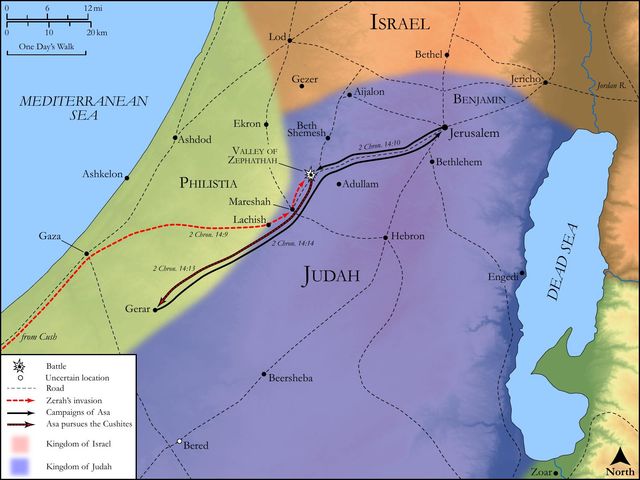
See on the biblical-era map
Study this verse
Public-domain commentary
Matthew Henry
From his Commentary on the Whole Bible. Henry comments on passages, not single verses — this entry covers 2 Chronicles 14:1–8. His four-level outline is real structure in the source text, so it is rendered as structure.
Here is, I. Asa's general character (Ch2 14:2): He did that which was good and right in the eyes of the Lord his God. 1. He aimed at pleasing God, studied to approve himself to him. Happy are those that walk by this rule, to do that which is right, not in their own eyes, or in the eye of the world, but in the eyes of God. 2. He saw God's eye always upon him, and that helped much to keep him to what was good and right. 3. God graciously accepted him in what he did, and approved his conduct as good and right.
II.A blessed work of reformation which he set on foot immediately upon his accession to the crown.
1.He removed and abolished idolatry. Since Solomon admitted idolatry, in the latter end of his reign, nothing had been done to suppress it, and so, we presume, it had got ground. Strange gods were worshipped and had their altars, images, and groves; and the temple service, though kept up by the priests (Ch2 13:10), was neglected by many of the people. Asa, as soon as he had power in his hands, made it his business to destroy all those idolatrous altars and images (Ch2 14:3, Ch2 14:5), they being a great provocation to a jealous God and a great temptation to a careless unthinking people. He hoped by destroying the idols to reform the idolaters, which he aimed at, rather than to ruin them.
2.He revived and established the pure worship of God; and, since the priests did their part in attending God's altars, he obliged the people to do theirs (Ch2 14:4): He commanded Judah to seek the Lord God of their fathers, and not the gods of the heathen, and to do the law and the commandments, that is, to observe all divine institutions, which many had utterly neglected. In doing this, the land was quiet before him, Ch2 14:5. Though they were much in love with their idols, and very loth to leave them, yet the convictions of their consciences sided with the commands of Asa, and they could not, for shame, refuse to comply with them. Note, Those that have power in their hands, and will use it vigorously for the suppression of profaneness and the reformation of manners, will not meet with so much difficulty and opposition therein as perhaps they feared. Vice is a sneaking thing, and virtue has reason enough on its side to make all iniquity stop her mouth, Psa 107:42.
III.The tranquillity of his kingdom, after constant alarms of war during the last two reigns:
In his days the land was quiet ten years ( Ch2 14:1), no war with the kingdom of Israel, who did not recover the blow given them in the last reign for a great while. Abijah's victory, which was owing, under God, to his courage and bravery, laid a foundation for Asa's peace, which was the reward of his piety and reformation. Though Abijah had little religion himself, he was instrumental to prepare the way for one that had much. If Abijah had not done what he did to quiet the land, Asa could not have done what he did to reform it; for inter arma silent leges - amidst the din of arms the voice of law is unheard.
IV.The prudent improvement he made of that tranquillity:
The land had rest, for the Lord had given him rest. Note, If God give quietness, who then can make trouble? Job 34:29. Those have rest indeed to whom God gives rest, peace indeed to whom Christ gives peace, not as the world giveth, Joh 14:27. Now,
1.Asa takes notice of the rest they had as the gift of God (He hath given us rest on every side. Note, God must be acknowledged with thankfulness in the rest we are blessed with, of body and mind, family and country), and as the reward of the reformation begun: Because we have sought the Lord our God, he has given us rest. Note, As the frowns and rebukes of Providence should be observed for a check to us in an evil way, so the smiles of Providence should be taken notice of for our encouragement in that which is good. See Hag 2:18, Hag 2:19; Mal 3:10. We find by experience that it is good to seek the Lord; it gives us rest. While we pursue the world we meet with nothing but vexation.
2.He consults with his people, by their representatives, how to make a good use of the present gleams of peace they enjoyed, and concludes with them,
(1.)That they must not be idle, but busy. Times of rest from war should be employed in work, for we must always find ourselves something to do. In the years when he had no war he said, "Let us build; still let us be doing." When the churches had rest they were built up, Act 9:31. When the sword is sheathed take up the trowel.
(2.)That they must not be secure, but prepare for wars. In times of peace we must be getting ready for trouble, expect it and lay up in store for it.
[1.]He fortified his principle cities with walls, towers, gates, and bars, Ch2 14:7. "This let us do," says he, "while the land is yet before us," that is, "while we have opportunity and advantage for it and have nothing to hinder us." He speaks as if he expected that, some way or other, trouble would arise, when it would be too late to fortify, and when they would wish they had done it. So they built and prospered.
[2.]He had a good army ready to bring into the field (Ch2 14:8), not a standing army, but the militia or trained-bands of the country. Judah and Benjamin were mustered severally; and Benjamin (which not long ago was called little Benjamin, Psa 68:27) had almost as many soldiers as Judah, came as near as 28 to 30, so strangely had that tribe increased of late. The blessing of God can make a little one to become a thousand. It should seem, these two tribes were differently armed, both offensively and defensively. The men of Judah guarded themselves with targets, the men of Benjamin with shields, the former of which were much larger than the latter, Kg1 10:16, Kg1 10:17. The men of Judah fought with spears when they closed in with the enemy; the men of Benjamin drew bows, to reach the enemy at a distance. Both did good service, and neither could say to the other, I have no need of thee. Different gifts and employments are for the common good.
Continue studying 2 Chronicles 14:6 across the web’s major study libraries — every link below opens this exact verse, chapter, or book on the destination site.
Read & Compare
 BibleGatewayThis verse in more than 200 translations and 70 languages.
 Bible.comThe YouVersion reader — hundreds of translations, reading plans, and highlights.
 ESV.orgCrossway's official English Standard Version reader.
 NET BibleThe NET translation with 60,000+ translators' notes on every rendering decision.
 STEP BibleTyndale House's free study tool — original text, vocabulary, and scholarly resources.
 BibliaLogos Bible Software's free web reader.
 USCCBThe New American Bible (Revised Edition) with the U.S. bishops' study notes.
Commentaries
 BibleHub CommentariesDozens of classic commentaries on this verse, gathered on one page.
 StudyLightMore than 100 commentary sets — the largest collection on the web.
 BibleRefPlain-English commentary on what this verse means, verse by verse.
 Enduring WordDavid Guzik's free commentary on this chapter, widely used by Bible teachers.
 Bible Study ToolsVerse commentary alongside Greek and Hebrew study aids.
Original Language & Research
- BibleHub InterlinearThe verse word by word — original language, transliteration, and English.
- BibleHub LexiconEvery word's original-language definition and Strong's entry.
 Blue Letter BibleDeep-study tools — Strong's numbers, concordance, and word studies.
 SefariaThe Hebrew text with Rashi and centuries of Jewish commentary.
Sermons, Hymns & Audio


TrulyRandomVerse is not affiliated with these sites and doesn’t control their content. They’re linked because they’re genuinely useful.
Summary
Second Chronicles 14:6 encapsulates a significant period in King Asa's reign over Judah, detailing his strategic initiative to construct fortified cities. This crucial building program was not undertaken in a vacuum but was a direct consequence of a divinely granted era of peace, during which the land experienced profound rest and was free from military conflict. The verse emphatically attributes this tranquility not to human ingenuity or political maneuvering, but solely to the Lord's benevolent provision, thereby underscoring the profound theological principle that national well-being and security are ultimately rooted in divine favor and faithfulness.
Context
ShowHideLiterary Context
This verse is strategically positioned early in the narrative of King Asa's reign, immediately following a detailed account of his initial righteous reforms. The preceding verses, specifically 2 Chronicles 14:2-5, describe how Asa "did what was good and right in the eyes of the Lord his God." He diligently purged the land of idolatry, removing foreign altars, breaking down sacred pillars, and cutting down Asherim. Crucially, he also commanded the people of Judah to "seek the Lord God of their fathers and to obey the law and the commandment." This period of peace and subsequent construction, highlighted in 2 Chronicles 14:6-8, is presented as a direct divine reward for Asa's faithfulness. It serves as a foundational interlude, allowing Judah to consolidate its strength and prepare for the formidable military challenge that would soon arrive in the form of Zerah the Cushite's vast army, as recounted in 2 Chronicles 14:9-15. The narrative structure thus emphasizes that divine blessing and enablement often precede and facilitate human preparation and success.
Historical & Cultural Context
Following the schism of the united monarchy after Solomon's death, the Southern Kingdom of Judah, though smaller in territory and population than the Northern Kingdom of Israel, frequently faced existential threats from surrounding nations like Egypt, Philistia, and various Arabian tribes. In this volatile geopolitical landscape, the construction of fortified cities was not merely a convenience but an absolute necessity for national survival, providing essential refuge for the populace and strategic strongholds for military defense. Asa's reign, spanning approximately 911-870 BC, marked a significant departure from the idolatrous practices and political instability that characterized the reigns of his predecessors, Rehoboam and Abijah. The concept of "rest" (Hebrew: nuach) held profound theological significance in ancient Israel, often signifying God's fulfillment of His covenant promises of security and peace within the land, a theme vividly illustrated in the conquest narratives where God grants Israel rest from their enemies after their entry into Canaan, as seen in Joshua 21:44. This divinely bestowed rest allowed Judah a critical window of opportunity to strengthen its internal infrastructure without the immediate distraction of external conflict.
Key Themes
ShowHideThe most prominent theme in this verse is Divine Providence and Blessing, unequivocally stated by the phrase "because the LORD had given him rest." This highlights God's active, sovereign involvement in the affairs of His people, directly rewarding their obedience with peace, stability, and security. Another crucial theme is Prudent Leadership and Strategic Preparation. Asa's decision to "build fenced cities" during a period of peace demonstrates remarkable foresight and wisdom. He recognized that divinely granted rest is not an invitation to complacency but a strategic window for strengthening the kingdom's foundations, both physically and spiritually. This aligns with a broader biblical principle of diligent preparation in times of plenty for potential future scarcity or conflict. Finally, the verse powerfully underscores the theme of Obedience and its Consequences. Asa's earlier religious reforms and his unwavering commitment to seeking the Lord directly precede and enable this period of national tranquility and constructive activity. This illustrates a consistent pattern throughout the Deuteronomistic history, particularly in the books of Kings and Chronicles, where faithfulness to God consistently leads to blessing and prosperity, while disobedience inevitably invites hardship and divine judgment.
Exposition and Analysis
ShowHideKey Word Analysis
ShowHideA primitive root meaning "to build" literally and figuratively. In this context, it refers to the physical construction of cities, but it also carries the broader implication of establishing, repairing, and setting up. Asa's act of building signifies not just erecting structures, but actively strengthening and securing the kingdom's future. This was a proactive and foundational act of leadership.
This feminine noun denotes a "hemming in," a "rampart of protection," or "fortification." It describes cities that are specifically designed for defense, equipped with walls, towers, and other defensive structures. The use of this word emphasizes the strategic and defensive nature of Asa's building program, indicating a deliberate effort to enhance Judah's resilience against potential future invasions.
A primitive root meaning "to rest" or "settle down." This word is rich in theological meaning, extending beyond a mere cessation of hostilities to imply a state of quietness, security, and tranquility, often divinely bestowed. It signifies a comprehensive peace that enables flourishing and development, a state of being settled and at ease. The repetition of "rest" in the verse underscores its divine origin and profound impact, distinguishing it from a temporary lull in conflict and highlighting it as a period of profound divine favor.
Verse Breakdown
ShowHide"And he built fenced cities in Judah:"
This opening clause immediately establishes King Asa's proactive and wise leadership. During a period of peace, he did not become complacent but rather invested strategically in the long-term security of his kingdom. The construction of "fenced cities" (fortified urban centers) was an indispensable defensive measure in ancient warfare, providing essential protection for the populace and serving as strategic points for military deployment and control. This action demonstrates that true rest, particularly when divinely granted, is not passive idleness but an active opportunity for strengthening foundations.
"for the land had rest, and he had no war in those years;"
This section provides the immediate, practical reason for Asa's constructive activities. The absence of external military conflict created a crucial window of opportunity. The phrase "the land had rest" conveys a widespread state of peace and stability across the entire kingdom, allowing resources and manpower to be redirected from immediate defense to long-term construction and development. The explicit statement "he had no war" emphasizes the complete cessation of military engagements, highlighting the profound tranquility Judah enjoyed.
"because the LORD had given him rest."
This final, pivotal clause unveils the ultimate theological explanation for the peace and the subsequent building program. The tranquility was not a matter of chance, geopolitical fortune, or Asa's inherent military strength (which had not yet been tested). Instead, it was a direct, sovereign, and benevolent gift from God. This underscores the core message of the Chronicler: Judah's peace, security, and ability to flourish were entirely contingent upon divine favor, which in turn was a direct response to Asa's earlier obedience and religious reforms. It attributes all blessing, stability, and opportunity for growth to God's active and gracious hand in the affairs of His people.
Literary Devices
ShowHideThe verse prominently employs Repetition, specifically of the concept of "rest," which appears twice ("the land had rest," "the LORD had given him rest"). This repetition serves to profoundly emphasize the central theme of divine tranquility and its ultimate source. It highlights that the peace was not merely an absence of war, but a deep, divinely orchestrated state of security and flourishing. Furthermore, the verse masterfully utilizes Cause and Effect to establish a clear theological chain: Asa's initial faithfulness and obedience (implied from the preceding verses) led directly to God granting this period of rest, which then enabled Asa to wisely build and strengthen the kingdom. This demonstrates a clear Divine Intervention motif, where God's active hand is portrayed as the primary mover and enabler behind the nation's prosperity and peace, linking spiritual obedience to tangible national blessings.
Theological and Thematic Connections
ShowHideThe period of rest granted to Judah under King Asa, as described in 2 Chronicles 14:6, profoundly illustrates God's unwavering covenant faithfulness and His active, sovereign involvement in the lives of His people. This "rest" is far more than a temporary lull in hostilities; it is a divinely bestowed tranquility that creates an environment conducive to growth, consolidation, and strategic preparation. It teaches a fundamental theological truth: true peace and security ultimately derive from God's sovereign hand, often manifesting as a direct consequence of a nation's or a leader's obedience and diligent pursuit of righteousness. This divine rest is not an invitation to complacency or idleness but a sacred opportunity to build stronger foundations, both physically for national defense and spiritually for communal faithfulness, in anticipation of future challenges. It mirrors the broader biblical narrative where God graciously provides seasons of peace and prosperity to enable His people to flourish, fulfill their purposes, and prepare for what lies ahead.
Reflection and Application
ShowHideThe account of King Asa in 2 Chronicles 14:6 offers a powerful and enduring paradigm for individuals, families, and communities in every generation. It challenges us to profoundly recognize that periods of peace, stability, or relative ease in our lives are not merely fortunate coincidences but precious, intentional gifts from God. The critical lesson lies in how we steward these seasons of tranquility. Like Asa, who sagaciously invested in building and strengthening Judah's defenses during this divinely granted rest, we are called to be proactive and intentional in our spiritual, emotional, relational, and even physical lives. Instead of succumbing to the temptation of complacency or squandering these opportunities, we should leverage times of tranquility to deepen our faith, cultivate our character, fortify our relationships, and diligently prepare for the inevitable challenges that life will bring. This might involve dedicating more consistent time to prayer and meditation on God's Word, investing in spiritual disciplines, intentionally nurturing our family bonds and community connections, or building up our "spiritual fences" through accountability and wise counsel. True wisdom, as exemplified by Asa, lies in leveraging God-given rest for profound growth and preparedness, ensuring that our foundations are robust and resilient when the storms of life inevitably arrive.
Questions for Reflection
ShowHideFAQ
ShowHideWhat does "rest" mean in this biblical context, and why is it so important?
ShowHideIn 2 Chronicles 14:6, "rest" (Hebrew: nûwach H5117, and shâqaṭ H8252 for "had rest") signifies much more than just the absence of war. It denotes a comprehensive state of tranquility, security, and divinely granted peace that creates an environment conducive to flourishing and development. This rest is profoundly important because it is explicitly stated to be a direct gift from the Lord, intimately linked to King Asa's righteous leadership and the nation's renewed commitment to God. It highlights God's sovereign control over historical events and His willingness to bless obedience with periods of stability, enabling His people to grow and strengthen themselves without immediate external threats. This concept of divine rest is a recurring and significant theme throughout the Old Testament, often associated with God's covenant promises to His people, as seen when God gave Israel rest in the Promised Land after their conquests Joshua 21:44.
Why would King Asa build "fenced cities" if the land already had "no war"?
ShowHideAsa's decision to build "fenced cities" (fortified urban centers) during a time of peace demonstrates exceptionally prudent and wise leadership, rather than a lack of faith in God's provision. While God had indeed granted a period of profound rest, Asa understood that this tranquility was a strategic opportunity for preparedness, not an excuse for complacency or idleness. Fortified cities were absolutely vital for national defense in that day, providing crucial strategic strongholds and essential refuge for the population during times of conflict. Asa's actions reflect the profound wisdom of utilizing seasons of blessing and peace to strengthen foundations and proactively prepare for future challenges, recognizing that even divinely granted peace is not necessarily permanent. It is a powerful example of the practical application of faith, understanding that God's blessing enables and empowers human responsibility and foresight. This foresight proved critically important when Judah later faced the massive army of Zerah the Cushite 2 Chronicles 14:9, where these very fortifications would have played a significant role in their defense and strategic advantage.
Christ-Centered Fulfillment
ShowHideThe "rest" granted to King Asa and Judah in 2 Chronicles 14:6, a divinely given tranquility enabling building and strengthening, finds its ultimate and most profound fulfillment in the person and work of Jesus Christ. While Asa provided a temporary, physical rest from external enemies, Jesus offers a spiritual, eternal, and comprehensive rest for the soul. He is our true peace, the One who has broken down the dividing wall of hostility between God and humanity, and indeed between all peoples, making them one in Himself Ephesians 2:14. Just as God provided a season of rest for Judah to build and consolidate, Christ extends an eternal invitation to all who are weary and burdened by the weight of sin and life's struggles to come to Him and find true rest for their souls Matthew 11:28-30. This rest in Christ is not merely the absence of conflict but a deep, abiding, and supernatural peace that transcends all earthly circumstances, a peace that the world cannot give or take away John 14:27. Furthermore, just as Asa built physical cities as a defense, Christ is the ultimate builder of His spiritual kingdom, the Church, declaring that the gates of hell will not prevail against it Matthew 16:18. He establishes an unshakable foundation for all who believe in Him. The temporary rest experienced by Judah under Asa foreshadows the eternal Sabbath rest that remains for the people of God, a rest entered into by faith in Christ, our great High Priest, who has fully accomplished our redemption Hebrews 4:9-10. In Him, we find ultimate security, divine provision, and the perfect peace that empowers us to build lives of righteousness and purpose, even amidst a fallen and tumultuous world, knowing our true fortress is in Him.