


2 Chronicles 4:20
Bible text: King James Version (1769 Blayney text) · Public domain
Bible text: Berean Standard Bible · Public domain
Bible text: American Standard Version (1901) · Public domain
Bible text: World English Bible, Messianic edition · Public domain
Bible text: Geneva Bible (1599) · Public domain
Bible text: Young's Literal Translation · Public domain
- וְאֶתve·'Etand <obj.>H853Conj-w ¦ DirObjMParticle Object Indicatorוְandאֶת<obj.>
- הַמְּנֹרוֹתha·me·no·Rotthe lampstandsH4501Art ¦ N-fpNoun Plural Feminine Absoluteהַtheמְּנֹרוֹתlampstands
- וְנֵרֹתֵיהֶםve·ne·ro·tei·Hemand their lampsH5216Conj-w ¦ N-fpc ¦ 3mpNoun Plural Feminine Constructוְandנֵרֹתֵיlampsהֶםtheir
- לְבַעֲרָםle·va·'a·Ramto they burnH1197Prep-l ¦ V-Piel-Inf ¦ 3mpVerb Piel Infinitive Constructלְtoבַעֲרָburnםthey
- כַּמִּשְׁפָּטka·mish·Pataccording to the ordinanceH4941Prep-k ¦ N-msNoun Singular Masculine Absoluteכַּaccording to theמִּשְׁפָּטordinance
- לִפְנֵיlif·Nei<to> beforeH6440Prep-l ¦ N-mpcNoun Plural Masculine Constructלִ<to>פְנֵיbefore
- הַדְּבִירha·de·Virthe innermost roomH1687Art ¦ N-msNoun Singular Masculine Absoluteהַtheדְּבִירinnermost room
- זָהָבza·HavgoldH2091N-msNoun Singular Masculine Absolute
- סָגוּרsa·Gurpure goldH5462N-msNoun Singular Masculine Absolute
English is a literal word-by-word gloss of the Hebrew, not the KJV's wording. Why?
This is the original text the KJV's translators worked from — each Hebrew word with its own literal English meaning in this verse, prepared by scholars at Tyndale House, Cambridge. The KJV translates whole sentences, not word by word, so its wording differs: one Hebrew word can become several English words, and the KJV may choose “the LORD” where the gloss reads “Yahweh”. Both are faithful — they answer different questions. For the KJV's own rendering, switch to the KJV text.
Details
See on the biblical-era maps
Study this verse
Public-domain commentary
Matthew Henry
From his Commentary on the Whole Bible. Henry comments on passages, not single verses — this entry covers 2 Chronicles 4:11–22.
We have here such a summary both of the brass-work and the gold-work of the temple as we had before (Kg1 7:13, etc.), in which we have nothing more to observe than, 1. That Huram the workman was very punctual: He finished all that he was to make (Ch2 4:11), and left no part of his work undone. Huram, his father, he is called, Ch2 4:16. Probably it was a sort of nickname by which he was commonly known, Father Huram; for the king of Tyre called him Huram Abi, my father, in compliance with whom Solomon called him his, he being a great artist and father of the artificers in brass and iron. He acquitted himself well both for ingenuity and industry. 2. Solomon was very generous. He made all the vessels in great abundance (Ch2 4:18), many of a sort, that many hands might be employed, and so the work might go on with expedition, or that some might be laid up for use when others were worn out. Freely he has received, and he will freely give. When he had made vessels enough for the present he could not convert the remainder of the brass to his own use; it is devoted to God, and it shall be used for him.
Continue studying 2 Chronicles 4:20 across the web’s major study libraries — every link below opens this exact verse, chapter, or book on the destination site.
Read & Compare
 BibleGatewayThis verse in more than 200 translations and 70 languages.
 Bible.comThe YouVersion reader — hundreds of translations, reading plans, and highlights.
 ESV.orgCrossway's official English Standard Version reader.
 NET BibleThe NET translation with 60,000+ translators' notes on every rendering decision.
 STEP BibleTyndale House's free study tool — original text, vocabulary, and scholarly resources.
 BibliaLogos Bible Software's free web reader.
 USCCBThe New American Bible (Revised Edition) with the U.S. bishops' study notes.
Commentaries
 BibleHub CommentariesDozens of classic commentaries on this verse, gathered on one page.
 StudyLightMore than 100 commentary sets — the largest collection on the web.
 BibleRefPlain-English commentary on what this verse means, verse by verse.
 Enduring WordDavid Guzik's free commentary on this chapter, widely used by Bible teachers.
 Bible Study ToolsVerse commentary alongside Greek and Hebrew study aids.
Original Language & Research
- BibleHub InterlinearThe verse word by word — original language, transliteration, and English.
- BibleHub LexiconEvery word's original-language definition and Strong's entry.
 Blue Letter BibleDeep-study tools — Strong's numbers, concordance, and word studies.
 SefariaThe Hebrew text with Rashi and centuries of Jewish commentary.
Sermons, Hymns & Audio


TrulyRandomVerse is not affiliated with these sites and doesn’t control their content. They’re linked because they’re genuinely useful.
Summary
Second Chronicles 4:20 meticulously describes the golden lampstands and their associated lamps within Solomon's magnificent Temple, specifying their composition as "pure gold" and their function to burn continuously "after the manner before the oracle." This verse underscores the extraordinary craftsmanship, immense value, and symbolic purity inherent in the sacred furnishings, highlighting the profound presence of God, the unblemished nature required for worship, and the perpetual illumination that symbolized divine guidance and enduring light within His sacred dwelling place.
Context
ShowHideLiterary Context
This verse is intricately woven into the detailed architectural and furnishing account of Solomon's Temple, primarily found in 2 Chronicles 3 and 2 Chronicles 4. Preceding this description, the narrative has focused on the grand bronze implements like the altar, the molten sea, and the ten lavers, as detailed in 2 Chronicles 4:1-19. With verse 20, there is a distinct shift to the precious golden vessels intended for the Holy Place, including the lampstands, tables for the showbread, and other golden utensils mentioned in 2 Chronicles 4:21-22. This transition emphasizes the escalating sanctity and value of the objects closer to God's immediate presence, building upon the foundational instructions for the Tabernacle's single lampstand found in Exodus 25:31-40. The Chronicler's detailed account stresses the fulfillment of divine commands and the unparalleled splendor of God's house.
Historical & Cultural Context
Solomon's reign (c. 970-931 BC) marked an unparalleled era of prosperity, political stability, and architectural ambition for ancient Israel. The construction of the Temple in Jerusalem represented a pivotal moment, transitioning from the portable Tabernacle to a permanent, grand edifice that solidified Jerusalem as the spiritual and national capital. In the Temple, as in the Tabernacle where the lamps burned before the LORD, light played a crucial symbolic role in worship, often signifying divine presence, life, and revelation. The use of "pure gold" was not merely an ostentatious display but a deeply symbolic choice. Gold, being incorruptible, precious, and radiant, was universally associated with divinity, royalty, and purity. Its application to sacred objects in the Temple underscored the absolute holiness of Yahweh and the unblemished nature required for anything associated with His worship. This immense investment of resources reflected both the king's devotion and the nation's commitment to honoring their covenant God.
Key Themes
ShowHideThe description of the golden lampstands in 2 Chronicles 4:20 contributes significantly to several prominent themes within the book of Chronicles and the wider biblical narrative. Firstly, it powerfully illustrates the theme of Divine Presence and Glory, as the lampstands provided perpetual light directly "before the oracle," the innermost sanctuary where God's presence was uniquely manifested. Secondly, the explicit mention of "pure gold" highlights Holiness and Purity, emphasizing that God's dwelling and all its implements must be set apart, unblemished, and consecrated for His service. Thirdly, the mandate "that they should burn after the manner" points to Worship and Obedience, signifying the meticulous and continuous devotion required in the sanctuary's daily rituals. Finally, the expansion from one lampstand in the Tabernacle (as seen in Exodus 25) to ten in Solomon's Temple reflects a theme of Magnified Splendor and Abundant Provision, indicating a glorious increase in God's manifest presence and the resources dedicated to His worship, commensurate with the established kingdom.
Exposition and Analysis
ShowHideKey Word Analysis
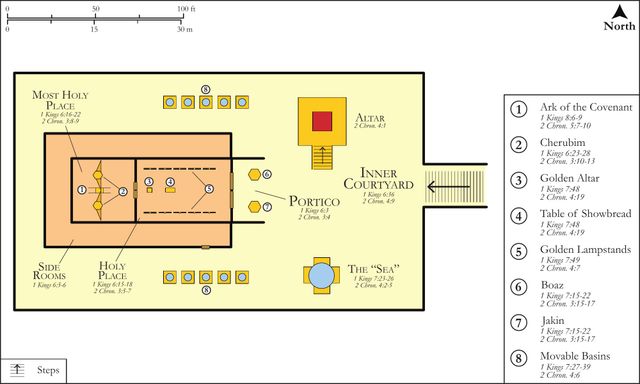
ShowHideThis term refers to the elaborate, multi-branched lampstands designed to hold oil lamps. While the Tabernacle featured a single menorah (Exodus 25:31), Solomon's Temple was equipped with ten, five positioned on each side of the Holy Place. This multiplication signifies an abundance of light, reflecting the magnified glory and increased scale of God's presence in the permanent sanctuary. Their primary function was to provide continuous illumination within the windowless Holy Place, symbolizing divine light and guidance.
This word specifically designates the Most Holy Place, or the Holy of Holies, the innermost and most sacred chamber of the Temple where the Ark of the Covenant resided. Derived from a root meaning "to speak," the term implies a "speaking place" or "inner sanctuary," signifying the location where God communed directly with His people, particularly through the high priest on the Day of Atonement. The lampstands being positioned "before the oracle" underscores their proximity to the very heart of God's immediate and revealed presence.
While the primary meaning of this root is "to shut up" or "to surrender," in this context, it functions idiomatically to denote "pure" or "unblemished." When applied to gold, as here ("pure gold"), it emphasizes the highest quality, unalloyed nature, and ceremonial cleanliness of the material. This purity was paramount for objects dedicated to divine service, symbolizing the holiness of God and the unblemished nature required for worship. It signified that only the most precious and incorruptible materials were deemed worthy for the dwelling of a holy God.
Verse Breakdown
ShowHide"Moreover the candlesticks with their lamps"
This initial phrase introduces the specific items being described: the substantial golden lampstands themselves, along with the individual lamps or bowls designed to hold the oil and wicks. This clarifies that the entire illuminating apparatus, not just the stands, was part of the divinely ordained design and material specification.
"that they should burn after the manner"
This clause indicates that the lamps were to be lit and meticulously maintained according to a specific, established ritual or custom. It implies a continuous burning, as was the practice in the Tabernacle (Exodus 27:20-21), ensuring that the Holy Place was never in darkness. This perpetual illumination symbolized God's unceasing presence, His constant watchfulness, and the unending nature of worship.
"before the oracle"
This phrase precisely locates the lampstands within the Temple's layout. They were situated in the Holy Place, immediately preceding the entrance to the Most Holy Place, the "oracle" or Holy of Holies. Their light, therefore, shone constantly towards the innermost sanctuary, emphasizing the profound sacredness of the space and the perpetual awareness of the divine presence residing within.
"of pure gold"
This concluding phrase reiterates the material composition, underscoring the extraordinary value, durability, and symbolic purity of these sacred objects. The use of pure, unalloyed gold reinforced the holiness of the Temple, the preciousness of God's presence, and the unblemished, perfect nature required for all aspects of worship and service to Him.
Literary Devices
ShowHideThe verse predominantly employs Symbolism and Emphasis through Material Description. The "candlesticks with their lamps" are profoundly symbolic, representing divine light, God's illuminating presence, and spiritual truth. Their continuous burning signifies God's enduring nature, His perpetual watchfulness, and the unceasing worship and service offered in His sanctuary. The phrase "before the oracle" symbolically places these objects in the immediate vicinity of God's most sacred dwelling, highlighting the profound holiness and the constant awareness of His presence. The repeated mention of "pure gold" (both here and in the subsequent verse, 2 Chronicles 4:21) serves as a powerful form of Emphasis. This reiteration underscores the immense value, incorruptibility, and divine standard applied to the Temple's furnishings. Gold itself is a potent symbol of divinity, royalty, purity, and supreme worth, reinforcing the sanctity and glory of God's house.
Theological and Thematic Connections
ShowHideThe golden lampstands in Solomon's Temple, perpetually burning before the oracle, serve as a profound theological symbol. They represent God's unceasing presence, His role as the ultimate source of all light and truth, and His constant illumination of the path for humanity. Just as the physical light dispelled darkness in the sanctuary, God's spiritual light reveals His character, His will, and His redemptive plan. This imagery establishes a powerful connection between the Old Testament sanctuary and the New Testament revelation of God's dwelling among His people, not confined to a physical structure, but through the person of Jesus Christ and the indwelling of His Spirit. The meticulous design and "pure gold" material speak volumes about the holiness of God and the unblemished purity required of those who would approach Him in worship. This foreshadows the perfect and unblemished sacrifice of Christ, which alone makes true access to God possible and acceptable.
Reflection and Application
ShowHideThe golden lampstands, burning continuously before the oracle, offer a rich tapestry for reflection on our own spiritual lives and the nature of our worship. They serve as a powerful reminder that God's presence is constant, illuminating, and ever-present, and that our lives, like those ancient lamps, are meant to perpetually reflect His divine light into a world often shrouded in spiritual darkness. The emphasis on "pure gold" challenges us to deeply consider the quality and integrity of our offerings to God—not merely material possessions, but our time, talents, affections, and character. Are they pure, unblemished, and given with wholehearted devotion, free from compromise or ulterior motives? Just as the lamps dispelled the physical darkness of the Holy Place, believers are called to be agents of spiritual light in their communities and beyond. This involves living lives of integrity, speaking truth with grace, demonstrating selfless love, and actively pointing others to the ultimate source of light, Jesus Christ. Our worship, whether expressed corporately in community or individually in private devotion, should be continuous, intentional, and pure, a constant burning before the "oracle" of God's indwelling presence within us and among us.
Questions for Reflection
ShowHideFAQ
ShowHideWhy were there ten lampstands in Solomon's Temple, unlike the single one in the Tabernacle?
ShowHideThe increase from one lampstand in the portable Tabernacle to ten in Solomon's permanent Temple (five on each side of the Holy Place) reflects the magnified glory, immense wealth, and established permanence of the new sanctuary. Solomon's Temple was a much larger and grander structure than the Tabernacle, necessitating more sources of light to adequately illuminate the expanded Holy Place. This multiplication also symbolized the abundant provision and manifest presence of God in a more magnificent dwelling, befitting the zenith of Israel's kingdom and the era of peace and prosperity under Solomon's reign. It underscored the increased splendor and divine favor upon the nation.
What is the significance of the "oracle" in this verse?
ShowHideThe "oracle" (Hebrew: dᵉbîyr) refers to the Most Holy Place, or Holy of Holies, which was the innermost and most sacred chamber of the Temple. This was the exclusive location where the Ark of the Covenant was kept, symbolizing the very throne and dwelling place of God's special, covenantal presence among His people. The term dᵉbîyr itself means "speaking place," indicating that it was the sacred space where God communed with His people, particularly through the high priest on the annual Day of Atonement. The lampstands were positioned in the Holy Place, directly before this innermost sanctuary, signifying that their light shone perpetually toward the very heart of God's dwelling, emphasizing the constant awareness of His holy and revealing presence.
Why was "pure gold" used for the lampstands and other Temple furnishings?
ShowHideThe use of "pure gold" for the lampstands and other sacred vessels was profoundly significant. In Scripture, gold was recognized as the most precious, incorruptible, and radiant metal, symbolizing divinity, purity, immense value, and permanence. Its unblemished nature represented the absolute holiness of God and the unblemished character required for His service and worship. By using only pure gold, the Israelites demonstrated that nothing less than the absolute best and most precious was fitting for God's dwelling and the sacred rituals performed in His presence. It underscored the sanctity of the Temple, the preciousness of God's presence, and the high standards of purity, devotion, and excellence expected in His service.
Christ-Centered Fulfillment
ShowHideThe golden lampstands of Solomon's Temple, burning continuously before the oracle, find their ultimate fulfillment and greater reality in the person and work of Jesus Christ. Just as the physical lamps provided essential light in the earthly sanctuary, Jesus unequivocally declares Himself to be the "light of the world" in John 8:12, dispelling the spiritual darkness of sin, ignorance, and death. He is the true and perfect illumination, the one through whom God's very nature and presence are fully revealed (John 1:4-5). Moreover, if the "oracle" was the "speaking place" where God communed with His people, then Jesus is the ultimate "oracle," the very Word of God made flesh (John 1:14), through whom God speaks directly, intimately, and definitively to humanity. The "pure gold" of the lampstands, symbolizing purity, divine worth, and incorruptibility, powerfully points to Christ's perfect, sinless nature and His infinitely precious, unblemished sacrifice, which alone grants true, unhindered access to God's holy presence. As believers, we are now called to be "the light of the world" (Matthew 5:14-16), reflecting the light of Christ in a dark and broken world, just as the Temple's lamps continuously burned before God. Our lives, empowered by the Holy Spirit, are to be a constant, pure, and illuminating witness to the glory of the one who is the true Lamb of God and the Light of the World.