


Ezra 6:8
- וּמִנִּיu·mi·Niand from meH4481Conj-w ¦ Prep ¦ 1csPrepositionוּandמִנִּfromיme
- שִׂיםsimit is madeH7761V-Peil-Perf-3msVerb Peil Perfect 3rd Singular Masculine
- טְעֵםte·'Ema decreeH2942N-csNoun Singular common gender Absolute
- לְמָאle·Ma'to whateverH3964Prep-l ¦ InterrogPronoun Interrogativeלְtoמָאwhatever
- דִיdithatH1768ConjConjunction
- תַעַבְדוּןta·'av·Dunyou will doH5648V-Peal-Imperf-2mpVerb Peal Imperfect 2nd Plural Masculine
- עִם'imwithH5974PrepPreposition
- שָׂבֵיsa·Vei[the] elders ofH7868N-mpcNoun Plural Masculine Construct
- יְהוּדָיֵאye·hu·da·Ye'Jews theH3062N-mp ¦ ArtNoun Gentilic Plural Masculine DefiniteיְהוּדָיֵJewsאthe
- אִלֵּךְ'i·LekhtheseH479PrtParticle Demonstrative
- לְמִבְנֵאle·miv·Ne'to buildH1124Prep-l ¦ V-Qal-InfVerb Qal Infinitive Constructלְtoמִבְנֵאbuild
- בֵּיתbeit[the] house ofH1005N-cscNoun Singular common gender Construct
- אֱלָהָא'e·la·Ha'<the> GodH426N-cs ¦ ArtNoun Singular common gender Definiteאֱלָהָ<the>אGod
- דֵךְDekhthisH1791PrtParticle Demonstrative
- וּמִנִּכְסֵיu·mi·nikh·Seiand from [the] properti<es> ofH5232Conj-w ¦ Prep-m ¦ N-mpcNoun Plural Masculine Constructוּandמִfromנִּכְסֵי[the] properti<es> of
- מַלְכָּאmal·Ka'king theH4430N-cs ¦ ArtNoun Singular common gender Definiteמַלְכָּkingאthe
- דִּיdiwhichH1768ConjConjunction
- מִדַּתmi·Dat[is] [the] tribute ofH4061N-fscNoun Singular Feminine Construct
- עֲבַר'a·Var[the] region beyondH5675N-cscNoun Singular common gender Construct
- נַהֲרָהna·ha·Rah'river theH5103N-cs ¦ ArtNoun Singular common gender Definiteנַהֲרָriverהthe
- אָסְפַּרְנָא'a·se·Par·na'diligentlyH629AdvAdverb
- נִפְקְתָאnif·ke·Ta'expense theH5313N-fs ¦ ArtNoun Singular Feminine Definiteנִפְקְתָexpenseאthe
- תֶּהֱוֵאte·he·Ve'let it beH1934V-Peal-Imperf-3fsVerb Peal Imperfect 3rd Singular Feminine
- מִתְיַהֲבָאmit·ya·ha·Va'givenH3052V-Hitpael-Prtcpl-fsVerb Hitpael Participle Singular Feminine Absolute
- לְגֻבְרַיָּאle·guv·rai·Ya'to men theH1400Prep-l ¦ N-mp ¦ ArtNoun Plural Masculine Definiteלְtoגֻבְרַיָּmenאthe
- אִלֵּךְ'i·LekhtheseH479PrtParticle Demonstrative
- דִּיdithatH1768ConjConjunction
- לָאla'notH3809NegParticle Negative
- לְבַטָּלָאle·va·ta·La'to make to ceaseH989Prep-l ¦ V-Piel-InfVerb Piel Infinitive Constructלְtoבַטָּלָאmake to cease
English is a literal word-by-word gloss of the Hebrew, not the KJV's wording. Why?
This is the original text the KJV's translators worked from — each Hebrew word with its own literal English meaning in this verse, prepared by scholars at Tyndale House, Cambridge. The KJV translates whole sentences, not word by word, so its wording differs: one Hebrew word can become several English words, and the KJV may choose “the LORD” where the gloss reads “Yahweh”. Both are faithful — they answer different questions. For the KJV's own rendering, switch to the KJV text.
Details
See on the biblical-era map
Study this verse
Public-domain commentary
Matthew Henry
From his Commentary on the Whole Bible. Henry comments on passages, not single verses — this entry covers Ezra 6:1–12. His four-level outline is real structure in the source text, so it is rendered as structure.
We have here, I. The decree of Cyrus for the building of the temple repeated. To this the Samaritans referred because the Jews pleaded it, and perhaps hoped it would not be found, and then their plea would be over-ruled and a stop put to their work. Search was ordered to be made for it among the records; for, it seems, the tribes had not taken care to provide themselves with an authentic copy of it, which might have stood them in good stead, but they must appeal to the original. It was looked for in Babylon (Ezr 6:1), where Cyrus was when he signed it. But, when it was not found there, Darius did not make that a pretence to conclude that therefore there was no such decree, and thereupon to give judgment against the Jews; but it is probable, having himself heard that such a decree was certainly made, he ordered the rolls in other places to be searched, and at length it was found at Achmetha, in the province of the Medes, Ezr 6:2. Perhaps some that durst not destroy it, yet hid it there, out of ill will to the Jews, that they might lose the benefit of it. But Providence so ordered that it came to light; and it is here inserted, Ezr 6:3-5. 1. Here is a warrant for the building of the temple: Let the house of God at Jerusalem, yea, let that house be built (so it may be read), within such and such dimensions, and with such and such materials. 2. A warrant for the taking of the expenses of the building out of the king's revenue, Ezr 6:4. We do not find that they had received what was here ordered them, the face of things at court being soon changed. 3. A warrant for the restoring of the vessels and utensils of the temple, which Nebuchadnezzar had taken away (Ezr 6:5), with an order that the priests, the Lord's ministers, should return them all to their places in the house of God.
II.The confirmation of it by a decree of Darius, grounded upon it and in pursuance of it.
1.The decree of Darius is very explicit and satisfactory.
(1.)He forbids his officers to do any thing in opposition to the building of the temple. The manner of expression intimates that he knew they had a mind to hinder it: Be you far hence (Ezr 6:6); let the work of this house of God alone, Ezr 6:7. Thus was the wrath of the enemy made to praise God and the remainder thereof did he restrain.
(2.)He orders them out of his own revenue to assist the builders with money,
[1.]For carrying on the building, Ezr 6:8. Herein he pursues the example of Cyrus, Ezr 6:4.
[2.]For maintaining the sacrifices there when it was built, Ezr 6:9. He ordered that they should be supplied with every thing they wanted both for burnt-offerings and meat-offerings. He was content it should be a rent-charge upon his revenue, and ordered it to be paid every day, and this without fail, that they might offer sacrifices and prayers with them (for the patriarchs, when they offered sacrifice, called on the name of the Lord, so did Samuel, Elijah, and others) for the life (that is, the happiness and prosperity) of the king and his sons, Ezr 6:10. See here how he gives honour, First, To Israel's God, whom he calls once and again the God of heaven. Secondly, To his ministers, in ordering his commissioners to give out supplies for the temple service at the appointment of the priests. Those that thought to control them must now be, in this matter, at their command. It was a new thing for God's priests to have such an interest in the public money. Thirdly, To prayer: That they may pray for the life of the king. He knew they were a praying people, and had heard that God was nigh to them in all that which they called upon him for. He was sensible he needed their prayers and might receive benefit by them, and was kind to them in order that he might have an interest in their prayers. It is the duty of God's people to pray for those that are in authority over them, not only for the good and gentle, but also for the forward; but they are particularly bound in gratitude to pray for their protectors and benefactors; and it is the wisdom of princes to desire their prayers, and to engage them. Let not the greatest princes despise the prayers of the meanest saints; it is desirable to have them for us, and dreadful to have them against us.
(3.)He enforces his decree with a penalty (Ezr 6:11): "Let none either oppose the work and service of the temple or withhold the supports granted to it by the crown upon pain of death. If any alter this decree, let him be (hanged before his own door as we say), hanged upon a beam of his own house, and, as an execrable man, let his house be made a dunghill."
(4.)He entails a divine curse upon all those kings and people that should ever have any hand in the destruction of this house, Ezr 6:12. What he would not do himself for the protection of the temple he desired that God, to whom vengeance belongs, would do. This bespeaks him zealous in the cause; and though this temple was, at length, most justly destroyed by the righteous hand of God, yet perhaps the Romans, who were the instruments of that destruction, felt the effects of this curse, for that empire sensibly declined ever after.
2.From all this we learn,
(1.)That the heart of kings is in the hand of God, and he turns it which way soever he pleases; what they are he makes them to be, for he is King of kings.
(2.)That when God's time has come for the accomplishing of his gracious purposes concerning his church he will raise up instruments to promote them from whom such good service was not expected. The earth sometimes helps the woman (Rev 12:16), and those are made use of for the defence of religion who have little religion themselves.
(3.)That what is intended for the prejudice of the church has often, by the overruling providence of God, been made serviceable to it, Phi 1:12. The enemies of the Jews, in appealing to Darius, hoped to get an order to suppress them, but, instead of that, they got an order to supply them. Thus out of the eater comes forth meat. The apocryphal Esdras (or Ezra), Book 1 ch. 3 and 4, gives another account of this decree in favour of the Jews, that Darius had vowed that if ever he came to the kingdom he would build the temple at Jerusalem, and that Zerubbabel, who was one of his attendants (whereas it is plain here that he was now at Jerusalem), for making an ingenious discourse before him on that subject (Great is the truth and will prevail), was told to ask what recompence he would, and asked only for this order, in pursuance of the king's vow.
Historical interpretation
Historical reception
1 surviving comment on this verse from the historical church.
But also it has been commanded by me, etc. For who could explain how much the Church has been aided or even enriched throughout the world by the liberality of royal gifts? Although it can also be understood allegorically, that expenses from the king's treasury are allotted to the work of the temple, when some from the family of secular princes come to the faith of Christ, with the princes themselves favoring them; who, as it were, were in the king's treasury, while they were privy to royal secrets. But they are given to the elders, that is, the senior Jews, for the expenses of the work of the temple, while to those who have preceded in the confession of Christ, entrusted to the teachers for education, and uniting to the members of the Church; such as Cassiodorus, formerly a senator, suddenly a doctor of the Church; who, while carefully considering what Ambrose, what Hilary, what Augustine, what Cyril, what John, what other brothers said in the exposition of the Psalms, which he made excellently, undoubtedly proved himself taught by the senior Jews, that is, the confessors and praisers. The subsequent statement is similar to this:
Continue studying Ezra 6:8 across the web’s major study libraries — every link below opens this exact verse, chapter, or book on the destination site.
Read & Compare
 BibleGatewayThis verse in more than 200 translations and 70 languages.
 Bible.comThe YouVersion reader — hundreds of translations, reading plans, and highlights.
 ESV.orgCrossway's official English Standard Version reader.
 NET BibleThe NET translation with 60,000+ translators' notes on every rendering decision.
 STEP BibleTyndale House's free study tool — original text, vocabulary, and scholarly resources.
 BibliaLogos Bible Software's free web reader.
 USCCBThe New American Bible (Revised Edition) with the U.S. bishops' study notes.
Commentaries
 BibleHub CommentariesDozens of classic commentaries on this verse, gathered on one page.
 StudyLightMore than 100 commentary sets — the largest collection on the web.
 BibleRefPlain-English commentary on what this verse means, verse by verse.
 Enduring WordDavid Guzik's free commentary on this chapter, widely used by Bible teachers.
 Bible Study ToolsVerse commentary alongside Greek and Hebrew study aids.
Original Language & Research
- BibleHub InterlinearThe verse word by word — original language, transliteration, and English.
- BibleHub LexiconEvery word's original-language definition and Strong's entry.
 Blue Letter BibleDeep-study tools — Strong's numbers, concordance, and word studies.
 SefariaThe Hebrew text with Rashi and centuries of Jewish commentary.
Sermons, Hymns & Audio


TrulyRandomVerse is not affiliated with these sites and doesn’t control their content. They’re linked because they’re genuinely useful.
Summary
Ezra 6:8 records a profound decree issued by King Darius I of Persia, which not only reaffirmed Cyrus's earlier mandate but significantly enhanced it by commanding that royal funds, specifically taxes collected from the Trans-Euphrates satrapy, be immediately disbursed to support the rebuilding of the Temple in Jerusalem. This royal edict ensured that the Jewish elders and workers would receive all necessary expenses without delay, thereby decisively preventing any further hindrance to the sacred construction project. It stands as a powerful testament to God's sovereign hand, orchestrating even the most powerful pagan rulers to fulfill His divine purposes for His people and the restoration of His house.
Context
ShowHideLiterary Context
Ezra 6:8 is situated within the dramatic narrative of the post-exilic return and the rebuilding of the Second Temple in Jerusalem. Following King Cyrus's initial decree permitting the Jews to return and commence construction (Ezra 1:1-4), the work began but soon faced significant and persistent opposition from surrounding peoples, leading to its cessation for many years, as recorded in Ezra 4:24. Divine intervention then came through the prophets Haggai and Zechariah, who powerfully exhorted the disheartened remnant to resume the sacred task (Haggai 1:1-11; Zechariah 4:6-10). When Tatnai, the governor of the Trans-Euphrates region, questioned the authority of the Jewish leaders and sought clarification from King Darius, the king ordered a search of the royal archives. Upon the discovery of Cyrus's original decree in Ecbatana (Ezra 6:1-5), Darius not only reaffirmed it but issued an even more stringent and detailed mandate, including severe penalties for those who would obstruct the work. Verse 8 specifically articulates the crucial financial provision that was to be given "forthwith," ensuring the project's unhindered completion.
Historical & Cultural Context
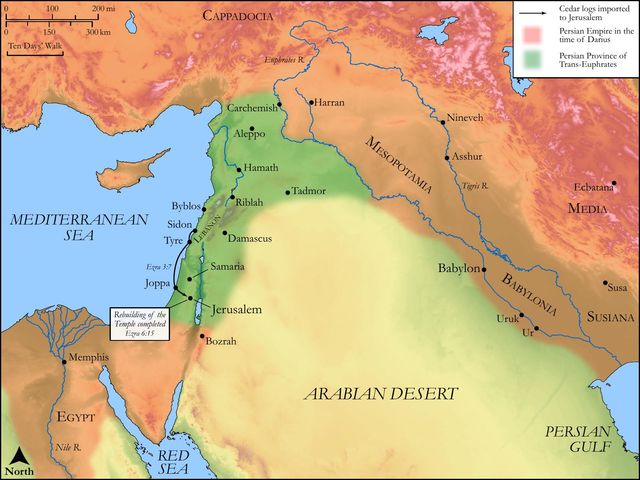
The Persian Empire, under the astute leadership of Darius I (522-486 BC), was an expansive and meticulously organized dominion. It was systematically divided into satrapies (provinces) for efficient administrative control and taxation. The region referred to as "beyond the river" (Trans-Euphrates, or Abar-Nahara in Aramaic) was a strategically vital satrapy encompassing territories west of the Euphrates River, including Judah, Syria, Phoenicia, and Samaria. The "tribute" collected from this region constituted a significant portion of the Persian crown's revenue. Darius's extraordinary decree to redirect these imperial funds toward the construction of the Jewish Temple was an exceptional act of royal patronage. This decision likely stemmed from a combination of factors: upholding the legal precedent set by Cyrus, a pragmatic desire to maintain stability and order within his vast empire by appeasing a significant religious group, and perhaps a degree of respect for the sanctity of the Jewish God, whose power was evident in the historical accounts of the region. This unprecedented financial backing from the world's superpower would have been perceived by the returning exiles as a profound demonstration of divine favor and provision.
Key Themes
ShowHideThis verse powerfully illustrates several enduring themes within the book of Ezra and the overarching biblical narrative. Firstly, it underscores Divine Sovereignty and Providence, showcasing God's unparalleled ability to utilize even pagan rulers like Darius—and earlier, Cyrus (Ezra 1:1)—to accomplish His redemptive purposes and meticulously provide for His people's needs from unexpected sources. This demonstrates that God's plans are not contingent on human will or political alignment but can powerfully leverage them for His glory. Secondly, it highlights the Centrality of God's House and Worship. The Temple was not merely a building; it was the focal point of Israel's identity, their covenant relationship with God, and the prescribed place of worship. Its rebuilding was therefore a spiritual imperative, a restoration of their communal life with God. The immediate and unhindered provision emphasizes the divine priority placed on the establishment and flourishing of true worship. Finally, the decree speaks directly to Overcoming Opposition. The Temple work had been maliciously halted by adversaries (Ezra 4:4-5), but Darius's decree, fortified by royal authority, substantial financial backing, and the explicit threat of severe penalties for obstruction (Ezra 6:11-12), represents God's active and decisive intervention to protect His people and ensure His will is carried out despite human resistance.
Exposition and Analysis
ShowHideKey Word Analysis
ShowHideThis term, derived from a root meaning "flavor," figuratively signifies "judgment" or "account." In this context, it refers to a formal, authoritative command or edict issued by the king. Darius's "decree" here is not merely a suggestion but a binding royal mandate, carrying the full weight of imperial authority, ensuring compliance and the immediate provision of funds for the Temple's construction. Its issuance underscores the king's absolute power and his determination to see the project completed.
Meaning "an outgo" or "expense," this word refers to the necessary financial provisions or costs required for the building project. The decree specifies that these expenses are to be given "forthwith," highlighting the king's commitment to ensuring that the work would not be delayed or hindered by a lack of funds. This direct allocation of royal revenue for a religious project of a subjugated people was an extraordinary act of patronage, demonstrating the king's serious intent.
This Aramaic verb means "to stop," "to cease," or "to be idle." Its inclusion reveals the primary concern addressed by Darius's decree: preventing any further cessation or obstruction of the Temple work, which had previously been halted by adversaries (Ezra 4:24). The decree, backed by royal authority and financial support, aimed to ensure that such hindrances would no longer be effective, thereby guaranteeing the continuous progress of the sacred construction.
Verse Breakdown
ShowHide"Moreover I make a decree what ye shall do to the elders of these Jews for the building of this house of God:"
This opening clause unequivocally establishes King Darius's supreme authority and the specific beneficiaries and purpose of his command. Darius, as the reigning monarch, issues a binding edict directly to his provincial governors ("ye shall do"), outlining their precise responsibilities toward the Jewish elders who are overseeing the Temple's reconstruction. The designation "this house of God" underscores the sacred nature of the project and implies Darius's recognition, or at least acknowledgment, of the God of Israel.
"that of the king's goods, [even] of the tribute beyond the river, forthwith expenses be given unto these men,"
This is the pivotal instruction regarding the financial provision. Darius commands that the necessary funds ("expenses") for the Temple's construction be drawn directly from the royal treasury ("king's goods") and, more specifically, from the tax revenues ("tribute") collected from the Trans-Euphrates satrapy. The inclusion of "forthwith" emphasizes the immediate, non-negotiable, and urgent nature of this financial support, ensuring that resources would be available without any bureaucratic delays.
"that they be not hindered."
This concluding clause articulates the explicit purpose and desired outcome of the decree's generous financial provision. The immediate and substantial funding was strategically designed to remove any financial obstacles or pretexts for opposition that could impede the progress of the Temple's rebuilding. It reflects Darius's firm determination to see the project completed without further interruption, thereby securing stability and order in his realm by supporting the religious practices of a significant segment of his populace.
Literary Devices
ShowHideThe passage primarily functions as a Royal Edict or Decree, a formal and authoritative pronouncement from the king, characterized by its imperative tone and direct commands. This genre underscores the absolute power of the Persian monarch and the binding nature of his word throughout the empire. There is a profound element of Divine Irony and Providence at play; the very taxes collected by a pagan empire, initially intended for its own imperial coffers, are now commanded by the king to be redirected to fund the worship of the God of Israel. This unexpected and extraordinary source of provision highlights God's sovereign control over nations and their rulers, turning what was meant for imperial gain into a means for His redemptive purposes. The adverb "forthwith" serves as a powerful Emphasis, underscoring the urgency, immediacy, and non-negotiable nature of the king's command regarding the provision, ensuring that no further delays would impede the sacred work.
Theological and Thematic Connections
ShowHideEzra 6:8 stands as a profound testament to God's unwavering faithfulness and His sovereign ability to provide for His people and His work, even through unexpected and seemingly unlikely channels. It vividly reveals that God's plans are not dependent on human resources, political alignments, or the absence of opposition, but can powerfully leverage them for His glory. Darius's decree is a clear demonstration that "the king's heart is in the hand of the Lord, like the rivers of water; He turns it wherever He wishes" Proverbs 21:1. This divine orchestration ensures that His purposes for His people and the establishment of His worship will ultimately prevail, regardless of human resistance or scarcity. It teaches believers to look beyond conventional means for God's provision and to trust in His boundless capacity to supply all that is needed for His Kingdom work, affirming His commitment to His covenant people.
Reflection and Application
ShowHideEzra 6:8 offers profound encouragement for believers today, serving as a powerful reminder that God remains actively involved in the affairs of humanity and is fully capable of providing for His work in the world. Just as He moved the heart of a pagan king to not only permit but also fund the rebuilding of His Temple, He can stir the hearts of individuals, institutions, and even governments to support His Kingdom initiatives today. This verse calls us to cultivate a deep trust in God's provision, even when resources seem scarce, opposition is strong, or the path forward appears uncertain. It also challenges us, as members of God's people, to be diligent and generous in our support of ministry, ensuring that those engaged in God's work are not "hindered" by a lack of necessary resources. Our prayers, our financial contributions, and our active participation are vital components that contribute to the unhindered progress of the gospel and the building up of God's spiritual house. Ultimately, this passage fosters perseverance in the face of adversity, instilling confidence that God will always ensure His divine purposes are accomplished.
Questions for Reflection
ShowHideFAQ
ShowHideWhy was King Darius so supportive of the Jewish Temple rebuilding project?
ShowHideDarius's support for the Jewish Temple rebuilding project stemmed from a confluence of factors, both pragmatic and providential. Firstly, upon investigation, he discovered and confirmed the original decree of King Cyrus (Ezra 6:1-5), which legally authorized the rebuilding. As a meticulous administrator and a king who valued order, stability, and the upholding of imperial decrees, Darius would have felt compelled to honor the mandates of his predecessors. Secondly, supporting the religious practices of his subjects, particularly those who committed to praying for the king and his sons (Ezra 6:10), was a common and shrewd strategy for maintaining peace, loyalty, and preventing unrest within his vast and diverse empire. By providing royal funds and protection, Darius ensured the project's completion, thereby securing the allegiance of the Jewish community and promoting stability in a key satrapy. Ultimately, from a biblical perspective, God was sovereignly working through Darius's political motivations and administrative principles to accomplish His divine will, just as He had done with Cyrus (Isaiah 45:1-3), demonstrating His ability to use even pagan rulers for His redemptive purposes.
Christ-Centered Fulfillment
ShowHideWhile Ezra 6:8 details the provision for a physical temple, its ultimate fulfillment points profoundly to the person and redemptive work of Jesus Christ, who is the true and ultimate Temple of God. The immediate and unhindered provision for the Old Testament Temple foreshadows God's perfect, complete, and unceasing provision for the spiritual Temple, which is the church, built upon the foundation of the apostles and prophets, with Christ Jesus Himself as the chief cornerstone (Ephesians 2:19-22). Just as Darius's decree ensured the physical structure could be completed without hindrance, Christ's sacrificial death and glorious resurrection provide the full and final means for humanity to access God, tearing down the veil that separated humanity from the Most Holy Place (Hebrews 10:19-20). He is the Lamb of God who takes away the sin of the world (John 1:29), providing the ultimate "expenses"—His very lifeblood—for our spiritual rebuilding, reconciliation with God, and eternal dwelling. Through Him, believers become living stones, actively built into a spiritual house for a holy priesthood (1 Peter 2:5), and God promises to supply all our needs according to His riches in glory in Christ Jesus (Philippians 4:19), ensuring that His redemptive work in and through His people will never be hindered.