


Ezra 7:1
- וְאַחַרve·'a·Charand afterH310Conj-w ¦ Adj-mscAdjective Numerical Singular Masculine Constructוְandאַחַרafter
- הַדְּבָרִיםha·de·va·Rimthe thingsH1697Art ¦ N-mpNoun Plural Masculine Absoluteהַtheדְּבָרִיםthings
- הָאֵלֶּהha·'E·leh<the> theseH428Art ¦ PrtParticle Demonstrativeהָ<the>אֵלֶּהthese
- בְּמַלְכוּתbe·mal·Khutin [the] reign ofH4438Prep-b ¦ N-fscNoun Singular Feminine Constructבְּinמַלְכוּת[the] reign of
- אַרְתַּחְשַׁסְתְּא'ar·tach·Shast'ArtaxerxesH783N-proper-mNoun Proper Masculine
- מֶלֶךְMe·lekh[the] king ofH4428N-mscNoun Singular Masculine Construct
- פָּרָסpa·RasPersiaH6539N-properNoun Proper Location
- עֶזְרָא'ez·Ra'EzraH5830N-proper-mNoun Proper Masculine
- בֶּןben[the] son ofH1121N-mscNoun Singular Masculine Construct
- שְׂרָיָהse·ra·YahSeraiahH8304N-proper-mNoun Proper Masculine
- בֶּןben[the] son ofH1121N-mscNoun Singular Masculine Construct
- עֲזַרְיָה'a·zar·YahAzariahH5838N-proper-mNoun Proper Masculine
- בֶּןben[the] son ofH1121N-mscNoun Singular Masculine Construct
- חִלְקִיָּהchil·ki·YahHilkiahH2518N-proper-mNoun Proper Masculine
English is a literal word-by-word gloss of the Hebrew, not the KJV's wording. Why?
This is the original text the KJV's translators worked from — each Hebrew word with its own literal English meaning in this verse, prepared by scholars at Tyndale House, Cambridge. The KJV translates whole sentences, not word by word, so its wording differs: one Hebrew word can become several English words, and the KJV may choose “the LORD” where the gloss reads “Yahweh”. Both are faithful — they answer different questions. For the KJV's own rendering, switch to the KJV text.
Details
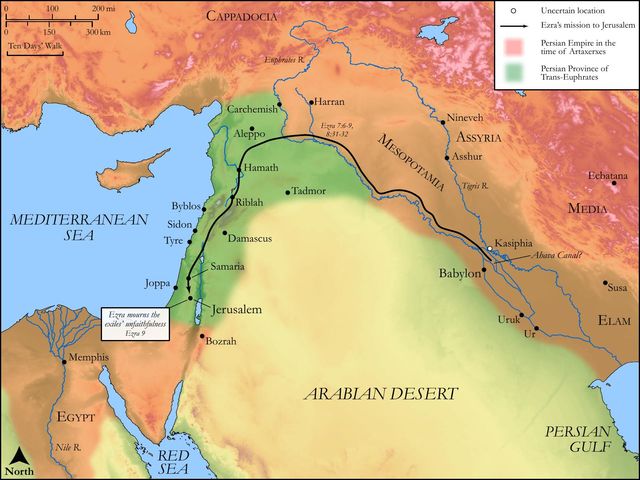
See on the biblical-era map
Study this verse
Public-domain commentary
Matthew Henry
From his Commentary on the Whole Bible. Henry comments on passages, not single verses — this entry covers Ezra 7:1–10. His three-level outline is real structure in the source text, so it is rendered as structure.
Here is, I. Ezra's pedigree. He was one of the sons of Aaron, a priest. Him God chose to be an instrument of good to Israel, that he might put honour upon the priesthood, the glory of which had been much eclipsed by the captivity. He is said to be the son of Seraiah, that Seraiah, as is supposed, whom the king of Babylon put to death when he sacked Jerusalem, Kg2 25:18, Kg2 25:21. If we take the shortest computation, it was seventy-five years since Seraiah died; many reckon it much longer, and, because they suppose Ezra called out in the prime of his time to public service, do therefore think that Seraiah was not his immediate parent, but his grandfather or great-grandfather, but that he was the first eminent person that occurred in his genealogy upwards, which is carried up here as high as Aaron, yet leaving out many for brevity-sake, which may be supplied from Ch1 6:4, etc. He was a younger brother, or his father was Jozadak, the father of Jeshua, so that he was not high priest, but nearly allied to the high priest.
II.His character. Though of the younger house, his personal qualifications made him very eminent.
1.He was a man of great learning, a scribe, a ready scribe, in the law of Moses, Ezr 7:6. He was very much conversant with the scriptures, especially the writings of Moses, had the words ready and was well acquainted with the sense and meaning of them. It is to be feared that learning ran low among the Jews in Babylon; but Ezra was instrumental to revive it. The Jews say that he collected and collated all the copies of the law he could find out, and published an accurate edition of it, with all the prophetical books, historical and poetical, that were given by divine inspiration, and so made up the canon of the Old Testament, with the addition of the prophecies and histories of his own time. If he was raised up of God, and qualified and inclined to do this, all generations have reason to call him blessed, and to bless God for him. God sent to the Jews prophets and scribes, Mat 23:34. Ezra went under the latter denomination. Now that prophecy was about to cease it was time to promote scripture-knowledge, pursuant to the counsel of God by the last of the prophets, Mal 4:4. Remember the law of Moses. Gospel ministers are called scribes instructed to the kingdom of heaven (Mat 13:52), New Testament scribes. It was a pity that such a worthy name as this should be worn, as it was in the degenerate ages of the Jewish church, by men who were professed enemies to Christ and his gospel (Woe unto you, scribes and Pharisees), who were learned in the letter of the law, but strangers to the spirit of it.
2.He was a man of great piety and holy zeal (Ezr 7:10): He had prepared his heart to seek the law of the Lord, etc.
(1.)That which he chose for his study was the law of the Lord. The Chaldeans, among whom he was born and bred, were famed for literature, especially the study of the stars, to which, being a studious man, we may suppose that Ezra was tempted to apply himself. But he got over the temptation; the law of his God was more to him than all the writings of their magicians and astrologers, which he knew enough of with good reason to despise them.
(2.)He sought the law of the Lord, that is, he made it his business to enquire into it, searched the scriptures, and sought the knowledge of God, of his mind and will, in the scriptures, which is to be found there, but not without seeking.
(3.)He made conscience of doing according to it; he set it before him as his rule, formed his sentiments and temper by it, and managed himself in his whole conversation according to it. This use we must make of our knowledge of the scriptures; for happy are we if we do what we know of the will of God.
(4.)He set himself to teach Israel the statutes and judgments of that law. What he knew he was willing to communicate for the good of others; for the ministration of the Spirit is given to every man to profit withal. But observe the method: he first learned and then taught, sought the law of the Lord and so laid up a good treasure, and then instructed others and laid out what he had laid up. He also first did and then taught, practised the commandments himself and then directed others in the practice of them; thus his example confirmed his doctrine.
(5.)He prepared his heart to do all this, or he fixed his heart. He took pains in his studies, and thoroughly furnished himself for what he designed, and then put on resolution to proceed and persevere in them, and thus he became a ready scribe. Moses in Egypt, Ezra in Babylon, and both in captivity, were wonderfully fitted for eminent services to the church.
III.His expedition to Jerusalem for the good of his country:
He went up from Babylon (Ezr 7:6), and, in four months' time, came to Jerusalem, Ezr 7:8. It was strange that such a man as he staid so long in Babylon after his brethren had gone up; but God sent him not thither till he had work for him to do there; and none went but those whose spirits God raised to go up. Some think that this Artaxerxes was the same with that Darius whose decree we had (ch. 6), and that Ezra came the very year after the temple was finished: that was the sixth year, this the seventh (v. 8), so Dr. Lightfoot. My worthy and learned friend, lately deceased, Mr. Talents, in his chronological tables, places it about fifty-seven years after the finishing of the temple; others further on. I have only to observe,
1.How kind the king was to him. He granted him all his request, whatever he desired to put him into a capacity to serve his country.
2.How kind his people were to him. When he went many more went with him, because they desired not to stay in Babylon when he had gone thence, and because they would venture to dwell in Jerusalem when he had gone thither.
3.How kind his God was to him. He obtained this favour from his king and country by the good hand of the Lord that was upon him, v. 6, 9. Note, Every creature is that to us which God makes it to be, and from him our judgment proceeds. As we must see the events that shall occur in the hand of God, so we must see the hand of God in the events that do occur, and acknowledge him with thankfulness when we have reason to call it his good hand.
Continue studying Ezra 7:1 across the web’s major study libraries — every link below opens this exact verse, chapter, or book on the destination site.
Read & Compare
 BibleGatewayThis verse in more than 200 translations and 70 languages.
 Bible.comThe YouVersion reader — hundreds of translations, reading plans, and highlights.
 ESV.orgCrossway's official English Standard Version reader.
 NET BibleThe NET translation with 60,000+ translators' notes on every rendering decision.
 STEP BibleTyndale House's free study tool — original text, vocabulary, and scholarly resources.
 BibliaLogos Bible Software's free web reader.
 USCCBThe New American Bible (Revised Edition) with the U.S. bishops' study notes.
Commentaries
 BibleHub CommentariesDozens of classic commentaries on this verse, gathered on one page.
 StudyLightMore than 100 commentary sets — the largest collection on the web.
 BibleRefPlain-English commentary on what this verse means, verse by verse.
 Enduring WordDavid Guzik's free commentary on this chapter, widely used by Bible teachers.
 Bible Study ToolsVerse commentary alongside Greek and Hebrew study aids.
Original Language & Research
- BibleHub InterlinearThe verse word by word — original language, transliteration, and English.
- BibleHub LexiconEvery word's original-language definition and Strong's entry.
 Blue Letter BibleDeep-study tools — Strong's numbers, concordance, and word studies.
 SefariaThe Hebrew text with Rashi and centuries of Jewish commentary.
Sermons, Hymns & Audio


TrulyRandomVerse is not affiliated with these sites and doesn’t control their content. They’re linked because they’re genuinely useful.
Summary
Ezra 7:1 serves as a pivotal transition in the book of Ezra, bridging the significant chronological gap between the initial return of exiles and the rebuilding of the Temple (chapters 1-6) and the subsequent spiritual reformation led by Ezra. This verse meticulously introduces Ezra, a key figure in post-exilic Judah, by establishing his historical context within the reign of Artaxerxes I and detailing his profound priestly lineage, thereby validating his spiritual and administrative authority for the comprehensive work of covenant restoration that lies ahead.
Context
ShowHideLiterary Context
Ezra 7:1 marks a dramatic and intentional shift in the book's narrative, following a substantial chronological gap of approximately 60 years after the dedication of the Second Temple, as recorded in Ezra 6:15. The preceding chapters meticulously detailed the physical restoration of Jerusalem and its worship infrastructure under the leadership of Zerubbabel and Joshua, focusing on the return from exile and the rebuilding of the Temple. This verse, with its opening phrase "Now after these things," signals a new and distinct phase in the post-exilic community's development, moving the narrative's focus from the physical reconstruction of the Temple to the spiritual reconstruction of the people through the Law. It introduces the book's second major protagonist, Ezra, whose arrival will catalyze a profound religious and reform, shifting the narrative's emphasis from temple construction to the critical importance of covenant fidelity and the diligent study and application of God's commands.
Historical & Cultural Context
The specific mention of "Artaxerxes king of Persia" refers to Artaxerxes I Longimanus, who reigned from 465 to 424 BC. Ezra's significant journey to Jerusalem is explicitly dated to the seventh year of this monarch's reign (approximately 458 BC), a detail further elaborated in Ezra 7:7. During this period, Judah existed as a relatively small province within the vast and powerful Achaemenid Persian Empire. Persian imperial policy, particularly under rulers like Cyrus and Darius, generally extended a degree of religious and cultural autonomy to conquered peoples, often supporting the restoration of local cults and traditions as a strategy for maintaining stability and loyalty across their diverse empire. This overarching policy provided the crucial political and administrative framework that enabled the Jewish exiles' return and their ambitious rebuilding efforts. Within this cultural milieu, the detailed genealogy provided for Ezra was not merely a historical record but a vital cultural and religious credential, establishing his social standing, legitimate priestly authority, and indisputable qualification for undertaking such a significant religious and administrative mission under imperial patronage.
Key Themes
ShowHideThis introductory verse immediately and powerfully highlights several key themes that are central not only to the book of Ezra but also to the broader post-exilic narrative. Firstly, it underscores the theme of Divine Timing and Providence, illustrating God's strategic and sovereign hand in raising up specific leaders for precise historical seasons—recognizing that after the physical temple was completed, a spiritual leader was critically needed to address the deeper issues of the community's heart. Secondly, it emphasizes the Importance of Righteous Leadership, as Ezra is presented as a man of impeccable heritage and divine calling, uniquely poised to guide the people back to God's commands and covenant. His very name, meaning "help" or "Yahweh helps," powerfully foreshadows his transformative role. Thirdly, the detailed Continuity of Priestly Lineage is paramount, connecting Ezra directly to the high priestly line of Aaron through Seraiah, who was the high priest at the time of Jerusalem's devastating destruction by Babylon, as recorded in 2 Kings 25:18-21. This meticulous lineage not only validated Ezra's inherent authority but also underscored the enduring nature of God's covenant with His people, even through periods of severe judgment and prolonged exile. This renewed emphasis on the Law and its proper observance becomes the dominant and driving theme from Ezra 7 onward.
Exposition and Analysis
ShowHideKey Word Analysis
ShowHideThis word, derived from a root meaning "the hind part," functions here as a crucial temporal marker, signifying a considerable passage of time and a sequential progression in the narrative. Its use immediately signals to the reader that the events about to be described occur subsequent to the preceding narrative, specifically the completion of the Temple, and introduces a new phase of the post-exilic history.
This versatile Hebrew term encompasses a wide semantic range, including "word," "matter," "affair," or "event." In this context, "these things" refers comprehensively to the preceding narrative of the exiles' return, the challenges faced, and the ultimate completion and dedication of the Second Temple (Ezra 1-6). It acts as a summary reference to the entire preceding historical account, setting the stage for the new developments.
While literally meaning "son," this term is used in its widest sense in Hebrew genealogies to denote lineal descent, including grandson, descendant, or even a member of a particular group. In Ezra's lengthy genealogy, "son of" indicates direct paternal lineage, meticulously tracing his ancestry through generations to establish his high priestly credentials and legitimate claim to authority.
Verse Breakdown
ShowHide"¶ Now after these things,"
This opening phrase serves as a significant temporal and narrative bridge. It indicates a considerable chronological gap (approximately 60 years) since the events of Ezra chapter 6, signaling a new section of the book and a shift in focus from the physical rebuilding of the Temple to the spiritual and legal restoration of the community.
"in the reign of Artaxerxes king of Persia,"
This clause precisely dates Ezra's mission, anchoring it firmly within the historical framework of the Achaemenid Persian Empire. The specific mention of Artaxerxes I Longimanus (465-424 BC) provides the vital political and imperial context in which Ezra operated and received his royal commission, highlighting the providential timing of his arrival.
"Ezra the son of Seraiah, the son of Azariah, the son of Hilkiah,"
This detailed genealogical fragment introduces Ezra and, more importantly, establishes his legitimate priestly authority. By tracing his lineage back through prominent high priests such as Seraiah (the last high priest before the exile) and Hilkiah (who rediscovered the Book of the Law during Josiah's reign), the text underscores Ezra's impeccable qualifications and divine appointment for the monumental task of restoring the Law and covenant fidelity among the returned exiles.
Literary Devices
ShowHideEzra 7:1 employs several significant literary devices to effectively introduce its protagonist and set the stage for the subsequent narrative. The phrase "Now after these things" functions as a clear Transition, signaling a major shift in both time and narrative focus within the book, moving from the physical rebuilding of the Temple to the crucial spiritual and legal restoration of the community. The extensive Genealogy provided for Ezra is not merely a list of names; it serves as a powerful device to establish his legitimacy, inherent authority, and direct connection to the historical high priestly line of Aaron, thereby validating his upcoming role as a religious reformer and interpreter of the Law. This detailed lineage also acts as a subtle but potent form of Foreshadowing, hinting at the profound impact Ezra will have, as his heritage links him directly to those who previously held significant roles in Israel's spiritual life, such as Hilkiah, who famously rediscovered the Book of the Law, and Seraiah, who witnessed the destruction of the first Temple.
Theological and Thematic Connections
ShowHideEzra 7:1 profoundly illustrates God's sovereign timing and His unwavering commitment to His covenant people, even through prolonged periods of exile and apparent dormancy. After the physical structure of the Temple was re-established, God, in His perfect wisdom, raised up Ezra—a man of impeccable priestly lineage, profound spiritual devotion, and scholarly acumen—to address the deeper spiritual and moral decay within the post-exilic community. This highlights a recurring biblical pattern: God provides the right leader for the right season, equipping individuals not just with natural abilities but with spiritual authority derived from their faithfulness and, in Ezra's case, their heritage and divine calling. The meticulous listing of Ezra's ancestry underscores the enduring nature of God's promises to the Levitical priesthood and His overarching intention to restore His people not just physically, but comprehensively and spiritually through a renewed adherence to His divine Law.
Reflection and Application
ShowHideEzra 7:1 invites us to consider God's strategic, patient, and purposeful work in the lives of individuals and communities throughout history. Just as Ezra was prepared over decades, honing his skills as a scribe and priest, and then called forth at a precise moment in history to lead a spiritual revival, so too does God prepare and call believers today for specific purposes within His grand redemptive plan. This verse encourages us to recognize that genuine spiritual restoration often follows or accompanies physical provision, emphasizing that true flourishing for God's people requires both a tangible presence (like the Temple) and, more critically, a vibrant spiritual life rooted in His Word. We are reminded of the profound importance of spiritual heritage, not as a source of self-righteous pride, but as a testament to God's faithfulness across generations and a foundational bedrock for present-day service and obedience. It challenges us to consider our own preparation and readiness for God's call, whether it involves personal spiritual discipline, leading others in faith, or engaging in the vital work of biblical literacy and discipleship within our spheres of influence. Our authority and effectiveness in ministry, like Ezra's, are ultimately rooted not in human credentials alone, but in our deep connection to God and His unchanging Word.
Questions for Reflection
ShowHideFAQ
ShowHideWhat is the significance of the 60-year gap between Ezra 6 and Ezra 7?
ShowHideThe 60-year gap between the completion of the Temple (around 516 BC, as recorded in Ezra 6:15) and Ezra's arrival in Jerusalem (around 458 BC, noted in Ezra 7:7) is highly significant and intentional. It highlights God's strategic timing and the evolving needs of the post-exilic community. While the physical structure of the Temple was rebuilt, the spiritual condition of the people had likely stagnated or even declined during this period, indicating that a physical edifice alone was insufficient for true restoration. The gap underscores that a spiritual revival, led by a dedicated scribe and priest like Ezra, was necessary to re-establish the Law and covenant fidelity among the returned exiles. This period also accounts for the reign of Xerxes I (Ahasuerus in the book of Esther) to occur chronologically between the events of Ezra 6 and Ezra 7, providing a fuller historical context for the broader Persian period.
Christ-Centered Fulfillment
ShowHideEzra 7:1, in its introduction of Ezra as a priest and scribe dedicated to the Law, powerfully points forward to the ultimate and perfect fulfiller of all these roles in the person of Jesus Christ. Ezra's divinely appointed mission was to restore the Law and bring the people back to covenant obedience, a necessary but ultimately incomplete work due to the pervasive nature of human sinfulness and the limitations of the Old Covenant. Jesus, however, is the one who perfectly fulfills the Law, not by abolishing its righteous demands but by bringing it to its intended purpose through His life, death, and resurrection (Matthew 5:17). As the true and greater High Priest, Jesus is not merely of a human lineage but of an eternal, unchangeable priesthood after the order of Melchizedek, offering a perfect and eternal sacrifice for sin that renders continuous atonement unnecessary (Hebrews 7:26-27). While Ezra brought spiritual aid and renewal through the diligent study and teaching of the written Law, Christ brings ultimate spiritual renewal and eternal life through the new covenant, which is supernaturally written on the hearts of believers by the Holy Spirit (Jeremiah 31:31-34). Ezra's diligent study and faithful teaching of God's Word profoundly foreshadow the living Word, Jesus, who is the full and final revelation of God's truth and grace (John 1:14 and John 1:17).