


Ezra 5:13
Bible text: King James Version (1769 Blayney text) · Public domain
Bible text: Berean Standard Bible · Public domain
Bible text: American Standard Version (1901) · Public domain
Bible text: World English Bible, Messianic edition · Public domain
Bible text: Geneva Bible (1599) · Public domain
Bible text: Young's Literal Translation · Public domain
- בְּרַםbe·RamneverthelessH1297AdvAdverb
- בִּשְׁנַתbish·Natin yearH8140Prep-b ¦ N-fscNoun Singular Feminine Constructבִּinשְׁנַתyear
- חֲדָהcha·DahoneH2298Adj-csAdjective Numerical Singular common gender Absolute
- לְכוֹרֶשׁle·Kho·reshof CyrusH3567Prep-l ¦ N-proper-mNoun Proper MasculineלְofכוֹרֶשׁCyrus
- מַלְכָּאmal·Ka'king theH4430N-cs ¦ ArtNoun Singular common gender Definiteמַלְכָּkingאthe
- דִּיdiofH1768ConjConjunction
- בָבֶלva·VelBabylonH895N-properNoun Proper Location
- כּוֹרֶשׁKo·reshCyrusH3567N-proper-mNoun Proper Masculine
- מַלְכָּאmal·Ka'king theH4430N-cs ¦ ArtNoun Singular common gender Definiteמַלְכָּkingאthe
- שָׂםsamhe madeH7761V-Peal-Perf-3msVerb Peal Perfect 3rd Singular Masculine
- טְעֵםte·'Ema decreeH2942N-csNoun Singular common gender Absolute
- בֵּיתbeit[the] house ofH1005N-cscNoun Singular common gender Construct
- אֱלָהָא'e·la·Ha'<the> GodH426N-cs ¦ ArtNoun Singular common gender Definiteאֱלָהָ<the>אGod
- דְנָהde·NahthisH1836PrtParticle Demonstrative
- לִבְּנֵאli·be·Ne'to buildH1124Prep-l ¦ V-Qal-InfVerb Qal Infinitive Constructלִtoבְּנֵאbuild
English is a literal word-by-word gloss of the Hebrew, not the KJV's wording. Why?
This is the original text the KJV's translators worked from — each Hebrew word with its own literal English meaning in this verse, prepared by scholars at Tyndale House, Cambridge. The KJV translates whole sentences, not word by word, so its wording differs: one Hebrew word can become several English words, and the KJV may choose “the LORD” where the gloss reads “Yahweh”. Both are faithful — they answer different questions. For the KJV's own rendering, switch to the KJV text.
Details
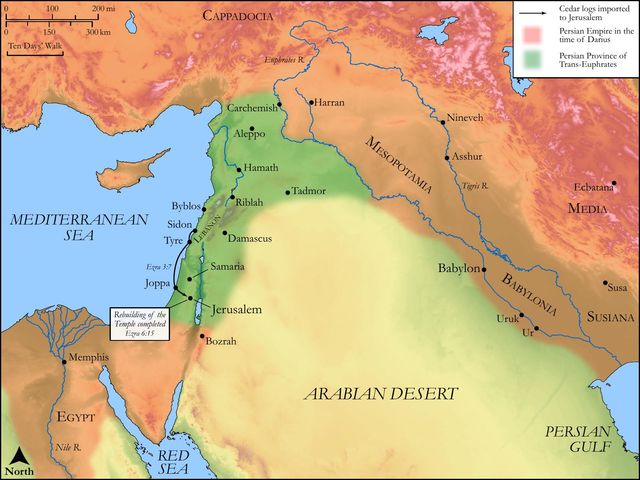
See on the biblical-era map
Study this verse
Public-domain commentary
Matthew Henry
From his Commentary on the Whole Bible. Henry comments on passages, not single verses — this entry covers Ezra 5:3–17. His two-level outline is real structure in the source text, so it is rendered as structure.
We have here, I. The cognizance which their neighbours soon took of the reviving of this good work. A jealous eye, it seems, they had upon them, and no sooner did the Spirit of God stir up the friends of the temple to appear for it than the evil spirit stirred up its enemies to appear against it. While the people built and ceiled their own houses their enemies gave them no molestation (Hag 1:4), though the king's order was to put a stop to the building of the city (Ezr 4:21); but when they fell to work again at the temple then the alarm was taken, and all heads were at work to hinder them, Ezr 5:3, Ezr 5:4. The adversaries are here named: Tatnai and Shethar-boznai. The governors we read of (ch. 4) were, it is probable, displaced at the beginning of this reign, as is usual. It is the policy of princes often to change their deputies, proconsuls, and rulers of provinces. These, though real enemies to the building of the temple, were men of better temper than the other, and made some conscience of telling truth. If all men have not faith (Th2 3:2), it is well some have, and a sense of honour. The church's enemies are not all equally wicked and unreasonable. The historian begins to relate what passed between the builders and those inquisitors (Ezr 5:3, Ezr 5:4), but breaks off his account, and refers to the ensuing copy of the letter they sent to the king, where the same appears more fully and at large, which he began to abridge (Ezr 5:4), or make an extract out of, though, upon second thoughts, he inserted the whole.
II.The care which the divine Providence took of this good work (Ezr 5:5):
The eye of their God was upon the elders of the Jews, who were active in the work, so that their enemies could not cause them to cease, as they would have done, till the matter came to Darius. They desired they would only cease till they had instructions from the king about it. But they would not so much as yield them that, for the eye of God was upon them, even their God. And,
1.That baffled their enemies, infatuated and enfeebled them, and protected the builders from their malicious designs. While we are employed in God's work we are taken under his special protection; his eye is upon us for good, seven eyes upon one stone in his temple; see Zac 3:9; Zac 4:10.
2.That quickened them. The elders of the Jews saw the eye of God upon them, to observe what they did and own them in what they did well, and then they had courage enough to face their enemies and to go on vigorously with their work, notwithstanding all the opposition they met with. our eye upon God, observing his eye upon us, will keep us to our duty and encourage us in it when the difficulties are ever so discouraging.
III.The account they sent to the king of this matter, in which we may observe,
1.How fully the elders of the Jews gave the Samaritans an account of their proceedings. They, finding them both busy and prosperous, that all hands were at work to run up this building and that it went on rapidly, put these questions to them: - "By what authority do you do these things, and who gave you that authority? Who set you to work? Have you that which will bear you out?" To this they answered that they had sufficient warrant to do what they did; for, (1.) "We are the servants of the God of heaven and earth. The God we worship is not a local deity, and therefore we cannot be charged with making a faction, or setting up a sect, in building this temple to his honour: but we pay our homage to a God on whom the whole creation depends, and therefore ought to be protected and assisted by all and hindered by none." It is the wisdom as well as duty of kings to countenance the servants of the God of heaven. (2.) "We have a prescription to this house; it was built for the honour of our God by Solomon many ages ago. It is no novel invention of our own; we are but raising the foundations of many generations," Isa 58:12. (3.) "It was to punish us for our sins that we were, for a time, put out of the possession of this house; not because the gods of the nations had prevailed against our God, but because we had provoked him (Ezr 5:12), for which he delivered us and our temple into the hands of the king of Babylon, but never intended thereby to put a final period to our religion. We were only suspended for a time, not deprived for ever." (4.) "We have the royal decree of Cyrus to justify us and bear us out in what we do. He not only permitted and allowed us, but charged and commanded us to build this house (Ezr 5:13), and to build it in its place (Ezr 5:15), the same place where it had stood before." He ordered this, not only in compassion to the Jews, but in veneration of their God, saying, He is the God. He also delivered the vessels of the temple to one whom he entrusted to see them restored to their ancient place and use, Ezr 5:14. And they had these to show in confirmation of what they alleged. (5.) "The building was begun according to this order as soon as ever we had returned, so that we have not forfeited the benefit of the order for want of pursuing it in time; still it has been in building, but, because we have met with opposition, it is not finished." But, observe, they mention not the falsehood and malice of the former governors, nor make any complaint of them, though they had cause enough, to teach us not to render bitterness for bitterness, nor the most just reproach for that which is most unjust, but to think it enough if we can obtain fair treatment for the future, without an invidious reference to former injuries, Ezr 5:16. This is the account they give of their proceedings, not asking what authority they had to examine them, nor upbraiding them with their idolatry, and superstitions, and medley religion. Let us learn hence with meekness and fear to give a reason of the hope that is in us (Pe1 3:15), rightly to understand, and then readily to declare, what we do in God's service and why we do it.
2.How fairly the Samaritans represented this to the king. (1.) They called the temple at Jerusalem the house of the great God (Ezr 5:8); for though the Samaritans, as it should seem, had yet gods many and lords many, they owned the God of Israel to be the great God, who is above all gods. "It is the house of the great God, and therefore we dare not oppose the building of it without orders from thee." (2.) They told him truly what was done, not stating, as their predecessors did, that they were fortifying the city as if they intended war, but only that they were rearing the temple as those that intended worship, Ezr 5:8. (3.) They fully represented their plea, told him what they had to say for themselves, and were willing that the cause should be set in a true light. (4.) They left it to the king to consult the records whether Cyrus had indeed made such a decree, and then to give directions as he should think fit, Ezr 5:17. We have reason to think that if Artaxerxes, in the foregoing chapter, had had the Jews' cause as fairly represented to him as it was here to Darius, he would not have ordered the work to be hindered. God's people could not be persecuted if they were not belied, could not be baited if they were not dressed up in bears' skins. Let but the cause of God and truth be fairly stated, and fairly heard, and it will keep its ground.
Continue studying Ezra 5:13 across the web’s major study libraries — every link below opens this exact verse, chapter, or book on the destination site.
Read & Compare
 BibleGatewayThis verse in more than 200 translations and 70 languages.
 Bible.comThe YouVersion reader — hundreds of translations, reading plans, and highlights.
 ESV.orgCrossway's official English Standard Version reader.
 NET BibleThe NET translation with 60,000+ translators' notes on every rendering decision.
 STEP BibleTyndale House's free study tool — original text, vocabulary, and scholarly resources.
 BibliaLogos Bible Software's free web reader.
 USCCBThe New American Bible (Revised Edition) with the U.S. bishops' study notes.
Commentaries
 BibleHub CommentariesDozens of classic commentaries on this verse, gathered on one page.
 StudyLightMore than 100 commentary sets — the largest collection on the web.
 BibleRefPlain-English commentary on what this verse means, verse by verse.
 Enduring WordDavid Guzik's free commentary on this chapter, widely used by Bible teachers.
 Bible Study ToolsVerse commentary alongside Greek and Hebrew study aids.
Original Language & Research
- BibleHub InterlinearThe verse word by word — original language, transliteration, and English.
- BibleHub LexiconEvery word's original-language definition and Strong's entry.
 Blue Letter BibleDeep-study tools — Strong's numbers, concordance, and word studies.
 SefariaThe Hebrew text with Rashi and centuries of Jewish commentary.
Sermons, Hymns & Audio


TrulyRandomVerse is not affiliated with these sites and doesn’t control their content. They’re linked because they’re genuinely useful.
Summary
Ezra 5:13 recounts the pivotal decree issued by King Cyrus, authorizing the rebuilding of the Temple in Jerusalem. This verse is presented by the Jewish elders to Tatnai, the Persian governor of Trans-Euphrates, serving as the foundational legal and divine justification for their resumed construction efforts, which had been halted for many years due to significant opposition. It powerfully underscores the sovereign hand of God orchestrating historical events through unexpected channels to fulfill His redemptive purposes for His people and the restoration of His worship.
Context
ShowHideLiterary Context
Ezra 5:13 is situated within a crucial administrative inquiry initiated by Tatnai, the governor of Trans-Euphrates, and Shethar-Bozenai, who question the Jewish elders' authority to resume rebuilding the Temple (Ezra 5:3). The elders, led by Zerubbabel and Jeshua, respond by appealing to King Cyrus's original decree, which is precisely what Ezra 5:13 reiterates. This verse directly recalls the initial authorization found in Ezra 1:1-4, providing the legal basis for their actions. It stands in direct contrast to the period of cessation and opposition detailed in Ezra 4, highlighting the renewed impetus for construction spurred by the prophetic ministries of Haggai and Zechariah (Ezra 5:1-2). The elders' reference to this decree sets the stage for their subsequent appeal to King Darius for verification and renewed support (Ezra 5:6-17).
Historical & Cultural Context
The historical backdrop for Ezra 5:13 is the early Achaemenid Persian Empire, which had recently absorbed the Neo-Babylonian Empire following Cyrus the Great's conquest of Babylon in 539 BC. Cyrus implemented a revolutionary policy of repatriation and religious restoration for conquered peoples, a stark departure from the Assyrian and Babylonian practices of forced deportation and cultural assimilation. This policy, exemplified by the decree in Ezra 5:13, was not merely benevolent but also a pragmatic strategy to foster loyalty and stability across his vast, diverse empire. For the Jewish exiles, this decree was a monumental turning point, signifying the end of their seventy-year Babylonian captivity, as foretold by prophets like Jeremiah. The Persian administrative structure, with its satrapies and appointed governors such as Tatnai in Trans-Euphrates (the region west of the Euphrates River, encompassing Judah), meant that any significant public works project, especially one of religious importance, required explicit imperial sanction to proceed without being deemed an act of rebellion.
Key Themes
ShowHideThis verse profoundly contributes to several overarching themes within the book of Ezra and broader biblical theology. Firstly, it powerfully illustrates Divine Sovereignty and Providence, demonstrating God's remarkable ability to use even pagan rulers, like Cyrus, as instruments to accomplish His specific will. This underscores that God's plans transcend human political structures and that the king's heart is in the hand of the Lord, who directs it wherever He pleases. Secondly, the verse highlights the Fulfillment of Prophecy, as Cyrus's edict directly corresponds to prophecies made decades earlier by Isaiah concerning a ruler named Cyrus who would command the rebuilding of Jerusalem and the Temple (Isaiah 44:28) and by Jeremiah regarding the completion of the seventy years of Babylonian captivity. Thirdly, Ezra 5:13 emphasizes Legitimacy and Authority, as the decree provides the crucial legal backing for the rebuilding project. This imperial sanction was essential for the Jews to assert their right to build before Persian officials, affirming that their work was not an unauthorized rebellion but a divinely sanctioned and legally permitted enterprise.
Exposition and Analysis
ShowHideKey Word Analysis
ShowHideThis name refers to Cyrus the Great, the founder of the Achaemenid Persian Empire. His appearance in biblical prophecy, specifically in Isaiah 44:28, decades before his birth, highlights God's pre-emptive knowledge and sovereign control over history. His decree to rebuild the Temple is a powerful testament to God's ability to use even non-believing rulers as instruments of His divine plan, demonstrating that no human power or political landscape can thwart His ultimate purposes.
This Aramaic term signifies an official, authoritative royal edict or command. It implies a formal, legally binding pronouncement from the highest authority in the empire, carrying immense weight and enforceability. The use of this specific term underscores that Cyrus's authorization was not a mere suggestion or permission but a powerful, enforceable mandate. For the Jewish elders, presenting this "decree" to Tatnai was crucial, as it provided the unimpeachable legal and administrative backing for their continued work.
This Aramaic word, corresponding to the Hebrew bayit, refers to a physical structure, but in this context, it specifically denotes the sacred Temple in Jerusalem. The phrase "house of God" emphasizes its divine dedication and purpose as the dwelling place for Yahweh among His people. The focus on rebuilding "this house of God" highlights the central importance of restored worship and the re-establishment of the covenant relationship between God and Israel, signifying spiritual and national restoration.
Verse Breakdown
ShowHide"But in the first year of Cyrus the king of Babylon"
This opening clause precisely dates the original decree to the very beginning of Cyrus's reign over Babylon, which commenced in 539/538 BC. It establishes the precise historical moment and the immense authority of the one issuing the command. The mention of "king of Babylon" emphasizes Cyrus's dominion over the former captors of Israel, signifying a dramatic and divinely orchestrated shift in power and the dawn of a new era for the Jewish exiles.
"[the same] king Cyrus made a decree"
The repetition of "king Cyrus" (or "the same king Cyrus" in the KJV translation) serves to emphasize the personal, deliberate, and authoritative nature of the king's action. It underscores that this was a specific, intentional act by the highest imperial authority, not a general policy or a subordinate's decision. The phrase "made a decree" highlights the active and authoritative nature of his command, signifying a formal, binding royal edict that carried the full weight of the Persian Empire.
"to build this house of God"
This final clause explicitly states the divine mandate and purpose of the decree: the reconstruction of the Temple in Jerusalem. The phrase "this house of God" clearly identifies the sacred nature of the building and its profound significance for the worship of Yahweh. From a theological perspective, this purpose was not merely a political concession but the direct fulfillment of God's promise to restore His dwelling place among His people, enabling the resumption of sacrificial worship and communal identity.
Literary Devices
ShowHideEzra 5:13 employs several significant literary devices that amplify its impact and meaning. Repetition is evident in the phrase "Cyrus the king of Babylon [the same] king Cyrus," which serves to emphasize the specific individual and his supreme, undeniable authority. This repetition reinforces the legitimacy and weight of the decree, leaving no doubt about its source. The use of Legal Language, particularly the Aramaic term "decree" (ṭᵉʻêm), underscores the official, binding, and authoritative nature of the king's command. This formal terminology lends an air of unimpeachable authenticity to the Jewish elders' argument before the Persian officials. Furthermore, the verse functions as a powerful act of Retrospection or Flashback, as the Jewish elders are recalling a foundational, past event—Cyrus's original decree—to justify their current actions and to counter the accusations of the Persian authorities. This literary technique effectively grounds their present work in a divinely sanctioned and historically verifiable precedent.
Theological and Thematic Connections
ShowHideEzra 5:13 stands as a profound testament to God's meticulous providence and His unwavering faithfulness to His covenant promises. It demonstrates that God's plans are not contingent upon human piety, political stability, or the absence of opposition, but rather transcend all earthly powers and circumstances. Through the decree of a pagan king like Cyrus, God orchestrated the return of His exiled people and the rebuilding of His sacred Temple, thereby fulfilling ancient prophecies and demonstrating His absolute sovereignty over nations and their rulers. This verse offers immense reassurance to believers that God is actively at work, often in the most unexpected ways and through the most unlikely instruments, to bring about His redemptive purposes. It highlights that divine authorization is the ultimate foundation for sacred work, providing both legitimacy and the assurance of ultimate success despite significant challenges and delays.
Reflection and Application
ShowHideEzra 5:13 offers profound encouragement for believers navigating periods of delay, opposition, or uncertainty in their spiritual journey or ministry. It serves as a powerful reminder that God's purposes are immutable and His decrees stand firm, regardless of the challenges we face. Just as the Jewish exiles had to recall and re-assert the original divine authorization for their work, we too are called to anchor our faith and efforts in God's unchanging word and sovereign will. This verse encourages us to look beyond immediate circumstances and trust that God is actively at work, often in unseen ways and through unexpected channels, to bring His plans to fruition. It challenges us to persevere in our God-given callings, knowing that His authorization is our ultimate validation and strength, even when the path is difficult, opposition arises, or progress seems slow. Our confidence rests not in our own strength or circumstances, but in the unwavering decree of the Almighty.
Questions for Reflection
ShowHideFAQ
ShowHideWhy is Cyrus called "king of Babylon" here, given he was Persian?
ShowHideCyrus is called "king of Babylon" because he had recently conquered the Neo-Babylonian Empire in 539 BC, thereby inheriting its dominion and authority over the region where the Jewish exiles resided. This title emphasizes the vast scope of his power and the legitimacy of his rule over the very territory from which the Jews were returning. It underscores that the decree was issued by the supreme ruler of the land, giving it undeniable legal weight in the eyes of the Persian officials like Tatnai, who were questioning the Jewish elders' authority.
Why was this specific decree so important to the Jewish elders when questioned by Tatnai?
ShowHideThis decree was paramount to the Jewish elders because it provided the irrefutable legal and divine authorization for their rebuilding efforts. After years of cessation due to opposition (as described in Ezra 4), the elders needed to demonstrate that their work was not an act of rebellion or unauthorized construction. Cyrus's original decree, detailed in Ezra 1, was the imperial sanction that permitted their return and the reconstruction of the Temple. By referencing this specific, documented decree, they asserted their legitimate right to continue the work, appealing to the very legal framework of the Persian Empire and affirming God's providential hand in their mission.
How does Ezra 5:13 relate to the earlier cessation of work on the Temple, as described in Ezra 4?
ShowHideEzra 5:13 directly addresses the context of the earlier cessation of work on the Temple. While Cyrus's decree (Ezra 1) provided the initial authorization and impetus for the rebuilding, opposition from surrounding peoples and administrative interference led to the work being halted for many years, as detailed in Ezra 4. Ezra 5 picks up with the prophets Haggai and Zechariah stirring the people to resume building. When Persian officials, led by Tatnai, inquire about their authority to restart, the elders refer back to the original, foundational decree of Cyrus in Ezra 5:13. This verse, therefore, serves as the Jewish response to the challenge, re-asserting the validity and divine backing of their project despite the long interruption and the attempts to undermine their legitimate work.
Christ-Centered Fulfillment
ShowHideEzra 5:13, with its emphasis on a sovereign decree from a powerful king enabling the rebuilding of God's physical house, powerfully foreshadows the ultimate, eternal "decree" of God concerning the building of His spiritual house through Jesus Christ. Just as Cyrus was God's chosen instrument to restore the physical Temple as a place of worship, Christ is God's ultimate instrument for the restoration of humanity and the establishment of the true spiritual Temple, His Church. The physical Temple, authorized by Cyrus, was a shadow of the spiritual reality where God truly dwells among His people. In Christ, God's ultimate decree of salvation is fulfilled, as He is the Lamb of God who takes away the sin of the world, the chief cornerstone upon whom the entire spiritual edifice is built. Through His atoning sacrifice and resurrection, Christ inaugurates a new covenant where believers, united with Him, become living stones in a spiritual house, a holy priesthood offering spiritual sacrifices, a dwelling place for God by the Spirit. Thus, Cyrus's decree in Ezra 5:13 points beyond itself to God's greater, eternal purpose to dwell with humanity through His Son, Jesus, who not only authorizes but is the very foundation and fulfillment of God's redemptive plan to build His eternal kingdom.