


Nehemiah 1:9
Bible text: King James Version (1769 Blayney text) · Public domain
Bible text: King James Version with Strong's numbers · Public domain
Bible text: Berean Standard Bible · Public domain
Bible text: American Standard Version (1901) · Public domain
Bible text: World English Bible, Messianic edition · Public domain
Bible text: Geneva Bible (1599) · Public domain
Bible text: Young's Literal Translation · Public domain
- וְשַׁבְתֶּםve·shav·Temand you will turn backH7725Conj-w ¦ V-Qal-ConsecPerf-2mpVerb Qal Consecutive Perfect 2nd Plural Masculineוְandשַׁבְתֶּםyou will turn back
- אֵלַי'e·Laito meH413Prep ¦ 1csPrepositionאֵלַtoיme
- וּשְׁמַרְתֶּםu·she·mar·Temand you will keepH8104Conj-w ¦ V-Qal-ConsecPerf-2mpVerb Qal Consecutive Perfect 2nd Plural Masculineוּandשְׁמַרְתֶּםyou will keep
- מִצְוֹתַיmitz·vo·Taimy commandmentsH4687N-fpc ¦ 1csNoun Plural Feminine Constructמִצְוֹתַcommandmentsיmy
- וַעֲשִׂיתֶםva·'a·si·Temand you will observeH6213Conj-w ¦ V-Qal-ConsecPerf-2mpVerb Qal Consecutive Perfect 2nd Plural Masculineוַandעֲשִׂיתֶםyou will observe
- אֹתָם'o·Tam<obj.> themH853DirObjM ¦ 3mpParticle Object Indicatorאֹתָ<obj.>םthem
- אִם'imifH518PrtParticle Conditional
- יִהְיֶהyih·Yehit will beH1961V-Qal-Imperf-3msVerb Qal Imperfect 3rd Singular Masculine
- נִדַּחֲכֶםni·da·cha·Khemyour banished [one]H5080V-Niphal-Prtcpl-ms ¦ 2mpVerb Niphal Participle Singular Masculine Constructנִדַּחֲbanished [one]כֶםyour
- בִּקְצֵהbik·Tzehat [the] end ofH7097Prep-b ¦ N-mscNoun Singular Masculine Constructבִּatקְצֵה[the] end of
- הַשָּׁמַיִםha·sha·Ma·yimthe heavensH8064Art ¦ N-mpNoun Plural Masculine Absoluteהַtheשָּׁמַיִםheavens
- מִשָּׁםmi·Shamfrom thereH8033Prep-m ¦ AdvAdverbמִfromשָּׁםthere
- אֲקַבְּצֵם'a·ka·be·TzemI will gather themH6908V-Piel-Imperf-1cs ¦ 3mpVerb Piel Imperfect 1st Singular common genderאֲקַבְּצֵI will gatherםthem
- וַהֲבִיאוֹתִיםva·ha·vo·'o·timand I will bring themH935Conj-w ¦ V-Hiphil-ConsecPerf-1cs ¦ 3mpVerb Hiphil Consecutive Perfect 1st Singular common genderוַandהֲבִיאוֹתִיI will bringםthem
- אֶל'eltoH413PrepPreposition
- הַמָּקוֹםha·ma·Komthe placeH4725Art ¦ N-msNoun Singular Masculine Absoluteהַtheמָּקוֹםplace
- אֲשֶׁר'a·SherwhereH834RelParticle Relative
- בָּחַרְתִּיba·Char·tiI have chosenH977V-Qal-Perf-1csVerb Qal Perfect 1st Singular common gender
- לְשַׁכֵּןle·sha·Kento cause to dwellH7931Prep-l ¦ V-Piel-InfVerb Piel Infinitive Constructלְtoשַׁכֵּןcause to dwell
- אֶת'et<obj.>H853DirObjMParticle Object Indicator
- שְׁמִיshe·Mimy nameH8034N-msc ¦ 1csNoun Singular Masculine Constructשְׁמִnameיmy
- שָׁםShamthereH8033AdvAdverb
English is a literal word-by-word gloss of the Hebrew, not the KJV's wording. Why?
This is the original text the KJV's translators worked from — each Hebrew word with its own literal English meaning in this verse, prepared by scholars at Tyndale House, Cambridge. The KJV translates whole sentences, not word by word, so its wording differs: one Hebrew word can become several English words, and the KJV may choose “the LORD” where the gloss reads “Yahweh”. Both are faithful — they answer different questions. For the KJV's own rendering, switch to the KJV text.
Details
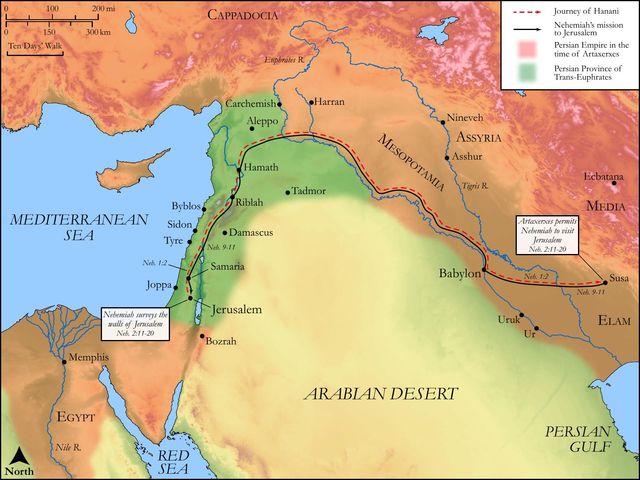
See on the biblical-era map
Study this verse
Public-domain commentary
Matthew Henry
From his Commentary on the Whole Bible. Henry comments on passages, not single verses — this entry covers Nehemiah 1:5–11. His two-level outline is real structure in the source text, so it is rendered as structure.
We have here Nehemiah's prayer, a prayer that has reference to all the prayers which he had for some time before been putting up to God day and night, while he continued his sorrows for the desolations of Jerusalem, and withal to the petition he was now intending to present to the king his master for his favour to Jerusalem. We may observe in this prayer,
I.His humble and reverent address to God, in which he prostrates himself before him, and gives unto him the glory due unto his name, Neh 1:5.
It is much the same with that of Daniel, Dan 9:4. It teaches us to draw near to God,
1.With a holy awe of his majesty and glory, remembering that he is the God of heaven, infinitely above us, and sovereign Lord over us, and that he is the great and terrible God, infinitely excelling all the principalities and powers both of the upper and of the lower world, angels and kings; and he is a God to be worshipped with fear by all his people, and whose powerful wrath all his enemies have reason to be afraid of. Even the terrors of the Lord are improvable for the comfort and encouragement of those that trust in him.
2.With a holy confidence in his grace and truth, for he keepeth covenant and mercy for those that love him, not only the mercy that is promised, but even more than he promised: nothing shall be thought too much to be done for those that love him and keep his commandments.
II.His general request for the audience and acceptance of all the prayers and confessions he now made to God (Neh 1:6):
"Let thy ear be attentive to the prayer, not which I say (barely saying prayer will not serve), but which I pray before thee (then we are likely to speed in praying when we pray in praying), and let they eyes be open upon the heart from which the prayer comes, and the case which is in prayer laid before thee." God formed the eye and planted the ear; and therefore shall he not see clearly? shall not he hear attentively?
III.His penitent confession of sin; not only Israel has sinned (it was no great mortification to him to own that), but I and my father's house have sinned, Neh 1:6. Thus does he humble himself, and take shame to himself, in this confession. We have (I and my family among the rest) dealt very corruptly against thee, Neh 1:7. In the confession of sin, let these two things be owned as the malignity of it - that it is a corruption of ourselves and an affront to God; it is dealing corruptly against God, setting up the corruptions of our own hearts in opposition to the commands of God.
IV.The pleas he urges for mercy for his people Israel.
1.He pleads what God had of old said to them, the rule he had settled of his proceedings towards them, which might be the rule of their expectations from him, Neh 1:8, Neh 1:9. He had said indeed that, if they broke covenant with him, he would scatter them among the nations, and that threatening was fulfilled in their captivity: never was people so widely dispersed as Israel was at this time, though at first so closely incorporated; but he had said withal that if they turned to him (as now they began to do, having renounced idolatry and kept to the temple service) he would gather them again. This he quotes from Deu 30:1-5, and begs leave to put God in mind of it (though the Eternal Mind needs no remembrancer) as that which he guided his desires by, and grounded his faith and hope upon, in praying this prayer: Remember, I beseech thee, that word; for thou hast said, Put me in remembrance. He had owned (Neh 1:7), We have not kept the judgments which thou commandedst thy servant Moses; yet he begs (Neh 1:8), Lord, remember the word which thou commandedst thy servant Moses; for the covenant is often said to be commanded. If God were not more mindful of his promises than we are of his precepts we should be undone. Our best pleas therefore in prayer are those that are taken from the promise of God, the word on which he has caused us to hope, Psa 119:49.
2.He pleads the relation wherein of old they stood to God: "These are thy servants and thy people (Neh 1:10), whom thou hast set apart for thyself, and taken into covenant with thee. Wilt thou suffer thy sworn enemies to trample upon and oppress thy sworn servants? If thou wilt not appear for thy people, whom wilt thou appear for?" See Isa 63:19. As an evidence of their being God's servants he gives them this character (Neh 1:11): "They desire to fear thy name; they are not only called by thy name, but really have a reverence for thy name; they now worship thee, and thee only, according to thy will, and have an awe of all the discoveries thou art pleased to make of thyself; this they have a desire to do," which denotes, (1.) Their good will to it. "It is their constant care and endeavour to be found in the way of their duty, and they aim at it, though in many instances they come short." (2.) Their complacency in it. "They take pleasure to fear thy name (so it may be read), not only do their duty, but do it with delight." Those shall graciously be accepted of God that truly desire to fear his name; for such a desire is his own work.
3.He pleads the great things God had formerly done for them (Neh 1:10): "Whom thou hast redeemed by thy great power, in the days of old. Thy power is still the same; wilt thou not therefore still redeem them and perfect their redemption? Let not those be overpowered by the enemy that have a God of infinite power on their side."
Lastly, He concludes with a particular petition, that God would prosper him in his undertaking, and give him favour with the king: this man he calls him, for the greatest of men are but men before God; they must know themselves to be so (Psa 9:20), and others must know them to be so. Who art thou that thou shouldst be afraid of a man? Mercy in the sight of this man is what he prays for, meaning not the king's mercy, but mercy from God in his address to the king. Favour with men is then comfortable when we can see it springing from the mercy of God.
Historical interpretation
Historical reception
1 surviving comment on this verse from the historical church.
But I say, Has the Lord used iniquity to snatch the nations from the power of his enemies and recall them to faith in him and to his dominion? By no means. For "Israel" was once "the Lord's portion," but they made Israel turn from their God in sin, and because of their sins God said to them, "Behold, you have been separated by your sins and because of your sins you have been scattered under the whole heaven." But again he says to them, "If your dispersion should be from one end of heaven to the other, from there I will gather you, says the Lord." Because, therefore, "the princes of this world" had first invaded "the Lord's portion," "the good shepherd" had, necessarily, the ninety and nine having been left on the heights, to descend to the lands and seek the one sheep that was lost, and when it was found and carried back on his shoulders, to recall it to the sheepfold of perfection on high.
Continue studying Nehemiah 1:9 across the web’s major study libraries — every link below opens this exact verse, chapter, or book on the destination site.
Read & Compare
 BibleGatewayThis verse in more than 200 translations and 70 languages.
 Bible.comThe YouVersion reader — hundreds of translations, reading plans, and highlights.
 ESV.orgCrossway's official English Standard Version reader.
 NET BibleThe NET translation with 60,000+ translators' notes on every rendering decision.
 STEP BibleTyndale House's free study tool — original text, vocabulary, and scholarly resources.
 BibliaLogos Bible Software's free web reader.
 USCCBThe New American Bible (Revised Edition) with the U.S. bishops' study notes.
Commentaries
 BibleHub CommentariesDozens of classic commentaries on this verse, gathered on one page.
 StudyLightMore than 100 commentary sets — the largest collection on the web.
 BibleRefPlain-English commentary on what this verse means, verse by verse.
 Enduring WordDavid Guzik's free commentary on this chapter, widely used by Bible teachers.
 Bible Study ToolsVerse commentary alongside Greek and Hebrew study aids.
Original Language & Research
- BibleHub InterlinearThe verse word by word — original language, transliteration, and English.
- BibleHub LexiconEvery word's original-language definition and Strong's entry.
 Blue Letter BibleDeep-study tools — Strong's numbers, concordance, and word studies.
 SefariaThe Hebrew text with Rashi and centuries of Jewish commentary.
Sermons, Hymns & Audio


TrulyRandomVerse is not affiliated with these sites and doesn’t control their content. They’re linked because they’re genuinely useful.
Summary
Nehemiah 1:9 presents a foundational divine promise, fervently recalled by Nehemiah in his prayer for Jerusalem's restoration. It articulates God's unwavering commitment to gather His scattered people from the farthest reaches of the earth and bring them back to His chosen dwelling place, contingent upon their sincere repentance and faithful obedience to His commandments. This verse serves as a powerful declaration of God's enduring covenant loyalty and His sovereign power to restore those who genuinely turn back to Him.
Context
ShowHideLiterary Context
Nehemiah 1:9 is deeply embedded within Nehemiah's heartfelt prayer of confession and intercession, meticulously recorded in Nehemiah 1:5-11. This prayer immediately follows Nehemiah's receipt of devastating news regarding Jerusalem's desolate state, its broken walls, and the profound affliction of its inhabitants, as detailed in Nehemiah 1:3. Overwhelmed with grief, Nehemiah responds with mourning, fasting, and prayer, meticulously recounting God's covenant faithfulness while simultaneously acknowledging Israel's corporate sin. Verse 9 specifically cites a pivotal divine promise, almost certainly drawn from the Mosaic covenant, which Nehemiah strategically employs as the very basis for his passionate plea for restoration, thereby demonstrating his profound reliance on God's established and unwavering word.
Historical & Cultural Context
The historical backdrop for this verse is the post-exilic period, specifically around 445 BC. Although a significant number of Jews had returned to Judah under the leadership of Zerubbabel and Ezra, Jerusalem remained in a precarious state, its walls in ruins. This physical vulnerability symbolized a profound lack of security, a diminished national identity, and, in the eyes of surrounding nations, a perceived absence of divine favor. The people were living under the rule of the Persian Empire, a stark contrast to their former sovereign independence. The concept of "scattering" was not merely a theological idea but a lived, painful reality, a direct consequence of the Babylonian exile that had been explicitly foretold in numerous prophetic warnings, such as those found in Deuteronomy 28. Consequently, the promise of "gathering" was a profound and deeply cherished hope, intricately woven into the fabric of the covenant promises of a return to the ancestral land and the re-establishment of a purified community centered around God's chosen dwelling, the Temple.
Key Themes
ShowHideThis verse powerfully contributes to several overarching themes that resonate throughout the book of Nehemiah and the broader biblical narrative. It emphatically underscores the theme of Covenant Faithfulness, highlighting God's unwavering commitment to His promises despite His people's persistent disobedience, a principle beautifully articulated in Deuteronomy 30:1-5. Central to the verse is the theme of Repentance and Obedience, presenting them as non-negotiable prerequisites for divine restoration and blessing. Furthermore, it powerfully emphasizes God's Sovereignty and Power to Gather, demonstrating His infinite ability to bring His dispersed people from "the uttermost part of the heaven" back to His chosen place. Finally, the verse profoundly reinforces the Significance of Jerusalem and the Temple as the unique and sacred locus of God's presence and His name, essential for the spiritual and national identity of Israel.
Exposition and Analysis
ShowHideKey Word Analysis
ShowHideThis primitive root signifies a radical change of direction, a turning back or returning. In a theological context, it denotes repentance—a deliberate decision to abandon a path of sin and disobedience and to reorient one's life towards God and His ways. It implies not merely regret, but a transformative action and commitment to obedience, often involving a return to a previous state of relationship or adherence.
Derived from a verb meaning "to command," this noun refers to the divine instructions, laws, and statutes given by God, primarily through Moses, as the terms of the covenant. "Keeping" and "doing" them implies active, volitional obedience, not just intellectual assent. This highlights the practical, ethical, and relational demands of the covenant relationship, where adherence to God's precepts is a vital expression of faithfulness.
This primitive root means "to grasp" or "to collect." In the context of this verse, it denotes God's active and sovereign act of collecting His dispersed people from their scattered locations. It implies a purposeful reassembly, bringing together those who were separated, often with the intent of restoration and communal re-establishment. This word emphasizes God's initiative and power in reversing the consequences of exile.
Verse Breakdown
ShowHide"But [if] ye turn unto me, and keep my commandments, and do them;"
This opening clause establishes the critical condition for God's restorative action. It is a direct call to covenant fidelity, demanding a genuine and active turning away from sin (repentance) and a committed adherence to God's revealed will (obedience). The repetition of "keep... and do them" emphasizes not just intellectual knowledge of the law, but its practical, consistent application in daily life, highlighting the volitional and active nature of true obedience.
"though there were of you cast out unto the uttermost part of the heaven,"
This phrase vividly describes the extreme extent of Israel's dispersion, a direct consequence of their disobedience and God's judgment. "Uttermost part of the heaven" is a powerful hyperbole, emphasizing that no distance or scattering is beyond God's reach or power to reverse. It acknowledges the severity of their judgment while simultaneously setting the stage for God's omnipotent and limitless intervention.
"[yet] will I gather them from thence, and will bring them unto the place that I have chosen to set my name there."
This is God's sovereign and unconditional promise of restoration, contingent upon the people's repentance. Despite the vastness of their dispersion, God pledges to actively collect and bring His people back. The destination, "the place that I have chosen to set my name there," unequivocally refers to Jerusalem and specifically the Temple Mount. This signifies not just a physical return, but a spiritual re-centering around God's manifested presence, His authority, and the restoration of proper worship and covenant relationship.
Literary Devices
ShowHideNehemiah 1:9 is rich in Covenant Language, directly echoing the conditional promises and warnings found throughout the Mosaic covenant, particularly in Deuteronomy 30. The structure employs a clear Conditional Clause ("if... then...") which sets out the divine prerequisite for restoration, highlighting the reciprocal nature of the covenant relationship. The phrase "unto the uttermost part of the heaven" functions as Hyperbole, dramatically emphasizing the vastness of the dispersion and, by extension, the limitless scope of God's power to gather. This verse also utilizes Divine Promise, a direct declaration from God, recalled by Nehemiah, which serves as the bedrock of hope for the exiled community. Finally, the idiom "to set my name there" is a profound form of Metonymy, where "name" stands for God's very presence, character, authority, and glory, underscoring the sanctity and unique significance of Jerusalem as His chosen dwelling place.
Theological and Thematic Connections
ShowHideNehemiah 1:9 stands as a powerful testament to God's covenant faithfulness and His enduring commitment to His people, even in the face of their profound disobedience. It underscores the biblical principle that while sin leads to dispersion and judgment, genuine repentance and a return to God's commandments invariably activate His promises of restoration and gathering. This verse highlights God's sovereign power to reverse even the most extreme consequences of human sin, demonstrating His capacity to bring His scattered people back to Himself and to His chosen place of worship. It illustrates the dynamic interplay between divine grace and human responsibility, where God's promises are contingent upon a responsive and obedient heart. The ultimate goal of this gathering is not merely physical relocation, but a spiritual re-centering around God's presence and His name, establishing a renewed relationship of worship and covenant fidelity.
Reflection and Application
ShowHideNehemiah 1:9 offers profound encouragement and a clear challenge for believers today. It reminds us that God's character is one of unwavering faithfulness, even when we, like ancient Israel, stray from His path. The promise of gathering and restoration is not just for a nation in exile, but for every individual who has wandered from God's will. It calls us to a deep, transformative repentance—a genuine "turning unto" the Lord that is evidenced by a renewed commitment to "keep His commandments and do them." This verse teaches us that no matter how far we feel we have drifted, or how "scattered" our lives may seem due to past choices or present circumstances, God's arm is not too short to gather us. Our restoration, both individually and corporately, begins with humility, confession, and a sincere desire to align our lives with His divine will, trusting in His boundless capacity to redeem and restore. It invites us to participate actively in our spiritual journey, knowing that our obedience unlocks the fullness of His promised blessings.
Questions for Reflection
ShowHideFAQ
ShowHideWas this promise specifically given to Nehemiah, or was he recalling an earlier promise?
ShowHideNehemiah was recalling an earlier promise, specifically one found within the Mosaic covenant. The language and themes of Nehemiah 1:9 strongly echo passages from Deuteronomy 30:1-5, where Moses outlines the consequences of disobedience (dispersion) and the promise of restoration upon repentance. Nehemiah, in his prayer, is appealing to God's established covenant word, demonstrating his faith that God remains true to His character and promises across generations.
What does "the place that I have chosen to set my name there" refer to?
ShowHideThis phrase unequivocally refers to Jerusalem, and more specifically, the Temple Mount within Jerusalem. Throughout the Old Testament, God consistently designates Jerusalem as the unique location where He has chosen to manifest His presence, receive worship, and establish His authority. Passages like Deuteronomy 12:11 and 1 Kings 8:29 speak of God "setting His name" there, signifying His ownership, His unique presence, and the place where His glory would dwell among His people. It was the spiritual and religious center of Israel, the focal point of their national and religious identity.
Does this verse imply that God's promises are conditional?
ShowHideYes, this verse clearly presents a conditional aspect to God's promise of gathering and restoration for Israel. The phrase "But if ye turn unto me, and keep my commandments, and do them" establishes the prerequisite for the subsequent divine action. While God's ultimate faithfulness to His covenant is unconditional, the immediate blessings and restoration within the covenant relationship often depend on the people's obedience and repentance. This highlights the reciprocal nature of the covenant, where human response is crucial for experiencing the fullness of God's promised blessings and for the covenant relationship to flourish.
Christ-Centered Fulfillment
ShowHideNehemiah 1:9, with its profound promise of gathering and restoration contingent upon repentance and obedience, finds its ultimate and most profound fulfillment in Jesus Christ. While the Old Testament promise primarily concerned a physical return to the land and a re-establishment of the Temple, Christ inaugurates a new and greater gathering that transcends geographical boundaries and ethnic distinctions. He is the true Temple, the ultimate "place where God has chosen to set His name," in whom the fullness of God's presence truly dwells (John 2:19-21). Through His atoning sacrifice on the cross and His glorious resurrection, Jesus provides the perfect means for genuine repentance and empowers true obedience, not merely to external laws, but to the law written on the heart by the Holy Spirit (Jeremiah 31:33). The "gathering" promised here expands dramatically beyond ethnic Israel to include all who believe in Him, both Jew and Gentile, forming the new people of God—the Church, united in Christ (Ephesians 2:11-22). The scattering of humanity due to sin is definitively overcome by Christ's redemptive work, who gathers those "scattered abroad" by sin into one unified body, His Bride (John 11:51-52). Ultimately, the "place that I have chosen to set my name there" points forward to the heavenly Jerusalem, the eternal dwelling place of God with His redeemed people, where Christ reigns supreme and all true worship is offered in Spirit and truth (Revelation 21:1-4).