


Ezra 5:17
Bible text: King James Version (1769 Blayney text) · Public domain
Bible text: King James Version with Strong's numbers · Public domain
Bible text: Berean Standard Bible · Public domain
Bible text: American Standard Version (1901) · Public domain
Bible text: World English Bible, Messianic edition · Public domain
Bible text: Geneva Bible (1599) · Public domain
Bible text: Young's Literal Translation · Public domain
- וּכְעַןu·khe·'Anand nowH3705Conj-w ¦ AdvAdverbוּandכְעַןnow
- הֵןhenifH2006ConjConjunction
- עַל'altoH5922PrepPreposition
- מַלְכָּאmal·Ka'king theH4430N-cs ¦ ArtNoun Singular common gender Definiteמַלְכָּkingאthe
- טָבTav[it is] goodH2869Adj-csAdjective Singular common gender Absolute
- יִתְבַּקַּרYit·ba·karlet it be searchedH1240V-Hitpaal-Imperf-3msVerb Hitpaal Imperfect 3rd Singular Masculine
- בְּבֵיתbe·Veitin [the] house ofH1005Prep-b ¦ N-cscNoun Singular common gender Constructבְּinבֵית[the] house of
- גִּנְזַיָּאgin·zai·Ya'treasures theH1596N-mp ¦ ArtNoun Plural Masculine Definiteגִּנְזַיָּtreasuresאthe
- דִּיdiofH1768ConjConjunction
- מַלְכָּאmal·Ka'king theH4430N-cs ¦ ArtNoun Singular common gender Definiteמַלְכָּkingאthe
- תַמָּהta·MahthereH8536AdvAdverb
- דִּיdiwhichH1768ConjConjunction
- בְּבָבֶלbe·va·Vel[are] in BabylonH895Prep-b ¦ N-properNoun Proper Locationבְּ[are] inבָבֶלBabylon
- הֵןhenwhetherH2006ConjConjunction
- אִיתַי'i·TaithereH383N-csNoun Singular common gender Absolute
- דִּיdi[is] thatH1768ConjConjunction
- מִןminfromH4481PrepPreposition
- כּוֹרֶשׁKo·reshCyrusH3567N-proper-mNoun Proper Masculine
- מַלְכָּאmal·Ka'king theH4430N-cs ¦ ArtNoun Singular common gender Definiteמַלְכָּkingאthe
- שִׂיםsimit was madeH7761V-Peil-Perf-3msVerb Peil Perfect 3rd Singular Masculine
- טְעֵםte·'Em[is] a decreeH2942N-csNoun Singular common gender Absolute
- לְמִבְנֵאle·miv·Ne'to buildH1124Prep-l ¦ V-Qal-InfVerb Qal Infinitive Constructלְtoמִבְנֵאbuild
- בֵּיתbeit[the] house ofH1005N-cscNoun Singular common gender Construct
- אֱלָהָא'e·la·Ha'<the> GodH426N-cs ¦ ArtNoun Singular common gender Definiteאֱלָהָ<the>אGod
- דֵךְdekhthisH1791PrtParticle Demonstrative
- בִּירוּשְׁלֶםbi·ru·she·Lemin JerusalemH3390Prep-b ¦ N-properNoun Proper LocationבִּinירוּשְׁלֶםJerusalem
- וּרְעוּתu·re·'Utand [the] will ofH7470Conj-w ¦ N-fscNoun Singular Feminine Constructוּandרְעוּת[the] will of
- מַלְכָּאmal·Ka'king theH4430N-cs ¦ ArtNoun Singular common gender Definiteמַלְכָּkingאthe
- עַל'alconcerningH5922PrepPreposition
- דְּנָהde·NahthisH1836PrtParticle Demonstrative
- יִשְׁלַחyish·Lachlet him sendH7972V-Peal-Imperf-3msVerb Peal Imperfect 3rd Singular Masculine
- עֲלֶינָא'a·Lei·na'to usH5922Prep ¦ 1cpPrepositionעֲלֶיtoנָאus
English is a literal word-by-word gloss of the Hebrew, not the KJV's wording. Why?
This is the original text the KJV's translators worked from — each Hebrew word with its own literal English meaning in this verse, prepared by scholars at Tyndale House, Cambridge. The KJV translates whole sentences, not word by word, so its wording differs: one Hebrew word can become several English words, and the KJV may choose “the LORD” where the gloss reads “Yahweh”. Both are faithful — they answer different questions. For the KJV's own rendering, switch to the KJV text.
Details
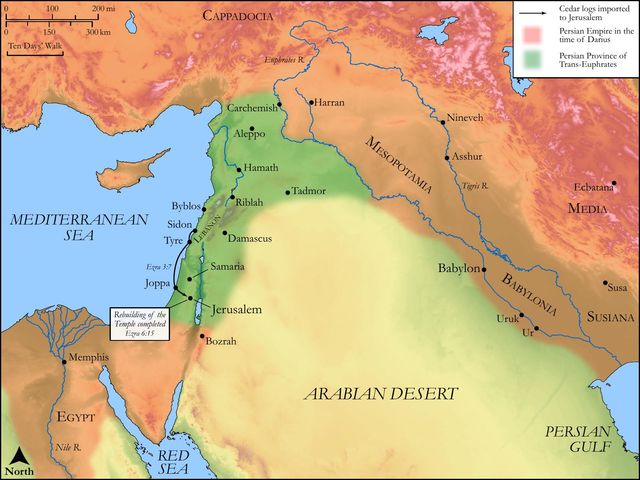
See on the biblical-era map
Study this verse
Public-domain commentary
Matthew Henry
From his Commentary on the Whole Bible. Henry comments on passages, not single verses — this entry covers Ezra 5:3–17. His two-level outline is real structure in the source text, so it is rendered as structure.
We have here, I. The cognizance which their neighbours soon took of the reviving of this good work. A jealous eye, it seems, they had upon them, and no sooner did the Spirit of God stir up the friends of the temple to appear for it than the evil spirit stirred up its enemies to appear against it. While the people built and ceiled their own houses their enemies gave them no molestation (Hag 1:4), though the king's order was to put a stop to the building of the city (Ezr 4:21); but when they fell to work again at the temple then the alarm was taken, and all heads were at work to hinder them, Ezr 5:3, Ezr 5:4. The adversaries are here named: Tatnai and Shethar-boznai. The governors we read of (ch. 4) were, it is probable, displaced at the beginning of this reign, as is usual. It is the policy of princes often to change their deputies, proconsuls, and rulers of provinces. These, though real enemies to the building of the temple, were men of better temper than the other, and made some conscience of telling truth. If all men have not faith (Th2 3:2), it is well some have, and a sense of honour. The church's enemies are not all equally wicked and unreasonable. The historian begins to relate what passed between the builders and those inquisitors (Ezr 5:3, Ezr 5:4), but breaks off his account, and refers to the ensuing copy of the letter they sent to the king, where the same appears more fully and at large, which he began to abridge (Ezr 5:4), or make an extract out of, though, upon second thoughts, he inserted the whole.
II.The care which the divine Providence took of this good work (Ezr 5:5):
The eye of their God was upon the elders of the Jews, who were active in the work, so that their enemies could not cause them to cease, as they would have done, till the matter came to Darius. They desired they would only cease till they had instructions from the king about it. But they would not so much as yield them that, for the eye of God was upon them, even their God. And,
1.That baffled their enemies, infatuated and enfeebled them, and protected the builders from their malicious designs. While we are employed in God's work we are taken under his special protection; his eye is upon us for good, seven eyes upon one stone in his temple; see Zac 3:9; Zac 4:10.
2.That quickened them. The elders of the Jews saw the eye of God upon them, to observe what they did and own them in what they did well, and then they had courage enough to face their enemies and to go on vigorously with their work, notwithstanding all the opposition they met with. our eye upon God, observing his eye upon us, will keep us to our duty and encourage us in it when the difficulties are ever so discouraging.
III.The account they sent to the king of this matter, in which we may observe,
1.How fully the elders of the Jews gave the Samaritans an account of their proceedings. They, finding them both busy and prosperous, that all hands were at work to run up this building and that it went on rapidly, put these questions to them: - "By what authority do you do these things, and who gave you that authority? Who set you to work? Have you that which will bear you out?" To this they answered that they had sufficient warrant to do what they did; for, (1.) "We are the servants of the God of heaven and earth. The God we worship is not a local deity, and therefore we cannot be charged with making a faction, or setting up a sect, in building this temple to his honour: but we pay our homage to a God on whom the whole creation depends, and therefore ought to be protected and assisted by all and hindered by none." It is the wisdom as well as duty of kings to countenance the servants of the God of heaven. (2.) "We have a prescription to this house; it was built for the honour of our God by Solomon many ages ago. It is no novel invention of our own; we are but raising the foundations of many generations," Isa 58:12. (3.) "It was to punish us for our sins that we were, for a time, put out of the possession of this house; not because the gods of the nations had prevailed against our God, but because we had provoked him (Ezr 5:12), for which he delivered us and our temple into the hands of the king of Babylon, but never intended thereby to put a final period to our religion. We were only suspended for a time, not deprived for ever." (4.) "We have the royal decree of Cyrus to justify us and bear us out in what we do. He not only permitted and allowed us, but charged and commanded us to build this house (Ezr 5:13), and to build it in its place (Ezr 5:15), the same place where it had stood before." He ordered this, not only in compassion to the Jews, but in veneration of their God, saying, He is the God. He also delivered the vessels of the temple to one whom he entrusted to see them restored to their ancient place and use, Ezr 5:14. And they had these to show in confirmation of what they alleged. (5.) "The building was begun according to this order as soon as ever we had returned, so that we have not forfeited the benefit of the order for want of pursuing it in time; still it has been in building, but, because we have met with opposition, it is not finished." But, observe, they mention not the falsehood and malice of the former governors, nor make any complaint of them, though they had cause enough, to teach us not to render bitterness for bitterness, nor the most just reproach for that which is most unjust, but to think it enough if we can obtain fair treatment for the future, without an invidious reference to former injuries, Ezr 5:16. This is the account they give of their proceedings, not asking what authority they had to examine them, nor upbraiding them with their idolatry, and superstitions, and medley religion. Let us learn hence with meekness and fear to give a reason of the hope that is in us (Pe1 3:15), rightly to understand, and then readily to declare, what we do in God's service and why we do it.
2.How fairly the Samaritans represented this to the king. (1.) They called the temple at Jerusalem the house of the great God (Ezr 5:8); for though the Samaritans, as it should seem, had yet gods many and lords many, they owned the God of Israel to be the great God, who is above all gods. "It is the house of the great God, and therefore we dare not oppose the building of it without orders from thee." (2.) They told him truly what was done, not stating, as their predecessors did, that they were fortifying the city as if they intended war, but only that they were rearing the temple as those that intended worship, Ezr 5:8. (3.) They fully represented their plea, told him what they had to say for themselves, and were willing that the cause should be set in a true light. (4.) They left it to the king to consult the records whether Cyrus had indeed made such a decree, and then to give directions as he should think fit, Ezr 5:17. We have reason to think that if Artaxerxes, in the foregoing chapter, had had the Jews' cause as fairly represented to him as it was here to Darius, he would not have ordered the work to be hindered. God's people could not be persecuted if they were not belied, could not be baited if they were not dressed up in bears' skins. Let but the cause of God and truth be fairly stated, and fairly heard, and it will keep its ground.
Continue studying Ezra 5:17 across the web’s major study libraries — every link below opens this exact verse, chapter, or book on the destination site.
Read & Compare
 BibleGatewayThis verse in more than 200 translations and 70 languages.
 Bible.comThe YouVersion reader — hundreds of translations, reading plans, and highlights.
 ESV.orgCrossway's official English Standard Version reader.
 NET BibleThe NET translation with 60,000+ translators' notes on every rendering decision.
 STEP BibleTyndale House's free study tool — original text, vocabulary, and scholarly resources.
 BibliaLogos Bible Software's free web reader.
 USCCBThe New American Bible (Revised Edition) with the U.S. bishops' study notes.
Commentaries
 BibleHub CommentariesDozens of classic commentaries on this verse, gathered on one page.
 StudyLightMore than 100 commentary sets — the largest collection on the web.
 BibleRefPlain-English commentary on what this verse means, verse by verse.
 Enduring WordDavid Guzik's free commentary on this chapter, widely used by Bible teachers.
 Bible Study ToolsVerse commentary alongside Greek and Hebrew study aids.
Original Language & Research
- BibleHub InterlinearThe verse word by word — original language, transliteration, and English.
- BibleHub LexiconEvery word's original-language definition and Strong's entry.
 Blue Letter BibleDeep-study tools — Strong's numbers, concordance, and word studies.
 SefariaThe Hebrew text with Rashi and centuries of Jewish commentary.
Sermons, Hymns & Audio


TrulyRandomVerse is not affiliated with these sites and doesn’t control their content. They’re linked because they’re genuinely useful.
Summary
Ezra 5:17 records the crucial request from Tatnai, the Persian governor of Trans-Euphrates, to King Darius I. Faced with the Jewish exiles' renewed efforts to rebuild the Temple in Jerusalem and their assertion of prior authorization by King Cyrus, Tatnai formally petitions Darius to initiate an official search within the royal archives in Babylon. This administrative inquiry aims to verify the existence and precise content of Cyrus's original edict, thereby establishing the legitimate authority for the Temple's reconstruction and guiding the king's subsequent directives on the matter.
Context
ShowHideLiterary Context
This verse serves as the concluding and most significant component of an official letter dispatched by Tatnai, Shethar-boznai, and their colleagues to King Darius I, as detailed in Ezra 5. The letter is a direct consequence of their on-site inquiry to the Jewish elders in Jerusalem, questioning the authority by which they were rebuilding the "house of God" and the city walls (Ezra 5:3-4). In response, the Jewish leaders confidently asserted that King Cyrus had issued a specific decree permitting their return to Jerusalem and the reconstruction of the Temple (Ezra 5:11-15). Tatnai's letter, therefore, functions as an official administrative report and a formal request for the king to verify the Jews' claims by searching the royal records. This pivotal request directly sets the stage for the providential discovery of Cyrus's decree in Ezra 6:1-2, which ultimately vindicates the Jews' actions and ensures the successful completion of the Temple.
Historical & Cultural Context
Ezra 5:17 is situated during the reign of Darius I (Hystaspes), approximately between 520-518 BC, roughly two decades after Cyrus the Great's initial decree in 538 BC that allowed the Jewish exiles to return and rebuild their Temple. The Persian Empire was renowned for its highly organized and efficient administrative system, characterized by meticulous record-keeping. Royal decrees were legally binding throughout the vast empire and were carefully archived in various imperial centers. Babylon, having been conquered by Cyrus and serving as a significant administrative hub, was a logical place to search for early Persian edicts, though the decree was eventually found in Ecbatana (Ezra 6:2). Tatnai, as the governor of the satrapy "beyond the River" (Trans-Euphrates), was acting within his official capacity to ensure proper legal authorization for such a large-scale public works project, especially one with religious and political implications for a subjugated people. His actions reflect the standard bureaucratic procedures of the Achaemenid Persian Empire.
Key Themes
ShowHideThis verse powerfully underscores several key themes within the book of Ezra and the broader biblical narrative. Firstly, it highlights Divine Sovereignty over earthly rulers, demonstrating how God orchestrates events and uses even pagan kings like Cyrus and Darius to fulfill His prophetic purposes and promises concerning His people and the rebuilding of His sanctuary. This is a recurring motif, as seen in passages like Proverbs 21:1. Secondly, it emphasizes the importance of Legitimacy and Authority in undertaking God's work; the Jews relied on a legitimate royal decree, and the Persian officials sought proper verification, illustrating that divine work often operates within established human systems. Thirdly, the passage speaks to Persistence in Faith despite opposition and bureaucratic hurdles; the Jewish leaders' unwavering confidence in Cyrus's decree, even under scrutiny, reflects their trust that God would ultimately vindicate their efforts, echoing the resilience of God's people throughout history. Finally, it showcases the theme of Truth and Verification, as the Persian administrative process of due diligence inadvertently serves God's plan by confirming the divine mandate for the Temple's reconstruction, a truth that could not be suppressed.
Exposition and Analysis
ShowHideKey Word Analysis
ShowHideFrom H1240, corresponding to the Hebrew root meaning "to plough" or "break forth," it figuratively means "to inspect, admire, care for, consider." In this context, it specifically denotes a formal, diligent inquiry or investigation, particularly a search through official records. Tatnai's request is not a casual suggestion but a demand for a thorough bureaucratic process to ascertain the truth.
From H1596, this term refers to a royal archive or repository for official documents, records, and decrees, rather than primarily a place for storing monetary wealth. As noted in Ezra 6:1, it is explicitly called the "house of the rolls" or "house of the books," confirming its function as a central record office. This highlights the Persian Empire's meticulous administrative practices and their reliance on written legal precedents.
From H2942, this word signifies a formal, authoritative, and legally binding order or edict issued by the king. It carries the full weight of imperial law and was enforceable throughout the Persian Empire. The use of this term emphasizes that Cyrus's original command was not merely a suggestion or a verbal permission, but a solemn, written, and legally valid mandate that provided the legitimate foundation for the Temple's reconstruction.
Verse Breakdown
ShowHide"Now therefore, if [it seem] good to the king"
This opening phrase exemplifies the deferential and respectful tone characteristic of petitions addressed to Persian monarchs. It acknowledges the king's ultimate authority and discretion, presenting the request as subject to his sovereign will and judgment, even though Tatnai is acting within his official duties as governor. This politeness underscores the gravity of the matter.
"let there be search made in the king's treasure house, which [is] there at Babylon"
This is Tatnai's specific and practical request for verification. He directs the king to initiate an official, diligent search within the royal archives. The mention of "Babylon" is significant, as it was a major administrative center and likely housed important records from the early Persian period, especially those related to the conquest of Babylon and the subsequent policies of Cyrus.
"whether it be [so], that a decree was made of Cyrus the king to build this house of God at Jerusalem"
This clause articulates the precise purpose of the search: to confirm the existence and exact content of the decree attributed to King Cyrus. It directly addresses the Jews' claim and seeks official validation of their authority to rebuild the Temple in Jerusalem, emphasizing the religious nature of the structure ("this house of God") and the specific mandate for its construction.
"and let the king send his pleasure to us concerning this matter"
This final part of the request seeks a clear, definitive ruling or instruction from King Darius. Tatnai desires an official response that will provide unambiguous administrative guidance on how to proceed with the situation in Jerusalem, whether to permit, halt, or modify the building work based on the findings of the archive search. This highlights the need for clear imperial directives.
Literary Devices
ShowHideEzra 5:17, as part of Tatnai's official letter, effectively employs several literary devices. There is a subtle Irony at play: Tatnai's diligent investigation, seemingly designed to scrutinize or even potentially halt the Temple rebuilding, inadvertently becomes the very catalyst for its official re-authorization and accelerated completion under royal patronage. The request for a search also serves as a strong element of Foreshadowing, pointing directly to the subsequent discovery of Cyrus's decree in Ezra 6:1-2, which will decisively vindicate the Jews' claims. Furthermore, the entire passage is presented in an Epistolary Form, highlighting the bureaucratic and legalistic nature of the Persian administration and the formal channels through which interactions between subject peoples and the imperial power were conducted. This formal structure underscores the gravity and official weight of the matter at hand, emphasizing the importance of documented authority.
Theological and Thematic Connections
ShowHideEzra 5:17 powerfully illustrates the overarching theme of God's sovereign control over the nations and their rulers. Despite the formidable power of the Persian Empire and the meticulousness of its bureaucracy, God's divine will ultimately prevails. Tatnai's administrative inquiry, though seemingly a challenge to the Jews' work, becomes the very means by which God's earlier decree through Cyrus is confirmed and re-enforced by Darius. This demonstrates that God works through established human systems, even those of pagan empires, to accomplish His redemptive purposes and fulfill His promises to His people. The pursuit of truth and legal verification within the Persian system ultimately serves to validate God's plan for the rebuilding of His Temple, showcasing His faithfulness to His covenant and His ability to turn potential obstacles into instruments of His will.
Reflection and Application
ShowHideEzra 5:17 offers profound lessons for believers navigating life and ministry. It reminds us that God's work, even when divinely ordained, often encounters bureaucratic hurdles, skepticism, and administrative processes that require patience and integrity. Just as the Jewish leaders confidently pointed to a verifiable decree, we are called to ground our actions in the unchanging truth of God's Word, which is our ultimate authority. This passage encourages us to trust that God can work through secular systems and even through the diligence of those who might initially question our motives. It challenges us to maintain transparency and integrity in our endeavors, knowing that God can use scrutiny to bring about His purposes, ultimately vindicating His work and His people. We are called to be both fervent in spirit and wise in our dealings, relying on God to open doors and remove obstacles in His perfect timing, demonstrating both faith and responsible stewardship in all our undertakings.
Questions for Reflection
ShowHideFAQ
ShowHideWhy was the "treasure house" at Babylon, not Susa or Ecbatana?
ShowHideWhile the Persian Empire had multiple royal cities and administrative centers (Susa, Ecbatana, Persepolis), Babylon was a significant imperial city, especially during the early Persian period after its conquest by Cyrus. It was logical for early decrees, particularly those issued shortly after the empire's expansion, to be archived there. The decree of Cyrus was indeed found in Ecbatana (Achmetha) later (Ezra 6:2), suggesting that copies or originals might have been kept in various key administrative locations across the vast empire. Tatnai's initial request to search Babylon indicates it was a primary and expected location for such a foundational document.
What does this verse tell us about Persian administration?
ShowHideEzra 5:17 vividly illustrates the highly organized and centralized bureaucracy of the Persian Empire. It reveals a system that valued meticulous record-keeping, legal precedent, and due diligence. Royal decrees were not merely verbal commands but formal, written documents that were carefully archived and could be retrieved for verification. This emphasis on official authorization and documented law underscores the legalistic nature of Persian governance and the importance of proper administrative channels for any significant undertaking, even the rebuilding of the Temple in Jerusalem. It highlights a sophisticated imperial system capable of managing a vast and diverse empire through established legal frameworks.
Christ-Centered Fulfillment
ShowHideEzra 5:17, with its focus on the verification of a royal decree to build the "house of God," finds its ultimate fulfillment in Jesus Christ. The meticulous search for an earthly decree foreshadows the absolute certainty and divine validation of God's eternal plan, revealed and accomplished in Christ. Just as the physical Temple was to be rebuilt according to a king's decree, Christ Himself is the ultimate "House of God," the true and living Temple not made with human hands (John 2:19-21). His authority is not found in dusty earthly archives, but in His divine nature and His resurrection from the dead, which definitively validated His claims and mission (Romans 1:4). The rebuilding of the physical Temple pointed to the ultimate dwelling of God among His people, a reality fully realized in Christ's incarnation (John 1:14) and, subsequently, in the Church as the spiritual temple built upon Him, the chief cornerstone (Ephesians 2:19-22). The administrative process to confirm the Temple's legitimacy in Ezra ultimately points to the irrefutable, divinely decreed authority of Christ, through whom God's people are now built into a holy habitation for the Spirit (1 Peter 2:4-5), a living testament to God's enduring presence.