


Ezra 5:16
Bible text: King James Version (1769 Blayney text) · Public domain
Bible text: King James Version with Strong's numbers · Public domain
Bible text: Berean Standard Bible · Public domain
Bible text: American Standard Version (1901) · Public domain
Bible text: World English Bible, Messianic edition · Public domain
Bible text: Geneva Bible (1599) · Public domain
Bible text: Young's Literal Translation · Public domain
- אֱדַיִן'e·Da·yinthenH116AdvAdverb
- שֵׁשְׁבַּצַּרshe·she·ba·TzarSheshbazzarH8340N-proper-mNoun Proper Masculine
- דֵּךְDekhthisH1791PrtParticle Demonstrative
- אֲתָא'a·Ta'he cameH858V-Peal-Perf-3msVerb Peal Perfect 3rd Singular Masculine
- יְהַבye·Havhe laidH3052V-Peal-Perf-3msVerb Peal Perfect 3rd Singular Masculine
- אֻשַּׁיָּא'u·shai·Ya'foundations theH787N-mp ¦ ArtNoun Plural Masculine Definiteאֻשַּׁיָּfoundationsאthe
- דִּיdiofH1768ConjConjunction
- בֵיתveit[the] house ofH1005N-cscNoun Singular common gender Construct
- אֱלָהָא'e·la·Ha'<the> GodH426N-cs ¦ ArtNoun Singular common gender Definiteאֱלָהָ<the>אGod
- דִּיdiwhichH1768ConjConjunction
- בִירוּשְׁלֶםvi·ru·she·Lem[is] in JerusalemH3390Prep-b ¦ N-properNoun Proper Locationבִ[is] inירוּשְׁלֶםJerusalem
- וּמִןu·minand fromH4481Conj-w ¦ PrepPrepositionוּandמִןfrom
- אֱדַיִן'e·Da·yinthenH116AdvAdverb
- וְעַדve·'adand untilH5705Conj-w ¦ PrepPrepositionוְandעַדuntil
- כְּעַןke·'AnnowH3705AdvAdverb
- מִתְבְּנֵאmit·be·Ne'[it is] being builtH1124V-Hitpael-Prtcpl-msVerb Hitpael Participle Singular Masculine Absolute
- וְלָאve·La'and notH3809Conj-w ¦ NegParticle Negativeוְandלָאnot
- שְׁלִםshe·Lim[it is] finishedH8000V-Peal-Perf-3msVerb Peal Perfect 3rd Singular Masculine
English is a literal word-by-word gloss of the Hebrew, not the KJV's wording. Why?
This is the original text the KJV's translators worked from — each Hebrew word with its own literal English meaning in this verse, prepared by scholars at Tyndale House, Cambridge. The KJV translates whole sentences, not word by word, so its wording differs: one Hebrew word can become several English words, and the KJV may choose “the LORD” where the gloss reads “Yahweh”. Both are faithful — they answer different questions. For the KJV's own rendering, switch to the KJV text.
Details
See on the biblical-era map
Study this verse
Public-domain commentary
Matthew Henry
From his Commentary on the Whole Bible. Henry comments on passages, not single verses — this entry covers Ezra 5:3–17. His two-level outline is real structure in the source text, so it is rendered as structure.
We have here, I. The cognizance which their neighbours soon took of the reviving of this good work. A jealous eye, it seems, they had upon them, and no sooner did the Spirit of God stir up the friends of the temple to appear for it than the evil spirit stirred up its enemies to appear against it. While the people built and ceiled their own houses their enemies gave them no molestation (Hag 1:4), though the king's order was to put a stop to the building of the city (Ezr 4:21); but when they fell to work again at the temple then the alarm was taken, and all heads were at work to hinder them, Ezr 5:3, Ezr 5:4. The adversaries are here named: Tatnai and Shethar-boznai. The governors we read of (ch. 4) were, it is probable, displaced at the beginning of this reign, as is usual. It is the policy of princes often to change their deputies, proconsuls, and rulers of provinces. These, though real enemies to the building of the temple, were men of better temper than the other, and made some conscience of telling truth. If all men have not faith (Th2 3:2), it is well some have, and a sense of honour. The church's enemies are not all equally wicked and unreasonable. The historian begins to relate what passed between the builders and those inquisitors (Ezr 5:3, Ezr 5:4), but breaks off his account, and refers to the ensuing copy of the letter they sent to the king, where the same appears more fully and at large, which he began to abridge (Ezr 5:4), or make an extract out of, though, upon second thoughts, he inserted the whole.
II.The care which the divine Providence took of this good work (Ezr 5:5):
The eye of their God was upon the elders of the Jews, who were active in the work, so that their enemies could not cause them to cease, as they would have done, till the matter came to Darius. They desired they would only cease till they had instructions from the king about it. But they would not so much as yield them that, for the eye of God was upon them, even their God. And,
1.That baffled their enemies, infatuated and enfeebled them, and protected the builders from their malicious designs. While we are employed in God's work we are taken under his special protection; his eye is upon us for good, seven eyes upon one stone in his temple; see Zac 3:9; Zac 4:10.
2.That quickened them. The elders of the Jews saw the eye of God upon them, to observe what they did and own them in what they did well, and then they had courage enough to face their enemies and to go on vigorously with their work, notwithstanding all the opposition they met with. our eye upon God, observing his eye upon us, will keep us to our duty and encourage us in it when the difficulties are ever so discouraging.
III.The account they sent to the king of this matter, in which we may observe,
1.How fully the elders of the Jews gave the Samaritans an account of their proceedings. They, finding them both busy and prosperous, that all hands were at work to run up this building and that it went on rapidly, put these questions to them: - "By what authority do you do these things, and who gave you that authority? Who set you to work? Have you that which will bear you out?" To this they answered that they had sufficient warrant to do what they did; for, (1.) "We are the servants of the God of heaven and earth. The God we worship is not a local deity, and therefore we cannot be charged with making a faction, or setting up a sect, in building this temple to his honour: but we pay our homage to a God on whom the whole creation depends, and therefore ought to be protected and assisted by all and hindered by none." It is the wisdom as well as duty of kings to countenance the servants of the God of heaven. (2.) "We have a prescription to this house; it was built for the honour of our God by Solomon many ages ago. It is no novel invention of our own; we are but raising the foundations of many generations," Isa 58:12. (3.) "It was to punish us for our sins that we were, for a time, put out of the possession of this house; not because the gods of the nations had prevailed against our God, but because we had provoked him (Ezr 5:12), for which he delivered us and our temple into the hands of the king of Babylon, but never intended thereby to put a final period to our religion. We were only suspended for a time, not deprived for ever." (4.) "We have the royal decree of Cyrus to justify us and bear us out in what we do. He not only permitted and allowed us, but charged and commanded us to build this house (Ezr 5:13), and to build it in its place (Ezr 5:15), the same place where it had stood before." He ordered this, not only in compassion to the Jews, but in veneration of their God, saying, He is the God. He also delivered the vessels of the temple to one whom he entrusted to see them restored to their ancient place and use, Ezr 5:14. And they had these to show in confirmation of what they alleged. (5.) "The building was begun according to this order as soon as ever we had returned, so that we have not forfeited the benefit of the order for want of pursuing it in time; still it has been in building, but, because we have met with opposition, it is not finished." But, observe, they mention not the falsehood and malice of the former governors, nor make any complaint of them, though they had cause enough, to teach us not to render bitterness for bitterness, nor the most just reproach for that which is most unjust, but to think it enough if we can obtain fair treatment for the future, without an invidious reference to former injuries, Ezr 5:16. This is the account they give of their proceedings, not asking what authority they had to examine them, nor upbraiding them with their idolatry, and superstitions, and medley religion. Let us learn hence with meekness and fear to give a reason of the hope that is in us (Pe1 3:15), rightly to understand, and then readily to declare, what we do in God's service and why we do it.
2.How fairly the Samaritans represented this to the king. (1.) They called the temple at Jerusalem the house of the great God (Ezr 5:8); for though the Samaritans, as it should seem, had yet gods many and lords many, they owned the God of Israel to be the great God, who is above all gods. "It is the house of the great God, and therefore we dare not oppose the building of it without orders from thee." (2.) They told him truly what was done, not stating, as their predecessors did, that they were fortifying the city as if they intended war, but only that they were rearing the temple as those that intended worship, Ezr 5:8. (3.) They fully represented their plea, told him what they had to say for themselves, and were willing that the cause should be set in a true light. (4.) They left it to the king to consult the records whether Cyrus had indeed made such a decree, and then to give directions as he should think fit, Ezr 5:17. We have reason to think that if Artaxerxes, in the foregoing chapter, had had the Jews' cause as fairly represented to him as it was here to Darius, he would not have ordered the work to be hindered. God's people could not be persecuted if they were not belied, could not be baited if they were not dressed up in bears' skins. Let but the cause of God and truth be fairly stated, and fairly heard, and it will keep its ground.
Continue studying Ezra 5:16 across the web’s major study libraries — every link below opens this exact verse, chapter, or book on the destination site.
Read & Compare
 BibleGatewayThis verse in more than 200 translations and 70 languages.
 Bible.comThe YouVersion reader — hundreds of translations, reading plans, and highlights.
 ESV.orgCrossway's official English Standard Version reader.
 NET BibleThe NET translation with 60,000+ translators' notes on every rendering decision.
 STEP BibleTyndale House's free study tool — original text, vocabulary, and scholarly resources.
 BibliaLogos Bible Software's free web reader.
 USCCBThe New American Bible (Revised Edition) with the U.S. bishops' study notes.
Commentaries
 BibleHub CommentariesDozens of classic commentaries on this verse, gathered on one page.
 StudyLightMore than 100 commentary sets — the largest collection on the web.
 BibleRefPlain-English commentary on what this verse means, verse by verse.
 Enduring WordDavid Guzik's free commentary on this chapter, widely used by Bible teachers.
 Bible Study ToolsVerse commentary alongside Greek and Hebrew study aids.
Original Language & Research
- BibleHub InterlinearThe verse word by word — original language, transliteration, and English.
- BibleHub LexiconEvery word's original-language definition and Strong's entry.
 Blue Letter BibleDeep-study tools — Strong's numbers, concordance, and word studies.
 SefariaThe Hebrew text with Rashi and centuries of Jewish commentary.
Sermons, Hymns & Audio


TrulyRandomVerse is not affiliated with these sites and doesn’t control their content. They’re linked because they’re genuinely useful.
Summary
Ezra 5:16 is a crucial declaration by the Jewish elders to Tatnai, the Persian governor, providing historical justification for their resumed work on the Jerusalem Temple. This verse precisely recounts the initial laying of the Temple's foundation by Sheshbazzar, acting under King Cyrus's original decree, and candidly acknowledges the significant, multi-decade delay in its construction. It underscores the arduous and interrupted nature of this sacred task, highlighting the unwavering perseverance required in God's work despite prolonged opposition and periods of inactivity.
Context
ShowHideLiterary Context
Ezra 5:16 is strategically placed within a formal letter from Tatnai, the governor of Trans-Euphrates, and his colleagues to King Darius I (found in Ezra 5:6-17). Tatnai had arrived in Jerusalem to investigate the unauthorized rebuilding of the Temple. The Jewish elders, in response to his inquiry, provided a detailed historical and legal defense for their actions. Verses 11-16 of their testimony, quoted by Tatnai, narrate their identity as servants of the God of heaven and earth, the destruction of the first Temple, King Cyrus's decree for rebuilding, and the pivotal role of Sheshbazzar in laying the foundation. This specific verse directly addresses the initial phase of construction, linking the current efforts to the original, divinely sanctioned mandate, thereby asserting the legitimacy of their continued work after the previous cessation documented in Ezra 4:24. It serves as a historical anchor for their appeal to Darius.
Historical & Cultural Context
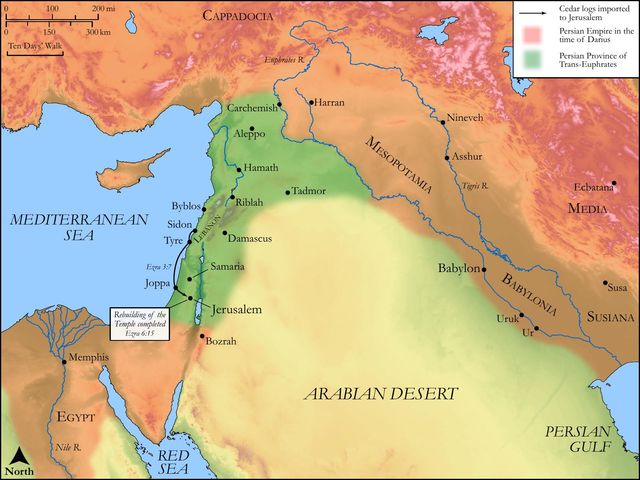
The setting for Ezra 5:16 is the post-exilic period under the vast Persian Empire, specifically during the reign of Darius I (522-486 BC). Decades earlier, following the Babylonian conquest of Jerusalem and the destruction of the First Temple (586 BC), the Jewish people were exiled. King Cyrus the Great of Persia, after conquering Babylon, issued a remarkable decree around 538 BC, permitting the exiled Jews to return to Judah and rebuild their Temple (Ezra 1:1-4). Sheshbazzar, identified as the "prince of Judah" and a prominent leader, was commissioned by Cyrus to lead the first wave of returnees and initiate the Temple's reconstruction, even bringing back the sacred Temple vessels (Ezra 1:7-11). While the foundation was laid around 536 BC, significant local opposition, culminating in a royal decree from a later king, Artaxerxes (as recounted in Ezra 4), led to an approximate 18-year cessation of work. It was only through the powerful prophetic ministries of Haggai and Zechariah, starting around 520 BC, that the people, under the leadership of Zerubbabel and Jeshua, were spiritually reawakened and spurred to resume the building, prompting Tatnai's official inquiry. The verse vividly encapsulates this extended period of interruption and renewed dedication.
Key Themes
ShowHideEzra 5:16 powerfully contributes to several overarching themes within the book of Ezra and the broader biblical narrative. Firstly, it underscores the divine faithfulness and historical continuity of God's redemptive plan for His people and their worship. The Temple's rebuilding was not merely a human endeavor but a divinely initiated and sustained task, rooted in God's covenant promises and King Cyrus's decree. Secondly, the phrase "not finished" centrally highlights the theme of perseverance amidst protracted opposition and delay. It reflects the immense obstacles, periods of apathy, and external interference that plagued the Temple's reconstruction, serving as a poignant testament to the enduring challenges inherent in God's work. Thirdly, the verse emphasizes accountability, legitimate authority, and the importance of remembering foundational acts. By explicitly recalling Sheshbazzar's initial laying of the foundation, the elders not only provide crucial historical context but also firmly establish the legitimate, divinely sanctioned basis for their current efforts, reinforcing the conviction that God's purposes, though delayed, will ultimately prevail, culminating in the Temple's eventual completion as recorded in Ezra 6:15.
Exposition and Analysis
ShowHideKey Word Analysis
ShowHideThis is the Aramaic transliteration of the Babylonian name given to the Jewish leader appointed by King Cyrus to oversee the initial return and the rebuilding of the Temple. As per Ezra 1:8, he was the "prince of Judah" and the one entrusted with the sacred Temple vessels. His mention here emphasizes the direct, authoritative link to Cyrus's original decree and the critical first phase of the Temple's reconstruction, establishing the legitimacy and continuity of the entire project.
This Aramaic term refers to the bedrock or base upon which a structure is built. In Israel, the laying of a foundation was a highly significant, often ceremonial, event marking the official commencement of a major construction project, as when "the builders laid the foundation of the temple of the LORD." For the "house of God," this act was profoundly symbolic, representing the re-establishment of God's dwelling place among His people in Jerusalem, signifying renewed hope, covenant, and the restoration of proper worship.
This Aramaic verb, often translated as "to complete," "to restore," or "to make whole," conveys the idea of bringing something to its intended conclusion or perfection. In Ezra 5:16, its negation ("not finished" using lâʼ) is crucial. It highlights the protracted and incomplete state of the Temple's construction at the time of Tatnai's inquiry, underscoring the significant period of interruption, the challenges faced, and the ongoing nature of the divinely mandated task.
Verse Breakdown
ShowHide"Then came the same Sheshbazzar"
This clause establishes the historical continuity and the authoritative beginning of the Temple's reconstruction. "Then" (Aramaic, ʼĕdayin) points back to the time immediately following Cyrus's decree. The phrase "the same Sheshbazzar" (Aramaic, dêk Shêshᵉbatstsar) emphasizes that the individual who initiated the work was indeed the one divinely commissioned and officially appointed by the Persian king, lending irrefutable legitimacy to the entire enterprise. It grounds the current efforts in a historically verifiable and authoritative origin.
"and laid the foundation of the house of God which is in Jerusalem"
This specifies the precise, foundational act performed by Sheshbazzar. It was not merely any building, but "the house of God" (Aramaic, bayith ʼĕlâhh), emphasizing its sacred purpose and profound significance as the central place of Israelite worship and the visible symbol of God's presence among His people. The location, "in Jerusalem" (Aramaic, Yᵉrûwshâlêm), firmly ties the rebuilding to the historical, spiritual, and prophetic capital of the Jewish nation, reinforcing its unique importance.
"and since that time even until now hath it been in building, and yet it is not finished"
This crucial temporal statement conveys the immense duration and the interrupted, ongoing nature of the Temple's construction. "Since that time even until now" (Aramaic, min ʼĕdayin ʻad kᵉʻan) bridges the significant gap of nearly two decades between the initial foundation-laying and the present inquiry by Tatnai, highlighting the protracted period of delay. The concluding phrase, "and yet it is not finished" (Aramaic, lâʼ shᵉlam), serves as a factual, yet implicitly apologetic, statement explaining why the work was still ongoing when Tatnai arrived. It candidly acknowledges the challenges, opposition, and periods of inactivity, while also subtly implying a determined commitment to complete the divinely mandated task.
Literary Devices
ShowHideEzra 5:16 employs several literary devices to convey its multifaceted message. It functions primarily as Historical Narrative within an official report, providing a concise yet critical chronological account of the Temple's rebuilding efforts. The elders' statement also serves as an Apologia or defense, as they are justifying their actions and the legitimacy of their work to a Persian official; by recounting the history, they establish the legal and divine basis for their continued construction. The phrase "since that time even until now hath it been in building, and yet it is not finished" utilizes Chronological Markers ("since that time," "until now") to emphasize the immense duration and the persistent challenges faced by the builders. The concluding "not finished" acts as a form of Understatement, subtly highlighting the arduous and protracted nature of the task, which had been plagued by significant delays and opposition. There is also an element of Irony in the fact that a divinely mandated and urgently needed project had been so long delayed and was still incomplete, underscoring the human obstacles God's work often encounters.
Theological and Thematic Connections
ShowHideEzra 5:16 powerfully illustrates God's unwavering commitment to His covenant people and His overarching purposes, even when human efforts falter or face immense opposition. The long delay in the Temple's construction, culminating in the declaration "not finished," serves as a poignant reminder that God's timing often differs from ours, and His work may involve seasons of waiting, testing, and renewed zeal. Yet, the very act of the elders recounting this history demonstrates their deep faith in the divine origin of the project and their steadfast conviction that it must be completed. It underscores the profound biblical truth that God's foundational plans for His people and His dwelling place will ultimately prevail, regardless of the obstacles or the passage of time. The perseverance of the faithful remnant, stirred by prophetic word, reflects God's faithfulness in raising up leaders and inspiring His people to complete what He has begun, ensuring His redemptive purposes are brought to fruition.
Reflection and Application
ShowHideEzra 5:16 offers profound insights for believers today, reminding us that the work of God, whether in our personal lives, in the corporate body of Christ, or in broader the renewal of society, is often a long-term endeavor marked by both foundational beginnings and periods of significant challenge. Just as the Temple's rebuilding faced decades of delay and fierce opposition, our spiritual journeys, ministry efforts, or even efforts to bring about God's kingdom on earth may encounter setbacks, apathy, or direct resistance. This verse encourages us to persevere, to faithfully remember the initial divine call and the spiritual "foundations" laid by God and by those who came before us. It challenges us to honestly assess whether our own spiritual "buildings" or God-given tasks are "not finished" due to neglect, fear, distraction, or discouragement, and to be re-stirred by God's Spirit to continue the good work He has given us, trusting in His ultimate faithfulness to bring His divine purposes to completion in His perfect timing.
Questions for Reflection
ShowHideFAQ
ShowHideWho was Sheshbazzar, and what was his role in the Temple's rebuilding?
ShowHideSheshbazzar was a pivotal figure in the initial return of the Jewish exiles from Babylon to Jerusalem following King Cyrus's decree. He is identified in Ezra 1:8 as the "prince of Judah" and was personally entrusted by Cyrus with the sacred vessels of the former Temple, along with the crucial mandate to initiate its rebuilding. As stated in Ezra 5:16, his specific and foundational role was to "lay the foundation of the house of God." While his exact relationship to Zerubbabel (who later led the completion) is a subject of scholarly debate—some suggest he was an earlier governor, a title for Zerubbabel, or even Zerubbabel's Babylonian name—his significance lies in his being the divinely appointed and royally commissioned individual who initiated the physical reconstruction of the Temple in Jerusalem, setting the stage for the later completion.
Why did the Temple rebuilding take so long, and what caused the delays mentioned in "not finished"?
ShowHideThe Temple rebuilding, which commenced around 536 BC with the laying of the foundation, faced significant and prolonged delays, ultimately taking approximately 18 years from the foundation to its resumption under Darius I, and then another four years to its eventual completion around 516 BC. The primary cause for the initial, extended halt was intense and persistent opposition from the local peoples inhabiting the land, particularly the Samaritans. These adversaries actively sought to hinder the work through intimidation, false accusations, and political maneuvering, as detailed in Ezra 4:1-24. This opposition eventually culminated in a royal decree from King Artaxerxes (a later king than Darius, but mentioned in the historical narrative of Ezra 4) that officially stopped the construction. Furthermore, a degree of apathy, spiritual complacency, and misplaced priorities among the Jewish people themselves contributed to the delay, as powerfully highlighted by the prophets Haggai and Zechariah, who rebuked the people for diligently building their own comfortable houses while God's house lay in ruins (Haggai 1:2-4).
Christ-Centered Fulfillment
ShowHideEzra 5:16, with its focus on the physical Temple's foundation and its long, interrupted construction, finds profound Christ-centered fulfillment in the New Testament. The earthly Temple, though a vital center of worship and God's presence, was always a shadow pointing to a greater, ultimate reality: Jesus Christ Himself. Jesus boldly declared, "Destroy this temple, and in three days I will raise it up," speaking not of the stone structure, but of the temple of His own body (John 2:19-21). He is the true and perfect "house of God," the very dwelling place of God among humanity, and the ultimate, unshakeable foundation upon which all spiritual reality is built (1 Corinthians 3:11). Furthermore, the "building" that was "not finished" in Ezra's day powerfully foreshadows the ongoing construction of God's spiritual house, the Church, of which Christ is the indispensable cornerstone (Ephesians 2:19-22). Just as the physical temple was eventually completed, God's redemptive work in and through Christ is assured of its glorious completion. The "not finished" aspect of the earthly temple also resonates with the ongoing, progressive work of sanctification in believers' lives, where God, who began a good work in us, will faithfully bring it to completion at the day of Jesus Christ (Philippians 1:6). Ultimately, the promise of God dwelling intimately with His people, partially realized in the Temple, finds its perfect, eternal, and glorious fulfillment in the New Jerusalem, where there is no need for a physical temple because the Lord God Almighty and the Lamb are its temple (Revelation 21:3 and Revelation 21:22).