


Ezra 4:21
Bible text: King James Version (1769 Blayney text) · Public domain
Bible text: King James Version with Strong's numbers · Public domain
Bible text: Berean Standard Bible · Public domain
Bible text: American Standard Version (1901) · Public domain
Bible text: World English Bible, Messianic edition · Public domain
Bible text: Geneva Bible (1599) · Public domain
Bible text: Young's Literal Translation · Public domain
- כְּעַןke·'AnnowH3705AdvAdverb
- שִׂימוּSi·mumakeH7761V-Peal-Imp-2mpVerb Peal Imperative 2nd Plural Masculine
- טְּעֵםte·'Ema decreeH2942N-csNoun Singular common gender Absolute
- לְבַטָּלָאle·va·ta·La'to make to ceaseH989Prep-l ¦ V-Piel-InfVerb Piel Infinitive Constructלְtoבַטָּלָאmake to cease
- גֻּבְרַיָּאguv·rai·Ya'men theH1400N-mp ¦ ArtNoun Plural Masculine Definiteגֻּבְרַיָּmenאthe
- אִלֵּךְ'i·LekhtheseH479PrtParticle Demonstrative
- וְקִרְיְתָאve·kir·ye·Ta'and city theH7149Conj-w ¦ N-fs ¦ ArtNoun Singular Feminine Definiteוְandקִרְיְתָcityאthe
- דָךְdoKhthisH1791PrtParticle Demonstrative
- לָאla'notH3809NegParticle Negative
- תִתְבְּנֵאtit·be·Ne'it will be builtH1124V-Hitpael-Imperf-3fsVerb Hitpael Imperfect 3rd Singular Feminine
- עַד'aduntilH5705PrepPreposition
- מִנִּיmi·Nifrom meH4481Prep ¦ 1csPreposition Definiteמִנִּfromיme
- טַעְמָאta'·Ma'decree theH2942N-cs ¦ ArtNoun Singular common gender Definiteטַעְמָdecreeאthe
- יִתְּשָׂםyi·te·Samit will be madeH7761V-Hitpael-Imperf-3msVerb Hitpael Imperfect 3rd Singular Masculine
English is a literal word-by-word gloss of the Hebrew, not the KJV's wording. Why?
This is the original text the KJV's translators worked from — each Hebrew word with its own literal English meaning in this verse, prepared by scholars at Tyndale House, Cambridge. The KJV translates whole sentences, not word by word, so its wording differs: one Hebrew word can become several English words, and the KJV may choose “the LORD” where the gloss reads “Yahweh”. Both are faithful — they answer different questions. For the KJV's own rendering, switch to the KJV text.
Details
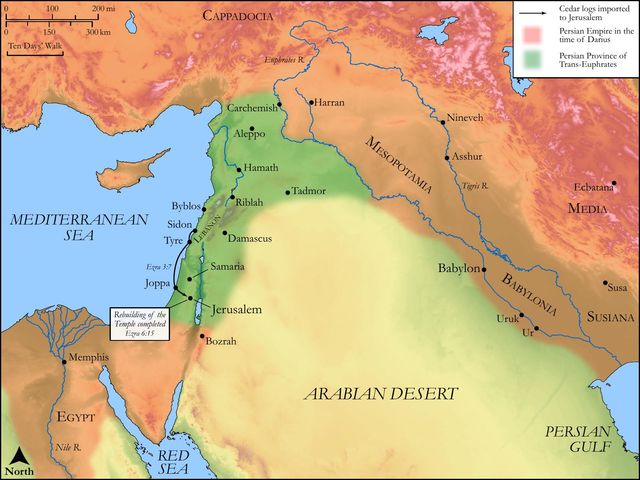
See on the biblical-era map
Study this verse
Public-domain commentary
Matthew Henry
From his Commentary on the Whole Bible. Henry comments on passages, not single verses — this entry covers Ezra 4:17–24. His two-level outline is real structure in the source text, so it is rendered as structure.
Here we have,
I.The orders which the king of Persia gave, in answer to the information sent him by the Samaritans against the Jews.
He suffered himself to be imposed upon by their fraud and falsehood, took no care to examine the allegations of their petition concerning that which the Jews were now doing, but took it for granted that the charge was true, and was very willing to gratify them with an order of council to stay proceedings.
1.He consulted the records concerning Jerusalem, and found that it had indeed rebelled against the king of Babylon, and therefore that it was, as they called it, a bad city (Ezr 4:19), and withal that in times past kings had reigned there, to whom all the countries on that side the river had been tributaries (Ezr 4:20), and that therefore there was danger that if ever they were able (which they were never likely to be) they would claim them again. Thus he says as they said, and pretends to give a reason for so doing. See the hard fate of princes, who must see and hear with other men's eyes and ears, and give judgment upon things as they are represented to them, though often represented falsely. God's judgment is always just because he sees things as they are, and it is according to truth.
2.He appointed these Samaritans to stop the building of the city immediately, till further orders should be given about it, Ezr 4:21, Ezr 4:22. Neither they, in their letter, nor he, in his order, make any mention of the temple, and the building of that, because both they and he knew that they had not only a permission, but a command, from Cyrus to rebuild that, which even these Samaritans had not the confidence to move for the repeal of. They spoke only of the city: "Let not that be built," that is, as a city with walls and gates; "whatever you do, prevent that, lest damage grow to the hurt of the kings:" he would not that the crown should lose by his wearing it.
II.The use which the enemies of the Jews made of these orders, so fraudulently obtained; upon the receipt of them they went up in haste to Jerusalem, Ezr 4:23. Their feet ran to evil, Pro 1:16. They were impatient till the builders were served with this prohibition, which they produced as their warrant to make them cease by force and power. As they abused the king in obtaining this order by their mis-informations, so they abused him in the execution of it; for the order was only to prevent the walling of the city, but, having force and power on their side, they construed it as relating to the temple, for it was that to which they had an ill will, and which they only wanted some colour to hinder the building of. There was indeed a general clause in the order, to cause these men to cease, which had reference to their complaint about building the walls; but they applied it to the building of the temple. See what need we have to pray, not only for kings, but for all in authority under them, and the governors sent by them, because the quietness and peaceableness of our lives, in all godliness and honesty, depend very much upon the integrity and wisdom of inferior magistrates, as well as the supreme. The consequence was that the work of the house of God ceased for a time, through the power and insolence of its enemies; and so, through the coldness and indifference of its friends, it stood still till the second year of Darius Hystaspes, for to me it seems clear by the thread of this sacred history that it was that Darius, Ezr 4:24. Though now a stop was put to it by the violence of the Samaritans, yet that they might soon after have gone on by connivance, if they had had a due affection to the work, appears by this, that before they had that express warrant from the king for doing it (ch. 6) they were reproved by the prophets for not doing it, Ezr 5:1, compared with Hag 1:1, etc. If they had taken due care to inform Cambyses of the truth of this case, perhaps he would have recalled his order; but, for aught I know, some of the builders were almost as willing it should cease as the adversaries themselves were. At some periods the church has suffered more by the coldness of its friends than by the heat of its enemies; but both together commonly make church-work slow work.
Historical interpretation
Historical reception
1 surviving comment on this verse from the historical church.
The Jews said, “This temple was built in forty-six years, and you will raise it up in three days?” They answered as they understood. But lest we too should perceive our Lord’s spiritual word in a carnal way, the Evangelist subsequently explained what temple it was of which he was speaking. As for their stating that the temple was built in forty-six years, they meant not its first but its second building. For Solomon, the first [builder], finished the temple very rapidly within seven years, during a time of great peace in his kingdom. It was destroyed by the Chaldeans, but after seventy years it began to be rebuilt, at the bidding of Cyrus the Persian, when the captivity was lightened. But the descendants of those who were deported were unable to finish the work that they were doing under the rulers Zerubbabel and Jeshua before forty-six years had passed, on account of the resistance of the neighboring nations.This number [forty-six] of years is also most apt for the perfecting of our Lord’s physical body. Writers on natural history tell us that the form of the human body is completed within this number of days. During the first six days after conception it has a likeness to milk; during the following nine days it is changed into blood; next, in twelve days, it becomes solid; during the remaining eighteen days it is formed into the perfect features of all its members; and after this, during the time remaining until birth, it increases in size. Six plus nine plus twelve plus eighteen makes forty-five. If to this we add one, that is, the day on which the body, divided into its separate members, begins to grow, we find the same number of days in the building up of our Lord’s body as there were years in the construction of the temple.
Continue studying Ezra 4:21 across the web’s major study libraries — every link below opens this exact verse, chapter, or book on the destination site.
Read & Compare
 BibleGatewayThis verse in more than 200 translations and 70 languages.
 Bible.comThe YouVersion reader — hundreds of translations, reading plans, and highlights.
 ESV.orgCrossway's official English Standard Version reader.
 NET BibleThe NET translation with 60,000+ translators' notes on every rendering decision.
 STEP BibleTyndale House's free study tool — original text, vocabulary, and scholarly resources.
 BibliaLogos Bible Software's free web reader.
 USCCBThe New American Bible (Revised Edition) with the U.S. bishops' study notes.
Commentaries
 BibleHub CommentariesDozens of classic commentaries on this verse, gathered on one page.
 StudyLightMore than 100 commentary sets — the largest collection on the web.
 BibleRefPlain-English commentary on what this verse means, verse by verse.
 Enduring WordDavid Guzik's free commentary on this chapter, widely used by Bible teachers.
 Bible Study ToolsVerse commentary alongside Greek and Hebrew study aids.
Original Language & Research
- BibleHub InterlinearThe verse word by word — original language, transliteration, and English.
- BibleHub LexiconEvery word's original-language definition and Strong's entry.
 Blue Letter BibleDeep-study tools — Strong's numbers, concordance, and word studies.
 SefariaThe Hebrew text with Rashi and centuries of Jewish commentary.
Sermons, Hymns & Audio


TrulyRandomVerse is not affiliated with these sites and doesn’t control their content. They’re linked because they’re genuinely useful.
Summary
Ezra 4:21 records the decisive royal decree issued by King Artaxerxes, commanding the immediate cessation of all rebuilding efforts in Jerusalem. This pivotal moment underscores the formidable political and bureaucratic opposition faced by the returned Jewish exiles as they endeavored to restore their homeland, revealing the temporary triumph of adversaries who successfully leveraged imperial power to halt a divinely ordained project.
Context
ShowHideLiterary Context
Ezra 4:21 is situated within a crucial section that meticulously details the persistent opposition to the rebuilding efforts in Jerusalem. While the surrounding chapters (Ezra 1-3, 5-6) primarily focus on the reconstruction of the temple, Ezra 4 specifically addresses the broader rebuilding of the city, particularly its defensive walls. This verse presents the direct consequence of a meticulously crafted letter sent to King Artaxerxes by Rehum the chancellor and Shimshai the scribe, a communication detailed in Ezra 4:11-16. This letter falsely accused the Jewish returnees of rebellious intentions, asserting that a rebuilt and fortified Jerusalem would inevitably become a significant threat to Persian authority and imperial revenue. The king's response, following a thorough investigation of historical records (as explicitly mentioned in Ezra 4:19-20), confirmed his deep-seated fear of a resurgent, rebellious city, leading directly to the unequivocal decree articulated in this verse. The verse is immediately followed by the swift and forceful enforcement of this decree, causing all work to cease, as stated in Ezra 4:23-24. It is vital to note the deliberate chronological jump in Ezra 4, where events from Artaxerxes' reign are presented out of strict historical sequence to group all forms of opposition to rebuilding together, before the narrative returns to the temple's completion under Darius in Ezra 5.
Historical & Cultural Context
The events of Ezra 4:21 unfold during the critical post-exilic period, specifically within the reign of Artaxerxes I (465-424 BC), a significant time following the initial return of Jewish exiles under the benevolent decree of Cyrus the Great. The Persian Empire stood as the dominant world power, maintaining its vast dominion through a highly organized and efficient administrative system, which included regional governors, chancellors, and scribes. The "adversaries of Judah and Benjamin" were local inhabitants, often identified as Samaritans, who had settled in the land during the Babylonian exile and perceived their influence, land claims, and security to be severely threatened by the re-establishment of a strong and independent Jewish presence. Their accusations to the king skillfully tapped into legitimate Persian concerns regarding the maintenance of order, the collection of tribute, and the prevention of rebellion within their extensive provinces. Jerusalem, indeed, possessed a historical reputation as a rebellious city, having famously defied both the Babylonian and Assyrian empires in the past—a fact that Artaxerxes' diligent officials would have readily confirmed through a review of imperial archives. The king's primary motivations were pragmatic: ensuring political stability and maintaining economic control. He viewed any fortification of Jerusalem as a direct challenge to imperial authority and a potential threat to vital tax revenues, a concern explicitly articulated in the adversaries' letter found in Ezra 4:13.
Key Themes
ShowHideThis verse powerfully illustrates several enduring and profound themes within the book of Ezra and the broader biblical narrative of God's redemptive history. Firstly, it highlights the persistent opposition to God's work and His chosen people. The rebuilding of Jerusalem, understood as a divinely mandated project for the restoration of Judah, was met with fierce and cunning resistance from those who sought to undermine this sacred endeavor. This opposition often manifested through political maneuvering, slander, and outright deception, as vividly portrayed in the adversaries' manipulative letter. Secondly, the verse underscores the immense and absolute power of royal decrees in the Persian court. A king's "commandment" or edict was considered absolute, immediately binding, and unchallengeable, possessing the authority to halt major national projects and profoundly impact the lives of entire populations. Thirdly, it speaks to the theme of divine timing and human delay. While God's ultimate plan for Jerusalem's restoration was certain and unchangeable, this specific decree led to a significant and prolonged pause in the rebuilding of the city walls, a crucial task that would not be fully resumed until the time of Nehemiah, decades later. This demonstrates that God's purposes unfold according to His perfect and often mysterious timing, which may involve periods of waiting, apparent setbacks, and human frustration. Finally, the verse implicitly touches on the profound sovereignty of God over human authorities, even over powerful and seemingly absolute monarchs like Artaxerxes. Though the king's decree appeared to thwart God's immediate plan, ultimately, God's will would prevail, as triumphantly seen in later chapters of Ezra and the book of Nehemiah, where the work is eventually completed.
Exposition and Analysis
ShowHideKey Word Analysis
ShowHideThis word (H2942) refers to an official royal edict, a binding judgment, or a decree. It conveys the absolute authority and finality of the king's word. In this context, it is not merely an instruction but a legal, administrative order that must be enforced without question. The term emphasizes the weight and power behind Artaxerxes' decision, making it a formidable, legally binding obstacle to the rebuilding efforts.
This verb (H989) means to stop, to nullify, to make void, or to bring to an end. It implies a complete, immediate, and permanent cessation of activity until otherwise ordered. The king's order was not for a slowdown or a temporary pause for review, but for the work to be entirely halted and rendered ineffective, reflecting the severity of his concern and the effectiveness of the adversaries' accusations.
This passive verb (H1124) means "to be built" or "to be constructed." While the temple rebuilding was the primary focus of the initial returnees, this specific command refers to the city itself, particularly its fortifications and walls. The king's fear was of a re-fortified Jerusalem becoming a center of rebellion, and thus his decree specifically targeted the construction that would enhance its defensive capabilities and potential for defiance.
Verse Breakdown
ShowHide"Give ye now commandment to cause these men to cease"
This is King Artaxerxes' direct, forceful, and authoritative instruction to his provincial officials, specifically Rehum and Shimshai, who had sent the accusatory letter. The "ye" refers to these Persian administrators in the Trans-Euphrates province, empowering them to enforce the royal will immediately and without hesitation. The phrase "cause these men to cease" is a clear and unambiguous directive to halt the Jewish builders' work immediately and completely, indicating a swift and decisive intervention.
"and that this city be not builded"
This clause explicitly specifies the object of the prohibition: the city of Jerusalem. The king's concern was not merely about the specific individuals engaged in construction but about the very act of rebuilding the city, especially its defensive structures and walls, which he perceived as a direct threat to imperial control, stability, and the collection of tribute. This highlights the political and strategic dimension of the decree.
"until [another] commandment shall be given from me"
This crucial phrase indicates that the cessation, while immediate and absolute, is not necessarily permanent, but it is entirely contingent upon the king's future will and decision. It powerfully reinforces Artaxerxes' absolute authority; only he possesses the power to reverse or modify this decree. This conditional clause underscores the precarious and dependent position of the Jewish exiles, whose future and the resumption of their work were subject to the whims and political calculations of a foreign monarch, foreshadowing the long and frustrating delay that would ensue before the work could resume.
Literary Devices
ShowHideEzra 4:21 employs several potent literary devices that enhance its meaning and impact. The most prominent is the Decree/Edict, a ubiquitous and highly significant form of communication in the Persian Empire. This formal, legal language underscores the absolute and binding nature of the king's word, highlighting the gravity of the situation and the formidable, unchallengeable power wielded by Artaxerxes. There is also a strong element of Antithesis or Contrast at play: the fervent, divinely inspired desire of the Jewish exiles to rebuild their sacred city stands in stark opposition to the king's stern, humanly motivated command to cease all construction. This creates significant narrative tension, emphasizing the powerful external forces working against God's people and His purposes. Furthermore, the phrase "until [another] commandment shall be given from me" functions as a subtle yet significant form of Foreshadowing, hinting that this setback, while severe, is not the final word in the narrative. While it clearly signifies a substantial delay, it also implicitly suggests the possibility of future divine intervention that would ultimately lead to the resumption and completion of the work, as indeed occurs later in the books of Ezra and Nehemiah. Finally, there is a profound degree of Irony in the situation: the king's decree, intended to secure his empire and prevent rebellion, inadvertently serves God's larger, sovereign plan by delaying the work until a more opportune and divinely appointed time, demonstrating that even the most powerful human rulers are ultimately instruments in God's omnipotent hands.
Theological and Thematic Connections
ShowHideEzra 4:21 serves as a stark and enduring reminder that the work of God's kingdom often faces formidable and multi-faceted opposition. Just as the rebuilding of Jerusalem was met with cunning political maneuvering, false accusations, and a powerful royal decree, so too throughout biblical history do we consistently see God's people and His redemptive purposes encountering fierce resistance. This opposition is not merely human in origin but frequently possesses a spiritual dimension, as forces hostile to God's redemptive plan actively seek to hinder and undermine His work. Yet, the overarching narrative of Ezra, even in this moment of apparent setback, implicitly points to God's unassailable sovereignty. Despite the king's absolute authority and the immediate enforcement of his decree, God's ultimate purpose for Jerusalem would not be thwarted but would unfold precisely according to His perfect timing and unwavering will. This verse, therefore, becomes a profound testament to the enduring truth that while human decrees and adverse circumstances can indeed cause delays, difficulties, and distress, they cannot ultimately derail or nullify the divine will of the Almighty.
Reflection and Application
ShowHideEzra 4:21 offers profound and timeless lessons for believers today, particularly regarding the inherent nature of God's work in the world and our essential participation in it. When we commit ourselves wholeheartedly to God's purposes, whether in personal spiritual growth, nurturing our families, engaging in church ministry, or broader societal engagement for justice and righteousness, we should realistically anticipate opposition. This opposition may not always manifest as overt persecution but can take more subtle forms such as bureaucratic hurdles, slanderous accusations, unexpected financial setbacks, or frustrating delays. This verse calls us to cultivate deep patience and unwavering perseverance, reminding us that apparent setbacks are not necessarily defeats but may, in fact, be an integral part of God's larger, often inscrutable, timing and plan. It challenges us to trust implicitly in God's ultimate sovereignty, knowing with certainty that even when human authorities or seemingly insurmountable circumstances appear to hinder His work, His plans will ultimately and triumphantly prevail. Our faith is often refined and deepened in these periods of waiting and resistance, teaching us to rely more profoundly on God's omnipotent power and perfect wisdom rather than on our own limited efforts or the fluctuating external circumstances.
Questions for Reflection
ShowHideFAQ
ShowHideWhy did King Artaxerxes issue this decree to stop the rebuilding?
ShowHideKing Artaxerxes issued this decree primarily due to a misleading and fear-mongering letter sent by the "adversaries of Judah and Benjamin," specifically Rehum the chancellor and Shimshai the scribe, as meticulously detailed in Ezra 4:11-16. They accused the Jewish returnees of rebellious intentions, claiming that if Jerusalem's walls were rebuilt, the city would inevitably become a center of defiance against Persian authority, refusing to pay tribute, custom, and toll, thereby significantly diminishing the king's revenue. Artaxerxes, after consulting historical records that confirmed Jerusalem's past as a powerful and rebellious city (Ezra 4:19-20), acted out of paramount political and economic concern to prevent any potential uprising and loss of imperial control.
How long did the cessation of rebuilding last due to this decree?
ShowHideThe decree in Ezra 4:21 led to a significant and prolonged cessation of the rebuilding work on Jerusalem's city walls. According to Ezra 4:24, the work ceased "unto the second year of the reign of Darius king of Persia." This refers to Darius I (Darius the Great), under whom the temple rebuilding resumed and was eventually completed (Ezra 5-Ezra 6). However, the specific rebuilding of the city walls, which was the direct focus of Artaxerxes' decree, would not fully resume until the time of Nehemiah, decades later, during the reign of Artaxerxes I himself (Nehemiah 2). Thus, for the city walls, the delay was substantial, lasting many years.
Does this decree mean God's plan for Jerusalem was thwarted?
ShowHideNo, God's ultimate plan for Jerusalem was emphatically not thwarted, but rather delayed according to His sovereign and perfect timing. While Artaxerxes' decree imposed a significant setback and caused understandable frustration for the Jewish exiles, it did not ultimately prevent the fulfillment of God's promises. The temple was indeed completed under Darius (Ezra 6), and the city walls were eventually rebuilt under Nehemiah, with God's direct intervention and favor, even from Artaxerxes himself (Nehemiah 2:8). This historical episode serves as a powerful reminder that God's purposes are unshakeable and His plans are infallible, even when faced with formidable human opposition and apparent delays. As Proverbs 19:21 profoundly states, "Many are the plans in a person's heart, but it is the Lord's purpose that prevails."
Christ-Centered Fulfillment
ShowHideEzra 4:21, with its vivid depiction of a royal decree halting the rebuilding of God's chosen city due to powerful and deceptive opposition, finds its ultimate Christ-centered fulfillment in the life, redemptive death, and ongoing work of Jesus Christ and His Church. Just as the physical city of Jerusalem faced relentless adversaries who sought to prevent its restoration, so too did Christ, the true builder of God's eternal kingdom, encounter unyielding opposition. From the very beginning of His earthly ministry, forces of darkness and human sin conspired to "cause Him to cease" His redemptive work (John 1:11). The crucifixion itself appeared to be the ultimate decree to stop God's plan, a moment when the "building" of salvation seemed utterly demolished and abandoned. However, like the "until another commandment" in Ezra, the cross was not the final word. God's ultimate "commandment" came through the glorious resurrection, demonstrating with irrefutable power that no human or demonic decree can thwart His divine purpose (Acts 2:23-24). Furthermore, the Church, as the spiritual "city of God" and Christ's living body, continues to face opposition in its mission to build the kingdom of God on earth (Matthew 16:18). Yet, the unwavering promise remains that the gates of hell will not prevail against it. The temporary cessation in Ezra foreshadows the temporary triumph of evil, which ultimately serves to highlight God's greater victory and the establishment of an eternal kingdom that "shall never be destroyed" (Daniel 2:44). Christ's finished work ensures that the spiritual Jerusalem, the New Jerusalem, will be fully built and descend from heaven, a glorious testament to God's unyielding purpose and Christ's ultimate, eternal triumph (Revelation 21:2).