


Ezra 4:20
- וּמַלְכִיןu·mal·Khinand kingsH4430Conj-w ¦ N-mpNoun Plural Masculine Absoluteוּandמַלְכִיןkings
- תַּקִּיפִיןta·ki·FinstrongH8624Adj-mpAdjective Plural Masculine Absolute
- הֲווֹha·Vothey wereH1934V-Peal-Perf-3mpVerb Peal Perfect 3rd Plural Masculine
- עַל'aloverH5922PrepPreposition
- יְרוּשְׁלֶםye·Ru·she·LemJerusalemH3390N-properNoun Proper Location
- וְשַׁלִּיטִיןve·Sha·li·Tinand having masteryH7990Conj-w ¦ Adj-mpAdjective Plural Masculine Absoluteוְandשַׁלִּיטִיןhaving mastery
- בְּכֹלbe·Kholover allH3606Prep-b ¦ N-cscNoun Singular common gender Constructבְּoverכֹלall
- עֲבַר'a·Var[the] region beyondH5675N-cscNoun Singular common gender Construct
- נַהֲרָהna·ha·Rah'river theH5103N-cs ¦ ArtNoun Singular common gender Definiteנַהֲרָriverהthe
- וּמִדָּהu·mi·Dahand tributeH4061Conj-w ¦ N-fsNoun Singular Feminine Absoluteוּandמִדָּהtribute
- בְלוֹve·LotaxH1093N-csNoun Singular common gender Absolute
- וַהֲלָךְva·ha·Lakhand tollH1983Conj-w ¦ N-csNoun Singular common gender Absoluteוַandהֲלָךְtoll
- מִתְיְהֵבmit·ye·Hev[was] being paidH3052V-Hitpael-Prtcpl-msVerb Hitpael Participle Singular Masculine Absolute
- לְהוֹןle·Honto themPrep-l ¦ 3mpSuffix Personal 3rd Plural Masculineלְtoהוֹןthem
English is a literal word-by-word gloss of the Hebrew, not the KJV's wording. Why?
This is the original text the KJV's translators worked from — each Hebrew word with its own literal English meaning in this verse, prepared by scholars at Tyndale House, Cambridge. The KJV translates whole sentences, not word by word, so its wording differs: one Hebrew word can become several English words, and the KJV may choose “the LORD” where the gloss reads “Yahweh”. Both are faithful — they answer different questions. For the KJV's own rendering, switch to the KJV text.
Details
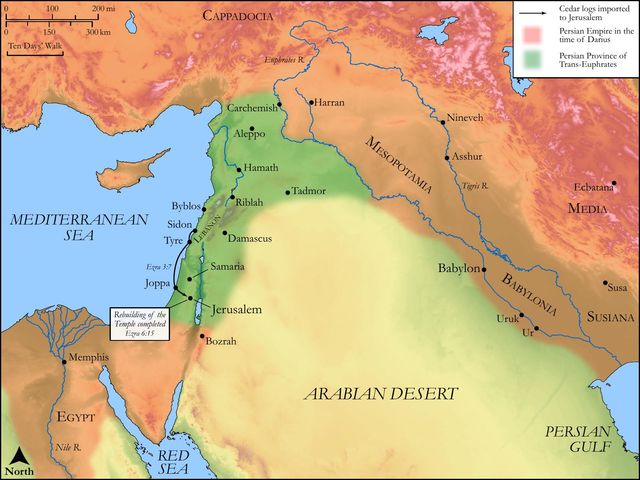
See on the biblical-era map
Study this verse
Public-domain commentary
Matthew Henry
From his Commentary on the Whole Bible. Henry comments on passages, not single verses — this entry covers Ezra 4:17–24. His two-level outline is real structure in the source text, so it is rendered as structure.
Here we have,
I.The orders which the king of Persia gave, in answer to the information sent him by the Samaritans against the Jews.
He suffered himself to be imposed upon by their fraud and falsehood, took no care to examine the allegations of their petition concerning that which the Jews were now doing, but took it for granted that the charge was true, and was very willing to gratify them with an order of council to stay proceedings.
1.He consulted the records concerning Jerusalem, and found that it had indeed rebelled against the king of Babylon, and therefore that it was, as they called it, a bad city (Ezr 4:19), and withal that in times past kings had reigned there, to whom all the countries on that side the river had been tributaries (Ezr 4:20), and that therefore there was danger that if ever they were able (which they were never likely to be) they would claim them again. Thus he says as they said, and pretends to give a reason for so doing. See the hard fate of princes, who must see and hear with other men's eyes and ears, and give judgment upon things as they are represented to them, though often represented falsely. God's judgment is always just because he sees things as they are, and it is according to truth.
2.He appointed these Samaritans to stop the building of the city immediately, till further orders should be given about it, Ezr 4:21, Ezr 4:22. Neither they, in their letter, nor he, in his order, make any mention of the temple, and the building of that, because both they and he knew that they had not only a permission, but a command, from Cyrus to rebuild that, which even these Samaritans had not the confidence to move for the repeal of. They spoke only of the city: "Let not that be built," that is, as a city with walls and gates; "whatever you do, prevent that, lest damage grow to the hurt of the kings:" he would not that the crown should lose by his wearing it.
II.The use which the enemies of the Jews made of these orders, so fraudulently obtained; upon the receipt of them they went up in haste to Jerusalem, Ezr 4:23. Their feet ran to evil, Pro 1:16. They were impatient till the builders were served with this prohibition, which they produced as their warrant to make them cease by force and power. As they abused the king in obtaining this order by their mis-informations, so they abused him in the execution of it; for the order was only to prevent the walling of the city, but, having force and power on their side, they construed it as relating to the temple, for it was that to which they had an ill will, and which they only wanted some colour to hinder the building of. There was indeed a general clause in the order, to cause these men to cease, which had reference to their complaint about building the walls; but they applied it to the building of the temple. See what need we have to pray, not only for kings, but for all in authority under them, and the governors sent by them, because the quietness and peaceableness of our lives, in all godliness and honesty, depend very much upon the integrity and wisdom of inferior magistrates, as well as the supreme. The consequence was that the work of the house of God ceased for a time, through the power and insolence of its enemies; and so, through the coldness and indifference of its friends, it stood still till the second year of Darius Hystaspes, for to me it seems clear by the thread of this sacred history that it was that Darius, Ezr 4:24. Though now a stop was put to it by the violence of the Samaritans, yet that they might soon after have gone on by connivance, if they had had a due affection to the work, appears by this, that before they had that express warrant from the king for doing it (ch. 6) they were reproved by the prophets for not doing it, Ezr 5:1, compared with Hag 1:1, etc. If they had taken due care to inform Cambyses of the truth of this case, perhaps he would have recalled his order; but, for aught I know, some of the builders were almost as willing it should cease as the adversaries themselves were. At some periods the church has suffered more by the coldness of its friends than by the heat of its enemies; but both together commonly make church-work slow work.
Historical interpretation
Historical reception
1 surviving comment on this verse from the historical church.
The Jews said, “This temple was built in forty-six years, and you will raise it up in three days?” They answered as they understood. But lest we too should perceive our Lord’s spiritual word in a carnal way, the Evangelist subsequently explained what temple it was of which he was speaking. As for their stating that the temple was built in forty-six years, they meant not its first but its second building. For Solomon, the first [builder], finished the temple very rapidly within seven years, during a time of great peace in his kingdom. It was destroyed by the Chaldeans, but after seventy years it began to be rebuilt, at the bidding of Cyrus the Persian, when the captivity was lightened. But the descendants of those who were deported were unable to finish the work that they were doing under the rulers Zerubbabel and Jeshua before forty-six years had passed, on account of the resistance of the neighboring nations.This number [forty-six] of years is also most apt for the perfecting of our Lord’s physical body. Writers on natural history tell us that the form of the human body is completed within this number of days. During the first six days after conception it has a likeness to milk; during the following nine days it is changed into blood; next, in twelve days, it becomes solid; during the remaining eighteen days it is formed into the perfect features of all its members; and after this, during the time remaining until birth, it increases in size. Six plus nine plus twelve plus eighteen makes forty-five. If to this we add one, that is, the day on which the body, divided into its separate members, begins to grow, we find the same number of days in the building up of our Lord’s body as there were years in the construction of the temple.
Continue studying Ezra 4:20 across the web’s major study libraries — every link below opens this exact verse, chapter, or book on the destination site.
Read & Compare
 BibleGatewayThis verse in more than 200 translations and 70 languages.
 Bible.comThe YouVersion reader — hundreds of translations, reading plans, and highlights.
 ESV.orgCrossway's official English Standard Version reader.
 NET BibleThe NET translation with 60,000+ translators' notes on every rendering decision.
 STEP BibleTyndale House's free study tool — original text, vocabulary, and scholarly resources.
 BibliaLogos Bible Software's free web reader.
 USCCBThe New American Bible (Revised Edition) with the U.S. bishops' study notes.
Commentaries
 BibleHub CommentariesDozens of classic commentaries on this verse, gathered on one page.
 StudyLightMore than 100 commentary sets — the largest collection on the web.
 BibleRefPlain-English commentary on what this verse means, verse by verse.
 Enduring WordDavid Guzik's free commentary on this chapter, widely used by Bible teachers.
 Bible Study ToolsVerse commentary alongside Greek and Hebrew study aids.
Original Language & Research
- BibleHub InterlinearThe verse word by word — original language, transliteration, and English.
- BibleHub LexiconEvery word's original-language definition and Strong's entry.
 Blue Letter BibleDeep-study tools — Strong's numbers, concordance, and word studies.
 SefariaThe Hebrew text with Rashi and centuries of Jewish commentary.
Sermons, Hymns & Audio


TrulyRandomVerse is not affiliated with these sites and doesn’t control their content. They’re linked because they’re genuinely useful.
Summary
Ezra 4:20 encapsulates the cunning strategy of Jerusalem's adversaries in their attempt to halt the post-exilic rebuilding efforts. In a meticulously crafted letter to King Artaxerxes, Persian officials exaggerated Jerusalem's historical might and its potential as a rebellious city, arguing that its restoration would inevitably lead to a cessation of crucial "toll, tribute, and custom" payments. This verse masterfully reveals the economic and political dimensions of the opposition faced by the returning Jewish exiles, designed to appeal directly to the king's self-interest and portray the rebuilding as a dangerous act of sedition against imperial authority.
Context
ShowHideLiterary Context
Ezra 4:20 is situated within a pivotal section of the book of Ezra, specifically Ezra 4:6-23, which meticulously chronicles the sustained opposition to the rebuilding of both the temple and the city walls in Jerusalem. Following the benevolent decree of King Cyrus, which permitted the Jewish exiles to return and commence reconstruction (as detailed in Ezra 1:1-4), local adversaries—primarily Samaritans and other peoples residing in the region—actively sought to frustrate these divinely ordained efforts. The immediate literary context of verse 20 is a highly persuasive and manipulative letter dispatched by these officials, including Rehum the commanding officer and Shimshai the scribe, to King Artaxerxes (found in Ezra 4:11-16). Their core argument centered on portraying Jerusalem as a historically rebellious city that, if allowed to be rebuilt, would inevitably defy imperial authority and withhold vital taxes, thereby profoundly undermining the king's dominion over the Trans-Euphrates province. Verse 20 serves as a crucial rhetorical flourish within their argument, meticulously designed to instill fear and provoke a swift royal decree to cease the construction.
Historical & Cultural Context
The events described in Ezra 4 unfold during the expansive reign of the Persian Empire, specifically under Artaxerxes I (465-424 BC). The phrase "countries beyond the river" refers to the satrapy of Abar-nahara (Trans-Euphrates), a strategically vital administrative and revenue-generating province for the Persian Empire. Jerusalem, despite its diminished state, occupied a critical geographical position within this region. The sophisticated Persian administrative system was heavily reliant upon a robust and efficient taxation structure, encompassing various forms of levies, to sustain its vast empire, fund its armies, and support its lavish court. Local officials, often appointed directly by the king, bore the significant responsibility of collecting these taxes and ensuring regional stability. The adversaries' appeal to Artaxerxes was culturally astute and politically shrewd; any perceived threat to imperial control or, more critically, to imperial revenue, was regarded with utmost gravity by Persian monarchs, who viewed such challenges as direct affronts to their absolute authority and potential precursors to widespread rebellion. The historical memory of Jerusalem's past independence and its occasional revolts against previous empires (such as Babylon) provided a plausible, albeit deliberately exaggerated, foundation for the accusers' claims, making their narrative resonate with the king's concerns.
Key Themes
ShowHideThis verse powerfully illuminates several profound themes pertinent to God's redemptive history. Firstly, it highlights the persistent opposition to God's redemptive work. The rebuilding of Jerusalem and its sacred temple was central to God's covenantal plan for the restoration of His people, yet it faced relentless human resistance, often cunningly cloaked in seemingly legitimate political and economic pretexts. Secondly, it underscores the pervasive theme of political manipulation and propaganda. The accusers did not merely present facts but engaged in deliberate rhetorical exaggeration and selective historical recounting to achieve their desired outcome—the cessation of the rebuilding. They skillfully appealed to the king's self-interest, framing the Jews' efforts as a direct economic and political threat to his dominion. Thirdly, it reveals the vulnerability of God's people to worldly power structures and the concomitant need for divine intervention. Despite the clear divine mandate for the rebuilding, the work could be temporarily halted by a human decree, demonstrating the practical challenges and precarious position faced by the exiles. This echoes earlier themes of Israel's past glory under kings like Solomon, whose dominion extended "over all the kingdoms from the River to the land of the Philistines, as far as the border of Egypt" (1 Kings 4:21), a historical truth the accusers likely twisted to their advantage. Ultimately, this opposition, though initially successful in causing a delay, did not ultimately thwart God's sovereign plan, a powerful theme of divine faithfulness that permeates the narratives of Ezra and Nehemiah, often requiring fervent prayer and vigilant action from God's people, as seen in Nehemiah 4:9.
Exposition and Analysis
ShowHideKey Word Analysis
ShowHideThis term specifically refers to a tribute in money, often understood as a land tax or property tax. It represents a direct, fixed levy on the inhabitants or their possessions, frequently tied to agricultural produce or land ownership. Its inclusion in the accusers' letter implies a warning of a significant loss of regular, predictable revenue that would otherwise flow from the Jewish population and potentially from the wider region if Jerusalem were to become a center of resistance, thereby directly impacting the imperial treasury.
This word denotes an excise tax or duty on articles consumed or on persons, akin to a poll tax. It signifies a broader economic impact beyond just land, touching on commercial activity and the general populace. Its mention suggests a comprehensive financial threat, indicating that a rebellious Jerusalem would disrupt not only property taxes but also other forms of revenue derived from trade and individual levies.
This term refers to a road tax or duty on goods passing through certain checkpoints, similar to modern customs duties or tariffs. It implies revenue generated from trade routes and commercial traffic. By specifically listing this, the accusers emphasized that a strong, independent Jerusalem could disrupt the flow of goods and the associated revenues, further demonstrating the city's potential to undermine the empire's economic infrastructure and control over vital trade arteries.
Verse Breakdown
ShowHide"There have been mighty kings also over Jerusalem"
This clause serves as the historical foundation for the accusers' argument, an appeal to the past designed to evoke fear and suspicion. It reminds King Artaxerxes that Jerusalem was not merely a provincial town but had once been the seat of powerful monarchs, such as David and Solomon. While factually true, the insidious implication here is that Jerusalem inherently possesses a rebellious spirit and a latent capacity for significant power that could directly challenge the Persian Empire, thus framing the current rebuilding efforts as a dangerous resurgence of this historical threat.
"which have ruled over all [countries] beyond the river"
This expands upon the previous point, deliberately exaggerating Jerusalem's historical dominion to encompass the entire Trans-Euphrates satrapy. While David and Solomon did exert considerable regional influence, the claim that they "ruled over all countries beyond the river" in the same comprehensive manner as the Persian king was a calculated overstatement. Its purpose was to paint a vivid picture of Jerusalem as a former imperial capital, implying that its resurgence would directly challenge Artaxerxes's control over this vital and revenue-rich province, potentially leading to a significant loss of territory and imperial authority.
"and toll, tribute, and custom, was paid unto them"
This is the crucial financial consequence and the core of the accusers' economic argument. By stating that these specific forms of taxation were once paid to Jerusalem's kings, they cunningly imply that a rebuilt Jerusalem would demand such payments from the region, thereby diverting essential revenue from the Persian treasury. This directly appeals to the king's self-interest, warning of a significant and tangible financial loss if the rebuilding is allowed to continue, making the perceived threat concrete, immediate, and highly persuasive.
Literary Devices
ShowHideThe language of Ezra 4:20, as articulated by the adversaries, is replete with Propaganda and a shrewd Rhetorical Appeal to Self-Interest. The accusers skillfully employ Hyperbole by exaggerating Jerusalem's past dominion ("all [countries] beyond the river") in order to inflate the perceived threat. This deliberate overstatement is not an objective historical account but a strategic manipulation of historical facts, meticulously designed to instill fear and suspicion in King Artaxerxes. Their argument is a classic example of Fear-Mongering, subtly suggesting that a rebuilt Jerusalem would inevitably become a center of rebellion, leading to significant and unavoidable financial losses for the empire. By specifically itemizing "toll, tribute, and custom," they make a direct and compelling Appeal to the King's Financial Interests, demonstrating precisely how the rebuilding would directly impact his treasury. This calculated and manipulative use of language aims to persuade the king by presenting a worst-case scenario that directly threatens his power and wealth, rather than relying on objective truth or genuine concern.
Theological and Thematic Connections
ShowHideEzra 4:20 serves as a profound reminder that God's redemptive work in the world frequently encounters formidable opposition, which does not always manifest as overt spiritual wickedness but often arises from seemingly legitimate political or economic concerns. The adversaries' strategy here reflects a recurring biblical pattern where human self-interest, fear, and the desire for control clash directly with divine purposes. This verse highlights the underlying spiritual battle beneath human events; what appears to be a mere dispute over taxes and political stability is, at its root, an insidious attempt to frustrate God's plan for the restoration of His people and the re-establishment of His worship in Jerusalem. However, the ultimate theological truth powerfully affirmed throughout Scripture is that no human scheme, however cunningly devised or powerfully executed, can ultimately thwart God's sovereign and immutable will.
Reflection and Application
ShowHideEzra 4:20 offers profound and enduring insights for believers today, serving as a powerful reminder that spiritual endeavors and the advancement of God's kingdom often encounter resistance, sometimes cloaked in plausible, yet misleading, arguments about practicalities, financial implications, or the maintenance of social order. This passage calls us to cultivate a deep spiritual discernment, enabling us to recognize that opposition to God's work may not always manifest as direct persecution but can subtly arise from political maneuvering, economic pressures, or the manipulation of public opinion. It profoundly encourages perseverance in the face of setbacks, fostering an understanding that delays and obstacles are often an integral part of the journey, but God's ultimate purposes will unfailingly prevail. We are invited to trust implicitly in God's sovereignty, knowing that even when human rulers are swayed by false reports or self-interest, God remains firmly in control, orchestrating all of history to fulfill His divine and perfect will. Our call as believers is to remain steadfast and faithful to our mission, earnestly praying for wisdom and courage to navigate the complex and often challenging landscape of worldly opposition, confident that the gates of hell will not ultimately prevail against the church that Christ is building.
Questions for Reflection
ShowHideFAQ
ShowHideWho were the "mighty kings" mentioned in Ezra 4:20?
ShowHideThe "mighty kings" primarily refer to historical Israelite monarchs like King David and King Solomon. David established Jerusalem as the capital of a united kingdom and significantly expanded its territory and influence, while Solomon's reign was characterized by immense wealth, profound wisdom, and extensive dominion that stretched "from the River to the land of the Philistines, as far as the border of Egypt" (1 Kings 4:21). The accusers in Ezra 4:20 likely exaggerated the extent and nature of their rule to instill fear in King Artaxerxes, portraying Jerusalem as a perpetually rebellious city with a history of challenging imperial authority and controlling vast regions, thereby implying that its rebuilding would pose a similar threat to Persian control over the vital Trans-Euphrates province.
What was the significance of "beyond the river" in this context?
ShowHide"Beyond the river" (Aramaic: Abar-nahara) refers to the satrapy or province situated west of the great Euphrates River, encompassing regions such as Syria, Phoenicia, and Judah. This was an exceptionally crucial administrative and economic region for the vast Persian Empire, providing significant revenue through its fertile lands and strategic control over vital trade routes. By claiming that Jerusalem's former kings ruled "over all [countries] beyond the river," the accusers were directly asserting that a rebuilt Jerusalem would threaten the Persian king's dominion over this indispensable province. This geographical reference underscored the perceived magnitude of the threat to Artaxerxes's imperial power and his fundamental financial interests.
Why did the accusers focus so heavily on "toll, tribute, and custom"?
ShowHideThe accusers focused so heavily on "toll, tribute, and custom" because these represented direct and tangible financial losses for the Persian Empire. Persian kings relied profoundly on a robust and efficient taxation system to fund their vast empire, maintain their formidable armies, and support their lavish courts. By warning that a rebuilt Jerusalem would inevitably lead to a cessation of these specific payments, the adversaries directly appealed to King Artaxerxes's self-interest and his paramount concern for imperial revenue. This argument was highly effective because it presented a concrete, immediate, and economically devastating threat, framing the Jewish rebuilding efforts not merely as a religious endeavor but as a direct challenge to the financial stability and political authority of the Persian crown.
Christ-Centered Fulfillment
ShowHideEzra 4:20, with its vivid portrayal of powerful earthly rulers opposing God's chosen people through political machinations and economic manipulation, finds its ultimate fulfillment and profound counterpoint in the person and redemptive work of Jesus Christ. The "mighty kings" of Jerusalem's past, though significant in their historical context, ultimately foreshadowed the true King whose dominion is not of this world (John 18:36). Just as the adversaries in Ezra sought to halt the rebuilding of the earthly temple and city, so too did the powers of this fallen world conspire vehemently against Christ, the living Temple (John 2:19-21), and His divine mission to build His eternal church (Matthew 16:18). The economic and political threats leveled against the exiles in Ezra powerfully anticipate the myriad ways the kingdom of God is opposed by worldly systems that prioritize their own revenue, control, and fleeting power over divine purposes. Yet, unlike the temporary setback experienced in Ezra, Christ's foundational work cannot be thwarted; His kingdom is eternal, and He has already decisively triumphed over all earthly powers and spiritual principalities through His cross and resurrection (Colossians 2:15). Ultimately, the "toll, tribute, and custom" of all nations will not be paid to transient earthly kings, but to the Lamb of God, for "the kingdom of the world has become the kingdom of our Lord and of his Christ, and he shall reign forever and ever" (Revelation 11:15). Indeed, every knee will bow and every tongue confess that Jesus Christ is Lord, to the everlasting glory of God the Father (Philippians 2:9-11).