


Ezra 6:2
Bible text: King James Version (1769 Blayney text) · Public domain
Bible text: Berean Standard Bible · Public domain
Bible text: American Standard Version (1901) · Public domain
Bible text: World English Bible, Messianic edition · Public domain
Bible text: Geneva Bible (1599) · Public domain
Bible text: Young's Literal Translation · Public domain
- וְהִשְׁתְּכַחve·hish·te·Khachand it was foundH7912Conj-w ¦ V-Hitpael-Perf-3msVerb Hitpael Perfect 3rd Singular Masculineוְandהִשְׁתְּכַחit was found
- בְּאַחְמְתָאbe·'ach·me·Ta'in EcbatanaH307Prep-b ¦ N-properNoun Proper LocationבְּinאַחְמְתָאEcbatana
- בְּבִירְתָאbe·vi·re·Ta'in citadel theH1001Prep-b ¦ N-fs ¦ ArtNoun Singular Feminine Definiteבְּinבִירְתָcitadelאthe
- דִּיdiwhichH1768ConjConjunction
- בְּמָדַיbe·ma·Dai[is] in MediaH4076Prep-b ¦ N-properNoun Proper Locationבְּ[is] inמָדַיMedia
- מְדִינְתָּהme·di·ne·Tah'province theH4083N-fs ¦ ArtNoun Singular Feminine Definiteמְדִינְתָּprovinceהthe
- מְגִלָּהme·gi·Laha scrollH4040N-fsNoun Singular Feminine Absolute
- חֲדָהcha·DahoneH2298Adj-csAdjective Numerical Singular common gender Absolute
- וְכֵןve·khenand as followsH3652Conj-w ¦ AdvAdverbוְandכֵןas follows
- כְּתִיבke·Tivit was writtenH3790V-Peil-Prtcpl-msVerb Peil Participle Singular Masculine Absolute
- בְּגַוַּהּbe·ga·Vahin its midstH1459Prep-b ¦ N-csc ¦ 3fsNoun Singular common gender Constructבְּinגַוַּmidstהּits
- דִּכְרוֹנָהdikh·ro·Nah'<the> memorandumH1799N-cs ¦ ArtNoun Singular common gender Definiteדִּכְרוֹנָ<the>הmemorandum
English is a literal word-by-word gloss of the Hebrew, not the KJV's wording. Why?
This is the original text the KJV's translators worked from — each Hebrew word with its own literal English meaning in this verse, prepared by scholars at Tyndale House, Cambridge. The KJV translates whole sentences, not word by word, so its wording differs: one Hebrew word can become several English words, and the KJV may choose “the LORD” where the gloss reads “Yahweh”. Both are faithful — they answer different questions. For the KJV's own rendering, switch to the KJV text.
Details
See on the biblical-era map
Study this verse
Public-domain commentary
Matthew Henry
From his Commentary on the Whole Bible. Henry comments on passages, not single verses — this entry covers Ezra 6:1–12. His four-level outline is real structure in the source text, so it is rendered as structure.
We have here, I. The decree of Cyrus for the building of the temple repeated. To this the Samaritans referred because the Jews pleaded it, and perhaps hoped it would not be found, and then their plea would be over-ruled and a stop put to their work. Search was ordered to be made for it among the records; for, it seems, the tribes had not taken care to provide themselves with an authentic copy of it, which might have stood them in good stead, but they must appeal to the original. It was looked for in Babylon (Ezr 6:1), where Cyrus was when he signed it. But, when it was not found there, Darius did not make that a pretence to conclude that therefore there was no such decree, and thereupon to give judgment against the Jews; but it is probable, having himself heard that such a decree was certainly made, he ordered the rolls in other places to be searched, and at length it was found at Achmetha, in the province of the Medes, Ezr 6:2. Perhaps some that durst not destroy it, yet hid it there, out of ill will to the Jews, that they might lose the benefit of it. But Providence so ordered that it came to light; and it is here inserted, Ezr 6:3-5. 1. Here is a warrant for the building of the temple: Let the house of God at Jerusalem, yea, let that house be built (so it may be read), within such and such dimensions, and with such and such materials. 2. A warrant for the taking of the expenses of the building out of the king's revenue, Ezr 6:4. We do not find that they had received what was here ordered them, the face of things at court being soon changed. 3. A warrant for the restoring of the vessels and utensils of the temple, which Nebuchadnezzar had taken away (Ezr 6:5), with an order that the priests, the Lord's ministers, should return them all to their places in the house of God.
II.The confirmation of it by a decree of Darius, grounded upon it and in pursuance of it.
1.The decree of Darius is very explicit and satisfactory.
(1.)He forbids his officers to do any thing in opposition to the building of the temple. The manner of expression intimates that he knew they had a mind to hinder it: Be you far hence (Ezr 6:6); let the work of this house of God alone, Ezr 6:7. Thus was the wrath of the enemy made to praise God and the remainder thereof did he restrain.
(2.)He orders them out of his own revenue to assist the builders with money,
[1.]For carrying on the building, Ezr 6:8. Herein he pursues the example of Cyrus, Ezr 6:4.
[2.]For maintaining the sacrifices there when it was built, Ezr 6:9. He ordered that they should be supplied with every thing they wanted both for burnt-offerings and meat-offerings. He was content it should be a rent-charge upon his revenue, and ordered it to be paid every day, and this without fail, that they might offer sacrifices and prayers with them (for the patriarchs, when they offered sacrifice, called on the name of the Lord, so did Samuel, Elijah, and others) for the life (that is, the happiness and prosperity) of the king and his sons, Ezr 6:10. See here how he gives honour, First, To Israel's God, whom he calls once and again the God of heaven. Secondly, To his ministers, in ordering his commissioners to give out supplies for the temple service at the appointment of the priests. Those that thought to control them must now be, in this matter, at their command. It was a new thing for God's priests to have such an interest in the public money. Thirdly, To prayer: That they may pray for the life of the king. He knew they were a praying people, and had heard that God was nigh to them in all that which they called upon him for. He was sensible he needed their prayers and might receive benefit by them, and was kind to them in order that he might have an interest in their prayers. It is the duty of God's people to pray for those that are in authority over them, not only for the good and gentle, but also for the forward; but they are particularly bound in gratitude to pray for their protectors and benefactors; and it is the wisdom of princes to desire their prayers, and to engage them. Let not the greatest princes despise the prayers of the meanest saints; it is desirable to have them for us, and dreadful to have them against us.
(3.)He enforces his decree with a penalty (Ezr 6:11): "Let none either oppose the work and service of the temple or withhold the supports granted to it by the crown upon pain of death. If any alter this decree, let him be (hanged before his own door as we say), hanged upon a beam of his own house, and, as an execrable man, let his house be made a dunghill."
(4.)He entails a divine curse upon all those kings and people that should ever have any hand in the destruction of this house, Ezr 6:12. What he would not do himself for the protection of the temple he desired that God, to whom vengeance belongs, would do. This bespeaks him zealous in the cause; and though this temple was, at length, most justly destroyed by the righteous hand of God, yet perhaps the Romans, who were the instruments of that destruction, felt the effects of this curse, for that empire sensibly declined ever after.
2.From all this we learn,
(1.)That the heart of kings is in the hand of God, and he turns it which way soever he pleases; what they are he makes them to be, for he is King of kings.
(2.)That when God's time has come for the accomplishing of his gracious purposes concerning his church he will raise up instruments to promote them from whom such good service was not expected. The earth sometimes helps the woman (Rev 12:16), and those are made use of for the defence of religion who have little religion themselves.
(3.)That what is intended for the prejudice of the church has often, by the overruling providence of God, been made serviceable to it, Phi 1:12. The enemies of the Jews, in appealing to Darius, hoped to get an order to suppress them, but, instead of that, they got an order to supply them. Thus out of the eater comes forth meat. The apocryphal Esdras (or Ezra), Book 1 ch. 3 and 4, gives another account of this decree in favour of the Jews, that Darius had vowed that if ever he came to the kingdom he would build the temple at Jerusalem, and that Zerubbabel, who was one of his attendants (whereas it is plain here that he was now at Jerusalem), for making an ingenious discourse before him on that subject (Great is the truth and will prevail), was told to ask what recompence he would, and asked only for this order, in pursuance of the king's vow.
Continue studying Ezra 6:2 across the web’s major study libraries — every link below opens this exact verse, chapter, or book on the destination site.
Read & Compare
 BibleGatewayThis verse in more than 200 translations and 70 languages.
 Bible.comThe YouVersion reader — hundreds of translations, reading plans, and highlights.
 ESV.orgCrossway's official English Standard Version reader.
 NET BibleThe NET translation with 60,000+ translators' notes on every rendering decision.
 STEP BibleTyndale House's free study tool — original text, vocabulary, and scholarly resources.
 BibliaLogos Bible Software's free web reader.
 USCCBThe New American Bible (Revised Edition) with the U.S. bishops' study notes.
Commentaries
 BibleHub CommentariesDozens of classic commentaries on this verse, gathered on one page.
 StudyLightMore than 100 commentary sets — the largest collection on the web.
 BibleRefPlain-English commentary on what this verse means, verse by verse.
 Enduring WordDavid Guzik's free commentary on this chapter, widely used by Bible teachers.
 Bible Study ToolsVerse commentary alongside Greek and Hebrew study aids.
Original Language & Research
- BibleHub InterlinearThe verse word by word — original language, transliteration, and English.
- BibleHub LexiconEvery word's original-language definition and Strong's entry.
 Blue Letter BibleDeep-study tools — Strong's numbers, concordance, and word studies.
 SefariaThe Hebrew text with Rashi and centuries of Jewish commentary.
Sermons, Hymns & Audio


TrulyRandomVerse is not affiliated with these sites and doesn’t control their content. They’re linked because they’re genuinely useful.
Summary
Ezra 6:2 describes the providential discovery of King Cyrus's original decree concerning the rebuilding of the temple in Jerusalem. Located in the royal archives at Achmetha, a significant summer palace in the province of the Medes, this crucial document, found as a "roll" containing an official "record," provided the indispensable legal validation necessary to counter the opposition and secure King Darius I's unwavering support for the continuation and completion of the sacred work.
Context
ShowHideLiterary Context
The immediate literary context of Ezra 6:2 is the direct response to King Darius I's command in Ezra 6:1 to search the royal archives for a decree from King Cyrus regarding the rebuilding of the temple in Jerusalem. This imperial search was prompted by a challenging letter from Tatnai, the governor of Trans-Euphrates, and his colleagues, who questioned the authority of the Jews to undertake such a monumental project, as detailed in Ezra 5:6-17. The successful discovery of the "roll" in this verse serves as the critical turning point in the narrative, providing irrefutable legal validation for the claims of the Jewish elders. This pivotal moment sets the stage for Darius's subsequent favorable and comprehensive decree in Ezra 6:6-12, which not only permits but actively supports the temple's reconstruction. Thus, Ezra 6:2 functions as the narrative hinge, transitioning the plot from uncertainty and formidable opposition to divine vindication and decisive royal support for God's people.
Historical & Cultural Context
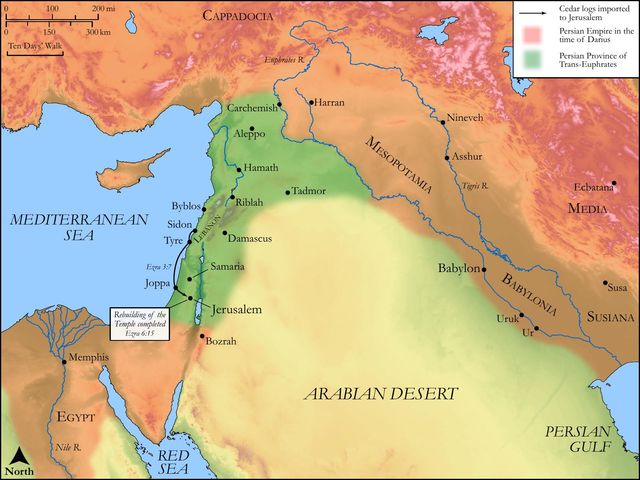
Achmetha, historically known as Ecbatana (modern Hamadan, Iran), held significant importance as one of the four royal capitals of the Achaemenid Persian Empire, frequently serving as a favored summer residence for its kings. Its location within the "province of the Medes" underscores the vast administrative reach and meticulous record-keeping practices characteristic of the Persian Empire under King Darius I (reigned 522-486 BC). While primary imperial archives were often housed in major capitals like Susa or Babylon, the existence of such crucial documents in secondary royal centers like Ecbatana highlights the comprehensive and decentralized nature of Persian bureaucracy. Royal decrees, once issued, carried immense legal authority and were meticulously preserved, serving as binding law throughout the empire. The search and discovery of Cyrus's decree within these state archives was far more than a mere administrative formality; it was a legal necessity to ascertain the legitimacy of the Jews' temple reconstruction efforts and to guide the king's decision in a matter of significant imperial concern and religious policy.
Key Themes
ShowHideThis verse powerfully contributes to several key themes woven throughout the book of Ezra and the broader biblical narrative. Foremost is the theme of Divine Providence, demonstrating God's meticulous oversight and active involvement in the affairs of His people, even working through pagan rulers and their intricate administrative systems. The discovery of the decree at the precise moment it was needed, in a specific and perhaps unexpected location, underscores God's sovereign control over historical events to fulfill His purposes, echoing His earlier work through Cyrus in Ezra 1:1-4. Secondly, the verse highlights the theme of Legitimacy and Validation. The "record" found was not a mere suggestion but a legally binding royal decree, providing irrefutable proof of the Jews' authorized work and validating their claims against the accusations of their adversaries, as seen in Ezra 5:3-5. Finally, it reinforces the Continuity of God's Plan, showing that the temple rebuilding was not a new, unauthorized venture but the ongoing execution of a divine mandate first initiated by Cyrus, ensuring the restoration of Jerusalem and its worship life, a foundational element of the post-exilic community's identity and hope for the future.
Exposition and Analysis
ShowHideKey Word Analysis
ShowHideThis is the Hebrew transcription of the Old Persian "Hagmatana," known in Greek as Ecbatana. Located in modern-day Hamadan, Iran, Achmetha was one of the four royal capitals of the Achaemenid Persian Empire, serving primarily as a summer residence for the kings. Its mention here emphasizes the extensive and decentralized nature of Persian imperial record-keeping, suggesting that important documents were archived not only in primary administrative centers like Susa or Babylon but also in other royal palaces.
This term refers to a scroll, the standard format for official documents, letters, and literary works in that day. Scrolls were typically made from papyrus or prepared animal skins (parchment). The use of "roll" here indicates that the found document was a formal, written artifact, preserved in a manner befitting a royal decree or official state record.
This Aramaic word (used in the Aramaic section of Ezra, 4:8-6:18) denotes an official memorandum, a register, or a formal record. It implies a document of legal or administrative significance, not a casual note. The "record" was a precise and authoritative account of Cyrus's original decree, providing the necessary legal basis for the Jews' activities and confirming their claims to King Darius.
Verse Breakdown
ShowHide"And there was found at Achmetha"
This opening phrase immediately highlights the successful and timely outcome of Darius's search order. The passive voice ("there was found") subtly emphasizes the providential nature of the discovery, suggesting that the finding was not merely a result of human effort but also of divine orchestration, ensuring the document appeared precisely when needed to advance God's purposes.
"in the palace that [is] in the province of the Medes"
This clause provides specific geographical and administrative details, pinpointing the exact location of the discovery within Achmetha. The "palace" signifies a royal residence, underscoring the official and authoritative nature of the archives where the document was stored. The "province of the Medes" further clarifies the imperial jurisdiction and the vastness of the Persian Empire's administrative reach, demonstrating the comprehensive nature of their record-keeping.
"a roll, and therein [was] a record thus written"
This specifies both the physical form and the crucial content of the discovered item. The "roll" (scroll) indicates a formal, durable document, designed for long-term preservation and official use. The "record" (Aramaic dikrôwn') denotes an official, legally binding memorandum or registry, signifying its authoritative status. The phrase "thus written" implies that the document contained the exact, authoritative text of Cyrus's decree, ready to be presented and acted upon, leaving no room for ambiguity or dispute regarding its authenticity or content.
Literary Devices
ShowHideEzra 6:2 employs several subtle but significant literary devices that enrich its theological impact. The most prominent is Divine Providence, where the seemingly coincidental discovery of the scroll at the precise moment it was needed underscores God's active and sovereign involvement in human affairs. The text presents the finding as a straightforward administrative event, yet its perfect timing and specific location imply a guiding divine hand, orchestrating circumstances to fulfill His purposes. There is also a degree of Irony in the narrative: the vindication of God's people and the advancement of His temple project come not from a direct divine revelation to them, but through the administrative bureaucracy of a pagan empire, specifically through a document issued by one pagan king and found by another. This highlights God's ability to use any means, even secular governmental structures and their meticulous record-keeping, to achieve His sacred purposes. Furthermore, the verse serves as a point of Foreshadowing, as the discovery of this vital record immediately signals a positive turning point in the narrative, hinting at the favorable outcome and renewed, unhindered support for the temple's reconstruction that will follow.
Theological and Thematic Connections
ShowHideEzra 6:2 powerfully illustrates the theological truth of God's absolute sovereignty over all earthly powers and circumstances. Even when His people face formidable opposition and their work seems stalled, God remains faithful to His covenant promises, meticulously orchestrating events behind the scenes. The discovery of Cyrus's decree, decades after its initial promulgation, in a distant royal archive, is a profound testament to God's meticulous providence. He works through the seemingly mundane administrative processes of a pagan empire to validate His people's claims and advance His divine agenda. This demonstrates that no human authority, no matter how powerful or seemingly opposed, can ultimately thwart God's will; rather, they can be unwitting instruments in His hands. This verse offers deep reassurance to believers that God is always at work, even when His activity is not immediately apparent, ensuring His purposes are brought to fruition and His promises fulfilled.
Reflection and Application
ShowHideThe discovery of Cyrus's decree in Ezra 6:2 offers profound encouragement and practical application for believers today. It serves as a powerful reminder that God's plans are unshakeable, and His timing is perfect, even when circumstances appear bleak or opposition seems insurmountable. Just as He providentially ensured the preservation and timely revelation of a crucial document for His people in ancient Persia, He continues to work in our lives, orchestrating events and validating His purposes through unexpected channels and seemingly ordinary means. This verse calls us to cultivate a deeper trust in God's faithfulness, to persevere in His work despite challenges, and to recognize that He often operates behind the scenes, using both the ordinary and the extraordinary to bring about His sovereign will. It teaches us to look beyond immediate obstacles and to rest in the unwavering assurance that God will ultimately vindicate His truth and bring His promises to fruition, no matter how long the wait or how great the opposition.
Questions for Reflection
ShowHideFAQ
ShowHideWhy was Cyrus's decree found in Achmetha (Ecbatana) and not in a more prominent Persian capital like Susa or Babylon?
ShowHideAchmetha, or Ecbatana, was one of the four royal capitals of the Achaemenid Persian Empire, serving particularly as a summer residence for the kings. The Persian Empire was vast, and its administrative system was highly organized and decentralized. Important documents and decrees were not exclusively stored in one central archive but could be found in various royal palaces and administrative centers across the empire. The discovery in Achmetha highlights the comprehensive nature of Persian record-keeping, ensuring that vital decrees were accessible in multiple locations. Theologically, its specific location and timely discovery also underscore divine providence, as God ensured the document was found precisely where and when it was needed to advance His purposes for the temple's rebuilding.
What was the specific significance of the terms "roll" and "record" in this verse?
ShowHideThe term "roll" (Aramaic mᵉgillâh') refers to a scroll, which was the standard physical format for official documents, letters, and literary works in that day. Its mention indicates that the document was a formal, preserved artifact, designed for long-term storage and official use, not a casual note. The term "record" (Aramaic dikrôwn') denotes an official memorandum, a register, or a formal legal document. Together, these terms emphasize that the discovered item was an authoritative, legally binding decree from King Cyrus, providing irrefutable proof of the Jews' authorization to rebuild the temple. It was not merely a historical curiosity but a document with active legal weight, crucial for the king's decision and the immediate future of the temple project.
How did the discovery of this record specifically impact the ongoing work of rebuilding the temple in Jerusalem?
ShowHideThe discovery of Cyrus's original decree was absolutely pivotal. It provided the irrefutable legal validation that King Darius I required to confirm the legitimacy of the Jews' temple rebuilding efforts, which had been challenged by local governors (as seen in Ezra 5:6-17). With this official "record" in hand, Darius was able to issue his own comprehensive decree (detailed in Ezra 6:6-12), not only reaffirming Cyrus's authorization but also providing robust royal support, protection, and even financial assistance for the completion of the temple. This discovery removed the legal obstacles, silenced the adversaries, and ensured the successful and unhindered completion of the sacred structure, thereby fulfilling God's promise to restore His people and their worship.
Christ-Centered Fulfillment
ShowHideEzra 6:2, with its focus on the providential discovery of a crucial decree, finds its ultimate Christ-centered fulfillment in the overarching, meticulously orchestrated plan of God for humanity's redemption through Jesus Christ. Just as a hidden "record" was revealed at the appointed time to validate the temple's rebuilding, so too was God's eternal "record" or decree concerning salvation revealed and brought to glorious fruition in the person and work of Jesus. The physical temple, whose rebuilding was validated by this decree, ultimately pointed to Christ Himself, who declared, "Destroy this temple, and in three days I will raise it up," referring to the temple of His own body. The meticulous care with which God ensured the preservation and discovery of Cyrus's decree foreshadows His even greater, perfect orchestration of history to bring about the incarnation, crucifixion, and resurrection of His Son, the Lamb of God who takes away the sin of the world. Through Christ, God's ultimate and eternal plan for reconciliation and the establishment of His true spiritual temple—the Church, built on the foundation of the apostles and prophets with Christ Jesus himself as the chief cornerstone—is fully realized. The "record" of salvation, written in eternity, was perfectly executed in time through the life, death, and resurrection of our Lord, ensuring that God's redemptive purposes will never be thwarted, but will stand forever, just as His word will not return to Him empty, but will accomplish that which He purposes.