


Ezra 4:15
Bible text: King James Version (1769 Blayney text) · Public domain
Bible text: King James Version with Strong's numbers · Public domain
Bible text: Berean Standard Bible · Public domain
Bible text: American Standard Version (1901) · Public domain
Bible text: World English Bible, Messianic edition · Public domain
Bible text: Geneva Bible (1599) · Public domain
Bible text: Young's Literal Translation · Public domain
- דִּיdithatH1768ConjConjunction
- יְבַקַּרye·va·Karhe will searchH1240V-Pael-Imperf-3msVerb Pael Imperfect 3rd Singular Masculine
- בִּסְפַרbis·farin [the] book ofH5609Prep-b ¦ N-cscNoun Singular common gender Constructבִּinסְפַר[the] book of
- דָּכְרָנַיָּאda·khe·Ra·nai·Ya'records theH1799N-mp ¦ ArtNoun Plural Masculine Definiteדָּכְרָנַיָּrecordsאthe
- דִּיdiofH1768ConjConjunction
- אֲבָהָתָךְ'a·va·ha·Takhyour fathersH2N-fsc ¦ 2msNoun Singular Feminine Constructאֲבָהָתָfathersךְyour
- וּתְהַשְׁכַּחU·te·hash·kachso you may findH7912Conj-w ¦ V-Hiphil-ConjImperf-2msVerb Hiphil Conjunction+Imperfect 2nd Singular Masculineוּsoתְהַשְׁכַּחyou may find
- בִּסְפַרbis·Farin [the] book ofH5609Prep-b ¦ N-cscNoun Singular common gender Constructבִּinסְפַר[the] book of
- דָּכְרָנַיָּאda·khe·ra·nai·Ya'records theH1799N-mp ¦ ArtNoun Plural Masculine Definiteדָּכְרָנַיָּrecordsאthe
- וְתִנְדַּעve·tin·Da'so you may knowH3046Conj-w ¦ V-Qal-ConjImperf-2msVerb Qal Conjunction+Imperfect 2nd Singular Masculineוְsoתִנְדַּעyou may know
- דִּיdithatH1768ConjConjunction
- קִרְיְתָאkir·ye·Ta'city theH7149N-fs ¦ ArtNoun Singular Feminine Definiteקִרְיְתָcityאthe
- דָךְdakhthisH1791PrtParticle Demonstrative
- קִרְיָאkir·Ya'[is] a cityH7149N-fsNoun Singular Feminine Absolute
- מָרָדָאma·ra·Da'rebelliousH4779Adj-fsAdjective Singular Feminine Absolute
- וּמְהַנְזְקַתu·me·han·ze·Katand injuringH5142Conj-w ¦ V-Hiphil-Prtcpl-fsVerb Hiphil Participle Singular Feminine Constructוּandמְהַנְזְקַתinjuring
- מַלְכִיןmal·Khin<of> kingsH4430N-mpNoun Plural Masculine Absolute
- וּמְדִנָןu·me·di·Nanand provincesH4083Conj-w ¦ N-fpNoun Plural Feminine Absoluteוּandמְדִנָןprovinces
- וְאֶשְׁתַּדּוּרve·'esh·ta·Durand a revoltH849Conj-w ¦ N-csNoun Singular common gender Absoluteוְandאֶשְׁתַּדּוּרa revolt
- עָבְדִין'a·ve·Din[it was] makingH5648V-Peal-Prtcpl-mpVerb Peal Participle Plural Masculine Absolute
- בְּגַוַּהּbe·ga·Vahin its midstH1459Prep-b ¦ N-csc ¦ 3fsNoun Singular common gender Constructבְּinגַוַּmidstהּits
- מִןminfromH4481PrepPreposition
- יוֹמָתyo·Mat[the] days ofH3118N-fpcNoun Plural Feminine Construct
- עָלְמָא'al·Ma'<the> antiquityH5957N-cs ¦ ArtNoun Singular common gender Definiteעָלְמָ<the>אantiquity
- עַל'AlonH5922PrepPreposition
- דְּנָהde·NahthisH1836PrtParticle Demonstrative
- קִרְיְתָאkir·ye·Ta'city theH7149N-fs ¦ ArtNoun Singular Feminine Definiteקִרְיְתָcityאthe
- דָךְdakhthisH1791PrtParticle Demonstrative
- הָחָרְבַתHa·cha·re·Vatit was laid wasteH2718V-Hophal-Perf-3fsVerb Hophal Perfect 3rd Singular Feminine
English is a literal word-by-word gloss of the Hebrew, not the KJV's wording. Why?
This is the original text the KJV's translators worked from — each Hebrew word with its own literal English meaning in this verse, prepared by scholars at Tyndale House, Cambridge. The KJV translates whole sentences, not word by word, so its wording differs: one Hebrew word can become several English words, and the KJV may choose “the LORD” where the gloss reads “Yahweh”. Both are faithful — they answer different questions. For the KJV's own rendering, switch to the KJV text.
Details
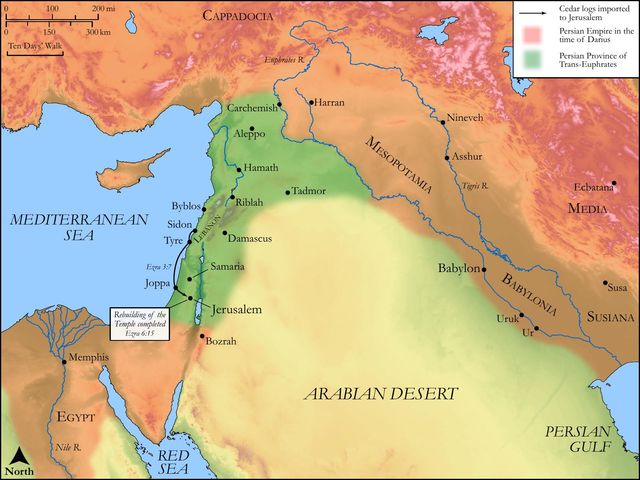
See on the biblical-era map
Study this verse
Public-domain commentary
Matthew Henry
From his Commentary on the Whole Bible. Henry comments on passages, not single verses — this entry covers Ezra 4:6–16. His four-level outline is real structure in the source text, so it is rendered as structure.
Cyrus stedfastly adhered to the Jews' interest, and supported his own grant. It was to no purpose to offer any thing to him in prejudice of it. What he did was from a good principle, and in the fear of God, and therefore he adhered to it. But, though his reign in all was thirty years, yet after the conquest of Babylon, and his decree for the release of the Jews, some think that he reigned but three years, others seven, and then either died or gave up that part of his government, in which his successor was Ahasuerus (Ezr 4:6), called also Artaxerxes (Ezr 4:7), supposed to be the same that in heathen authors is called Cambyses, who had never taken such cognizance of the despised Jews as to concern himself for them, nor had he that knowledge of the God of Israel which his predecessor had. To him these Samaritans applied by letter for an order to stop the building of the temple; and they did it in the beginning of his reign, being resolved to lose no time when they thought they had a king for their purpose. See how watchful the church's enemies are to take the first opportunity of doing it a mischief; let not its friends be less careful to do it a kindness. Here is,
I.The general purport of the letter which they sent to the king, to inform him of this matter.
It is called (Ezr 4:6) an accusation against the inhabitants of Judah and Jerusalem. The devil is the accuser of the brethren (Rev 12:10), and he carries on his malicious designs against them, not only by accusing them himself before God, as he did Job, but by acting as a lying spirit in the mouths of his instruments, whom he employs to accuse them before magistrates and kings and to make them odious to the many and obnoxious to the mighty. Marvel not if the same arts be still used to depreciate serious godliness.
II.The persons concerned in writing this letter.
The contrivers are named (Ezr 4:7) that plotted the thing, the writers (Ezr 4:8) that put it into form, and the subscribers (Ezr 4:9) that concurred in it and joined with them in this representation, this misrepresentation I should call it. Now see here,
1.How the rulers take counsel together against the Lord and his temple, with their companions. The building of the temple would do them no harm, yet they appear against it with the utmost concern and virulence, perhaps because the prophets of the God of Israel had foretold the famishing and perishing of all the gods of the heathen, Zep 2:11; Jer 10:11.
2.How the people concurred with them in imagining this vain thing. They followed the cry, though ignorant of the merits of the cause. All the several colonies of that plantation (nine are here mentioned), who had their denomination from the cities or countries of Assyria, Chaldea, Persia, etc., whence they came, set their hands, by their representatives, to this letter. Perhaps they were incensed against these returned Jews because many of the ten tribes were among them, whose estates they had got into their possession, and of whom they were therefore jealous, lest they should attempt the recovery of them hereafter.
III.A copy of the letter itself, which Ezra inserts here out of the records of the kingdom of Persia, into which it had been entered; and it is well we have it, that we may see whence the like methods, still taken to expose good people and baffle good designs, are copied.
1.They represent themselves as very loyal to the government, and greatly concerned for the honour and interest of it, and would have it thought that the king had no such loving faithful subjects in all his dominions as they were, none so sensible of their obligations to him, Ezr 4:14. Because we are salted with the salt of the palace (so it is in the margin), "we have our salary from the court, and could no more live without it than flesh could be preserved without salt;" or, as some think, their pay or pension was sent them in salt; or "Because we had our education in the palace, and were brought up at the king's table," as we find, Dan 1:5. These were those whom he intended to prefer; they did eat their portion of the king's meat. "Now, in consideration of this, it is not meet for us to see the king's dishonour;" and therefore they urge him to stop the building of the temple, which would certainly be the king's dishonour more than any thing else. Note, A secret enmity to Christ and his gospel is often gilded over with a pretended affection to Caesar and his power. The Jews hated the Roman government, and yet, to serve a turn, could cry, We have no king but Caesar. But (to allude to this), if those that lived upon the crown thought themselves bound in gratitude thus to support the interest of it, much more reason have we thus to argue ourselves into a pious concern for God's honour; we have our maintenance from the God of heaven and are salted with his salt, live upon his bounty and are the care of his providence; and therefore it is not meet for us to see his dishonour without resenting it and doing what we can to prevent it.
2.They represent the Jews as disloyal, and dangerous to the government, that Jerusalem was the rebellious and bad city (Ezr 4:12), hurtful to kings and provinces, Ezr 4:15. See how Jerusalem, the joy of the whole earth (Psa 48:2), is here reproached as the scandal of the whole earth. The enemies of the church could not do the bad things they design against it if they did not first give it a bad name. Jerusalem had been a loyal city to its rightful princes, and its present inhabitants were as well affected to the king and his government as any of his provinces whatsoever. Daniel, who was a Jew, had lately approved himself so faithful to his prince that his worst enemies could find no fault in his management, Dan 6:4. But thus was Elijah most unjustly charged with troubling Israel, the apostles with turning the world upside down, and Christ himself with perverting the nation and forbidding to give tribute to Caesar; and we must not think it strange if the same game be still played. Now here,
(1.)Their history of what was past was invidious, that within this city sedition had been moved of old time, and, for that cause, it was destroyed, Ezr 4:15. It cannot be denied but that there was some colour given for this suggestion by the attempts of Jehoiakim and Zedekiah to shake off the yoke of the king of Babylon, which, if they had kept close to their religion and the temple they were now rebuilding, they would never have come under. But it must be considered,
[1.]That they were themselves, and their ancestors, sovereign princes, and their efforts to recover their rights, if there had not been in them the violation of an oath, for aught I know, would have been justifiable, and successful too, had they taken the right method and made their peace with God first.
[2.]Though these Jews, and their princes, had been guilty of rebellion, yet it was unjust therefore to fasten this as an indelible brand upon this city, as if that must for ever after go under the name of the rebellious and bad city. The Jews, in their captivity, had given such specimens of good behaviour as were sufficient, with any reasonable men, to roll away that one reproach; for they were instructed (and we have reason to hope that they observed their instructions) to seek the peace of the city where they were captives and pray to the Lord for it, Jer 29:7. It was therefore very unfair, though not uncommon, thus to impute the iniquity of the fathers to the children.
(2.)Their information concerning what was now doing was grossly false in matter of fact. Very careful they were to inform the king that the Jews had set up the walls of this city, nay, had finished them (so it is in the margin) and joined the foundations (Ezr 4:12), when this was far from being the case. They had only begun to build the temple, which Cyrus commanded them to do, but, as for the walls, there was nothing done nor designed towards the repair of them, as appears by the condition they were in many years after (Neh 1:3), all in ruins. What shall be given, and what done, to these false tongues, nay, which is worse, these false pens? sharp arrows, doubtless, of the mighty, and coals of juniper, Psa 120:3, Psa 120:4. If they had not been perfectly lost to all virtue and honour they would not, and if they had not been very secure of the king's countenance they durst not, have written that to the king which all their neighbours knew to be a notorious lie. See Pro 29:12.
(3.)Their prognostics of the consequences were altogether groundless and absurd. They were very confident, and would have the king believe it upon their word, that if this city should be built, not only the Jews would pay no toll, tribute, or custom (Ezr 4:13), but (since a great lie is as soon spoken as a little one) that the king would have no portion at all on this side the river (Ezr 4:16), that all the countries on this side Euphrates would instantly revolt, drawn in to do so by their example; and, if the prince in possession should connive at this, he would wrong, not only himself, but his successors: Thou shalt endamage the revenue of the kings. See how every line in this letter breathes both the subtlety and malice of the old serpent.
Continue studying Ezra 4:15 across the web’s major study libraries — every link below opens this exact verse, chapter, or book on the destination site.
Read & Compare
 BibleGatewayThis verse in more than 200 translations and 70 languages.
 Bible.comThe YouVersion reader — hundreds of translations, reading plans, and highlights.
 ESV.orgCrossway's official English Standard Version reader.
 NET BibleThe NET translation with 60,000+ translators' notes on every rendering decision.
 STEP BibleTyndale House's free study tool — original text, vocabulary, and scholarly resources.
 BibliaLogos Bible Software's free web reader.
 USCCBThe New American Bible (Revised Edition) with the U.S. bishops' study notes.
Commentaries
 BibleHub CommentariesDozens of classic commentaries on this verse, gathered on one page.
 StudyLightMore than 100 commentary sets — the largest collection on the web.
 BibleRefPlain-English commentary on what this verse means, verse by verse.
 Enduring WordDavid Guzik's free commentary on this chapter, widely used by Bible teachers.
 Bible Study ToolsVerse commentary alongside Greek and Hebrew study aids.
Original Language & Research
- BibleHub InterlinearThe verse word by word — original language, transliteration, and English.
- BibleHub LexiconEvery word's original-language definition and Strong's entry.
 Blue Letter BibleDeep-study tools — Strong's numbers, concordance, and word studies.
 SefariaThe Hebrew text with Rashi and centuries of Jewish commentary.
Sermons, Hymns & Audio


TrulyRandomVerse is not affiliated with these sites and doesn’t control their content. They’re linked because they’re genuinely useful.
Summary
Ezra 4:15 encapsulates a pivotal moment in the post-exilic restoration of Jerusalem, articulating the core of a shrewd and malicious accusation leveled against the returning Jewish exiles by their adversaries. This verse, embedded within a letter to King Artaxerxes, urgently requests the monarch to consult ancient royal archives to confirm Jerusalem's alleged history as an inherently rebellious city, destructive to imperial authority, and a persistent source of sedition. It strategically employs historical precedent and fear-mongering to justify the cessation of the temple and city rebuilding, highlighting the persistent opposition faced by God's people in fulfilling His divine purposes.
Context
ShowHideLiterary Context
Ezra 4 meticulously chronicles the escalating opposition encountered by the Jewish community who returned to Judah under Zerubbabel to reconstruct the temple in Jerusalem. Initially, the adversaries, primarily Samaritans and other peoples resettled in the region by previous Assyrian and Babylonian kings, attempted to discourage and intimidate the builders Ezra 4:4-5. When these tactics failed, the opposition escalated to formal political and legal challenges. Ezra 4:6-23 details a series of letters dispatched to successive Persian kings, with Ezra 4:7-16 specifically focusing on a crucial letter penned by Rehum the chancellor and Shimshai the scribe to King Artaxerxes I. Ezra 4:15 serves as the climactic and most damning assertion within their argument, functioning as a strategic appeal to historical precedent designed to validate their claims of Jewish disloyalty and inherent rebelliousness, with the explicit aim of persuading the king to halt the rebuilding efforts.
Historical & Cultural Context
The vast Persian Empire, particularly under rulers like Artaxerxes I (reigning 465-424 BC), maintained its dominion through a highly centralized and efficient administrative system. The paramount concerns of the empire were stability, loyalty, and the consistent flow of tribute and taxes. Any indication of rebellion, insurrection, or sedition was met with swift and severe reprisal. The adversaries' calculated appeal to "the book of the records of thy fathers" was a masterstroke, as these Persian royal archives were renowned for their meticulousness and served as authoritative historical and legal documentation. Jerusalem, having been utterly destroyed by Babylon in 586 BC after a series of revolts against the king of Babylon, indeed possessed a historical reputation for resisting imperial powers, first Assyria and then Babylon. This historical reality, though often provoked by foreign oppression or stemming from Israel's own covenant unfaithfulness, was skillfully exploited by the adversaries to portray the returning Jews as inherently rebellious and a tangible threat to Persian peace, security, and revenue.
Key Themes
ShowHideThis verse powerfully contributes to several overarching themes within the book of Ezra and the broader biblical narrative. Firstly, it vividly illustrates the theme of Opposition to God's Work, demonstrating how divine plans for restoration and redemption are frequently met with human resistance, often cloaked in seemingly legitimate political or economic concerns. The adversaries' actions are not merely political maneuvering but are spiritually motivated to hinder the re-establishment of God's people and their worship in Jerusalem, a pattern consistently observed throughout salvation history, such as the concerted efforts to stop the rebuilding of Jerusalem's walls in Nehemiah 4. Secondly, it underscores the theme of False Accusation and Slander, where truth is twisted, historical facts are manipulated, and fear is incited to achieve malicious ends. The portrayal of Jerusalem as inherently "rebellious" and "hurtful" is a gross generalization and distortion, designed to provoke fear and prejudice, a tactic that resonates through biblical narratives, from Joseph's brothers conspiring against him to the unjust accusations leveled against Jesus. Lastly, the verse subtly points to the Sovereignty of God amidst human schemes; despite the temporary success of the adversaries in halting the work, as explicitly stated in Ezra 4:24, God's ultimate purpose for Jerusalem and His people would ultimately prevail, demonstrating His faithfulness to His covenant promises.
Exposition and Analysis
ShowHideKey Word Analysis
ShowHideThe Aramaic term בְּקַר (bᵉqar), corresponding to the Hebrew בָּקַר (baqar), literally means "to plough" or "to break forth," but figuratively, it signifies "to inspect," "to inquire," or "to make search." In this context, it implies a thorough, official investigation into the royal records, suggesting a confident expectation on the part of the accusers that such a detailed examination will unequivocally confirm their claims. It lends an air of legitimacy and objectivity to their demand.
The Aramaic מָרָד (mârâd), derived from the root signifying "to rebel," portrays Jerusalem not merely as a disobedient city but as one characterized by an active, persistent, and inherent spirit of revolt, defiance, or insurrection. This word carries a strong connotation of insubordination and a refusal to submit to established authority, painting a picture of a city that is a constant source of trouble and instability for any ruling power.
The Aramaic נְזַק (nᵉzaq) means to suffer or (causatively) to inflict loss, damage, or injury. It implies that Jerusalem's alleged rebellious nature leads to tangible, detrimental consequences for the empire, specifically for "kings and provinces." This suggests not only political instability but also potential economic loss, disruption of trade routes, or challenges to imperial control, making the city a liability rather than an asset to the Persian administration.
The Aramaic אֶשְׁתַּדּוּר (ʼeshtaddûwr), derived from a root implying "to send" in a bad sense, refers to rebellion or insurrection. This term emphasizes the active promotion of disloyalty and the incitement of others to rebel. It suggests that Jerusalem was not merely a passive recipient of rebellion but an active instigator, a hotbed of subversive activity that could spread throughout the empire, a gravely serious charge in any centralized monarchy.
Verse Breakdown
ShowHide"That search may be made in the book of the records of thy fathers:"
This opening clause reveals the adversaries' strategic appeal to the highest authority—the king's own royal archives. The "records of thy fathers" refers to the historical documents and chronicles meticulously maintained by previous Persian kings, considered unimpeachable sources of truth and legal precedent. The request for a "search" implies a confident expectation that these records will corroborate their claims, lending an air of legitimacy and historical validation to their accusations.
"so shalt thou find in the book of the records, and know that this city [is] a rebellious city, and hurtful unto kings and provinces,"
This clause presents the anticipated and confidently asserted outcome of the proposed archival search. The adversaries declare with certainty that the records will confirm Jerusalem's long-standing character as "a rebellious city" (מָרָד, mârâd). Furthermore, they claim it is "hurtful" (נְזַק, nᵉzaq), implying it causes damage or loss, not just to the king directly but also to the broader "provinces" within his empire, suggesting a wider destabilizing effect. This aims to evoke fear for the empire's security and prosperity.
"and that they have moved sedition within the same of old time:"
This part elaborates on the nature of Jerusalem's rebellion, specifying that its inhabitants have actively "moved sedition" (אֶשְׁתַּדּוּר, ʼeshtaddûwr), meaning they have incited or stirred up revolt from within the city itself. The phrase "of old time" emphasizes the historical continuity of this alleged behavior, presenting it as an inherent and perpetual characteristic of Jerusalem and its people, rather than an isolated incident, thereby reinforcing the urgency of stopping its rebuilding.
"for which cause was this city destroyed."
This concluding clause serves as the adversaries' ultimate justification and dire warning. They directly link Jerusalem's past destruction (referring to the Babylonian conquest in 586 BC) to its alleged history of rebellion and sedition. By presenting the destruction as a direct, inevitable consequence of its inherent nature, they implicitly warn King Artaxerxes that rebuilding Jerusalem would inevitably lead to similar problems for the Persian Empire, thus urging him to prevent its restoration to safeguard imperial stability.
Literary Devices
ShowHideEzra 4:15 masterfully employs several potent literary devices to achieve its persuasive and manipulative effect. Central to the adversaries' communication is a sophisticated Rhetorical Strategy, as they meticulously craft an argument designed to appeal directly to the king's self-interest, his paramount concern for imperial stability, and his inherent fear of rebellion, rather than an objective presentation of truth. They effectively utilize an Appeal to Authority by demanding a comprehensive search of the royal archives ("the book of the records of thy fathers"), thereby lending a veneer of historical authenticity and irrefutable evidence to their otherwise biased claims. There is clear Hyperbole in their sweeping portrayal of Jerusalem as perpetually "a rebellious city" and "hurtful unto kings and provinces," exaggerating its historical threat to imperial powers to ensure the king's decisive and negative action. Furthermore, the verse functions as a piece of Propaganda, as the adversaries selectively present historical facts and interpret them maliciously to construct a narrative that precisely serves their agenda of halting the rebuilding. Finally, there is a profound Irony in their appeal to "truth" from the records, as their underlying motive is to obstruct God's truth and purpose for His people, demonstrating how human schemes often ironically confirm divine realities.
Theological and Thematic Connections
ShowHideThe accusations detailed in Ezra 4:15 illuminate a recurring spiritual dynamic throughout biblical history: the forces of opposition will frequently employ distortion, fear-mongering, and appeals to historical precedent to thwart God's redemptive work. This verse serves as a stark reminder that those who endeavor to build up God's kingdom, whether physically reconstructing a temple, spiritually building the church, or simply living faithfully, will inevitably encounter resistance. This opposition often masks spiritual animosity under the guise of legitimate political, economic, or social concerns. Yet, the temporary success of such opposition never ultimately frustrates God's sovereign plan, as His purposes always prevail, often through unexpected means and at His appointed time. The narrative of Ezra, despite this significant setback, ultimately affirms God's faithfulness to His covenant promises and His unwavering ability to bring His people to their intended destiny, demonstrating His overarching control even amid human malice.
Reflection and Application
ShowHideEzra 4:15 offers profound and enduring lessons for believers navigating opposition in their own lives and ministries. It serves as a potent reminder that when we are engaged in God's work, whether it's building up the local church, serving the community, or simply striving to live a life of faithfulness, we can anticipate resistance. This opposition frequently manifests as false accusations, misrepresentation, and the deliberate manipulation of facts, all designed to discredit, discourage, and ultimately halt our efforts. The adversaries in Ezra were not driven by a genuine concern for truth or justice but by a desire for power, control, and the preservation of their own interests, employing fear-mongering and historical distortion to achieve their ends. For us today, this necessitates developing keen spiritual discernment to recognize the true nature of opposition, understanding that not all criticism is constructive or well-intentioned. It calls us to persevere with unwavering integrity, trusting implicitly that God's ultimate purpose cannot be thwarted by human schemes, and that even temporary setbacks can be part of His larger, sovereign plan. Our response should be rooted in fervent prayer, steadfast adherence to truth, and an unwavering commitment to the Lord's calling, rather than succumbing to fear, retaliation, or discouragement.
Questions for Reflection
ShowHideFAQ
ShowHideWas Jerusalem truly a "rebellious city" as the adversaries claimed?
ShowHideWhile the adversaries in Ezra 4:15 certainly exaggerated and manipulated the historical narrative for their own malicious purposes, Jerusalem did indeed possess a history of rebellion against various imperial powers, particularly Assyria and Babylon. From the perspective of these empires, Jerusalem's actions, often driven by a misguided desire for political independence or a misplaced trust in foreign alliances rather than God, consistently led to conflict and ultimately its devastating destruction in 586 BC (e.g., the accounts in 2 Kings 24-25). The adversaries cleverly exploited this historical reality, twisting it to imply an inherent, perpetual seditious nature of the city and its inhabitants, thereby justifying their demand to halt its rebuilding. Their claim was a half-truth, strategically deployed to incite fear and suspicion in the Persian king.
Christ-Centered Fulfillment
ShowHideEzra 4:15, with its portrayal of a "rebellious city" facing destruction due to its inherent sedition, finds profound Christ-centered fulfillment not only in the person of Jesus but also in the broader narrative of salvation history. Humanity, in its fallen state, is the ultimate "rebellious city," having moved "sedition" against its Creator since the primal rebellion in Genesis 3. This pervasive rebellion led directly to spiritual destruction and profound separation from God. Jesus, however, is the true and faithful King, the ultimate Lamb of God who perfectly fulfills the law and takes away the sin of the world John 1:29. He came to Jerusalem, the very city historically accused of rebellion, and faced false accusations of sedition against Caesar (e.g., Luke 23:2), ultimately being "destroyed" (crucified) not for His own rebellion, but for ours. Through His perfect life, atoning sacrifice on the cross, and glorious resurrection, He conquers the rebellion of sin, establishing a new, heavenly Jerusalem—His church—that is eternally loyal and obedient to God Revelation 21:2. His redemptive work ensures that despite all human opposition, false accusations, and schemes, God's ultimate plan for redemption and the establishment of His eternal kingdom will prevail, not through earthly power or political maneuvering, but through the triumph of the crucified and resurrected King of kings Philippians 2:9-11.