


Numbers 23:23
Bible text: King James Version (1769 Blayney text) · Public domain
Bible text: King James Version with Strong's numbers · Public domain
Bible text: Berean Standard Bible · Public domain
Bible text: American Standard Version (1901) · Public domain
Bible text: World English Bible, Messianic edition · Public domain
Bible text: Geneva Bible (1599) · Public domain
Bible text: Young's Literal Translation · Public domain
- כִּיkiforH3588PrtParticle Conditional
- לֹאlo'notH3808NegParticle Negative
- נַחַשׁna·chashenchantmentH5173N-msNoun Singular Masculine Absolute
- בְּיַעֲקֹבbe·ya·'a·Ko[is] in JacobH3290Prep-b ¦ N-proper-mNoun Proper Masculineבְּ[is] inיַעֲקֹבJacob
- וְלֹאve·lo'and notH3808Conj-w ¦ NegParticle Negativeוְandלֹאnot
- קֶסֶםKe·semdivinationH7081N-msNoun Singular Masculine Absolute
- בְּיִשְׂרָאֵלbe·Yis·ra·'El[is] in IsraelH3478Prep-b ¦ N-properNoun Proper Locationבְּ[is] inיִשְׂרָאֵלIsrael
- כָּעֵתka·'Etabout <the> this timeH6256Prep-k ¦ N-csNoun Singular common gender Absoluteכָּabout <the>עֵתthis time
- יֵאָמֵרye·'a·Merit will be saidH559V-Niphal-Imperf-3msVerb Niphal Imperfect 3rd Singular Masculine
- לְיַעֲקֹבle·ya·'a·Koof JacobH3290Prep-l ¦ N-proper-mNoun Proper MasculineלְofיַעֲקֹבJacob
- וּלְיִשְׂרָאֵלu·le·Yis·ra·'Eland of IsraelH3478Conj-w ¦ Prep-l ¦ N-properNoun Proper LocationוּandלְofיִשְׂרָאֵלIsrael
- מַהmahwhat!H4100InterrogPronoun Interrogative
- פָּעַלPa·'alhas he doneH6466V-Qal-Perf-3msVerb Qal Perfect 3rd Singular Masculine
- אֵל'ElGodH410N-msNoun Singular Masculine Absolute
English is a literal word-by-word gloss of the Hebrew, not the KJV's wording. Why?
This is the original text the KJV's translators worked from — each Hebrew word with its own literal English meaning in this verse, prepared by scholars at Tyndale House, Cambridge. The KJV translates whole sentences, not word by word, so its wording differs: one Hebrew word can become several English words, and the KJV may choose “the LORD” where the gloss reads “Yahweh”. Both are faithful — they answer different questions. For the KJV's own rendering, switch to the KJV text.
Details
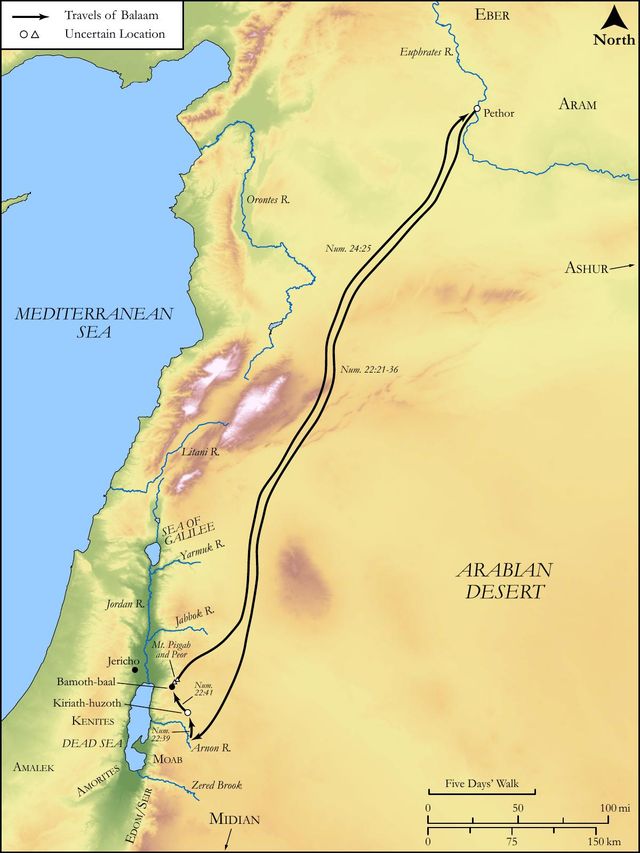
See on the biblical-era map
Study this verse
Public-domain commentary
Matthew Henry
From his Commentary on the Whole Bible. Henry comments on passages, not single verses — this entry covers Numbers 23:13–30. His four-level outline is real structure in the source text, so it is rendered as structure.
Here is, I. Preparation made the second time, as before, for the cursing of Israel. 1. The place is changed, Num 23:13. Balak fancied that Balaam, having so full a prospect of the whole camp of Israel, from the top of the rocks (Num 23:9), was either so enamoured with the beauty of it that he would not curse them or so affrighted with the terror of it that he durst not; and therefore he would bring him to another place, form which he might see only some part of them, which would appear more despicable, and that part at least which would lie in view he hoped he might obtain leave to curse, and so by degrees he should get ground against them, intending, no doubt, if he had gained this point, to make his attack on that part of the camp of Israel which Balaam now had in his eye, and into which he was to throw the fireballs of his curses. See how restless and unwearied the church's enemies are in their malicious attempts to ruin it; they leave no stone unturned, no project untried, to compass it. O that we were as full of contrivance and resolution in prosecuting good designs for the glory of God! 2. The sacrifices are repeated, new altars are built, a bullock and a ram offered on every altar, and Balak attends his sacrifice as closely as ever, Num 23:14, Num 23:15. Were we thus earnest to obtain the blessing as Balak was to procure a curse (designedly upon Israel, but really upon himself and his people), we should not grudge the return both of the charge and of the labour of religious exercises. 3. Balaam renews his attendance on God, and God meets him the second time, and puts another word into his mouth, not to reverse the former, but to ratify it, Num 23:16, Num 23:17. If God said not to Balaam, Seek in vain, much less will he say so to any of the seed of Jacob, who shall surely find him, not only as Balaam, their instructor and oracle, but their bountiful rewarder. When Balaam returned Balak was impatient to know what message he had: "What hath the Lord spoken? Are there any better tidings yet, any hopes of speeding?" This should be our enquiry when we come to hear the word of God. See Jer 23:35.
II.A second conversion of the curse into a blessing by the overruling power of God; and this blessing is both larger and stronger than the former, and quite cuts off all hopes of altering it. Balak having been so forward to ask what the Lord had spoken (Num 23:17), Balaam now addresses himself particularly to him (Num 23:18): Rise up, Balak, and hear. It was a message from God that he had to deliver, and it is required of Balak, though a king, that he attend (hear and hearken, with a close application of mind, let not a word slip), and also that he attend with reverence: Rise up, and hear. His successor Eglon, when he was to receive a message from God, rose out of his seat, Jdg 3:20.
1.Two things Balaam in this discourse informs Balak of, sorely to his grief and disappointment: -
(1.)That he had no reason to hope that he should ruin Israel.
[1.]It would be to no purpose to attempt to ruin them, and he would deceive himself if he expected it, for three reasons: -
First, Because God is unchangeable: God is not a man that he should lie, Num 23:19. Men change their minds, and therefore break their words; they lie, because they repent. But God does neither. He never changes his mind, and therefore never recalls his promise. Balaam had owned (Num 23:8) that he could not alter God's counsel, and thence he infers here that God himself would not alter it; such is the imperfection of man, and such the perfection of God. It is impossible for God to lie, Heb 6:18. And, when in scripture he is said to repent, it is not meant of any change of his mind (for he is in one mind, and who can turn him?) but only of the change of his way. This is a great truth, that with God there is no variableness nor shadow of turning. Now here, 1. He appeals to Balak himself concerning it: "Hath he said, and shall he not do it? Said it in his own purpose, and shall he not perform it in his providence, according to the counsel of his will? Hath he spoken in his word, in his promise, and shall he not make it good? Can we think otherwise of God than that he is unchangeably one with himself and true to his word? All his decrees are unalterable, and all his promises inviolable." 2. He applies this general truth to the case in hand (Num 23:20): He hath blessed and I cannot reverse it, that is, "I cannot prevail with him to reverse it." Israel were of old a blessed people, a seed that the Lord had blessed; the blessing of Abraham came upon them; they were born under the blessing of the covenant, and born to the blessing of Canaan, and therefore they could not be cursed, unless you could suppose that the God of eternal truth should break his word, and become false to himself and his people.
Secondly, Because Israel are at present unblamable: he has not beheld iniquity in Jacob, Num 23:21. Not but that there was iniquity in Jacob, and God saw it; but, 1. There was not such a degree of iniquity as might provoke God to abandon them and give them up to ruin. As bad as they were, they were not so bad as this. 2. There was no idolatry among them, which is in a particular manner called iniquity and perverseness; we have found nothing of that kind in Israel since the golden calf, and therefore, though they were in other instances very provoking, yet God would not cast them off. Balaam knew that nothing would separate between them and God but sin. While God saw no reigning sin among them, he would send no destroying curse among them; and therefore, as long as they kept in with God, he despaired of ever doing them any mischief. Note, While we keep from sin we keep from harm. Some give another sense of those words; they read it thus: He has not beheld wrong offered to Jacob, nor will he see any grievance done to Israel, that is, "He has not nor will he permit it, or allow it; he will not see Israel injured, but he will right them, and avenge their quarrel." Note, God will not bear to see any injury done to his church and people; for what is done against them he takes as done against himself, and will reckon for it accordingly.
Thirdly, Because the power of both was irresistible. He shows Balak that there was no contending with them, it was to no purpose to attempt it; for, 1. They had the presence of God with them: "The Lord his God is with him in a particular manner, and not provoked to withdraw from him." 2. They had the joy of that presence, and were always made to triumph in it: The shout or alarm of a king is among them. They shout against their enemies, as sure of victory and success, glorying continually in God as their King and conqueror for them. 3. They had had the experience of the benefit of God's presence with them, and his power engaged for them; for God brought them out of Egypt, Num 23:22. The power which had done that could never be restrained, never resisted; and, having begun so gloriously, he would no doubt finish gloriously. 4. While they had God's presence with them they had the strength of a unicorn, able to make head against all that opposed them. See Num 24:8. Such is the strength which the God of Israel gives unto his people.
[2.]From all this he infers that it was to no purpose for him to think of doing them a mischief by all the arts he could use, Num 23:23. First, He owns himself baffled. Surely there is no enchantment against Jacob so as to prevail. The curses of hell can never take place against the blessings of heaven. Not but that attempts of this kind would be made, but they would certainly be fruitless and ineffectual. Some observe that Jacob denotes the church low and afflicted, Israel denotes it prosperous and advanced; but be the church high or low, be her friends few or many, let second causes smile or frown, it comes all to one: no weapon formed against it shall prosper. Note, God easily can, and certainly will, baffle and disappoint all the devices and designs of the powers of darkness against his church, so that they shall not prevail to destroy it. Secondly, He foresees that this would be remembered in time to come. According to this time, that is, with reference to this we are now about, it shall be said concerning Jacob and Israel, and said by them, What hath God wrought! What great things hath God done for his people! It shall be said with wonder, joy, and thankfulness, and a challenge to the neighbouring nations to produce any similar instances of the care of their gods for them. Note, The defeating of the designs of the church's enemies ought to be had in everlasting remembrance to the glory of God. There is none like unto the God of Jeshurun. What Balaam says here concerning the pre-eminence of the God of Israel above all the gods of the Gentiles perhaps Moses refers to when he says (Deu 32:31), Their rock is not as our rock, even our enemies themselves being judges, Balaam particularly. Balak therefore has no hopes of ruining Israel. But,
(2.)Balaam shows him that he had more reason to fear being ruined by them, for they were likely to make bloody work among his neighbours; and, if he and his country escaped, it was not because he was too great for them to meddle with, but because he fell not within their commission Num 23:24. Behold, and tremble; the people that now have lain for some time closely encamped do but repose themselves for a while like a lion couchant, but shortly they shall rise up as a great lion, a lion rampant, that shall not lie down till he eat of the prey, and drink the blood of the slain. This seems to point at the victories he foresaw they would obtain over the Canaanites, that they would never lay down their arms till they had made a complete conquest of the land they had now in view; and, when his neighbour's house was on fire, he had reason to think his own in danger.
2.Now what was the issue of this disappointment?
(1.)Balak and Balaam were both of them sick of the cause.
[1.]Balak is now willing to have his conjurer silenced. Since he cannot say what he would have him, he wishes him to say nothing: "Neither curse them at all nor bless them at all, Num 23:25. If thous canst not curse them, I beseech thee not to bless them. If thou canst no assist and encourage my forces, yet do not oppose and dispirit them" Note, God can make those that depart from him weary of the multitude of their counsels, Isa 47:13; Isa 57:10.
[2.]Balaam is still willing to own himself overruled, and appeals to what he had said in the beginning of this enterprise (Num 22:38): All that the Lord speaketh, that I must do, Num 23:26. This sows, First, In general, that the way of man is not in himself; there are many devices in man's heart, but God's counsels shall stand. Secondly, In particular, that, as no weapon formed against the church shall prosper, so every tongue that rises against her in judgment god will control and condemn, Isa 54:17.
(2.)Yet they resolve to make another attempt. They think it scorn to be baffled, and therefore pursue the design, though it be only to their further confusion. And now the third time,
[1.]They change the place. Balak is at last convinced that it is not Balaam's fault, on whom, before, he had laid the blame, but that really he was under a divine check, and therefore now he hopes to bring him to a place whence God might at least permit him to curse them, v. 27. Probably he and Balaam were the more encouraged thus to repeat their attempt because God had the second time allowed Balaam to go, though he had forbidden him the first time. Since by repeated trials they had carried that point, they hope in like manner to carry this. Thus because sinners are borne with, and sentence against their evil works is not executed speedily, their hearts are the more fully set in them to do evil. The place to which Balak now took Balaam was the top of Peor, the most eminent high place in all his country, where, it is probable, Baal was worshipped, and it was thence called Baal-peor. He chose this place with a hope, either, First, That it being the residence (as he fancied) of Baal, the god of Moab, Jehovah the God of Israel would not, or could not, come hither to hinder the operation; or, Secondly, That, it being a place acceptable to his god, it would be so to the Lord, and there he would be brought into a good humour. Such idle conceits have foolish men of God, and so vain are their imaginations concerning him. Thus the Syrians fancied the Lord to be God of the hills, but not of the valleys (Kg1 20:28), as if he were more powerful in one place than he is in every place.
[2.]They repeat their sacrifice, seven bullocks and seven rams, upon seven altars, v. 29, 30. Thus do they persevere in their expensive oblations, though they had no promise on which to build their hopes of speeding. Let not us therefore, who have a promise that the vision at the end shall speak and not lie, be discouraged by delays, but continue instant in prayer, and not faint, Luk 18:1.
Continue studying Numbers 23:23 across the web’s major study libraries — every link below opens this exact verse, chapter, or book on the destination site.
Read & Compare
 BibleGatewayThis verse in more than 200 translations and 70 languages.
 Bible.comThe YouVersion reader — hundreds of translations, reading plans, and highlights.
 ESV.orgCrossway's official English Standard Version reader.
 NET BibleThe NET translation with 60,000+ translators' notes on every rendering decision.
 STEP BibleTyndale House's free study tool — original text, vocabulary, and scholarly resources.
 BibliaLogos Bible Software's free web reader.
 USCCBThe New American Bible (Revised Edition) with the U.S. bishops' study notes.
Commentaries
 BibleHub CommentariesDozens of classic commentaries on this verse, gathered on one page.
 StudyLightMore than 100 commentary sets — the largest collection on the web.
 BibleRefPlain-English commentary on what this verse means, verse by verse.
 Enduring WordDavid Guzik's free commentary on this chapter, widely used by Bible teachers.
 Bible Study ToolsVerse commentary alongside Greek and Hebrew study aids.
Original Language & Research
- BibleHub InterlinearThe verse word by word — original language, transliteration, and English.
- BibleHub LexiconEvery word's original-language definition and Strong's entry.
 Blue Letter BibleDeep-study tools — Strong's numbers, concordance, and word studies.
 SefariaThe Hebrew text with Rashi and centuries of Jewish commentary.
Sermons, Hymns & Audio


TrulyRandomVerse is not affiliated with these sites and doesn’t control their content. They’re linked because they’re genuinely useful.
Summary
Numbers 23:23 presents a profound declaration from Balaam, a non-Israelite prophet divinely compelled to bless Israel despite Moabite King Balak's intent for a curse. This verse powerfully asserts God's absolute sovereignty and impenetrable protection over His covenant people, proclaiming that no human or demonic enchantment or divination can prevail against them. It culminates in a prophetic exclamation, foretelling a future where generations will marvel at the undeniable, miraculous works God has performed on behalf of Jacob and Israel.
Context
ShowHideLiterary Context
This verse is intricately woven into the narrative of Balaam's third oracle, found in Numbers 23:18-24. Following two previous attempts by Balak to induce a curse upon Israel, God supernaturally constrained Balaam to utter blessings instead (Numbers 23:7-10 and Numbers 23:18-24). This third oracle continues to develop the overarching theme of God's unchangeable purpose and unwavering faithfulness to His covenant with Israel. The immediate preceding verse, Numbers 23:22, sets the stage by depicting God bringing Israel out of Egypt with the strength of a wild ox, thereby establishing the divine power that undergirds their invincibility. The subsequent verse, Numbers 23:24, further extends this imagery, portraying Israel as a powerful, victorious nation, which reinforces the concept of God's active protection and empowerment.
Historical & Cultural Context
The historical setting places the Israelites encamped on the plains of Moab, poised to enter the Promised Land. Balak, the King of Moab, was gripped by fear at the sheer multitude of the Israelite nation and sought to employ Balaam, a renowned diviner from Mesopotamia, to curse them. Among the nations, practices such as divination, sorcery, and the belief in the efficacy of curses were deeply ingrained cultural norms. Kings frequently hired seers or prophets to manipulate perceived spiritual forces for military advantage or national protection. This pervasive cultural backdrop dramatically highlights the radical nature of God's intervention in this narrative: He not only utterly nullified these pagan practices but also subverted them, compelling the very diviner hired to curse to instead declare His own supreme authority and blessing. This served as an undeniable testament to both Israel and the surrounding nations that the God of Israel was utterly unique, sovereign, and supreme over all perceived spiritual powers and human schemes.
Key Themes
ShowHideNumbers 23:23 powerfully articulates several core themes central to the book of Numbers and the broader Pentateuch. Firstly, it underscores Divine Sovereignty and Protection, asserting God's absolute control over all circumstances, including the words of men and the efficacy of pagan rituals. No force, human or spiritual, can thwart God's immutable plan for His chosen people, a truth echoed in Psalm 33:10-11. Secondly, it highlights the Futility of Pagan Practices, explicitly negating the power of "enchantment" and "divination" against God's people. This stands in stark contrast to the common beliefs of the time and reinforces God's strict prohibitions against such practices for Israel, as detailed in Deuteronomy 18:10-12. Finally, the exclamation "What hath God wrought!" points to the theme of God's Mighty and Undeniable Works, implying a future filled with miraculous interventions and successes for Israel that will be so clearly divine in origin that all observers will be compelled to acknowledge God's hand. This echoes the promise that God would turn curses into blessings, as seen in Deuteronomy 23:5.
Exposition and Analysis
ShowHideKey Word Analysis
ShowHideThis Hebrew term refers to various forms of sorcery, omen-seeking, or the practice of divination, sometimes specifically associated with snake charming or interpreting omens. It implies a subtle, insidious attempt to manipulate or predict events through secret, often illicit, arts. Its use here emphasizes that even the most cunning or hidden magical practices are utterly powerless against God's protective hand over Israel.
This is a broader term for fortune-telling, necromancy, or seeking supernatural knowledge through ungodly means, including its associated fees or oracles. While nachash might imply specific techniques, qeçem encompasses the general pursuit of illicit supernatural power or knowledge to influence outcomes. The pairing of these terms signifies the comprehensive futility of all pagan attempts to harm or control God's people.
A primitive root meaning "to do or make (systematically and habitually), especially to practise." When combined with "God" (Hebrew, ʼêl' from H410, meaning strength, mighty, the Almighty), the phrase "What hath God wrought!" (מַה־פָּעַל אֵל) becomes a powerful exclamation. It is an expression of awe, wonder, and recognition of unique, undeniable divine action, emphasizing that God's works are so profound and evident that they compel astonished acknowledgment from all who witness them.
Verse Breakdown
ShowHide"Surely [there is] no enchantment against Jacob, neither [is there] any divination against Israel"
This opening clause is a definitive, absolute declaration of divine protection. It asserts that no form of pagan magic, sorcery, or illicit supernatural manipulation—whether subtle or overt, specific or general—can succeed in harming or cursing God's chosen people, identified by their ancestral names, Jacob and Israel. This highlights God's absolute sovereignty over all spiritual powers and human schemes, rendering all attempts to undermine His will utterly impotent and futile.
"according to this time"
This phrase indicates that the declaration is not merely a timeless theological truth but also a specific, immediate pronouncement for the present moment and the unfolding future of Israel. It signifies that from this point forward, the reality of God's protective hand will be evident and undeniable in their history and experiences, serving as a powerful testament to His ongoing and active divine intervention.
"it shall be said of Jacob and of Israel"
This is a profound prophetic statement, indicating that the future actions of God on behalf of His people will be so clear, so miraculous, and so undeniable that they will become a common, acknowledged truth. It implies that both within Israel and among the surrounding nations, there will be a widespread recognition and testimony to God's unique and powerful involvement in their destiny.
"What hath God wrought!"
This climactic exclamation encapsulates the awe, wonder, and profound admiration that will accompany the recognition of God's deeds. It is a rhetorical question that demands no answer but rather evokes deep reverence for God's powerful, effective, and often unexpected works. It signifies that Israel's triumphs, deliverances, and blessings will be so obviously attributable to divine power that human agency will be overshadowed, and God alone will receive the glory and astonished acknowledgment.
Literary Devices
ShowHideNumbers 23:23 is rich in Parallelism, a characteristic feature of Hebrew poetry and prophetic speech. The synonymous pairing of "Jacob" and "Israel" reinforces the singular identity of God's covenant people, while "enchantment" and "divination" are also paralleled to emphasize the comprehensive futility of all pagan practices. The phrase "What hath God wrought!" functions as a powerful Rhetorical Exclamation, designed not to elicit an answer but to evoke profound awe and wonder at God's undeniable actions. There is also a strong element of Prophecy and Foreshadowing, as Balaam's words declare a future reality where God's works on behalf of Israel will be undeniably evident to all. Finally, the entire narrative surrounding Balaam's oracles is imbued with Irony, as the very individual hired to curse Israel is supernaturally compelled to bless them, thereby highlighting God's supreme control and the ultimate impotence of human and demonic opposition to His divine will.
Theological and Thematic Connections
ShowHideNumbers 23:23 stands as a powerful testament to God's unwavering faithfulness, His absolute sovereignty, and His impenetrable protection over His chosen people. It assures believers that no scheme of the enemy, no human malice, and no spiritual attack can ultimately thwart God's sovereign plan or prevail against those who are in covenant with Him. This truth provides immense comfort and peace, reminding us that our security is not based on our strength or wisdom, but on the omnipotence and faithfulness of God, who actively works on behalf of His own. It calls us to trust in His unseen hand, even when circumstances seem dire, knowing that His purposes for us cannot be undone by any external force, and that His power far surpasses any earthly or spiritual opposition.
Reflection and Application
ShowHideThis verse offers profound comfort and a compelling call to worship for believers today. In a world often filled with fear, uncertainty, and spiritual opposition, Numbers 23:23 reminds us that our ultimate security rests solely in the sovereign protection of God. Just as He shielded ancient Israel from the malevolent curses of Balaam, He continues to watch over His people, ensuring that no weapon formed against us will ultimately prosper or derail His divine purposes. This truth empowers us to face challenges with courage, knowing that even when we encounter adversity, it cannot separate us from God's unwavering love or thwart His overarching plan for our lives. Moreover, the exclamation "What hath God wrought!" serves as a powerful reminder to cultivate a spirit of profound gratitude and active recognition. We are called to actively discern and declare God's mighty works in our personal lives, in our families, in our communities, and in the world around us. When we witness His hand at work, turning difficult situations into testimonies of His grace, providing unexpected breakthroughs, bringing about justice, or transforming hearts, we should join in this ancient exclamation of awe and wonder. This practice strengthens our faith, fosters a deeper, more intimate relationship with our active and present God, and allows us to bear compelling witness to His ongoing involvement in history and in the lives of His beloved people.
Questions for Reflection
ShowHideFAQ
ShowHideWas Balaam a true prophet of God, or a pagan diviner?
ShowHideBalaam was primarily a diviner from Mesopotamia, known for his ability to pronounce blessings and curses, often for hire. He was not a faithful prophet of Yahweh in the same vein as Moses or Samuel. However, in the narrative of Numbers, God uniquely chose to speak through him, even compelling him against his will, to demonstrate His absolute sovereignty over all spiritual powers and human intentions. Despite Balaam's pagan background and his later counsel to Balak that led Israel into sin (Numbers 31:16), God used him as an unwilling instrument to declare His divine purposes, highlighting that God's plan cannot be thwarted by human or demonic opposition. The New Testament warns against "the way of Balaam" (2 Peter 2:15-16), emphasizing his covetousness and unfaithfulness despite being used by God.
Does this verse mean believers will never experience hardship or attack?
ShowHideNo, this verse does not promise an absence of hardship or attack for believers. Instead, it specifically declares that no enchantment or divination (pagan magic, curses, or illicit spiritual manipulation) can ultimately succeed against God's people, nor can any evil scheme thwart His ultimate plan for them. Believers will face trials, tribulations, and spiritual attacks in this world, as Jesus Himself warned (John 16:33). However, the profound assurance of Numbers 23:23 is that these hardships cannot separate us from God's love or derail His ultimate purposes for our lives. God's protection ensures that while we may suffer, the enemy's curses are nullified, and His sovereign hand will ultimately work all things for our good and His glory, as affirmed in Romans 8:28 and Romans 8:38-39.
Christ-Centered Fulfillment
ShowHideNumbers 23:23 finds its ultimate and most glorious fulfillment in Jesus Christ. The declaration that "no enchantment against Jacob, neither any divination against Israel" can prevail points directly to the invincible victory of God's ultimate "Israel," the Church, through Christ. Jesus, through His sacrificial death and triumphant resurrection, utterly disarmed and triumphed over all principalities and powers, rendering all spiritual forces of evil and their attempts to curse or condemn utterly impotent against those who are "in Him" (Colossians 2:15). His cross is the definitive "no" to every curse, absorbing the full wrath of God against sin and breaking the power of death and the devil (Hebrews 2:14-15). The exclamation "What hath God wrought!" reaches its zenith in the resurrection of Christ, which is the unparalleled mighty work of God, demonstrating His supreme power over sin, death, and hell (Acts 2:24). For believers, being united with Christ means we share in His victory and are eternally protected from any spiritual force that would seek to separate us from God's love (Romans 8:38-39). The new creation in Christ is God's greatest ongoing "wrought" work, transforming lives and guaranteeing a future where His glory will be fully revealed (2 Corinthians 5:17).