


John 7:47
Bible text: King James Version (1769 Blayney text) · Public domain
Bible text: Berean Standard Bible · Public domain
Bible text: American Standard Version (1901) · Public domain
Bible text: World English Bible, Messianic edition · Public domain
Bible text: Geneva Bible (1599) · Public domain
Bible text: Young's Literal Translation · Public domain
- ἀπεκρίθησανapekrithēsanAnsweredG611V-ADI-3PVerb Aorist Middle Deponent Indicative 3rd Plural
- οὖνounthereforeG3767CONJConjunction
- αὐτοῖςautoisthemG846P-DPMPersonal pronoun Dative Plural Masculine
- οἱhoitheG3588T-NPMDefinite article Nominative Plural Masculine
- Φαρισαῖοι·PharisaioiPhariseesG5330N-NPM-TNoun Nominative Plural Masculine Title
- μὴmēSurely notG3361PRT-NNegative Particle Negative
- καὶkaialsoG2532CONJConjunction
- ὑμεῖςhumeisyou yourselvesG4771P-2NPPersonal pronoun Nominative 2nd Plural
- πεπλάνησθε;peplanēsthehave been deceived?G4105V-RPI-2PVerb Perfect Passive Indicative 2nd Plural
English is a literal word-by-word gloss of the Greek, not the KJV's wording. Why?
This is the original text the KJV's translators worked from — each Greek word with its own literal English meaning in this verse, prepared by scholars at Tyndale House, Cambridge. The KJV translates whole sentences, not word by word, so its wording differs: one Greek word can become several English words, and the KJV may choose “charity” where the gloss reads “love”. Both are faithful — they answer different questions. For the KJV's own rendering, switch to the KJV text.
Details
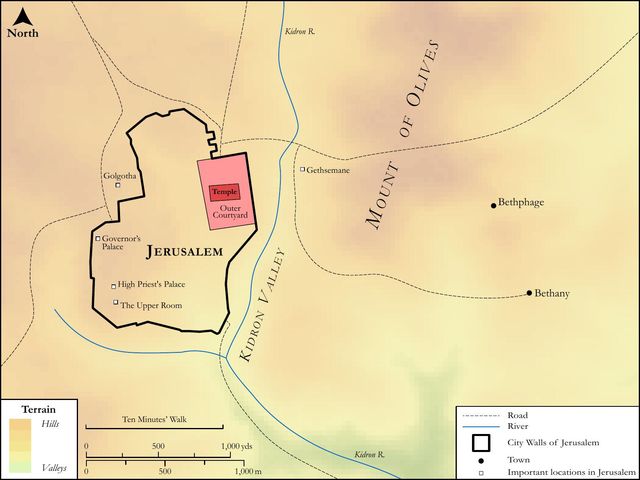
See on the biblical-era maps


Study this verse
Public-domain commentary
Matthew Henry
From his Commentary on the Whole Bible. Henry comments on passages, not single verses — this entry covers John 7:45–53. His four-level outline is real structure in the source text, so it is rendered as structure.
The chief priests and Pharisees are here in a close cabal, contriving how to suppress Christ; though this was the great day of the feast, they attended not the religious services of the day, but left them to the vulgar, to whom it was common for those great ecclesiastics to consign and turn over the business of devotion, while they thought themselves better employed in the affairs of church-policy. They sat in the council-chamber, expecting Christ to be brought a prisoner to them, as they had issued out warrants for apprehending him, Joh 7:32. Now here we are told,
I.What passed between them and their own officers, who returned without him, re infecta - having done nothing. Observe,
1.The reproof they gave the officers for not executing the warrant they gave them: Why have you not brought him? He appeared publicly; the people were many of them disgusted, and would have assisted them in taking him; this was the last day of the feast, and they would not have such another opportunity; "why then did you neglect your duty?" It vexed them that those who were their own creatures, who depended on them, and on whom they depended, into whose minds they had instilled prejudices against Christ, should thus disappoint them. Note, Mischievous men fret that they cannot do the mischief they would, Psa 112:10; Neh 6:16.
2.The reason which the officers gave for the non-execution of their warrant: Never man spoke like this man, Joh 7:46. Now,
(1.)This was a very great truth, that never any man spoke with that wisdom, and power, and grace, that convincing clearness, and that charming sweetness, wherewith Christ spoke; none of the prophets, no, not Moses himself.
(2.)The very officers that were sent to take him were taken with him, and acknowledged this. Though they were probably men who had no quick sense of reason or eloquence, and certainly had no inclination to think well of Jesus, yet so much self-evidence was there in what Christ said that they could not but prefer him before all those that sat in Moses's seat. Thus Christ was preserved by the power God has upon the consciences even of bad men.
(3.)They said this to their lords and masters, who could not endure to hear any thing that tended to the honour of Christ and yet could not avoid hearing this. Providence ordered it so that this should be said to them, that it might be a vexation in their sin and an aggravation of their sin. Their own officers, who could not be suspected to be biassed in favour of Christ, are witnesses against them. This testimony of theirs should have made them reflect upon themselves, with this thought, "Do we know what we are doing, when we are hating and persecuting one that speaks so admirably well?"
3.The Pharisees endeavour to secure their officers to their interest, and to beget in them prejudices against Christ, to whom they saw them begin to be well affected. They suggest two things: -
(1.)That if they embrace the gospel of Christ they will deceive themselves (Joh 7:47): Are you also deceived? Christianity has, from its first rise, been represented to the world as a great cheat upon it, and they that embraced it as men deceived, then when they began to be undeceived. Those that looked for a Messiah in external pomp thought those deceived who believed in a Messiah that appeared in poverty and disgrace; but the event declares that none were ever more shamefully deceived, nor put a greater cheat upon themselves, than those who promised themselves worldly wealth and secular dominion with the Messiah. Observe what a compliment the Pharisees paid to these officers: "Are you also deceived? What! men of your sense, and thought, and figure; men that know better than to be imposed upon by every pretender and upstart teacher?" They endeavour to prejudice them against Christ by persuading them to think well of themselves.
(2.)That they will disparage themselves. Most men, even in their religion, are willing to be governed by the example of those of the first rank; these officers therefore, whose preferments, such as they were, gave them a sense of honour, are desired to consider,
[1.]That, if they become disciples of Christ, they go contrary to those who were persons of quality and reputation: "Have any of the rulers, or of the Pharisees, believed on him? You know they have not, and you ought to be bound up by their judgment, and to believe and do in religion according to the will of your superiors; will you be wiser than they?" Some of the rulers did embrace Christ (Mat 9:18; Joh 4:53), and more believed in him, but wanted courage to confess him (Joh 12:42); but, when the interest of Christ runs low in the world, it is common for its adversaries to represent it as lower than really it is. But it was too true that few, very few, of them did. Note, First, The cause of Christ has seldom had rulers and Pharisees on its side. It needs not secular supports, nor proposes secular advantages, and therefore neither courts nor is courted by the great men of this world. Self-denial and the cross are hard lessons to rulers and Pharisees. Secondly, This has confirmed many in their prejudices against Christ and his gospel, that the rulers and Pharisees have been no friends to them. Shall secular men pretend to be more concerned about spiritual things than spiritual men themselves, or to see further into religion than those who make its study their profession? If rulers and Pharisees do not believe in Christ, they that do believe in him will be the most singular, unfashionable, ungenteel people in the world, and quite out of the way of preferment; thus are people foolishly swayed by external motives in matters of eternal moment, are willing to be damned for fashion-sake, and to go to hell in compliment to the rulers and Pharisees.
[2.]That they will link themselves with the despicable vulgar sort of people (Joh 7:43): But this people, who know not the law, are cursed, meaning especially those that were well-affected to the doctrine of Christ. Observe, First, How scornfully and disdainfully they speak of them: This people. It is not laos, this lay-people, distinguished from them that were the clergy, but ochlos outos, this rabble-people, this pitiful, scandalous, scoundrel people, whom they disdained to set with the dogs of their flock though God had set them with the lambs of his. If they meant the commonalty of the Jewish nation, they were the seed of Abraham, and in covenant with God, and not to be spoken of with such contempt. The church's common interests are betrayed when any one part of it studies to render the other mean and despicable. If they meant the followers of Christ, though they were generally persons of small figure and fortune, yet by owning Christ they discovered such a sagacity, integrity, and interest in the favours of Heaven, as made them truly great and considerable. Note, As the wisdom of God has often chosen base things, and things which are despised, so the folly of men has commonly debased and despised those whom God has chosen. Secondly, How unjustly they reproach them as ignorant of the word of God: They know not the law; as if none knew the law but those that knew it from them, and no scripture-knowledge were current but what came out of their mint; and as if none knew the law but such as were observant of their canons and traditions. Perhaps many of those whom they thus despised knew the law, and the prophets too, better than they did. Many a plain, honest, unlearned disciple of Christ, by meditation, experience, prayers, and especially obedience, attains to a more clear, sound, and useful knowledge of the word of God, than some great scholars with all their wit and learning. Thus David came to understand more than the ancients and all his teachers, Psa 119:99, Psa 119:100. If the common people did not know the law, yet the chief priests and Pharisees, of all men, should not have upbraided them with this; for whose fault was it but theirs, who should have taught them better, but, instead of that, took away the key of knowledge? Luk 11:52. Thirdly, How magisterially they pronounce sentence upon them: they are cursed, hateful to God, and all wise men; epikatartoi - an execrable people. It is well that their saying they were cursed did not make them so, for the curse causeless shall not come. It is a usurpation of God's prerogative, as well as great uncharitableness, to say of any particular persons, much more of any body of people, that they are reprobates. We are unable to try, and therefore unfit to condemn, and our rule is, Bless, and curse not. Some think they meant no more than that the people were apt to be deceived and made fools of; but they use this odious word, They are cursed, to express their own indignation, and to frighten their officers from having any thing to do with them; thus the language of hell, in our profane age, calls every thing that is displeasing cursed, and damned, and confounded. Now, for aught that appears, these officers had their convictions baffled and stifled by these suggestions, and they never enquire further after Christ; one word from a ruler or Pharisee will sway more with many than the true reason of things, and the great interests of their souls.
II.What passed between them and Nicodemus, a member of their own body, Joh 7:50, etc. Observe,
1.The just and rational objection which Nicodemus made against their proceedings. Even in their corrupt and wicked sanhedrim God left not himself quite without witness against their enmity; nor was the vote against Christ carried nemine contradicente - unanimously. Observe,
(1.)Who it was that appeared against them; it was Nicodemus, he that came to Jesus by night, being one of them, Joh 7:50. Observe, concerning him,
[1.]That, though he had been with Jesus, and taken him for his teacher, yet he retained his place in the council, and his vote among them. Some impute this to his weakness and cowardice, and think it was his fault that he did not quit his place, but Christ had never said to him, Follow me, else he would have done as others that left all to follow him; therefore it seems rather to have been his wisdom not immediately to throw up his place, because there he might have opportunity of serving Christ and his interest, and stemming the tide of the Jewish rage, which perhaps he did more than we are aware of. He might there be as Hushai among Absalom's counsellors, instrumental to turn their counsels into foolishness. Though we must in no case deny our Master, yet we may wait for an opportunity of confessing him to the best advantage. God has his remnant among all sorts, and many times finds, or puts, or makes, some good in the worst places and societies. There was Daniel in Nebuchadnezzar's court, and Nehemiah in Artaxerxes's.
[2.]That though at first he came to Jesus by night, for fear of being known, and still continued in his post; yet, when there was occasion, he boldly appeared in defence of Christ, and opposed the whole council that were set against him. Thus many believers who at first were timorous, and ready to flee at the shaking of a leaf, have at length, by divine grace, grown courageous, and able to laugh at the shaking of a spear. Let none justify the disguising of their faith by the example of Nicodemus, unless, like him, they be ready upon the first occasion openly to appear in the cause of Christ, though they stand alone in it; for so Nicodemus did here, and Joh 19:39.
(2.)What he alleged against their proceedings (Joh 7:51): Doth our law judge any man before it hear him (akousē par' autou - hear from himself) and know what he doeth? By no means, nor doth the law of any civilized nation allow it. Observe,
[1.]He prudently argues from the principles of their own law, and an incontestable rule of justice, that no man is to be condemned unheard. Had he urged the excellency of Christ's doctrine or the evidence of his miracles, or repeated to them his divine discourse with him (ch. 3), it had been but to cast pearls before swine, who would trample them under their feet, and would turn again and rend him; therefore he waives them.
[2.]Whereas they had reproached the people, especially the followers of Christ, as ignorant of the law, he here tacitly retorts the charge upon themselves, and shows how ignorant they were of some of the first principles of the law, so unfit were they to give law to others.
[3.]The law is here said to judge, and hear, and know, when magistrates that govern and are governed by it judge, and hear, and know; for they are the mouth of the law, and whatsoever they bind and loose according to the law is justly said to be bound and loosed by the law.
[4.]It is highly fit that none should come under the sentence of the law, till they have first by a fair trial undergone the scrutiny of it. Judges, when they receive the complaints of the accuser, must always reserve in their minds room for the defence of the accused, for they have two ears, to remind them to hear both sides; this is said to be the manner of the Romans, Act 25:18. The method of our law is Oyer and Terminer, first to hear and then to determine.
[5.]Persons are to be judged, not by what is said of them, but by what they do. Our law will not ask what men's opinions are of them, or out-cries against them, but, What have they done? What overt-acts can they be convicted of? Sentence must be given, secundum allegata et probata - according to what is alleged and proved. Facts, and not faces, must be known in judgment; and the scale of justice must be used before the sword of justice.
Now we may suppose that the motion Nicodemus made in the house upon this was, That Jesus should be desired to come and give them an account of himself and his doctrine, and that they should favour him with an impartial and unprejudiced hearing; but, though none of them could gainsay his maxim, none of them would second his motion.
2.What was said to this objection. Here is no direct reply given to it; but, when they could not resist the force of his argument, they fell foul upon him, and what was to seek in reason they made up in railing and reproach. Note, It is a sign of a bad cause when men cannot bear to hear reason, and take it as an affront to be reminded of its maxims. Whoever are against reason give cause to suspect that reason is against them. See how they taunt him: Art thou also of Galilee? Joh 7:52. Some think he was well enough served for continuing among those whom he knew to be enemies to Christ, and for his speaking no more on the behalf of Christ than what he might have said on behalf of the greatest criminal - that he should not be condemned unheard. Had he said, "As for this Jesus, I have heard him myself, and know he is a teacher come from God, and you in opposing him fight against God," as he ought to have said, he could not have been more abused than he was for this feeble effort of his tenderness for Christ. As to what they said to Nicodemus, we may observe,
(1.)How false the grounds of their arguing were, for,
[1.]They suppose that Christ was of Galilee, and this was false, and if they would have been at the pains of an impartial enquiry they would have found it so.
[2.]They suppose that because most of his disciples were Galileans they were all such, whereas he had abundance of disciples in Judea.
[3.]They suppose that out of Galilee no prophet had risen, and for this appeal to Nicodemus's search; yet this was false too: Jonah was of Gath-hepher, Nahum an Elkoshite, both of Galilee. Thus do they make lies their refuge.
(2.)How absurd their arguings were upon these grounds, such as were a shame to rulers and Pharisees.
[1.]Is any man of worth and virtue ever the worse for the poverty and obscurity of his country? The Galileans were the seed of Abraham; barbarians and Scythians are the seed of Adam; and have we not all one Father?
[2.]Supposing no prophet had risen out of Galilee, yet it is not impossible that any should arise thence. If Elijah was the first prophet of Gilead (as perhaps he was), and if the Gileadites were called fugitives, must it therefore be questioned whether he was a prophet or no?
3.The hasty adjournment of the court hereupon. They broke up the assembly in confusion, and with precipitation, and every man went to his own house. They met to take counsel together against the Lord and his Anointed, but they imagined a vain think; and not only he that sits in heaven laughed at them, but we may sit on earth and laugh at them too, to see all the policy of the close cabal broken to pieces with one plain honest word. They were not willing to hear Nicodemus, because they could not answer him. As soon as they perceived they had one such among them, they saw it was to no purpose to go on with their design, and therefore put off the debate to a more convenient season, when he was absent. Thus the counsel of the Lord is made to stand, in spite of the devices in the hearts of men.
Historical interpretation
Seven Centuries of Reception
10 surviving comments on this verse. Each one is dated, so this reads as a timeline rather than a list.
Select a marker to jump to its quote. Markers stagger vertically where authors wrote within a few decades of each other.
"The officers," saith the Evangelist, "came, and the Pharisees said unto them, Why have ye not brought him?" To "come" was a far greater deed than to have remained, for in the latter case they would have been rid of the annoyance of these men, but now they become heralds of the wisdom of Christ, and manifested their boldness in greater degree. And they say not, "We could not become of the multitude, for they gave heed unto Him as unto a prophet"; but what? "Never man spake as this Man." Yet they might have alleged that, but they show their right feeling. For theirs was the saying not only of men admiring Him, but blaming their masters, because they had sent them to bind Him whom it behooved rather to hear.
When they ought to have asked what He spake, and to have marveled at the words, they do not so, (knowing that they might have been captivated,) but reason with them from a very foolish argument; "Wherefore," saith one, "hath none of the rulers believed on Him?" Dost thou then make this a charge against Christ, tell me, and not against the unbelievers?
There is nothing clearer, nothing simpler than the truth, if we deal not perversely; just as (on the other hand) if we deal perversely, nothing is more difficult. For behold, the Scribes and Pharisees, who seemed forsooth to be wiser than other men, being ever with Christ for the sake of plotting against Him, and beholding His miracles, and reading the Scriptures, were nothing profited, but were even harmed while the officers, who could not claim one of these privileges, were subdued by one single sermon, and they who had gone forth to bind Him, came back bound themselves by wonder. We must not only marvel at their understanding, that they needed not signs, but were taken by the teaching alone; (for they said not, "Never man wrought miracles thus," but, "Never man spake thus";) we must not, I say, merely marvel at their understanding, but also at their boldness, that they spake thus to those that had sent them, to the Pharisees, to His enemies, to men who were doing all with a view to gratify their enmity.
"But the people," saith one, "which knoweth not the Law, are accursed." Then is the charge against you the heavier, because the people believed, and ye believed not. They acted like men that knew the Law; how then are they accursed? It is ye that are accursed, who keep not the Law, not they, who obey the Law. Neither was it right, on the evidence of unbelievers, to slander one in whom they believed not, for this is an unjust mode of acting. For ye also believed not God, as Paul saith; "What if some did not believe? shall their unbelief make the faith of God of none effect? God forbid." (Rom. iii. 3, 4.) For the Prophets ever rebuked them, saying, "Hear, ye rulers of Sodom"; and, "Thy rulers are disobedient" (Isa. i. 10, 23); and again, "Is it not for you to know judgment?" (Mic. iii. 1.) And everywhere they attack them vehemently.
(Hom. lii. 1) The Pharisees and Scribes profited nothing by seeing the miracles, and reading the Scriptures; but their officers, who had done neither, were captivated with once hearing Him; and they who went to take hold of Him, were themselves taken hold of by the miracle. Nor did they say, We could not because of the multitude: but made themselves proclaimers of Christ's wisdom: The officers answered, Never man spake like this Man.
(Hom. lii. 1) Not only is their wisdom to be admired, for not wanting miracles, but being convinced by His teaching only, (for they do not say, Never man did such miracles as this Man, but, Never man spake like this Man,) but also their boldness, in saying this to the Pharisees, who were such enemies of Christ. They had not heard a long discourse, but minds unprepossessed against Him did not require one.
(Hom. lii. 1) They make use of the most foolish argument against them: Have any of the rulers or of the Pharisees believed on Him? but this people who knoweth not the law are cursed? This then was their ground of accusation, that the people believed, but they themselves did not.
(Hom. lii. 1) How then are they cursed, who are convinced by the law? Rather are ye cursed, who have not observed the law.
But they who had been sent to take Him returned clear of the crime and full of admiration. For they even gave witness to His divine doctrine, when those by whom they had been sent asked, "Why have ye not brought him?" They answered that they had never heard a man so speak: "For not any man so speaks." But He spake thus, because He was God and man. But the Pharisees, repelling their testimony, said to them: "Are ye also deceived?" We see, indeed, that you also have been charmed by his discourses. "Hath any one of the rulers or the Pharisees believed on him? But this multitude who know not the law are cursed." They who knew not the law believed on Him who had sent the law; and those men who were teaching the law despised Him, that it might be fulfilled which the Lord Himself had said, "I am come that they who see not may see, and they that see may be made blind." For the Pharisees, the teachers of the law, were made blind, and the people that knew not the law, and yet believed on the author of the law, were enlightened.
(Tract. xxxiii. 1) They however who were sent to take Him, returned guiltless of the offence, and full of admiration: Then came the officers to the chief priests and Pharisees; and they said unto them, Why have ye not brought Him?
(Tract. xxxiii. 1) He spoke thus, because He was both God and man.
(Tract. xxxiii. 1) The Pharisees however rejected their testimony: Then answered them the Pharisees, Are ye also led away? As if to say, We see that you are charmed by His discourse.
(Tract. xxxiii. 1) They who knew not the law, believed on Him who had given the law, and they who taught the law condemned Him; thus fulfilling our Lord's words, I am come, that they which see not might see, and that they which see might be made blind. (c. 19:39)
It seems likely that the officers were more strongly Jewish, and ever cleaving to the Pharisees and sharing their common mind, and ever soused with the words of their rulers, were persuaded to think the same with them, as being ever with them. But when they came, no ways bringing the Lord, but astonishment-stricken beyond their expectation, and late and only now marvelling at Him Whom they ought not to have hated at the beginning, and thinking that all the rest ought to be persuaded by them: they say with a kind of deep anguish, Have YE also been deceived? And understand how this saying is replete with a sort of despair of any hope as regards the people. For as though the rest of the multitude had already been deceived, so many as were not over-stable, they put forth their fear as to the officers. For the remaining multitude (says it) of the common people who are not versed in the sacred Scriptures, nor yet fortified by cleaving to us, let it be granted (if so be) to them to be joined to Him with inconsiderate impulses, and easily-caught to agree to what He hath said and done: but whence hath this error been admitted by you too? how have yourselves also been deceived? what was it drew you off from your love to us, albeit withered in equal unbelief with us? something like this does the Pharisees' word seem to tell us.
Not among the rulers; for they were resolved one way, viz. not to acknowledge Him as Christ. The more moderate of them only used malicious words, in order to oppose Christ's path to glory; but the more malignant wished to lay hands on Him: And some of them would have taken Him.
The Pharisees answer the officers courteously and gently; because they are afraid of their forthwith separating from them, and joining Christ.
Continue studying John 7:47 across the web’s major study libraries — every link below opens this exact verse, chapter, or book on the destination site.
Read & Compare
 BibleGatewayThis verse in more than 200 translations and 70 languages.
 Bible.comThe YouVersion reader — hundreds of translations, reading plans, and highlights.
 ESV.orgCrossway's official English Standard Version reader.
 NET BibleThe NET translation with 60,000+ translators' notes on every rendering decision.
 STEP BibleTyndale House's free study tool — original text, vocabulary, and scholarly resources.
 BibliaLogos Bible Software's free web reader.
 USCCBThe New American Bible (Revised Edition) with the U.S. bishops' study notes.
Commentaries
 BibleHub CommentariesDozens of classic commentaries on this verse, gathered on one page.
 StudyLightMore than 100 commentary sets — the largest collection on the web.
 BibleRefPlain-English commentary on what this verse means, verse by verse.
 Enduring WordDavid Guzik's free commentary on this chapter, widely used by Bible teachers.
 Bible Study ToolsVerse commentary alongside Greek and Hebrew study aids.
Original Language & Research
- BibleHub InterlinearThe verse word by word — original language, transliteration, and English.
- BibleHub LexiconEvery word's original-language definition and Strong's entry.
 Blue Letter BibleDeep-study tools — Strong's numbers, concordance, and word studies.
 CNTR CollationThe earliest Greek manuscripts of this verse, collated letter by letter.
Sermons, Hymns & Audio


TrulyRandomVerse is not affiliated with these sites and doesn’t control their content. They’re linked because they’re genuinely useful.
Summary
The Pharisees, infuriated by the temple guards' failure to apprehend Jesus, respond with a condescending question that reveals their profound spiritual blindness and elitism. Their query, "Are ye also deceived?", expresses their disbelief that anyone, especially their own officers, could be swayed by Jesus' teachings, whom they considered a deceiver and a threat to their authority and understanding of the Law. This moment underscores the escalating conflict between Jesus and the Jewish religious establishment, highlighting their inability to recognize divine truth due to their entrenched prejudice and self-righteousness.
Context
ShowHideLiterary Context
This verse is situated within the broader narrative of Jesus' ministry during the Feast of Tabernacles in Jerusalem, as detailed in John 7. Throughout the chapter, Jesus teaches openly in the temple, sparking debate and division among the crowds and the religious authorities. The immediate preceding verses (John 7:45-46) describe the temple officers, dispatched by the chief priests and Pharisees to arrest Jesus, returning empty-handed. Their astonishing explanation—"Never man spake like this man"—serves as the direct catalyst for the Pharisees' indignant outburst in John 7:47. This sequence vividly portrays the growing tension and the Pharisees' increasing frustration with Jesus' popularity and perceived defiance of their authority.
Historical & Cultural Context
The Pharisees were one of the most influential Jewish religious sects in the first century, known for their strict adherence to the Mosaic Law and their extensive body of oral traditions. They held significant sway over the common people and were often at odds with other groups like the Sadducees. Their self-perception was that they were the true interpreters and guardians of God's Law, viewing themselves as spiritually superior to the "unlearned" masses, often referred to as the 'am ha'aretz (people of the land). This cultural elitism is palpable in their reaction to the temple guards. The setting of the Feast of Tabernacles, a major pilgrimage festival, meant Jerusalem was teeming with Jews from all over, making Jesus' public teaching and the authorities' inability to control the narrative even more politically and religiously charged.
Key Themes
ShowHideJohn 7:47 powerfully contributes to several key themes within the Gospel of John. Foremost is the theme of spiritual blindness and unbelief, particularly among the religious leaders who, despite witnessing Jesus' signs and hearing His profound teachings, refuse to believe in Him (John 5:39-40). Their question also highlights their elitism and contempt for the common people, whom they consider ignorant and easily misled, contrasting sharply with Jesus' compassion for the crowds (Matthew 9:36). Furthermore, the verse underscores the authority and impact of Jesus' words, which even His would-be captors could not resist (John 7:46). This ongoing conflict between Jesus and the Jewish leadership is a central motif, leading ultimately to His crucifixion.
Exposition and Analysis
ShowHideKey Word Analysis
ShowHideThis word signifies a response, but in this context, it carries the weight of an indignant, almost accusatory retort rather than a simple reply. It suggests a reaction born out of frustration and anger, highlighting the Pharisees' immediate and hostile rejection of the guards' testimony.
Derived from a Hebrew root meaning "separated," this term denotes a Jewish sect characterized by their strict adherence to the Law and their oral traditions. In the Gospels, they frequently represent the religious establishment that opposes Jesus, embodying self-righteousness, legalism, and a profound spiritual inability to recognize the Messiah. Their identity as "Pharisees" immediately signals a source of opposition and judgmentalism.
While a common conjunction, in this interrogative context, "also" is crucial. It implies a shared characteristic or fate. The Pharisees are essentially asking, "Are you, like the ignorant masses, also deluded?" It reveals their condescending view of the common people and their assumption that anyone who believes in Jesus must be mistaken.
Meaning "to roam from safety, truth, or virtue," this word describes being led astray, misled, or deluded. The Pharisees use it to accuse the guards of having wandered from the truth, implying that Jesus is a false teacher and His followers are victims of his trickery. This term encapsulates their fundamental misunderstanding of Jesus' identity and mission, viewing His influence not as divine revelation but as dangerous deception.
Verse Breakdown
ShowHide"Then answered them the Pharisees"
This opening phrase immediately sets a tone of confrontation. The "then" (G3767, oûn) indicates a direct and consequential response to the temple guards' report in John 7:46. The Pharisees' act of "answering" is not a calm inquiry but an indignant reaction, revealing their anger and frustration at the guards' failure to comply with their orders and their unexpected positive testimony about Jesus. It underscores their position of authority and their expectation of unquestioning obedience.
"Are ye also deceived?"
This is a rhetorical question, not posed to elicit information but to express the Pharisees' contempt, disbelief, and accusation. The inclusion of "also" (G2532, kaí) is critical, implying that the guards have fallen into the same error as the "common people" whom the Pharisees already considered ignorant and deluded. The Greek particle for "are" (G4105, planáō) combined with "deceived" (G4105, planáō) and the negative particle (G3361, mḗ) forms a question that expects a negative answer, effectively accusing the guards of being misled by Jesus. It highlights the Pharisees' spiritual arrogance and their inability to comprehend how anyone could genuinely be drawn to Jesus without being under some form of delusion.
Literary Devices
ShowHideThe verse effectively employs Rhetorical Question and Irony to illuminate the spiritual state of the Pharisees. The question, "Are ye also deceived?", is not a genuine search for information but a loaded accusation, designed to shame and dismiss the guards' testimony. It functions as a statement of the Pharisees' own prejudiced conviction that Jesus is a deceiver, and anyone who believes in Him is therefore deluded. This reveals their closed-mindedness and their inability to engage with the truth presented to them. Furthermore, the scene is rich in Irony. The very individuals who consider themselves enlightened and guardians of truth are profoundly blind, while the uneducated temple guards, sent to arrest Jesus, are the ones who perceive something extraordinary about Him. The "deceived" are, in fact, the accusers, who cannot see the divine truth standing before them, while those they accuse have a nascent glimmer of understanding. This dramatic irony underscores the Pharisees' spiritual arrogance and their tragic failure to recognize the Messiah.
Theological and Thematic Connections
ShowHideThe Pharisees' question in John 7:47 serves as a poignant theological statement about the nature of spiritual blindness and the danger of human pride. Their inability to see Jesus for who He truly is stems not from a lack of evidence, but from a hardened heart and a rigid adherence to their own traditions and interpretations, which they elevated above divine revelation. They prioritized their social standing, their power, and their preconceived notions of the Messiah over the actual person of Jesus. This illustrates a universal human tendency to reject truth when it challenges established beliefs or threatens personal comfort and authority. The incident highlights that true spiritual understanding requires humility and an openness to God's work, even when it defies human expectations or social norms.
Reflection and Application
ShowHideThe Pharisees' arrogant dismissal of the temple guards' testimony in John 7:47 offers a timeless warning for all who seek to follow God. It challenges us to critically examine our own hearts for any seeds of spiritual pride, elitism, or preconceived notions that might hinder our ability to perceive and embrace God's truth, especially when it comes in unexpected forms or from unexpected sources. Just as the Pharisees looked down on the "unlearned" masses, we must guard against judging others based on their background, education, or social status within the church or society. True spiritual discernment requires humility, a willingness to be challenged, and an open heart to God's Spirit, who often works in ways that defy our expectations. Our focus should always be on seeking God's truth, not on defending our own interpretations or maintaining a sense of intellectual or spiritual superiority. This verse calls us to cultivate a posture of teachability, recognizing that God can reveal Himself to anyone, regardless of their societal standing or theological training.
Questions for Reflection
ShowHideFAQ
ShowHideWhy were the Pharisees so upset by the temple guards' report?
ShowHideThe Pharisees were deeply upset because the temple guards, whom they had dispatched with clear instructions to arrest Jesus, returned empty-handed and, worse, offered a positive testimony about Him. The guards' statement, "Never man spake like this man" (John 7:46), directly challenged the Pharisees' authority and their narrative that Jesus was a deceiver or a false prophet. This unexpected report not only represented a failure to execute their orders but also suggested that Jesus possessed an undeniable, compelling power in His words that even their own officers could not resist. This undermined their control, threatened their religious and political standing, and confirmed their fear that Jesus was gaining too much influence over the common people.
What does "deceived" imply in this context, and why did the Pharisees use this word?
ShowHideIn this context, "deceived" (Greek: planáō) implies being led astray from the truth, being deluded, or wandering from the correct path. The Pharisees used this word because, from their perspective, Jesus was a dangerous charlatan who was misleading the people. They believed that anyone who followed Jesus or was impressed by His teachings was fundamentally mistaken, having been "tricked" or "seduced" away from the true understanding of God's Law and the Messiah. By asking, "Are ye also deceived?" (John 7:47), they were not only accusing the guards but also expressing their contempt for the common people who believed in Jesus, whom they considered ignorant and easily swayed. It was a rhetorical question designed to shame the guards and reinforce the Pharisees' conviction that Jesus' popularity was a sign of mass delusion, not divine revelation.
Christ-Centered Fulfillment
ShowHideThe Pharisees' indignant question, "Are ye also deceived?", profoundly highlights humanity's persistent struggle to recognize and receive God's truth when it is embodied in a form that challenges preconceived notions. Their spiritual blindness to Jesus, the very Son of God, foreshadows the broader rejection of Christ by many who were steeped in religious tradition but lacked true spiritual discernment. Jesus, as the ultimate revelation of God (John 1:18), came into the world, but "the world knew him not" (John 1:10), and "his own received him not" (John 1:11). The Pharisees' accusation of "deception" against Jesus is a tragic irony, for He is the Way, the Truth, and the Life (John 14:6), and those who follow Him are led into truth, not astray. Their rejection of Jesus ultimately culminated in His crucifixion, yet through this very act, God's plan for salvation was fulfilled. Thus, the Pharisees' question, intended to discredit Jesus, inadvertently underscores the profound truth that only in Christ is true understanding found, and to reject Him is to remain truly deceived, wandering from the path of life. Despite their efforts, Jesus' authority and truth could not be contained, for He is the Lord of all (Philippians 2:9-11).