


John 7:43
Bible text: King James Version (1769 Blayney text) · Public domain
Bible text: Berean Standard Bible · Public domain
Bible text: American Standard Version (1901) · Public domain
Bible text: World English Bible, Messianic edition · Public domain
Bible text: Geneva Bible (1599) · Public domain
Bible text: Young's Literal Translation · Public domain
- ΣχίσμαSchismaA divisionG4978N-NSNNoun Nominative Singular Neuter
- οὖνounthereforeG3767CONJConjunction
- ἐγένετοegenetooccurredG1096V-2ADI-3SVerb 2nd Aorist Middle Deponent Indicative 3rd Singular
- ἐνeninG1722PREPPreposition
- τῷtōtheG3588T-DSMDefinite article Dative Singular Masculine
- ὄχλῳochlōcrowdG3793N-DSMNoun Dative Singular Masculine
- δι᾽di᾽because ofG1223PREPPreposition
- αὐτόνautonHimG846P-ASMPersonal pronoun Accusative Singular Masculine
English is a literal word-by-word gloss of the Greek, not the KJV's wording. Why?
This is the original text the KJV's translators worked from — each Greek word with its own literal English meaning in this verse, prepared by scholars at Tyndale House, Cambridge. The KJV translates whole sentences, not word by word, so its wording differs: one Greek word can become several English words, and the KJV may choose “charity” where the gloss reads “love”. Both are faithful — they answer different questions. For the KJV's own rendering, switch to the KJV text.
Details
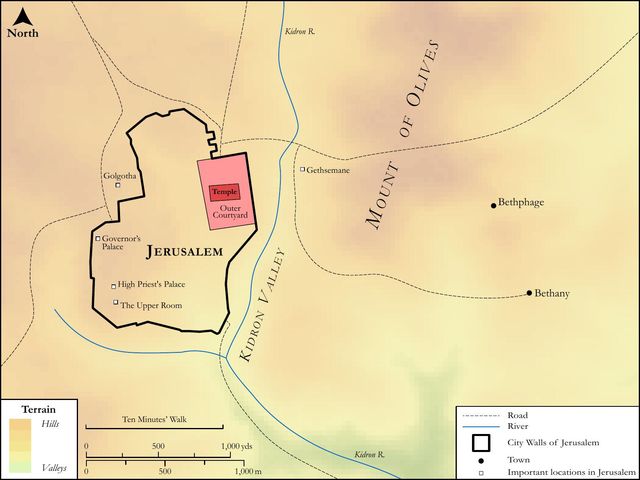
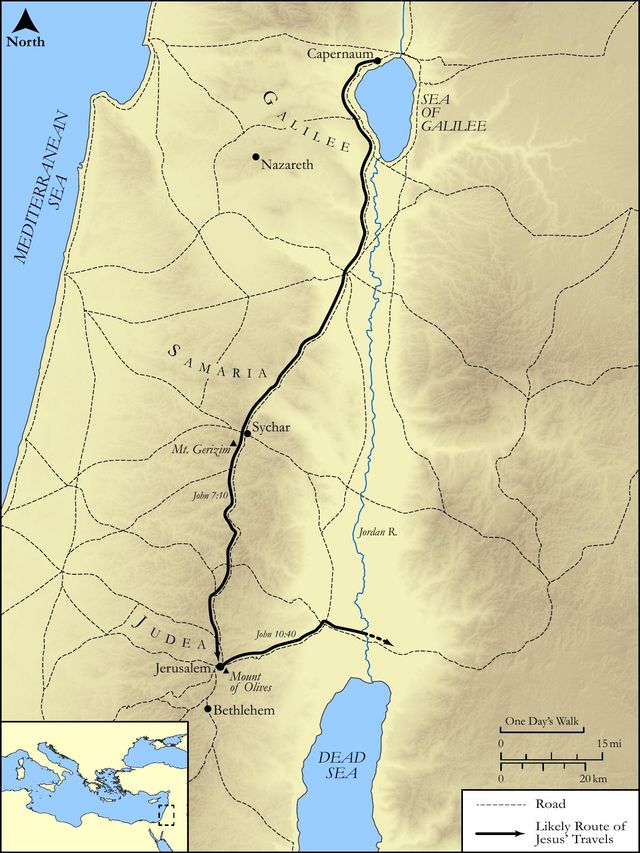
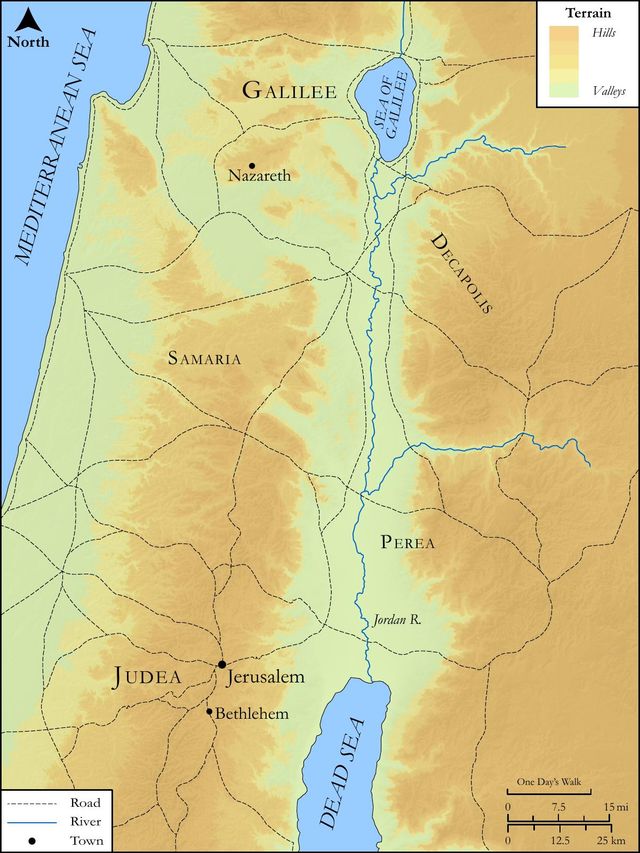
See on the biblical-era maps
Study this verse
Public-domain commentary
Matthew Henry
From his Commentary on the Whole Bible. Henry comments on passages, not single verses — this entry covers John 7:37–44. His four-level outline is real structure in the source text, so it is rendered as structure.
In these verses we have,
I.Christ's discourse, with the explication of it, Joh 7:37-39.
It is probable that these are only short hints of what he enlarged upon, but they have in them the substance of the whole gospel; here is a gospel invitation to come to Christ, and a gospel promise of comfort and happiness in him. Now observe,
1.When he gave this invitation: On the last day of the feast of tabernacles, that great day. The eighth day, which concluded that solemnity, was to be a holy convocation, Lev 23:36. Now on this day Christ published this gospel-call, because (1.) Much people were gathered together, and, if the invitation were given to many, it might be hoped that some would accept of it, Pro 1:20. Numerous assemblies give opportunity of doing the more good. (2.) The people were now returning to their homes, and he would give them this to carry away with them as his parting word. When a great congregation is to be dismissed, and is about to scatter, as here, it is affecting to think that in all probability they will never come all together again in this world, and therefore, if we can say or do any thing to help them to heaven, that must be the time. It is good to be lively at the close of an ordinance. Christ made this offer on the last day of the feast. [1.] To those who had turned a deaf ear to his preaching on the foregoing days of this sacred week; he will try them once more, and, if they will yet hear his voice, they shall live. [2.] To those who perhaps might never have such another offer made them, and therefore were concerned to accept of this; it would be half a year before there would be another feast, and in that time they would many of them be in their graves. Behold now is the accepted time.
2.How he gave this invitation: Jesus stood and cried, which denotes,
(1.)His great earnestness and importunity. His heart was upon it, to bring poor souls in to himself. The erection of his body and the elevation of his voice were indications of the intenseness of his mind. Love to souls will make preachers lively.
(2.)His desire that all might take notice, and take hold of this invitation. He stood, and cried, that he might the better be heard; for this is what every one that hath ears is concerned to hear. Gospel truth seeks no corners, because it fears no trials. The heathen oracles were delivered privately by them that peeped and muttered; but the oracles of the gospel were proclaimed by one that stood, and cried. How sad is the case of man, that he must be importuned to be happy, and how wonderful the grace of Christ, that he will importune him! Ho, every one, Isa 55:1.
3.The invitation itself is very general: If any man thirst, whoever he be, he is invited to Christ, be he high or low, rich or poor, young or old, bond or free, Jew or Gentile. It is also very gracious: "If any man thirst, let him come to me and drink. If any man desires to be truly and eternally happy, let him apply himself to me, and be ruled by me, and I will undertake to make him so."
(1.)The persons invited are such as thirst, which may be understood, either,
[1.]Of the indigence of their cases; either as to their outward condition (if any man be destitute of the comforts of this life, or fatigued with the crosses of it, let his poverty and afflictions draw him to Christ for that peace which the world can neither give nor take away), or as to their inward state: "If any man want spiritual blessings, he may be supplied by me." Or,
[2.]Of the inclination of their souls and their desires towards a spiritual happiness. If any man hunger and thirst after righteousness, that is, truly desire the good will of God towards him, and the good work of God in him.
(2.)The invitation itself: Let him come to me. Let him not go to the ceremonial law, which would neither pacify the conscience nor purify it, and therefore could not make the comers thereunto perfect, Heb 10:1. Nor let him go to the heathen philosophy, which does but beguile men, lead them into a wood, and leave them there; but let him go to Christ, admit his doctrine, submit to his discipline, believe in him; come to him as the fountain of living waters, the giver of all comfort.
(3.)The satisfaction promised: "Let him come and drink, he shall have what he comes for, and abundantly more, shall have that which will not only refresh, but replenish, a soul that desires to be happy."
4.A gracious promise annexed to this gracious call (Joh 7:38): He that believeth on me, out of his belly shall flow - (1.) See here what it is to come to Christ: It is to believe on him, as the scripture hath said; it is to receive and entertain him as he is offered to us in the gospel. We must not frame a Christ according to our fancy, but believe in a Christ according to the scripture. (2.) See how thirsty souls, that come to Christ, shall be made to drink. Israel, that believed Moses, drank of the rock that followed them, the streams followed; but believers drink of a rock in them, Christ in them; he is in them a well of living water, Joh 4:14. Provision is made not only for their present satisfaction, but for their continual perpetual comfort. Here is, [1.] Living water, running water, which the Hebrew language calls living, because still in motion. The graces and comforts of the Spirit are compared to living (meaning running) water, because they are the active quickening principles of spiritual life, and the earnests and beginnings of eternal life. See Jer 2:13. [2.] Rivers of living water, denoting both plenty and constancy. The comfort flows in both plentifully and constantly as a river; strong as a stream to bear down the oppositions of doubts and fears. There is a fulness in Christ of grace for grace. [3.] These flow out of his belly, that is, out of his heart or soul, which is the subject of the Spirit's working and the seat of his government. There gracious principles are planted; and out of the heart, in which the Spirit dwells, flow the issues of life, Pro 4:23. There divine comforts are lodged, and the joy that a stranger doth not intermeddle with. He that believes has the witness in himself, Jo1 5:10. Sat lucis intus - Light abounds within. Observe, further, where there are springs of grace and comfort in the soul that will send forth streams: Out of his belly shall flow rivers. First, Grace and comfort will produce good actions, and a holy heart will be seen in a holy life; the tree is known by its fruits, and the fountain by its streams. Secondly, They will communicate themselves for the benefit of others; a good man is a common good. His mouth is a well of life, Pro 10:11. It is not enough that we drink waters out of our own cistern, that we ourselves take the comfort of the grace given us, but we must let our fountains be dispersed abroad, Pro 5:15, Pro 5:16.
Those words, as the scripture hath said, seem to refer to some promise in the Old Testament to this purport, and there are many; as that God would pour out his Spirit, which is a metaphor borrowed from waters (Pro 1:23; Joe 2:28; Isa 44:3; Zac 12:10); that the dry land should become springs of water (Isa 41:18); that there should be rivers in the desert (Isa 43:19); that gracious souls should be like a spring of water (Isa 58:11); and the church a well of living water, Sol 4:15. And here may be an allusion to the waters issuing out of Ezekiel's temple, Eze 47:1. Compare Rev 22:1, and see Zac 14:8. Dr. Lightfoot and others tell us it was a custom of the Jews, which they received by tradition, the last day of the feast of tabernacles to have a solemnity, which they called Libatio aquae - The pouring out of water. They fetched a golden vessel of water from the pool of Siloam, brought it into the temple with sound of trumpet and other ceremonies, and, upon the ascent to the altar, poured it out before the Lord with all possible expressions of joy. Some of their writers make the water to signify the law, and refer to Isa 12:3; Isa 55:1. Others, the Holy Spirit. And it is thought that our Saviour might here allude to this custom. Believers shall have the comfort, not of a vessel of water fetched from a pool, but of a river flowing from themselves. The joy of the law, and the pouring out of the water, which signified this, are not to be compared with the joy of the gospel in the wells of salvation.
5.Here is the evangelist's exposition of this promise (Joh 7:39): This spoke he of the Spirit: not of any outward advantages accruing to believers (as perhaps some misunderstood him), but of the gifts, graces, and comforts of the Spirit. See how scripture is the best interpreter of scripture. Observe,
(1.)It is promised to all that believe on Christ that they shall receive the Holy Ghost. Some received his miraculous gifts (Mar 16:17, Mar 16:18); all receive his sanctifying graces. The gift of the Holy Ghost is one of the great blessings promised in the new covenant (Act 2:39), and, if promised, no doubt performed to all that have an interest in that covenant.
(2.)The Spirit dwelling and working in believers is as a fountain of living running water, out of which plentiful streams flow, cooling and cleansing as water, mollifying and moistening as water, making them fruitful, and others joyful; see Joh 3:5. When the apostles spoke so fluently of the things of God, as the Spirit gave them utterance (Act 2:4), and afterwards preached and wrote the gospel of Christ with such a flood of divine eloquence, then this was fulfilled, Out of his belly shall flow rivers.
(3.)This plentiful effusion of the Spirit was yet the matter of a promise; for the Holy Ghost was not yet given, because Jesus was not yet glorified. See here [1.] That Jesus was not yet glorified. It was certain that he should be glorified, and he was ever worthy of all honour; but he was as yet in a state of humiliation and contempt. He had never forfeited the glory he had before all worlds, nay, he had merited a further glory, and, besides his hereditary honours, might claim the achievement of a mediatorial crown; and yet all this is in reversion. Jesus is now upheld (Isa 42:1), is now satisfied (Isa 53:11), is now justified (Ti1 3:16), but he is not yet glorified. And, if Christ must wait for his glory, let not us think it much to wait for ours. [2.] That the Holy Ghost was not yet given. oupō gar hēn pneuma - for the Holy Ghost was not yet. The Spirit of God was from eternity, for in the beginning he moved upon the face of the waters. He was in the Old Testament prophets and saints, and Zacharias and Elisabeth were both filled with the Holy Ghost. This therefore must be understood of the eminent, plentiful, and general effusion of the Spirit which was promised, Joe 2:28, and accomplished, Act 2:1, etc. The Holy Ghost was not yet given in that visible manner that was intended. if we compare the clear knowledge and strong grace of the disciples of Christ themselves, after the day of Pentecost, with their darkness and weakness before, we shall understand in what sense the Holy Ghost was not yet given; the earnests and first-fruits of the Spirit were given, but the full harvest was not yet come. That which is most properly called the dispensation of the Spirit did not yet commence. The Holy Ghost was not yet given in such rivers of living water as should issue forth to water the whole earth, even the Gentile world, not in the gifts of tongues, to which perhaps this promise principally refers. [3.] That the reason why the Holy Ghost was not given was because Jesus was not yet glorified. First, The death of Christ is sometimes called his glorification (Joh 13:31); for in his cross he conquered and triumphed. Now the gift of the Holy Ghost was purchased by the blood of Christ: this was the valuable consideration upon which the grant was grounded, and therefore till this price was paid (though many other gifts were bestowed upon its being secured to be paid) the Holy Ghost was not given. Secondly, There was not so much need of the Spirit, while Christ himself was here upon earth, as there was when he was gone, to supply the want of him. Thirdly, The giving of the Holy Ghost was to be both an answer to Christ's intercession (Joh 14:16), and an act of his dominion; and therefore till he is glorified, and enters upon both these, the Holy Ghost is not given. Fourthly, The conversion of the Gentiles was the glorifying of Jesus. When certain Greeks began to enquire after Christ, he said, Now is the Son of man glorified, Joh 12:23. Now the time when the gospel should be propagated in the nations was not yet come, and therefore there was as yet no occasion for the gift of tongues, that river of living water. But observe, though the Holy Ghost was not yet given, yet he was promised; it was now the great promise of the Father, Act 1:4. Though the gifts of Christ's grace are long deferred, yet they are well secured: and, while we are waiting for the good promise, we have the promise to live upon, which shall speak and shall not lie.
II.The consequents of this discourse, what entertainment it met with; in general, it occasioned differences:
There was a division among the people because of him, Joh 7:43. There was a schism, so the word is; there were diversities of opinions, and those managed with heat and contention; various sentiments, and those such as set them at variance. Think we that Christ came to send peace, that all would unanimously embrace his gospel? No, the effect of the preaching of his gospel would be division, for, while some are gathered to it, others will be gathered against it; and this will put things into a ferment, as here; but this is no more the fault of the gospel than it is the fault of a wholesome medicine that it stirs up the peccant humours in the body, in order to the discharge of them. Observe what the debate was: -
1.Some were taken with him, and well affected to him: Many of the people, when they heard this saying, heard him with such compassion and kindness invite poor sinners to him, and with such authority engage to make them happy, that they could not but think highly of him.
(1.)Some of them said, O, a truth this is the prophet, that prophet whom Moses spoke of to the fathers, who should be like unto him; or, This is the prophet who, according to the received notions of the Jewish church, is to be the harbinger and forerunner of the Messiah; or, This is truly a prophet, one divinely inspired and sent of God.
(2.)Others went further, and said, This is the Christ (Joh 7:41), not the prophet of the Messiah, but the Messiah himself. The Jews had at this time a more than ordinary expectation of the Messiah, which made them ready to say upon every occasion, Lo, here is Christ, or Lo, he is there; and this seems to be only the effect of some such confused and floating notions which caught at the first appearance, for we do not find that these people became his disciples and followers; a good opinion of Christ is far short of a lively faith in Christ; many give Christ a good word that give him no more. These here said, This is the prophet, and this is the Christ, but could not persuade themselves to leave all and follow him; and so this their testimony to Christ was but a testimony against themselves.
2.Others were prejudiced against him. No sooner was this great truth started, that Jesus is the Christ, than immediately it was contradicted and argued against: and this one thing, that his rise and origin were (as they took it for granted) out of Galilee, was thought enough to answer all the arguments for his being the Christ. For, shall Christ come out of Galilee? Has not the scripture said that Christ comes of the seed of David? See here,
(1.)A laudable knowledge of the scripture. They were so far in the right, that the Messiah was to be a rod out of the stem of Jesse (Isa 11:1), that out of Bethlehem should arise the Governor, Mic 5:2. This even the common people knew by the traditional expositions which their scribes gave them. Perhaps the people who had these scriptures so ready to object against Christ were not alike knowing in other parts of holy writ, but had had these put into their mouths by their leaders, to fortify their prejudices against Christ. Many that espouse some corrupt notions, and spend their zeal in defence of them, seem to be very ready in the scriptures, when indeed they know little more than those scriptures which they have been taught to pervert.
(2.)A culpable ignorance of our Lord Jesus. They speak of it as certain and past dispute that Jesus was of Galilee, whereas by enquiring of himself, or his mother, or his disciples, or by consulting the genealogies of the family of David, or the register at Bethlehem, they might have known that he was the Son of David, and a native of Bethlehem; but this they willingly are ignorant of. Thus gross falsehoods in matters of fact, concerning persons and things, are often taken up by prejudiced and partial men, and great resolves founded upon them, even in the same place and the same age wherein the persons live and the things are done, while the truth might easily be found out.
3.Others were enraged against him, and they would have taken him, Joh 7:44. Though what he said was most sweet and gracious, yet they were exasperated against him for it. Thus did our Master suffer ill for saying and doing well. They would have taken him; they hoped somebody or other would seize him, and, if they had thought no one else would, they would have done it themselves. They would have taken him; but no man laid hands on him, being restrained by an invisible power, because his hour was not come. As the malice of Christ's enemies is always unreasonable, so sometimes the suspension of it is unaccountable.
Historical interpretation
Historical reception
3 surviving comments on this verse. Each one is dated, so this reads as a timeline rather than a list.
Select a marker to jump to its quote. Markers stagger vertically where authors wrote within a few decades of each other.
Others said, "When Christ cometh, no man knoweth whence He is" (ver. 27); and there was a difference of opinion, as might be expected in a confused multitude; for not attentively did they listen to His words, nor for the sake of learning. Wherefore He maketh them no answer; yet they said, "Doth Christ come out of Galilee?" And He had praised, as being "an Israelite indeed," Nathanael, who had said in a more forcible and striking manner, "Can there any good thing come out of Nazareth?" (c. i. 46.) But then these men, and they who said to Nicodemus, "Search and look, for out of Galilee ariseth no prophet" (ver. 52), said it not seeking to learn, but merely to overturn the opinion concerning Christ. Nathanael said this, being a lover of the truth, and knowing exactly all the ancient histories; but they looked only to one thing, and that was to remove the opinion that He was the Christ, on which account He revealed nothing to them. For they who even contradicted themselves, and said at one time, "No man knoweth whence He cometh," at another, "From Bethlehem," would manifestly even if they had been informed have opposed Him. For be it that they knew not the place of His birth, that He was from Bethlehem, because of His dwelling in Nazareth, (yet this cannot be allowed, for He was not born there,) were they ignorant of His race also, that He was "of the house and lineage of David"? How then said they, "Doth not Christ come of the seed of David?" (Ver. 42.) Because they wished to conceal even this fact by that question, saying all that they said with malicious intent. Why did they not come to Him and say, "Since we admire thee in other respects, and thou biddest us believe thee according to the Scriptures, tell us how it is that the Scriptures say that Christ must come from Bethlehem, when thou art come from Galilee?" But they said nothing of the kind, but all in malice. And to show that they spoke not enquiringly, nor as desiring to learn, the Evangelist straightway hath added, that, "Some of them would have taken Him, but no man laid his hand upon Him."
This, if nothing else, might have been sufficient to cause compunction in them, but they felt it not, as the Prophet saith, "They were cleft asunder, and were not pricked in heart." (Ps. xxxv. 15 LXX.)
(Hom. li. 2) Or thus; By the glory of Christ, He means the cross. For, whereas we were enemies, and gifts are not made to enemies, but to friends, it was necessary that the victim should be first offered up, and the enmity of the flesh removed; that, being made friends of God, we might be capable of receiving the gift.
(Hom. li. 2.) But be it so, they knew not His birth-place: were they ignorant also of His extraction? that He was of the house and family of David? Why did they ask, Hath not the Scripture said, that Christ cometh of the seed of David? They wished to conceal His extraction, and therefore put forward where He had been educated. For this reason, they do not go to Christ and ask, How say the Scriptures that Christ must come from Bethlehem, whereas Thou comest from Galilee? purposely and of malice prepense they do not do this. And because they were thus inattentive, and indifferent about knowing the truth, Christ did not answer them: though He had lauded Nathanael, when he said, Can any good thing come out of Nazareth? and called Him an Israelite indeed, as being a lover of truth, and well learned in the ancient Scriptures.
So there was a division among the people concerning Him.
(Hom. li. 2) The Evangelist says this to show, that they had no concern for, and no anxiety to learn, the truth.
But no man laid hands on Him.
(Hom. li. 2) This were sufficient to have raised some compunction in them; but no, such malignity believes nothing; it looks only to one thing, blood.
To no purpose do they wrangle and are split into diverse opinions, some supposing that He is the Prophet, others the Christ. And the cause of their division, that they know not Christ, nor understand the accuracy of the Holy Scriptures: for else would they believing that none other is Jesus than the Prophet of the Law, have departed from their unseasonable dispute.
Continue studying John 7:43 across the web’s major study libraries — every link below opens this exact verse, chapter, or book on the destination site.
Read & Compare
 BibleGatewayThis verse in more than 200 translations and 70 languages.
 Bible.comThe YouVersion reader — hundreds of translations, reading plans, and highlights.
 ESV.orgCrossway's official English Standard Version reader.
 NET BibleThe NET translation with 60,000+ translators' notes on every rendering decision.
 STEP BibleTyndale House's free study tool — original text, vocabulary, and scholarly resources.
 BibliaLogos Bible Software's free web reader.
 USCCBThe New American Bible (Revised Edition) with the U.S. bishops' study notes.
Commentaries
 BibleHub CommentariesDozens of classic commentaries on this verse, gathered on one page.
 StudyLightMore than 100 commentary sets — the largest collection on the web.
 BibleRefPlain-English commentary on what this verse means, verse by verse.
 Enduring WordDavid Guzik's free commentary on this chapter, widely used by Bible teachers.
 Bible Study ToolsVerse commentary alongside Greek and Hebrew study aids.
Original Language & Research
- BibleHub InterlinearThe verse word by word — original language, transliteration, and English.
- BibleHub LexiconEvery word's original-language definition and Strong's entry.
 Blue Letter BibleDeep-study tools — Strong's numbers, concordance, and word studies.
 CNTR CollationThe earliest Greek manuscripts of this verse, collated letter by letter.
Sermons, Hymns & Audio


TrulyRandomVerse is not affiliated with these sites and doesn’t control their content. They’re linked because they’re genuinely useful.
Summary
John 7:43 succinctly captures the profound and unavoidable impact of Jesus' presence and teaching during the Feast of Tabernacles in Jerusalem. His claims and identity served as an immediate catalyst, polarizing the crowds into distinct factions of belief and unbelief, thereby revealing the deep-seated spiritual and intellectual divisions already present among the people. This verse highlights that Jesus was not a figure who could be met with indifference; His very existence demanded a definitive response, leading to a significant schism within the populace.
Context
ShowHideLiterary Context
John 7:43 is the immediate conclusion to a series of intense debates and discussions surrounding Jesus' identity and origin during the Feast of Tabernacles. Throughout the chapter, Jesus' public teaching, despite His initial secret arrival, provokes varied reactions: some believe He is the Christ (John 7:31), while others dismiss Him as a deceiver (John 7:12) or question His authority and wisdom given His Galilean origin (John 7:15). The Jewish leaders, particularly the Pharisees and chief priests, are actively seeking to arrest Him (John 7:32), further intensifying the atmosphere. The division described in verse 43 is the direct outcome of the people's engagement with Jesus' words and the conflicting interpretations of Old Testament prophecies concerning the Messiah's birthplace and lineage, specifically the debate over whether the Christ could come from Galilee (John 7:41-42).
Historical & Cultural Context
The setting is the Feast of Tabernacles (Sukkot), one of the three major pilgrimage festivals in ancient Israel, which brought a large influx of people to Jerusalem. This festival was rich with messianic expectations, often featuring ceremonies involving water (recalling God's provision in the wilderness) and light (symbolizing God's presence). Jesus' teachings within this context, particularly His declarations about living water (John 7:37-39) and being the light of the world (John 8:12), directly challenged and redefined these deeply held cultural and religious symbols. The people's understanding of the Messiah was heavily influenced by traditional interpretations of prophecy, often focusing on outward signs like geographical origin (Bethlehem, as per Micah 5:2) and Davidic lineage, leading to confusion and skepticism when confronted with Jesus, who they perceived as merely "from Nazareth of Galilee."
Key Themes
ShowHideThis verse powerfully contributes to several overarching themes in John's Gospel and the broader biblical narrative. Firstly, it underscores The Divisive Nature of Christ. Jesus, by His very person, claims, and teachings, inherently forces a decision, acting as a spiritual wedge that separates humanity into those who believe and those who reject Him. This aligns with Jesus' own declaration that He came not to bring peace but a sword, setting people against one another for the sake of truth (Matthew 10:34-36). Secondly, it highlights the Varied Human Response to Divine Truth. Faced with undeniable signs and profound teaching, individuals respond differently based on their preconceptions, spiritual receptivity, and willingness to embrace challenging truths. Lastly, the verse exemplifies the theme of Misunderstanding and Misinterpretation of Prophecy. A significant source of the division among the people was their selective or superficial understanding of Old Testament prophecies, which prevented them from recognizing Jesus as the promised Messiah, even when His life and works fulfilled them.
Exposition and Analysis
ShowHideKey Word Analysis
ShowHideThis word, translated as "division," literally means a "split" or "tear." It is the root of the English word "schism." In the context of John 7:43, it powerfully conveys a deep, fundamental rift or fracture in opinion and unity among the people. It's not a minor disagreement but a tearing apart of consensus, indicating a profound and irreconcilable divergence of views regarding Jesus' identity and claims.
Translated as "was" or "there was," this verb signifies "to come into being," "to become," or "to happen." Its use here emphasizes that the division was not merely a static state but an active, dynamic process that came into existence as a direct result of Jesus' presence. It implies a developing situation, a growing polarization that was actively forming among the populace.
This preposition, translated as "because of," denotes the channel or cause of an action. Here, it unequivocally identifies Jesus ("him") as the direct and primary cause of the division. The rift among the people was not accidental or incidental; it was a consequence directly attributable to who Jesus was and what He said and did.
Verse Breakdown
ShowHide"So there was a division"
This opening phrase indicates a consequential outcome, directly linking the division to the preceding debates and Jesus' public ministry. The "division" (schísma) implies a profound and active polarization, a tearing apart of the collective opinion, rather than a mere difference of views. It signifies that the people were forced to take a side, unable to remain neutral.
"among the people"
This specifies the scope of the division. It was not confined to the religious elite or a small sect but permeated the general populace who had gathered for the Feast. This highlights the widespread impact of Jesus' ministry, affecting the common person and creating a societal cleavage.
"because of him"
This crucial phrase identifies Jesus as the singular and unavoidable catalyst for this societal split. His person, His claims to divinity, His teachings, and His miraculous works were the direct cause of the profound disagreement. He was the focal point around which all opinions converged and diverged, forcing individuals to confront His identity and respond.
Literary Devices
ShowHideThe verse employs several potent literary devices. Irony is prominent, as the Messiah, who was prophesied to bring unity and peace to Israel, instead becomes the very source of profound division. This unexpected outcome highlights the radical nature of God's truth, which often challenges human expectations and exposes the true state of hearts. The Antithesis or Contrast between belief and unbelief, acceptance and rejection, is starkly drawn, demonstrating that Jesus' presence creates an unavoidable binary choice. Furthermore, the "division" serves as a powerful Foreshadowing, not only of the ultimate rejection of Jesus by the Jewish leadership but also of the ongoing spiritual separation throughout history between those who embrace Christ and those who do not.
Theological and Thematic Connections
ShowHideJohn 7:43 profoundly illustrates that Jesus is inherently a figure of division, not because He seeks to divide, but because His truth and Person demand a definitive response. The revelation of God's truth in Christ naturally separates those who are receptive to it from those who are not, those who are willing to submit to His authority from those who cling to their own understanding or traditions. This division is not merely a sociological phenomenon but a theological one, reflecting the spiritual state of humanity in response to divine light. Jesus' presence exposes the hidden thoughts and intentions of hearts, forcing individuals to confront their deepest allegiances. This dynamic underscores that genuine faith in Christ necessitates a clear choice, often leading to a separation from prevailing societal norms or even familial ties for the sake of following Him.
Reflection and Application
ShowHideJohn 7:43 serves as a timeless reminder that Jesus continues to be a figure who divides opinion, not only in society at large but often within families, communities, and even our own hearts. His claims to be the exclusive way to God, the ultimate truth, and the source of all life still challenge modern sensibilities and provoke strong reactions. Understanding this historical reality can help us navigate contemporary discussions about faith with both clarity and compassion. We are called to recognize that the gospel, by its very nature, demands a response that will inevitably create a distinction between those who embrace it and those who reject it. This verse encourages believers to examine their own hearts: have we fully submitted to Christ's claims, or do we allow preconceived notions, cultural pressures, or personal biases to hinder our complete surrender to Him? It also challenges us to lovingly and truthfully present the person of Christ, understanding that while some will accept, others, just as in Jesus' time, will remain divided or even hostile.
Questions for Reflection
ShowHideFAQ
ShowHideWhy did Jesus cause division, rather than unity, among the people?
ShowHideJesus caused division not because His mission was to sow discord, but because His very presence and claims exposed the true spiritual condition of people's hearts and demanded an ultimate allegiance. He presented a truth that challenged existing religious paradigms, cultural expectations, and personal comfort zones. The Messiah was expected to unite Israel under a political kingdom, but Jesus offered a spiritual kingdom that required repentance and faith. This radical redefinition of God's kingdom and the exclusive nature of His claims (e.g., John 14:6) forced people to make a choice: either accept Him as the Son of God and Lord, or reject Him. This choice naturally created a "schism" between those who believed and those who refused to believe, revealing the underlying divisions of light and darkness, truth and falsehood.
Christ-Centered Fulfillment
ShowHideJohn 7:43, highlighting the immediate division caused by Jesus, finds its profound Christ-centered fulfillment in the ultimate purpose of His incarnation and sacrifice. The "division" among the people foreshadows the eschatological separation that Jesus Himself will enact as the righteous judge. His coming was not merely to offer peace indiscriminately, but to bring a truth that would expose hearts and demand a verdict. This is fulfilled in His crucifixion and resurrection, which became the ultimate dividing line for all humanity: the cross, a stumbling block to some and foolishness to others, yet the power and wisdom of God to those who are being saved (1 Corinthians 1:18-25). Through His atoning work, Jesus established the means by which humanity is divided into two fundamental groups: those who are "in Christ" by faith, receiving eternal life (John 3:16), and those who remain in their sin, under judgment (John 3:18). Ultimately, the division seen in John 7:43 points forward to the final judgment where Jesus, the Son of Man, will separate the nations as a shepherd separates the sheep from the goats, based on their response to Him and His kingdom (Matthew 25:31-46). Thus, Jesus is not just a historical divider, but the eternal dividing line of salvation and judgment.