


John 10:19
Bible text: King James Version (1769 Blayney text) · Public domain
Bible text: Berean Standard Bible · Public domain
Bible text: American Standard Version (1901) · Public domain
Bible text: World English Bible, Messianic edition · Public domain
Bible text: Geneva Bible (1599) · Public domain
Bible text: Young's Literal Translation · Public domain
- ΣχίσμαSchismaDivisionG4978N-NSNNoun Nominative Singular Neuter
- οὖνounthereforeG3767CONJConjunction
- πάλινpalinagainG3825ADVAdverb
- ἐγένετοegenetothere wasG1096V-2ADI-3SVerb 2nd Aorist Middle Deponent Indicative 3rd Singular
- ἐνenamongG1722PREPPreposition
- τοῖςtoistheG3588T-DPMDefinite article Dative Plural Masculine
- ἸουδαίοιςIoudaioisJewsG2453N-DPM-PGNoun Dative Plural Masculine Individual Gentilic
- διὰdiaon account ofG1223PREPPreposition
- τοὺςtous<the>G3588T-APMDefinite article Accusative Plural Masculine
- λόγουςlogouswordsG3056N-APMNoun Accusative Plural Masculine
- τούτουςtoutoustheseG3778D-APMDemonstrative pronoun Accusative Plural Masculine
English is a literal word-by-word gloss of the Greek, not the KJV's wording. Why?
This is the original text the KJV's translators worked from — each Greek word with its own literal English meaning in this verse, prepared by scholars at Tyndale House, Cambridge. The KJV translates whole sentences, not word by word, so its wording differs: one Greek word can become several English words, and the KJV may choose “charity” where the gloss reads “love”. Both are faithful — they answer different questions. For the KJV's own rendering, switch to the KJV text.
Details
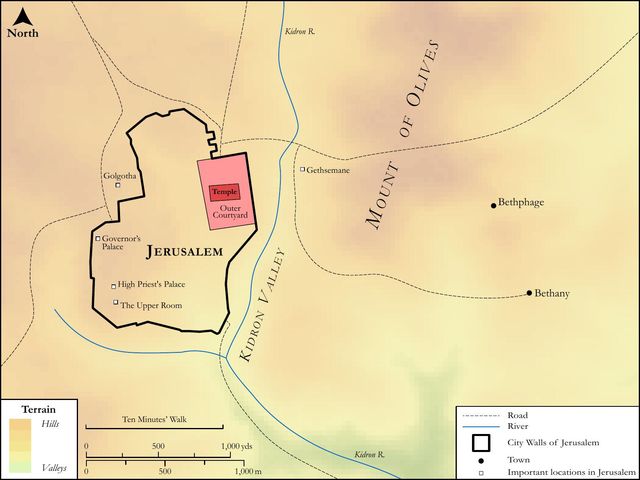
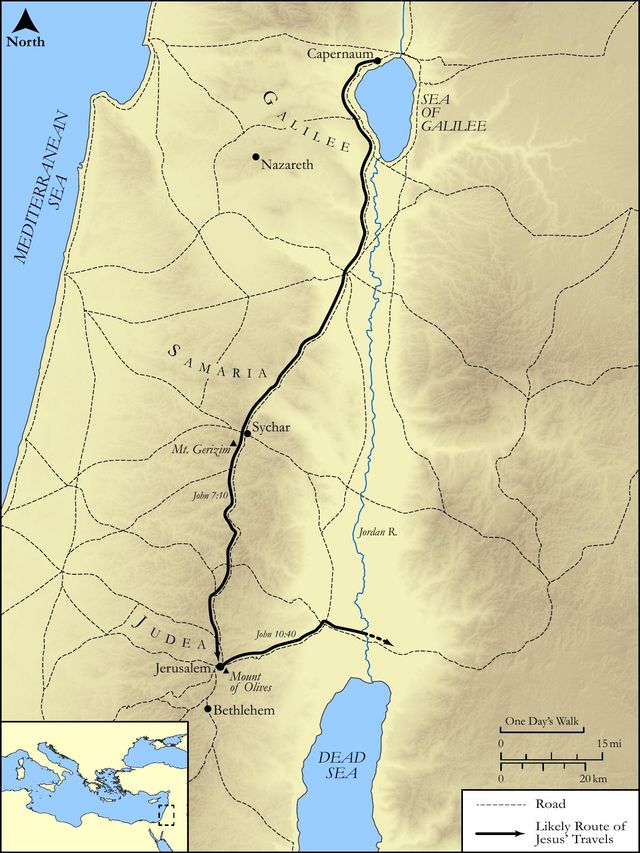
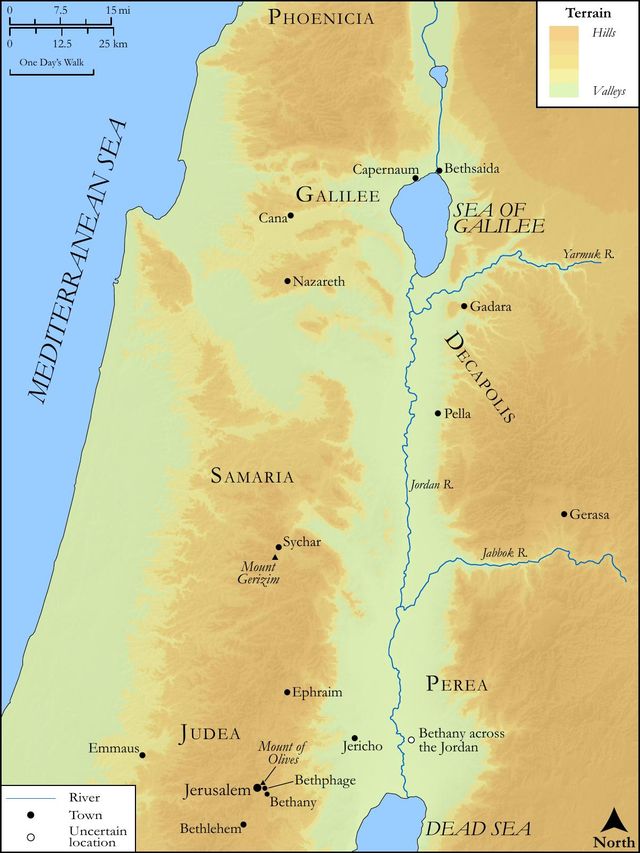
See on the biblical-era maps
Study this verse
Public-domain commentary
Matthew Henry
From his Commentary on the Whole Bible. Henry comments on passages, not single verses — this entry covers John 10:19–21. His two-level outline is real structure in the source text, so it is rendered as structure.
We have here an account of the people's different sentiments concerning Christ, on occasion of the foregoing discourse; there was a division, a schism, among them; they differed in their opinions, which threw them into heats and parties. Such a ferment as this they had been in before (Joh 7:43; Joh 9:16); and where there has once been a division again. Rents are sooner made than made up or mended. This division was occasioned by the sayings of Christ, which, one would think, should rather have united them all in him as their centre; but they set them at variance, as Christ foresaw, Luk 12:51. But it is better that men should be divided about the doctrine of Christ than united in the service of sin, Luk 11:21. See what the debate was in particular.
I.Some upon this occasion spoke ill of Christ and of his sayings, either openly in the face of the assembly, for his enemies were very impudent, or privately among themselves. They said, He has a devil, and is mad, why do you hear him?
1.They reproach him as a demoniac. The worst of characters is put upon the best of men. He is a distracted man, he raves and is delirious, and no more to be heard than the rambles of a man in bedlam. Thus still, if a man preaches seriously and pressingly of another world, he shall be said to talk like an enthusiast; and his conduct shall be imputed to fancy, a heated brain, and a crazed imagination.
2.They ridicule his hearers: "Why hear you him? Why do you so far encourage him as to take notice of what he says?" Note, Satan ruins many by putting them out of conceit with the word and ordinances, and representing it as a weak and silly thing to attend upon them. Men would not thus be laughed out of their necessary food, and yet suffer themselves to be laughed out of what is more necessary. Those that hear Christ, and mix faith with what they hear, will soon be able to give a good account why they hear him.
II.Others stood up in defence of him and his discourse, and, though the stream ran strong, dared to swim against it; and, though perhaps they did not believe on him as the Messiah, they could not bear to hear him thus abused. If they could say no more of him, this they would maintain, that he was a man in his wits, that he had not a devil, that he was neither senseless nor graceless. The absurd and most unreasonable reproaches, that have sometimes been cast upon Christ and his gospel, have excited those to appear for him and it who otherwise had no great affection to either. Two things they plead: - 1. The excellency of his doctrine: "These are not the words of him that hath a devil; they are not idle words; distracted men are not used to talk at this rate. These are not the words of one that is either violently possessed with a devil or voluntarily in league with the devil." Christianity, if it be not the true religion, is certainly the greatest cheat that ever was put upon the world; and, if so, it must be of the devil, who is the father of all lies: but it is certain that the doctrine of Christ is no doctrine of devils, for it is levelled directly against the devil's kingdom, and Satan is too subtle to be divided against himself. So much of holiness there is in the words of Christ that we may conclude they are not the words of one that has a devil, and therefore are the words of one that was sent of God; are not from hell, and therefore must be from heaven. 2. The power of his miracles: Can a devil, that is, a man that has a devil, open the eyes of the blind? Neither mad men nor bad men can work miracles. Devils are not such lords of the power of nature as to be able to work such miracles; nor are they such friends to mankind as to be willing to work them if they were able. The devil will sooner put out men's eyes than open them. Therefore Jesus had not a devil.
Historical interpretation
Four Centuries of Reception
6 surviving comments on this verse. Each one is dated, so this reads as a timeline rather than a list.
Select a marker to jump to its quote. Markers stagger vertically where authors wrote within a few decades of each other.
(Hom. lx. 3) Because He spoke as one greater than man, they said He had a devil. But that He had not a devil, others proved from His works: Others said, These are not the words of Him that hath a devil. Can a devil open the eyes of the blind? As if to say, Not even the words themselves are those of one that hath a devil; but if the words do not convince you, be persuaded by the works. Our Lord having already given proof who He was by His works, was silent. They were unworthy of an answer. Indeed, as they disagreed amongst themselves, an answer was unnecessary. Their opposition only brought out, for our imitation, our Lord's gentleness, and long suffering.
What then did Christ? He answered nothing to these things. Before this He had replied, "I have not a devil"; but not so now; for since He had afforded proof by His actions, He afterwards held His peace. For neither were they worthy of an answer, who said that He was possessed of a devil, on account of those actions for which they ought to have admired and deemed Him to be God. And how were any farther refutations from Him needed, when they opposed and refuted each other? Wherefore He was silent, and bore all mildly. And not for this reason only, but also to teach us all meekness and long-suffering.
"There was a division therefore among the Jews. And some said, He hath a devil and is mad. Others said, These are not the words of him that hath a devil: can a devil open the eyes of the blind?" For because His words were greater than belonged to man, and not of common use, they said that He had a devil, calling Him so now for the fourth time. For they before had said "Thou hast a devil, who seeketh to kill thee?"; and again, "Said we not well that thou art a Samaritan, and hast a devil?"; and here, "He hath a devil and is mad why hear ye him?" Or rather we should say, that He heard this not for the fourth time, but frequently. For to ask, "Said we not well that thou hast a devil?" is a sign that they had said so not twice or thrice, but many times. "Others said, These are not the words of him that hath a devil: can a devil open the eyes of the blind?" For since they could not silence their opponents by words, they now brought proof from His works. "Certainly neither are the words those of one that hath a devil, yet if ye are not persuaded by the words, be ye shamed by the works. For if they are not the acts of one that hath a devil, and are greater than belong to man, it is quite clear that they proceed from some divine power." Seest thou the argument? That they were greater than belonged to man is plain, from the Jews saying, "He hath a devil" that He had not a devil, He showed by what He did.
But while the Lord thus spake, for the light was shining in the darkness, and the darkness comprehended it not, "there was a dissension again created among the Jews for these sayings, and many of them said, He hath a devil, and is mad: why hear ye him?" This was the thickest darkness. Others said, "These are not the words of him that hath a devil; can a devil open the eyes of the blind?" The eyes of such were now begun to be opened.
The words of the Saviour go down into the hearts of His hearers, and those whom they find gentle and yielding they immediately mould and transform to a good condition, but those whom they find hard they recoil from or in some manner turn away from. So that he who has his mind somewhat prepared for fair reason will gladly receive the saving words, but he who is not so will not. Something of this sort was what happened to the people of the Jews to experience. For when they had heard the Saviour's words, they are divided into two parties, and those who are more amenable to reason now incline towards the first principle of salvation, but the hard of heart become worse than they were at first. And the inspired Evangelist seems to be struck with astonishment as to how it happened that the people of the Jews were divided on account of these words. For I think it is very evident that from surprise at the hardness of those who did not believe he says: There arose a division because of these words; by means of which, he seems to imply, the Jews ought to have been fully persuaded that Jesus was the Christ. So wonderful were the words of the Saviour. But when even these words were spoken, by which it was fair to expect that even the very hard to catch would be ensnared into conviction, there arose a division among them. He marvels much therefore that they had given themselves over in an unholy manner to a shameless disregard of evidence. For I suppose it was just to accuse them in proportion as it was reasonable to marvel at the words of Our Saviour. He certainly spake God-befitting words and such as went beyond man; and the magnificence and God-befitting boldness of His superhuman words drive the multitude to intemperate folly. And since it was usual for those who were in truth possessed with devils to speak evil very readily, being of course easily provoked to rage and outside the pale of all intelligence, and since they thought that the Lord was a mere man, not understanding that He was in His Nature God; for these reasons they said He had a devil, as one who blasphemed so intemperately. Because they heard Him say such things as it befitted only God to say. Looking upon Him as one like ourselves, and not yet knowing Who He was by Nature, they considered Him to speak evil when He spake in any way that befitted God. Therefore, agreeably to His Incarnation and condescendingly, because of the infirmity of His hearers, He also often employs our manner of speech. The people of the Jews therefore are divided: and some, understanding nothing whatever of the mysteries concerning Him, are insolent in an unholy manner; but others, who are more reasonable in their habit of mind, do not condemn Him rashly, but ruminate on His words, and carefully test them, and begin to perceive the sweetness in them. And in this way they arrive at a most praiseworthy discernment, and do not attribute to the babblings of a demoniac words so sober and full of the highest wisdom. For it is the custom of those [demons] when they are driving men mad, to speak beside the mark. The Pharisees therefore were more like demoniacs, who called by this name One Who was free of all disease; and did not notice that they were proclaiming the disease which was in themselves, and were doing no other than explaining in their folly the very evil that possessed themselves. And for my part I think that they speak with the highest degree of evil craftiness, when they say the Lord is demoniac. For since He charged them with being wretched and hireling shepherds, who abandoned their sheep to the wolf, and cared altogether so little for their flock; being in no small alarm lest perhaps the people, understanding what was said, should now refuse any longer to be shepherded by them, and follow the instruction given by Christ; on this account, trying to cheat the understanding of the common people, they say: He hath a devil; why hear ye Him? But these words too, the words of those men who spake with evil craft, had the opposite result to that which they intended. And the others, judging from the quality of the words, discern that the words of the Lord are without blame, not such as would be those of one possessed with a devil: moreover, the miracles, says one, offer an irresistible testimony. For although you find fault with His words as not blamelessly spoken, yet it is impossible that any one can at the same time be possessed with a devil and do such works as only God is able to do. Therefore, fair judges recognised Him from His works and also from admiration of the words which He spake.
But the light shined in darkness, and the darkness comprehended it not. There was a division among the Jews for these sayings. And many of them said, He hath a devil, and is mad.
Continue studying John 10:19 across the web’s major study libraries — every link below opens this exact verse, chapter, or book on the destination site.
Read & Compare
 BibleGatewayThis verse in more than 200 translations and 70 languages.
 Bible.comThe YouVersion reader — hundreds of translations, reading plans, and highlights.
 ESV.orgCrossway's official English Standard Version reader.
 NET BibleThe NET translation with 60,000+ translators' notes on every rendering decision.
 STEP BibleTyndale House's free study tool — original text, vocabulary, and scholarly resources.
 BibliaLogos Bible Software's free web reader.
 USCCBThe New American Bible (Revised Edition) with the U.S. bishops' study notes.
Commentaries
 BibleHub CommentariesDozens of classic commentaries on this verse, gathered on one page.
 StudyLightMore than 100 commentary sets — the largest collection on the web.
 BibleRefPlain-English commentary on what this verse means, verse by verse.
 Enduring WordDavid Guzik's free commentary on this chapter, widely used by Bible teachers.
 Bible Study ToolsVerse commentary alongside Greek and Hebrew study aids.
Original Language & Research
- BibleHub InterlinearThe verse word by word — original language, transliteration, and English.
- BibleHub LexiconEvery word's original-language definition and Strong's entry.
 Blue Letter BibleDeep-study tools — Strong's numbers, concordance, and word studies.
 CNTR CollationThe earliest Greek manuscripts of this verse, collated letter by letter.
Sermons, Hymns & Audio


TrulyRandomVerse is not affiliated with these sites and doesn’t control their content. They’re linked because they’re genuinely useful.
Summary
John 10:19 succinctly captures the immediate and profound impact of Jesus's preceding discourse on His identity as the Good Shepherd. His authoritative declarations, intended to reveal His divine nature and salvific mission, did not lead to universal acceptance but instead intensified the existing polarization among His Jewish listeners, resulting in a significant and recurring division of opinion and belief concerning His claims.
Context
ShowHideLiterary Context
This verse serves as a pivotal transition, marking the immediate reaction to Jesus's profound "Good Shepherd" discourse in John 10:1-18. In this discourse, Jesus presents Himself as the true shepherd, contrasting Himself with false leaders, and declares His unique relationship with the Father, His authority to lay down His life and take it up again (John 10:17-18), and His power to grant eternal life to His sheep (John 10:27-28). The "sayings" of John 10:19 directly refer to these weighty claims, which challenged the prevailing religious and political authorities and forced a response from the populace. The verse also foreshadows the subsequent confrontation at the Feast of Dedication in John 10:22-39.
Historical & Cultural Context
The setting for this discourse, though not explicitly stated until John 10:22, is Jerusalem during the Feast of Dedication (Hanukkah). This festival commemorated the rededication of the Temple after its desecration by Antiochus IV Epiphanes, a time imbued with nationalistic and messianic fervor. The "Jews" in John's Gospel often refer not to the entire Jewish populace, but specifically to the Jewish leadership (Pharisees, Sadducees, scribes) who were largely antagonistic towards Jesus. Their opposition stemmed from Jesus's claims of divine authority, which they perceived as blasphemous, and His challenge to their religious traditions and power structures. The expectation of a political Messiah who would liberate Israel from Roman rule also contributed to their inability or unwillingness to accept Jesus's spiritual kingship, leading to deep-seated cultural and theological clashes.
Key Themes
ShowHideJohn 10:19 powerfully encapsulates several recurring themes in John's Gospel. Foremost is the polarizing nature of truth as embodied in Jesus Christ; His words consistently act as a catalyst, forcing individuals to choose between belief and unbelief, revealing the true state of their hearts. This leads directly to the theme of spiritual division, where the message of Jesus, rather than uniting all, creates a clear chasm between those who recognize His divine authority and those who reject it, often viewing Him as a threat or a blasphemer. This pattern of division is evident throughout John's narrative, such as the varied responses to Jesus's identity and miracles documented in John 7:40-43 and John 9:16. The verse also highlights the challenge of Jesus's claims, as His assertions of intimate union with the Father and authority over life and death were profoundly offensive to those who did not believe, leading to accusations of blasphemy and attempts to stone Him (John 10:30-33).
Exposition and Analysis
ShowHideKey Word Analysis
ShowHideDerived from a verb meaning "to split" or "to tear," this word signifies a profound rupture or disunity, a "schism." In this context, it is not merely a difference of opinion but a deep, irreconcilable tearing apart of belief within the Jewish community. It denotes a fundamental and often hostile separation, reflecting the radical nature of Jesus's impact.
This adverb indicates a repetition or recurrence. Its inclusion here is crucial, as it highlights that the division among the Jews was not a new phenomenon but a consistent and predictable response to Jesus's teachings and claims throughout His ministry. It underscores the ongoing spiritual conflict and the persistent unbelief of many of the Jewish leaders.
This term refers to "something said," "a word," or "a discourse." In John's Gospel, lógos often carries profound theological weight, especially when referring to Jesus as the "Word" (John 1:1). Here, it specifically points to the powerful and challenging declarations Jesus had just made about Himself as the Good Shepherd, His divine authority, and His relationship with the Father. These specific words were the direct catalyst for the division.
Verse Breakdown
ShowHide"There was a division"
This phrase immediately establishes the central consequence of Jesus's discourse. His words did not bring about universal understanding or unity, but rather the opposite – a clear and distinct separation among His hearers. This division was not accidental but an inherent outcome of the truth Jesus proclaimed.
"therefore again"
The conjunction "therefore" indicates a direct causal link between Jesus's "sayings" and the resulting division. The adverb "again" emphasizes the recurring nature of this response. It implies that this was not the first time Jesus's words had caused such a split, reinforcing a pattern of belief and unbelief, acceptance and rejection, that characterized His ministry.
"among the Jews"
This specifies the group experiencing the division. As often in John's Gospel, "the Jews" here refers primarily to the religious and political leaders in Jerusalem who were consistently resistant to Jesus's claims and authority. The division was internal to this community, highlighting the profound challenge Jesus posed to their established order.
"for these sayings"
This clause directly identifies the cause of the division: Jesus's specific words and teachings. It was not His actions or miracles alone, but the content of His authoritative declarations about His identity, mission, and relationship with God that provoked such a strong and polarizing reaction. His claims were too significant to be met with indifference.
Literary Devices
ShowHideJohn 10:19 employs several literary devices to convey its powerful message. The most prominent is Antithesis, as Jesus's message, intended to gather and unite His sheep, paradoxically creates a profound division among those who hear it. This highlights the inherent conflict between divine truth and human unbelief. The use of Repetition is evident in the word "again" (Greek: pálin), which underscores the recurring motif of division in response to Jesus throughout John's Gospel, transforming it from an isolated incident into a consistent pattern of human reaction to divine revelation. This also functions as Foreshadowing, hinting at the escalating opposition that will ultimately lead to Jesus's crucifixion, as His polarizing claims continue to deepen the chasm between belief and unbelief. The verse also carries a strong element of Dramatic Irony, as the Good Shepherd, who comes to give life and gather His flock, brings about a schism among those He seeks to save, revealing their spiritual blindness.
Theological and Thematic Connections
ShowHideJohn 10:19 profoundly illustrates the inherent nature of divine truth to expose and divide. Jesus's words, being the very essence of God's revelation, cannot be met with neutrality. They compel a response, revealing the true spiritual alignment of individuals. This division is not a failure of Jesus's message, but rather an inevitable consequence of light entering darkness, where some embrace the light while others recoil from it. It underscores that genuine faith in Christ necessitates a clear break from the world's values and self-reliance, leading to a spiritual separation that often manifests in social and relational friction. The truth of Christ is a sword that divides, discerning between those who are truly His sheep and those who are not, ultimately leading to the separation of humanity into two distinct camps: those who believe and those who reject Him.
Reflection and Application
ShowHideThe division caused by Jesus's words in John 10:19 remains a timeless reality. The claims of Christ are so absolute and foundational that they demand a decisive response; there is no middle ground. For those who embrace Him as the Good Shepherd and Son of God, His words bring life, peace, and eternal security. For those who reject Him, His words become a stumbling block, leading to hardened hearts and increased opposition. This verse challenges us to examine our own response to Jesus. Are we among those who hear His voice and follow Him, or do we find ourselves resisting or rationalizing His claims? The truth of Christ continues to divide families, communities, and nations, forcing every individual to confront the most important question: Who do you say that Jesus is? Our response to His "sayings" determines our eternal destiny and shapes our present reality.
Questions for Reflection
ShowHideFAQ
ShowHideWhy did Jesus's words consistently cause division among the Jews?
ShowHideJesus's words caused consistent division because His claims were profoundly radical and challenged the core religious, political, and social structures of His day. He asserted divine authority, equality with God (John 10:30), and the power to forgive sins and give eternal life, which many Jewish leaders viewed as blasphemy. Furthermore, His teachings often contradicted their interpretations of the Law and their traditions, and His messianic identity did not align with their expectations of a political liberator. His words forced a choice, revealing the spiritual state of hearts and separating those who were open to God's truth from those hardened by tradition and self-interest.
Christ-Centered Fulfillment
ShowHideJohn 10:19, with its depiction of division, paradoxically points to the ultimate Christ-centered fulfillment of God's redemptive plan. The very "sayings" that caused a schism among the Jews are the words of the Incarnate Word, Jesus Christ, who came not to bring peace to all indiscriminately, but to bring a sword of truth that would divide light from darkness (Matthew 10:34-36). This division is essential for the gathering of God's true sheep, those whom the Father has given to the Son (John 6:37). Jesus, as the Good Shepherd, came to lay down His life to gather "other sheep" who are not of this fold (John 10:16), ultimately uniting them into one flock under one Shepherd. The division highlights the necessity of His atoning work, which alone can bridge the chasm between humanity and God, and between Jew and Gentile, creating one new humanity in Himself (Ephesians 2:14-16). Thus, the immediate division in John 10:19 foreshadows the ultimate judgment and separation of humanity at the end of the age, where Christ will separate the sheep from the goats (Matthew 25:31-33), demonstrating His sovereign authority over all.