


John 8:19
Bible text: King James Version (1769 Blayney text) · Public domain
Bible text: King James Version with Strong's numbers · Public domain
Bible text: Berean Standard Bible · Public domain
Bible text: American Standard Version (1901) · Public domain
Bible text: World English Bible, Messianic edition · Public domain
Bible text: Geneva Bible (1599) · Public domain
Bible text: Young's Literal Translation · Public domain
- ἔλεγονelegonThey were sayingG3004V-IAI-3PVerb Imperfect Active Indicative 3rd Plural
- οὖνounthereforeG3767CONJConjunction
- αὐτῷ·autōto HimG846P-DSMPersonal pronoun Dative Singular Masculine
- ποῦpouWhereG4226ADV-IAdverb Interrogative
- ἐστινestinisG1510V-PAI-3SVerb Present Active Indicative 3rd Singular
- ὁhotheG3588T-NSMDefinite article Nominative Singular Masculine
- πατήρpatērFatherG3962N-NSM-TNoun Nominative Singular Masculine Title
- σου;souof You?G4771P-2GSPersonal pronoun Genitive 2nd Singular
- ἈπεκρίθηApekrithēAnsweredG611V-ADI-3SVerb Aorist Middle Deponent Indicative 3rd Singular
- ὁho<the>G3588T-NSMDefinite article Nominative Singular Masculine
- Ἰησοῦς·IēsousJesusG2424N-NSM-PNoun Nominative Singular Masculine Individual
- οὔτεouteNeitherG3777CONJ-NConjunction Negative
- ἐμὲemeMe myselfG1473P-1ASPersonal pronoun Accusative 1st Singular
- οἴδατεoidateyou knowG1492V-RAI-2PVerb Perfect Active Indicative 2nd Plural
- οὔτεoutenor [know]G3777CONJ-NConjunction Negative
- τὸνtontheG3588T-ASMDefinite article Accusative Singular Masculine
- πατέραpateraFatherG3962N-ASM-TNoun Accusative Singular Masculine Title
- μουmouof MineG3165P-1GSPersonal pronoun Genitive 1st Singular
- εἰeiIfG1487CONDConjunction
- ἐμὲemeMe myselfG1473P-1ASPersonal pronoun Accusative 1st Singular
- ᾔδειτεēdeiteyou had knownG1492V-2LAI-2PVerb Pluperfect Active Indicative 2nd Plural
- καὶkaialsoG2532CONJConjunction
- τὸνtontheG3588T-ASMDefinite article Accusative Singular Masculine
- πατέραpateraFatherG3962N-ASM-TNoun Accusative Singular Masculine Title
- μουmouof MineG3165P-1GSPersonal pronoun Genitive 1st Singular
- ἂνanthen wouldG302PRTParticle or Disjunctive
- ᾔδειτεēdeiteyou have knownG1492V-2LAI-2PVerb Pluperfect Active Indicative 2nd Plural
English is a literal word-by-word gloss of the Greek, not the KJV's wording. Why?
This is the original text the KJV's translators worked from — each Greek word with its own literal English meaning in this verse, prepared by scholars at Tyndale House, Cambridge. The KJV translates whole sentences, not word by word, so its wording differs: one Greek word can become several English words, and the KJV may choose “charity” where the gloss reads “love”. Both are faithful — they answer different questions. For the KJV's own rendering, switch to the KJV text.
Details
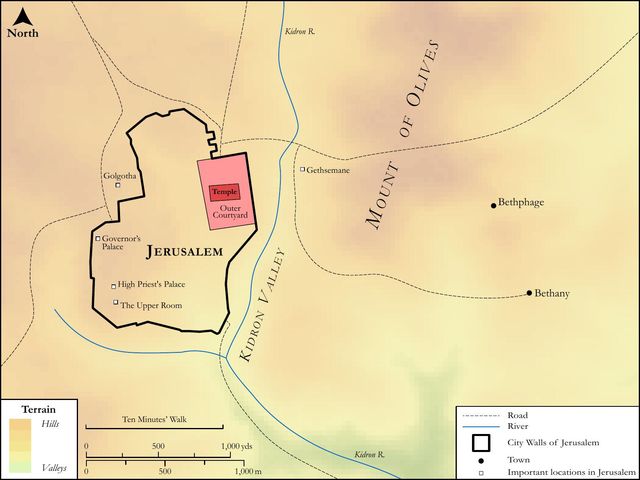
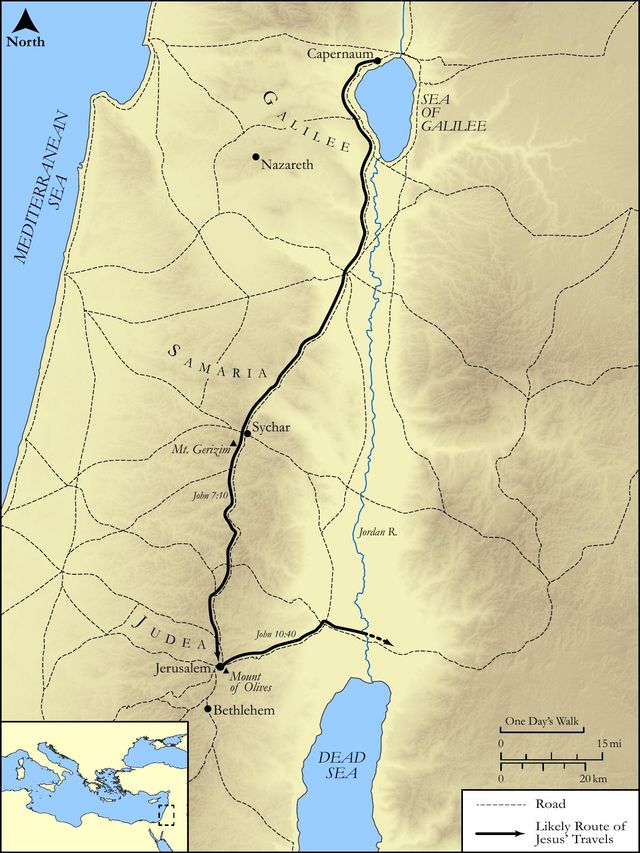
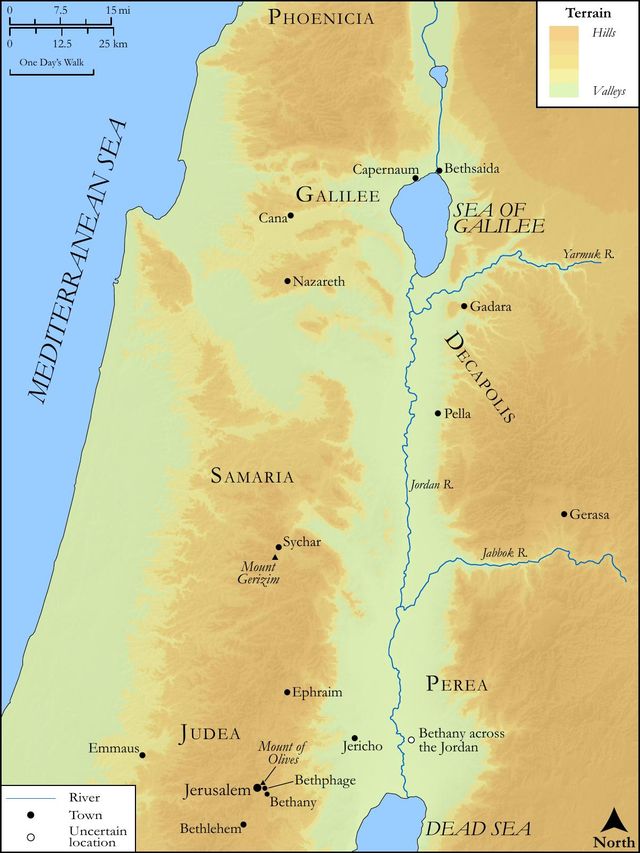
See on the biblical-era maps
Study this verse
Public-domain commentary
Matthew Henry
From his Commentary on the Whole Bible. Henry comments on passages, not single verses — this entry covers John 8:12–20. His four-level outline is real structure in the source text, so it is rendered as structure.
The rest of the chapter is taken up with debates between Christ and contradicting sinners, who cavilled at the most gracious words that proceeded out of his mouth. It is not certain whether these disputes were the same day that the adulteress was discharged; it is probable they were, for the evangelist mentions no other day, and takes notice (Joh 8:2) how early Christ began that day's work. Though those Pharisees that accused the woman had absconded, yet there were other Pharisees (Joh 8:13) to confront Christ, who had brass enough in their foreheads to keep them in countenance, though some of their party were put to such a shameful retreat; nay perhaps that made them the more industrious to pick quarrels with him, to retrieve, if possible, the reputation of their baffled party. In these verses we have,
I.A great doctrine laid down, with the application of it.
1.The doctrine is, That Christ is the light of the world (Joh 8:12): Then spoke Jesus again unto them; though he had spoken a great deal to them to little purpose, and what he had said was opposed, yet he spoke again, for he speaketh once, yea, twice. They had turned a deaf ear to what he said, and yet he spoke again to them, saying, I am the light of the world. Note, Jesus Christ is the light of the world. One of the rabbies saith, Light is the name of the Messiah, as it is written, Dan 2:22, And light dwelleth with him. God is light, and Christ is the image of the invisible God; God of gods, Light of lights. He was expected to be a light to enlighten the Gentiles (Luk 2:32), and so the light of the world, and not of the Jewish church only. The visible light of the world is the sun, and Christ is the Sun of righteousness. One sun enlightens the whole world, so does one Christ, and there needs no more. Christ in calling himself the light expresses,
(1.)What he is in himself - most excellent and glorious.
(2.)What he is to the world - the fountain of light, enlightening every man. What a dungeon would the world be without the sun! So would it be without Christ by whom light came into the world, Joh 3:19.
2.The inference from this doctrine is, He that followeth me, as a traveller follows the light in a dark night, shall not walk in darkness, but shall have the light of life. If Christ be the light, then,
(1.)It is our duty to follow him, to submit ourselves to his guidance, and in every thing take directions from him, in the way that leads to happiness. Many follow false lights - ignes fatui, that lead them to destruction; but Christ is the true light. It is not enough to look at this light, and to gaze upon it, but we must follow it, believe in it, and walk in it, for it is a light to our feet, not our eyes only.
(2.)It is the happiness of those who follow Christ that they shall not walk in darkness. They shall not be left destitute of those instructions in the way of truth which are necessary to keep them from destroying error, and those directions in the way of duty which are necessary to keep them from damning sin. They shall have the light of life, that knowledge and enjoyment of God which will be to them the light of spiritual life in this world and of everlasting life in the other world, where there will be no death nor darkness. Follow Christ, and we shall undoubtedly be happy in both worlds. Follow Christ, and we shall follow him to heaven.
II.The objection which the Pharisees made against this doctrine, and it was very trifling and frivolous:
Thou bearest record of thyself; thy record is not true, Joh 8:13. In this objection they went upon the suspicion which we commonly have of men's self-condemnation, which is concluded to be the native language of self-love, such as we are all ready to condemn in others, but few are willing to own in themselves. But in this case the objection was very unjust, for,
1.They made that his crime, and a diminution to the credibility of his doctrine, which in the case of one who introduced a divine revelation was necessary and unavoidable. Did not Moses and all the prophets bear witness of themselves when they avouched themselves to be God's messengers? Did not the Pharisees ask John Baptist, What sayest thou of thyself?
2.They overlooked the testimony of all the other witnesses, which corroborated the testimony he bore of himself. Had he only borne record of himself, his testimony had indeed been suspicious, and the belief of it might have been suspended; but his doctrine was attested by more than two or three credible witnesses, enough to establish every word of it.
III.Christ's reply to this objection, Joh 8:14.
He does not retort upon them as he might ("You profess yourselves to be devout and good men, but your witness is not true"), but plainly vindicates himself; and, though he had waived his own testimony (Joh 5:31), yet here he abides by it, that it did not derogate from the credibility of his other proofs, but was necessary to show the force of them. He is the light of the world, and it is the property of light to be self-evidencing. First principles prove themselves. He urges three things to prove that his testimony, though of himself, was true and cogent.
1.That he was conscious to himself of his own authority, and abundantly satisfied in himself concerning it. He did not speak as one at uncertainty, nor propose a disputable notion, about which he himself hesitated, but declared a decree, and gave such an account of himself as he would abide by: I know whence I came, and whither I go. He was fully apprised of his own undertaking from first to last; knew whose errand he went upon, and what his success would be. He knew what he was before his manifestation to the world, and what he should be after; that he came from the Father, and was going to him (Joh 16:28), came from glory, and was going to glory, (Joh 17:5). This is the satisfaction of all good Christians, that though the world know them not, as it knew him not, yet they know whence their spiritual life comes, and whither it tends, and go upon sure grounds.
2.That they are very incompetent judges of him, and of his doctrine, and not to be regarded.
(1.)Because they were ignorant, willingly and resolvedly ignorant: You cannot tell whence I came, and whither I go. To what purpose is it to talk with those who know nothing of the matter, nor desire to know? He had told them of his coming from heaven and returning to heaven, but it was foolishness to them, they received it not; it was what the brutish man knows not, Psa 92:6. They took upon them to judge of that which they did not understand, which lay quite out of the road of their acquaintance. Those that despise Christ's dominions and dignities speak evil of what they know not, Jude, Jde 1:8, Jde 1:10.
(2.)Because they were partial (Joh 8:15): You judge after the flesh. When fleshly wisdom gives the rule of judgment, and outward appearances only are given in evidence, and the case decided according to them, then men judge after the flesh; and when the consideration of a secular interest turns the scale in judging of spiritual matters, when we judge in favour of that which pleases the carnal mind, and recommends us to a carnal world, we judge after the flesh; and the judgment cannot be right when the rule is wrong. The Jews judged of Christ and his gospel by outward appearances, and, because he appeared so mean, thought it impossible he should be the light of the world; as if the sun under a cloud were no sun.
(3.)Because they were unjust and unfair towards him, intimated in this: "I judge no man; I neither make nor meddle with your political affairs, nor does my doctrine or practice at all intrench upon, or interfere with, your civil rights or secular powers." He thus judged no man. Now, if he did not war after the flesh, it was very unreasonable for them to judge him after the flesh, and to treat him as an offender against the civil government. Or, "I judge no man," that is, "not now in my first coming, that is deferred till I come again," Joh 3:17. Prima dispensatio Christi medicinalis est, non judicialis - The first coming of Christ was for the purpose of administering, not justice, but medicine.
3.That his testimony of himself was sufficiently supported and corroborated by the testimony of his Father with him and for him (Joh 8:16): And yet, if I judge, my judgment is true. He did in his doctrine judge (Joh 9:39), though not politically. Consider him then,
(1.)As a judge, and his own judgment was valid: "If I judge, I who have authority to execute judgments, I to whom all things are delivered, I who am the Son of God, and have the Spirit of God, if I judge, my judgment is true, of incontestable rectitude and uncontrollable authority, Rom 2:2. If I should judge, my judgment must be true, and then you would be condemned; but the judgment-day is not yet come, you are not yet to be condemned, but spared, and therefore now I judge no man;" so Chrysostom. Now that which makes his judgment unexceptionable is,
[1.]His Father's concurrence with him: I am not alone, but I and the Father. He has the Father's concurring counsels to direct; as he was with the Father before the world in forming the counsels, so the Father was with him in the world in prosecuting and executing those counsels, and never left him inops consilii - without advice, Isa 11:2. All the counsels of peace ( and of war too) were between them both, Zac 6:13. He had also the Father's concurring power to authorize and confirm what he did; see Psa 89:21, etc.; Isa 42:1. He did not act separately, but in his own name and his Father's, and by the authority aforesaid, Joh 5:17, and Joh 14:9, Joh 14:10.
[2.]His Father's commission to him: "It is the Father that sent me." Note, God will go along with those that he sends; see Exo 3:10, Exo 3:12 : Come, and I will send thee, and certainly I will be with thee. Now, if Christ had a commission from the Father, and the Father's presence with him in all his administrations, no doubt his judgment was true and valid; no exception lay against it, no appeal lay from it.
(2.)Look upon him as a witness, and now he appeared no otherwise (having not as yet taken the throne of judgment), and as such his testimony was true and unexceptionable; this he shows, Joh 8:17, Joh 8:18, where,
[1.]He quotes a maxim of the Jewish law, Joh 8:17. That the testimony of two men is true. Not as if it were always true in itself, for many a time hand has been joined in hand to bear a false testimony, Kg1 21:10. But it is allowed as sufficient evidence upon which to ground a verdict (verum dictum), and if nothing appear to the contrary it is taken for granted to be true. Reference is here had to that law (Deu 17:6), At the mouth of two witnesses shall he that is worthy of death be put to death. And see Deu 9:15; Num 35:30. It was in favour of life that in capital cases two witnesses wee required, as with us in case of treason. See Heb 6:18.
[2.]He applies this to the case in hand (Joh 8:18): I am one that bear witness of myself, and the Father that sent me bears witness of me. Behold two witnesses! Though in human courts, where two witnesses are required, the criminal or candidate is not admitted to be a witness for himself; yet in a matter purely divine, which can be proved only by a divine testimony, and God himself must be the witness, if the formality of two or three witnesses be insisted on, there can be no other than the eternal Father, the eternal Son of the Father, and the eternal Spirit. Now if the testimony of two distinct persons, that are men, and therefore may deceive or be deceived, is conclusive, much more ought the testimony of the Son of God concerning himself, backed with the testimony of his Father concerning him, to command assent; see Jo1 5:7, Jo1 5:9-11. Now this proves not only that the Father and the Son are two distinct persons (for their respective testimonies are here spoken of as the testimonies of two several persons), but that these two are one, not only one in their testimony, but equal in power and glory, and therefore the same in substance. St. Austin here takes occasion to caution his hearers against Sabellianism on the one hand, which confounded the persons in the Godhead, and Arianism on the other, which denied the Godhead of the Son and Spirit. Alius est filius, et alius pater, non tamed aliud, sed hoc ipsum est et pater, et filius, scilicet unus Deus est - The Son is one Person, and the Father is another; they do not, however, constitute two Beings, but the Father is the same Being that the Son is, that is, the only true God. Tract. 36, in Joann. Christ here speaks of himself and the Father as witnesses to the world, giving in evidence to the reason and conscience of the children of men, whom he deals with as men. And these witnesses to the world now will in the great day be witnesses against those that persist in unbelief, and their word will judge men.
This was the sum of the first conference between Christ and these carnal Jews, in the conclusion of which we are told how their tongues were let loose, and their hands tied.
First, How their tongues were let loose (such was the malice of hell) to cavil at his discourse, Joh 8:19. Though in what he said there appeared nothing of human policy or artifice, but a divine security, yet they set themselves to cross questions with him. None so incurably blind as those that resolve they will not see. Observe,
a.How they evaded the conviction with a cavil: Then said they unto him, Where is thy Father? They might easily have understood, by the tenour of this and his other discourses, that when he spoke of his Father he meant no other than God himself; yet they pretend to understand him of a common person, and, since he appeals to his testimony, they bid him call his witness, and challenge him, if he can, to produce him: Where is thy Father? Thus, as Christ said of them (Joh 8:15), they judge after the flesh. Perhaps they hereby intend a reflection upon the meanness and obscurity of his family: Where is thy Father, that he should be fit to give evidence in such a case as this? Thus they turned it off with a taunt, when they could not resist the wisdom and spirit with which he spoke.
b.How he evaded the cavil with a further conviction; he did not tell them where his Father was, but charged them with wilful ignorance: "You neither know me nor my Father. It is to no purpose to discourse to you about divine things, who talk of them as blind men do of colours. Poor creatures! you know nothing of the matter." (a.) He charges them with ignorance of God: "You know not my Father." In Judah was God known (Psa 76:1); they had some knowledge of him as the God that made the world, but their eyes were darkened that they could not see the light of his glory shining in the face of Jesus Christ. The little children of the Christian church know the Father, know him as a Father (Jo1 2:13); but these rulers of the Jews did not, because they would not so know him. (b.) He shows them the true cause of their ignorance of God: If you had known me, you would have known my Father also. The reason why men are ignorant of God is because they are unacquainted with Jesus Christ. Did we know Christ, [a.] In knowing him we should know the Father, of whose person he is the express image, Joh 14:9. Chrysostom proves hence the Godhead of Christ, and his equality with his Father. We cannot say, "He that knows a man knows an angel," or, "He that knows a creature knows the Creator;" but he that knows Christ knows the Father. [b.] By him we should be instructed in the knowledge of God, and introduced into an acquaintance with him. If we knew Christ better, we should know the Father better; but, where the Christian religion is slighted and opposed, natural religion will soon be lost and laid aside. Deism makes way for atheism. Those become vain in their imaginations concerning God that will not learn of Christ.
Secondly, See how their hands were tied, though their tongues were thus let loose; such was the power of Heaven to restrain the malice of hell. These words spoke Jesus, these bold words, these words of conviction and reproof, in the treasury, an apartment of the temple, where, to be sure, the chief priests, whose gain was their godliness, were mostly resident, attending the business of the revenue. Christ taught in the temple, sometimes in one part, sometimes in another, as he saw occasion. Now the priests who had so great a concern in the temple, and looked upon it as their demesne, might easily, with the assistance of the janizaries that were at their beck, either have seized him and exposed him to the rage of the mob, and that punishment which they called the beating of the rebels; or, at least, have silenced him, and stopped his mouth there, as Amos, though tolerated in the land of Judah, was forbidden to prophesy in the king's chapel, Amo 7:12, Amo 7:13. Yet even in the temple, where they had him in their reach, no man laid hands on him, for his hour was not yet come. See here, 1. The restraint laid upon his persecutors by an invisible power; none of them durst meddle with him. God can set bounds to the wrath of men, as he does to the waves of the sea. Let us not therefore fear danger in the way of duty; for God hath Satan and all his instruments in a chain. 2. The reason of this restraint: His hour was not yet come. The frequent mention of this intimates how much the time of our departure out of the world depends upon the fixed counsel and decree of God. It will come, it is coming; not yet come, but it is at hand. Our enemies cannot hasten it any sooner, nor our friends delay it any longer, than the time appointed of the Father, which is very comfortable to every good man, who can look up and say with pleasure, My times are in thy hands; and better there than in our own. His hour was not yet come, because his work was not done, nor his testimony finished. To all God's purposes there is a time.
Historical interpretation
Nine Centuries of Reception
15 surviving comments on this verse. Each one is dated, so this reads as a timeline rather than a list.
Select a marker to jump to its quote. Markers stagger vertically where authors wrote within a few decades of each other.
It is necessary to observe that the heterodox think that this text proves clearly that the God whom the Jews worshiped was not the Father of Christ. For if, they say, the Savior said "you know neither me nor my Father" to the Pharisees who worshiped the Creator, then it is evident that the Pharisees did not know the Father of Jesus because he was different from the Creator.… But they who say these things have not understood the divine Scriptures or observed the usage of language in them.…If anyone knew about the Creator and his priestly service, the sons of Eli did, having been raised at the place of worship. Yet, because they sinned, it is written of them in the First Book of Kings that they … "did not know the Lord." …
So, again, the Pharisees did not know the Father since they did not live according to the Creator's will. For knowing God can also refer to knowing God, which is something different from merely believing in him.… But who could not agree that the words written in the Psalms, "Be still and know that I am God," were written for a people who believe in the Creator?
(tom. xix. l. in Joan. in princ.) Ye neither know Me, nor My Father: this seems inconsistent with what was said above, Ye both know Me, and know whence I am. But the latter is spoken in reply to some from Jerusalem, who asked, Do the rulers know indeed that this is the very Christ? Ye neither know Me is addressed to the Pharisees. To the former persons from Jerusalem however He said, He that sent Me, is true, Whom ye know not. You will ask then, How is that true, If ye know Me, ye would know My Father also? when they of Jerusalem, to whom He said, Ye know Me, did not know the Father. To this we must reply, that our Saviour sometimes speaks of Himself as man, and some-times as God. Ye both know Me, He says as man: ye neither know Me, as God.
(tom. xix. l. in Joan. in princ.) It is proper to observe, that the followers of other sects think this text proves clearly, that the God, whom the Jews worshipped, was not the Father of Christ. For if, say they, our Saviour said this to the Pharisees, who worshipped God as the Governor of the world, it is evident that the Father of Jesus, whom the Pharisees knew not, was a different person from the Creator. But they do not observe that this is a usual manner of speaking in Scripture. Though a man may know the existence of God, and have learned from the Father that He only must be worshipped, yet if his life is not good, he is said not to have the knowledge of God. Thus the sons of Eli, on account of their wickedness, are said not to have known God. And thus again the Pharisees did not know the Father; because they did not live according to their Creator's command. And there is another thing meant too by knowing God, different from merely believing in Him. It is said, Be still then, and know that I am God. (Ps. 45:10) And this, it is certain, was written for a people that believed in the Creator. But to know by believing, and believe simply, are different things. To the Pharisees, to whom He says, Ye neither know Me, nor My Father, He could with right have said, Ye do not even believe in My Father; for he who denies the Son, has not the Father, either by faith or knowledge. But Scripture gives us another sense of knowing a thing, viz. being joined to that thing. Adam knew his wife, when he was joined to her. And if he who is joined to a woman knows that woman, he who is joined to the Lord is one spirit, and knows the Lord. And in this sense the Pharisees neither knew the Father, nor the Son. But may not a man know God, and yet not know the Father? Yes; these are two different conceptions. And therefore among an infinite number of prayers offered up in the Law, we do not find any one addressed to God the Father. They only pray to Him as God and Lord; in order not to anticipate the grace shed by Jesus over the whole world, calling all men to the Sonship, according to the Psalm, I will declare Thy name unto my brethren.
"But I judge no man." He saith indeed also that "the Father judgeth no man." (c. v. 22.) How then doth He here declare, that, "If I judge, My judgment is just, for I am not alone"? He again speaketh in reply to their thoughts. "The judgment which is Mine is the judgment of the Father. The Father, judging, would not judge otherwise than as I do, and I should not judge otherwise than as the Father."
And they said that they were profited nothing by saying that they knew God the Father, while they knew not Him. And He saith that the cause of this (ignorance) was that they were not willing to know Him. Therefore He telleth them that it was not possible to know the Father without knowing Him, that even so He might draw them to the knowledge of Him. For since leaving Him they even sought to get the knowledge of the Father, He saith, "Ye cannot know the Father without Me." So that they who blaspheme the Son, blaspheme not the Son only, but Him that begat Him also.
For, "I know," He saith, "whence I come." This would not greatly affect them, but the adding, "and whither I go," would rather terrify them, since He was not to remain in death. But why said He not, "I know that I am God," instead of, "I know whence I come"? He ever mingleth lowly words with sublime, and even these He veileth. For after saying, "I bear witness of Myself," and proving this, He descendeth to a humbler strain. As though He had said, "I know from whom I am sent, and to whom I depart." For so they could have had nothing to say against it, when they heard that He was sent from Him, and would depart to Him.
"I could not have spoken," He saith, "any falsehood, I who am come from thence, and depart thither, to the true God. But ye know not God, and therefore judge according to the flesh. For if having heard so many sure signs and proofs ye still say, 'thy witness is not true,' if ye deem Moses worthy of credit, both as to what he speaketh concerning others and what he speaketh concerning himself, but Christ not so, this is to judge according to the flesh."
"Then said they unto Him, Who is thy father? Jesus answered, Ye neither know Me, nor My Father." Because while they knew they spake as though they knew not, and as if trying Him, He doth not even deem them worthy of an answer. Wherefore henceforth He speaketh all more clearly and more boldly; drawing His testimony from signs, and from His teaching of them that followed Him, and by the Cross being near.
Wherefore did He mention the Father? Because they would not have thought that the Son was to be believed unless He received the witness of the Father. Besides, the saying doth not even hold good. For in the case of men when two bear witness in a matter pertaining to another, then their witness is true, (this is for two to witness,) but if one should witness for himself, then they are no longer two. Seest thou that He said this for nothing else but to show that He was of the same Substance, that He needed no other witness, and was in nothing inferior to the Father?
"Where is thy Father?" For we have heard thee say, "I am not alone, but I and the Father that sent me:" we see thee alone, we do not see thy Father with thee; how sayest thou that thou art not alone, but that thou art with thy Father? Else show us that thy Father is with thee. And the Lord answered them: Do ye know me, that I should show you the Father? This is indeed what follows; this is what He answered in His own words. For see what He said, "Ye neither know me nor my Father: if ye knew me, ye would perhaps know my Father also." Ye say then, "Where is thy Father?" As if already ye knew me; as if what you see were all that I am. Therefore because ye know not me, I do not show you my Father. Ye suppose me, in fact, to be a man; hence ye seek a man for my father, because "ye judge after the flesh." But because, according to what you see, I am one thing, and another thing according to what you see not, and that I as hidden from you speak of my Father as hidden, it is requisite that you should first know me, and then ye know my Father also.
"For if ye knew me, ye would perhaps know my Father also." He who knows all things is not in doubt when He says perhaps, but rebuking. Now see how this very word perhaps, which seems to be a word of doubting, may be spoken chidingly. Yea, a word expressive of doubt it is when used by man, for man doubts because he knows not; but when a word of doubting is spoken by God, from whom surely nothing is hid, it is unbelief that is reproved by that doubting, not the Godhead merely expressing an opinion. For men sometimes chidingly express doubt concerning things which they hold certain; that is, use a word of doubting, while in their heart they doubt not.
(Tract. xxxvii. 1) Those who had heard our Lord say, Ye judge after the flesh, showed that they did so; for they understood what He said of His Father in a carnal sense: Then said they unto Him, Where is Thy Father? meaning, We have heard Thee say, I am not alone, but I and the Father that sent Me. We see Thee alone; prove to us then that Thy Father is with Thee.
(Tract. xxxvii. 2.) As if He said, Ye ask where is Thy Father? As if ye knew Me already, and I were nothing else but what ye see. But ye know Me not, and therefore I tell you nothing of My Father. Ye think Me indeed a mere man, and therefore among men look for My Father. But, forasmuch as I am different altogether, according to My seen and unseen natures, and speak of My Father in the hidden sense according to My hidden nature; it is plain that ye must first know Me, and then ye will know My Father; If ye had known Me, ye would have known My Father also.
(Tract. xxxvii. 7) What does this mean: If ye knew Me, ye would know My Father also, but, I and My Father are one? It is a common expression, when you see one man very like another, If you have seen him, you have seen the other. You say this, because they are so like. And thus our Lord says, If ye had known Me, ye had known My Father also; not that the Father is the Son, but that the Son is like the Father.
(Tract. xxxviii. s. 3) This word perhapsc is used only by way of rebuke, though it seems to express doubt. As used by men indeed it is the expression of doubt, but He who knew all things could only mean by that doubt to rebuke unbelief. Nay, even we sometimes say perhaps, when they are certain of a thing, e. g. when you are angry with your slave, and say, Do not you heed me? Consider, perhaps I am your master. So our Lord's doubt is a reproof to the unbelievers, when He says, Ye should have known perhaps My Father also.
A little before He said, "My judgment is true; because I am not alone, but I and the Father that sent me:" as if He said, The reason why my judgment is true is, because I am the Son of God, because I speak the truth, because I am truth itself. Those men, understanding Him carnally, said, "Where is thy Father?" Now hear, O Arian: "Ye neither know me, nor my Father;" because, "If ye knew me, ye would know my Father also." What doth this mean, except "I and the Father are one"? When thou seest some person like some other,-give heed, beloved, it is a common remark; let not that appear to you difficult which you see to be customary,-when, I say, thou seest some person like another, and thou knowest the person to whom he is like, thou sayest in wonder, "How like this person is to that!" Thou wouldst not say this unless there were two. Here one who does not know the person to whom thou sayest the other is like remarks, "Is he so like him?" And thou answerest him: What, dost thou not know that person? Saith he, "No, I do not." Immediately thou, in order to make known to him the person whom he does not know by means of the person whom he observes before him, answerest, saying, Having seen this man, thou hast seen the other.
Thou didst not, surely, assert that they are one person in saying this, or that they are not two; but made such answer because of the likeness: "If thou knowest the one, thou knowest the other; for they are very like, and there is no difference whatever between them." Hence also the Lord saith, "If ye knew me, ye would know my Father also;" not that the Son is the Father but like the Father. Let the Arian blush. Thanks be to the Lord that even the Arian is separate from the Sabellian error, and is not a Patripassian: he does not affirm that the Father assumed flesh and came to men, that the Father suffered, rose again, and somehow ascended to Himself; this he does not affirm; he acknowledges with me the Father to be Father, the Son to be Son. But, O brother, thou hast escaped that shipwreck, why go to the other? Father is Father, Son is Son; why dost thou affirm that the Son is unlike, that He is different, another substance? If He were unlike, would He say to His disciples, "He that hath seen me hath seen the Father"? Would He say to the Jews, "If ye knew me, ye would know my Father also"? How would this be true, unless that other was also true, "I and the Father are one"?
They said therefore unto Him, Where is Thy Father?
In this too most especially may one, I deem, and with good reason cry out against the stolidity of the Jews, uttering that word of the Prophet, Behold O foolish people and without heart. For after much discourse and often with them from our Saviour Christ, Who over and over makes mention of God the Father in Heaven, the wretched ones sink down into so great folly as to dare to say, Where is Thy Father? For they think nought at all of Him Who is His God and Father in the Heavens, but look round at and seek for Joseph, believing him to be Christ's father and no otherwise. Thou seest then how they have been with reason called a people verily foolish and heartless: for able not so much as to raise the eye of their understanding above things of earth, they show that true it is which was said of them, Let their eyes be darkened that they see not, and bow Thou down their back alway. For of irrational creatures is the back bowed, for they have this form from nature, and there is nothing of uprightness in them. And the mind of the Jews has become in some way like the beasts and has declined ever downwards, seeing nothing of heavenly things. For shall we not by the very fact itself, instructed aright in this matter, think and judge truly concerning them? for if they had at all thought of God the Father in Heaven, how would they have sought in place the Unembodied? how (tell me) would they, saying most unadvisedly of God Who filleth all things, Where is He, not fight with the whole Divine Scripture, albeit the Divine-speaking Psalmist, going through (as he was able) his words about God, and attributing to Him the power of filling all things, says, Whither shall I go from Thy Spirit, and from Thy Presence whither shall I flee? if I ascend up into heaven, THOU art there, if I go down to hell, behold Thou, if I take my wings at morning and depart unto the uttermost parts of the sea, even there shall Thy Hand lead me and Thy Right Hand shall hold me. Yea and God Himself Who is over all, showing clearly that He possesseth not nature circumscribed by space, saith to those so unholy Jews, Do not I fill heaven and earth, saith the Lord? what house will ye build Me, or what the place of My rest? Heaven is My Throne and earth My footstool. One may therefore see the Jews in all things without understanding, when they say to the Saviour Christ, Where is Thy Father? except they say this of His reputed father after the flesh, in this too doting.
But it is likely that the words of the Jews had some other deep meaning. For since they thought that the holy Virgin had committed adultery before marriage, therefore they rail most bitterly against Christ as not even knowing from whom He is, saying, Where is Thy father? doting
Jesus answered, Neither Me do ye know nor My Father, if ye had known Me, ye should have known My Father also.
True is the word and in no respect can it be accused of lying. For they who indeed suppose Christ to be of Joseph, or of fornication, and who know not that the Word beamed forth of God the Father, how will they not with reason hear, Neither Me do ye know nor My Father? For if they had known the Word that beamed forth of God the Father, and was for our sakes made in the flesh, according to the Divine Scripture, they would have known Him too Who begat Him. For most accurate knowledge of the Father is through the Son implanted in the understanding of the more zealous after learning, as He too affirmed, saying unto God the Father, I manifested Thy Name to the men, and again, Thy knowledge was made marvellous by Me. For since we know the Son, we know by Him Him Who begat Him. For through Both is brought in the perception of the Other: and when the Father is mentioned, the memory of His Offspring surely comes in with it, and again with the signification of the Son, the Name of Him Who begat Him comes in too. For therefore is the Son a Door (so to speak) and way leading unto the knowledge of the Father. And so does He say, No man cometh unto the Father but by Me. For we must needs first learn (as is possible) what the Son is by Nature; and so, as from Image and most accurate Impress, understand well the Archetype. For in the Son is the Father seen, and in the Nature of His own Offspring as in a mirror, is He Perfectly seen. But if this be true, as it is true, let the God-opposing Arian blush. For needs must the Impress of His Essence be in every way and manner like to Him, lest ought else than what the Father is, be supposed to be perfectly beaming forth in the Son. And if He love to be known in the Son and to shine forth in Him, He knows (I suppose) of a surety that He is Consubstantial too, and in nothing whatever inferior to His Own inherent Glory: for He would not have chosen to be believed to be in lesser case than He is by Nature. And since He loves and has willed this, how must we not needs now confess that the Son is every way like the Father, in order that through Him we may know Him also That begat Him, as we have already said, ascending aright from the Image to the Archetype, and be able to have an unblameable conception of the Holy Trinity?
Thus then he who knoweth the Son, knoweth the Father too. But consider how the Lord after having said the truth to the Jews, interweaves some other device also in His speech; for having said clearly, Neither Me do ye know nor My Father, He draws gently off the mind of the Jews, that they should not think only humanly of Him, nor suppose that He is in truth the son of Joseph who was taken economically but should rather seek and enquire Who is the Word in Flesh, Who His Father by Nature.
Those who suppose that Christ is the son of Joseph or was born as a result of fornication and who do not know that the Word shone forth from God the Father—how can such people not understand Jesus’ words, “You know neither me nor my Father”? If they had known that the Word has shone forth from the Father and was for our sakes made in the flesh according to the divine Scripture, then they would have known the one who begat Jesus. For those who zealously seek after knowledge are given accurate knowledge of the Father through the Son.… The Father and the Son are mutually revealing. When the Father is mentioned, one recalls his offspring, and similarly when the Son is mentioned we remember the one who begat him. And so, the Son is like the doorway leading to knowledge of the Father, and it is in this sense that Jesus says, “No one comes to the Father but by me.”
Some remark that this is said in contumely and contempt; to insinuate either that He is born of fornication, and knows not who His Father is; or as a slur on the low situation of His father, i. e. Joseph; as if to say, Thy father is an obscure, ignoble person; why dost Thou so often mention him? So because they asked the question, to tempt Him, not to get at the truth, Jesus answered, Ye neither know Me, nor My Father.
Let the Arian blush: for if, as he says, the Son be a creature, how does it follow that he who knows the creature, knows God? For not even by knowing the substance of Angels, does one know the Divine Substance? Forasmuch therefore as he who knows the Son, knows the Father, it is certain that the Son is consubstantial with the Father.
Continue studying John 8:19 across the web’s major study libraries — every link below opens this exact verse, chapter, or book on the destination site.
Read & Compare
 BibleGatewayThis verse in more than 200 translations and 70 languages.
 Bible.comThe YouVersion reader — hundreds of translations, reading plans, and highlights.
 ESV.orgCrossway's official English Standard Version reader.
 NET BibleThe NET translation with 60,000+ translators' notes on every rendering decision.
 STEP BibleTyndale House's free study tool — original text, vocabulary, and scholarly resources.
 BibliaLogos Bible Software's free web reader.
 USCCBThe New American Bible (Revised Edition) with the U.S. bishops' study notes.
Commentaries
 BibleHub CommentariesDozens of classic commentaries on this verse, gathered on one page.
 StudyLightMore than 100 commentary sets — the largest collection on the web.
 BibleRefPlain-English commentary on what this verse means, verse by verse.
 Enduring WordDavid Guzik's free commentary on this chapter, widely used by Bible teachers.
 Bible Study ToolsVerse commentary alongside Greek and Hebrew study aids.
Original Language & Research
- BibleHub InterlinearThe verse word by word — original language, transliteration, and English.
- BibleHub LexiconEvery word's original-language definition and Strong's entry.
 Blue Letter BibleDeep-study tools — Strong's numbers, concordance, and word studies.
 CNTR CollationThe earliest Greek manuscripts of this verse, collated letter by letter.
Sermons, Hymns & Audio


TrulyRandomVerse is not affiliated with these sites and doesn’t control their content. They’re linked because they’re genuinely useful.
Summary
In John 8:19, Jesus confronts the spiritual blindness of the Jewish leaders who question His Father's identity, asserting that their failure to recognize Him directly correlates to their inability to know God the Father. This pivotal exchange underscores the inseparable unity between the Son and the Father, revealing that true knowledge of God is mediated exclusively through Jesus Christ, highlighting the profound implications of rejecting Jesus' divine claims.
Context
ShowHideLiterary Context
This verse is situated within a highly confrontational discourse between Jesus and the Jewish religious authorities during the Feast of Tabernacles in Jerusalem. Following Jesus' declaration as "the light of the world" in John 8:12, He asserts the validity of His testimony because He knows His divine origin and destination (John 8:14). The leaders challenge His self-attestation, invoking the Mosaic Law's requirement for two witnesses. Jesus responds by stating that He is one witness, and His Father, who sent Him, is the other (John 8:18). It is in this immediate aftermath, as they grasp for a way to discredit His claims, that they pose the challenging question, "Where is thy Father?" Their question is not a genuine inquiry but a hostile attempt to expose what they perceive as a lack of legitimate authority or divine backing, perhaps even hinting at illegitimacy of birth, a common slander against Jesus.
Historical & Cultural Context
The setting is the Temple treasury, a public area where much teaching and debate occurred. The Jewish leaders, primarily Pharisees, were deeply rooted in the Law and tradition, often viewing themselves as the custodians of God's truth. Their worldview was shaped by a strict monotheism and a profound reverence for God, whom they believed could only be known through the Law and the Temple system. The concept of God having a "Son" in the divine sense, or a man claiming a unique, intimate relationship with God as "Father" in a way that implied equality, was blasphemous to them. Their question "Where is thy Father?" could also be interpreted as a demand for Jesus to produce His divine witness, or perhaps a veiled insult regarding His earthly parentage. The Feast of Tabernacles itself was a time of great nationalistic and spiritual fervor, commemorating God's provision in the wilderness and looking forward to the Messiah's reign, making it a fertile ground for intense theological and political disputes.
Key Themes
ShowHideJohn 8:19 powerfully contributes to several overarching themes in John's Gospel. Firstly, it highlights the inseparable unity and mutual revelation of the Father and the Son. Jesus consistently emphasizes that to know Him is to know the Father, and vice versa, as seen in John 14:7 and John 10:30. Secondly, the verse underscores the theme of spiritual blindness and unbelief. Despite Jesus' clear declarations and miraculous signs throughout John 8, the Jewish leaders remain willfully ignorant, unable to perceive divine truth because they refuse to believe in Jesus. Their inability to "know" Jesus is directly linked to their inability to "know" God, illustrating the tragic consequences of rejecting God's ultimate revelation. Finally, it reinforces the theme of Jesus as the exclusive revelation of God. He is not merely a prophet or a teacher, but the very embodiment of God's presence and truth, through whom all true knowledge of the invisible God is made manifest, echoing the profound truth found in Colossians 1:15.
Exposition and Analysis
ShowHideKey Word Analysis
ShowHideThis primary verb, used here in its perfect tense, signifies more than mere intellectual acquaintance. It implies an experiential, intimate, and personal knowledge, a deep understanding that comes from direct perception or relationship. Jesus is not saying the leaders lack information about His Father; rather, they lack a profound, relational understanding that comes from knowing Him. Their failure to have this intimate knowledge of Jesus directly correlates to their failure to truly know God the Father.
This word, apparently a primary one, refers to a "father" literally or figuratively, near or more remote. In this context, it refers to God as Jesus' divine Father, emphasizing His unique and intimate relationship with the first person of the Trinity. The leaders' question "Where is thy Father?" attempts to dismiss or discredit this divine paternity, viewing it as a human claim without divine substantiation.
A primary particle of conditionality, "if" introduces a hypothetical or conditional statement. In this verse, "if ye had known me, ye should have known my Father also" presents a counterfactual condition. Jesus is not suggesting a possibility they might still fulfill, but rather highlighting their current, profound failure to know Him, which logically prevents them from knowing the Father. It underscores the certainty of their spiritual blindness given their rejection of Him.
Verse Breakdown
ShowHide"Then said they unto him, Where is thy Father?"
This opening clause sets the confrontational tone. The Jewish leaders, having just heard Jesus claim His Father as a witness to His identity, pose a question that is less an inquiry and more a challenge. They seek to expose what they perceive as a weakness in Jesus' claims, implying that His Father is unknown, illegitimate, or non-existent in any meaningful sense that would validate Jesus' authority. It's a demand for proof, framed as an accusation.
"Jesus answered,"
This brief clause highlights Jesus' immediate and authoritative response. He does not shy away from their challenge but directly addresses their underlying spiritual issue, shifting the focus from their hostile inquiry to their profound spiritual deficiency.
"Ye neither know me, nor my Father:"
Jesus' direct accusation reveals the core of their problem. The "knowledge" (eídō) He speaks of is not merely intellectual recognition but a deep, personal, and experiential understanding. He states unequivocally that their failure to know Him is inextricably linked to their failure to know God the Father. This implies a profound spiritual blindness, a rejection of the very revelation of God standing before them.
"if ye had known me, ye should have known my Father also."
This conditional statement serves as a powerful theological declaration. Jesus asserts that true knowledge of the Father is contingent upon knowing Him. Their ignorance of Jesus is the direct cause of their ignorance of God. This highlights the unique and indispensable role of Jesus as the sole mediator and revealer of God, making it clear that there is no true access to or understanding of the Father apart from Him.
Literary Devices
ShowHideThe passage employs several potent literary devices. Irony is prominent, as the religious leaders, who pride themselves on their knowledge of God, are precisely those whom Jesus declares do not know God because they reject His Son. Their question, intended to expose Jesus, instead exposes their own spiritual blindness. Jesus' response also utilizes a form of parallelism and antithesis, contrasting their current state of not knowing Him or the Father with the hypothetical state of knowing the Father if they had known Him. This creates a powerful rhetorical effect, emphasizing the direct and necessary link between knowing the Son and knowing the Father. Furthermore, Jesus' statement functions as a profound assertion or declaration, not merely a retort. He speaks with divine authority, revealing a fundamental theological truth about the nature of God and the path to knowing Him.
Theological and Thematic Connections
ShowHideJohn 8:19 is a cornerstone passage for understanding the Trinitarian nature of God and the unique mediatorial role of Jesus Christ. It profoundly asserts the inseparable unity between the Father and the Son, making it clear that true knowledge of God is not achievable through human intellect, religious ritual, or legalistic adherence, but solely through a personal, experiential relationship with Jesus. The leaders' spiritual blindness serves as a stark warning: rejecting Jesus is tantamount to rejecting God Himself, as He is the ultimate and complete revelation of the Father. This verse lays the groundwork for later, more explicit declarations of Jesus' divine identity and His essential role in humanity's access to God.
Reflection and Application
ShowHideThis verse challenges us to deeply examine the nature of our own "knowledge" of God. Do we merely possess intellectual facts about Him, or do we have a profound, intimate, and experiential relationship with Him through Jesus Christ? Jesus' words to the Jewish leaders serve as a timeless reminder that genuine faith is not about religious adherence or theological acumen alone, but about personal encounter and submission to the Son. Our understanding of God the Father is directly proportional to the depth of our relationship with Jesus. If we claim to know God but neglect or diminish the person and work of Jesus, we fall into the same spiritual blindness as those who questioned Him in the Temple. This verse calls us to continually seek a deeper knowledge of Christ, for in Him alone is the Father fully revealed, leading us into a richer, more authentic relationship with the living God.
Questions for Reflection
ShowHideFAQ
ShowHideWhy did the Jewish leaders not know Jesus or the Father, despite their religious devotion?
ShowHideThe Jewish leaders, particularly the Pharisees, were deeply devoted to the Law and traditions, believing they knew God through these means. However, Jesus reveals their knowledge was superficial and incomplete because they failed to recognize Him as the Son sent by the Father. Their spiritual blindness stemmed from their preconceived notions of the Messiah and their unwillingness to accept Jesus' divine claims. They sought God through their own understanding and works, rather than through the unique revelation provided by Jesus. As Jesus states in John 5:39-40, they searched the Scriptures, believing they had eternal life in them, yet they were unwilling to come to Him, the very one the Scriptures testified about. Their rejection of Jesus, the visible image of the invisible God, meant they could not truly know the Father who sent Him.
Christ-Centered Fulfillment
ShowHideJohn 8:19 finds its profound Christ-centered fulfillment in Jesus' unique role as the sole revealer of God the Father. The Old Testament hinted at God's nature and character through prophets, laws, and covenants, but it was in Jesus that the invisible God became fully visible and knowable. He is the Logos made flesh, the perfect embodiment of divine truth and presence, as John 1:14 declares. Jesus' life, teachings, miracles, and ultimately His sacrificial death and resurrection, are the ultimate revelation of the Father's love, justice, and mercy. Through His atoning work, humanity, once alienated from God by sin, is reconciled and granted access to the Father. As Hebrews 1:1-3 explains, God, who spoke in various ways in the past, has now spoken to us by His Son, "the radiance of God's glory and the exact representation of His being." Therefore, to truly know the Father is to embrace Jesus as Lord and Savior, for He is "the way, the truth, and the life," and "no one comes to the Father except through Me," as He Himself asserts in John 14:6. This verse powerfully underscores that the entire trajectory of salvation history culminates in Christ, through whom alone we can enter into a true and saving knowledge of God.